
1 Chronicles 18:14

Hebrew (Westminster Leningrad Codex) 1 Chronicles 18:14 appears in the Hebrew Old Testament. The text above is from the Westminster Leningrad Codex. Each word links to its Strong’s number, a concise gloss, and parsing drawn from the Open Scriptures Hebrew Bible morphology. Click any word for its full Brown-Driver-Briggs (BDB) entry.
Download image
Cite this verse

1 Chronicles 18:14 (World English Bible). Public Domain. Lemma interlinear Bible study tool, https://lemma.gebible.app/v/1-chronicles/18/14.

Show BibTeX & RIS
BibTeX
RIS
English Translation
David reigned over all Israel; and he executed justice and righteousness to all his people.
World English Bible · Public Domain
Download a study sheet

One document with this verse’s original text, its word-by-word gloss line, the meaning frame, cross-references with their text, attributed commentary, and full source and license credits — printable, and it pastes into notes with its structure intact.

This verse Autodidact and up

Study sheet (.html) Plain text (.txt)

A passage Seminary Student

Up to 50 verses in one chapter. A passage sheet keeps up to 6 commentary sources and 12 cross-references per verse, in the order this page ranks them, and says so on the sheet whenever that leaves anything out. Ask for a single verse and you get the Autodidact verse sheet above.

Everything on this page stays free to read, with no account — the sheet is a download of what is already on screen, not access to it.

Want to remove ads? Support Godless Engineer
Compare translations 3

The same verse in 3 English versions, stacked beneath the original-language interlinear above. Click any original word for its lexicon entry.

Each is an independent rendering of the whole verse — the interlinear is not word-aligned to these translations.

Highlighted words mark where these versions differ — a whole-verse word diff, not a word-by-word alignment.

  • World English Bible Public Domain
    David reigned over all Israel; and he executed justice and righteousness to all his people.
  • King James Version Public Domain
    So David reigned over all Israel, and executed judgment and justice among all his people.
  • unfoldingWord Literal Text CC BY-SA 4.0
    And David reigned over all of Israel. And it happened that he was doing judgment and righteousness for all of his people.

unfoldingWord Literal Text — © unfoldingWord, licensed CC BY-SA 4.0. Word-aligned USFM3 via Door43 (git.door43.org/unfoldingWord/en_ult).

Versions to compare (up to 4)

3 of 4 selected

Show all 18 translations

Every available English version of this verse, each an independent rendering of the whole verse.

  • World English Bible Public Domain
    David reigned over all Israel; and he executed justice and righteousness to all his people.
  • Berean Standard Bible Public Domain
    Thus David reigned over all Israel and administered justice and righteousness for all his people:
  • Majority Standard Bible Public Domain
    Thus David reigned over all Israel and administered justice and righteousness for all his people:
  • King James Version Public Domain
    So David reigned over all Israel, and executed judgment and justice among all his people.
  • American Standard Version (1901) Public Domain
    And David reigned over all Israel; and he executed justice and righteousness unto all his people.
  • Revised Version (1885) Public Domain
    And David reigned over all Israel; and he executed judgment and justice unto all his people.
  • Geneva Bible (1599) Public Domain
    So Dauid reigned ouer all Israel, and executed iudgement and iustice to all his people.
  • Douay-Rheims (1899) Public Domain
    So David reigned over all Israel, and executed judgment and justice among all his people.
  • Young's Literal Translation Public Domain
    And David reigneth over all Israel, and he is doing judgment and righteousness to all his people,
  • Literal Standard Version CC BY-SA 4.0
    And David reigns over all Israel, and he is doing judgment and righteousness to all his people,
  • Unlocked Literal Bible CC BY-SA 4.0
    David reigned over all Israel, and he administered justice and righteousness to all his people.
  • unfoldingWord Literal Text CC BY-SA 4.0
    And David reigned over all of Israel. And it happened that he was doing judgment and righteousness for all of his people.
  • Darby Bible Public Domain
    And David reigned over all Israel, and executed judgment and justice to all his people.
  • World Messianic Bible Public Domain
    David reigned over all Israel; and he executed justice and righteousness for all his people.
  • Webster's Bible Public Domain
    So David reigned over all Israel, and executed judgment and justice among all his people.
  • Free Bible Version CC BY-SA 4.0
    David ruled over all Israel. He did what was fair and right for all his people.
  • Bible in Basic English Public Domain
    So David was king over all Israel, judging and giving right decisions for all his people.
  • JPS Tanakh (1917) Public Domain
    And David reigned over all Israel; and he executed justice and righteousness unto all his people.

Literal Standard Version (2020), Covenant Press — licensed CC BY-SA 4.0. Text via the HelloAO Bible API (eBible.org). Unlocked Literal Bible (unfoldingWord) — licensed CC BY-SA 4.0. Text via the HelloAO Bible API (eBible.org). unfoldingWord Literal Text — © unfoldingWord, licensed CC BY-SA 4.0. Word-aligned USFM3 via Door43 (git.door43.org/unfoldingWord/en_ult). Free Bible Version, Dr. Jonathan Gallagher — licensed CC BY-SA 4.0. Text via the HelloAO Bible API (eBible.org).

Word by word

More ways to search: Search by grammar → Find every occurrence → Compare this word →

Practice this passage: Drill this verse → Learn its vocabulary →

וּצְדָקָ֖ה
tsᵉdâqâh
H6666
“and · righteousness”
Conjunction + Noun, Common, Feminine, Singular, Absolute
Part of Speech
Conjunction + Noun
Type
Common
Gender
Feminine
Number
Singular
State
Absolute
Full BDB Definition

Origin: from H6663

TWOT: 1879b

justice, righteousness - righteousness (in government) - of judge, ruler, king - of law - of Davidic king Messiah - righteousness (of God's attribute) - righteousness (in a case or cause) - righteousness, truthfulness - righteousness (as ethically right) - righteousness (as vindicated), justification, salvation - of God - prosperity (of people) - righteous acts
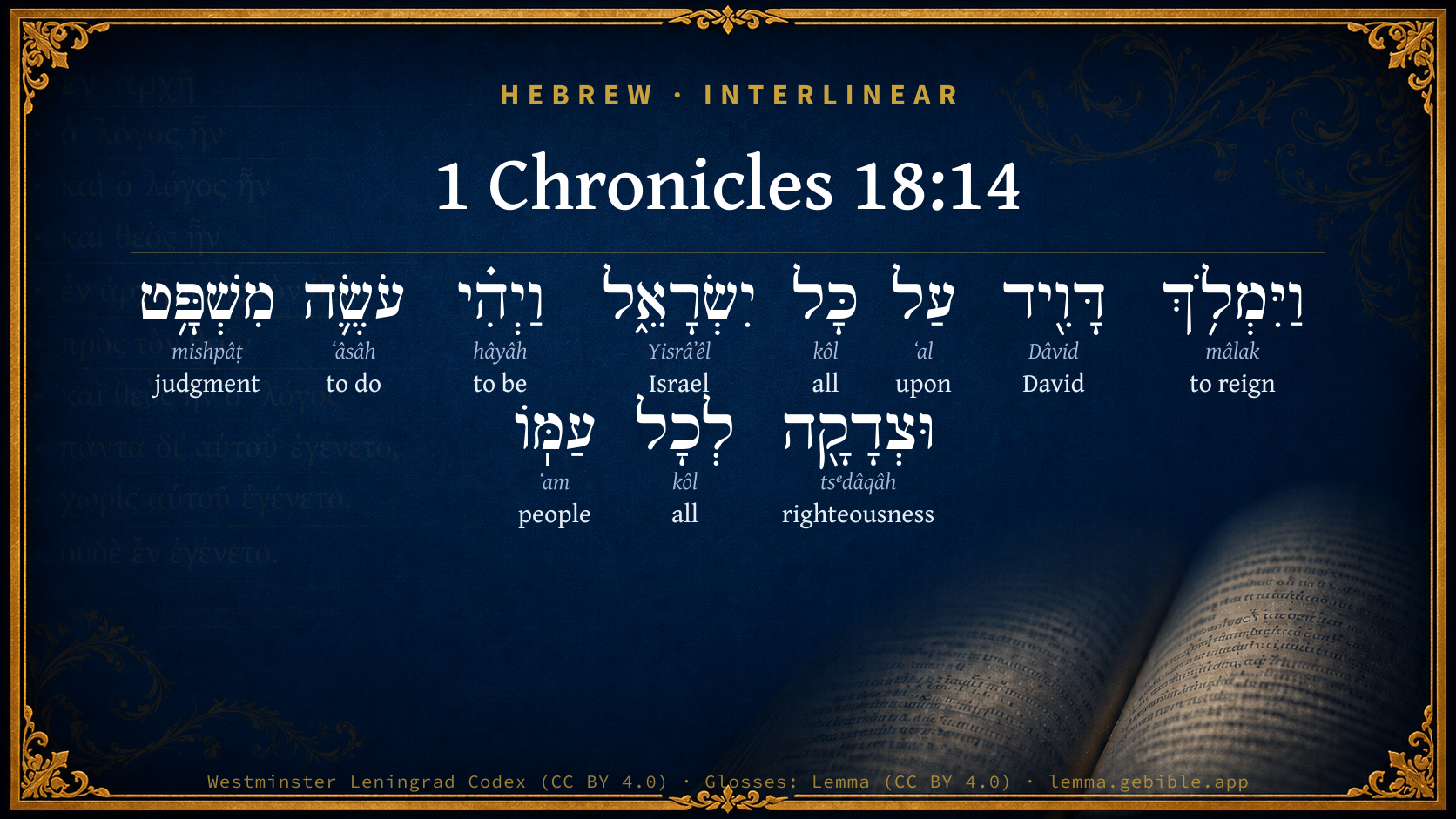
  1. וַיִּמְלֹ֥ךְ mâlak H4427 “and · to reign” Conjunction + Verb, Qal, Sequential Imperfect, 3rd Person, Masculine, Singular
  2. דָּוִ֖יד Dâvid H1732 “David” Noun, Proper
  3. עַל ʻal H5921 “upon” Preposition
  4. כָּל kôl H3605 “all of” Noun, Common, Masculine, Singular, Construct
  5. יִשְׂרָאֵ֑ל Yisrâʼêl H3478 “Israel” Noun, Proper
  6. וַיְהִ֗י hâyâh H1961 “and · to be” Conjunction + Verb, Qal, Sequential Imperfect, 3rd Person, Masculine, Singular
  7. עֹשֶׂ֛ה ʻâsâh H6213 “doing” Verb, Qal, Participle Active, Masculine, Singular, Absolute
  8. מִשְׁפָּ֥ט mishpâṭ H4941 “judgment” Noun, Common, Masculine, Singular, Absolute
  9. לְכָל kôl H3605 “to/for · all of” Preposition + Noun, Common, Masculine, Singular, Construct
  10. עַמּֽוֹ ʻam H5971 “people · his” Noun, Common, Masculine, Singular, Construct + Suffix, Personal, 3rd Person, Masculine, Singular

About this verse

These counts appear in no published source. They are computed here, from the morphology-tagged text and Lemma’s own curated glosses. What Lemma adds →

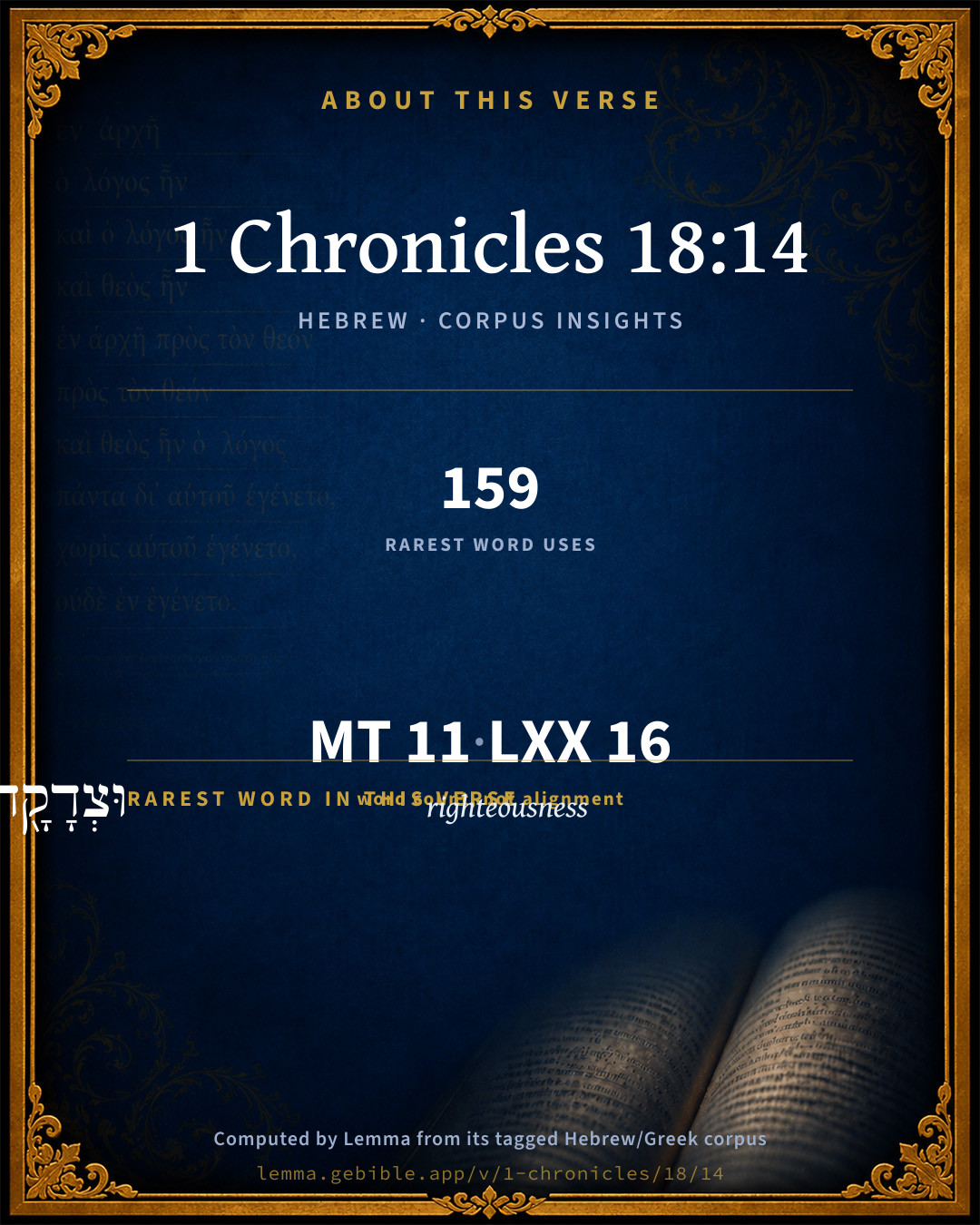
11
words
10
distinct lemmas
Historical
section

Grammatical profile

  • 3 verbs
  • 7 nouns
  • 1 preposition

Verb forms

  • וַיִּמְלֹ֥ךְ Qal · Sequential Imperfect
  • וַיְהִ֗י Qal · Sequential Imperfect
  • עֹשֶׂ֛ה Qal · Participle Active

Repetition

A word recurs within this verse — often emphatic in Hebrew:

Hebrew & Septuagint length

In English translation the verse runs 15 words from the Hebrew and 16 from the Septuagint (LXX English) — closely comparable.

A rough comparison of the two English renderings, which tokenize alike — not a word-level alignment.

Word counts can differ between the Hebrew and the Greek without any difference in meaning — e.g. the Hebrew direct-object marker אֵת has no separate Greek word, and Greek often adds the article ὁ.

In the original languages it is 11 Hebrew tokens and 16 Greek tokens — but the two are counted differently (Hebrew bundles its prefixes and suffixes into one token; the Greek is in lemma form), so that isn’t a like-for-like length.

Cross-references

9

Topical passages linked to 1 Chronicles 18:14 in the Treasury of Scripture Knowledge — connected by theme and wording, ordered by reader-vote popularity; previews shown in the World English Bible.

  • Psalms 89:14 Righteousness and justice are the foundation of your throne. Loving kindness and truth go before your face.
  • Jeremiah 33:15 In those days, and at that time, will I cause a Branch of righteousness to grow up to David; and he shall execute justice and righteousness in the land.
  • Jeremiah 23:5–6 Behold, the days come, says Yahweh, that I will raise to David a righteous Branch, and he shall reign as king and deal wisely, and shall execute justice and righteousness in the land.
  • 2 Samuel 8:15 David reigned over all Israel; and David executed justice and righteousness to all his people.
  • 1 Chronicles 12:38 All these being men of war, who could order the battle array, came with a perfect heart to Hebron, to make David king over all Israel: and all the rest also of Israel were of one heart to make David king.
  • Psalms 78:71–72 From following the ewes that have their young, He brought him to be the shepherd of Jacob, his people, And Israel, his inheritance.
  • Isaiah 9:7 Of the increase of his government and of peace there shall be no end, on the throne of David, and on his kingdom, to establish it, and to uphold it with justice and with righteousness from henceforth even forever. The zeal of Yahweh of Hosts will perform this.
  • Isaiah 32:1–2 Behold, a king shall reign in righteousness, and princes shall rule in justice.
  • Jeremiah 22:15 Shall you reign, because you strive to excel in cedar? Didn't your father eat and drink, and do justice and righteousness? then it was well with him.

Cross-references courtesy of OpenBible.info (CC BY 4.0).

Hebrew and Greek witnesses Masoretic Hebrew ↔ Greek Septuagint

The same verse in the two great witnesses to the Old Testament, shown verse-for-verse.

These are two independent witnesses, not word-aligned to each other, and the Septuagint is shown in lemma (dictionary) form.

Hebrew 1 Chronicles 18:14 Masoretic · Westminster Leningrad Codex

וַיִּמְלֹ֥ךְ דָּוִ֖יד עַל כָּל יִשְׂרָאֵ֑ל וַיְהִ֗י עֹשֶׂ֛ה מִשְׁפָּ֥ט וּצְדָקָ֖ה לְכָל עַמּֽוֹ

David reigned over all Israel; and he executed justice and righteousness to all his people.

World English Bible · Public Domain

Greek LXX 1 Chronicles 18:14 Septuagint · lemma form

καί βασιλεύω δαυίδ ἐπί πᾶς ἰσραήλ καί εἰμί ποῖος κρίμα καί δικαιοσύνη ὁ πᾶς λαός αὐτός

So David reigned over all Israel; and he executed judgment and justice to all his people.

LXX2012 (modern English Septuagint) · Public Domain

Hebrew: Westminster Leningrad Codex (CC BY 4.0). Greek: Septuagint (public domain); English from LXX2012 (modern English Septuagint) (Public Domain). How the Septuagint differs from the Hebrew →

Commentary

Notes on 1 Chronicles 18:14 from classic Christian and Jewish commentators (each source and its license shown beneath its notes). The classic Christian expositions comment on the surrounding passage and are grouped to its opening verse, so a note may address several verses; the Jewish commentaries on the Tanakh (Rashi and others) are per-verse, so they appear only where the commentator wrote on this verse.

Lemma curates 59 commentaries, every one of them public domain or Creative Commons licensed, each selected and text-cleaned for this edition rather than reprinted as found. About our sources →

The Biblical Illustrator

Joseph S. Exell

1Ch_18:14

So David reigned over all Israel, and executed Judgment and Justice.

I. The victories of peace are nobler and more enduring than those of war. We are very familiar with David the warrior. His early triumph over Goliath put his name into the mouth and songs of Israel. It had been a little thing if he had only vanquished the enemies of Israel. When this was done his truest, noblest works began. He encouraged the people to careful cultivation of their fields by carefully cultivating his own. He would have nothing lost. The waste land must be reclaimed. His stewards must give exact account of their stewardship. Commerce, with its increase of comforts, is quickened. Architecture is improved; huts give way to houses. Arrangements are made for due and prompt administration of justice in all parts of the country. The health and education of the people the king remembers and provides for. These were right royal undertakings, and became David better than his crown. Wars fill a large and loud place in history. The works of peace are silent, unobtrusive. Picturesque pens may describe a battle in which thousands perish, but how little can they describe the battle waged by sanitary officers and medical men against disease and its causes by which thousands, ten thousands, are saved!

II. The blessing of a wise administrator to a nation. David was a true ruler of men. Not only by possession of a personal charm which attached trusty friends to him, but also by devising those measures which were for the wider well-being of the people. He had eminently the faculty of government like many other great men of his nation--Joseph, Moses, Joshua, Hezekiah, Daniel. When rulers are wise, and, like David, know what they ought to do, this, too, is one of Gods gifts to men.

III. The importance of psalmody in Divine worship. Psalmody, as an institution, owes its origin to David. In chap. 25. we can see with what care it was instituted.

IV. The beauty of friendship is seen in davids treatment of mephibosheth.

The Biblical Illustrator, edited by Joseph S. Exell (c. 1880s–1900s) — public domain. Text from a community e-Sword module.

Joseph Benson's Commentary

1Ch 18:14. So David reigned, and executed judgment and justice among the people — And therefore answered the end of his elevation; and served the purposes of the kingdom of providence, and of that God who sits in the throne judging right. Thus also he became an eminent type of the Messiah, the sceptre of whose kingdom is a right sceptre.

Joseph Benson's Commentary on the Old and New Testaments (1811–1818) — public domain. Text from a community e-Sword module.

Tyndale Open Study Notes

Tyndale Open Resources

18:14-17 The listing of David’s officials demonstrates the greatness of his rule over all of Israel.

Tyndale Open Study Notes — © Tyndale Open Resources, licensed CC BY-SA 4.0. Text via the HelloAO Bible API.

Ellicott's Commentary for English Readers

(14) Executed.—Was doing; a permanent state of things.

Judgment and justice.—Right and justice. The former is the quality, the latter the conduct which embodies it.

Among.—For, or unto.

(14-17) David’s internal administration and high officers of state.

A Bible Commentary for English Readers, edited by Charles John Ellicott (1878–1897) — public domain. Text from a community e-Sword module.

The Cambridge Bible for Schools and Colleges

gen. ed. J. J. S. Perowne

14–17 (= 2Sa_8:15-18; cp. ib. 2Sa_20:23-26). David’s Officials

14. among all his people] R.V. unto all his people. David was his own chief justice, but probably the work was too much for one man; cp. 2Sa_15:2-4 with Kirkpatrick’s note.

The Cambridge Bible for Schools and Colleges (gen. ed. J. J. S. Perowne; Cambridge University Press, 1878–1918) — public domain. Text from a community e-Sword module.

The Pulpit Commentary

A righteous ruler.

David"s work as a warrior was preparatory to his as a king. He defeated enemies and vanquished conspirators, in order that there might be peace and tranquillity in the land, in order that the pursuits and arts of peace might take the place of violence, disorder, and turbulence. It is still sometimes necessary that the sword should be drawn for the protection of liberty and for the preservation of order. There could not be a worthier, a nobler outcome of David"s campaigns and victories than that recorded in the text: "So David reigned over all Israel, and executed judgment and justice among all his people.

I CIVIL SOCIETY INVOLVES THE EXERCISE OF AUTHORITY. This need not reside in a king; it may be a president, or other chief magistrate. But in some person or persons must be deposited the right and power to rule. Unless men are to live in the condition of savages or brutes, civil authority must be constituted, recognized, and supported. Checks to arbitrary power, limitations to all personal action, there must be; but not to the destruction of a right to reign and to require obedience.

II CIVIL SOCIETY INVOLVES THE MAINTENANCE OF JUSTICE BETWEEN MAN AND MALE. Power is good when rightly used. Right and might should go together. Rulers are not entrusted with authority for the indulgence of their own caprice, or the enhancement of their own glory. They are bound to act, "not for their own, but for their people"s good." In Oriental countries it was and is the custom for princes themselves to sit in the gate and to administer justice. It was so with David and Solomon, and with other kings of Israel. In modern society, where law is more complex, the administration of justice is confided to a profession to judges and magistrates. In any case, well-ordered society requires both judicial and legislative functions, in whomsoever centred. "The powers that be are ordained of God.

III CIVIL SOCIETY IS CONSOLIDATED AND PERFECTED BY JUSTICE, "David reigned over all Israel." This was undoubtedly the consequence of the impartial administration of justice among all classes. Civil rulers have often been slow to learn the lesson, that there is no foundation for general content like unswerving justice. Just rulers make contented and united peoples.

IV CIVIL SOCIETY IS DESTINED TO EXTEND ITS ADVANTAGES TO ALL MANKIND. Every community where kings and rulers reign with justice, every nation which is exalted by righteousness, is a beacon to the world. Peoples so favoured have a sacred mission to fulfil, and upon them is laid a responsibility from which there is no escape. T.

King"s justice.

Of all the features of royalty the chronicler selects one, or apparently two, as special characteristics of David"s reign. "He executed judgment and justice among all his people." Magistracy, the deciding of disputes, and the punishment of criminals, are always prominent parts of kingly duty. They are less, apparently, in our times, because our sovereign does not preside in person in our law-courts, but delegates her duty to her judges. They were more, apparently, kingly work in ancient times, and under Eastern conceptions of royalty. When Solomon entered on the responsibilities of kingship, the thing that seemed most serious to him was his duty as a judge. He felt the need of judicial insight, seeing that, as a young man, he had no treasured stores of experience. His request of wisdom chiefly referred to this necessary gift of Eastern kingship. Kitto says, "The wisdom which he craved was that of which he had already enough to be able to appreciate the value of its increase practical wisdom, sagacity, clearness of judgment and intellect in the administration of justice and in the conduct of public affairs." The administration of justice may well be set thus prominently forward, for probably nothing bears so directly upon the wellbeing of a nation as the wisdom and the purity of its judges. The terms used in this verse are, however, intended to include more than court-justice, and we may see that

I KINGLY JUSTICE IS THE EXPRESSION IN THE NATION OF THE PATERNAL RULE. The family is the first aggregation of human individuals, and its head and ruler is the father. The next aggregation of men is that of the tribe; a number of families uniting their interests, and dwelling together, and at the head of the tribe, as ruler and judge, is the patriarch, or tribal father. The larger aggregation of men is the union of tribes in the nation, but the same idea is preserved, and the recognized head and ruler is the king-father, or the fatherly king. The associations of these two terms need to be carefully given; and it should be shown how the one tones the other. This distinction being set prominently forward, The king seeks to do the absolutely right without any more than a general knowledge of and interest in his people; a king cannot be expected to know individuals. But exactly this is of the very essence of fatherhood. The father is as loyal to the right as the king, but he seeks to apply the claims of right to the actual condition of individuals, whom he knows with precision, and in whom he feels a direct and personal interest. And so it may be said that the perfect idea of a king is expressed in the term father, and that a true father must have all that is essential to a king. It is always said of the good king, "He is the father of his people.

II KINGLY JUSTICE IS THE REVELATION TO MEN OF THE DIVINE JUSTICE. No one word can suffice to present the relations of God with men. And that because no words contain an absolute and necessary meaning. Their connotation differs for different individuals. Show that neither king nor father are sufficient alone. We want for God a word which shall bring home to our hearts the conviction that he is dominated by the sense of right; but we as certainly want a word which shall assure us that all his ways with us are toned with personal interest in us, perfect knowledge of us, and the gentlest consideration for our weaknesses and wants. So the justice of God must be to us both kingly and fatherly.

This subject opens up the discussion of the true basis of the "atonement." Only by fully estimating Divine justice as both kingly and fatherly can we discern the "needs be" for a satisfaction of eternal law, and a persuasive manifestation of eternal love. R.T.

The Pulpit Commentary (1880–1919), ed. H.D.M. Spence-Jones & Joseph S. Exell — public domain. Text from a community e-Sword module.

unfoldingWord translationNotes

Door43 World Missions Community

over all Israel

"over all the Israelites"

he administered justice and righteousness to all his people

The abstract nouns "justice" and "righteousness" can be translated as adjectives. AT: "he did what was just and right for all his people" (See: Abstract Nouns)

Zeruiah ... Ahilud ... Ahitub ... Abiathar ... Shavsha ... Benaiah ... Jehoiada

These are the names of men. (See: How to Translate Names)

recorder

the person who writes down details of special events

Ahimelech

This spelling represents a correction of the spelling "Abimelech," which some versions follow. The corrected spelling makes this verse agree with 2 Samuel 8:17.

Zadok son of Ahitub and Ahimelech son of Abiathar were priests

Some versions correct this to say that Ahitub and Ahimelech were high priests.

Kerethites ... Pelethites

These are the names of foreign people groups who became David's bodyguards.

translationWords

reign

Israel

administration

just

righteous

people group

Joab

son

commander

Jehoshaphat

Zadok

priest

scribe

king

advice

unfoldingWord translationNotes — © Distant Shores Media and the Door43 World Missions Community, licensed CC BY-SA 4.0. Source: git.door43.org/Door43/en_tn.

Rashi

Rabbi Shlomo Yitzchaki (Rashi)

justice and charity He retired from waging any more wars and from going forth and coming in battle, and he sat constantly and judged Israel fairly.

Rashi on the Tanakh — English translations: “The Judaica Press complete Tanach with Rashi, translated by A. J. Rosenberg” (CC BY 4.0); “Pentateuch with Rashi's commentary by M. Rosenbaum and A.M. Silbermann, 1929-1934” (public domain); “The Metsudah Tanach series, Lakewood, N.J” (CC BY 4.0); and “The Book of Joshua, Metsudah Publications, 1997” (CC BY 4.0). Text via Sefaria.

Lesson kit

Teaching starters — assembled from the data on this page, not authored interpretation. Every prompt links to the verse data it draws on. Edit before teaching.

1 Chronicles, in the Historical, opens this verse with 11 words (10 distinct Hebrew lemmas). Its most distinctive word is tsᵉdâqâh (“righteousness”). A historical commentator’s framing appears above. Read the whole chapter for the surrounding context.

Discussion questions

  1. How does “righteousness” (tsᵉdâqâh) shape what this verse is saying?
  2. How does Psalms 89:14, which shares this passage’s theme, read alongside this verse?
  3. What does the repetition of “all” (2× in this one verse) do in this verse?
  4. These translations render this verse differently. What is at stake in choosing one wording over another?
  5. «וַיִּמְלֹ֥ךְ» is a Qal Sequential Imperfect verb. How does that grammatical form shape the action described?
  6. Compare how The Biblical Illustrator and Joseph Benson's Commentary read this verse. Where do they agree or differ?

Things to notice

Reading settings

Reading text

Shown beneath each verse's original-language words.

Old Testament
Old Testament edition

Read the OT as the Masoretic Hebrew (MT) or the Greek Septuagint (LXX).

English shown for the Greek Septuagint (in the Hebrew ↔ Greek comparison).

Comparing translations? Open the Compare panel on any verse page to stack up to four side by side.