1 Chronicles 11:5

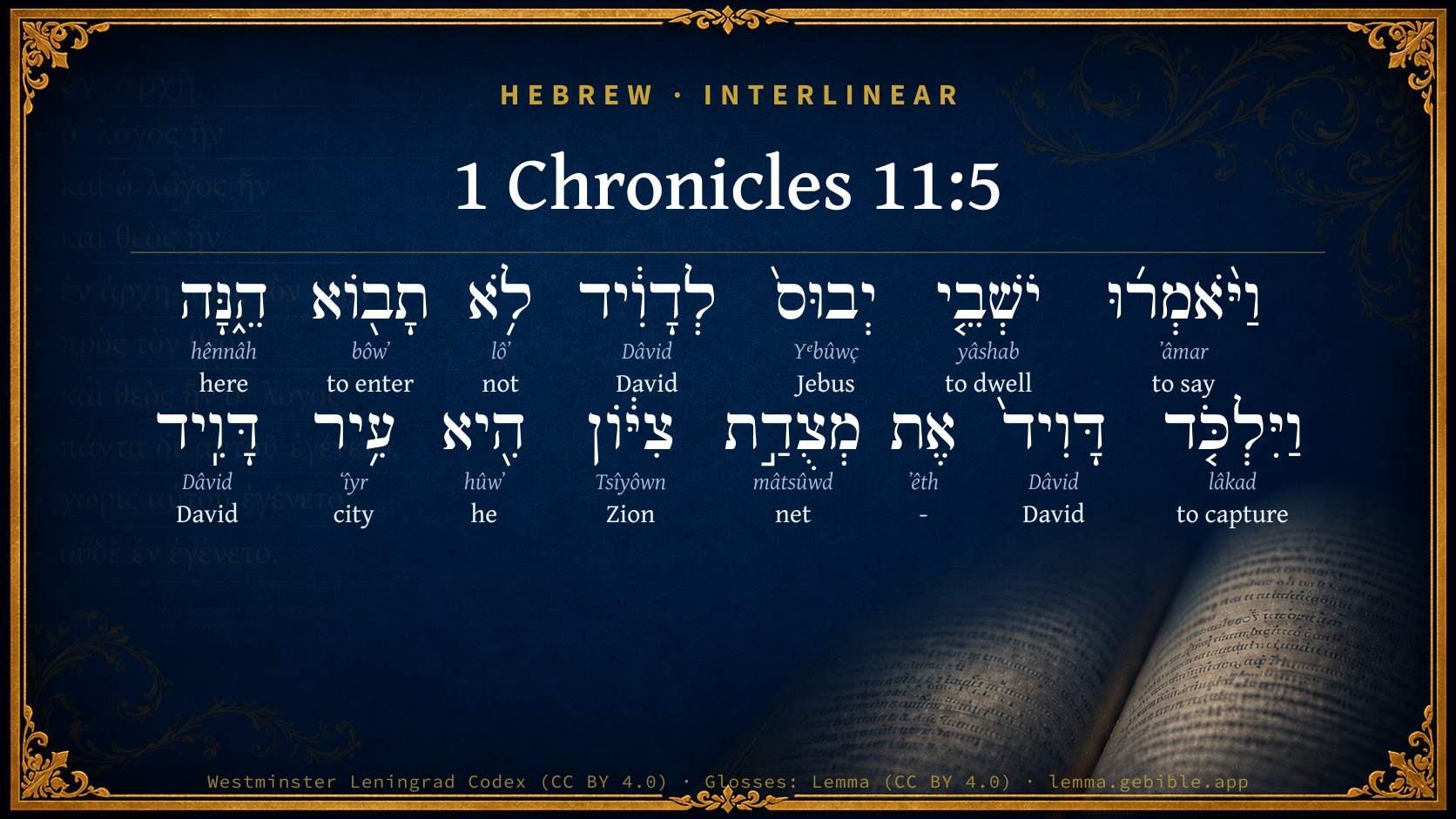
Hebrew (Westminster Leningrad Codex) 1 Chronicles 11:5 appears in the Hebrew Old Testament. The text above is from the Westminster Leningrad Codex. Each word links to its Strong’s number, a concise gloss, and parsing drawn from the Open Scriptures Hebrew Bible morphology. Click any word for its full Brown-Driver-Briggs (BDB) entry.
Download image
Cite this verse

1 Chronicles 11:5 (World English Bible). Public Domain. Lemma interlinear Bible study tool, https://lemma.gebible.app/v/1-chronicles/11/5.

Show BibTeX & RIS
BibTeX
RIS
English Translation
The inhabitants of Jebus said to David, You shall not come in here. Nevertheless David took the stronghold of Zion; the same is the city of David.
World English Bible · Public Domain
Download a study sheet

One document with this verse’s original text, its word-by-word gloss line, the meaning frame, cross-references with their text, attributed commentary, and full source and license credits — printable, and it pastes into notes with its structure intact.

This verse Autodidact and up

Study sheet (.html) Plain text (.txt)

A passage Seminary Student

Up to 50 verses in one chapter. A passage sheet keeps up to 6 commentary sources and 12 cross-references per verse, in the order this page ranks them, and says so on the sheet whenever that leaves anything out. Ask for a single verse and you get the Autodidact verse sheet above.

Everything on this page stays free to read, with no account — the sheet is a download of what is already on screen, not access to it.

Want to remove ads? Support Godless Engineer
Compare translations 3

The same verse in 3 English versions, stacked beneath the original-language interlinear above. Click any original word for its lexicon entry.

Each is an independent rendering of the whole verse — the interlinear is not word-aligned to these translations.

Highlighted words mark where these versions differ — a whole-verse word diff, not a word-by-word alignment.

  • World English Bible Public Domain
    The inhabitants of Jebus said to David, You shall not come in here. Nevertheless David took the stronghold of Zion; the same is the city of David.
  • King James Version Public Domain
    And the inhabitants of Jebus said to David, Thou shalt not come hither. Nevertheless David took the castle of Zion, which is the city of David.
  • unfoldingWord Literal Text CC BY-SA 4.0
    And the dwellers of Jebus said to David, “You will not come here.” But David captured the stronghold of Zion, that the City of David.

unfoldingWord Literal Text — © unfoldingWord, licensed CC BY-SA 4.0. Word-aligned USFM3 via Door43 (git.door43.org/unfoldingWord/en_ult).

Versions to compare (up to 4)

3 of 4 selected

Show all 18 translations

Every available English version of this verse, each an independent rendering of the whole verse.

  • World English Bible Public Domain
    The inhabitants of Jebus said to David, You shall not come in here. Nevertheless David took the stronghold of Zion; the same is the city of David.
  • Berean Standard Bible Public Domain
    The people of Jebus said to David, “You will never get in here.” Nevertheless, David captured the fortress of Zion (that is, the City of David).
  • Majority Standard Bible Public Domain
    The people of Jebus said to David, “You will never get in here.” Nevertheless, David captured the fortress of Zion (that is, the City of David).
  • King James Version Public Domain
    And the inhabitants of Jebus said to David, Thou shalt not come hither. Nevertheless David took the castle of Zion, which is the city of David.
  • American Standard Version (1901) Public Domain
    And the inhabitants of Jebus said to David, Thou shalt not come in hither. Nevertheless David took the stronghold of Zion; the same is the city of David.
  • Revised Version (1885) Public Domain
    And the inhabitants of Jebus said to David, Thou shalt not come in hither. Nevertheless David took the strong hold of Zion; the same is the city of David.
  • Geneva Bible (1599) Public Domain
    And the inhabitants of Iebus said to Dauid, Thou shalt not come in hither. Neuertheles Dauid tooke the towre of Zion, which is the city of Dauid.
  • Douay-Rheims (1899) Public Domain
    And the inhabitants of Jebus said to David: Thou shalt not come in here. But David took the castle of Sion, which is the city of David.
  • Young's Literal Translation Public Domain
    And the inhabitants of Jebus say to David, `Thou dost not come in hither;' and David captureth the fortress of Zion -- it `is' the city of David.
  • Literal Standard Version CC BY-SA 4.0
    And the inhabitants of Jebus say to David, “You do not come in here”; and David captures the fortress of Zion—it [is] the City of David.
  • Unlocked Literal Bible CC BY-SA 4.0
    The inhabitants of Jebus said to David, “You will not come in here.” But David took the stronghold of Zion, that is, the city of David.
  • unfoldingWord Literal Text CC BY-SA 4.0
    And the dwellers of Jebus said to David, “You will not come here.” But David captured the stronghold of Zion, that the City of David.
  • Darby Bible Public Domain
    And the inhabitants of Jebus said to David, Thou shalt not come in hither. But David took the stronghold of Zion, which is the city of David.
  • World Messianic Bible Public Domain
    The inhabitants of Jebus said to David, “You will not come in here!” Nevertheless David took the stronghold of Zion. The same is David’s city.
  • Webster's Bible Public Domain
    And the inhabitants of Jebus said to David, Thou shalt not come hither. Nevertheless David took the castle of Zion, which is the city of David.
  • Free Bible Version CC BY-SA 4.0
    The Jebusites told David, “You will not enter here!” But David did capture the fortress of Zion, now known as the City of David.
  • Bible in Basic English Public Domain
    And the people of Jebus said to David, You will not come in here. But still, David took the strong place of Zion, which is the town of David.
  • JPS Tanakh (1917) Public Domain
    And the inhabitants of Jebus said to David: 'Thou shalt not come in hither.' Nevertheless David took the stronghold of Zion; the same is the city of David.

Literal Standard Version (2020), Covenant Press — licensed CC BY-SA 4.0. Text via the HelloAO Bible API (eBible.org). Unlocked Literal Bible (unfoldingWord) — licensed CC BY-SA 4.0. Text via the HelloAO Bible API (eBible.org). unfoldingWord Literal Text — © unfoldingWord, licensed CC BY-SA 4.0. Word-aligned USFM3 via Door43 (git.door43.org/unfoldingWord/en_ult). Free Bible Version, Dr. Jonathan Gallagher — licensed CC BY-SA 4.0. Text via the HelloAO Bible API (eBible.org).

Word by word

More ways to search: Search by grammar → Find every occurrence → Compare this word →

Practice this passage: Drill this verse → Learn its vocabulary →

יְבוּס֙
Yᵉbûwç
H2982
“Jebus”
Noun, Proper
Part of Speech
Noun
Type
Proper
Full BDB Definition

Origin: from H947

TWOT: None

Jebus = "threshing place" - an early name for Jerusalem, the city of the Jebusites; also 'Jebusi'
  1. וַיֹּ֨אמְר֜וּ ʼâmar H559 “and · to say” Conjunction + Verb, Qal, Sequential Imperfect, 3rd Person, Masculine, Plural
  2. יֹשְׁבֵ֤י yâshab H3427 “dwelling” Verb, Qal, Participle Active, Masculine, Plural, Construct
  3. לְדָוִ֔יד Dâvid H1732 “to/for · David” Preposition + Noun, Proper
  4. לֹ֥א lôʼ H3808 “not” Particle, Negative
  5. תָב֖וֹא bôwʼ H935 “to enter” Verb, Qal, Imperfect, 2nd Person, Masculine, Singular
  6. הֵ֑נָּה hênnâh H2008 “here” Adverb
  7. וַיִּלְכֹּ֤ד lâkad H3920 “and · to capture” Conjunction + Verb, Qal, Sequential Imperfect, 3rd Person, Masculine, Singular
  8. דָּוִיד֙ Dâvid H1732 “David” Noun, Proper
  9. אֶת ʼêth H853 “-” Particle, Direct Object
  10. מְצֻדַ֣ת mâtsûwd H4686 “net of” Noun, Common, Both, Singular, Construct
  11. צִיּ֔וֹן Tsîyôwn H6726 “Zion” Noun, Proper
  12. הִ֖יא hûwʼ H1931 “he” Pronoun, Personal, 3rd Person, Feminine, Singular
  13. עִ֥יר ʻîyr H5892 “city of” Noun, Common, Feminine, Singular, Construct
  14. דָּוִֽיד Dâvid H1732 “David” Noun, Proper

About this verse

These counts appear in no published source. They are computed here, from the morphology-tagged text and Lemma’s own curated glosses. What Lemma adds →

15
words
13
distinct lemmas
Historical
section

Notable vocabulary

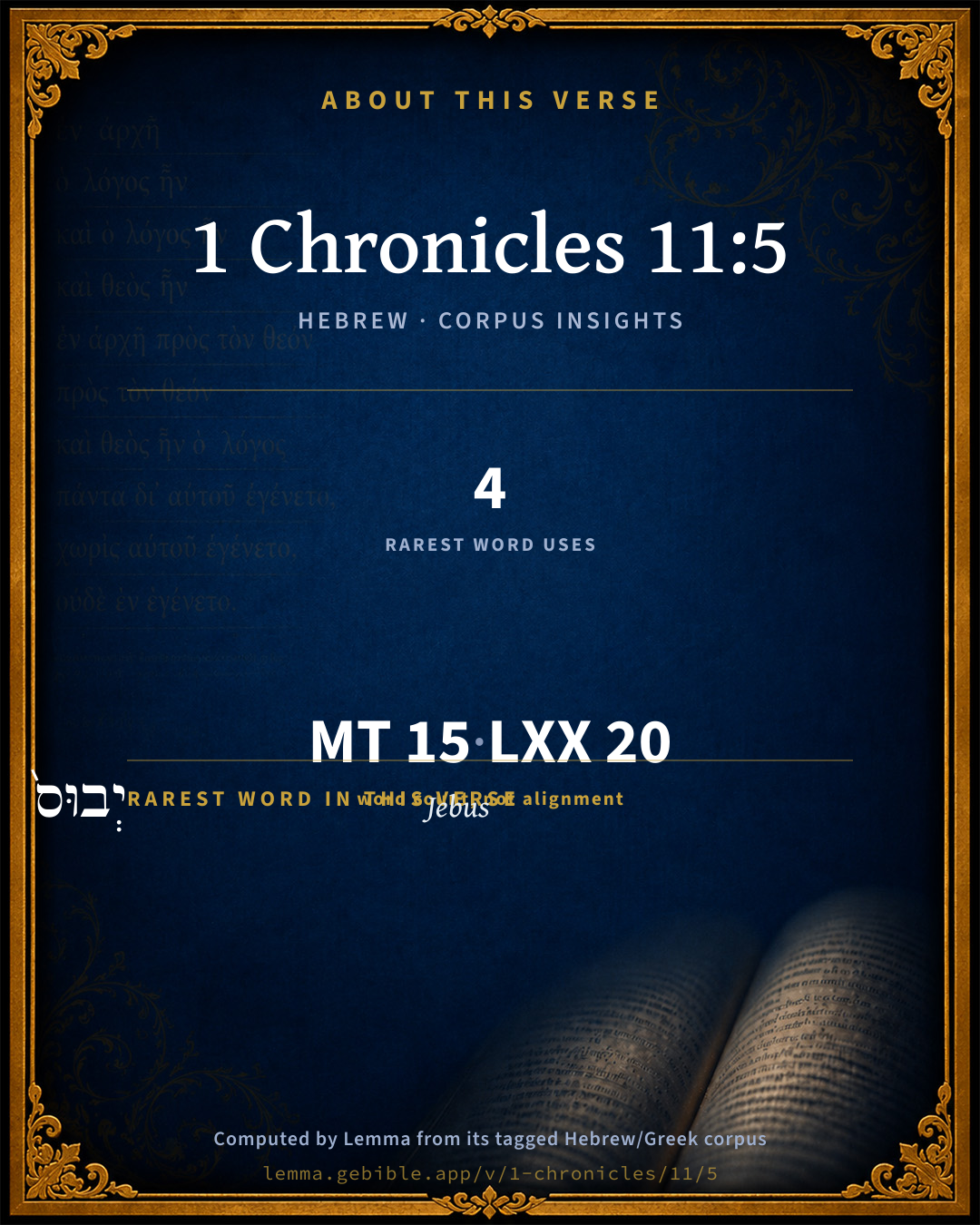
The rarest word here is יְבוּס֙ Jebus H2982 — appearing just 4 times in the whole Hebrew Bible.

Shared distinctive vocabulary

יְבוּס֙ Jebus H2982 occurs in 4 verses of the Hebrew Bible. Also found in:

Grammatical profile

  • 4 verbs
  • 7 nouns
  • 1 pronoun
  • 1 adverb
  • 2 particles

Verb forms

  • וַיֹּ֨אמְר֜וּ Qal · Sequential Imperfect
  • יֹשְׁבֵ֤י Qal · Participle Active
  • תָב֖וֹא Qal · Imperfect
  • וַיִּלְכֹּ֤ד Qal · Sequential Imperfect

Repetition

A word recurs within this verse — often emphatic in Hebrew:

  • לְדָוִ֔יד David H1732 ×3

Hebrew & Septuagint length

In English translation the verse runs 27 words from the Hebrew and 20 from the Septuagint (LXX English) — closely comparable.

A rough comparison of the two English renderings, which tokenize alike — not a word-level alignment.

Word counts can differ between the Hebrew and the Greek without any difference in meaning — e.g. the Hebrew direct-object marker אֵת has no separate Greek word, and Greek often adds the article ὁ.

In the original languages it is 15 Hebrew tokens and 20 Greek tokens — but the two are counted differently (Hebrew bundles its prefixes and suffixes into one token; the Greek is in lemma form), so that isn’t a like-for-like length.

Cross-references

23

Topical passages linked to 1 Chronicles 11:5 in the Treasury of Scripture Knowledge — connected by theme and wording, ordered by reader-vote popularity; previews shown in the World English Bible.

  • Psalms 132:13 For Yahweh has chosen Zion. He has desired it for his habitation.
  • 1 Samuel 17:9–10 If he be able to fight with me, and kill me, then will we be your servants; but if I prevail against him, and kill him, then shall you be our servants, and serve us.
  • 1 Samuel 17:26 David spoke to the men who stood by him, saying, What shall be done to the man who kills this Philistine, and takes away the reproach from Israel? for who is this uncircumcised Philistine, that he should defy the armies of the living God?
  • 1 Samuel 17:36 Your servant struck both the lion and the bear: and this uncircumcised Philistine shall be as one of them, seeing he has defied the armies of the living God.
  • 2 Samuel 5:9 David lived in the stronghold, and called it the city of David. David built round about from Millo and inward.
  • 2 Samuel 6:10 So David would not remove the ark of Yahweh to him into the city of David; but David carried it aside into the house of Obed-edom the Gittite.
  • 2 Samuel 6:12 It was told king David, saying, Yahweh has blessed the house of Obed-edom, and all that pertains to him, because of the ark of God. David went and brought up the ark of God from the house of Obed-edom into the city of David with joy.
  • 1 Kings 8:1 Then Solomon assembled the elders of Israel, and all the heads of the tribes, the princes of the fathers' [houses] of the children of Israel, to king Solomon in Jerusalem, to bring up the ark of the covenant of Yahweh out of the city of David, which is Zion.
  • 1 Chronicles 11:7 David lived in the stronghold; therefore they called it the city of David.
  • 2 Chronicles 5:2 Then Solomon assembled the elders of Israel, and all the heads of the tribes, the princes of the fathers' [houses] of the children of Israel, to Jerusalem, to bring up the ark of the covenant of Yahweh out of the city of David, which is Zion.
  • Psalms 2:6 "Yet I have set my king on my holy hill of Zion."
  • Psalms 9:11 Sing praises to Yahweh, who dwells in Zion, And declare among the people what he has done.
  • Psalms 48:2 Beautiful in elevation, the joy of the whole earth, Is Mount Zion, on the north sides, The city of the great King.
  • Psalms 48:12–13 Walk about Zion, and go around her. Number its towers;
  • Psalms 78:68 But chose the tribe of Judah, Mount Zion which he loved.
  • Psalms 87:2 Yahweh loves the gates of Zion more than all the dwellings of Jacob.
  • Psalms 87:5 Yes, of Zion it will be said, "This one and that one was born in her;" The Most High himself will establish her.
  • Psalms 122:5 For there are set thrones for judgment, The thrones of David's house.
  • Psalms 125:1–2 Those who trust in Yahweh are as Mount Zion, Which can't be moved, but remains forever.
  • Lamentations 4:11–12 Yahweh has accomplished his wrath, he has poured out his fierce anger; He has kindled a fire in Zion, which has devoured the foundations of it.
  • Romans 9:33 even as it is written, "Behold, I lay in Zion a stumbling stone and a rock of offense; And no one who believes in him will be disappointed."
  • Hebrews 12:22 But you have come to Mount Zion, and to the city of the living God, the heavenly Jerusalem, and to innumerable hosts of angels,
  • Revelation 14:1 I saw, and behold, the Lamb standing on Mount Zion, and with him a number, one hundred forty-four thousand, having his name, and the name of his Father, written on their foreheads.

Cross-references courtesy of OpenBible.info (CC BY 4.0).

Hebrew and Greek witnesses Masoretic Hebrew ↔ Greek Septuagint

The same verse in the two great witnesses to the Old Testament, shown verse-for-verse.

These are two independent witnesses, not word-aligned to each other, and the Septuagint is shown in lemma (dictionary) form.

Hebrew 1 Chronicles 11:5 Masoretic · Westminster Leningrad Codex

וַיֹּ֨אמְר֜וּ יֹשְׁבֵ֤י יְבוּס֙ לְדָוִ֔יד לֹ֥א תָב֖וֹא הֵ֑נָּה וַיִּלְכֹּ֤ד דָּוִיד֙ אֶת מְצֻדַ֣ת צִיּ֔וֹן הִ֖יא עִ֥יר דָּוִֽיד

The inhabitants of Jebus said to David, You shall not come in here. Nevertheless David took the stronghold of Zion; the same is the city of David.

World English Bible · Public Domain

Greek LXX 1 Chronicles 11:5 Septuagint · lemma form

εἶπον δέ ὁ καταοἰκέω ιεβους ὁ δαυίδ οὐ εἰςἔρχομαι ὧδε καί προ καταλαμβάνω ὁ περιοχή σιων οὗτος ὁ πόλις δαυίδ

You shall not enter in hither. But he took the strong hold of Sion: this is the city of David.

LXX2012 (modern English Septuagint) · Public Domain

Hebrew: Westminster Leningrad Codex (CC BY 4.0). Greek: Septuagint (public domain); English from LXX2012 (modern English Septuagint) (Public Domain). How the Septuagint differs from the Hebrew →

Commentary

Notes on 1 Chronicles 11:5 from classic Christian and Jewish commentators (each source and its license shown beneath its notes). The classic Christian expositions comment on the surrounding passage and are grouped to its opening verse, so a note may address several verses; the Jewish commentaries on the Tanakh (Rashi and others) are per-verse, so they appear only where the commentator wrote on this verse.

Lemma curates 59 commentaries, every one of them public domain or Creative Commons licensed, each selected and text-cleaned for this edition rather than reprinted as found. About our sources →

Trapp's Complete Commentary

John Trapp

1Ch 11:5 And the inhabitants of Jebus said to David, Thou shalt not come hither. Nevertheless David took the castle of Zion, which [is] the city of David.

1Ch 11:6 And David said, Whosoever smiteth the Jebusites first shall be chief and captain. So Joab the son of Zeruiah went first up, and was chief.

Ver. 5,6. See 2Sa 5:6-8.

John Trapp, A Commentary or Exposition upon All the Books of the Old and New Testament (1647–1656) — public domain. Text from a community e-Sword module.

Ellicott's Commentary for English Readers

(5) Thou shalt not come hither.—A jeer. (Comp. 2Sa_5:6.) “And one spake unto David, saying, Thou shalt not come in hither. The blind and the lame will have kept thee out!” The Jebusites trusted in the strength of their fortress. Even the weakest defence would be sufficient to repel David’s assault.

A Bible Commentary for English Readers, edited by Charles John Ellicott (1878–1897) — public domain. Text from a community e-Sword module.

The Cambridge Bible for Schools and Colleges

gen. ed. J. J. S. Perowne

5. Thou shalt not come hither] A longer speech of defiance is given in 2Sa_5:6 (see R.V. mg.) in which the Jebusites assert that their city is so strong by nature that a garrison of blind and lame is sufficient for its defence.

the castle of Zion] R.V. the strong hold of Zion. The site of this (afterwards “the city of David”) is on the S.E. of the present city, on the S. of the Haram (the Temple area), and on a level lower than that of the Haram (Socin-Benzinger in Bädeker, p. 22; Sir C. Wilson in Smith’s Bible Dict. ed. 2, “Jerusalem,” p. 1648). For the less probable view that the stronghold of Zion was on the S.W. of the present city see C. R. Conder in Hastings’ Bible Dict., Art. “Jerusalem,” vol. ii. p. 591.

The Cambridge Bible for Schools and Colleges (gen. ed. J. J. S. Perowne; Cambridge University Press, 1878–1918) — public domain. Text from a community e-Sword module.

Haydock's Catholic Bible Commentary

Here. In 2 Kings v. 6, the passage is much fuller, and attended with many difficulties. Kennicott would correct and translate it: "And they spake unto David, saying, Thou shalt not come hither: for the blind and the lame shall keep thee off, by saying David shall not come hither. But David took the stronghold of Sion," (different from the citadel. Josephus) "which is the city of David. And David said, on that day, whosoever (first) smiteth the Jebusites, and, through the subterraneous passage, reacheth the blind and the lame, which are hated of David’s soul, because the blind and the lame continue to say, he shall not come into this house---shall be head and captain. So Joab, the son of Zeruiah, went up first, and was head."

George Leo Haydock (1774–1849), Haydock's Catholic Family Bible and Commentary, 1859 edition — public domain. Excludes Psalms (Douay-Rheims chapter numbering differs from Protestant) and Deuterocanonical books (Catholic canon only).

The Pulpit Commentary

Thou shalt not come hither. The inhabitants of Jebus added something beside. (2Sa_5:6) They had said, "Except thou take away the blind and the lame, thou shalt not come in hither: thinking, David cannot come in hither." The castle of Zion. This fort became the site of the temple. It is the Acra of Josephus, and is different from the modern Zion. It was the eastern hill in the city, was the second highest elevation in the city, and up to the time of the destruction of the city of Jerusalem was uniformly named Zion, though from the time of Constantine it has been used for the name of the western hill, the site of Jerusalem. There is but little doubt of the identity of the hill of Moriah with the hill of Zion, though no individual passage of Scripture asserts it. The passage before us, however, with its parallel, tells us plainly enough that the city of David, and that which became the sacred hill of Zion are one; and many passages in the Psalms and the prophets both confirm this and point out the difference between Zion and Jerusalem.

The Pulpit Commentary (1880–1919), ed. H.D.M. Spence-Jones & Joseph S. Exell — public domain. Text from a community e-Sword module.

Scofield Reference Notes

C. I. Scofield

castle of Zion

Heb. castle.

(1) Zion, the ancient Jebusite stronghold, is the southwest eminence in Jerusalem, called in Scripture the city of David, and associated with the Davidic royalty both historically and prophetically 1Ch 11:7; Psa 2:6; Isa 2:3. The word is often used of the whole city of Jerusalem considered as the city of God Psa 48:2; Psa 48:3 especially in passages referring to the future kingdom-age; Isa 1:27; Isa 2:3; Isa 4:1-6; Joe 3:16; Zec 1:16; Zec 1:17; Zec 8:3-8; Rom 11:26. In Heb 12:22 the word is used symbolically of heaven.

(2) In Deu 4:48 the name is given to a projection or peak of Mount Hermon.

The Scofield Reference Bible (1917 edition), notes by C. I. Scofield — public domain. Text from a community e-Sword module.

Rashi

Rabbi Shlomo Yitzchaki (Rashi)

And the inhabitants of Jebus said to David, “You shall not come here” He does not explain here why, but in Samuel (II 5:6), Scripture explains: “... and they said to David, saying: You shall not come here unless you remove the blind and the lame.” They saw that they were unable to withstand David. They therefore stationed blind and lame persons before the city gate, “as if to say: David shall not come here,” unless he wages war with these blind people, for they knew that it is disgraceful for a king to wage war against blind men, and because of this, he would turn back and not wage war with them. David said to himself, however, “It is true that it is neither right nor proper for me to wage war with the blind and with the lame, but ‘whoever smites the Jebusites’ in a way that he ‘reaches the tower’ shall pull them and cast them away from there, viz. the blind.” “Therefore they say: The blind and the lame shall not come into the house;” into the house of David, because it will be a disgrace for him, lest they say that David waged war with these [handicapped people].

Rashi on the Tanakh — English translations: “The Judaica Press complete Tanach with Rashi, translated by A. J. Rosenberg” (CC BY 4.0); “Pentateuch with Rashi's commentary by M. Rosenbaum and A.M. Silbermann, 1929-1934” (public domain); “The Metsudah Tanach series, Lakewood, N.J” (CC BY 4.0); and “The Book of Joshua, Metsudah Publications, 1997” (CC BY 4.0). Text via Sefaria.

Lesson kit

Teaching starters — assembled from the data on this page, not authored interpretation. Every prompt links to the verse data it draws on. Edit before teaching.

1 Chronicles, in the Historical, opens this verse with 15 words (13 distinct Hebrew lemmas). Its most distinctive word is Yᵉbûwç (“Jebus”). A historical commentator’s framing appears above. Read the whole chapter for the surrounding context.

Discussion questions

  1. How does “Jebus” (Yᵉbûwç) shape what this verse is saying?
  2. Judges 19:10 shares the word «Jebus» with this verse. How do the two illuminate each other?
  3. “David” occurs 3× in this one verse. What is the effect of the repetition?
  4. These translations render this verse differently. What is at stake in choosing one wording over another?
  5. The verb «וַיֹּ֨אמְר֜וּ» is Qal Sequential Imperfect. How does its form color the action?
  6. Reading how Trapp's Complete Commentary and Ellicott's Commentary for English Readers read this verse, where do the two commentators agree and where do they part?

Things to notice

Reading settings

Reading text

Shown beneath each verse's original-language words.

Old Testament
Old Testament edition

Read the OT as the Masoretic Hebrew (MT) or the Greek Septuagint (LXX).

English shown for the Greek Septuagint (in the Hebrew ↔ Greek comparison).

Comparing translations? Open the Compare panel on any verse page to stack up to four side by side.