Isaiah 16:5

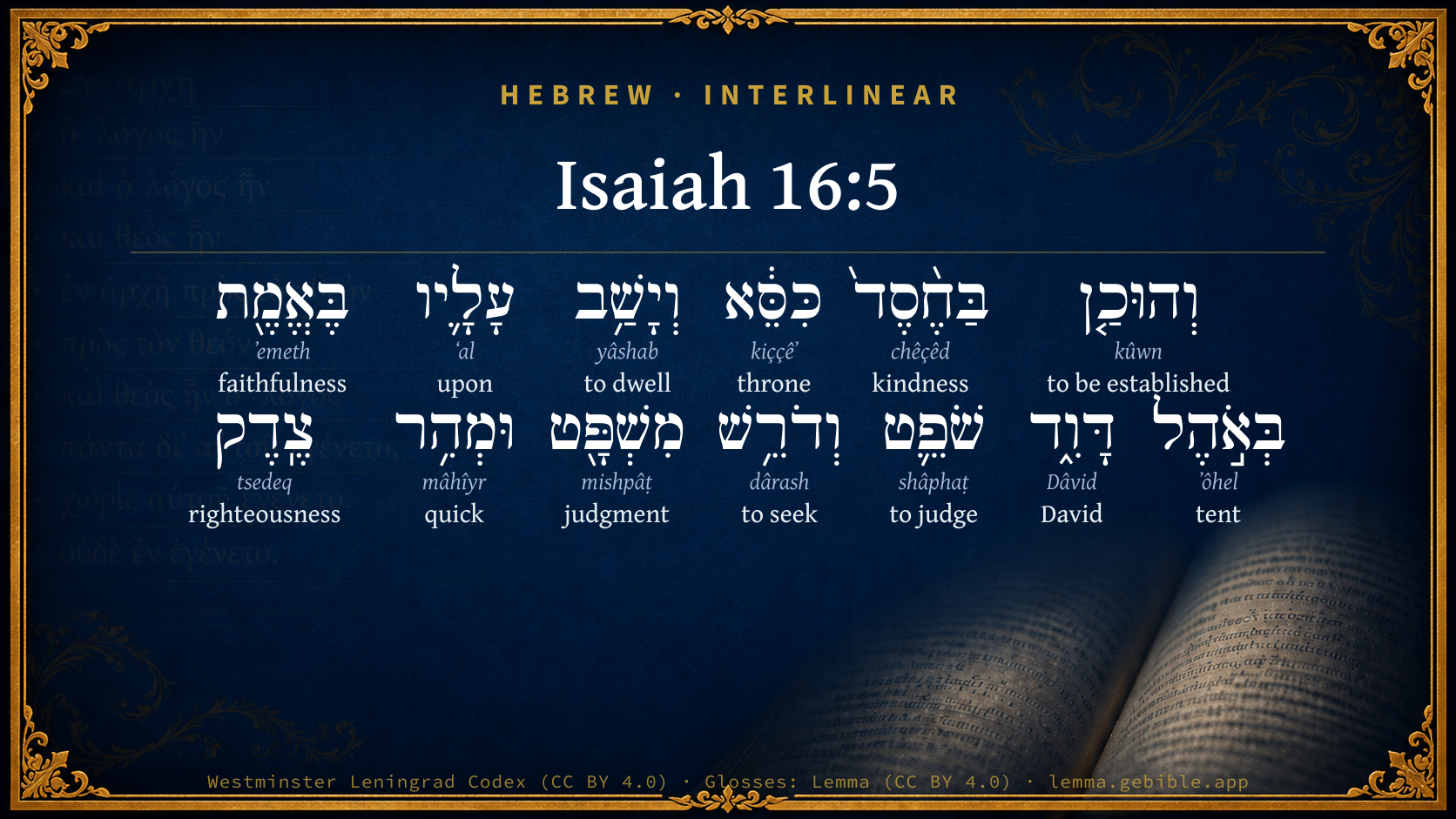
Hebrew (Westminster Leningrad Codex) Isaiah 16:5 appears in the Hebrew Old Testament. The text above is from the Westminster Leningrad Codex. Each word links to its Strong’s number, a concise gloss, and parsing drawn from the Open Scriptures Hebrew Bible morphology. Click any word for its full Brown-Driver-Briggs (BDB) entry.
Download image
Cite this verse

Isaiah 16:5 (World English Bible). Public Domain. Lemma interlinear Bible study tool, https://lemma.gebible.app/v/isaiah/16/5.

Show BibTeX & RIS
BibTeX
RIS
English Translation
A throne shall be established in loving kindness; and one shall sit thereon in truth, in the tent of David, judging, and seeking justice, and swift to do righteousness.
World English Bible · Public Domain
Download a study sheet

One document with this verse’s original text, its word-by-word gloss line, the meaning frame, cross-references with their text, attributed commentary, and full source and license credits — printable, and it pastes into notes with its structure intact.

This verse Autodidact and up

Study sheet (.html) Plain text (.txt)

A passage Seminary Student

Up to 50 verses in one chapter. A passage sheet keeps up to 6 commentary sources and 12 cross-references per verse, in the order this page ranks them, and says so on the sheet whenever that leaves anything out. Ask for a single verse and you get the Autodidact verse sheet above.

Everything on this page stays free to read, with no account — the sheet is a download of what is already on screen, not access to it.

Want to remove ads? Support Godless Engineer
Compare translations 3

The same verse in 3 English versions, stacked beneath the original-language interlinear above. Click any original word for its lexicon entry.

Each is an independent rendering of the whole verse — the interlinear is not word-aligned to these translations.

Highlighted words mark where these versions differ — a whole-verse word diff, not a word-by-word alignment.

  • World English Bible Public Domain
    A throne shall be established in loving kindness; and one shall sit thereon in truth, in the tent of David, judging, and seeking justice, and swift to do righteousness.
  • King James Version Public Domain
    And in mercy shall the throne be established: and he shall sit upon it in truth in the tabernacle of David, judging, and seeking judgment, and hasting righteousness.
  • unfoldingWord Literal Text CC BY-SA 4.0
    And the throne will be established in covenant faithfulness, and one will sit on it in truth in the tent of David, judging and seeking justice and swift of righteousness.” q1

unfoldingWord Literal Text — © unfoldingWord, licensed CC BY-SA 4.0. Word-aligned USFM3 via Door43 (git.door43.org/unfoldingWord/en_ult).

Versions to compare (up to 4)

3 of 4 selected

Show all 18 translations

Every available English version of this verse, each an independent rendering of the whole verse.

  • World English Bible Public Domain
    A throne shall be established in loving kindness; and one shall sit thereon in truth, in the tent of David, judging, and seeking justice, and swift to do righteousness.
  • Berean Standard Bible Public Domain
    in loving devotion a throne will be established in the tent of David. A judge seeking justice and hastening righteousness will sit on it in faithfulness.
  • Majority Standard Bible Public Domain
    in loving devotion a throne will be established in the tent of David. A judge seeking justice and hastening righteousness will sit on it in faithfulness.
  • King James Version Public Domain
    And in mercy shall the throne be established: and he shall sit upon it in truth in the tabernacle of David, judging, and seeking judgment, and hasting righteousness.
  • American Standard Version (1901) Public Domain
    And a throne shall be established in lovingkindness; and one shall sit thereon in truth, in the tent of David, judging, and seeking justice, and swift to do righteousness.
  • Revised Version (1885) Public Domain
    And a throne shall be established in mercy, and one shall sit thereon in truth, in the tent of David; judging, and seeking judgment, and swift to do righteousness.
  • Geneva Bible (1599) Public Domain
    And in mercy shall the throne be prepared, and hee shall sit vpon it in stedfastnesse, in the tabernacle of Dauid, iudging, and seeking iudgement, and hasting iustice.
  • Douay-Rheims (1899) Public Domain
    And a throne shall be prepared in mercy, and one shall sit upon it in truth in the tabernacle of David, judging and seeking judgment and quickly rendering that which is just.
  • Young's Literal Translation Public Domain
    And established in kindness is the throne, And `one' hath sat on it in truth, in the tent of David, Judging and seeking judgment, and hasting righteousness.
  • Literal Standard Version CC BY-SA 4.0
    And the throne is established in kindness, || And [One] has sat on it in truth, in the tent of David, || Judging and seeking judgment, and hastening righteousness.
  • Unlocked Literal Bible CC BY-SA 4.0
    A throne will be established in covenant faithfulness; and one from David's tent will faithfully sit there. He will judge as he seeks justice and does righteousness.
  • unfoldingWord Literal Text CC BY-SA 4.0
    And the throne will be established in covenant faithfulness, and one will sit on it in truth in the tent of David, judging and seeking justice and swift of righteousness.” q1
  • Darby Bible Public Domain
    And a throne shall be established in mercy: and in the tent of David there shall sit upon it, in truth, one judging and seeking justice and hastening righteousness.
  • World Messianic Bible Public Domain
    A throne will be established in loving kindness. One will sit on it in truth, in the tent of David, judging, seeking justice, and swift to do righteousness.
  • Webster's Bible Public Domain
    And in mercy shall the throne be established: and he shall sit upon it in truth in the tabernacle of David, judging, and seeking judgment, and hasting righteousness.
  • Free Bible Version CC BY-SA 4.0
    Then a kingdom will be set up based on trustworthy love, and on its throne will sit a faithful king from the line of David. He will judge fairly, and will be passionately committed to doing what is right.
  • Bible in Basic English Public Domain
    Then a king's seat will be based on mercy, and one will be seated on it in the tent of David for ever; judging uprightly, and quick to do righteousness.
  • JPS Tanakh (1917) Public Domain
    And a throne is established through mercy, and there sitteth thereon in truth, in the tent of David, one that judgeth, and seeketh justice, and is ready in righteousness.

Literal Standard Version (2020), Covenant Press — licensed CC BY-SA 4.0. Text via the HelloAO Bible API (eBible.org). Unlocked Literal Bible (unfoldingWord) — licensed CC BY-SA 4.0. Text via the HelloAO Bible API (eBible.org). unfoldingWord Literal Text — © unfoldingWord, licensed CC BY-SA 4.0. Word-aligned USFM3 via Door43 (git.door43.org/unfoldingWord/en_ult). Free Bible Version, Dr. Jonathan Gallagher — licensed CC BY-SA 4.0. Text via the HelloAO Bible API (eBible.org).

Word by word

More ways to search: Search by grammar → Find every occurrence → Compare this word →

Practice this passage: Drill this verse → Learn its vocabulary →

וּמְהִ֥ר
mâhîyr
H4106
“and · quick of”
Conjunction + Adjective, Adjective, Masculine, Singular, Construct
Part of Speech
Conjunction + Adjective
Type
Adjective
Gender
Masculine
Number
Singular
State
Construct
Full BDB Definition

Origin: from H4116

TWOT: 1152c

quick, prompt, skilled, ready
  1. וְהוּכַ֤ן kûwn H3559 “and · to be established” Conjunction + Verb, Hophal, Sequential Perfect, 3rd Person, Masculine, Singular
  2. בַּחֶ֨סֶד֙ chêçêd H2617 “in/at the · kindness” Preposition, Determined + Noun, Common, Masculine, Singular, Absolute
  3. כִּסֵּ֔א kiççêʼ H3678 “throne” Noun, Common, Masculine, Singular, Absolute
  4. וְיָשַׁ֥ב yâshab H3427 “and · to dwell” Conjunction + Verb, Qal, Sequential Perfect, 3rd Person, Masculine, Singular
  5. עָלָ֛יו ʻal H5921 “upon · him” Preposition + Suffix, Personal, 3rd Person, Masculine, Singular
  6. בֶּאֱמֶ֖ת ʼemeth H571 “in/at · faithfulness” Preposition + Noun, Common, Feminine, Singular, Absolute
  7. בְּאֹ֣הֶל ʼôhel H168 “in/at · tent of” Preposition + Noun, Common, Masculine, Singular, Construct
  8. דָּוִ֑ד Dâvid H1732 “David” Noun, Proper
  9. שֹׁפֵ֛ט shâphaṭ H8199 “judging” Verb, Qal, Participle Active, Masculine, Singular, Absolute
  10. וְדֹרֵ֥שׁ dârash H1875 “and · seeking” Conjunction + Verb, Qal, Participle Active, Masculine, Singular, Absolute
  11. מִשְׁפָּ֖ט mishpâṭ H4941 “judgment” Noun, Common, Masculine, Singular, Absolute
  12. צֶֽדֶק tsedeq H6664 “righteousness” Noun, Common, Masculine, Singular, Absolute

About this verse

These counts appear in no published source. They are computed here, from the morphology-tagged text and Lemma’s own curated glosses. What Lemma adds →

13
words
13
distinct lemmas
Prophets
section

Notable vocabulary

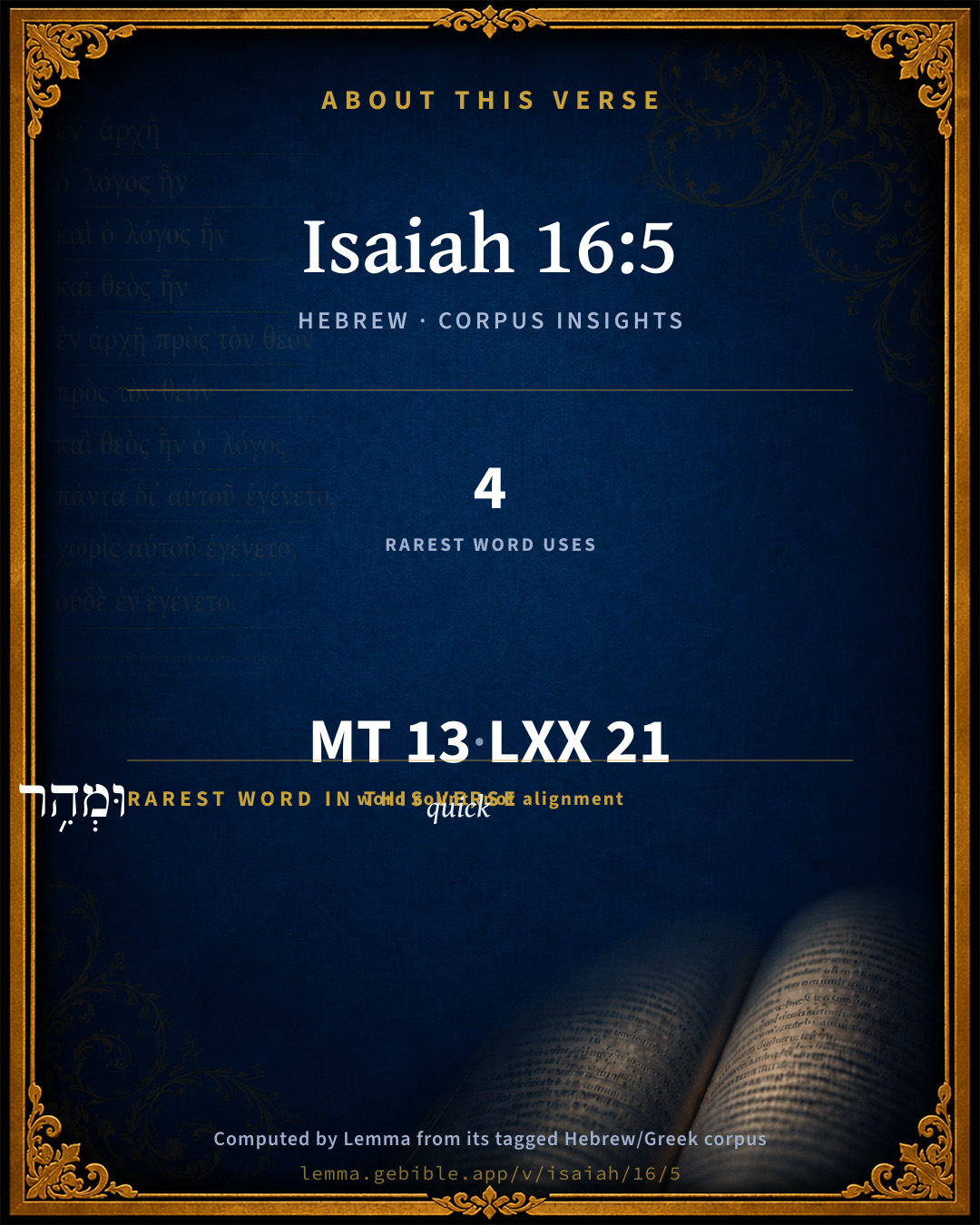
The rarest word here is וּמְהִ֥ר quick H4106 — appearing just 4 times in the whole Hebrew Bible.

Shared distinctive vocabulary

וּמְהִ֥ר quick H4106 occurs in 4 verses of the Hebrew Bible. Also found in:

Grammatical profile

  • 4 verbs
  • 7 nouns
  • 1 adjective
  • 1 preposition

Verb forms

  • וְהוּכַ֤ן Hophal · Sequential Perfect
  • וְיָשַׁ֥ב Qal · Sequential Perfect
  • שֹׁפֵ֛ט Qal · Participle Active
  • וְדֹרֵ֥שׁ Qal · Participle Active

Hebrew & Septuagint length

In English translation the verse runs 29 words from the Hebrew and 29 from the Septuagint (LXX English) — the same length.

A rough comparison of the two English renderings, which tokenize alike — not a word-level alignment.

Word counts can differ between the Hebrew and the Greek without any difference in meaning — e.g. the Hebrew direct-object marker אֵת has no separate Greek word, and Greek often adds the article ὁ.

In the original languages it is 13 Hebrew tokens and 21 Greek tokens — but the two are counted differently (Hebrew bundles its prefixes and suffixes into one token; the Greek is in lemma form), so that isn’t a like-for-like length.

Cross-references

30

Topical passages linked to Isaiah 16:5 in the Treasury of Scripture Knowledge — connected by theme and wording, ordered by reader-vote popularity; previews shown in the World English Bible.

  • Daniel 7:14 There was given him dominion, and glory, and a kingdom, that all the peoples, nations, and languages should serve him: his dominion is an everlasting dominion, which shall not pass away, and his kingdom that which shall not be destroyed.
  • Isaiah 9:6–7 For to us a child is born, to us a son is given; and the government shall be on his shoulder: and his name shall be called Wonderful, Counselor, Mighty God, Everlasting Father, Prince of Peace.
  • Micah 4:7 And I will make that which was lame a remnant, And that which was cast far off a strong nation: And Yahweh will reign over them on Mount Zion from then on, even forever.
  • Daniel 7:27 The kingdom and the dominion, and the greatness of the kingdoms under the whole the sky, shall be given to the people of the saints of the Most High: his kingdom is an everlasting kingdom, and all dominions shall serve and obey him.
  • Isaiah 32:1–2 Behold, a king shall reign in righteousness, and princes shall rule in justice.
  • Zechariah 9:9 Rejoice greatly, daughter of Zion! Shout, daughter of Jerusalem! Behold, your king comes to you! He is righteous, and having salvation; Lowly, and riding on a donkey, Even on a colt, the foal of a donkey.
  • Luke 1:31–33 Behold, you will conceive in your womb, and bring forth a son, and will call his name 'Jesus.'
  • 2 Samuel 7:16 Your house and your kingdom shall be made sure for ever before you: your throne shall be established forever.
  • Proverbs 20:28 Love and faithfulness keep the king safe. His throne is sustained by love.
  • Acts 15:16–17 'After these things I will return. I will again build the tent of David, which has fallen. I will again build its ruins. I will set it up,
  • 2 Peter 3:11–12 Therefore since all these things are thus to be destroyed, what manner of persons ought you to be in holy living and godliness,
  • 2 Samuel 5:9 David lived in the stronghold, and called it the city of David. David built round about from Millo and inward.
  • 2 Samuel 23:3 The God of Israel said, The Rock of Israel spoke to me: One who rules over men righteously, Who rules in the fear of God,
  • 1 Kings 10:9 Blessed be Yahweh your God, who delighted in you, to set you on the throne of Israel: because Yahweh loved Israel forever, therefore made he you king, to do justice and righteousness.
  • 2 Chronicles 31:20 Thus did Hezekiah throughout all Judah; and he worked that which was good and right and faithful before Yahweh his God.
  • Psalms 61:6–7 You will prolong the king's life; His years shall be for generations.
  • Psalms 72:2–4 He will judge your people with righteousness, And your poor with justice.
  • Psalms 85:10 Mercy and truth meet together. Righteousness and peace have kissed each other.
  • Psalms 89:1–2 I will sing of the loving kindness of Yahweh forever. With my mouth, I will make known your faithfulness to all generations.
  • Psalms 89:14 Righteousness and justice are the foundation of your throne. Loving kindness and truth go before your face.
  • Psalms 96:13 Before Yahweh; for he comes, For he comes to judge the earth. He will judge the world with righteousness, The peoples with his truth.
  • Psalms 98:9 Let them sing before Yahweh, For he comes to judge the earth. He will judge the world with righteousness, And the peoples with equity.
  • Psalms 99:4 The King's strength also loves justice. You do establish equity. You execute justice and righteousness in Jacob.
  • Proverbs 29:14 The king who fairly judges the poor, His throne shall be established forever.
  • Isaiah 11:1–5 There shall come forth a shoot out of the stock of Jesse, and a branch out of his roots shall bear fruit.
  • Isaiah 55:4 Behold, I have given him for a witness to the peoples, a leader and commander to the peoples.
  • Jeremiah 23:5–6 Behold, the days come, says Yahweh, that I will raise to David a righteous Branch, and he shall reign as king and deal wisely, and shall execute justice and righteousness in the land.
  • Amos 9:11 In that day I will raise up the tent of David who is fallen, and close up its breaches, and I will raise up its ruins, and I will build it as in the days of old;
  • Luke 1:69–75 And has raised up a horn of salvation for us in the house of his servant David
  • Hebrews 1:8–9 but of the Son he says, "Your throne, O God, is forever and ever; The scepter of uprightness is the scepter of your Kingdom.

Cross-references courtesy of OpenBible.info (CC BY 4.0).

Hebrew and Greek witnesses Masoretic Hebrew ↔ Greek Septuagint

The same verse in the two great witnesses to the Old Testament, shown verse-for-verse.

These are two independent witnesses, not word-aligned to each other, and the Septuagint is shown in lemma (dictionary) form.

Hebrew Isaiah 16:5 Masoretic · Westminster Leningrad Codex

וְהוּכַ֤ן בַּחֶ֨סֶד֙ כִּסֵּ֔א וְיָשַׁ֥ב עָלָ֛יו בֶּאֱמֶ֖ת בְּאֹ֣הֶל דָּוִ֑ד שֹׁפֵ֛ט וְדֹרֵ֥שׁ מִשְׁפָּ֖ט וּמְהִ֥ר צֶֽדֶק

A throne shall be established in loving kindness; and one shall sit thereon in truth, in the tent of David, judging, and seeking justice, and swift to do righteousness.

World English Bible · Public Domain

Greek LXX Isaiah 16:5 Septuagint · lemma form

καί διαὀρθόω μετά ἔλεος θρόνος καί καταἵζω ἐπί αὐτός μετά ἀλήθεια ἐν σκηνή δαυίδ κρίνω καί ἐκζητέω κρίμα καί σπεύδω δικαιοσύνη

And a throne shall be established with mercy; and one shall sit upon it with truth in the tabernacle of David, judging, and earnestly seeking judgments, and hasting righteousness.

LXX2012 (modern English Septuagint) · Public Domain

Hebrew: Westminster Leningrad Codex (CC BY 4.0). Greek: Septuagint (public domain); English from LXX2012 (modern English Septuagint) (Public Domain). How the Septuagint differs from the Hebrew →

Targum (Aramaic paraphrase)

1

The Targum is the ancient Jewish Aramaic paraphrase of the Hebrew Scriptures — an interpretive translation, not the Hebrew text itself. Onkelos (literal) and Pseudo-Jonathan (expansive) render the Torah, and Jonathan the Prophets. Coverage is partial: where no permissively-licensed English translation exists for a verse, only the Aramaic is shown. This is verse-level text, not a word-by-word alignment to the Hebrew.

  1. Targum Jonathan Prophets (Joshua–Malachi)
    בְּכֵן מְשִׁיחָא דְיִשְׂרָאֵל יְתַקֵן בְּטוּב כּוּרְסוֹהִי וִיתֵיב עֲלוֹהִי בִקְשׁוֹט בְּקַרְתָּא דְדָוִד דָאִין וְתָבַע דִין וַעֲבַד קְשׁוֹט:

    Then the throne of the Messiah of Israel shall be established in goodness, and he shall sit upon it in truth in the city of David, judging and seeking justice, and executing truth.

    Targum Jonathan — Aramaic: “Mikraot Gedolot” (public domain). English: “Sefaria Community Translation” (CC0 1.0 (public-domain dedication)); “London "Chaldee Paraphrase," 1871” (public domain). Text via Sefaria.

Commentary

Notes on Isaiah 16:5 from classic Christian and Jewish commentators (each source and its license shown beneath its notes). The classic Christian expositions comment on the surrounding passage and are grouped to its opening verse, so a note may address several verses; the Jewish commentaries on the Tanakh (Rashi and others) are per-verse, so they appear only where the commentator wrote on this verse.

Lemma curates 59 commentaries, every one of them public domain or Creative Commons licensed, each selected and text-cleaned for this edition rather than reprinted as found. About our sources →

Trapp's Complete Commentary

John Trapp

Isa 16:5 And in mercy shall the throne be established: and he shall sit upon it in truth in the tabernacle of David, judging, and seeking judgment, and hasting righteousness.

Ver. 5. For in mercy (or piety) shall the throne be established.] Hezekiah’s throne shall, but especially Christ’s, from whom ye may once have occasion to borrow that mercy which now you are called upon to lend to those outcasts of Israel.

And he shall set upon it,] i.e., He shall make it his business to relieve and right his people.

And seeking judgment.] Making inquisition after wrongs of such as dare not complain. The Grand Signor, they say, shows himself on purpose weekly abroad, for the receiving the poor’s petitions and punishing the grandees of his court, by whom they are oppressed; whence also he styleth himself Awlem Penawh - i.e., the world’s refuge.

And hastening justice.] Despatching and dispeeding causes.

John Trapp, A Commentary or Exposition upon All the Books of the Old and New Testament (1647–1656) — public domain. Text from a community e-Sword module.

The Biblical Illustrator

Joseph S. Exell

Isa_16:5

In mercy shall the throne be established

The moral purpose of judgment

The moral purpose of judgment is never concealed in the Divine writings.

God is always seeking to bring about the time when in mercy His throne shall be established, and when there shall sit upon it in truth one who will represent the ideal judgment and blessing of God. The fifth verse might be rendered, In mercy shall a throne be established, and One shall sit upon it in truth. The prophet has constantly kept before his mind the image of an ideal king. The ideal was partially fulfilled in Hezekiah, yet only partially; the prophet was sure One was coming who would fulfil it in its utmost meaning, and he steadfastly kept his eye on the bright day when Gods throne should be established among the nations, and His sceptre should be extended over all. God does not exist merely to destroy, nor does He rule only in order that He may humble and crush; His purpose is one of equity, righteousness, blessing, cultivation. (J. Parker, D. D.)

The Biblical Illustrator, edited by Joseph S. Exell (c. 1880s–1900s) — public domain. Text from a community e-Sword module.

Joseph Benson's Commentary

Isa 16:5. And in mercy — By my mercy. I am now punishing their sins, yet I will deliver them for my own mercy’s sake. The throne shall be established — The kingdom of Judah. He — Their king; shall sit upon it in truth — That is, firmly and constantly; for truth is often put for the stability and certainty of a thing, as 2Ch 32:1; Pro 11:18. In the tabernacle of David — In the house, or palace, which is called a tent, or tabernacle, with respect to the unsettledness of David’s house, which now indeed was more like a tabernacle than a strong palace. Seeking judgment — Searching out the truth of things with care and diligence; and hasting righteousness — Neither denying nor yet delaying justice. Interpreters vary greatly concerning the application of this passage. Some refer it entirely to Hezekiah, a pious and just king, whose throne, after the chastisement of Sennacherib in Judea, was established in glory; others refer it immediately to the Messiah; and others again to both: to Hezekiah as the type, and to the Messiah, in a more sublime sense, as the antitype; and this seems to be nearly the opinion of Vitringa, who thinks that while the prophet was speaking of the advantages of the kingdom of Hezekiah, he was carried forward to a contemplation of the kingdom of Christ, and made use of such phrases as, in their full extent, can only be applied to that kingdom.

Joseph Benson's Commentary on the Old and New Testaments (1811–1818) — public domain. Text from a community e-Sword module.

Tyndale Open Study Notes

Tyndale Open Resources

16:5 God would establish one of David’s descendants as king (see also 9:7; 11:1-5, 10-12).

Tyndale Open Study Notes — © Tyndale Open Resources, licensed CC BY-SA 4.0. Text via the HelloAO Bible API.

Geneva Bible (1599)

Geneva Bible translators

Meaning, Christ.

Geneva Bible (1599) marginal notes — public domain. Text via Bolls.life.

Jamieson, Fausset & Brown

Robert Jamieson, A. R. Fausset & David Brown

If Judah shelters the suppliant Moab, allowing him to remain in Idumea, a blessing will redound to Judah itself and its "throne."

truth . . . judgment . . . righteousness--language so divinely framed as to apply to "the latter days" under King Messiah, when "the Lord shall bring again the captivity of Moab" (Psa 72:2; Psa 96:13; Psa 98:9; Jer 48:47; Rom 11:12).

hasting--"prompt in executing."

Jamieson, Fausset & Brown — Commentary Critical and Explanatory on the Whole Bible (1871) — public domain (CC PDM 1.0). Text via the HelloAO Bible API.

Adam Clarke's Commentary

Verse 5. In mercy shall the throne be established] May not this refer to the throne of Hezekiah? Here we have the character of such a king as cannot fail to be a blessing to the people.

1. "He sitteth on the throne in truth"-He does not merely profess to be the father and protector of his people: but he is actually such.

2. He is judging. He is not a man of war or blood, who wastes his subjects' lives and treasures in contentions with neighbouring nations, in order to satisfy his ambition by the extension of his territory. On the contrary, his whole life is occupied in the distribution of justice.

3. He seeketh judgment. He seeks out the poor distressed ones who cannot make their way to him, and avenges them on their oppressors.

4. He hastens righteousness. He does not suffer any of the courts of justice to delay the determination of the causes brought before them: he so orders that the point in litigation be fairly, fully, and speedily heard; and then judgment pronounced. Delays in the execution of justice answer little end but the enriching of unprincipled lawyers.

Adam Clarke's Commentary on the Bible (1810–1826) — public domain. Text from a community e-Sword/MySword module.

Ellicott's Commentary for English Readers

(5) And in mercy shall the throne . . .—Better, less definitely, in mercy shall a throne be established, and one shall sit upon it in truth. The prophet has in mind the ideal king of Isa_9:4-7; Isa_11:1-5 (of whom Hezekiah was a partial type and representative), whom he expected after the downfall of the Assyrian oppressor. For the “tabernacle of David,” comp. Amo_9:11.

A Bible Commentary for English Readers, edited by Charles John Ellicott (1878–1897) — public domain. Text from a community e-Sword module.

The Cambridge Bible for Schools and Colleges

gen. ed. J. J. S. Perowne

5. And in mercy] If we follow Hitzig’s view of Isa_16:4 this would be rendered “then in mercy.” The phraseology of the verse is Messianic (see esp. ch. Isa_9:6) but not exclusively so (cf. Pro_8:28). In the lips of the Moabites the language is that of extravagant and (as Isa_16:6 appears to intimate) insincere adulation. It implies an offer of perpetual submission on the part of the Moabites to the Davidic dynasty, and therefore the question whether the throne be that of Judah or that of Moab is immaterial.

and he shall sit … judging] Better: and there shall sit upon it in faithfulness in the tabernacle of David (cf. Amo_9:11) one who judgeth, &c.

hasting righteousness] i.e. as R.V. has it, swift to do righteousness.

The Cambridge Bible for Schools and Colleges (gen. ed. J. J. S. Perowne; Cambridge University Press, 1878–1918) — public domain. Text from a community e-Sword module.

John Gill's Exposition

And in mercy shall the throne be established,.... That is, the throne of Hezekiah, and his government over Judah, which was more firmly settled and established after the overthrow of the Assyrian army, through the mercy of God vouchsafed to him, and on account of the mercy he exercised among his subjects, see Pro 20:28. Hezekiah was a type of Christ, and his throne typical of his, and the ultimate view of the prophecy may be to the stability of the kingdom of Christ; so the Targum,

"then the Christ of Israel, his throne shall be established in goodness:''

and he shall sit upon it in truth; which does not so much intend the reality of his sitting there, as his continuance, signified by sitting, and the constancy and stability of his reign, or his governing with faith fulness and truth;

in the tabernacle of David; or "tent"; meaning his palace, or house in Jerusalem, alluding to his having been a shepherd before he was a king, or referring to the unsettled state of David's house; this was typical of the church of God, where Christ sits and reigns as King, see Amo 9:11; the Targum is,

"in the city of David;''

Jerusalem, as Aben Ezra:

judging and seeking judgment; acting the part of a righteous, faithful, and diligent Judge; seeking to do justice to the poor and needy, and searching into the cause that comes before him, to find out, and take the right side of it:

and hasting righteousness; not delaying justice, protracting a cause, deferring the sentence, and the execution of it, but dispatching the whole as speedily as may be; all which characters, though they may be found in Hezekiah, yet are much more eminently in Christ.

John Gill's Exposition of the Whole Bible (1746–1763) — public domain (CC PDM 1.0). Text via the HelloAO Bible API.

Albert Barnes' Notes on the Bible

And in mercy - In benignity; kindness; benevolence.

Shall the throne be established - The throne of the king of Judah. That is, he that shall sit upon the throne of David shall be disposed to repay the kindness which is now sought at the hand of Moab, and shall be able to do it.

And he shall sit upon it - The king of Israel.

In truth - In faithfulness; that is, shall be true and faithful. His character shall be such that he will do justice, and will furnish protection and aid to the Moabites, if they now receive the fugitives of Israel.

In the tabernacle of David - In the dwelling place; the palace of David; for so the word “tabernacle, or tent” (אהל 'ôhel) seems to be used here. It means “temple” in Eze 41:1. It denotes a habitation, or dwelling place, in general, in Pro 14:11; Psa 52:7; Psa 91:10. The palace, court, or “citadel” of David, was on mount Zion; and the sense here is, that the king to whom Israel refers would be a worthy successor of David - just, true, faithful, benignant, and disposed to repay the favors now sought at the hand of Moab.

Seeking judgment - Anxious to do right; and seeking an opportunity to recompense those who had shown any favor to the people of the Jews. Moab, therefore, if she would now afford protection to the Jews, might be certain of a recompense.

And hasting righteousness - Not tardy and slow in doing what should be done - anxious to do justice to all. It is implied here also, that a king who would be so just, and so anxious to do “right” to all, would not only be ready to show kindness to the Moabites, if they protected the fugitives of Judea, but would also be disposed to do “right” if they refused that protection; that is, would be disposed to inflict “punishment” on them. Alike, therefore, by the hope of the protection and favor of the king of the Jews, and by the dread of punishment, the prophet endeavors to persuade Moab now to secure their favor by granting protection to their exiles.

Albert Barnes' Notes on the Bible (1834–1885) — public domain. Text from a community e-Sword/MySword module.

Haydock's Catholic Bible Commentary

Just. This regards Christ, (St. Jerome) prefigured by (Haydock) Ezechias. (Calmet)

George Leo Haydock (1774–1849), Haydock's Catholic Family Bible and Commentary, 1859 edition — public domain. Excludes Psalms (Douay-Rheims chapter numbering differs from Protestant) and Deuterocanonical books (Catholic canon only).

Matthew Poole's English Annotations

In mercy; by my mercy. Though they have sinned, and I am now punishing their sins, yet I will deliver them for my own mercy’s sake.

The throne; the kingdom od Judah. Therefore for thine own sake show them kindness in this day of their distress; for they will be capable of requiting thee.

He; their king, which is easily and necessarily understood.

Shall sit upon it in truth; which may respect either,

1. The manner of his government, exercising truth and justice. But that is more plainly and fully expressed in the last part of the verse. Or,

2. The continuance of it, in truth, i.e. firmly and constantly; for truth is oft put for the stability and certainty of a thing, as 2Ch 32:1; Pro 11:18; Isa 61:8. And this makes the argument more considerable to the present purpose. The kingdom shall not only be restored, but firmly settled; therefore it is your interest, O Moabites, to be kind to my people.

In the tabernacle; in the house, or palace, which is called a tent, or tabernacle, either because houses are frequently so called in Scripture, as 2Sa 20:1; 1Ki 8:66; 12:16, or with respect unto the unsettledness of David’s house, which now indeed was more like a tabernacle than a strong palace; and yet, notwithstanding its present imbecility, should be firmly established.

Seeking judgment; searching out the truth of causes and things with care and diligence, which is the duty of a judge.

Hasting righteousness; neither denying nor yet delaying justice. And these good qualifications seem to be here mentioned, partly to teach the rulers of Moab their duty towards their own people, and the Israelites which were among them; and partly as a reason and evidence of that stability which he had promised to the house of David.

Matthew Poole's English Annotations on the Holy Bible (1683–1685) — public domain. Text from a community e-Sword/MySword module.

The Pulpit Commentary

And in mercy shall the throne be established; rather, and there shall be a throne established in mercy. A Messianic vision comes upon the prophet in connection with the disappearance of the oppressor. There shall be one day he knows not how soon or how late a throne established in mercy, and "One shall be seated upon it in truth, who. shall occupy the tent or, "house of David, as one who judges, and seeks justice, and hastens on the reign of righteousness.

The foundations of power.

On what foundation does power rest? What will secure it to those who have gained it, or into whose hands it falls? We look at the foundations of

I HUMAN SOVEREIGNTY. The throne of Judah was to be restored, and it should be "established in mercy" or benignity. He that sat upon it should "sit in truth," "judging and seeking judgment, and hasting righteousness;" i.e. engaged in the administration of justice, endeavoring to act justly, and acting, not with a troublesome delay, but with an appreciable promptitude. These are the two foundations on which sovereignty rests everywhere and always benignity and justice. The throne may rely on centuries of unchallenged rule, may be fortified by venerable tradition and ancient laws, may be guarded by many thousands of muskets; but it does not stand on any secure basis, it is certain to be ultimately overthrown, if it is unjust in enactment or harsh in execution. Righteousness, justice between man and man, between class and class, between sect and sect a broad and unbroken impartiality; this great virtue, and its most excellent handmaid, benignity kindness in manner, sympathy shown to the unfortunate, consideration for the poor and unbefriended; these are the pillars on which alone human sovereignty will be secure. It has been well said by an English statesman that "justice and mercy are the supreme attributes of Deity, but all men everywhere comprehend them; there is no speech nor language in which their voice is not heard, and they cannot be vainly exercised" with the millions of mankind.

II THE RULE OF CHRIST. Jesus Christ claims to be Sovereign of the world. "Thou art a King, then?" said the astonished procurator. "Thou sayest that I am a King," replied the Son of man. And his word has been justified by the event, for he is ruling now over vast multitudes of human souls. On what does his power rest? On these foundations righteousness and mercy.

1. He, the Lord of truth, of holiness, of love, has a right to the homage of our minds, to the assent of our conscience, to the unmeasured gratitude and devoted love of our hearts.

2. He, who is full of kindness, of forbearance, of tenderness, of beneficent bestowal and gracious purpose, he will continue to reign over those who have willingly bowed beneath his spiritual sway. "In mercy shall" his "throne be established.

III INDIVIDUAL INFLUENCE. Men covet power; they do well to do so. If they seek it in order that they may exert a precious and helpful influence on the minds and on the lives of others, their ambition is no other than an honorable and laudable aspiration. Its possession by any man must be according to "the ability which God giveth" (the original faculty with which his Creator has endowed him), and according to the favoring circumstances which God has thrown around him. But, these being taken into thought, the power which a man will wield and the duration of its exercise must depend on the measure of these two great moral qualities, benignity and righteousness. In mercy in kindness, in breadth of beneficence, in readiness and reality of sympathy, in genuineness and greatness of self-forgetting love shall every man"s throne be established. But he that would sit long on the throne, he that would continue to exercise power with men, he that would retain his influence over men, must be a righteous as well as a genial and gracious man; he must "seek judgment," must "haste to righteousness;" he must obviously endeavor to do that which is right between man and man; he must eagerly embrace the opportunity of making the crooked things straight, of restoring that which is wrong, of lifting up that which should no longer be abased. C.

Righteousness hindered or hastened.

There is a possible reference here to King Hezekiah, and of him it is said that "seeking judgment and hasting righteousness" should be characteristics. The expression, "hasting righteousness," is a very suggestive one. Cheyne translates, "is prompt in righteousness." The following thought may be worked out and illustrated: Establishing righteousness in the earth is God"s purpose, and towards the accomplishing of that purpose the speedy accomplishment of it every good man should work. But what are the facts of life, which we cannot fail to observe?

I RIGHTEOUSNESS HAS ACTIVE OPPONENTS. They who would dethrone God attack righteousness, which is the spirit and the demand of his rule.

II RIGHTEOUSNESS IS HINDERED BY STOLID RESISTERS. With whom it is much more difficult to deal than with active opponents. They simply block the way of God"s chariot-wheels.

III RIGHTEOUSNESS IS DELAYED BY THE WEAKLY INDIFFERENT. Who put no strength into either good or evil.

IV RIGHTEOUSNESS HAS EARNEST HASTENERS. Men and women who strive for it, witness for it, suffer for it. Whose whole lives do but repeat the great cry with which the Book of God closes: "Come, Lord Jesus, come quickly;" "Even so, come, Lord Jesus. R.T.

The Pulpit Commentary (1880–1919), ed. H.D.M. Spence-Jones & Joseph S. Exell — public domain. Text from a community e-Sword module.

John Wesley's Explanatory Notes

In mercy - By my mercy. I am now punishing their sins, yet I will deliver them for my own mercy's sake. The throne - The kingdom of Judah. He - Their king. In truth - That is, firmly and constantly; for truth is often put for the stability and certainty of a thing, as 2 Chron. xxxii, 1 Prov. xi, 18. Tabernacle - ln the house, or palace, which is called a tent, or tabernacle, with respect to the unsettledness of David's house, which now indeed was more like a tabernacle than a strong palace. Seeking - Searching out the truth of things with care and diligence. Hasting - Neither denying, nor yet delaying justice.

John Wesley, Explanatory Notes Upon the Whole Bible (1754–1765) — public domain. Text via the GEBible commentary corpus.

J. A. Alexander on Isaiah

Joseph Addison Alexander

This verse contains a promise, that if the Jews afforded shelter to the fugitives of Moab, their own government should be strengthened by this exercise of mercy, and their national prosperity promoted by the appearance of a king in the family of David, who should possess the highest qualifications of a moral kind for the regal office. And a throne shall be established in mercy, and one shall sit upon it in truth in the tent of David, judging and seeking justice and prompt in equity.

Joseph Addison Alexander, The Prophecies of Isaiah (1846–1847; New York: Scribner, 1870–1878) — public domain. Text from a community e-Sword module.

Scofield Reference Notes

C. I. Scofield

tabernacle of David

(See Scofield "Act 15:16")

The Scofield Reference Bible (1917 edition), notes by C. I. Scofield — public domain. Text from a community e-Sword module.

unfoldingWord translationNotes

Door43 World Missions Community

A throne will be established in covenant faithfulness

Here "throne" refers to the power to rule as king. The abstract noun "faithfulness" can be stated as "faithful." This can be stated in active form. AT: "Yahweh will be faithful to the covenant and he will appoint a king" (See: Metonymy and Abstract Nouns and Active or Passive)

one from David's tent will faithfully sit there

Here "David's tent" represents David's family, including his descendants. Sitting on the throne represents ruling. AT: "a descendant of David will rule faithfully" (See: Metonymy)

as he seeks justice

Seeking justice represents wanting to do what is just. (See: Metaphor)

translationWords

throne

covenant faithfulness

David

faithful

judge

just

righteous

unfoldingWord translationNotes — © Distant Shores Media and the Door43 World Missions Community, licensed CC BY-SA 4.0. Source: git.door43.org/Door43/en_tn.

Rashi

Rabbi Shlomo Yitzchaki (Rashi)

And the throne shall be established through lovingkindness When this destruction comes upon you, then the throne of David shall be established and magnified, for at that time, Sennacherib shall meet his downfall through Hezekiah, whose throne shall be established through the lovingkindness that he shall perform, as we find that he bestowed lovingkindness, as it is stated in II Chron. (30:24): “For Hezekiah, king of Judah provided for the assembly a thousand bulls and seven thousand sheep.”

and there shall sit...one who judges and demands justice and performs righteousness Heb. וּמְהִר צֶדֶק. Jonathan renders: and performs justice.

Rashi on the Tanakh — English translations: “The Judaica Press complete Tanach with Rashi, translated by A. J. Rosenberg” (CC BY 4.0); “Pentateuch with Rashi's commentary by M. Rosenbaum and A.M. Silbermann, 1929-1934” (public domain); “The Metsudah Tanach series, Lakewood, N.J” (CC BY 4.0); and “The Book of Joshua, Metsudah Publications, 1997” (CC BY 4.0). Text via Sefaria.

Ibn Ezra

Rabbi Abraham ibn Ezra

בחסד For the piety (of Hezekiah).

The throne of royalty.

In the tabernacle of David. In Jerusalem.

A judge. Hezekiah.

מהיר Quick. Root מהר to be quick; comp. מהרה quickly.

Ibn Ezra on the Tanakh — English translations: “Sefaria Community Translation” (CC0 1.0 (public-domain dedication)); “Yalkut, Sifsei Chachomim Chumash, Metsudah Publications, 2009” (CC BY 4.0); and “Commentary of Ibn Ezra on Isaiah - trans. by M. Friedlander, 1873” (public domain). Text via Sefaria.

Lesson kit

Teaching starters — assembled from the data on this page, not authored interpretation. Every prompt links to the verse data it draws on. Edit before teaching.

Isaiah, in the Prophets, opens this verse with 13 words (13 distinct Hebrew lemmas). Its most distinctive word is mâhîyr (“quick”). A historical commentator’s framing appears above. Read the whole chapter for the surrounding context.

Discussion questions

  1. The word mâhîyr carries the sense “quick.” How does it shape the verse?
  2. How does Ezra 7:6, which shares the word «quick», read alongside this verse?
  3. The translations on this page render this verse differently — a whole-verse word diff, not a word-by-word alignment. What might account for the different wordings?
  4. «וְהוּכַ֤ן» is a Hophal Sequential Perfect verb. How does that grammatical form shape the action described?
  5. Compare how Trapp's Complete Commentary and The Biblical Illustrator read this verse. Where do they agree or differ?

Things to notice

Reading settings

Reading text

Shown beneath each verse's original-language words.

Old Testament
Old Testament edition

Read the OT as the Masoretic Hebrew (MT) or the Greek Septuagint (LXX).

English shown for the Greek Septuagint (in the Hebrew ↔ Greek comparison).

Comparing translations? Open the Compare panel on any verse page to stack up to four side by side.