
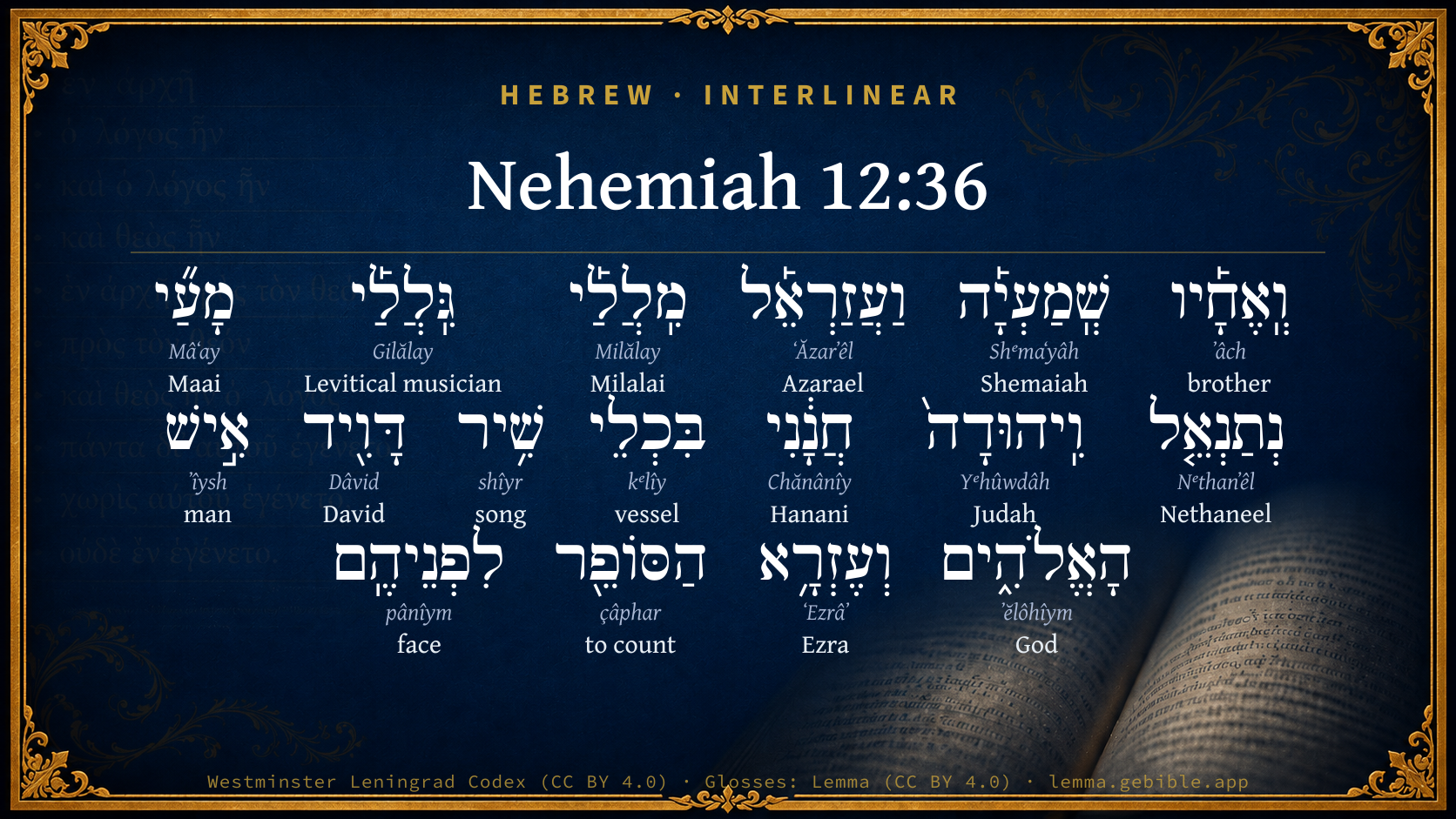
Nehemiah 12:36

Hebrew (Westminster Leningrad Codex) Nehemiah 12:36 appears in the Hebrew Old Testament. The text above is from the Westminster Leningrad Codex. Each word links to its Strong’s number, a concise gloss, and parsing drawn from the Open Scriptures Hebrew Bible morphology. Click any word for its full Brown-Driver-Briggs (BDB) entry.
Download image
Cite this verse

Nehemiah 12:36 (World English Bible). Public Domain. Lemma interlinear Bible study tool, https://lemma.gebible.app/v/nehemiah/12/36.

Show BibTeX & RIS
BibTeX
RIS
English Translation
and his brothers, Shemaiah, and Azarel, Milalai, Gilalai, Maai, Nethanel, and Judah, Hanani, with the musical instruments of David the man of God; and Ezra the scribe was before them.
World English Bible · Public Domain
Highlights
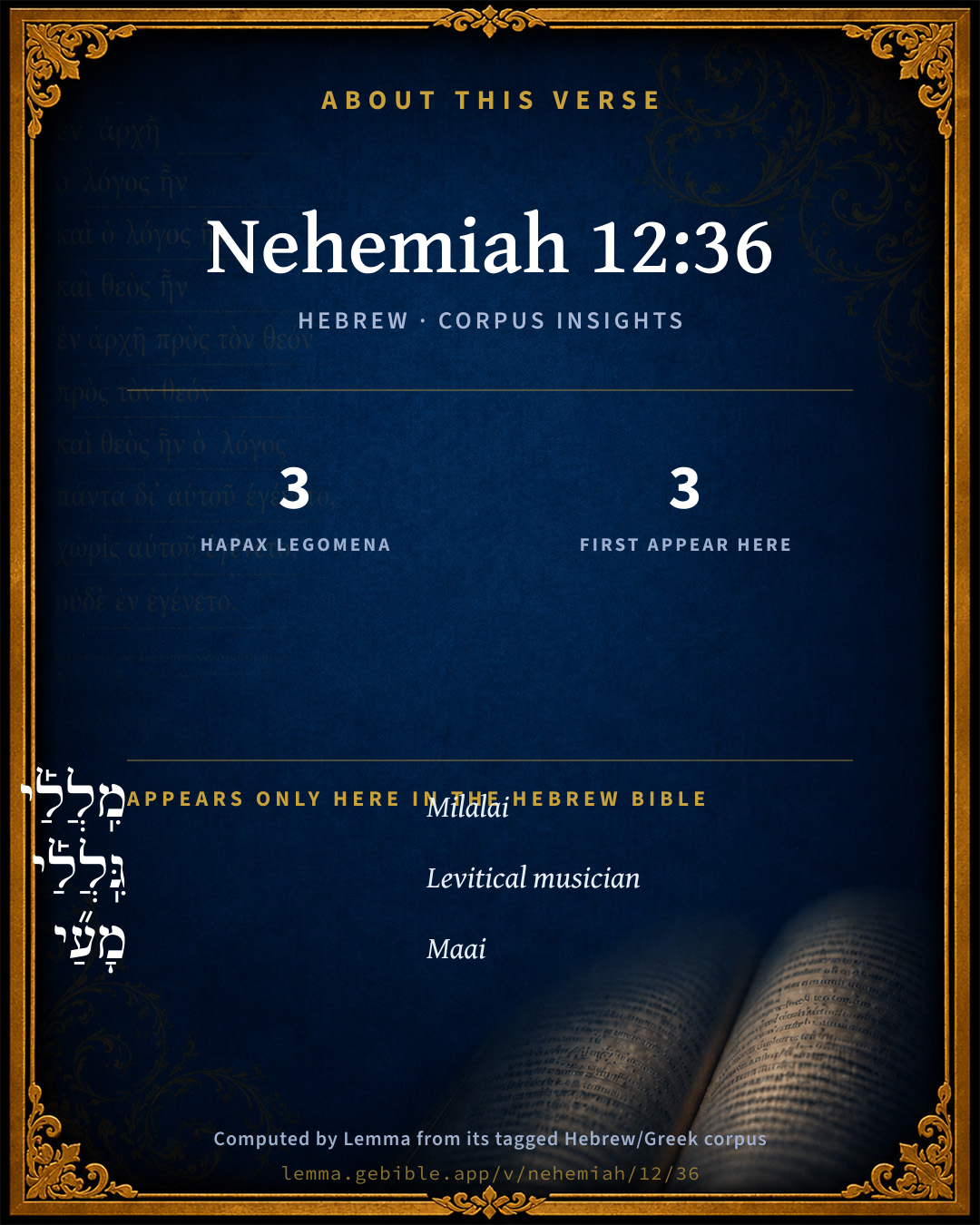
  • 3 hapax legomena — only here in the Hebrew Bible
  • 3 first appearances in the Hebrew Bible
Full analysis ↓
Download a study sheet

One document with this verse’s original text, its word-by-word gloss line, the meaning frame, cross-references with their text, attributed commentary, and full source and license credits — printable, and it pastes into notes with its structure intact.

This verse Autodidact and up

Study sheet (.html) Plain text (.txt)

A passage Seminary Student

Up to 50 verses in one chapter. A passage sheet keeps up to 6 commentary sources and 12 cross-references per verse, in the order this page ranks them, and says so on the sheet whenever that leaves anything out. Ask for a single verse and you get the Autodidact verse sheet above.

Everything on this page stays free to read, with no account — the sheet is a download of what is already on screen, not access to it.

Want to remove ads? Support Godless Engineer
Compare translations 3

The same verse in 3 English versions, stacked beneath the original-language interlinear above. Click any original word for its lexicon entry.

Each is an independent rendering of the whole verse — the interlinear is not word-aligned to these translations.

Highlighted words mark where these versions differ — a whole-verse word diff, not a word-by-word alignment.

  • World English Bible Public Domain
    and his brothers, Shemaiah, and Azarel, Milalai, Gilalai, Maai, Nethanel, and Judah, Hanani, with the musical instruments of David the man of God; and Ezra the scribe was before them.
  • King James Version Public Domain
    And his brethren, Shemaiah, and Azarael, Milalai, Gilalai, Maai, Nethaneel, and Judah, Hanani, with the musical instruments of David the man of God, and Ezra the scribe before them.
  • unfoldingWord Literal Text CC BY-SA 4.0
    and his brothers, Shemaiah, and Azarel, Milalai, Gilalai, Maai, Nethanel and Judah, Hanani, with the instruments of song of David, the man of God. And Ezra the scribe was before their face.

unfoldingWord Literal Text — © unfoldingWord, licensed CC BY-SA 4.0. Word-aligned USFM3 via Door43 (git.door43.org/unfoldingWord/en_ult).

Versions to compare (up to 4)

3 of 4 selected

Show all 18 translations

Every available English version of this verse, each an independent rendering of the whole verse.

  • World English Bible Public Domain
    and his brothers, Shemaiah, and Azarel, Milalai, Gilalai, Maai, Nethanel, and Judah, Hanani, with the musical instruments of David the man of God; and Ezra the scribe was before them.
  • Berean Standard Bible Public Domain
    and his associates—Shemaiah, Azarel, Milalai, Gilalai, Maai, Nethanel, Judah, and Hanani—with the musical instruments prescribed by David the man of God. Ezra the scribe led the procession.
  • Majority Standard Bible Public Domain
    and his associates—Shemaiah, Azarel, Milalai, Gilalai, Maai, Nethanel, Judah, and Hanani—with the musical instruments prescribed by David the man of God. Ezra the scribe led the procession.
  • King James Version Public Domain
    And his brethren, Shemaiah, and Azarael, Milalai, Gilalai, Maai, Nethaneel, and Judah, Hanani, with the musical instruments of David the man of God, and Ezra the scribe before them.
  • American Standard Version (1901) Public Domain
    and his brethren, Shemaiah, and Azarel, Milalai, Gilalai, Maai, Nethanel, and Judah, Hanani, with the musical instruments of David the man of God; and Ezra the scribe was before them.
  • Revised Version (1885) Public Domain
    and his brethren, Shemaiah, and Azarel, Milalai, Gilalai, Maai, Nethanel, and Judah, Hanani, with the musical instruments of David the man of God; and Ezra the scribe was before them:
  • Geneva Bible (1599) Public Domain
    And his brethren, Shemaiah, and Azareel, Milalai, Gilalai, Maai, Nethaneel, and Iudah, Hanani, with the musicall instruments of Dauid the man of God: and Ezra the scribe went before them.
  • Douay-Rheims (1899) Public Domain
    And they went up over against them by the stairs of the city of David, at the going up of the wall of the house of David, and to the water gate eastward:
  • Young's Literal Translation Public Domain
    and his brethren Shemaiah, and Azarael, Milalai, Gilalai, Maai, Nethaneel, and Judah, Hanani, with instruments of song of David the man of God, and Ezra the scribe `is' before them;
  • Literal Standard Version CC BY-SA 4.0
    and his brothers Shemaiah, and Azarael, Milalai, Gilalai, Maai, Nethaneel, and Judah, Hanani, with instruments of song of David the man of God, and Ezra the scribe [is] before them;
  • Unlocked Literal Bible CC BY-SA 4.0
    There also were Zechariah's relatives, Shemaiah, Azarel, Milalai, Gilalai, Maai, Nethanel, Judah, Hanani, with the musical instruments of David the man of God. Ezra the scribe was in front of them.
  • unfoldingWord Literal Text CC BY-SA 4.0
    and his brothers, Shemaiah, and Azarel, Milalai, Gilalai, Maai, Nethanel and Judah, Hanani, with the instruments of song of David, the man of God. And Ezra the scribe was before their face.
  • Darby Bible Public Domain
    and his brethren, Shemaiah, and Azareel, Milalai, Gilalai, Maai, Nethaneel, and Judah, Hanani, with the musical instruments of David the man of God; and Ezra the scribe before them.
  • World Messianic Bible Public Domain
    and his brothers, Shemaiah, Azarel, Milalai, Gilalai, Maai, Nethanel, Judah, and Hanani, with the musical instruments of David the man of God; and Ezra the scribe was before them.
  • Webster's Bible Public Domain
    And his brethren, Shemaiah, and Azarael, Milalai, Gilalai, Maai, Nethaneel, and Judah, Hanani, with the musical instruments of David the man of God, and Ezra the scribe before them.
  • Free Bible Version CC BY-SA 4.0
    and his fellow priests, Shemaiah, Azarel, Milalai, Gilalai, Maai, Nethanel, Judah, and Hanani, along with the musical instruments as required by David, the man of God. Ezra the scribe led them.
  • Bible in Basic English Public Domain
    And his brothers, Shemaiah, and Azarel, Milalai, Gilalai, Maai, Nethanel and Judah, Hanani, with the music-instruments of David, the man of God; and Ezra the scribe was at their head;
  • JPS Tanakh (1917) Public Domain
    and his brethren, Shemaiah, and Azarel, Milalai, Gilalai, Maai, Nethanel, and Judah, Hanani, with the musical instruments of David the man of God; and Ezra the scribe was before them;

Literal Standard Version (2020), Covenant Press — licensed CC BY-SA 4.0. Text via the HelloAO Bible API (eBible.org). Unlocked Literal Bible (unfoldingWord) — licensed CC BY-SA 4.0. Text via the HelloAO Bible API (eBible.org). unfoldingWord Literal Text — © unfoldingWord, licensed CC BY-SA 4.0. Word-aligned USFM3 via Door43 (git.door43.org/unfoldingWord/en_ult). Free Bible Version, Dr. Jonathan Gallagher — licensed CC BY-SA 4.0. Text via the HelloAO Bible API (eBible.org).

Word by word

More ways to search: Search by grammar → Find every occurrence → Compare this word →

Practice this passage: Drill this verse → Learn its vocabulary →

מִֽלֲלַ֡י
Milălay
H4450
“Milalai”
Noun, Proper
Part of Speech
Noun
Type
Proper
Full BDB Definition

Origin: from H4448

TWOT: None

Milalai = "eloquent" - son of the priest Jonathan and a descendant of Asaph
  1. וְֽאֶחָ֡יו ʼâch H251 “and · brothers · his” Conjunction + Noun, Common, Masculine, Plural, Construct + Suffix, Personal, 3rd Person, Masculine, Singular
  2. שְֽׁמַעְיָ֡ה Shᵉmaʻyâh H8098 “Shemaiah” Noun, Proper
  3. וַעֲזַרְאֵ֡ל ʻĂzarʼêl H5832 “and · Azarael” Conjunction + Noun, Proper
  4. גִּֽלֲלַ֡י Gilălay H1562 “Levitical musician” Noun, Proper
  5. מָעַ֞י Mâʻay H4597 “Maai” Noun, Proper
  6. נְתַנְאֵ֤ל Nᵉthanʼêl H5417 “Nethaneel” Noun, Proper
  7. וִֽיהוּדָה֙ Yᵉhûwdâh H3063 “and · Judah” Conjunction + Noun, Proper
  8. חֲנָ֔נִי Chănânîy H2607 “Hanani” Noun, Proper
  9. בִּכְלֵי kᵉlîy H3627 “in/at · vessels of” Preposition + Noun, Common, Masculine, Plural, Construct
  10. שִׁ֥יר shîyr H7892 “song of” Noun, Common, Both, Singular, Construct
  11. דָּוִ֖יד Dâvid H1732 “David” Noun, Proper
  12. אִ֣ישׁ ʼîysh H376 “man of” Noun, Common, Masculine, Singular, Construct
  13. הָאֱלֹהִ֑ים ʼĕlôhîym H430 “the · God(s)” Particle, Definite Article + Noun, Common, Masculine, Plural, Absolute
  14. וְעֶזְרָ֥א ʻEzrâʼ H5830 “and · Ezra” Conjunction + Noun, Proper
  15. הַסּוֹפֵ֖ר çâphar H5608 “the · scribe” Particle, Definite Article + Noun, Common, Masculine, Singular, Absolute
  16. לִפְנֵיהֶֽם pânîym H6440 “to/for · face(s) · their” Preposition + Noun, Common, Both, Plural, Construct + Suffix, Personal, 3rd Person, Masculine, Plural

About this verse

These counts appear in no published source. They are computed here, from the morphology-tagged text and Lemma’s own curated glosses. What Lemma adds →

17
words
17
distinct lemmas
Historical
section

Notable vocabulary

3 hapax legomena — words that appear only here in the entire Hebrew Bible:

  • מִֽלֲלַ֡י Milalai H4450
  • גִּֽלֲלַ֡י Levitical musician H1562
  • מָעַ֞י Maai H4597

First appearance in Scripture

These words make their first canonical appearance in the Hebrew Bible here:

  • מִֽלֲלַ֡י Milalai H4450
  • גִּֽלֲלַ֡י Levitical musician H1562
  • מָעַ֞י Maai H4597

Shared distinctive vocabulary

וַעֲזַרְאֵ֡ל Azarael H5832 occurs in 6 verses of the Hebrew Bible. Also found in:

Grammatical profile

  • 17 nouns

Cross-references

6

Topical passages linked to Nehemiah 12:36 in the Treasury of Scripture Knowledge — connected by theme and wording, ordered by reader-vote popularity; previews shown in the World English Bible.

  • Nehemiah 12:24 The chiefs of the Levites: Hashabiah, Sherebiah, and Jeshua the son of Kadmiel, with their brothers over against them, to praise and give thanks, according to the commandment of David the man of God, watch next to watch.
  • 1 Chronicles 23:5 and four thousand were doorkeepers; and four thousand praised Yahweh with the instruments which I made, [said David], for giving praise.
  • 2 Chronicles 8:14 He appointed, according to the ordinance of David his father, the divisions of the priests to their service, and the Levites to their offices, to praise, and to minister before the priests, as the duty of every day required; the doorkeepers also by their divisions at every gate: for so had David the man of God commanded.
  • Ezra 7:1 Now after these things, in the reign of Artaxerxes king of Persia, Ezra the son of Seraiah, the son of Azariah, the son of Hilkiah,
  • Ezra 8:1 Now these are the heads of their fathers' [houses], and this is the genealogy of those who went up with me from Babylon, in the reign of Artaxerxes the king:
  • Amos 6:5 Who strum on the strings of a harp; Who invent for themselves instruments of music, like David;

Cross-references courtesy of OpenBible.info (CC BY 4.0).

Hebrew and Greek witnesses Masoretic Hebrew ↔ Greek Septuagint

The same verse in the two great witnesses to the Old Testament, shown verse-for-verse.

These are two independent witnesses, not word-aligned to each other, and the Septuagint is shown in lemma (dictionary) form.

Hebrew Nehemiah 12:36 Masoretic · Westminster Leningrad Codex

וְֽאֶחָ֡יו שְֽׁמַעְיָ֡ה וַעֲזַרְאֵ֡ל מִֽלֲלַ֡י גִּֽלֲלַ֡י מָעַ֞י נְתַנְאֵ֤ל וִֽיהוּדָה֙ חֲנָ֔נִי בִּכְלֵי שִׁ֥יר דָּוִ֖יד אִ֣ישׁ הָאֱלֹהִ֑ים וְעֶזְרָ֥א הַסּוֹפֵ֖ר לִפְנֵיהֶֽם

and his brothers, Shemaiah, and Azarel, Milalai, Gilalai, Maai, Nethanel, and Judah, Hanani, with the musical instruments of David the man of God; and Ezra the scribe was before them.

World English Bible · Public Domain

Greek LXX Structure differs

The Septuagint has no separate book of Nehemiah. Its Greek text is the second half of Esdras B (2 Esdras), chapters 11–23; Ezra is the first half (1–10).

A verse-for-verse comparison isn’t shown here because the chapters and verses don’t line up. Switch to the LXX edition with the MT / LXX toggle above to read the Greek directly.

Hebrew: Westminster Leningrad Codex (CC BY 4.0). Greek: Septuagint (public domain); English from a public-domain English Septuagint. How the Septuagint differs from the Hebrew →

Commentary

Notes on Nehemiah 12:36 from classic Christian and Jewish commentators (each source and its license shown beneath its notes). The classic Christian expositions comment on the surrounding passage and are grouped to its opening verse, so a note may address several verses; the Jewish commentaries on the Tanakh (Rashi and others) are per-verse, so they appear only where the commentator wrote on this verse.

Lemma curates 59 commentaries, every one of them public domain or Creative Commons licensed, each selected and text-cleaned for this edition rather than reprinted as found. About our sources →

Trapp's Complete Commentary

John Trapp

Neh 12:36 And his brethren, Shemaiah, and Azarael, Milalai, Gilalai, Maai, Nethaneel, and Judah, Hanani, with the musical instruments of David the man of God, and Ezra the scribe before them.

Ver. 36. And Ezra before them] Before the first company, as Nehemiah came after the second, Neh 12:4. As the first went round from the west southward till they came to the east; so the second company went from the west northward, till they came to the east, where they both met at length in the Temple, Neh 12:41. Praising God with all sorts of music, vocal and instrumental. This was a most solemn and sacred procession, far different from those of the Papists. The French historian telleth us of their Henry, that going in procession together with his cardinal, they had in the middle between them Morionem, nugas et ineptias agentem, a jester to make them sport; here was good devotion therewhile. The philosopher told the fiddlers, he could be merry without them. And Aristotle being asked what he thought of music? answered, Iovem nec canere, neque cytharam pulsare, Jupiter neither sings nor plays on an instrument. But though God needeth it not, careth not for it; yet so far as it might excite and further devotion, these holy priests and Levites made use of the musical instruments of David (called musical instruments of God, 1Ch 16:42), and Ezra before them, as a guide; they also sang aloud, and so generally rejoiced, that their joy was heard even afar off, Neh 12:42-43. This was right.

John Trapp, A Commentary or Exposition upon All the Books of the Old and New Testament (1647–1656) — public domain. Text from a community e-Sword module.

Geneva Bible (1599)

Geneva Bible translators

That is, the brethren of Zaccur.

Geneva Bible (1599) marginal notes — public domain. Text via Bolls.life.

Ellicott's Commentary for English Readers

(36) With the musical instruments of David the man of God.—No part of the service deviated from sacred precedents (comp. Neh_12:27).

Ezra the scribe before them.—Between the singers and the princes came he who was the greatest in dignity, though the second in office.

A Bible Commentary for English Readers, edited by Charles John Ellicott (1878–1897) — public domain. Text from a community e-Sword module.

The Cambridge Bible for Schools and Colleges

gen. ed. J. J. S. Perowne

36. Azarael … Nethaneel] R.V. Azarel … Nethanel. These two names recall ‘Nethaniah and Asharelah, the sons of Asaph,’ in 1Ch_25:2.

David the man of God] Cf. Neh_12:24.

Ezra … before them] The mention of Ezra’s name here seems to indicate that he held in respect of the ‘right hand’ procession the same position occupied by Nehemiah in the other. If so, the words ‘before them’ will mean, not at the head of the professional musicians (which was Zechariah’s place), but at the head of the whole civil and religious procession. His place in the procession would then be before Hoshaiah and half of ‘the princes of Judah’ (Neh_12:31-32).

The Cambridge Bible for Schools and Colleges (gen. ed. J. J. S. Perowne; Cambridge University Press, 1878–1918) — public domain. Text from a community e-Sword module.

John Gill's Exposition

And from above the gate of Ephraim,.... The gate which led to the tribe of Ephraim, where that tribe formerly dwelt, see Neh 8:16

and above the old gate; of which mention is made, Neh 3:6

and above the fish gate, and the tower of Hananeel, and the tower of Meah, even unto the sheep gate; of all which see Neh 3:1, and they stood still in the prison gate; which was not a gate of the city, but of the court of the prison, Neh 3:25, which was near both the king's palace and the temple, see Jer 20:1.

John Gill's Exposition of the Whole Bible (1746–1763) — public domain (CC PDM 1.0). Text via the HelloAO Bible API.

Haydock's Catholic Bible Commentary

CHAPTER XII.

George Leo Haydock (1774–1849), Haydock's Catholic Family Bible and Commentary, 1859 edition — public domain. Excludes Psalms (Douay-Rheims chapter numbering differs from Protestant) and Deuterocanonical books (Catholic canon only).

Whedon's Commentary on the Bible

Daniel D. Whedon

36. The musical instruments of David — Such instruments as David invented, and introduced into the sacred service. Comp. 1Ch_15:16; 1Ch_23:5; 2Ch_29:26.

Daniel D. Whedon (gen. ed.), Commentary on the Old and New Testaments (1874–1909) — public domain. Text from a community e-Sword module.

The Pulpit Commentary

The musical instruments of David. Cymbals, psalteries, and harps. See above, ver. 27, and comp. 1Ch_15:16, 1Ch_15:19-21. The Jews had become acquainted with a great variety of musical instruments during the captivity, (Dan_3:7 Psa_150:4, Psa_150:5) but rigidly excluded all except the old instruments from the service of religion. Ezra the scribe before them. As their leader. It is interesting to find no jealousy separating Ezra from the governor who had superseded him. As the two conjointly had addressed the people on a former occasion, (Neh_8:9) so now they conjointly conducted the ceremony of the dedication.

The Pulpit Commentary (1880–1919), ed. H.D.M. Spence-Jones & Joseph S. Exell — public domain. Text from a community e-Sword module.

unfoldingWord translationNotes

Door43 World Missions Community

There also were

"Along with them were"

Zechariah ... Shemaiah, Azarel, Milalai, Gilalai, Maai, Nethanel, Judah, Hanani ... David ... Ezra

These are the names of males. (See: How to Translate Names)

Ezra the scribe was in front of them

"Ezra the scribe was leading them"

Fountain Gate ... Water Gate

These are the names of openings in the wall.

translationWords

Zechariah (OT)

David

God

Ezra

scribe

fountain

gate

city of David

palace

water

unfoldingWord translationNotes — © Distant Shores Media and the Door43 World Missions Community, licensed CC BY-SA 4.0. Source: git.door43.org/Door43/en_tn.

Rashi

Rabbi Shlomo Yitzchaki (Rashi)

And his brethren the colleagues of Zechariah the priest.

Rashi on the Tanakh — English translations: “The Judaica Press complete Tanach with Rashi, translated by A. J. Rosenberg” (CC BY 4.0); “Pentateuch with Rashi's commentary by M. Rosenbaum and A.M. Silbermann, 1929-1934” (public domain); “The Metsudah Tanach series, Lakewood, N.J” (CC BY 4.0); and “The Book of Joshua, Metsudah Publications, 1997” (CC BY 4.0). Text via Sefaria.

Lesson kit

Teaching starters — assembled from the data on this page, not authored interpretation. Every prompt links to the verse data it draws on. Edit before teaching.

Nehemiah, in the Historical, opens this verse with 17 words (17 distinct Hebrew lemmas). Its most distinctive word is Milălay (“Milalai”). A historical commentator’s framing appears above. Read the whole chapter for the surrounding context.

Discussion questions

  1. How does “Milalai” (Milălay) shape what this verse is saying?
  2. 3 words here appear nowhere else in the Hebrew Bible. Why might the author reach for such rare wording?
  3. 3 words make their first appearance in Scripture here. What does this debut establish?
  4. How does 1 Chronicles 12:6, which shares the word «Azarael», read alongside this verse?
  5. These translations render this verse differently; the difference is in the English rendering, not the original. What questions does that raise?
  6. Compare how Trapp's Complete Commentary and Geneva Bible (1599) read this verse. Where do they agree or differ?

Things to notice

  • 3 words in this verse appear nowhere else in the Hebrew Bible.
  • 3 words make their first canonical appearance in Scripture here.
  • These translations choose different wording for 9 words in this verse.
  • 17 distinct Hebrew lemmas span 17 words in this verse.

Reading settings

Reading text

Shown beneath each verse's original-language words.

Old Testament
Old Testament edition

Read the OT as the Masoretic Hebrew (MT) or the Greek Septuagint (LXX).

English shown for the Greek Septuagint (in the Hebrew ↔ Greek comparison).

Comparing translations? Open the Compare panel on any verse page to stack up to four side by side.