
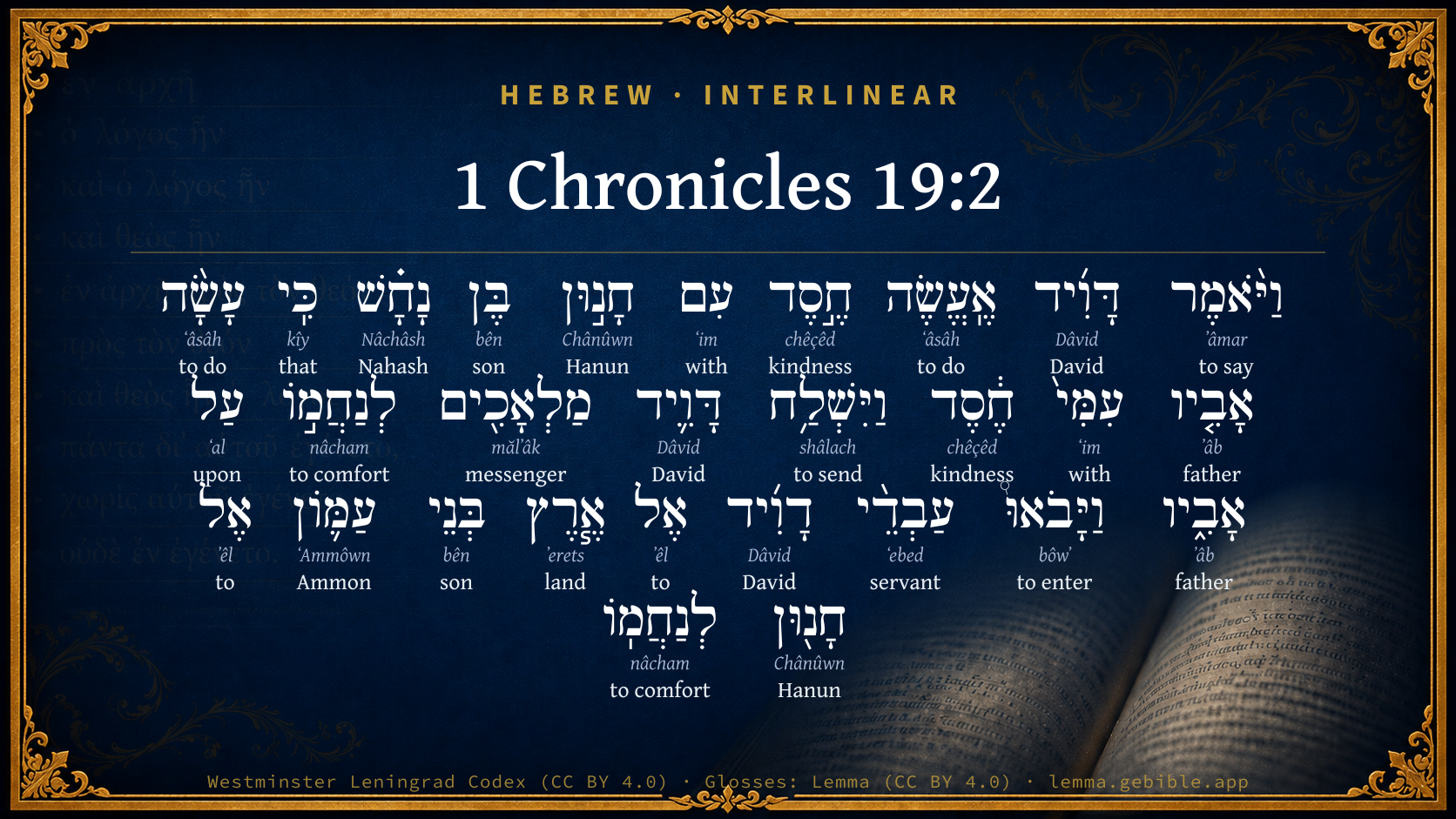
1 Chronicles 19:2

Hebrew (Westminster Leningrad Codex) 1 Chronicles 19:2 appears in the Hebrew Old Testament. The text above is from the Westminster Leningrad Codex. Each word links to its Strong’s number, a concise gloss, and parsing drawn from the Open Scriptures Hebrew Bible morphology. Click any word for its full Brown-Driver-Briggs (BDB) entry.
Download image
Cite this verse

1 Chronicles 19:2 (World English Bible). Public Domain. Lemma interlinear Bible study tool, https://lemma.gebible.app/v/1-chronicles/19/2.

Show BibTeX & RIS
BibTeX
RIS
English Translation
David said, I will show kindness to Hanun the son of Nahash, because his father shown kindness to me. So David sent messengers to comfort him concerning his father. David's servants came into the land of the children of Ammon to Hanun, to comfort him.
World English Bible · Public Domain
Download a study sheet

One document with this verse’s original text, its word-by-word gloss line, the meaning frame, cross-references with their text, attributed commentary, and full source and license credits — printable, and it pastes into notes with its structure intact.

This verse Autodidact and up

Study sheet (.html) Plain text (.txt)

A passage Seminary Student

Up to 50 verses in one chapter. A passage sheet keeps up to 6 commentary sources and 12 cross-references per verse, in the order this page ranks them, and says so on the sheet whenever that leaves anything out. Ask for a single verse and you get the Autodidact verse sheet above.

Everything on this page stays free to read, with no account — the sheet is a download of what is already on screen, not access to it.

Want to remove ads? Support Godless Engineer
Compare translations 3

The same verse in 3 English versions, stacked beneath the original-language interlinear above. Click any original word for its lexicon entry.

Each is an independent rendering of the whole verse — the interlinear is not word-aligned to these translations.

Highlighted words mark where these versions differ — a whole-verse word diff, not a word-by-word alignment.

  • World English Bible Public Domain
    David said, I will show kindness to Hanun the son of Nahash, because his father shown kindness to me. So David sent messengers to comfort him concerning his father. David's servants came into the land of the children of Ammon to Hanun, to comfort him.
  • King James Version Public Domain
    And David said, I will show kindness unto Hanun the son of Nahash, because his father showed kindness to me. And David sent messengers to comfort him concerning his father. So the servants of David came into the land of the children of Ammon to Hanun, to comfort him.
  • unfoldingWord Literal Text CC BY-SA 4.0
    And David said, “I will do kindness with Hanun, the son of Nahash, for his father did kindness with me.” And David sent messengers to console him concerning his father. And the servants of David came to the land of the sons of Ammon, to Hanun, to console him

unfoldingWord Literal Text — © unfoldingWord, licensed CC BY-SA 4.0. Word-aligned USFM3 via Door43 (git.door43.org/unfoldingWord/en_ult).

Versions to compare (up to 4)

3 of 4 selected

Show all 18 translations

Every available English version of this verse, each an independent rendering of the whole verse.

  • World English Bible Public Domain
    David said, I will show kindness to Hanun the son of Nahash, because his father shown kindness to me. So David sent messengers to comfort him concerning his father. David's servants came into the land of the children of Ammon to Hanun, to comfort him.
  • Berean Standard Bible Public Domain
    And David said, “I will show kindness to Hanun son of Nahash, because his father showed kindness to me.” So David sent messengers to console Hanun concerning his father. But when David’s servants arrived in the land of the Ammonites to console him,
  • Majority Standard Bible Public Domain
    And David said, “I will show kindness to Hanun son of Nahash, because his father showed kindness to me.” So David sent messengers to console Hanun concerning his father. But when David’s servants arrived in the land of the Ammonites to console him,
  • King James Version Public Domain
    And David said, I will show kindness unto Hanun the son of Nahash, because his father showed kindness to me. And David sent messengers to comfort him concerning his father. So the servants of David came into the land of the children of Ammon to Hanun, to comfort him.
  • American Standard Version (1901) Public Domain
    And David said, I will show kindness unto Hanun the son of Nahash, because his father showed kindness to me. So David sent messengers to comfort him concerning his father. And David's servants came into the land of the children of Ammon to Hanun, to comfort him.
  • Revised Version (1885) Public Domain
    And David said, I will shew kindness unto Hanun the son of Nahash, because his father shewed kindness to me. So David sent messengers to comfort him concerning his father. And David’s servants came into the land of the children of Ammon to Hanun, to comfort him.
  • Geneva Bible (1599) Public Domain
    And Dauid said, I will shew kindnesse vnto Hanun the sonne of Nahash, because his father shewed kindnesse vnto me. And Dauid sent messengers to comfort him for his father. So the seruants of Dauid came into the lande of the children of Ammon to Hanun to comfort him.
  • Douay-Rheims (1899) Public Domain
    And David said: I will shew kindness to Hanon the son of Naas: for his father did a favour to me. And David sent messengers to comfort him upon the death of his father. But when they were come into the land of the children of Ammon, to comfort Hanon,
  • Young's Literal Translation Public Domain
    and David saith, `I do kindness with Hanun son of Nahash, for his father did with me kindness;' and David sendeth messengers to comfort him concerning his father. And the servants of David come in unto the land of the sons of Ammon, unto Hanun, to comfort him,
  • Literal Standard Version CC BY-SA 4.0
    and David says, “I do kindness with Hanun son of Nahash, for his father did kindness with me”; and David sends messengers to comfort him concerning his father. And the servants of David come to the land of the sons of Ammon, to Hanun, to comfort him,
  • Unlocked Literal Bible CC BY-SA 4.0
    David said, “I will show kindness to Hanun son of Nahash, because his father showed kindness to me.” So David sent messengers to console him concerning his father. David's servants entered the land of the Ammonites and went to Hanun, in order to console him.
  • unfoldingWord Literal Text CC BY-SA 4.0
    And David said, “I will do kindness with Hanun, the son of Nahash, for his father did kindness with me.” And David sent messengers to console him concerning his father. And the servants of David came to the land of the sons of Ammon, to Hanun, to console him
  • Darby Bible Public Domain
    And David said, I will shew kindness to Hanun the son of Nahash, because his father shewed kindness to me. And David sent messengers to comfort him concerning his father. And David's servants came into the land of the children of Ammon to Hanun, to comfort him.
  • World Messianic Bible Public Domain
    David said, “I will show kindness to Hanun the son of Nahash, because his father showed kindness to me.” So David sent messengers to comfort him concerning his father. David’s servants came into the land of the children of Ammon to Hanun to comfort him.
  • Webster's Bible Public Domain
    And David said, I will show kindness to Hanun the son of Nahash, because his father showed kindness to me. And David sent messengers to comfort him concerning his father. So the servants of David came into the land of the children of Ammon to Hanun, to comfort him.
  • Free Bible Version CC BY-SA 4.0
    David said, “I will be kind to Hanun, son of Nahash, for his father was kind to me.” So David sent messengers to comfort him over his father's death. David's ambassadors arrived in the land of the Ammonites and went to comfort Hanun.
  • Bible in Basic English Public Domain
    And David said, I will be a friend to Hanun, the son of Nahash, because his father was a friend to me. So David sent men to him, to give him words of comfort on account of his father. And the servants of David came to Hanun, to the land of the children of Ammon, offering him comfort.
  • JPS Tanakh (1917) Public Domain
    And David said: 'l will show kindness unto Hanun the son of Nahash, because his father showed kindness to me.' So David sent messengers to comfort him concerning his father. And David's servants came into the land of the children of Ammon to Hanun, to comfort him.

Literal Standard Version (2020), Covenant Press — licensed CC BY-SA 4.0. Text via the HelloAO Bible API (eBible.org). Unlocked Literal Bible (unfoldingWord) — licensed CC BY-SA 4.0. Text via the HelloAO Bible API (eBible.org). unfoldingWord Literal Text — © unfoldingWord, licensed CC BY-SA 4.0. Word-aligned USFM3 via Door43 (git.door43.org/unfoldingWord/en_ult). Free Bible Version, Dr. Jonathan Gallagher — licensed CC BY-SA 4.0. Text via the HelloAO Bible API (eBible.org).

Word by word

More ways to search: Search by grammar → Find every occurrence → Compare this word →

Practice this passage: Drill this verse → Learn its vocabulary →

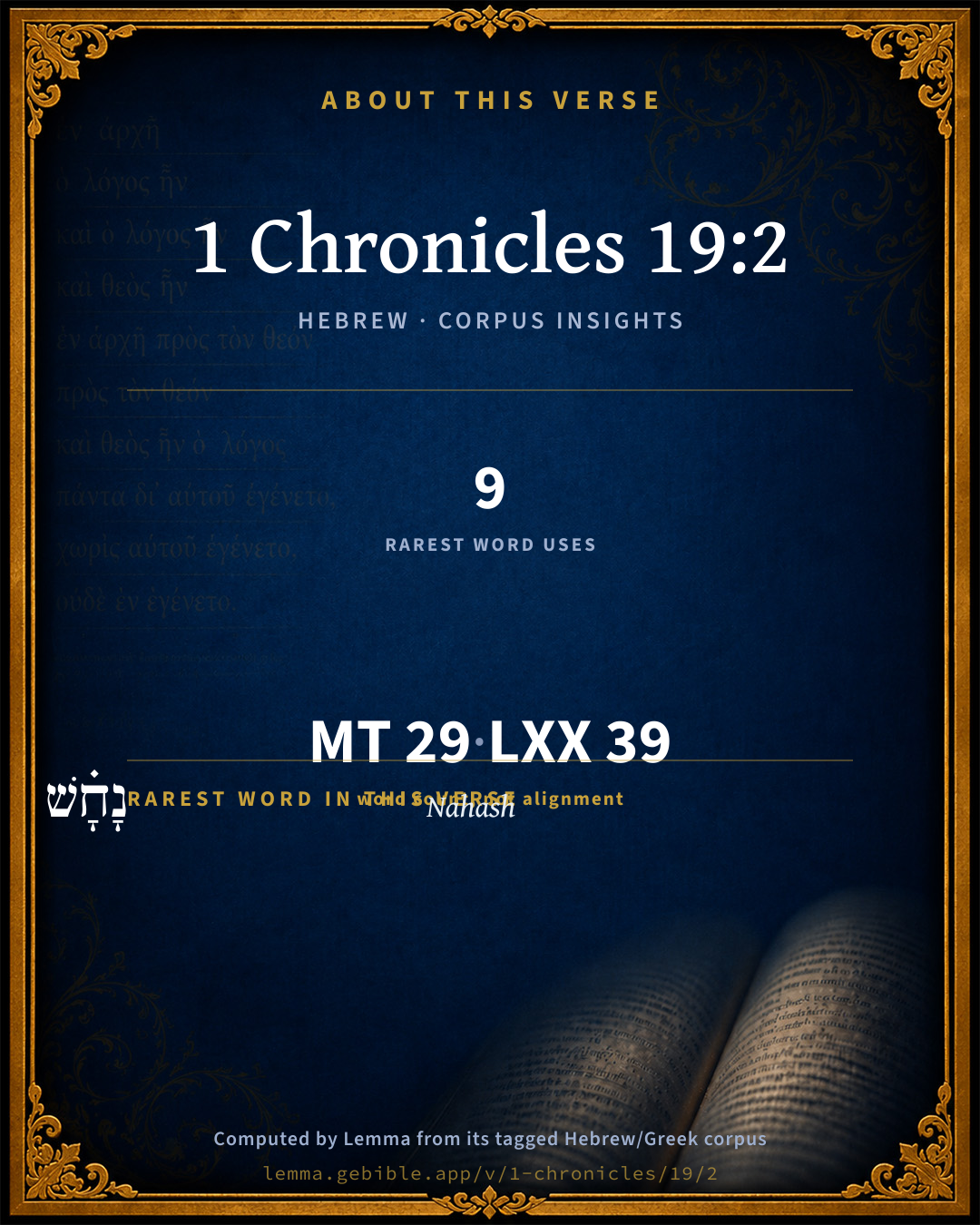
נָחָ֗שׁ
Nâchâsh
H5176
“Nahash”
Noun, Proper
Part of Speech
Noun
Type
Proper
Full BDB Definition

Origin: the same as H5175

TWOT: None

Nahash = "serpent" - a king of the Ammonites during the time of king Saul - the father of Abigail, the mother of Amasa, the commander of Absalom's army
  1. וַיֹּ֨אמֶר ʼâmar H559 “and · to say” Conjunction + Verb, Qal, Sequential Imperfect, 3rd Person, Masculine, Singular
  2. דָּוִ֜יד Dâvid H1732 “David” Noun, Proper
  3. אֶֽעֱשֶׂה ʻâsâh H6213 “to do” Verb, Qal, Imperfect, 1st Person, Common, Singular
  4. חֶ֣סֶד chêçêd H2617 “kindness” Noun, Common, Masculine, Singular, Absolute
  5. עִם ʻim H5973 “with” Preposition
  6. חָנ֣וּן Chânûwn H2586 “Hanun” Noun, Proper
  7. בֶּן bên H1121 “son of” Noun, Common, Masculine, Singular, Construct
  8. כִּֽי kîy H3588 “that” Conjunction
  9. עָשָׂ֨ה ʻâsâh H6213 “to do” Verb, Qal, Perfect, 3rd Person, Masculine, Singular
  10. אָבִ֤יו ʼâb H1 “father · his” Noun, Common, Masculine, Singular, Construct + Suffix, Personal, 3rd Person, Masculine, Singular
  11. עִמִּי֙ ʻim H5973 “with · me” Preposition + Suffix, Personal, 1st Person, Common, Singular
  12. חֶ֔סֶד chêçêd H2617 “kindness” Noun, Common, Masculine, Singular, Absolute
  13. וַיִּשְׁלַ֥ח shâlach H7971 “and · to send” Conjunction + Verb, Qal, Sequential Imperfect, 3rd Person, Masculine, Singular
  14. דָּוִ֛יד Dâvid H1732 “David” Noun, Proper
  15. מַלְאָכִ֖ים mălʼâk H4397 “messengers” Noun, Common, Masculine, Plural, Absolute
  16. לְנַחֲמ֣וֹ nâcham H5162 “to comfort · him” Preposition + Verb, Piel, Infinitive Construct + Suffix, Personal, 3rd Person, Masculine, Singular
  17. עַל ʻal H5921 “upon” Preposition
  18. אָבִ֑יו ʼâb H1 “father · his” Noun, Common, Masculine, Singular, Construct + Suffix, Personal, 3rd Person, Masculine, Singular
  19. וַיָּבֹאוּ֩ bôwʼ H935 “and · to enter” Conjunction + Verb, Qal, Sequential Imperfect, 3rd Person, Masculine, Plural
  20. עַבְדֵ֨י ʻebed H5650 “servants of” Noun, Common, Masculine, Plural, Construct
  21. דָוִ֜יד Dâvid H1732 “David” Noun, Proper
  22. אֶל ʼêl H413 “to” Preposition
  23. אֶ֧רֶץ ʼerets H776 “land of” Noun, Common, Both, Singular, Construct
  24. בְּנֵי bên H1121 “sons of” Noun, Common, Masculine, Plural, Construct
  25. עַמּ֛וֹן ʻAmmôwn H5983 “Ammon” Noun, Proper
  26. אֶל ʼêl H413 “to” Preposition
  27. חָנ֖וּן Chânûwn H2586 “Hanun” Noun, Proper
  28. לְנַחֲמֽוֹ nâcham H5162 “to comfort · him” Preposition + Verb, Piel, Infinitive Construct + Suffix, Personal, 3rd Person, Masculine, Singular

About this verse

These counts appear in no published source. They are computed here, from the morphology-tagged text and Lemma’s own curated glosses. What Lemma adds →

29
words
19
distinct lemmas
Historical
section

Notable vocabulary

The rarest word here is נָחָ֗שׁ Nahash H5176 — appearing just 9 times in the whole Hebrew Bible.

Shared distinctive vocabulary

נָחָ֗שׁ Nahash H5176 occurs in 8 verses of the Hebrew Bible. Also found in:

Grammatical profile

  • 7 verbs
  • 16 nouns
  • 5 prepositions
  • 1 conjunction

Verb forms

  • וַיֹּ֨אמֶר Qal · Sequential Imperfect
  • אֶֽעֱשֶׂה Qal · Imperfect
  • עָשָׂ֨ה Qal · Perfect
  • וַיִּשְׁלַ֥ח Qal · Sequential Imperfect
  • לְנַחֲמ֣וֹ Piel · Infinitive Construct
  • וַיָּבֹאוּ֩ Qal · Sequential Imperfect
  • לְנַחֲמֽוֹ Piel · Infinitive Construct

Repetition

Words recur within this verse — often emphatic in Hebrew:

  • דָּוִ֜יד David H1732 ×3
  • אֶֽעֱשֶׂה to do H6213 ×2
  • חֶ֣סֶד kindness H2617 ×2
  • חָנ֣וּן Hanun H2586 ×2
  • בֶּן son H1121 ×2
  • אָבִ֤יו father H1 ×2
  • לְנַחֲמ֣וֹ to comfort H5162 ×2
  • עִם with H5973 ×2
  • אֶל to H413 ×2

Hebrew & Septuagint length

In English translation the verse runs 45 words from the Hebrew and 53 from the Septuagint (LXX English) — closely comparable.

A rough comparison of the two English renderings, which tokenize alike — not a word-level alignment.

Word counts can differ between the Hebrew and the Greek without any difference in meaning — e.g. the Hebrew direct-object marker אֵת has no separate Greek word, and Greek often adds the article ὁ.

In the original languages it is 29 Hebrew tokens and 39 Greek tokens — but the two are counted differently (Hebrew bundles its prefixes and suffixes into one token; the Greek is in lemma form), so that isn’t a like-for-like length.

Cross-references

11

Topical passages linked to 1 Chronicles 19:2 in the Treasury of Scripture Knowledge — connected by theme and wording, ordered by reader-vote popularity; previews shown in the World English Bible.

  • Deuteronomy 23:3–6 An Ammonite or a Moabite shall not enter into the assembly of Yahweh; even to the tenth generation shall none belonging to them enter into the assembly of Yahweh forever:
  • 1 Samuel 30:26 When David came to Ziklag, he sent of the spoil to the elders of Judah, even to his friends, saying, Behold, a present for you of the spoil of the enemies of Yahweh:
  • Genesis 19:37–38 The firstborn bore a son, and named him Moab. The same is the father of the Moabites to this day.
  • 2 Samuel 9:1 David said, Is there yet any who is left of the house of Saul, that I may show him kindness for Jonathan's sake?
  • 2 Samuel 9:7 David said to him, "Don't be afraid of him; for I will surely show you kindness for Jonathan your father's sake, and will restore you all the land of Saul your father; and you shall eat bread at my table continually."
  • 2 Kings 4:13 He said to him, Say now to her, Behold, you have been careful for us with all this care; what is to be done for you? would you be spoken for to the king, or to the captain of the host? She answered, I dwell among my own people.
  • Nehemiah 4:3 Now Tobiah the Ammonite was by him, and he said, Even that which they are building, if a fox go up, he shall break down their stone wall.
  • Nehemiah 4:7 But it happened that when Sanballat, Tobiah, the Arabians, the Ammonites, and the Ashdodites heard that the repairing of the walls of Jerusalem went forward, [and] that the breaches began to be stopped, then they were very angry;
  • Nehemiah 13:1 On that day they read in the book of Moses in the audience of the people; and therein was found written, that an Ammonite and a Moabite should not enter into the assembly of God forever,
  • Esther 6:3 The king said, What honor and dignity has been bestowed on Mordecai for this? Then the king's servants who ministered to him said, "Nothing has been done for him."
  • Ecclesiastes 9:15 Now a poor wise man was found in it, and he by his wisdom delivered the city; yet no man remembered that same poor man.

Cross-references courtesy of OpenBible.info (CC BY 4.0).

Hebrew and Greek witnesses Masoretic Hebrew ↔ Greek Septuagint

The same verse in the two great witnesses to the Old Testament, shown verse-for-verse.

These are two independent witnesses, not word-aligned to each other, and the Septuagint is shown in lemma (dictionary) form.

Hebrew 1 Chronicles 19:2 Masoretic · Westminster Leningrad Codex

וַיֹּ֨אמֶר דָּוִ֜יד אֶֽעֱשֶׂה חֶ֣סֶד עִם חָנ֣וּן בֶּן נָחָ֗שׁ כִּֽי עָשָׂ֨ה אָבִ֤יו עִמִּי֙ חֶ֔סֶד וַיִּשְׁלַ֥ח דָּוִ֛יד מַלְאָכִ֖ים לְנַחֲמ֣וֹ עַל אָבִ֑יו וַיָּבֹאוּ֩ עַבְדֵ֨י דָוִ֜יד אֶל אֶ֧רֶץ בְּנֵי עַמּ֛וֹן אֶל חָנ֖וּן לְנַחֲמֽוֹ

David said, I will show kindness to Hanun the son of Nahash, because his father shown kindness to me. So David sent messengers to comfort him concerning his father. David's servants came into the land of the children of Ammon to Hanun, to comfort him.

World English Bible · Public Domain

Greek LXX 1 Chronicles 19:2 Septuagint · lemma form

καί εἶπον δαυίδ ποιέω ἔλεος μετά αναν υἱός ναας ὡς ποιέω ὁ πατήρ αὐτός μετά ἐγώ ἔλεος καί ἀποστέλλω ἄγγελος δαυίδ ὁ παρακαλέω αὐτός περί ὁ πατήρ αὐτός καί ἔρχομαι παῖς δαυίδ εἰς γῆ υἱός αμμων ὁ παρακαλέω αὐτός

And David said, I will act kindly toward Anan the son of Naas, as his father acted kindly towards me. And David sent messengers to condole with him on the death of his father. So the servants of David came into the land of the children of Ammon to Anan, to comfort him.

LXX2012 (modern English Septuagint) · Public Domain

Hebrew: Westminster Leningrad Codex (CC BY 4.0). Greek: Septuagint (public domain); English from LXX2012 (modern English Septuagint) (Public Domain). How the Septuagint differs from the Hebrew →

Commentary

Notes on 1 Chronicles 19:2 from classic Christian and Jewish commentators (each source and its license shown beneath its notes). The classic Christian expositions comment on the surrounding passage and are grouped to its opening verse, so a note may address several verses; the Jewish commentaries on the Tanakh (Rashi and others) are per-verse, so they appear only where the commentator wrote on this verse.

Lemma curates 59 commentaries, every one of them public domain or Creative Commons licensed, each selected and text-cleaned for this edition rather than reprinted as found. About our sources →

Geneva Bible (1599)

Geneva Bible translators

Because Nahash received David and his company, when Saul persecuted him he would now show pleasure to his son for the same.

Geneva Bible (1599) marginal notes — public domain. Text via Bolls.life.

Ellicott's Commentary for English Readers

(2) Nahash Samuel omits, but adds “Hanun.” The omissions in each are perhaps accidental. Saul’s first campaign was against Nahash (1 Samuel 11).

Children of Ammon.—Sons of Ammon, like “sons of Israel.” The title calls attention to their tribal organisation.

Because.—For. Samuel, “according as.”

Shewed kindness to me.—The Hebrew phrase, which answers to the Greek of Luk_1:72. (See Revised Version.)

The rest of the verse is made more perspicuous than in 2Sa_10:2 by slight changes and additions.

A Bible Commentary for English Readers, edited by Charles John Ellicott (1878–1897) — public domain. Text from a community e-Sword module.

The Cambridge Bible for Schools and Colleges

gen. ed. J. J. S. Perowne

2. sent messengers to comfort him] A usual piece of international courtesy; cp. 2Ki_20:12. Its breach was resented. In the Tellel-Amarna letters (x. 16) the king of Kardunias writes, “Should not my brother (i.e. the king of Egypt) have heard that I am sick? Why has he not comforted me? Why has he not sent his messenger, not looked into it?” (ed. H. Winckler, p. 23).

The Cambridge Bible for Schools and Colleges (gen. ed. J. J. S. Perowne; Cambridge University Press, 1878–1918) — public domain. Text from a community e-Sword module.

Albert Barnes' Notes on the Bible

Hanun - A Philistine king of this name is mentioned in the Assyrian inscriptions as paying tribute to Tiglath-pileser and warring with Sargon.

Albert Barnes' Notes on the Bible (1834–1885) — public domain. Text from a community e-Sword/MySword module.

The Pulpit Commentary

Because his father showed kindness to me. The instance of kindness here alluded to is not recorded. There may have been many opportunities and calls for it during David"s persecuted life, and when the Ammonite king would feel a motive beyond any intrinsic goodness of heart to "show kindness" to the youth who was Saul"s object of hatred. It is, however, very remarkable that we find a genuine kindliness towards David still cleaving to the succession of Ammonite kings, even after the events of this chapter. (2Sa_17:27-29) Hanna. Nothing else is known of this Hanun. Though here the name of an Ammonite king, we find it in. Neh_3:13, Neh_3:30, the name of two of those who helped repair the city. The Assyrian Inscriptions contain the name as that of a Philistine king, tributary to Tiglath-pileser (see "Speaker"s Commentary

HOMILIES BY J.R. THOMSON

Kindness and sympathy.

Stern warrior though David was, and capable of severe and even cruel actions, he nevertheless had a warm and tender heart. So much might be gathered from the story of his youthful affection for Jonathan, and from that of his subsequent forbearance towards Saul. In maturer years he retained the warm sensibilities of humanity. Thus, when the King of Ammon died, David felt sincerely for his son and successor, and, that he might give expression to his kindly sympathy, "sent messengers to comfort him concerning his father." His compassionate feelings, and his courteous and graceful expression of them, are suggestive of some reflections upon human kindness and sympathy.

I Consider THE GROUND AND ORIGIN of these feelings. They lie deep in human nature, and are, in fact (as Bishop Butler has so well shown), as much natural social principles, as self-love is a principle of individual action. They are implanted by God, and are akin to his own gracious and benevolent disposition. He is a God of "love and kindness;" "in all our afflictions he is afflicted." Especially is this apparent in redemption. It was compassion that animated the Divine Father in his purpose to save our sinful race. It was love that actuated the incarnation and sacrifice of Immanuel. The dispositions, then, of which we are treating have their deep foundation in the character, the attributes, of our Creator. So far from being signs of human weakness, they are an honour and ornament of humanity.

II Regard THE OCCASION of the manifestation of these dispositions. Human life is such as to call them forth. No man, no woman, can go through life without abundant opportunity for the display of these qualities. In times of health and prosperity there is comparatively little occasion for sympathy and tender kindness. But times of trouble, sickness, suffering, adversity, bereavement, must come to all men. Such times are the providentially appointed opportunities for kindly sympathy. Then the friend will "show himself friendly." David"s heart was touched by the tidings of his friend"s death, and he was drawn to show kindness to the living son for the sake of the deceased father. A sense of gratitude naturally and properly gave acuteness to these feelings. David had in former days received kindness from Nahash, and on this account he all the more felt the claim of the fatherless son upon his friendly sympathy.

III Observe THE OUTWARD FORMS which these feelings assume. These must be determined by circumstances, according to relative age, social position, and character. Sometimes by sympathizing expression of countenance and manner, sometimes by words spoken or written, sometimes by services, sometimes by appropriate and seasonable gifts, we may show our cordial sympathy, and thus rivet the sacred bonds of humanity and of friendship. David on this occasion sent envoys to his friend"s son, to condole with him and to assure him of his good feeling and his good wishes. Such action must in the circumstances have proved gratifying and strengthening. Wisdom and tact will discern the most suitable way of acting in the several cases which may arise.

IV Reflect upon THE VALUE of these dispositions. To underestimate, still more to despise kindness, is the sign of an unjust and an ignoble mind. Shall we leave out of sight, in reckoning life"s riches, the precious sympathy, the dear kindness, of our kindred and our friends? These dispositions have a value which only the heats can appraise; they are in themselves precious, and no just mind would barter them for diamonds and gold. They have also a practical and substantial worth. When one friend is taken from us for a season, it is no mean advantage to have another friend, upon whose counsel we may lean, and upon whose sympathy and faithfulness we may count. Human kindness is a poor substitute for Divine compassion, but it may well prove one of its fairest flowers, its richest fruits. T.

HOMILIES BY R. TUCK

Religious courtesy.

True religion of necessity involves the culture of the beautiful, the gracious, the considerate, and the sympathetic in human character. Its plea is effectively expressed by St. Paul: "Bear ye one another"s burdens, and so fulfil the law of Christ." This verse presents an instance of the courtesy which piety prompts. It is intended to point out that there was more in this matter than court formality; David bore a grateful sense of kindness shown him by Nahash, and found what seemed a most fitting time for acknowledging it. Illustrations may be given of the practical importance of the "polite" in human society; but better than formal politeness is the considerate courtesy of the good man. The counsel to all Christians is, "Be pitiful, be courteous.

I THE GOOD MAN IS SENSITIVE TO KINDNESS THAT MAY BE SHOWN HIM. As David cherished the memory of the kindness of Nahash. Some people take things done for them as their rights, and haughtily treat them as even below their rights. Those who are made sensible of the mercy of God to them in redemption, are always made sensitive to human kindnesses, which seem to them shadows of the Divine.

II THE GOOD MAN IS QUICK TO OBSERVE OPPORTUNITIES FOR SHOWING KINDNESS. Knowing how good it is to receive, he is ever ready to give. The sympathizing word is not restrained. The kindly and helpful deed is not postponed. The good man cherishes kind thoughts, but he will not rest without giving expression to them. The weak man tries to satisfy himself with cherishing good feelings. The large-hearted man is ever keenly observant, and nobly anxious, to find out the best forms and times for pressing good feeling into kindly word and deed. Our Master said, "If ye know these things, happy are ye if ye do them." Loyalty to truth is fully consistent with Christian courtesy, and with the most tender considerateness for the feelings of others. R.T.

The Pulpit Commentary (1880–1919), ed. H.D.M. Spence-Jones & Joseph S. Exell — public domain. Text from a community e-Sword module.

Rashi

Rabbi Shlomo Yitzchaki (Rashi)

because his father showed me kindness when David took his father, his mother, his brothers, and his father’s household and settled them in the region of the king of Moab, as it is written (I Sam. 22: 3): “And David went from there to Mizpeh Moab, and he said to the king of Moab: Let my father and mother come out now, etc.” And the children of Moab came and slew them all except Elihu, David’s brother, who fled to the land of the children of Ammon. Nahash, the king of the children of Ammon, accepted him, for they [David’s brothers] were no longer mentioned, except Elihu, as it is written in the grouping of the princes (below 27:18): “Of Judah: Elihu of the brothers of David.” That is the meaning of “for his father showed me kindness.” And it was on the basis of that hatred that David smote Moab and abused them more than his other enemies, as it is written (II Sam. 8:2): “And David smote Moab, etc.”

Rashi on the Tanakh — English translations: “The Judaica Press complete Tanach with Rashi, translated by A. J. Rosenberg” (CC BY 4.0); “Pentateuch with Rashi's commentary by M. Rosenbaum and A.M. Silbermann, 1929-1934” (public domain); “The Metsudah Tanach series, Lakewood, N.J” (CC BY 4.0); and “The Book of Joshua, Metsudah Publications, 1997” (CC BY 4.0). Text via Sefaria.

Lesson kit

Teaching starters — assembled from the data on this page, not authored interpretation. Every prompt links to the verse data it draws on. Edit before teaching.

1 Chronicles, in the Historical, opens this verse with 29 words (19 distinct Hebrew lemmas). Its most distinctive word is Nâchâsh (“Nahash”). A historical commentator’s framing appears above. Read the whole chapter for the surrounding context.

Discussion questions

  1. What does “Nahash” (Nâchâsh) contribute to the verse as a whole?
  2. How does 1 Samuel 11:1, which shares the word «Nahash», read alongside this verse?
  3. What does the repetition of “David” (3× in this one verse) do in this verse?
  4. These translations render this verse differently. What is at stake in choosing one wording over another?
  5. «וַיֹּ֨אמֶר» is a Qal Sequential Imperfect verb. How does that grammatical form shape the action described?
  6. Compare how Geneva Bible (1599) and Ellicott's Commentary for English Readers read this verse. Where do they agree or differ?

Things to notice

Reading settings

Reading text

Shown beneath each verse's original-language words.

Old Testament
Old Testament edition

Read the OT as the Masoretic Hebrew (MT) or the Greek Septuagint (LXX).

English shown for the Greek Septuagint (in the Hebrew ↔ Greek comparison).

Comparing translations? Open the Compare panel on any verse page to stack up to four side by side.