
1 Chronicles 21:8

Hebrew (Westminster Leningrad Codex) 1 Chronicles 21:8 appears in the Hebrew Old Testament. The text above is from the Westminster Leningrad Codex. Each word links to its Strong’s number, a concise gloss, and parsing drawn from the Open Scriptures Hebrew Bible morphology. Click any word for its full Brown-Driver-Briggs (BDB) entry.
Download image
Cite this verse

1 Chronicles 21:8 (World English Bible). Public Domain. Lemma interlinear Bible study tool, https://lemma.gebible.app/v/1-chronicles/21/8.

Show BibTeX & RIS
BibTeX
RIS
English Translation
David said to God, I have sinned greatly, in that I have done this thing: but now, put away, I beg you, the iniquity of your servant; for I have done very foolishly.
World English Bible · Public Domain
Download a study sheet

One document with this verse’s original text, its word-by-word gloss line, the meaning frame, cross-references with their text, attributed commentary, and full source and license credits — printable, and it pastes into notes with its structure intact.

This verse Autodidact and up

Study sheet (.html) Plain text (.txt)

A passage Seminary Student

Up to 50 verses in one chapter. A passage sheet keeps up to 6 commentary sources and 12 cross-references per verse, in the order this page ranks them, and says so on the sheet whenever that leaves anything out. Ask for a single verse and you get the Autodidact verse sheet above.

Everything on this page stays free to read, with no account — the sheet is a download of what is already on screen, not access to it.

Want to remove ads? Support Godless Engineer
Compare translations 3

The same verse in 3 English versions, stacked beneath the original-language interlinear above. Click any original word for its lexicon entry.

Each is an independent rendering of the whole verse — the interlinear is not word-aligned to these translations.

Highlighted words mark where these versions differ — a whole-verse word diff, not a word-by-word alignment.

  • World English Bible Public Domain
    David said to God, I have sinned greatly, in that I have done this thing: but now, put away, I beg you, the iniquity of your servant; for I have done very foolishly.
  • King James Version Public Domain
    And David said unto God, I have sinned greatly, because I have done this thing: but now, I beseech thee, do away the iniquity of thy servant; for I have done very foolishly.
  • unfoldingWord Literal Text CC BY-SA 4.0
    And David said to God, “I have sinned greatly, that I have done this thing. And now, please make the iniquity of your servant pass away, for I have acted very foolishly.”

unfoldingWord Literal Text — © unfoldingWord, licensed CC BY-SA 4.0. Word-aligned USFM3 via Door43 (git.door43.org/unfoldingWord/en_ult).

Versions to compare (up to 4)

3 of 4 selected

Show all 18 translations

Every available English version of this verse, each an independent rendering of the whole verse.

  • World English Bible Public Domain
    David said to God, I have sinned greatly, in that I have done this thing: but now, put away, I beg you, the iniquity of your servant; for I have done very foolishly.
  • Berean Standard Bible Public Domain
    Then David said to God, “I have sinned greatly because I have done this thing. Now I beg You to take away the iniquity of Your servant, for I have acted very foolishly.”
  • Majority Standard Bible Public Domain
    Then David said to God, “I have sinned greatly because I have done this thing. Now I beg You to take away the iniquity of Your servant, for I have acted very foolishly.”
  • King James Version Public Domain
    And David said unto God, I have sinned greatly, because I have done this thing: but now, I beseech thee, do away the iniquity of thy servant; for I have done very foolishly.
  • American Standard Version (1901) Public Domain
    And David said unto God, I have sinned greatly, in that I have done this thing: but now, put away, I beseech thee, the iniquity of thy servant; for I have done very foolishly.
  • Revised Version (1885) Public Domain
    And David said unto God, I have sinned greatly, in that I have done this thing: but now, put away, I beseech thee, the iniquity of thy servant; for I have done very foolishly.
  • Geneva Bible (1599) Public Domain
    Then Dauid saide vnto God, I haue sinned greatly, because I haue done this thing: but now, I beseech thee, remooue the iniquitie of thy seruant: for I haue done very foolishly.
  • Douay-Rheims (1899) Public Domain
    And David said to God: I have sinned exceedingly in doing this: I beseech thee take away the iniquity of thy servant, for I have done foolishly.
  • Young's Literal Translation Public Domain
    and David saith unto God, `I have sinned exceedingly, in that I have done this thing; and now, cause to pass away, I pray Thee, the iniquity of Thy servant, for I have acted very foolishly.'
  • Literal Standard Version CC BY-SA 4.0
    and David says to God, “I have sinned exceedingly in that I have done this thing; and now, please cause the iniquity of Your servant to pass away, for I have acted very foolishly.”
  • Unlocked Literal Bible CC BY-SA 4.0
    David said to God, “I have greatly sinned by doing this. Now take away your servant's guilt, for I have acted very foolishly.”
  • unfoldingWord Literal Text CC BY-SA 4.0
    And David said to God, “I have sinned greatly, that I have done this thing. And now, please make the iniquity of your servant pass away, for I have acted very foolishly.”
  • Darby Bible Public Domain
    And David said to God, I have sinned greatly, in that I have done this thing; and now, I beseech thee, put away the iniquity of thy servant; for I have done very foolishly.
  • World Messianic Bible Public Domain
    David said to God, “I have sinned greatly, in that I have done this thing. But now put away, I beg you, the iniquity of your servant, for I have done very foolishly.”
  • Webster's Bible Public Domain
    And David said to God, I have sinned greatly, because I have done this thing: but now, I beseech thee, do away the iniquity of thy servant; for I have done very foolishly.
  • Free Bible Version CC BY-SA 4.0
    Then David said to God, “I have committed a terrible sin by doing this. Please take away the guilt of your servant, for I have been very stupid.”
  • Bible in Basic English Public Domain
    Then David said to God, Great has been my sin in doing this; but now, be pleased to take away the sin of your servant, for I have done very foolishly.
  • JPS Tanakh (1917) Public Domain
    And David said unto God: 'I have sinned greatly, in that I have done this thing; but now, put away, I beseech Thee, the iniquity of Thy servant; for I have done very foolishly.'

Literal Standard Version (2020), Covenant Press — licensed CC BY-SA 4.0. Text via the HelloAO Bible API (eBible.org). Unlocked Literal Bible (unfoldingWord) — licensed CC BY-SA 4.0. Text via the HelloAO Bible API (eBible.org). unfoldingWord Literal Text — © unfoldingWord, licensed CC BY-SA 4.0. Word-aligned USFM3 via Door43 (git.door43.org/unfoldingWord/en_ult). Free Bible Version, Dr. Jonathan Gallagher — licensed CC BY-SA 4.0. Text via the HelloAO Bible API (eBible.org).

Word by word

More ways to search: Search by grammar → Find every occurrence → Compare this word →

Practice this passage: Drill this verse → Learn its vocabulary →

נִסְכַּ֖לְתִּי
çâkal
H5528
“to be foolish”
Verb, Niphal, Perfect, 1st Person, Common, Singular
Part of Speech
Verb
Stem
Niphal
Form
Perfect
Person
1st Person
Gender
Common
Number
Singular
Full BDB Definition

Origin: for H3688

TWOT: 1493

to be foolish, be a fool - (Piel) to make foolish, turn into foolishness - (Niphal) to act or do foolishly - (Hiphil) to do foolishly, play the fool
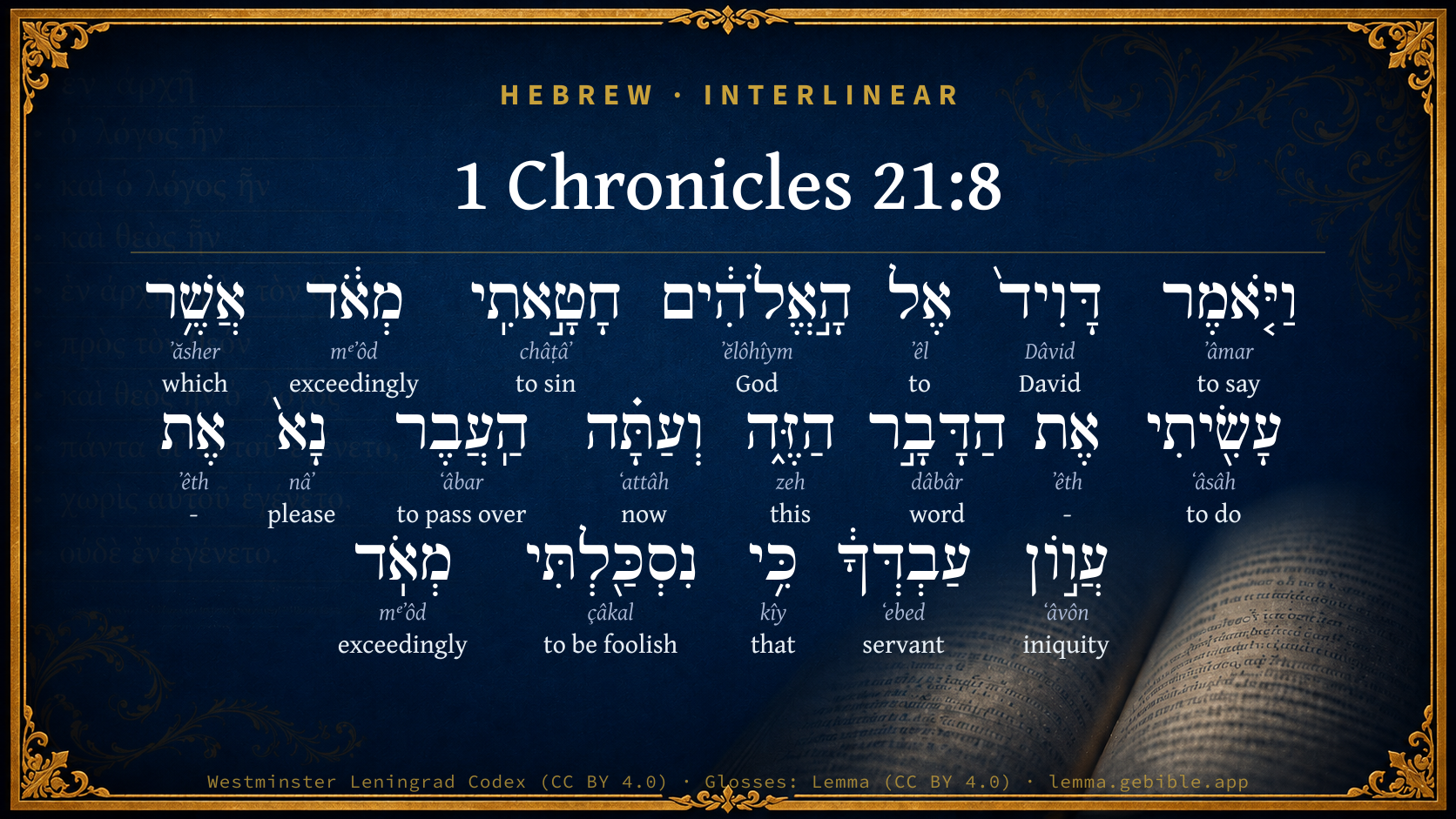
  1. וַיֹּ֤אמֶר ʼâmar H559 “and · to say” Conjunction + Verb, Qal, Sequential Imperfect, 3rd Person, Masculine, Singular
  2. דָּוִיד֙ Dâvid H1732 “David” Noun, Proper
  3. אֶל ʼêl H413 “to” Preposition
  4. הָ֣אֱלֹהִ֔ים ʼĕlôhîym H430 “the · God(s)” Particle, Definite Article + Noun, Common, Masculine, Plural, Absolute
  5. חָטָ֣אתִֽי châṭâʼ H2398 “to sin” Verb, Qal, Perfect, 1st Person, Common, Singular
  6. מְאֹ֔ד mᵉʼôd H3966 “exceedingly” Adverb
  7. אֲשֶׁ֥ר ʼăsher H834 “which” Particle, Relative
  8. עָשִׂ֖יתִי ʻâsâh H6213 “to do” Verb, Qal, Perfect, 1st Person, Common, Singular
  9. אֶת ʼêth H853 “-” Particle, Direct Object
  10. הַדָּבָ֣ר dâbâr H1697 “the · word” Particle, Definite Article + Noun, Common, Masculine, Singular, Absolute
  11. הַזֶּ֑ה zeh H2088 “the · this” Particle, Definite Article + Pronoun, Demonstrative, Masculine, Singular
  12. וְעַתָּ֗ה ʻattâh H6258 “and · now” Conjunction + Adverb
  13. הַֽעֲבֶר ʻâbar H5674 “pass over” Verb, Hiphil, Imperative, 2nd Person, Masculine, Singular
  14. נָא֙ nâʼ H4994 “please” Particle, Exhortation
  15. אֶת ʼêth H853 “-” Particle, Direct Object
  16. עֲו֣וֹן ʻâvôn H5771 “iniquity of” Noun, Common, Both, Singular, Construct
  17. עַבְדְּךָ֔ ʻebed H5650 “servant · your” Noun, Common, Masculine, Singular, Construct + Suffix, Personal, 2nd Person, Masculine, Singular
  18. כִּ֥י kîy H3588 “that” Conjunction
  19. מְאֹֽד mᵉʼôd H3966 “exceedingly” Adverb

About this verse

These counts appear in no published source. They are computed here, from the morphology-tagged text and Lemma’s own curated glosses. What Lemma adds →

20
words
18
distinct lemmas
Historical
section

Notable vocabulary

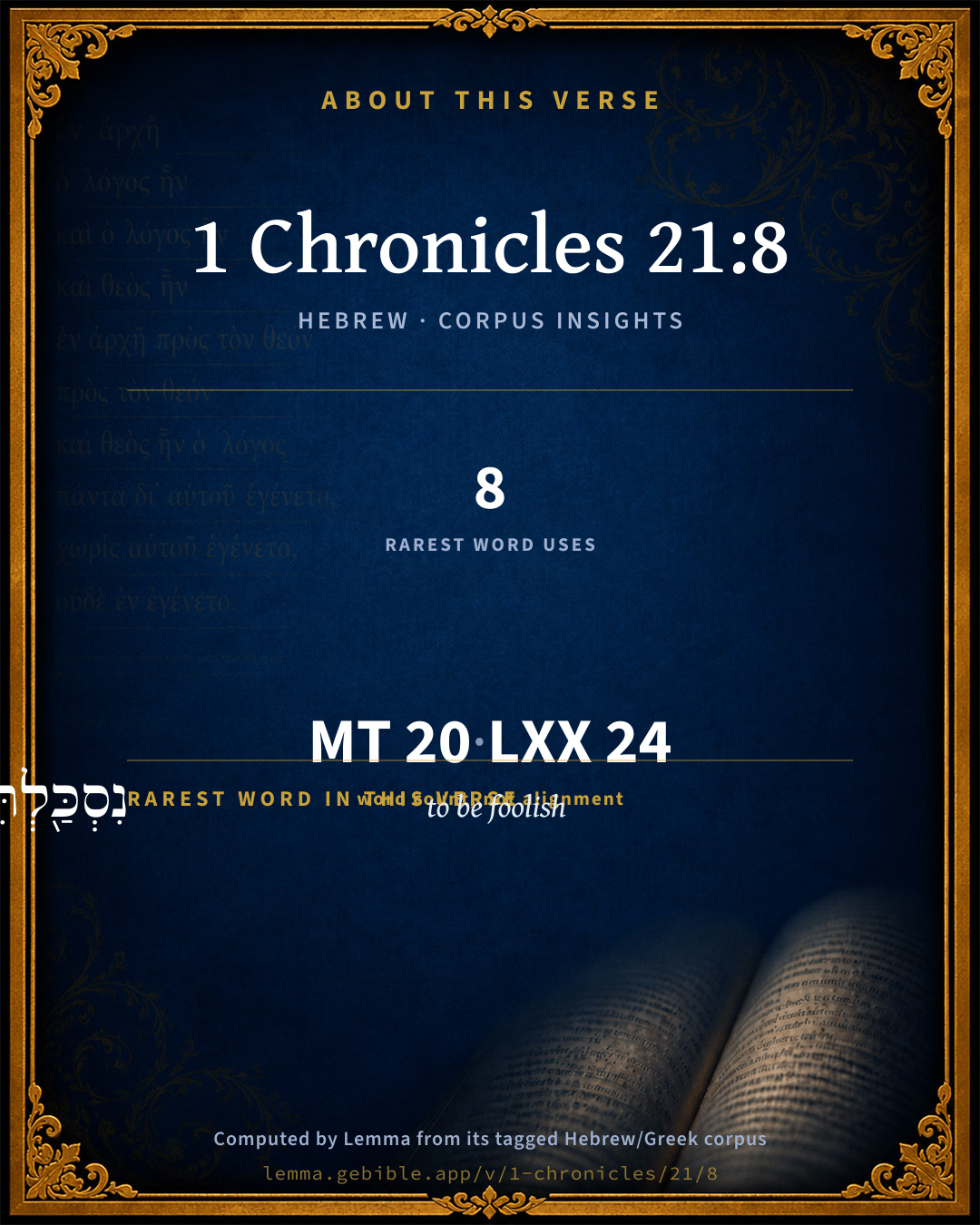
The rarest word here is נִסְכַּ֖לְתִּי to be foolish H5528 — appearing just 8 times in the whole Hebrew Bible.

Shared distinctive vocabulary

נִסְכַּ֖לְתִּי to be foolish H5528 occurs in 8 verses of the Hebrew Bible. Also found in:

Grammatical profile

  • 5 verbs
  • 5 nouns
  • 1 pronoun
  • 1 preposition
  • 1 conjunction
  • 3 adverbs
  • 4 particles

Verb forms

  • וַיֹּ֤אמֶר Qal · Sequential Imperfect
  • חָטָ֣אתִֽי Qal · Perfect
  • עָשִׂ֖יתִי Qal · Perfect
  • הַֽעֲבֶר Hiphil · Imperative
  • נִסְכַּ֖לְתִּי Niphal · Perfect

Repetition

A word recurs within this verse — often emphatic in Hebrew:

  • מְאֹ֔ד exceedingly H3966 ×2

Hebrew & Septuagint length

In English translation the verse runs 33 words from the Hebrew and 33 from the Septuagint (LXX English) — the same length.

A rough comparison of the two English renderings, which tokenize alike — not a word-level alignment.

Word counts can differ between the Hebrew and the Greek without any difference in meaning — e.g. the Hebrew direct-object marker אֵת has no separate Greek word, and Greek often adds the article ὁ.

In the original languages it is 20 Hebrew tokens and 24 Greek tokens — but the two are counted differently (Hebrew bundles its prefixes and suffixes into one token; the Greek is in lemma form), so that isn’t a like-for-like length.

Cross-references

15

Topical passages linked to 1 Chronicles 21:8 in the Treasury of Scripture Knowledge — connected by theme and wording, ordered by reader-vote popularity; previews shown in the World English Bible.

  • 2 Samuel 12:13 David said to Nathan, "I have sinned against Yahweh." Nathan said to David, "Yahweh also has put away your sin. You will not die.
  • Genesis 34:7 The sons of Jacob came in from the field when they heard it. The men were grieved, and they were very angry, because he had done folly in Israel in lying with Jacob's daughter; which thing ought not to be done.
  • 1 Samuel 13:13 Samuel said to Saul, You have done foolishly; you have not kept the commandment of Yahweh your God, which he commanded you: for now would Yahweh have established your kingdom on Israel forever.
  • 1 Samuel 26:21 Then said Saul, I have sinned: return, my son David; for I will no more do you harm, because my life was precious in your eyes this day: behold, I have played the fool, and have erred exceedingly.
  • 2 Samuel 13:13 I, where shall I carry my shame? and as for you, you will be as one of the fools in Israel. Now therefore, please speak to the king; for he will not withhold me from you.
  • 2 Samuel 24:10 David's heart struck him after that he had numbered the people. David said to Yahweh, I have sinned greatly in that which I have done: but now, Yahweh, put away, I beg you, the iniquity of your servant; for I have done very foolishly.
  • 2 Chronicles 10:9 He said to them, What counsel give you, that we may return answer to this people, who have spoken to me, saying, Make the yoke that your father did put on us lighter?
  • Psalms 25:11 For your name's sake, Yahweh, Pardon my iniquity, for it is great.
  • Psalms 32:5 I acknowledged my sin to you. I didn't hide my iniquity. I said, I will confess my transgressions to Yahweh, And you forgave the iniquity of my sin. Selah.
  • Psalms 51:1–3 Have mercy on me, God, according to your loving kindness. According to the multitude of your tender mercies, blot out my transgressions.
  • Jeremiah 3:13 Only acknowledge your iniquity, that you have transgressed against Yahweh your God, and have scattered your ways to the strangers under every green tree, and you have not obeyed my voice, says Yahweh.
  • Hosea 14:2 Take words with you, and return to Yahweh. Tell him, "Forgive all our sins, And accept that which is good: So we offer like bulls our lips.
  • Luke 15:18–19 I will get up and go to my father, and will tell him, "Father, I have sinned against heaven, and in your sight.
  • John 1:29 The next day, he saw Jesus coming to him, and said, "Behold, the Lamb of God, who takes away the sin of the world!
  • 1 John 1:9 If we confess our sins, he is faithful and righteous to forgive us the sins, and to cleanse us from all unrighteousness.

Cross-references courtesy of OpenBible.info (CC BY 4.0).

Hebrew and Greek witnesses Masoretic Hebrew ↔ Greek Septuagint

The same verse in the two great witnesses to the Old Testament, shown verse-for-verse.

These are two independent witnesses, not word-aligned to each other, and the Septuagint is shown in lemma (dictionary) form.

Hebrew 1 Chronicles 21:8 Masoretic · Westminster Leningrad Codex

וַיֹּ֤אמֶר דָּוִיד֙ אֶל הָ֣אֱלֹהִ֔ים חָטָ֣אתִֽי מְאֹ֔ד אֲשֶׁ֥ר עָשִׂ֖יתִי אֶת הַדָּבָ֣ר הַזֶּ֑ה וְעַתָּ֗ה הַֽעֲבֶר נָא֙ אֶת עֲו֣וֹן עַבְדְּךָ֔ כִּ֥י נִסְכַּ֖לְתִּי מְאֹֽד

David said to God, I have sinned greatly, in that I have done this thing: but now, put away, I beg you, the iniquity of your servant; for I have done very foolishly.

World English Bible · Public Domain

Greek LXX 1 Chronicles 21:8 Septuagint · lemma form

καί εἶπον δαυίδ πρός ὁ θεός ἁμαρτάνω σφόδρα ὅτι ποιέω ὁ πρᾶγμα οὗτος καί νῦν περιαἱρέω δή ὁ κακία παῖς σύ ὅτι ματαιόω σφόδρα

And David said to God, I have sinned exceedingly, in that I have done this thing: and now, I pray you, remove the sin of your servant; for I have been exceedingly foolish.

LXX2012 (modern English Septuagint) · Public Domain

Hebrew: Westminster Leningrad Codex (CC BY 4.0). Greek: Septuagint (public domain); English from LXX2012 (modern English Septuagint) (Public Domain). How the Septuagint differs from the Hebrew →

Commentary

Notes on 1 Chronicles 21:8 from classic Christian and Jewish commentators (each source and its license shown beneath its notes). The classic Christian expositions comment on the surrounding passage and are grouped to its opening verse, so a note may address several verses; the Jewish commentaries on the Tanakh (Rashi and others) are per-verse, so they appear only where the commentator wrote on this verse.

Lemma curates 59 commentaries, every one of them public domain or Creative Commons licensed, each selected and text-cleaned for this edition rather than reprinted as found. About our sources →

Trapp's Complete Commentary

John Trapp

1Ch 21:8 And David said unto God, I have sinned greatly, because I have done this thing: but now, I beseech thee, do away the iniquity of thy servant; for I have done very foolishly.

Ver. 8. {See Trapp on "2Sa 24:10"}

John Trapp, A Commentary or Exposition upon All the Books of the Old and New Testament (1647–1656) — public domain. Text from a community e-Sword module.

Joseph Benson's Commentary

1Ch 21:8. I have done very foolishly — I see plainly, and acknowledge, that I have been very foolish in thinking to found my security on the number of my people, instead of depending solely on thy almighty power and sovereign help.

Joseph Benson's Commentary on the Old and New Testaments (1811–1818) — public domain. Text from a community e-Sword module.

Ellicott's Commentary for English Readers

(8) And David said.—This verse is verbatim the same with its parallel, save that it makes the characteristic substitution of “God” for “Jehovah,” and adds the explanatory phrase “this thing” in the first half, and in the second omits the Divine Name altogether.

Do away.—Cause to pass over, and so away. David’s conscience misgave him in the night, before his interview with Gad. (See 2Sa_24:10-11.)

A Bible Commentary for English Readers, edited by Charles John Ellicott (1878–1897) — public domain. Text from a community e-Sword module.

The Cambridge Bible for Schools and Colleges

gen. ed. J. J. S. Perowne

8. do away the iniquity] Render perhaps, Remove the punishment; cp. Gen_4:13, R.V. with marg.

The Cambridge Bible for Schools and Colleges (gen. ed. J. J. S. Perowne; Cambridge University Press, 1878–1918) — public domain. Text from a community e-Sword module.

Haydock's Catholic Bible Commentary

Iniquity. David was guilty, though he retained both faith and hope. (Worthington)

George Leo Haydock (1774–1849), Haydock's Catholic Family Bible and Commentary, 1859 edition — public domain. Excludes Psalms (Douay-Rheims chapter numbering differs from Protestant) and Deuterocanonical books (Catholic canon only).

The Pulpit Commentary

Contrition.

David was a man who both sinned grievously and repented bitterly. If we have nowhere more striking examples than in his life of human frailty, we have nowhere more than in his recorded experience an example of anguish and of penitence for sin. Witness the state of mind manifested in the fifty-first psalm. We have in this most touching verse

I CONFESSION OF SIN. This language may be regarded as a model of sincerely uttered confession.

1. It was offered to God. "David said unto God." So in Psalm 51., Against thee, thee only, have I sinned." Not against society, not against the state; but against the Searcher of hearts and the Judge of all.

2. It was a taking to himself of the guilt. "1 have sinned." Instead of layingthe blame upon another, the king accepted it for himself. It is a sad thing when men take excuses into the presence of God.

3. David had a just sense of the heinousness of his sin. He felt that he hadsinned greatly. It was not in his view a light thing of which he had been guilty. How can we, as Christians, regard sin as a light matter, when we remember that sin brought our holy Saviour, the Lord of glory, to the ignominious cross?

4. The folly of sin was very apparent to David"s mind when he poured outhis soul in contrite confessions before the Lord. "I have done very foolishly.

II ENTREATY FOR PARDON. It would be a sad case, indeed, if, when the sinner acknowledged his errors and faults, he did so with no hope or expectation of grace and forgiveness. But David knew that God was a God delighting in mercy and ready to forgive. Accordingly he added to his confession this entreaty: "I beseech thee, do away the iniquity of thy servant." What abundant encouragement have we to present a prayer like this! The revelation of God"s character, the provision of a Divine Redeemer, the promises of a welcome gospel, all alike induce us to come unto God in the attitude, not only of sinners, but of suppliants, beseeching of him a favourable reception, and the extension to us as sinners of his clemency and grace. T.

Vers. 8-13.

The human and the Divine in the hour of penitence.

We have illustrated here

I THE HUMAN APPROACH TO GOD in the hour of penitence. "David said unto God, I have sinned greatly, because I have done this thing: but now, I beseech thee, do away the iniquity of thy servant," etc. (ver. 8). Here is, what there ever should be,

(1) a deep sense of sin in the soul;

(2) a frank admission of guilt, in word;

(3) a prayer that it may be put away, or forgiven;

(4) an intention to put it away from our own heart and life.

II THE DIVINE OVERTURE TO MAN. God met the attitude of his penitent servant with forgiveness and a penalty. Thus he met David"s penitence before. "David said I have sinned against the Lord. And Nathan said unto David, The Lord hath put away thy sin; thou shalt not die. Howbeit the child shall surely die". (2Sa_12:13, 2Sa_12:14) On the present occasion God offered David his mercy (not, indeed, expressed, but clearly understood), accompanied by a penalty in respect of which he might exercise his own judgment. In the choice which Jehovah thus offered David there was something exceptional. In his dealing with mankind God does, indeed, give us the one alternative of going on in sin with utter ruin at the end of it, or repentance and forgiveness with some penalty to be paid for past offences; but this is the only option he gives us. If we come to him, like David, penitently and trustfully, owning transgression, and pleading for mercy through Jesus Christ, he will reinstate us in our forfeited position, he will pardon and accept us as his reconciled children, and he will require of us that we suffer the necessary and inevitable consequences of our past misdeeds. If we have wasted our youth in folly, he gives us a regenerated and holy manhood and age, but he condemns us to go forward with a sense that we have lost for ever a large portion of the opportunity of life. If we have injured our health, enfeebled our intellect, and impaired our moral and spiritual force by guilty indulgences, he grants us his mercy and a cleansed and purified future, but he sends us on our way with a lessened manhood and talents reduced that should have been multiplied and enlarged. If we have thrown away the esteem and affection of the wise and holy, he receives us, when penitent, into the embrace of his Divine affection, but he makes us pay the penalty of our folly by climbing slowly up the steeps of regained reputation and of renewed confidence and love. Forgiveness, not unattended with inevitable penalty, that is the overture of God to the repentant sinner. In the penalty we pay there is no choice allowed us. The moral laws of the universe are simply not inverted or annulled; they do their work upon and within us: only with his pardoning love comes his Divine grace to enable us to endure, and to give us the victory in the strife.

III THE HUMAN RECEPTION OF THE DIVINE OFFER. The spirit of David was one of holy submission; he said, "Let me fall now into the hand of the Lord; for very great are his mercies" (ver. 13). In the acceptance of the overture and in the choice which he made, David expressed a devout and obedient disposition. This is to be our spirit also. We are

(1) gratefully to accept the mercy of the Lord;

(2) cheerfully to bear whatever penalty the guilty past may carry on into the near future;

(3) gladly to believe that the further future will free us from all consequences of sin, and hold nothing in its hand but Divine grace and goodness. C.

The Pulpit Commentary (1880–1919), ed. H.D.M. Spence-Jones & Joseph S. Exell — public domain. Text from a community e-Sword module.

Rashi

Rabbi Shlomo Yitzchaki (Rashi)

and now, please put aside the iniquity of Your servant - Heb. עֲווֹן. This עֲווֹן is written with the plene spelling, with two “vavim,” i.e., please put aside the full iniquity that I committed. This word is written with the plene spelling in four places in Scripture, and this is one of them. The second is in Psalms (51:7): “Behold with iniquity (בְּעָווֹן) I was formed,” as it is explained in Leviticus Rabbah (14:5), in the section entitled: (Lev. 12:2): “If a woman conceives seed: Even if one be the most pious of the pious, it is impossible that he should have no streak of unintentional iniquity, because he intended only for his own pleasure.” The third is (Prov. 5:22): “His iniquities (עֲווֹנוֹתָיו) shall trap the wicked man,” meaning his many iniquities. The fourth is in II Kings (7:9): “... we will incur guilt (עָווֹן). Now let us go and come and relate this in the king’s palace.” They said, “If we do not go and tell this in the king’s palace, it will be a grave iniquity, because enemies will come upon them.”

Rashi on the Tanakh — English translations: “The Judaica Press complete Tanach with Rashi, translated by A. J. Rosenberg” (CC BY 4.0); “Pentateuch with Rashi's commentary by M. Rosenbaum and A.M. Silbermann, 1929-1934” (public domain); “The Metsudah Tanach series, Lakewood, N.J” (CC BY 4.0); and “The Book of Joshua, Metsudah Publications, 1997” (CC BY 4.0). Text via Sefaria.

Lesson kit

Teaching starters — assembled from the data on this page, not authored interpretation. Every prompt links to the verse data it draws on. Edit before teaching.

1 Chronicles, in the Historical, opens this verse with 20 words (18 distinct Hebrew lemmas). Its most distinctive word is çâkal (“to be foolish”). A historical commentator’s framing appears above. Read the whole chapter for the surrounding context.

Discussion questions

  1. What does “to be foolish” (çâkal) contribute to the verse as a whole?
  2. Genesis 31:28 shares the word «to be foolish» with this verse. How do the two illuminate each other?
  3. “exceedingly” occurs 2× in this one verse. What is the effect of the repetition?
  4. The translations on this page render this verse differently — a whole-verse word diff, not a word-by-word alignment. What might account for the different wordings?
  5. The verb «וַיֹּ֤אמֶר» is Qal Sequential Imperfect. How does its form color the action?
  6. Reading how Trapp's Complete Commentary and Joseph Benson's Commentary read this verse, where do the two commentators agree and where do they part?

Things to notice

Reading settings

Reading text

Shown beneath each verse's original-language words.

Old Testament
Old Testament edition

Read the OT as the Masoretic Hebrew (MT) or the Greek Septuagint (LXX).

English shown for the Greek Septuagint (in the Hebrew ↔ Greek comparison).

Comparing translations? Open the Compare panel on any verse page to stack up to four side by side.