
2 Chronicles 35:3

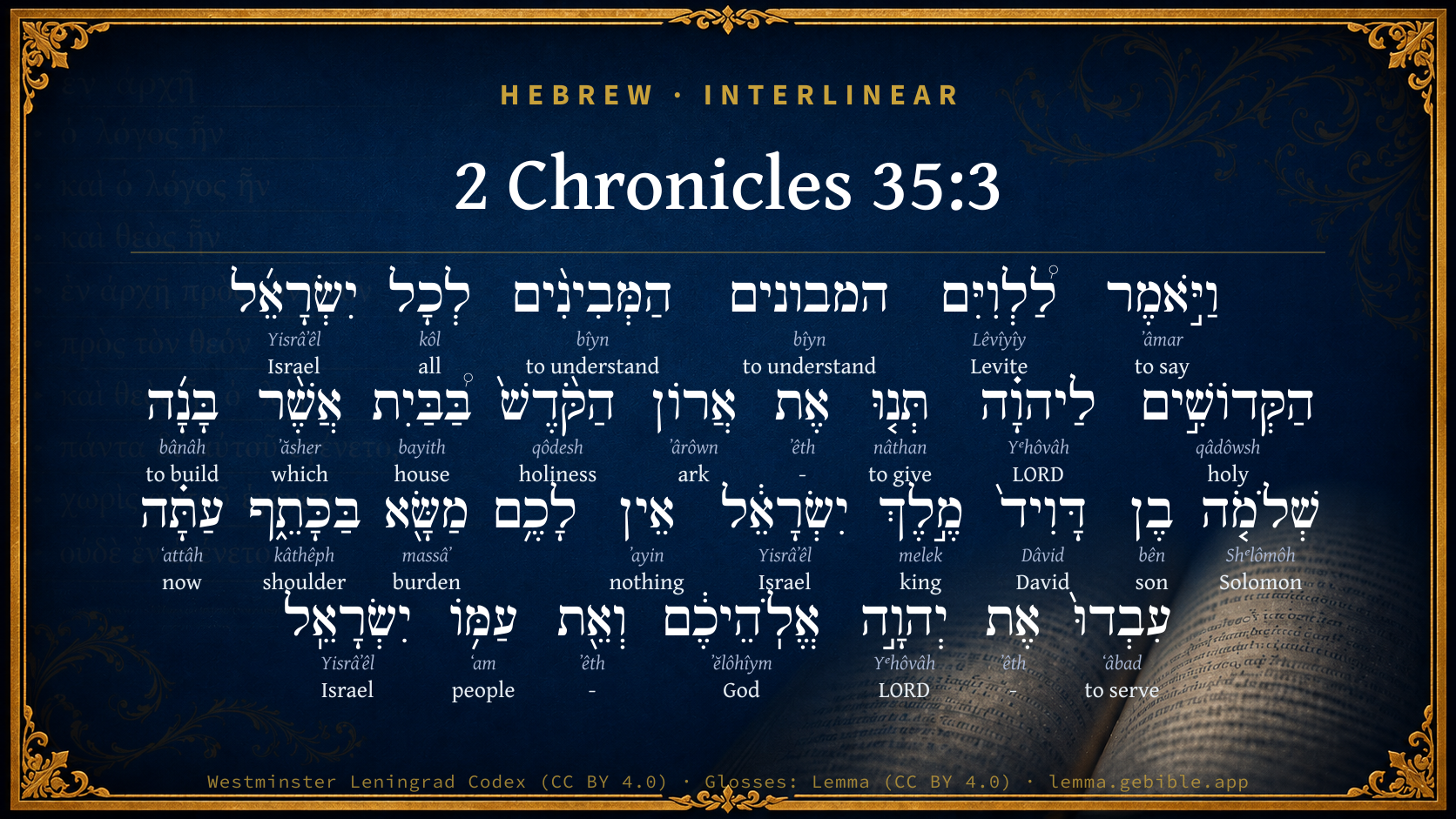
Hebrew (Westminster Leningrad Codex) 2 Chronicles 35:3 appears in the Hebrew Old Testament. The text above is from the Westminster Leningrad Codex. Each word links to its Strong’s number, a concise gloss, and parsing drawn from the Open Scriptures Hebrew Bible morphology. Click any word for its full Brown-Driver-Briggs (BDB) entry.
Download image
Cite this verse

2 Chronicles 35:3 (World English Bible). Public Domain. Lemma interlinear Bible study tool, https://lemma.gebible.app/v/2-chronicles/35/3.

Show BibTeX & RIS
BibTeX
RIS
English Translation
He said to the Levites who taught all Israel, who were holy to Yahweh, Put the holy ark in the house which Solomon the son of David king of Israel did build; there shall no more be a burden on your shoulders: now serve Yahweh your God, and his people Israel.
World English Bible · Public Domain
Download a study sheet

One document with this verse’s original text, its word-by-word gloss line, the meaning frame, cross-references with their text, attributed commentary, and full source and license credits — printable, and it pastes into notes with its structure intact.

This verse Autodidact and up

Study sheet (.html) Plain text (.txt)

A passage Seminary Student

Up to 50 verses in one chapter. A passage sheet keeps up to 6 commentary sources and 12 cross-references per verse, in the order this page ranks them, and says so on the sheet whenever that leaves anything out. Ask for a single verse and you get the Autodidact verse sheet above.

Everything on this page stays free to read, with no account — the sheet is a download of what is already on screen, not access to it.

Want to remove ads? Support Godless Engineer
Compare translations 3

The same verse in 3 English versions, stacked beneath the original-language interlinear above. Click any original word for its lexicon entry.

Each is an independent rendering of the whole verse — the interlinear is not word-aligned to these translations.

Highlighted words mark where these versions differ — a whole-verse word diff, not a word-by-word alignment.

  • World English Bible Public Domain
    He said to the Levites who taught all Israel, who were holy to Yahweh, Put the holy ark in the house which Solomon the son of David king of Israel did build; there shall no more be a burden on your shoulders: now serve Yahweh your God, and his people Israel.
  • King James Version Public Domain
    And said unto the Levites that taught all Israel, which were holy unto the LORD, Put the holy ark in the house which Solomon the son of David king of Israel did build; it shall not be a burden upon your shoulders: serve now the LORD your God, and his people Israel,
  • unfoldingWord Literal Text CC BY-SA 4.0
    And he said to the Levites who are teaching all Israel, who are sacred to Yahweh, “Place the Holy Box in the house that Solomon, the son of David, the king of Israel built; not to you all a burden on your shoulder. Now serve Yahweh your God and his people Israel.

unfoldingWord Literal Text — © unfoldingWord, licensed CC BY-SA 4.0. Word-aligned USFM3 via Door43 (git.door43.org/unfoldingWord/en_ult).

Versions to compare (up to 4)

3 of 4 selected

Show all 18 translations

Every available English version of this verse, each an independent rendering of the whole verse.

  • World English Bible Public Domain
    He said to the Levites who taught all Israel, who were holy to Yahweh, Put the holy ark in the house which Solomon the son of David king of Israel did build; there shall no more be a burden on your shoulders: now serve Yahweh your God, and his people Israel.
  • Berean Standard Bible Public Domain
    To the Levites who taught all Israel and were holy to the LORD, Josiah said: “Put the holy ark in the temple built by Solomon son of David king of Israel. It is not to be carried around on your shoulders. Now serve the LORD your God and His people Israel.
  • Majority Standard Bible Public Domain
    To the Levites who taught all Israel and were holy to the LORD, Josiah said: “Put the holy ark in the temple built by Solomon son of David king of Israel. It is not to be carried around on your shoulders. Now serve the LORD your God and His people Israel.
  • King James Version Public Domain
    And said unto the Levites that taught all Israel, which were holy unto the LORD, Put the holy ark in the house which Solomon the son of David king of Israel did build; it shall not be a burden upon your shoulders: serve now the LORD your God, and his people Israel,
  • American Standard Version (1901) Public Domain
    And he said unto the Levites that taught all Israel, that were holy unto Jehovah, Put the holy ark in the house which Solomon the son of David king of Israel did build; there shall no more be a burden upon your shoulders: now serve Jehovah your God, and his people Israel.
  • Revised Version (1885) Public Domain
    And he said unto the Levites that taught all Israel, which were holy unto the LORD, Put the holy ark in the house which Solomon the son of David king of Israel did build; there shall no more be a burden upon your shoulders: now serve the LORD your God, and his people Israel.
  • Geneva Bible (1599) Public Domain
    And he sayd vnto the Leuites that taught all Israel and were sanctified vnto the Lord, Put the holy Arke in the house which Salomon the sonne of Dauid King of Israel did build: it shalbe no more a burden vpon your shoulders: serue now the Lord your God and his people Israel,
  • Douay-Rheims (1899) Public Domain
    And he spoke to the Levites, by whose instruction all Israel was sanctified to the Lord, saying: Put the ark in the sanctuary of the temple, which Solomon the son of David king of Israel built: for you shall carry it no more: but minister now to the Lord your God, and to his people Israel.
  • Young's Literal Translation Public Domain
    and saith to the Levites -- who are teaching all Israel -- who are sanctified to Jehovah, `Put the holy ark in the house that Solomon son of David king of Israel built; it is not to you a burden on the shoulder. `Now, serve Jehovah your God, and His people Israel,
  • Literal Standard Version CC BY-SA 4.0
    and says to the Levites who are teaching all Israel, who are sanctified to YHWH, “Put the holy Ark in the house that Solomon son of David, king of Israel, built; it is not a burden on the shoulder to you. Now serve your God YHWH and His people Israel,
  • Unlocked Literal Bible CC BY-SA 4.0
    He said to the Levites who taught all Israel and who were set apart to Yahweh, “Put the holy ark in the house that Solomon son of David, king of Israel built. Do not carry it around on your shoulders any longer. Now worship Yahweh your God, and serve his people Israel.
  • unfoldingWord Literal Text CC BY-SA 4.0
    And he said to the Levites who are teaching all Israel, who are sacred to Yahweh, “Place the Holy Box in the house that Solomon, the son of David, the king of Israel built; not to you all a burden on your shoulder. Now serve Yahweh your God and his people Israel.
  • Darby Bible Public Domain
    And he said to the Levites, that taught all Israel, [and] who were holy to Jehovah, Put the holy ark in the house that Solomon the son of David, king of Israel, built; ye have not to carry it upon your shoulders. Serve now Jehovah your God, and his people Israel;
  • World Messianic Bible Public Domain
    He said to the Levites who taught all Israel, who were holy to the LORD, “Put the holy ark in the house which Solomon the son of David king of Israel built. It will no longer be a burden on your shoulders. Now serve the LORD your God and his people Israel.
  • Webster's Bible Public Domain
    And said to the Levites that taught all Israel, who were holy to the LORD, Put the holy ark in the house which Solomon the son of David king of Israel built; it shall not be a burden upon your shoulders: serve now the LORD your God, and his people Israel,
  • Free Bible Version CC BY-SA 4.0
    Josiah told the Levites who taught all Israel and were holy to the Lord, “Place the holy Ark in the Temple built by Solomon, son of David, king of Israel. It's not necessary for you to carry it around on your shoulders any more. Your responsibility now is to serve the Lord your God and his people Israel.
  • Bible in Basic English Public Domain
    And he said to the Levites, the teachers of all Israel, who were holy to the Lord, See, the holy ark is in the house which Solomon, the son of David, king of Israel, made; it will no longer have to be transported on your backs: now be the servants of the Lord your God and his people Israel,
  • JPS Tanakh (1917) Public Domain
    And he said unto the Levites that taught all Israel, that were holy unto the LORD: 'Put the holy ark in the house which Solomon the son of David king of Israel did build; there shall no more be a burden upon your shoulders; now serve the LORD your God, and His people Israel.

Literal Standard Version (2020), Covenant Press — licensed CC BY-SA 4.0. Text via the HelloAO Bible API (eBible.org). Unlocked Literal Bible (unfoldingWord) — licensed CC BY-SA 4.0. Text via the HelloAO Bible API (eBible.org). unfoldingWord Literal Text — © unfoldingWord, licensed CC BY-SA 4.0. Word-aligned USFM3 via Door43 (git.door43.org/unfoldingWord/en_ult). Free Bible Version, Dr. Jonathan Gallagher — licensed CC BY-SA 4.0. Text via the HelloAO Bible API (eBible.org).

Word by word

More ways to search: Search by grammar → Find every occurrence → Compare this word →

Practice this passage: Drill this verse → Learn its vocabulary →

מַשָּׂ֖א
massâʼ
H4853
“burden”
Noun, Common, Masculine, Singular, Absolute
Part of Speech
Noun
Type
Common
Gender
Masculine
Number
Singular
State
Absolute
Full BDB Definition

Origin: from H5375

TWOT: 1421d , 1421e

Massa = "burden" - load, bearing, tribute, burden, lifting (noun masculine) - load, burden - lifting, uplifting, that to which the soul lifts itself up - bearing, carrying - tribute, that which is carried or brought or borne - utterance, oracle, burden (noun masculine) - a son of Ishmael (noun proper masculine)
  1. וַיֹּ֣אמֶר ʼâmar H559 “and · to say” Conjunction + Verb, Qal, Sequential Imperfect, 3rd Person, Masculine, Singular
  2. לַ֠לְוִיִּם Lêvîyîy H3881 “to/for the · Levites” Preposition, Determined + Noun, Gentilic, Masculine, Plural, Absolute
  3. המבונים bîyn H995 “the · understanding” Particle, Definite Article + Verb, Hiphil, Participle Active, Masculine, Plural, Absolute
  4. הַמְּבִינִ֨ים bîyn H995 “the · understanding” Particle, Definite Article + Verb, Hiphil, Participle Active, Masculine, Plural, Absolute
  5. לְכָל kôl H3605 “to/for · all of” Preposition + Noun, Common, Masculine, Singular, Construct
  6. יִשְׂרָאֵ֜ל Yisrâʼêl H3478 “Israel” Noun, Proper
  7. הַקְּדוֹשִׁ֣ים qâdôwsh H6918 “the · holy” Particle, Definite Article + Adjective, Adjective, Masculine, Plural, Absolute
  8. לַיהוָ֗ה Yᵉhôvâh H3068 “to/for · LORD” Preposition + Noun, Proper
  9. תְּנ֤וּ nâthan H5414 “give” Verb, Qal, Imperative, 2nd Person, Masculine, Plural
  10. אֶת ʼêth H853 “-” Particle, Direct Object
  11. אֲרוֹן ʼârôwn H727 “ark of” Noun, Common, Both, Singular, Construct
  12. הַקֹּ֨דֶשׁ֙ qôdesh H6944 “the · holiness” Particle, Definite Article + Noun, Common, Masculine, Singular, Absolute
  13. בַּ֠בַּיִת bayith H1004 “in/at the · house” Preposition, Determined + Noun, Common, Masculine, Singular, Absolute
  14. אֲשֶׁ֨ר ʼăsher H834 “which” Particle, Relative
  15. בָּנָ֜ה bânâh H1129 “to build” Verb, Qal, Perfect, 3rd Person, Masculine, Singular
  16. שְׁלֹמֹ֤ה Shᵉlômôh H8010 “Solomon” Noun, Proper
  17. בֶן bên H1121 “son of” Noun, Common, Masculine, Singular, Construct
  18. דָּוִיד֙ Dâvid H1732 “David” Noun, Proper
  19. מֶ֣לֶךְ melek H4428 “king of” Noun, Common, Masculine, Singular, Construct
  20. יִשְׂרָאֵ֔ל Yisrâʼêl H3478 “Israel” Noun, Proper
  21. אֵין ʼayin H369 “nothing” Particle, Negative
  22. בַּכָּתֵ֑ף kâthêph H3802 “in/at the · shoulder” Preposition, Determined + Noun, Common, Feminine, Singular, Absolute
  23. עַתָּ֗ה ʻattâh H6258 “now” Adverb
  24. עִבְדוּ֙ ʻâbad H5647 “serve” Verb, Qal, Imperative, 2nd Person, Masculine, Plural
  25. אֶת ʼêth H853 “-” Particle, Direct Object
  26. יְהוָ֣ה Yᵉhôvâh H3068 “LORD” Noun, Proper
  27. אֱלֹֽהֵיכֶ֔ם ʼĕlôhîym H430 “God(s) · your” Noun, Common, Masculine, Plural, Construct + Suffix, Personal, 2nd Person, Masculine, Plural
  28. וְאֵ֖ת ʼêth H853 “and · -” Conjunction + Particle, Direct Object
  29. עַמּ֥וֹ ʻam H5971 “people · his” Noun, Common, Masculine, Singular, Construct + Suffix, Personal, 3rd Person, Masculine, Singular
  30. יִשְׂרָאֵֽל Yisrâʼêl H3478 “Israel” Noun, Proper

About this verse

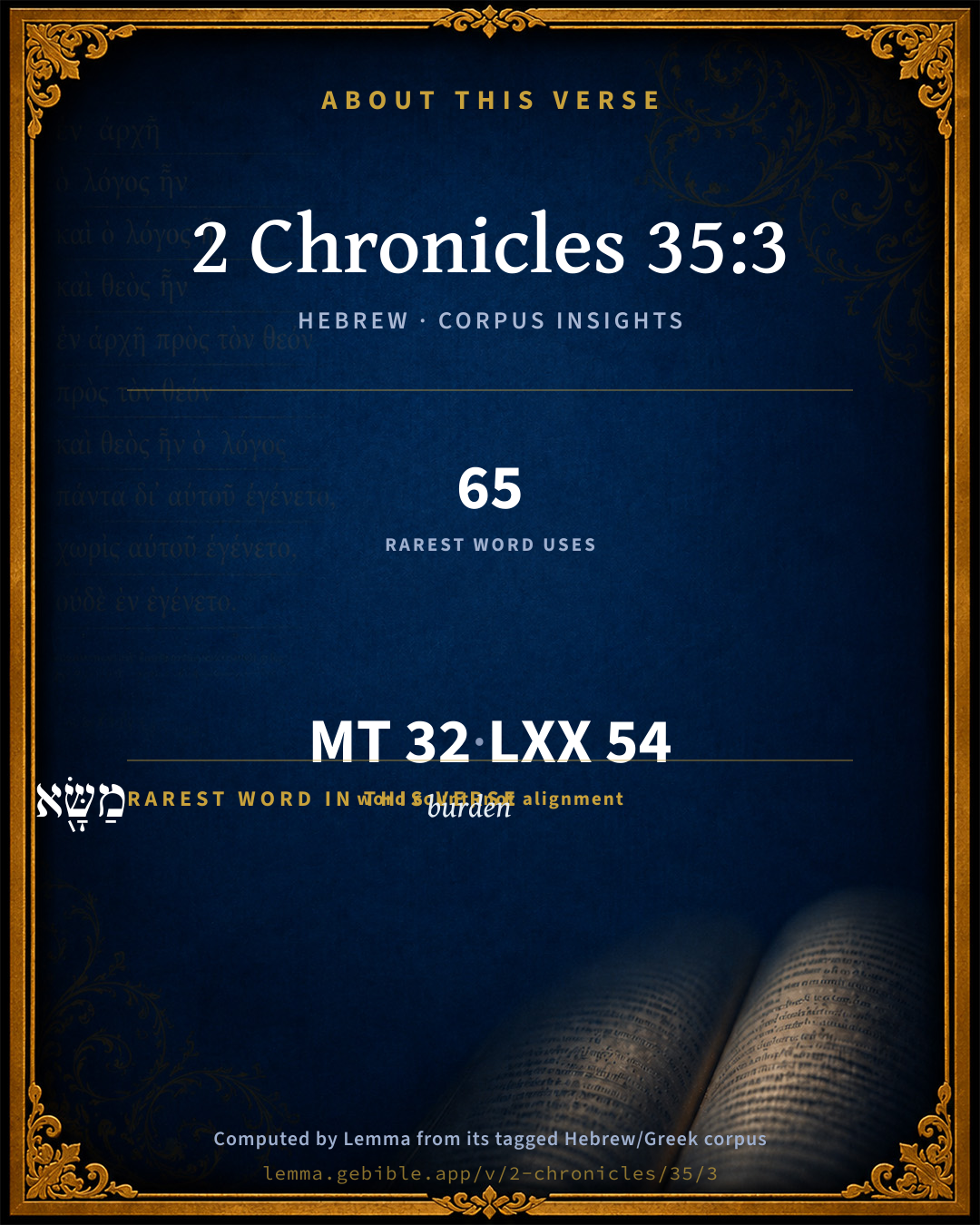
These counts appear in no published source. They are computed here, from the morphology-tagged text and Lemma’s own curated glosses. What Lemma adds →

32
words
25
distinct lemmas
Historical
section

Grammatical profile

  • 6 verbs
  • 18 nouns
  • 1 adjective
  • 1 preposition
  • 1 adverb
  • 5 particles

Verb forms

  • וַיֹּ֣אמֶר Qal · Sequential Imperfect
  • המבונים Hiphil · Participle Active
  • הַמְּבִינִ֨ים Hiphil · Participle Active
  • תְּנ֤וּ Qal · Imperative
  • בָּנָ֜ה Qal · Perfect
  • עִבְדוּ֙ Qal · Imperative

Repetition

Words recur within this verse — often emphatic in Hebrew:

  • יִשְׂרָאֵ֜ל Israel H3478 ×3
  • המבונים to understand H995 ×2
  • לַיהוָ֗ה LORD H3068 ×2

Hebrew & Septuagint length

In English translation the verse runs 51 words from the Hebrew and 65 from the Septuagint (LXX English) — closely comparable.

A rough comparison of the two English renderings, which tokenize alike — not a word-level alignment.

Word counts can differ between the Hebrew and the Greek without any difference in meaning — e.g. the Hebrew direct-object marker אֵת has no separate Greek word, and Greek often adds the article ὁ.

In the original languages it is 32 Hebrew tokens and 54 Greek tokens — but the two are counted differently (Hebrew bundles its prefixes and suffixes into one token; the Greek is in lemma form), so that isn’t a like-for-like length.

Cross-references

13

Topical passages linked to 2 Chronicles 35:3 in the Treasury of Scripture Knowledge — connected by theme and wording, ordered by reader-vote popularity; previews shown in the World English Bible.

  • 1 Chronicles 23:26 and also the Levites shall no more have need to carry the tent and all the vessels of it for the service of it.
  • Deuteronomy 33:10 They shall teach Jacob your ordinances, Israel your law: They shall put incense before you, Whole burnt offering on your altar.
  • 2 Chronicles 17:8–9 and with them the Levites, even Shemaiah, and Nethaniah, and Zebadiah, and Asahel, and Shemiramoth, and Jehonathan, and Adonijah, and Tobijah, and Tob-adonijah, the Levites; and with them Elishama and Jehoram, the priests.
  • 2 Chronicles 30:22 Hezekiah spoke comfortably to all the Levites who had good understanding [in the service] of Yahweh. So they ate throughout the feast for the seven days, offering sacrifices of peace-offerings, and making confession to Yahweh, the God of their fathers.
  • Malachi 2:7 For the priest's lips should keep knowledge, and they should seek the law at his mouth; for he is the messenger of Yahweh of Hosts.
  • Numbers 16:9–10 [seems it but] a small thing to you, that the God of Israel has separated you from the congregation of Israel, to bring you near to himself, to do the service of the tent of Yahweh, and to stand before the congregation to minister to them;
  • 2 Chronicles 5:7 The priests brought in the ark of the covenant of Yahweh to its place, into the oracle of the house, to the most holy place, even under the wings of the cherubim.
  • 2 Corinthians 4:5 For we don't preach ourselves, but Christ Jesus as Lord, and ourselves as your servants for Jesus' sake;
  • Numbers 4:15–49 "When Aaron and his sons have finished covering the sanctuary, and all the furniture of the sanctuary, as the camp moves forward; after that, the sons of Kohath shall come to carry it: but they shall not touch the sanctuary, lest they die. These things are the burden of the sons of Kohath in the Tent of Meeting.
  • Numbers 8:19 I have given the Levites as a gift to Aaron and to his sons from among the children of Israel, to do the service of the children of Israel in the Tent of Meeting, and to make atonement for the children of Israel; that there be no plague among the children of Israel, when the children of Israel come near to the sanctuary."
  • 2 Chronicles 8:11 Solomon brought up the daughter of Pharaoh out of the city of David to the house that he had built for her; for he said, My wife shall not dwell in the house of David king of Israel, because the places are holy, whereunto the ark of Yahweh has come.
  • 2 Chronicles 34:14 When they brought out the money that was brought into the house of Yahweh, Hilkiah the priest found the book of the law of Yahweh [given] by Moses.
  • Nehemiah 8:7–8 Also Jeshua, and Bani, and Sherebiah, Jamin, Akkub, Shabbethai, Hodiah, Maaseiah, Kelita, Azariah, Jozabad, Hanan, Pelaiah, and the Levites, caused the people to understand the law: and the people [stood] in their place.

Cross-references courtesy of OpenBible.info (CC BY 4.0).

Hebrew and Greek witnesses Masoretic Hebrew ↔ Greek Septuagint

The same verse in the two great witnesses to the Old Testament, shown verse-for-verse.

These are two independent witnesses, not word-aligned to each other, and the Septuagint is shown in lemma (dictionary) form.

Hebrew 2 Chronicles 35:3 Masoretic · Westminster Leningrad Codex

וַיֹּ֣אמֶר לַ֠לְוִיִּם המבונים הַמְּבִינִ֨ים לְכָל יִשְׂרָאֵ֜ל הַקְּדוֹשִׁ֣ים לַיהוָ֗ה תְּנ֤וּ אֶת אֲרוֹן הַקֹּ֨דֶשׁ֙ בַּ֠בַּיִת אֲשֶׁ֨ר בָּנָ֜ה שְׁלֹמֹ֤ה בֶן דָּוִיד֙ מֶ֣לֶךְ יִשְׂרָאֵ֔ל אֵין לָכֶ֥ם מַשָּׂ֖א בַּכָּתֵ֑ף עַתָּ֗ה עִבְדוּ֙ אֶת יְהוָ֣ה אֱלֹֽהֵיכֶ֔ם וְאֵ֖ת עַמּ֥וֹ יִשְׂרָאֵֽל

He said to the Levites who taught all Israel, who were holy to Yahweh, Put the holy ark in the house which Solomon the son of David king of Israel did build; there shall no more be a burden on your shoulders: now serve Yahweh your God, and his people Israel.

World English Bible · Public Domain

Greek LXX 2 Chronicles 35:3 Septuagint · lemma form

καί εἶπον ὁ λευείτης ὁ δυνατός ἐν πᾶς ἰσραήλ ὁ ἁγιάζω αὐτός ὁ κύριος καί τίθημι ὁ κιβωτός ὁ ἅγιος εἰς ὁ οἶκος ὅς οἰκοδομέω σαλωμών υἱός δαυίδ ὁ βασιλεύς ἰσραήλ καί εἶπον ὁ βασιλεύς οὐ εἰμί σύ αἴρω ἐπί ὦμος οὐδείς νῦν οὖν λειτουργέω ὁ κύριος θεός σύ καί ὁ λαός αὐτός ἰσραήλ

And he told the Levites that were able to act in all Israel, that they should consecrate themselves to the Lord: and they put the holy ark in the house which Solomon the son of David king of Israel built: and the king said, You⌃ must not carry anything on your shoulders: now then minister to the Lord your God, and to his people Israel.

LXX2012 (modern English Septuagint) · Public Domain

Hebrew: Westminster Leningrad Codex (CC BY 4.0). Greek: Septuagint (public domain); English from LXX2012 (modern English Septuagint) (Public Domain). How the Septuagint differs from the Hebrew →

Commentary

Notes on 2 Chronicles 35:3 from classic Christian and Jewish commentators (each source and its license shown beneath its notes). The classic Christian expositions comment on the surrounding passage and are grouped to its opening verse, so a note may address several verses; the Jewish commentaries on the Tanakh (Rashi and others) are per-verse, so they appear only where the commentator wrote on this verse.

Lemma curates 59 commentaries, every one of them public domain or Creative Commons licensed, each selected and text-cleaned for this edition rather than reprinted as found. About our sources →

Trapp's Complete Commentary

John Trapp

2Ch 35:3 And said unto the Levites that taught all Israel, which were holy unto the LORD, Put the holy ark in the house which Solomon the son of David king of Israel did build; [it shall] not [be] a burden upon [your] shoulders: serve now the LORD your God, and his people Israel,

Ver. 3. Put the holy ark in the house.] Heb., The ark of holiness: therefore that ark or chest is not here meant, wherein were put the collection moneys, as some would have it, but the ark of the covenant: which might be put out of its place in the days of his wicked father Amon, to make way for some idol in its room. He might remember, saith Cajetan, what damage had been done to the Philistines, when the ark stood by Dagon. The Hebrews tell us, that the priests in those idolatrous times had carried the holy ark out of the temple - that it might not stand there among those heathenish idols - and conveyed it to the house of Shallum, who was uncle to the prophet Jeremiah, and husband to the prophetess Huldah, {2Ch 34:22} and that therefore Josiah sent to her to consult with the Lord for him.

It shall not be a burden upon your shoulders,] q.d., You are eased of that burden; {1Ki 8:6} therefore,

Serve now the Lord your God, &c.] Employ yourselves so much the more freely and vigorously in this other part of your service. {1Ch 23:26}

John Trapp, A Commentary or Exposition upon All the Books of the Old and New Testament (1647–1656) — public domain. Text from a community e-Sword module.

Joseph Benson's Commentary

2Ch 35:3. That taught all Israel which were holy — That is, the Levites were holy unto the Lord. And therefore it may be rendered, and were holy, &c., that is, peculiarly dedicated to this service, of ministering to the priests, and instructing the people. Put the holy ark in the house, &c. — It appears from this that the ark had been removed from its place; but by whom or when cannot now be said. It shall not be a burden upon your shoulders — That is, hereafter. For they were to carry it to a settled place, there to remain: and then they would be obliged to bear it no further on their shoulders, as they had done before it was fixed in the temple. Serve now the Lord, &c. — Ministers must look upon themselves as servants both to Christ, and to the people for his sake. They must take care and take pains, and lay themselves out to the utmost, both for the honour and glory of God, and for the benefit of his people, not as having dominion over their faith, but as helpers of their holiness and joy.

Joseph Benson's Commentary on the Old and New Testaments (1811–1818) — public domain. Text from a community e-Sword module.

Tyndale Open Study Notes

Tyndale Open Resources

35:3 The holy Ark might have been removed from the Temple during the apostasy of Manasseh or Amon.

Tyndale Open Study Notes — © Tyndale Open Resources, licensed CC BY-SA 4.0. Text via the HelloAO Bible API.

Geneva Bible (1599)

Geneva Bible translators

As it was before the Temple was built: therefore your office only is now to teach the people, and to praise God.

So that the Levite’s charge was not only to minister in the Temple, but also to instruct the people in the word of God.

Geneva Bible (1599) marginal notes — public domain. Text via Bolls.life.

Adam Clarke's Commentary

Verse 3. Put the holy ark in the house] It is likely that the priests had secured this when they found that the idolatrous kings were determined to destroy every thing that might lead the people to the worship of the true God. And now, as all appears to be well established, the ark is ordered to be put into its own place.

For an ample account of this passover and the reformation that was then made, see on 2Kg 23:1, &c., and the places marked in the margin.

Adam Clarke's Commentary on the Bible (1810–1826) — public domain. Text from a community e-Sword/MySword module.

Ellicott's Commentary for English Readers

(3) The Levites that taught all Israel.—In the law (Neh_8:7; comp. also 2Ch_17:8-9).

Which were holy unto the Lord.—Separated to His service (Exo_28:36, “Holiness to the Lord,” the inscription on Aaron’s mitre),

Put the holy ark in the house.—This command implies that the ark had been removed from its place in the inner sanctuary. The removal probably took place under Manasseh or his son, with the object of saving the sacred symbol from profanation. Or perhaps the repair of the Temple under Josiah had necessitated such a step. A third explanation takes the words in the sense of “Let the ark be, where it stands, in its proper place. Do not give a thought to your ancient function of bearing it about; but set your minds upon present duties.” This, however, is too artificial.

It shall not be a burden.—Literally, hearing on the shoulder is not for you. (Comp. the like statement in 1Ch_23:26; see also Num_4:15; Num_7:9; 1Ch_15:2.)

Serve now the Lord . . . and his people.—In the manner indicated in 2Ch_35:4-6.

(3-6) The king’s charge to the Levites.

A Bible Commentary for English Readers, edited by Charles John Ellicott (1878–1897) — public domain. Text from a community e-Sword module.

The Cambridge Bible for Schools and Colleges

gen. ed. J. J. S. Perowne

3. that taught all Israel] Cp. Neh_8:7; Neh_8:9; also (perhaps) 2Ch_30:22, A.V.

The Cambridge Bible for Schools and Colleges (gen. ed. J. J. S. Perowne; Cambridge University Press, 1878–1918) — public domain. Text from a community e-Sword module.

John Gill's Exposition

And said unto the Levites that taught all Israel,.... Whose business it was to go through the several tribes, and instruct them in the knowledge of God, his word and worship, statutes and ordinances. In an ancient MS. mentioned by Junius, it is read, "who prepared for all Israel the holy things", &c.

which were holy unto the Lord; who were consecrated to the name of the Lord, as the Targum, dedicated to his worship and service; or it may signify the holy things they taught or prepared:

these put the holy ark in the house which Solomon the son of David king of Israel did build; which some think was removed from thence by Amon, and an idol put in its room, which is the greater trespass he is said to be guilty of, Ch2 33:23 others, that it was privately removed by the high priest in idolatrous times, and laid up in some secret place for the preservation of it; but rather the truth is, that it had been removed by the order of Josiah, for the sake of the repairs of the most holy place; and this being done, he orders it to be replaced; and though the Levites might not go into the holy of holies, yet they could carry it to the entrance of the holy place, and the priests from thence to the door of the most holy place, where the high priest could receive it, and fix it in its proper place:

it shall not be a burden upon your shoulders; it was not now to be carried from place to place, having a fixed abode in the most holy place, and therefore they were at leisure to attend other service:

serve now the Lord your God, and his people Israel; by singing the praises of God, and slaying the passover lambs for the people.

John Gill's Exposition of the Whole Bible (1746–1763) — public domain (CC PDM 1.0). Text via the HelloAO Bible API.

Albert Barnes' Notes on the Bible

Put the holy ark etc - The ark of the covenant may have been temporarily removed from the holy of holies while Josiah effected necessary repairs.

It shall not be a burden upon your shoulders - The removing and replacing the ark Josiah means “shall not henceforth be your duty. The ark shall remain undisturbed in the holy of holies. You shall return to your old employments, to the service of God and the instruction of the people.”

Albert Barnes' Notes on the Bible (1834–1885) — public domain. Text from a community e-Sword/MySword module.

Haydock's Catholic Bible Commentary

By whose. Sept. "the powerful in Israel, that they might be sanctified to the Lord; and they put," &c. Heb. "who instructed all Israel, the holy people of the Lord: Put," &c. H. --- No more. Heb. adds, "upon your shoulders;" (H.) whence it is inferred, that it had been carried about the cities of Juda, under the impious kings, who would not suffer it in the temple. C. --- Some believe that it was kept in the house of Sellum, the uncle of Jeremias, and husband of Olda. S. Jerom, Trad. T.

George Leo Haydock (1774–1849), Haydock's Catholic Family Bible and Commentary, 1859 edition — public domain. Excludes Psalms (Douay-Rheims chapter numbering differs from Protestant) and Deuterocanonical books (Catholic canon only).

Matthew Poole's English Annotations

Which were holy; or, and which were holy.

In the house; in the temple; or in the holy of holies; whence, it may seem, it had been removed, either,

1. By some of the wicked and idolatrous kings of Judah, possibly by Josiah’s father Amon; which peradventure may be implied by that expression, 2Ch 33:23, Amon trespassed more and more, i.e. more than he or his father Manasseh had done, which seems to point at some very enormous crime committed by him. Or,

2. By Josiah’s order, that the temple might be thoroughly repaired, both in the holy place, and in the most holy place, which some of the idolatrous kings of Judah, it may be, had defaced or defiled; and therefore it was to be searched in order to its reparation; and to that end it might seem fit to remove the ark: and upon this occasion Hilkiah might find the original book of the law, which was written by the hands of Moses, and by God’s command was laid beside the ark, and upon the removal of the ark was easily discovered.

It shall not be a burden upon your shoulders; or, that it might not be a burden, &c. So these words are to be joined with the former, as the reason why Solomon built this house, that the ark might have a constant and fixed habitation, and not need to be carried from place to place upon their shoulders, as it had been done whilst it was in the tabernacle. And withal, this is mentioned as an argument to quicken them to the more diligent service of God in their present work, because they were freed from that troublesome part of their office which lay upon their forefathers.

Matthew Poole's English Annotations on the Holy Bible (1683–1685) — public domain. Text from a community e-Sword/MySword module.

Whedon's Commentary on the Bible

Daniel D. Whedon

3. The Levites that taught all Israel — Certain Levites were especially intrusted with the work of teaching the people the law of God. 2Ch_17:9.

Which were holy unto the Lord — None but holy and consecrated ones could properly approach to or bear the ark.

Put the holy ark in the house — When and how the ark had been removed from its proper place in the temple is not recorded. Keil’s explanation, that the words do not mean a material moving of the ark, but are to be understood in the sense of “Overlook, leave it in the temple, for you are no longer to carry it on your shoulders,” is far from satisfactory, and amounts to no more than “Leave it in the place where it has hitherto stood;” a sense which he himself admits the words cannot bear. Equally untenable is the rabbinical opinion, that the words are a command to remove the ark to some subterranean chamber of the temple, where it might be safe in case the temple were destroyed. The words clearly imply that the ark had, for some reason, been removed from its proper place in the oracle, or holy of holies, which Solomon the son of David king of Israel did build; and most interpreters suppose that this had taken place during the godless reign of Amon, or, perhaps, of Manasseh, when it was removed either by them to make room for idolatrous statues, or by some pious priests and Levites in order to protect it from profanation and destruction. The latter supposition is the more probable, for as the book of the law, whose proper place was in the ark, had been removed and hidden in a secret place of the temple, so the ark itself may also have been concealed.

It shall not be a burden upon your shoulders — The Levites, perhaps, had the impression that it would be appropriate, and in keeping with most ancient usage, to bear the ark about the temple and its courts at the passover; but Josiah reminded them that since Solomon had built a settled place for the ark to abide in, it was no longer to be borne about.

Daniel D. Whedon (gen. ed.), Commentary on the Old and New Testaments (1874–1909) — public domain. Text from a community e-Sword module.

The Pulpit Commentary

That taught (see 2Ch_17:7, 2Ch_17:9; Deu_33:8-10) Which were holy. (so 2Ch_23:6) Put the holy ark net to you a burden on the shoulder. There is a double difficulty, though not of a very formidable character, in this portion of the verse. We can only conjecture why the ark was not in its proper place, probably having been temporarily removed during Josiah"s own restorations, or possibly having never been yet replaced from the date of some earlier removal of an iniquitous character and on the part of an iniquitous king. Secondly, as to the burden, some would explain the language as a reminiscence of the general and ever-applicable principle found in 1Ch_23:26. This, at any rate, would seem rather more satisfactory than the suggestion conveyed by the italic type of our Authorized Version. Perhaps the explanation may rather be that the ark had latterly again and again been shifted, and Josiah wishes to protest that neither for one reason nor another shall it be again moved.

HOMILIES BY W. CLARKSON Vers. 3-7.

The preferable service.

There is considerable uncertainty as to the meaning of the words (ver. 3), "put the holy ark in the house," etc. (see Exposition). But whatever interpretation we give them, it is clear that Josiah intended the Levites to understand that he required them to render a different and a higher service than that of carrying the ark as a burden on their shoulders; they were to "serve now the Lord their God, and his people Israel;" they were to do this by "standing in the holy place," by "killing the Passover," and thus enable "their brethren to do according to the Word of the Lord." In other words, instead of the work of sacred porterage to which they had been accustomed, they were to render important services in the sanctuary; were to be instrumental in the keeping of a sacred feast by all their brethren; were to render valuable assistance in aiding them to carry out the commandments of the Lord. They were to give up the lower for the higher service, the mechanical one for that which was more spiritual; one that was no longer needed for that which was urgent; the comparatively unprofitable for that which was likely to be fruitful of devotion and piety. We thus judge

I THAT ALL WORK FOR GOD MAY BE GOOD AND ACCEPTABLE. Josiah could not have meant that the carrying of the ark was not "service." Although the words, as they stand in the third verse, certainly bear that construction, we conclude that he could not have intended them to have that significance. No devout Jew would have questioned the statement that the work of carrying the ark of the covenant under Divine commandment was an act of sacred service. Indeed, it matters not how humble or even slight and trivial be the work we do in the cause of God, so long as it is rendered

(1) cheerfully, and not of constraint or grudgingly

(2) faithfully, diligently, taking our part and carrying it out with loyalty and thoroughness;

(3) harmoniously, in concert with our fellow-labourers;

(4) religiously, devoutly, doing what we do as unto Christ, and not only as unto man; it is then good and sacred and acceptable unto God our Saviour.

All works are good, and each is best As most it pleases thee; Each worker pleases when the rest He serves in charity; And neither work nor man unblest Wilt thou permit to be.

But there is another side to this truth. There are works which are to be preferred to others, if they can be rightly undertaken, because they are intrinsically better. Hence we urge

II THAT THERE IS WORK WHICH IS TO BE PREFERRED WHEN THE CHOICE IS OFFERED US.

1. The spiritual to the mechanical; e.g. leading in prayer or urging to religious decision or to deeper and fuller devotedness, (to be preferred) to the work of "the doorkeeper in the house of the Lord," good as that is in its time and way.

2. The practical to the speculative; e.g. doing some work of rescue or reformation rather than indulging in speculations as to the employments of the heavenly country, or trying to read the riddle of the Apocalypse.

1. The sympathetic to the argumentative. It may be well to demolish the arguments of the assailant of the faith; it is better to "visit the widow and the fatherless in their affliction;" to carry consolation and hope to those who are ready to.faint or to despair. The logical man does well to argue,

2. but the work of "the man who is a hiding-place from the wind and a covert from the tempest" is of a nobler, a Christlier kind.

3. The costly to the costless. No sum is too small for the treasury of the Lord, no word too simple for the sanctuary; yet is it a better thing to bring to Jesus Christ that which costs us something (2Sa_24:24) the work which commands and requires our strength, the word on which we have spent patient and prayerful thought, the feeling which is a real expenditure of ourselves. C.

The Pulpit Commentary (1880–1919), ed. H.D.M. Spence-Jones & Joseph S. Exell — public domain. Text from a community e-Sword module.

John Wesley's Explanatory Notes

The house - In the holy of holies. Whence, it may seem, it had been removed, by some of the wicked kings of Judah, possibly by Josiah's father Amon. A burden - Or, that it might not be a burden, so these words are to be joined with the former, as the reason why Solomon built this house, that the ark might have a constant and fixed habitation, and not need to be carried from place to place upon their shoulders, as it had been done while it was in the tabernacle. Ministers must look upon themselves as servants both to Christ, and to the people, for his sake. They must take care and take pains, and lay themselves out to the utmost, both for the honour and glory of God, and for the benefit of his people, not as having dominion over their faith, but as helpers of their holiness and joy.

John Wesley, Explanatory Notes Upon the Whole Bible (1754–1765) — public domain. Text via the GEBible commentary corpus.

unfoldingWord translationNotes

Door43 World Missions Community

that Solomon son of David, king of Israel built

The readers should understand that Solomon probably commanded other people to do the actual work. AT: "that Solomon, king of Israel, commanded the people to build" (See: Assumed Knowledge and Implicit Information)

by the name of your ancestral houses and your divisions

The word "name" is a collective noun, referring to each name of each ancestral house and each division. Your language may need to say "according to the names of your ancestral houses and your divisions."

your ancestral houses

The word "house" is a metonym for the family that lives in the house. AT: "the families that are descendants of your ancestors" (See: Metonymy)

divisions

groups into which the people had divided the priests and Levites

the written instructions of David ... and those of Solomon, his son

"the instructions that David ... and Solomon, his son, wrote"

translationWords

Levi

Israel

set apart

holy

ark of the covenant

Solomon

David

worship

people of God

name

house

written

unfoldingWord translationNotes — © Distant Shores Media and the Door43 World Missions Community, licensed CC BY-SA 4.0. Source: git.door43.org/Door43/en_tn.

Rashi

Rabbi Shlomo Yitzchaki (Rashi)

Place the Holy Ark According to its simple meaning, [they were to return it to its place] because Manasseh and Amon had removed the Holy Ark and placed their graven images in its place, as is proven above (33:7) concerning Manasseh: “And he placed the graven image of the idol, etc.” Therefore, Josiah commanded to return it and to place the Ark in the place that Solomon had built for it, but our Rabbis said (Yoma 42b) that he commanded the Levites to hide it there.

you have no burden on the shoulders This is another argument and the beginning of a statement. He said to them. You have no more toil of carrying a burden on your shoulders, i.e., all the vessels of the House of the Lord. You can no longer say, “Because of the toil of the burdens on our shoulders, we cannot serve the Lord and His people.” Therefore, from now on, serve the Lord your God with song and His people Israel by slaughtering and flaying their Passover sacrifices, as is proven below (verse 6): “And slaughter the Passover sacrifice and prepare yourselves, etc.”

Rashi on the Tanakh — English translations: “The Judaica Press complete Tanach with Rashi, translated by A. J. Rosenberg” (CC BY 4.0); “Pentateuch with Rashi's commentary by M. Rosenbaum and A.M. Silbermann, 1929-1934” (public domain); “The Metsudah Tanach series, Lakewood, N.J” (CC BY 4.0); and “The Book of Joshua, Metsudah Publications, 1997” (CC BY 4.0). Text via Sefaria.

Lesson kit

Teaching starters — assembled from the data on this page, not authored interpretation. Every prompt links to the verse data it draws on. Edit before teaching.

2 Chronicles, in the Historical, opens this verse with 32 words (25 distinct Hebrew lemmas). Its most distinctive word is massâʼ (“burden”). A historical commentator’s framing appears above. Read the whole chapter for the surrounding context.

Discussion questions

  1. The word massâʼ carries the sense “burden.” How does it shape the verse?
  2. How does 1 Chronicles 23:26, which shares this passage’s theme, read alongside this verse?
  3. What does the repetition of “Israel” (3× in this one verse) do in this verse?
  4. These translations render this verse differently. What is at stake in choosing one wording over another?
  5. «וַיֹּ֣אמֶר» is a Qal Sequential Imperfect verb. How does that grammatical form shape the action described?
  6. Compare how Trapp's Complete Commentary and Joseph Benson's Commentary read this verse. Where do they agree or differ?

Things to notice

Reading settings

Reading text

Shown beneath each verse's original-language words.

Old Testament
Old Testament edition

Read the OT as the Masoretic Hebrew (MT) or the Greek Septuagint (LXX).

English shown for the Greek Septuagint (in the Hebrew ↔ Greek comparison).

Comparing translations? Open the Compare panel on any verse page to stack up to four side by side.