1 Chronicles 16:2

Hebrew (Westminster Leningrad Codex) 1 Chronicles 16:2 appears in the Hebrew Old Testament. The text above is from the Westminster Leningrad Codex. Each word links to its Strong’s number, a concise gloss, and parsing drawn from the Open Scriptures Hebrew Bible morphology. Click any word for its full Brown-Driver-Briggs (BDB) entry.
Download image
Cite this verse

1 Chronicles 16:2 (World English Bible). Public Domain. Lemma interlinear Bible study tool, https://lemma.gebible.app/v/1-chronicles/16/2.

Show BibTeX & RIS
BibTeX
RIS
English Translation
When David had made an end of offering the burnt offering and the peace-offerings, he blessed the people in the name of Yahweh.
World English Bible · Public Domain
Download a study sheet

One document with this verse’s original text, its word-by-word gloss line, the meaning frame, cross-references with their text, attributed commentary, and full source and license credits — printable, and it pastes into notes with its structure intact.

This verse Autodidact and up

Study sheet (.html) Plain text (.txt)

A passage Seminary Student

Up to 50 verses in one chapter. A passage sheet keeps up to 6 commentary sources and 12 cross-references per verse, in the order this page ranks them, and says so on the sheet whenever that leaves anything out. Ask for a single verse and you get the Autodidact verse sheet above.

Everything on this page stays free to read, with no account — the sheet is a download of what is already on screen, not access to it.

Want to remove ads? Support Godless Engineer
Compare translations 3

The same verse in 3 English versions, stacked beneath the original-language interlinear above. Click any original word for its lexicon entry.

Each is an independent rendering of the whole verse — the interlinear is not word-aligned to these translations.

Highlighted words mark where these versions differ — a whole-verse word diff, not a word-by-word alignment.

  • World English Bible Public Domain
    When David had made an end of offering the burnt offering and the peace-offerings, he blessed the people in the name of Yahweh.
  • King James Version Public Domain
    And when David had made an end of offering the burnt offerings and the peace offerings, he blessed the people in the name of the LORD.
  • unfoldingWord Literal Text CC BY-SA 4.0
    And David finished offering the burnt offering and the peace offerings, and he blessed the people in the name of Yahweh.

unfoldingWord Literal Text — © unfoldingWord, licensed CC BY-SA 4.0. Word-aligned USFM3 via Door43 (git.door43.org/unfoldingWord/en_ult).

Versions to compare (up to 4)

3 of 4 selected

Show all 18 translations

Every available English version of this verse, each an independent rendering of the whole verse.

  • World English Bible Public Domain
    When David had made an end of offering the burnt offering and the peace-offerings, he blessed the people in the name of Yahweh.
  • Berean Standard Bible Public Domain
    When David had finished sacrificing the burnt offerings and peace offerings, he blessed the people in the name of the LORD.
  • Majority Standard Bible Public Domain
    When David had finished sacrificing the burnt offerings and peace offerings, he blessed the people in the name of the LORD.
  • King James Version Public Domain
    And when David had made an end of offering the burnt offerings and the peace offerings, he blessed the people in the name of the LORD.
  • American Standard Version (1901) Public Domain
    And when David had made an end of offering the burnt-offering and the peace-offerings, he blessed the people in the name of Jehovah.
  • Revised Version (1885) Public Domain
    And when David had made an end of offering the burnt offering and the peace offerings, he blessed the people in the name of the LORD.
  • Geneva Bible (1599) Public Domain
    And when Dauid had made an ende of offering the burnt offering and the peace offerings, hee blessed the people in the Name of the Lord.
  • Douay-Rheims (1899) Public Domain
    And when David had made an end of offering holocausts, and peace offerings, he blessed the people in the name of the Lord.
  • Young's Literal Translation Public Domain
    and David ceaseth from offering the burnt-offering and the peace-offerings, and blesseth the people in the name of Jehovah,
  • Literal Standard Version CC BY-SA 4.0
    and David ceases from offering the burnt-offering and the peace-offerings, and blesses the people in the Name of YHWH,
  • Unlocked Literal Bible CC BY-SA 4.0
    When David had finished sacrificing the burnt offering and the fellowship offerings, he blessed the people in the name of Yahweh.
  • unfoldingWord Literal Text CC BY-SA 4.0
    And David finished offering the burnt offering and the peace offerings, and he blessed the people in the name of Yahweh.
  • Darby Bible Public Domain
    And when David had ended offering up the burnt-offerings and the peace-offerings, he blessed the people in the name of Jehovah.
  • World Messianic Bible Public Domain
    When David had finished offering the burnt offering and the peace offerings, he blessed the people in the LORD’s name.
  • Webster's Bible Public Domain
    And when David had made an end of offering the burnt-offerings and the peace-offerings, he blessed the people in the name of the LORD.
  • Free Bible Version CC BY-SA 4.0
    Once David had finished presenting the burnt offerings and friendship offerings, he blessed the people in the name of the Lord.
  • Bible in Basic English Public Domain
    And when David had come to an end of making the burned offerings and peace-offerings, he gave the people a blessing in the name of the Lord.
  • JPS Tanakh (1917) Public Domain
    And when David had made an end of offering the burnt-offering and the peace-offerings, he blessed the people in the name of the LORD.

Literal Standard Version (2020), Covenant Press — licensed CC BY-SA 4.0. Text via the HelloAO Bible API (eBible.org). Unlocked Literal Bible (unfoldingWord) — licensed CC BY-SA 4.0. Text via the HelloAO Bible API (eBible.org). unfoldingWord Literal Text — © unfoldingWord, licensed CC BY-SA 4.0. Word-aligned USFM3 via Door43 (git.door43.org/unfoldingWord/en_ult). Free Bible Version, Dr. Jonathan Gallagher — licensed CC BY-SA 4.0. Text via the HelloAO Bible API (eBible.org).

Word by word

More ways to search: Search by grammar → Find every occurrence → Compare this word →

Practice this passage: Drill this verse → Learn its vocabulary →

וְהַשְּׁלָמִ֑ים
shelem
H8002
“and · the · peace offerings”
Conjunction + Particle, Definite Article + Noun, Common, Masculine, Plural, Absolute
Part of Speech
Conjunction + Particle + Noun
Type
Common
Gender
Masculine
Number
Plural
State
Absolute
Full BDB Definition

Origin: from H7999

TWOT: 2401b

peace offering, requital, sacrifice for alliance or friendship - voluntary sacrifice of thanks
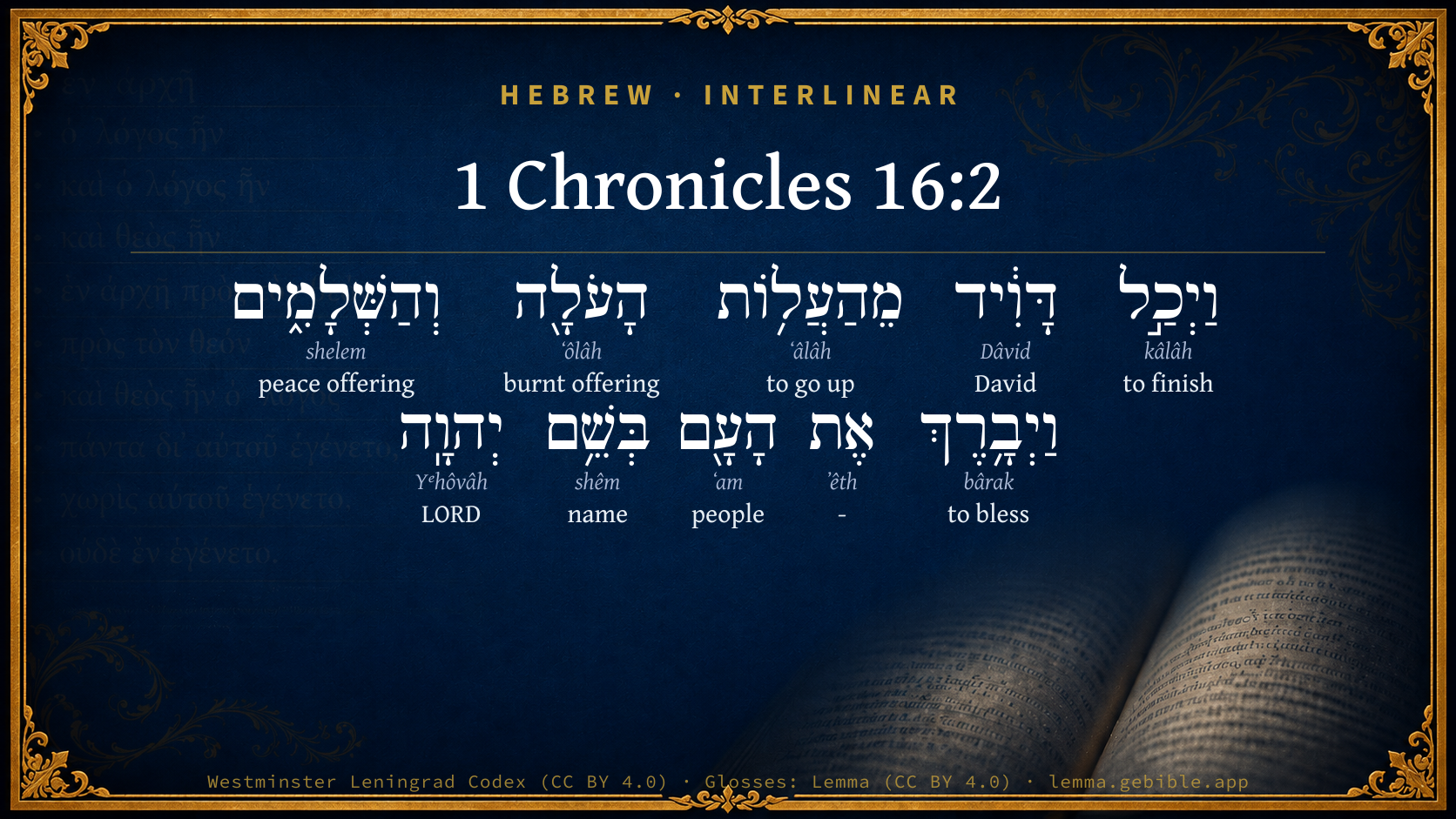
  1. וַיְכַ֣ל kâlâh H3615 “and · to finish” Conjunction + Verb, Piel, Sequential Imperfect, 3rd Person, Masculine, Singular
  2. דָּוִ֔יד Dâvid H1732 “David” Noun, Proper
  3. מֵהַעֲל֥וֹת ʻâlâh H5927 “from · to go up” Preposition + Verb, Hiphil, Infinitive Construct
  4. הָעֹלָ֖ה ʻôlâh H5930 “the · burnt offering” Particle, Definite Article + Noun, Common, Feminine, Singular, Absolute
  5. וַיְבָ֥רֶךְ bârak H1288 “and · to bless” Conjunction + Verb, Piel, Sequential Imperfect, 3rd Person, Masculine, Singular
  6. אֶת ʼêth H853 “-” Particle, Direct Object
  7. הָעָ֖ם ʻam H5971 “the · people” Particle, Definite Article + Noun, Common, Masculine, Singular, Absolute
  8. בְּשֵׁ֥ם shêm H8034 “in/at · name of” Preposition + Noun, Common, Masculine, Singular, Construct
  9. יְהוָֽה Yᵉhôvâh H3068 “LORD” Noun, Proper

About this verse

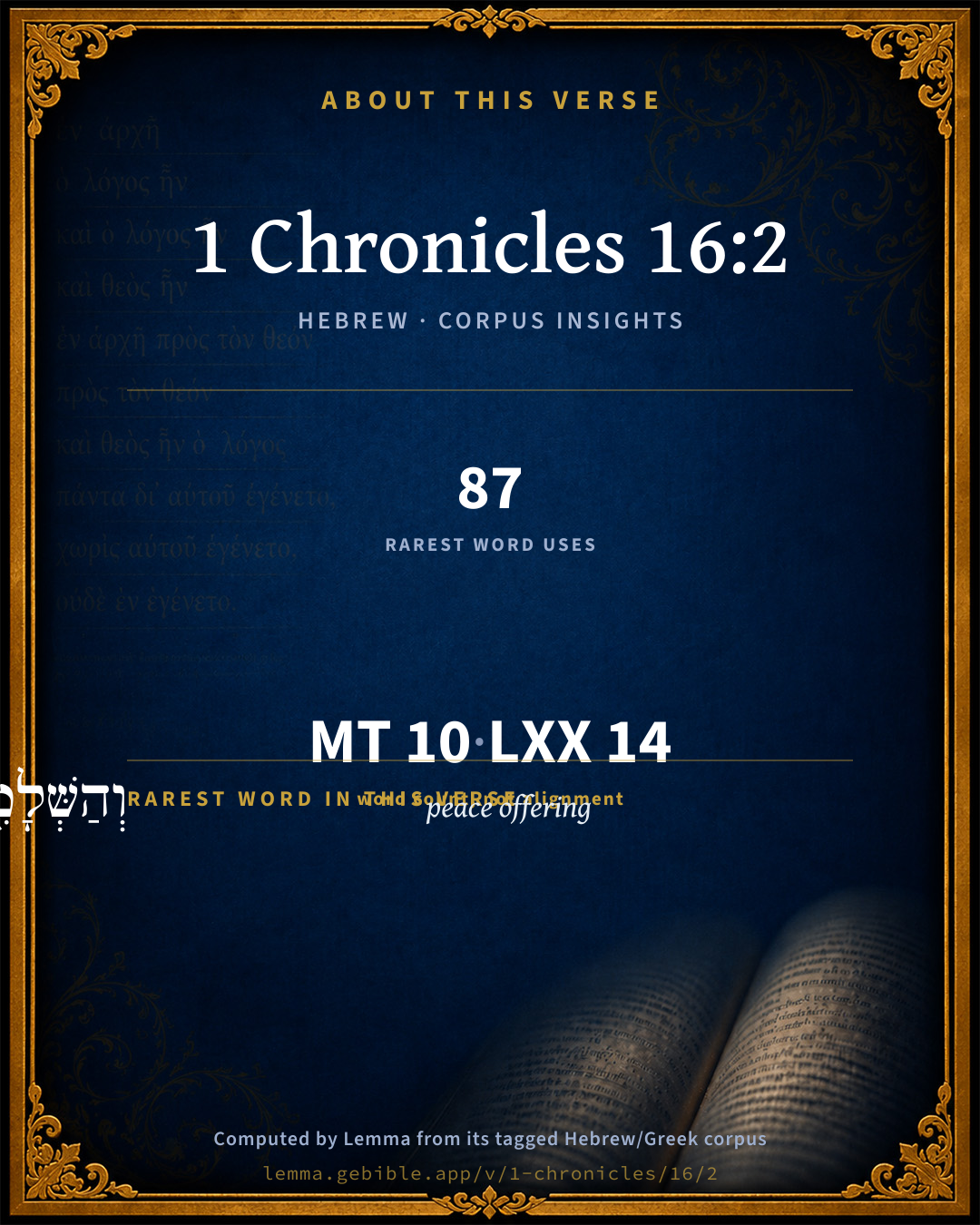
These counts appear in no published source. They are computed here, from the morphology-tagged text and Lemma’s own curated glosses. What Lemma adds →

10
words
10
distinct lemmas
Historical
section

Grammatical profile

  • 3 verbs
  • 6 nouns
  • 1 particle

Verb forms

  • וַיְכַ֣ל Piel · Sequential Imperfect
  • מֵהַעֲל֥וֹת Hiphil · Infinitive Construct
  • וַיְבָ֥רֶךְ Piel · Sequential Imperfect

Hebrew & Septuagint length

In English translation the verse runs 23 words from the Hebrew and 20 from the Septuagint (LXX English) — closely comparable.

A rough comparison of the two English renderings, which tokenize alike — not a word-level alignment.

Word counts can differ between the Hebrew and the Greek without any difference in meaning — e.g. the Hebrew direct-object marker אֵת has no separate Greek word, and Greek often adds the article ὁ.

In the original languages it is 10 Hebrew tokens and 14 Greek tokens — but the two are counted differently (Hebrew bundles its prefixes and suffixes into one token; the Greek is in lemma form), so that isn’t a like-for-like length.

Cross-references

14

Topical passages linked to 1 Chronicles 16:2 in the Treasury of Scripture Knowledge — connected by theme and wording, ordered by reader-vote popularity; previews shown in the World English Bible.

  • Genesis 47:10 Jacob blessed Pharaoh, and went out from the presence of Pharaoh.
  • Joshua 22:6 So Joshua blessed them, and sent them away; and they went to their tents.
  • 2 Chronicles 30:18–20 For a multitude of the people, even many of Ephraim and Manasseh, Issachar and Zebulun, had not cleansed themselves, yet did they eat the Passover otherwise than it is written. For Hezekiah had prayed for them, saying, The good Yahweh pardon everyone
  • 2 Chronicles 30:27 Then the priests the Levites arose and blessed the people: and their voice was heard, and their prayer came up to his holy habitation, even to heaven.
  • Genesis 14:19 He blessed him, and said, "Blessed be Abram of God Most High, possessor of heaven and earth:
  • Genesis 20:7 Now therefore, restore the man's wife. For he is a prophet, and he will pray for you, and you will live. If you don't restore her, know for sure that you will die, you, and all who are yours."
  • Genesis 47:7 Joseph brought in Jacob, his father, and set him before Pharaoh, and Jacob blessed Pharaoh.
  • Leviticus 1:3 "'If his offering is a burnt offering from the herd, he shall offer a male without blemish. He shall offer it at the door of the Tent of Meeting, that he may be accepted before Yahweh.
  • Numbers 6:23–27 "Speak to Aaron and to his sons, saying, 'This is how you shall bless the children of Israel.' You shall tell them,
  • 2 Samuel 6:18 When David had made an end of offering the burnt offering and the peace-offerings, he blessed the people in the name of Yahweh of Hosts.
  • 1 Kings 8:55–56 He stood, and blessed all the assembly of Israel with a loud voice, saying,
  • 2 Chronicles 29:29 When they had made an end of offering, the king and all who were present with him bowed themselves and worshiped.
  • Luke 24:50–51 He led them out as far as Bethany, and he lifted up his hands, and blessed them.
  • Hebrews 7:7 But without any dispute the less is blessed by the better.

Cross-references courtesy of OpenBible.info (CC BY 4.0).

Hebrew and Greek witnesses Masoretic Hebrew ↔ Greek Septuagint

The same verse in the two great witnesses to the Old Testament, shown verse-for-verse.

These are two independent witnesses, not word-aligned to each other, and the Septuagint is shown in lemma (dictionary) form.

Hebrew 1 Chronicles 16:2 Masoretic · Westminster Leningrad Codex

וַיְכַ֣ל דָּוִ֔יד מֵהַעֲל֥וֹת הָעֹלָ֖ה וְהַשְּׁלָמִ֑ים וַיְבָ֥רֶךְ אֶת הָעָ֖ם בְּשֵׁ֥ם יְהוָֽה

When David had made an end of offering the burnt offering and the peace-offerings, he blessed the people in the name of Yahweh.

World English Bible · Public Domain

Greek LXX 1 Chronicles 16:2 Septuagint · lemma form

καί συντελέω δαυίδ ἀναφέρω ὁλοκαύτωμα καί σωτήριον καί εὐλογέω ὁ λαός ἐν ὄνομα κύριος

And David finished offering up whole burnt offerings and peace-offerings, and blessed the people in the name of the Lord.

LXX2012 (modern English Septuagint) · Public Domain

Hebrew: Westminster Leningrad Codex (CC BY 4.0). Greek: Septuagint (public domain); English from LXX2012 (modern English Septuagint) (Public Domain). How the Septuagint differs from the Hebrew →

Commentary

Notes on 1 Chronicles 16:2 from classic Christian and Jewish commentators (each source and its license shown beneath its notes). The classic Christian expositions comment on the surrounding passage and are grouped to its opening verse, so a note may address several verses; the Jewish commentaries on the Tanakh (Rashi and others) are per-verse, so they appear only where the commentator wrote on this verse.

Lemma curates 59 commentaries, every one of them public domain or Creative Commons licensed, each selected and text-cleaned for this edition rather than reprinted as found. About our sources →

Trapp's Complete Commentary

John Trapp

1Ch 16:2 And when David had made an end of offering the burnt offerings and the peace offerings, he blessed the people in the name of the LORD.

Ver. 2. In the name of the Lord,] i.e., From Jehovah, the fountain and bestower of all good. Or, By the name of the Lord; i.e., by naming the Lord, the proper object of prayers and praises.

John Trapp, A Commentary or Exposition upon All the Books of the Old and New Testament (1647–1656) — public domain. Text from a community e-Sword module.

Geneva Bible (1599)

Geneva Bible translators

He called upon the Name of God, desiring him to prosper the people, and give good success to their beginnings.

Geneva Bible (1599) marginal notes — public domain. Text via Bolls.life.

Adam Clarke's Commentary

Verse 2. He blessed the people] "He blessed the people in the name of the WORD of the Lord." - T.

Adam Clarke's Commentary on the Bible (1810–1826) — public domain. Text from a community e-Sword/MySword module.

Ellicott's Commentary for English Readers

(2) The burnt offerings.—Heb., the burnt offering, as if one great holocaust were meant. This verse is identical with 2Sa_6:18, only omitting Sabaoth at the end, a Divine title which was perhaps obsolete in the chronicler’s day.

He blessed the people in the name of the Lord.—Comp. Num_6:22-27; 1Ki_8:14; 1Ki_8:55; Deu_33:1.

A Bible Commentary for English Readers, edited by Charles John Ellicott (1878–1897) — public domain. Text from a community e-Sword module.

The Cambridge Bible for Schools and Colleges

gen. ed. J. J. S. Perowne

2. blessed the people] Cp. 2Ch_6:3.

The Cambridge Bible for Schools and Colleges (gen. ed. J. J. S. Perowne; Cambridge University Press, 1878–1918) — public domain. Text from a community e-Sword module.

Haydock's Catholic Bible Commentary

Lord, wishing them all felicity, and making them presents, like the master of a family, ver. 43, and 2 Kings vi. 18. (Calmet) --- Any superior may bless. (Worthington)

George Leo Haydock (1774–1849), Haydock's Catholic Family Bible and Commentary, 1859 edition — public domain. Excludes Psalms (Douay-Rheims chapter numbering differs from Protestant) and Deuterocanonical books (Catholic canon only).

The Pulpit Commentary

He blessed the people in the name of the Lord; i.e. reverently in the Name of the Lord, and as vividly conscious of being in his presence, he pronounces blessings upon the people, and by short ejaculatory prayer and holy wish further begs for them those blessings which God only can give. In the time of David and Solomon (1Ki_8:14) the king realized far more closely the idea of the paternal relation to the people than had ever been since the time of the patriarchs of the elder days.

HOMILIES BY J.R. THOMSON Ver. 2.

Sacrifice and blessing.

The manner in which David celebrated the reception of the ark into its appointed tent on the height of his city was thoroughly characteristic. He acted as a king, and as a kind of royal mediator between the God of heaven and the chosen people Israel.

I HE BLESSED THE LORD IN THE NAME OF THE PEOPLE. For this was certainly the significance of the sacrifices, burnt offerings, and peace offerings. In offering them, the king was publicly acknowledging the authority of the supreme Lord, was publicly adoring and praising him as the God of the nation, and was publicly seeking his favour and countenance. Not that David offered these sacrifices with his own hands. What he did by means of the priests, whom he directed, he is represented as doing himself. It was a high day, a solemn and joyful festivity; and it was becoming that the Lord should be recognized, sought, and praised.

II HE BLESSED THE PEOPLE IN THE NAME OF THE LORD. Probably he pronounced a solemn benediction, invoking the gracious regard of the God of Israel upon the chosen nation. With the ark of the covenant in their possession, in the midst of their metropolis, the people might well be encouraged to rejoice in the presence and favour of him who is ever the Source of all good. It is a proof of David"s policy that he took this opportunity of feasting the assembled multitudes. This would no doubt create a favourable impression upon all minds. Their spiritual privileges, and their happiness in having a king so considerate and liberal as David to reign over them, would be associated in their minds. They would connect their religion and their loyalty together, and would cherish happy recollections of the solemnities of the day. T.

The Pulpit Commentary (1880–1919), ed. H.D.M. Spence-Jones & Joseph S. Exell — public domain. Text from a community e-Sword module.

Rashi

Rabbi Shlomo Yitzchaki (Rashi)

and he blessed the people in the name of the Lord which was called upon the Ark, as is written above (II Sam. 6:2): “the Ark of God, the Lord, upon which a name was called.”

Rashi on the Tanakh — English translations: “The Judaica Press complete Tanach with Rashi, translated by A. J. Rosenberg” (CC BY 4.0); “Pentateuch with Rashi's commentary by M. Rosenbaum and A.M. Silbermann, 1929-1934” (public domain); “The Metsudah Tanach series, Lakewood, N.J” (CC BY 4.0); and “The Book of Joshua, Metsudah Publications, 1997” (CC BY 4.0). Text via Sefaria.

Lesson kit

Teaching starters — assembled from the data on this page, not authored interpretation. Every prompt links to the verse data it draws on. Edit before teaching.

1 Chronicles, in the Historical, opens this verse with 10 words (10 distinct Hebrew lemmas). Its most distinctive word is shelem (“peace offering”). A historical commentator’s framing appears above. Read the whole chapter for the surrounding context.

Discussion questions

  1. How does “peace offering” (shelem) shape what this verse is saying?
  2. Genesis 47:10 shares this passage’s theme. How do the two illuminate each other?
  3. The translations on this page render this verse differently — a whole-verse word diff, not a word-by-word alignment. What might account for the different wordings?
  4. The verb «וַיְכַ֣ל» is Piel Sequential Imperfect. How does its form color the action?
  5. Reading how Trapp's Complete Commentary and Geneva Bible (1599) read this verse, where do the two commentators agree and where do they part?

Things to notice

Reading settings

Reading text

Shown beneath each verse's original-language words.

Old Testament
Old Testament edition

Read the OT as the Masoretic Hebrew (MT) or the Greek Septuagint (LXX).

English shown for the Greek Septuagint (in the Hebrew ↔ Greek comparison).

Comparing translations? Open the Compare panel on any verse page to stack up to four side by side.