
2 Chronicles 2:7

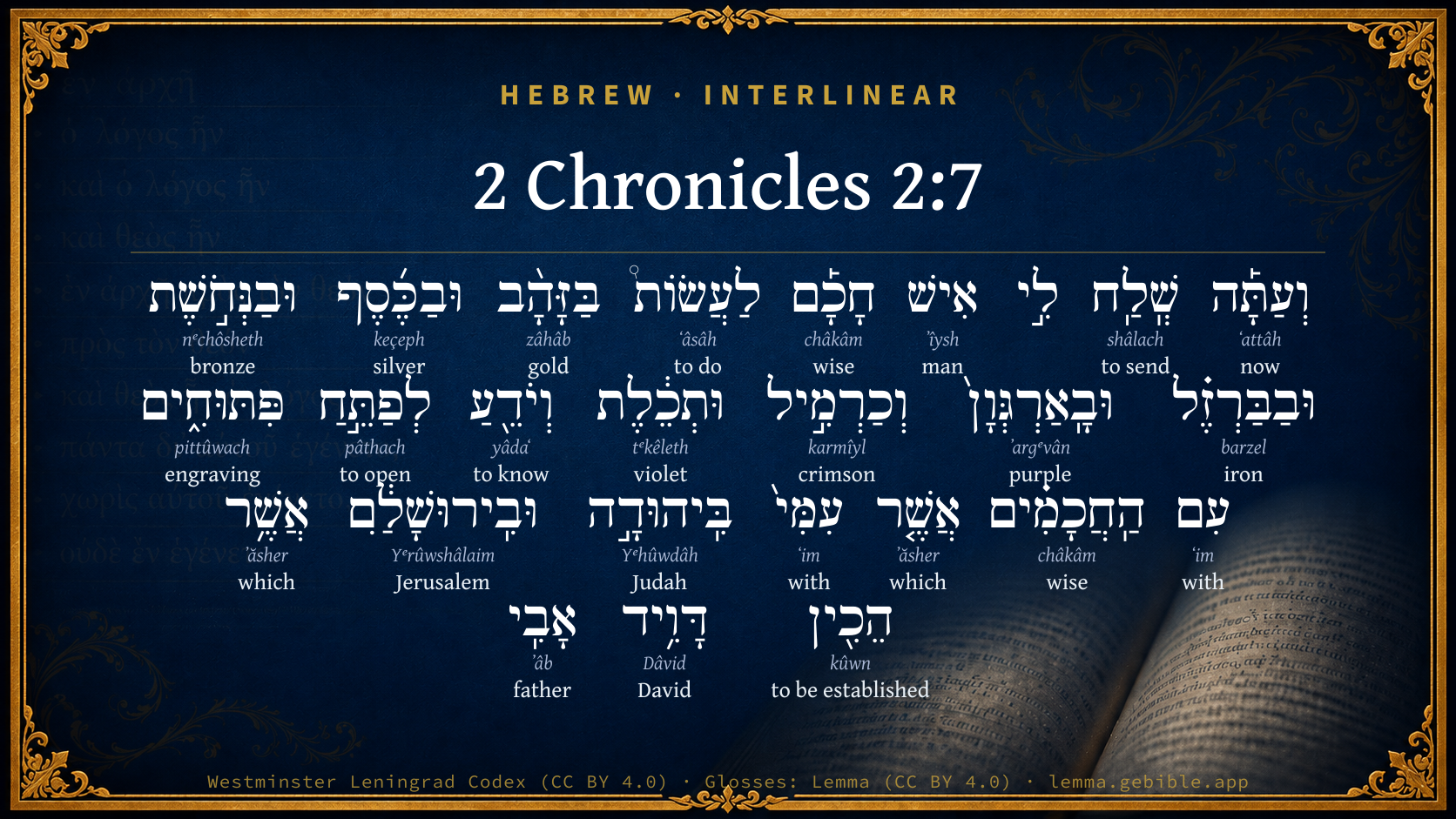
Hebrew (Westminster Leningrad Codex) 2 Chronicles 2:7 appears in the Hebrew Old Testament. The text above is from the Westminster Leningrad Codex. Each word links to its Strong’s number, a concise gloss, and parsing drawn from the Open Scriptures Hebrew Bible morphology. Click any word for its full Brown-Driver-Briggs (BDB) entry.
Download image
Cite this verse

2 Chronicles 2:7 (World English Bible). Public Domain. Lemma interlinear Bible study tool, https://lemma.gebible.app/v/2-chronicles/2/7.

Show BibTeX & RIS
BibTeX
RIS
English Translation
Now therefore send me a man skillful to work in gold, and in silver, and in brass, and in iron, and in purple, and crimson, and blue, and who knows how to engrave [all manner of] engravings, [to be] with the skillful men who are with me in Judah and in Jerusalem, whom David my father did provide.
World English Bible · Public Domain
Highlights
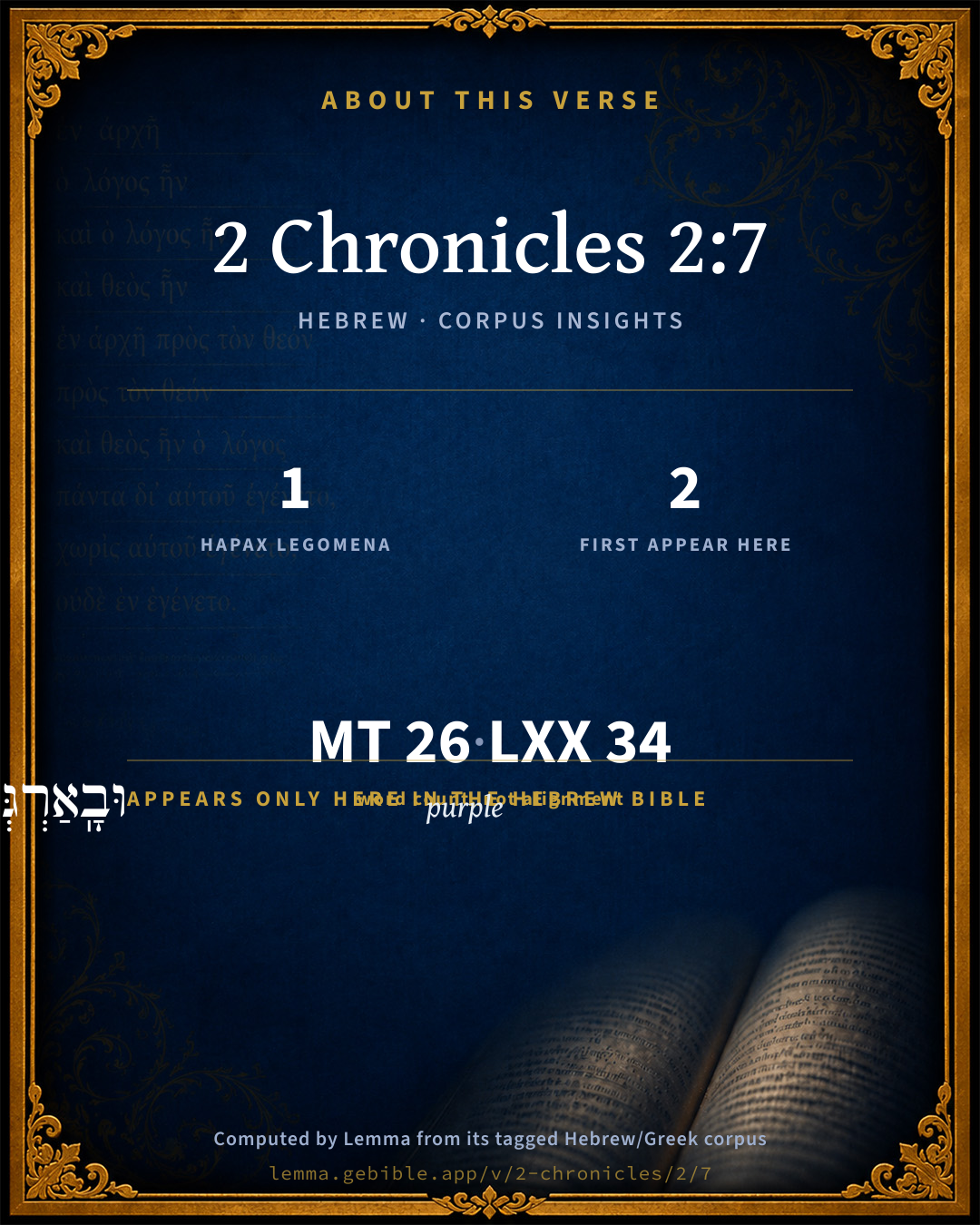
  • 1 hapax legomenon — only here in the Hebrew Bible
  • 2 first appearances in the Hebrew Bible
Full analysis ↓
Download a study sheet

One document with this verse’s original text, its word-by-word gloss line, the meaning frame, cross-references with their text, attributed commentary, and full source and license credits — printable, and it pastes into notes with its structure intact.

This verse Autodidact and up

Study sheet (.html) Plain text (.txt)

A passage Seminary Student

Up to 50 verses in one chapter. A passage sheet keeps up to 6 commentary sources and 12 cross-references per verse, in the order this page ranks them, and says so on the sheet whenever that leaves anything out. Ask for a single verse and you get the Autodidact verse sheet above.

Everything on this page stays free to read, with no account — the sheet is a download of what is already on screen, not access to it.

Want to remove ads? Support Godless Engineer
Compare translations 3

The same verse in 3 English versions, stacked beneath the original-language interlinear above. Click any original word for its lexicon entry.

Each is an independent rendering of the whole verse — the interlinear is not word-aligned to these translations.

Highlighted words mark where these versions differ — a whole-verse word diff, not a word-by-word alignment.

  • World English Bible Public Domain
    Now therefore send me a man skillful to work in gold, and in silver, and in brass, and in iron, and in purple, and crimson, and blue, and who knows how to engrave [all manner of] engravings, [to be] with the skillful men who are with me in Judah and in Jerusalem, whom David my father did provide.
  • King James Version Public Domain
    Send me now therefore a man cunning to work in gold, and in silver, and in brass, and in iron, and in purple, and crimson, and blue, and that can skill to grave with the cunning men that are with me in Judah and in Jerusalem, whom David my father did provide.
  • unfoldingWord Literal Text CC BY-SA 4.0
    And now, send to me a wise man to work in gold, and in silver, and in bronze, and in iron, and in purple and crimson and violet, and one who knows how to engrave engravings; with the wise who are with me in Judah and in Jerusalem, whom David my father prepared.

unfoldingWord Literal Text — © unfoldingWord, licensed CC BY-SA 4.0. Word-aligned USFM3 via Door43 (git.door43.org/unfoldingWord/en_ult).

Versions to compare (up to 4)

3 of 4 selected

Show all 18 translations

Every available English version of this verse, each an independent rendering of the whole verse.

  • World English Bible Public Domain
    Now therefore send me a man skillful to work in gold, and in silver, and in brass, and in iron, and in purple, and crimson, and blue, and who knows how to engrave [all manner of] engravings, [to be] with the skillful men who are with me in Judah and in Jerusalem, whom David my father did provide.
  • Berean Standard Bible Public Domain
    Send me, therefore, a craftsman skilled in engraving to work with gold and silver, with bronze and iron, and with purple, crimson, and blue yarn. He will work with my craftsmen in Judah and Jerusalem, whom my father David provided.
  • Majority Standard Bible Public Domain
    Send me, therefore, a craftsman skilled in engraving to work with gold and silver, with bronze and iron, and with purple, crimson, and blue yarn. He will work with my craftsmen in Judah and Jerusalem, whom my father David provided.
  • King James Version Public Domain
    Send me now therefore a man cunning to work in gold, and in silver, and in brass, and in iron, and in purple, and crimson, and blue, and that can skill to grave with the cunning men that are with me in Judah and in Jerusalem, whom David my father did provide.
  • American Standard Version (1901) Public Domain
    Now therefore send me a man skilful to work in gold, and in silver, and in brass, and in iron, and in purple, and crimson, and blue, and that knoweth how to grave `all manner of' gravings, `to be' with the skilful men that are with me in Judah and in Jerusalem, whom David my father did provide.
  • Revised Version (1885) Public Domain
    Now therefore send me a man cunning to work in gold, and in silver, and in brass, and in iron, and in purple, and crimson, and blue, and that can skill to grave all manner of gravings, to be with the cunning men that are with me in Judah and in Jerusalem, whom David my father did provide.
  • Geneva Bible (1599) Public Domain
    Sende me nowe therefore a cunning man that can worke in golde, in siluer, and in brasse, and in yron, and in purple, and crimosin and blue silke, and that can graue in grauen worke with the cunning men that are with me in Iudah and in Ierusalem, whom Dauid my father hath prepared.
  • Douay-Rheims (1899) Public Domain
    Send me therefore a skilful man, that knoweth how to work in gold, and in silver, in brass, and in iron, in purple, in scarlet and in blue, and that hath skill in engraving, with the artificers, which I have with me in Judea and Jerusalem, whom David my father provided.
  • Young's Literal Translation Public Domain
    `And now, send to me a wise man to work in gold, and in silver, and in brass, and in iron, and in purple, and crimson, and blue, and knowing to grave gravings with the wise men who `are' with me in Judah and in Jerusalem, whom David my father prepared;
  • Literal Standard Version CC BY-SA 4.0
    And now, send a wise man to me to work in gold, and in silver, and in bronze, and in iron, and in purple, and crimson, and blue, and knowing to engrave engravings with the wise men who [are] with me in Judah and in Jerusalem, whom my father David prepared;
  • Unlocked Literal Bible CC BY-SA 4.0
    So send me a man who is skilled at work in gold, silver, bronze, iron, and in purple, crimson, and blue wool, a man who knows how to make all kinds of engraved wood. He will be with the skilled men who are with me in Judah and Jerusalem, whom David my father provided.
  • unfoldingWord Literal Text CC BY-SA 4.0
    And now, send to me a wise man to work in gold, and in silver, and in bronze, and in iron, and in purple and crimson and violet, and one who knows how to engrave engravings; with the wise who are with me in Judah and in Jerusalem, whom David my father prepared.
  • Darby Bible Public Domain
    And now send me a man skilful to work in gold, and in silver, and in bronze, and in iron, and in purple and crimson and blue, and experienced in carving, besides the skilful men that are with me in Judah and in Jerusalem, whom David my father provided.
  • World Messianic Bible Public Domain
    “Now therefore send me a man skillful to work in gold, in silver, in bronze, in iron, and in purple, crimson, and blue, and who knows how to engrave engravings, to be with the skillful men who are with me in Judah and in Jerusalem, whom David my father provided.
  • Webster's Bible Public Domain
    Send me now therefore a man skillful to work in gold, and in silver, and in brass, and in iron, and in purple, and crimson, and blue, and that hath skill to grave with the skillful men that are with me in Judah and in Jerusalem, whom David my father provided.
  • Free Bible Version CC BY-SA 4.0
    So please send me a master craftsman who is skilled in working with gold, silver, bronze, and iron; and in purple, scarlet, and blue fabrics. He must also know how to engrave, working together with my expert craftsmen from Judea and Jerusalem provided by my father David.
  • Bible in Basic English Public Domain
    So now send me an expert worker in gold and silver and brass and iron? in purple and red and blue, and in the cutting of all sorts of ornament, to be with the expert workmen who are here in Judah and in Jerusalem, whom my father David got together.
  • JPS Tanakh (1917) Public Domain
    (2-6) Now therefore send me a man skilful to work in gold, and in silver, and in brass, and in iron, and in purple, and crimson, and blue, and that hath skill to grave all manner of gravings, to be with the skilful men that are with me in Judah and in Jerusalem, whom David my father did provide.

Literal Standard Version (2020), Covenant Press — licensed CC BY-SA 4.0. Text via the HelloAO Bible API (eBible.org). Unlocked Literal Bible (unfoldingWord) — licensed CC BY-SA 4.0. Text via the HelloAO Bible API (eBible.org). unfoldingWord Literal Text — © unfoldingWord, licensed CC BY-SA 4.0. Word-aligned USFM3 via Door43 (git.door43.org/unfoldingWord/en_ult). Free Bible Version, Dr. Jonathan Gallagher — licensed CC BY-SA 4.0. Text via the HelloAO Bible API (eBible.org).

Word by word

More ways to search: Search by grammar → Find every occurrence → Compare this word →

Practice this passage: Drill this verse → Learn its vocabulary →

וּבָֽאַרְגְּוָן֙
ʼargᵉvân
H710
“and · in/at the · purple”
Conjunction + Preposition, Determined + Noun, Common, Masculine, Singular, Absolute
Part of Speech
Conjunction + Preposition + Noun
Type
Common
Gender
Masculine
Number
Singular
State
Absolute
Full BDB Definition

Origin: a variation for H713

TWOT: 157b

purple
  1. וְעַתָּ֡ה ʻattâh H6258 “and · now” Conjunction + Adverb
  2. שְֽׁלַֽח shâlach H7971 “send” Verb, Qal, Imperative, 2nd Person, Masculine, Singular
  3. אִישׁ ʼîysh H376 “man” Noun, Common, Masculine, Singular, Absolute
  4. חָכָ֡ם châkâm H2450 “wise” Adjective, Adjective, Masculine, Singular, Absolute
  5. לַעֲשׂוֹת֩ ʻâsâh H6213 “to do” Preposition + Verb, Qal, Infinitive Construct
  6. בַּזָּהָ֨ב zâhâb H2091 “in/at the · gold” Preposition, Determined + Noun, Common, Masculine, Singular, Absolute
  7. וּבַכֶּ֜סֶף keçeph H3701 “and · in/at the · silver” Conjunction + Preposition, Determined + Noun, Common, Masculine, Singular, Absolute
  8. וּבַנְּחֹ֣שֶׁת nᵉchôsheth H5178 “and · in/at the · bronze” Conjunction + Preposition, Determined + Noun, Common, Feminine, Singular, Absolute
  9. וּבַבַּרְזֶ֗ל barzel H1270 “and · in/at the · iron” Conjunction + Preposition, Determined + Noun, Common, Masculine, Singular, Absolute
  10. וְכַרְמִ֣יל karmîyl H3758 “and · crimson” Conjunction + Noun, Common, Masculine, Singular, Absolute
  11. וּתְכֵ֔לֶת tᵉkêleth H8504 “and · violet” Conjunction + Noun, Common, Feminine, Singular, Absolute
  12. וְיֹדֵ֖עַ yâdaʻ H3045 “and · knowing” Conjunction + Verb, Qal, Participle Active, Masculine, Singular, Absolute
  13. לְפַתֵּ֣חַ pâthach H6605 “to open” Preposition + Verb, Piel, Infinitive Construct
  14. פִּתּוּחִ֑ים pittûwach H6603 “engravings” Noun, Common, Masculine, Plural, Absolute
  15. עִם ʻim H5973 “with” Preposition
  16. הַֽחֲכָמִ֗ים châkâm H2450 “the · wise” Particle, Definite Article + Adjective, Adjective, Masculine, Plural, Absolute
  17. אֲשֶׁ֤ר ʼăsher H834 “which” Particle, Relative
  18. עִמִּי֙ ʻim H5973 “with · me” Preposition + Suffix, Personal, 1st Person, Common, Singular
  19. בִּֽיהוּדָ֣ה Yᵉhûwdâh H3063 “in/at · Judah” Preposition + Noun, Proper
  20. וּבִֽירוּשָׁלִַ֔ם Yᵉrûwshâlaim H3389 “and · in/at · Jerusalem” Conjunction + Preposition + Noun, Proper
  21. אֲשֶׁ֥ר ʼăsher H834 “which” Particle, Relative
  22. הֵכִ֖ין kûwn H3559 “to be established” Verb, Hiphil, Perfect, 3rd Person, Masculine, Singular
  23. דָּוִ֥יד Dâvid H1732 “David” Noun, Proper
  24. אָבִֽי ʼâb H1 “father · my” Noun, Common, Masculine, Singular, Construct + Suffix, Personal, 1st Person, Common, Singular

About this verse

These counts appear in no published source. They are computed here, from the morphology-tagged text and Lemma’s own curated glosses. What Lemma adds →

26
words
22
distinct lemmas
Historical
section

Notable vocabulary

1 hapax legomenon — a word that appears only here in the entire Hebrew Bible:

  • וּבָֽאַרְגְּוָן֙ purple H710

First appearance in Scripture

These words make their first canonical appearance in the Hebrew Bible here:

  • וּבָֽאַרְגְּוָן֙ purple H710
  • וְכַרְמִ֣יל crimson H3758

Shared distinctive vocabulary

וְכַרְמִ֣יל crimson H3758 occurs in 3 verses of the Hebrew Bible. Also found in:

Grammatical profile

  • 5 verbs
  • 13 nouns
  • 2 adjectives
  • 3 prepositions
  • 1 adverb
  • 2 particles

Verb forms

  • שְֽׁלַֽח Qal · Imperative
  • לַעֲשׂוֹת֩ Qal · Infinitive Construct
  • וְיֹדֵ֖עַ Qal · Participle Active
  • לְפַתֵּ֣חַ Piel · Infinitive Construct
  • הֵכִ֖ין Hiphil · Perfect

Repetition

Words recur within this verse — often emphatic in Hebrew:

  • חָכָ֡ם wise H2450 ×2
  • עִם with H5973 ×2
  • אֲשֶׁ֤ר which H834 ×2

Hebrew & Septuagint length

In English translation the verse runs 58 words from the Hebrew and 57 from the Septuagint (LXX English) — closely comparable.

A rough comparison of the two English renderings, which tokenize alike — not a word-level alignment.

Word counts can differ between the Hebrew and the Greek without any difference in meaning — e.g. the Hebrew direct-object marker אֵת has no separate Greek word, and Greek often adds the article ὁ.

In the original languages it is 26 Hebrew tokens and 34 Greek tokens — but the two are counted differently (Hebrew bundles its prefixes and suffixes into one token; the Greek is in lemma form), so that isn’t a like-for-like length.

Cross-references

7

Topical passages linked to 2 Chronicles 2:7 in the Treasury of Scripture Knowledge — connected by theme and wording, ordered by reader-vote popularity; previews shown in the World English Bible.

  • Exodus 31:3–5 and I have filled him with the Spirit of God, in wisdom, and in understanding, and in knowledge, and in all manner of workmanship,
  • 1 Chronicles 22:15–16 There are also workmen with you in abundance, cutters and workers of stone and timber, and all kinds of men who are skillful in every kind of work:
  • 2 Chronicles 2:13–14 Now I have sent a skillful man, endowed with understanding, of Huram my father's,
  • 1 Kings 7:14 He was the son of a widow of the tribe of Naphtali, and his father was a man of Tyre, a worker in brass; and he was filled with wisdom and understanding and skill, to work all works in brass. He came to king Solomon, and performed all his work.
  • Isaiah 28:26 For his God does instruct him aright, [and] does teach him.
  • Isaiah 28:29 This also comes forth from Yahweh of Hosts, who is wonderful in counsel, and excellent in wisdom.
  • Isaiah 60:10 Foreigners shall build up your walls, and their kings shall minister to you: for in my wrath I struck you, but in my favor have I had mercy on you.

Cross-references courtesy of OpenBible.info (CC BY 4.0).

Hebrew and Greek witnesses Masoretic Hebrew ↔ Greek Septuagint

The same verse in the two great witnesses to the Old Testament, shown verse-for-verse.

These are two independent witnesses, not word-aligned to each other, and the Septuagint is shown in lemma (dictionary) form.

Hebrew 2 Chronicles 2:7 Masoretic · Westminster Leningrad Codex

וְעַתָּ֡ה שְֽׁלַֽח לִ֣י אִישׁ חָכָ֡ם לַעֲשׂוֹת֩ בַּזָּהָ֨ב וּבַכֶּ֜סֶף וּבַנְּחֹ֣שֶׁת וּבַבַּרְזֶ֗ל וּבָֽאַרְגְּוָן֙ וְכַרְמִ֣יל וּתְכֵ֔לֶת וְיֹדֵ֖עַ לְפַתֵּ֣חַ פִּתּוּחִ֑ים עִם הַֽחֲכָמִ֗ים אֲשֶׁ֤ר עִמִּי֙ בִּֽיהוּדָ֣ה וּבִֽירוּשָׁלִַ֔ם אֲשֶׁ֥ר הֵכִ֖ין דָּוִ֥יד אָבִֽי

Now therefore send me a man skillful to work in gold, and in silver, and in brass, and in iron, and in purple, and crimson, and blue, and who knows how to engrave [all manner of] engravings, [to be] with the skillful men who are with me in Judah and in Jerusalem, whom David my father did provide.

World English Bible · Public Domain

Greek LXX 2 Chronicles 2:7 Septuagint · lemma form

καί ἀποστέλλω ἐγώ ξύλον κέδρινος καί ἀρκεύθινος καί πεύκινος ἐκ ὁ λιβάνος ὅτι ἐγώ οἶδα ὡς ὁ δοῦλος σύ οἶδα κόπτω ξύλον ἐκ ὁ λιβάνος καί ἰδού ὁ παῖς σύ μετά ὁ παῖς ἐγώ

And now send me a man wise and skilled to work in gold, and in silver, and in brass, and in iron, and in purple, and in scarlet, and in blue, and one that knows how to grave together with the craftsmen who are with me in Juda and in Jerusalem, which materials my father David prepared.

LXX2012 (modern English Septuagint) · Public Domain

Hebrew: Westminster Leningrad Codex (CC BY 4.0). Greek: Septuagint (public domain); English from LXX2012 (modern English Septuagint) (Public Domain). How the Septuagint differs from the Hebrew →

Commentary

Notes on 2 Chronicles 2:7 from classic Christian and Jewish commentators (each source and its license shown beneath its notes). The classic Christian expositions comment on the surrounding passage and are grouped to its opening verse, so a note may address several verses; the Jewish commentaries on the Tanakh (Rashi and others) are per-verse, so they appear only where the commentator wrote on this verse.

Lemma curates 59 commentaries, every one of them public domain or Creative Commons licensed, each selected and text-cleaned for this edition rather than reprinted as found. About our sources →

Trapp's Complete Commentary

John Trapp

2Ch 2:7 Send me now therefore a man cunning to work in gold, and in silver, and in brass, and in iron, and in purple, and crimson, and blue, and that can skill to grave with the cunning men that [are] with me in Judah and in Jerusalem, whom David my father did provide.

Ver. 7. Send me now therefore a man.] See 1Ki 7:13-14.

John Trapp, A Commentary or Exposition upon All the Books of the Old and New Testament (1647–1656) — public domain. Text from a community e-Sword module.

The Biblical Illustrator

Joseph S. Exell

2Ch_2:7-16

Send me now therefore a man cunning to work in gold.

Huram and Solomon

Learn from this intercourse--

I. That friendship in life is helpful.

II. That co-operation among men is desirable.

III. That men may know God, yet not serve him.

IV. That when Gods people are consistent in their life, their influence upon others is for good. (J. Wolfendale.)

Co-operation

No temple should be built by any one man. Blessed be God, everything that is worth doing is done by co-operation, by acknowledged reciprocity of labour. Your breakfast-table was not spread by yourself, although it could not have been spread without you. Sometimes we may almost bless God that we cannot identify the authorship of some books in the Bible. It is better that many hands should have written the book than that some brilliant author should have retired into immortality on the ground of his being the only genius that could have written so marvellous a volume. (J. Parker, D.D.)

The Biblical Illustrator, edited by Joseph S. Exell (c. 1880s–1900s) — public domain. Text from a community e-Sword module.

Joseph Benson's Commentary

2Ch 2:7. Send me therefore a man cunning to work in gold, &c. — There were admirable artists, in all the works here referred to, at Tyre; some of whom Solomon desired to be sent to him, that they might assist those whom David had provided, but who were not so skilful as those of Tyre.

Joseph Benson's Commentary on the Old and New Testaments (1811–1818) — public domain. Text from a community e-Sword module.

Geneva Bible (1599)

Geneva Bible translators

Or, scarlet.

Geneva Bible (1599) marginal notes — public domain. Text via Bolls.life.

Jamieson, Fausset & Brown

Robert Jamieson, A. R. Fausset & David Brown

Send me now therefore a man cunning to work--Masons and carpenters were not asked for. Those whom David had obtained (Ch1 14:1) were probably still remaining in Jerusalem, and had instructed others. But he required a master of works; a person capable, like Bezaleel (Exo 35:31), of superintending and directing every department; for, as the division of labor was at that time little known or observed, an overseer had to be possessed of very versatile talents and experience. The things specified, in which he was to be skilled, relate not to the building, but the furniture of the temple. Iron, which could not be obtained in the wilderness when the tabernacle was built, was now, through intercourse with the coast, plentiful and much used. The cloths intended for curtains were, from the crimson or scarlet-red and hyacinth colors named, evidently those stuffs, for the manufacture and dyeing of which the Tyrians were so famous. "The graving," probably, included embroidery of figures like cherubim in needlework, as well as wood carving of pomegranates and other ornaments.

Jamieson, Fausset & Brown — Commentary Critical and Explanatory on the Whole Bible (1871) — public domain (CC PDM 1.0). Text via the HelloAO Bible API.

Adam Clarke's Commentary

Verse 7. Send me - a man cunning to work] A person of great ingenuity, who is capable of planning and directing, and who may be over the other artists.

Adam Clarke's Commentary on the Bible (1810–1826) — public domain. Text from a community e-Sword/MySword module.

Ellicott's Commentary for English Readers

(7) Send me now . . .—And now send me a wise man, to work in the gold and in the silver (1Ch_22:15; 2Ch_2:13).

And in (the) purple, and crimson, and blue.—No allusion is made to this kind of art in 2Ch_4:11-16, nor in 1Ki_7:13 seq., which describe only metallurgic works of this master, whose versatile genius might easily be paralleled by famous names of the Renaissance.

Purple (’argĕwân).—Aramaic form. (Heb. ’argâmân, Exo_25:4.)

Crimson (karmîl).—A word of Persian origin, occurring only here and in 2Ch_2:13, and 2Ch_3:14. (Comp. our word carmine.)

Blue (tĕkçleth).—Dark blue, or violet (Exo_25:4, and elsewhere.)

Can skill.—Knoweth how.

To grave.—Literally, to carve carvings; whether in wood or stone. (1Ki_6:29; Zec_3:9; Exo_28:9, on gems.)

With the cunning men.—The Hebrew connects this clause with the infinitive to work at the beginning of the verse. There should be a stop after the words to grave.

Whom David my father did provide (prepared, 1Ch_29:2).—1Ch_22:15; 1Ch_28:21.

A Bible Commentary for English Readers, edited by Charles John Ellicott (1878–1897) — public domain. Text from a community e-Sword module.

The Cambridge Bible for Schools and Colleges

gen. ed. J. J. S. Perowne

7. can skill to grave] Literally, knoweth how to grave.

to grave with the cunning men] R.V. to grave all manner of gravings, to be with the cunning men. To grave is “to carve.” Cp. 1Ki_6:29.

my father did provide] See 1Ch_22:15.

The Cambridge Bible for Schools and Colleges (gen. ed. J. J. S. Perowne; Cambridge University Press, 1878–1918) — public domain. Text from a community e-Sword module.

John Gill's Exposition

Send me also cedar trees, fir trees, and algum trees, out of Lebanon,.... Of the two first of these, and which Hiram sent, see Kg1 5:10. The algum trees are the same with the almug trees, Kg1 10:11 by a transposition of letters; these could not be coral, as some Jewish writers think, which grows in the sea, for these were in Lebanon; nor Brazil, as Kimchi, so called from a place of this name, which at this time was not known; though there were trees of almug afterwards brought from Ophir in India, as appears from the above quoted place, as well as from Arabia; and it seems, as Beckius (c) observes, to be an Arabic word, by the article "al" prefixed to it:

for I know that thy servants can skill to cut timber in Lebanon; better than his:

and, behold, my servants shall be with thy servants; to help and assist them in what they can, and to learn of them, see Kg1 5:6.

(c) In Targum in loc.

John Gill's Exposition of the Whole Bible (1746–1763) — public domain (CC PDM 1.0). Text via the HelloAO Bible API.

Albert Barnes' Notes on the Bible

See 1Ki 5:6, note; 1Ki 7:13, note.

Purple ... - “Purple, crimson, and blue,” would be needed for the hangings of the temple, which, in this respect, as in others, was conformed to the pattern of the tabernacle (see Exo 25:4; Exo 26:1, etc.). Hiram’s power of “working in purple, crimson,” etc., was probably a knowledge of the best modes of dyeing cloth these colors. The Phoenicians, off whose coast the murex was commonly taken, were famous as purple dyers from a very remote period.

Crimson - כרמיל karmı̂̂yl, the word here and elsewhere translated “crimson,” is unique to Chronicles and probably of Persian origin. The famous red dye of Persia and India, the dye known to the Greeks as κόκκος kokkos, and to the Romans as coccum, is obtained from an insect. Whether the “scarlet” שׁני shânı̂y of Exodus (Exo 25:4, etc.) is the same or a different red, cannot be certainly determined.

Albert Barnes' Notes on the Bible (1834–1885) — public domain. Text from a community e-Sword/MySword module.

Haydock's Catholic Bible Commentary

Purple. Hebrew argevan, (Haydock) a Chaldean word, of the same import as argueman, in Exodus. --- Scarlet and blue were also species of purple. The finest sort was found between Tyre and Carmel. See Vitruvius vii. 13.

George Leo Haydock (1774–1849), Haydock's Catholic Family Bible and Commentary, 1859 edition — public domain. Excludes Psalms (Douay-Rheims chapter numbering differs from Protestant) and Deuterocanonical books (Catholic canon only).

Whedon's Commentary on the Bible

Daniel D. Whedon

7. Send me… a man cunning to work in gold — A skilled artificer; a master workman. Here we have the specific request for such a workman, which is implied, but not explicitly stated, in Kings.

Daniel D. Whedon (gen. ed.), Commentary on the Old and New Testaments (1874–1909) — public domain. Text from a community e-Sword module.

The Pulpit Commentary

Send me a man cunning to work, etc. The parenthesis is now ended. By comparison of ver. 3, it appears that Solomon makes of Hiram"s services to David his father a very plea why his own requests addressed now to Hiram should be granted. If we may be guided by the form of the expressions used in 1Ch_14:1 and 2Sa_5:11, 2Sa_5:12, Hiram had in the first instance volunteered help to David, and had not waited to be applied to by David. This would show us more clearly the force of Solomon"s plea. Further, if we note the language of 1Ki_5:1, we may be disposed to think that it fills a gap in our present connection, and indicates that, though Solomon appears here to have had to take the initiative, an easy opportunity was opened, in the courteous embassy sent him in the persons of Hiram"s "servants." That the king of this most privileged, separate, and exclusive people of Israel (and he the one who conducted that people to the very zenith of their fame) should have to apply and be permitted to apply to foreign and, so to say, heathen help, in so intrinsic a matter as the finding of the "cunning" and the "skill" of head and hand for the most sacred and distinctive chef d oeuvre of the said exclusive nation, is a grand instance of nature breaking all trammels, even when most divinely purposed, and a grand token of the dawning comity of nations, of free-trade under the unlikeliest auspices, and of the brotherhood of humanity, never more broadly illustrated than when on an international scale. The competence of the Phoenicians and the people of Sidon and those over whom Hiram immediately reigned in the working of the metals, and furthermore in a very wide range of other subjects, is well sustained by the allusions of very various authorities. (already instanced 1Ch_14:1, and passim; Homer, "Iliad," 6:289-294; 23. 743; "Odys.," 4:614; 15:415-426; Herod., 3:19; 7:23, 44, 96; Strabo, 16:2. The man who was sent is described in vers. 13, 14, infra, as also 1Ki_7:13, 1Ki_7:14. Purple, ... crimson, ... blue. It is not absolutely necessary to suppose that the same Hiram, so skilled in working of gold, silver, brass, and iron, was the authority sent for these matters of various coloured dyes for the cloths that would later on be required for curtains and other similar purposes in the temple. So far, indeed, as the literal construction of the words go, this would seem to be what is meant, and no doubt may have been the case, though unlikely. The purple (wGda). A Chaldee form of this word (anwGra) occurs three times in Dan_5:7, Dan_5:16, Dan_5:29, and appears in each of those cases in our Authorized Version as "scarlet." Neither of these words is the word used in the numerous passages of Exodus, Numbers, Judges, Esther, Proverbs, Canticles, Jeremiah, and Ezekiel, nor, indeed, in ver. 13, infra and 2Ch_3:14. In all these places, numbering nearly forty, the word is b; g; ra.The purple was probably obtained from some shell-fish on the coast of the Mediterranean. The crimson (lymirk). Gesenius says that this was a colour obtained from multitudinous insects that tenanted one kind of the flex (Coccus ilicis), and that the word is from the Persian language. The Persian kerm, Sanscrit krimi, Armenian karmir, German carmesin, and our own "crimson," keep the same framework of letters or sound to a remarkable degree. This word is found only here, ver. 13, infra, and 2Ch_3:14. The crimson of Isa_1:18 and Jer_4:30, and the scarlet of some forty places in the Pentateuch and other books, come as the rendering of the word yniv; The blue (tlkeT) This is the same word as is used in some fifty other passages in Exodus, Numbers, and in later books. This colour was obtained from a shell-fish ( Helix ianthina) found in the Mediterranean, the shell of which was blue. Can skill to grave. The word "to grave" is the piel conjugation of the very familiar Hebrew verb jtP "to open." Out of twenty-nine times that the verb occurs in some part of the piel conjugation, it is translated "grave" nine times, "loosed" eleven times, "put off" twice, "ungirded" once, "opened" four times, "appear" once, and "go free" once. Perhaps the "opening" the ground with the plough (Isa_28:24) leads most easily on to the idea of "engraving." Cunning men whom... David did provide, As we read in 1Ch_22:15 1Ch_28:21.

The Pulpit Commentary (1880–1919), ed. H.D.M. Spence-Jones & Joseph S. Exell — public domain. Text from a community e-Sword module.

Lesson kit

Teaching starters — assembled from the data on this page, not authored interpretation. Every prompt links to the verse data it draws on. Edit before teaching.

2 Chronicles, in the Historical, opens this verse with 26 words (22 distinct Hebrew lemmas). Its most distinctive word is ʼargᵉvân (“purple”). A historical commentator’s framing appears above. Read the whole chapter for the surrounding context.

Discussion questions

  1. What does “purple” (ʼargᵉvân) contribute to the verse as a whole?
  2. 1 word here appears nowhere else in the Hebrew Bible. Why might the author reach for such rare wording?
  3. 2 words make their first appearance in Scripture here. What does this debut establish?
  4. How does 2 Chronicles 2:14, which shares the word «crimson», read alongside this verse?
  5. What does the repetition of “wise” (2× in this one verse) do in this verse?
  6. The translations on this page render this verse differently — a whole-verse word diff, not a word-by-word alignment. What might account for the different wordings?
  7. «שְֽׁלַֽח» is a Qal Imperative verb. How does that grammatical form shape the action described?
  8. Compare how Trapp's Complete Commentary and The Biblical Illustrator read this verse. Where do they agree or differ?

Things to notice

  • 1 word in this verse appears nowhere else in the Hebrew Bible.
  • 2 words make their first canonical appearance in Scripture here.
  • This verse counts 26 Hebrew ↔ 34 Greek words.
  • These translations choose different wording for 23 words in this verse.
  • “wise” occurs 2× in this single verse.

Reading settings

Reading text

Shown beneath each verse's original-language words.

Old Testament
Old Testament edition

Read the OT as the Masoretic Hebrew (MT) or the Greek Septuagint (LXX).

English shown for the Greek Septuagint (in the Hebrew ↔ Greek comparison).

Comparing translations? Open the Compare panel on any verse page to stack up to four side by side.