
Nehemiah 3:15

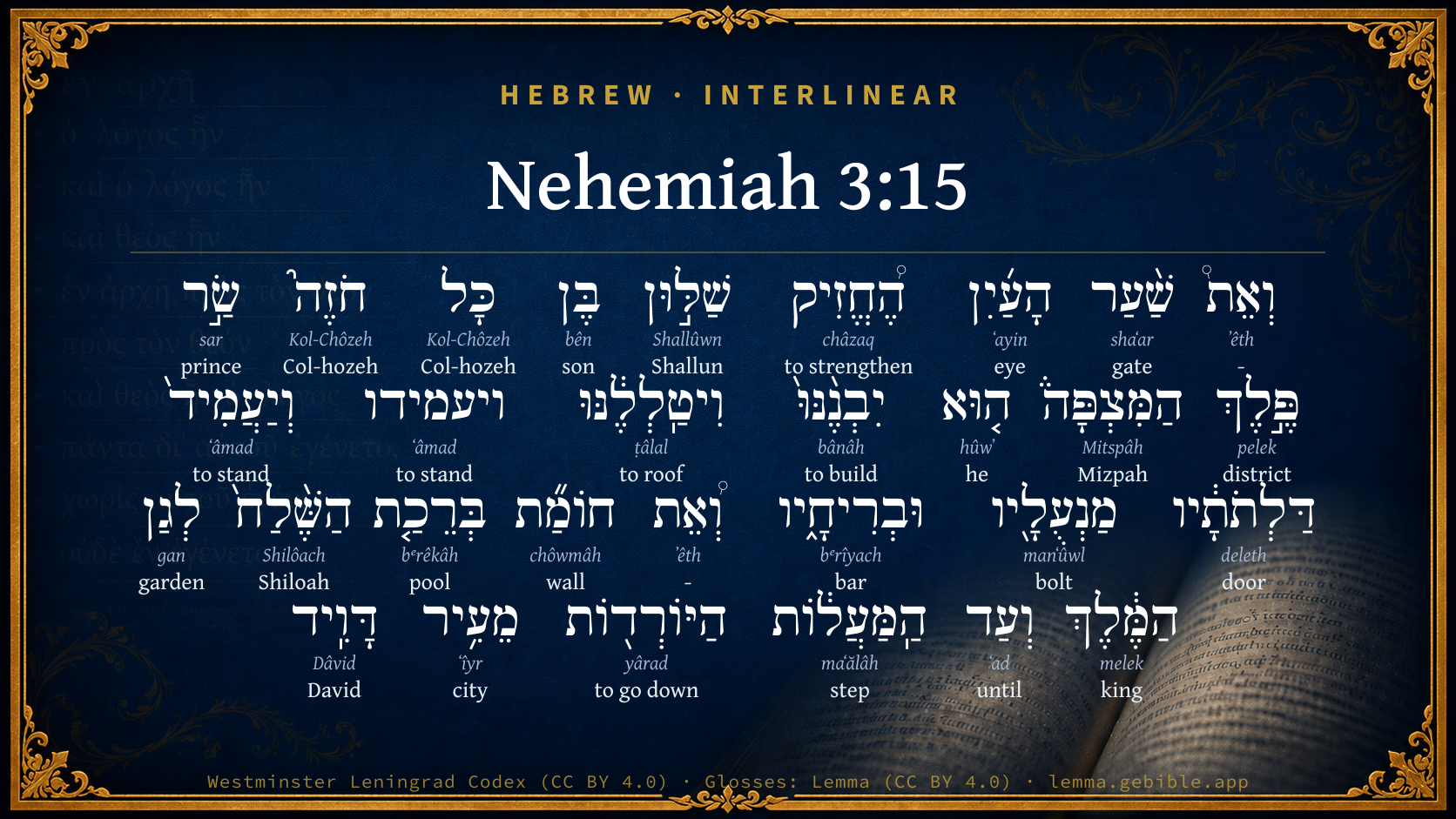
Hebrew (Westminster Leningrad Codex) Nehemiah 3:15 appears in the Hebrew Old Testament. The text above is from the Westminster Leningrad Codex. Each word links to its Strong’s number, a concise gloss, and parsing drawn from the Open Scriptures Hebrew Bible morphology. Click any word for its full Brown-Driver-Briggs (BDB) entry.
Download image
Cite this verse

Nehemiah 3:15 (World English Bible). Public Domain. Lemma interlinear Bible study tool, https://lemma.gebible.app/v/nehemiah/3/15.

Show BibTeX & RIS
BibTeX
RIS
English Translation
The spring gate repaired Shallun the son of Colhozeh, the ruler of the district of Mizpah; he built it, and covered it, and set up the doors of it, the bolts of it, and the bars of it, and the wall of the pool of Shelah by the king's garden, even to the stairs that go down from the city of David.
World English Bible · Public Domain
Highlights
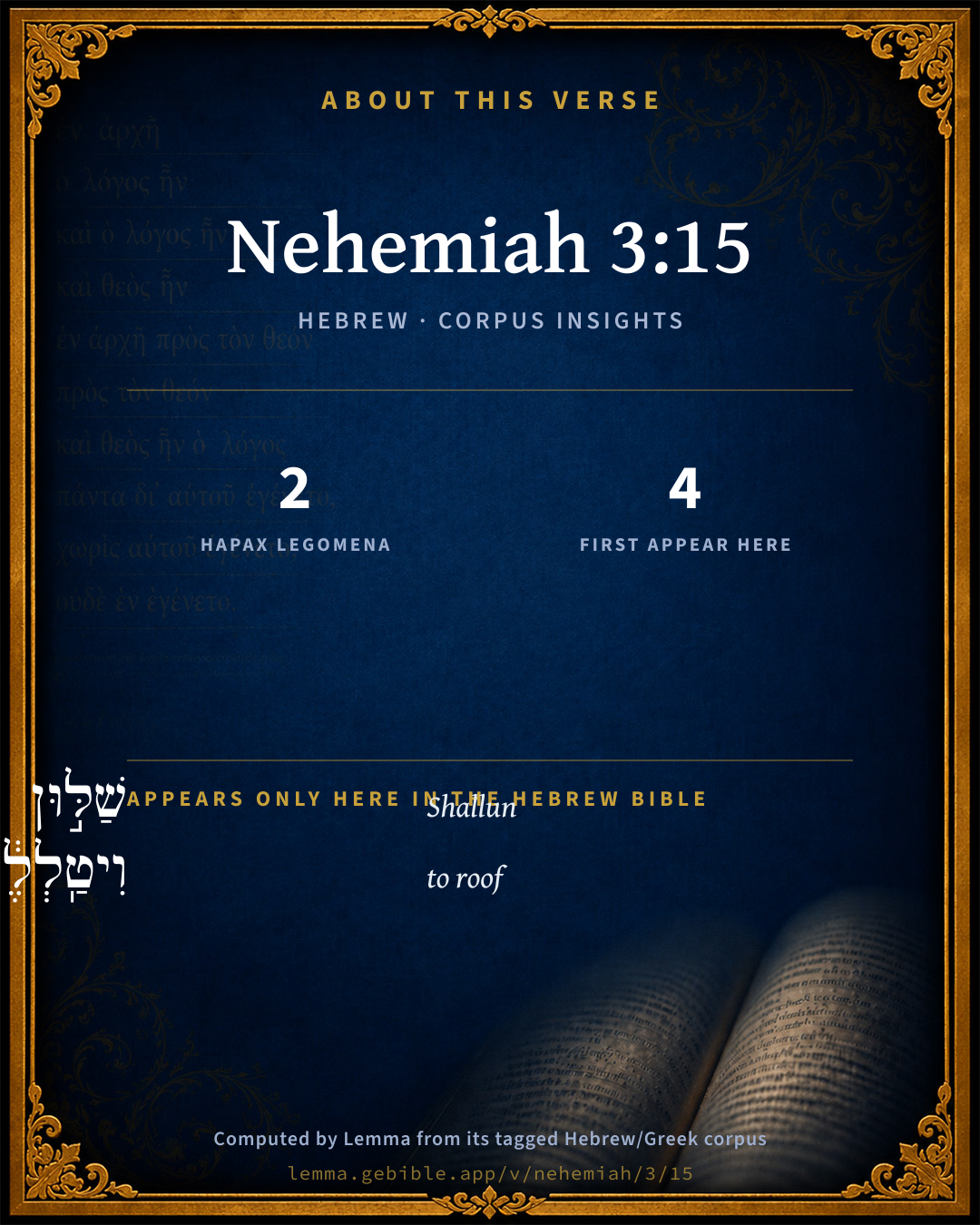
  • 2 hapax legomena — only here in the Hebrew Bible
  • 4 first appearances in the Hebrew Bible
Full analysis ↓
Download a study sheet

One document with this verse’s original text, its word-by-word gloss line, the meaning frame, cross-references with their text, attributed commentary, and full source and license credits — printable, and it pastes into notes with its structure intact.

This verse Autodidact and up

Study sheet (.html) Plain text (.txt)

A passage Seminary Student

Up to 50 verses in one chapter. A passage sheet keeps up to 6 commentary sources and 12 cross-references per verse, in the order this page ranks them, and says so on the sheet whenever that leaves anything out. Ask for a single verse and you get the Autodidact verse sheet above.

Everything on this page stays free to read, with no account — the sheet is a download of what is already on screen, not access to it.

Want to remove ads? Support Godless Engineer
Compare translations 3

The same verse in 3 English versions, stacked beneath the original-language interlinear above. Click any original word for its lexicon entry.

Each is an independent rendering of the whole verse — the interlinear is not word-aligned to these translations.

Highlighted words mark where these versions differ — a whole-verse word diff, not a word-by-word alignment.

  • World English Bible Public Domain
    The spring gate repaired Shallun the son of Colhozeh, the ruler of the district of Mizpah; he built it, and covered it, and set up the doors of it, the bolts of it, and the bars of it, and the wall of the pool of Shelah by the king's garden, even to the stairs that go down from the city of David.
  • King James Version Public Domain
    But the gate of the fountain repaired Shallun the son of Colhozeh, the ruler of part of Mizpah; he built it, and covered it, and set up the doors thereof, the locks thereof, and the bars thereof, and the wall of the pool of Siloah by the king's garden, and unto the stairs that go down from the city of David.
  • unfoldingWord Literal Text CC BY-SA 4.0
    And Shallun, the son of Kol-Hozeh, the administrator for the district of the Mizpah, strengthened the gate of the spring. He himself was building it and covering it and erecting its doors, its bolts, and its bars, and the wall of the pool of Shelach at the garden of the king even as far as the stairs descending from the city of David.

unfoldingWord Literal Text — © unfoldingWord, licensed CC BY-SA 4.0. Word-aligned USFM3 via Door43 (git.door43.org/unfoldingWord/en_ult).

Versions to compare (up to 4)

3 of 4 selected

Show all 18 translations

Every available English version of this verse, each an independent rendering of the whole verse.

  • World English Bible Public Domain
    The spring gate repaired Shallun the son of Colhozeh, the ruler of the district of Mizpah; he built it, and covered it, and set up the doors of it, the bolts of it, and the bars of it, and the wall of the pool of Shelah by the king's garden, even to the stairs that go down from the city of David.
  • Berean Standard Bible Public Domain
    The Fountain Gate was repaired by Shallun son of Col-hozeh, ruler of the district of Mizpah. He rebuilt it, roofed it, and installed its doors, bolts, and bars. He also repaired the wall of the Pool of Shelah near the king’s garden, as far as the stairs that descend from the City of David.
  • Majority Standard Bible Public Domain
    The Fountain Gate was repaired by Shallun son of Col-hozeh, ruler of the district of Mizpah. He rebuilt it, roofed it, and installed its doors, bolts, and bars. He also repaired the wall of the Pool of Shelah near the king’s garden, as far as the stairs that descend from the City of David.
  • King James Version Public Domain
    But the gate of the fountain repaired Shallun the son of Colhozeh, the ruler of part of Mizpah; he built it, and covered it, and set up the doors thereof, the locks thereof, and the bars thereof, and the wall of the pool of Siloah by the king's garden, and unto the stairs that go down from the city of David.
  • American Standard Version (1901) Public Domain
    And the fountain gate repaired Shallun the son of Colhozeh, the ruler of the district of Mizpah; he built it, and covered it, and set up the doors thereof, the bolts thereof, and the bars thereof, and the wall of the pool of Shelah by the king's garden, even unto the stairs that go down from the city of David.
  • Revised Version (1885) Public Domain
    And the fountain gate repaired Shallum the son of Col-hozeh, the ruler of the district of Mizpah; he built it, and covered it, and set up the doors thereof, the bolts thereof, and the bars thereof, and the wall of the pool of Shelah by the king’s garden, even unto the stairs that go down from the city of David.
  • Geneva Bible (1599) Public Domain
    But the gate of the fountaine fortified Shallun, the sonne of Col-hozeh, the ruler of the fourth part of Mizpah: he builded it, and couered it, and set on the doores thereof, the lockes thereof, and the barres thereof, and the wall vnto the fishpoole of Shelah by the Kings garden, and vnto the steppes that goe downe from the citie of Dauid.
  • Douay-Rheims (1899) Public Domain
    And the gate of the fountain Sellum the son of Cholhoza built, lord of the street of Maspha: he built it, and covered it, and set up the doors thereof, and the locks, and the bare, and the walls of the pool of Siloe unto the king's guard, and unto the steps that go down from the city of David.
  • Young's Literal Translation Public Domain
    And the gate of the fountain hath Shallum son of Col-Hozeh, head of the district of Mizpah, strengthened: he doth build it, and cover it, and set up its doors, its locks, and its bars, and the wall of the pool of Siloah, to the garden of the king, and unto the steps that are going down from the city of David.
  • Literal Standard Version CC BY-SA 4.0
    And Shallum son of Col-Hozeh, head of the district of Mizpah, has strengthened the Fountain Gate: he builds it, and covers it, and sets up its doors, its locks, and its bars, and the wall of the pool of Siloah, to the garden of the king, and to the steps that are going down from the City of David.
  • Unlocked Literal Bible CC BY-SA 4.0
    Shallun son of Kol-Hozeh, the ruler of the district of Mizpah, rebuilt the Fountain Gate. He built it, and put a cover on it and set its doors, its bolts, and its bars. He also rebuilt the wall of the Pool of Siloam by the king's garden, as far as the stairs leading down from the city of David.
  • unfoldingWord Literal Text CC BY-SA 4.0
    And Shallun, the son of Kol-Hozeh, the administrator for the district of the Mizpah, strengthened the gate of the spring. He himself was building it and covering it and erecting its doors, its bolts, and its bars, and the wall of the pool of Shelach at the garden of the king even as far as the stairs descending from the city of David.
  • Darby Bible Public Domain
    And the fountain-gate repaired Shallun the son of Colhozeh, the chief of the district of Mizpah; he built it, and covered it, and set up its doors, its locks and its bars, and the wall of the pool of Shelah by the king's garden, and to the stairs that go down from the city of David.
  • World Messianic Bible Public Domain
    Shallun the son of Colhozeh, the ruler of the district of Mizpah, repaired the spring gate. He built it, covered it, and set up its doors, its bolts, and its bars; and he repaired the wall of the pool of Shelah by the king’s garden, even to the stairs that go down from David’s city.
  • Webster's Bible Public Domain
    But the gate of the fountain repaired Shallun the son of Col-hozeh, the ruler of part of Mizpah; he built it, and covered it, and set up its doors, its locks, and its bars, and the wall of the pool of Siloah by the king's garden, and to the stairs that go down from the city of David.
  • Free Bible Version CC BY-SA 4.0
    The Fountain Gate was repaired by Shallun, son of Col-hozeh, ruler of the Mizpah district. He rebuilt it, put a roof on it, set up its doors, together with its bolts and bars. He rebuilt the wall of the Pool of Shelah by the king's garden, as far as the steps that go down from the City of David.
  • Bible in Basic English Public Domain
    And Shallun, the son of Col-hozeh, the ruler of the division of Mizpah, made good the doorway of the fountain, building it up and covering it and putting up its doors, with their locks and rods, with the wall of the pool of Shelah by the king's garden, as far as the steps which go down from the town of David.
  • JPS Tanakh (1917) Public Domain
    And the fountain gate repaired Shallun the son of Colhozeh, the ruler of the district of Mizpah; he built it, and covered it, and set up the doors thereof, the bolts thereof, and the bars thereof, and the wall of the pool of Shelah by the king's garden, even unto the stairs that go down from the city of David.

Literal Standard Version (2020), Covenant Press — licensed CC BY-SA 4.0. Text via the HelloAO Bible API (eBible.org). Unlocked Literal Bible (unfoldingWord) — licensed CC BY-SA 4.0. Text via the HelloAO Bible API (eBible.org). unfoldingWord Literal Text — © unfoldingWord, licensed CC BY-SA 4.0. Word-aligned USFM3 via Door43 (git.door43.org/unfoldingWord/en_ult). Free Bible Version, Dr. Jonathan Gallagher — licensed CC BY-SA 4.0. Text via the HelloAO Bible API (eBible.org).

Word by word

More ways to search: Search by grammar → Find every occurrence → Compare this word →

Practice this passage: Drill this verse → Learn its vocabulary →

שַׁלּ֣וּן
Shallûwn
H7968
“Shallun”
Noun, Proper
Part of Speech
Noun
Type
Proper
Full BDB Definition

Origin: probably for H7967

TWOT: None

Shallun = "retribution" - son of Colhozeh and ruler of a district of the Mizpah
  1. וְאֵת֩ ʼêth H853 “and · -” Conjunction + Particle, Direct Object
  2. שַׁ֨עַר shaʻar H8179 “gate of” Noun, Common, Masculine, Singular, Construct
  3. הָעַ֜יִן ʻayin H5869 “the · eye” Particle, Definite Article + Noun, Common, Both, Singular, Absolute
  4. הֶ֠חֱזִיק châzaq H2388 “to strengthen” Verb, Hiphil, Perfect, 3rd Person, Masculine, Singular
  5. בֶּן bên H1121 “son of” Noun, Common, Masculine, Singular, Construct
  6. כָּל Kol-Chôzeh H3626 “Col-hozeh” Noun, Proper
  7. חֹזֶה֮ Kol-Chôzeh H3626 “Col-hozeh” Noun, Proper
  8. שַׂ֣ר sar H8269 “prince of” Noun, Common, Masculine, Singular, Construct
  9. פֶּ֣לֶךְ pelek H6418 “district of” Noun, Common, Masculine, Singular, Construct
  10. הַמִּצְפָּה֒ Mitspâh H4709 “the · Mizpah” Particle, Definite Article + Noun, Proper
  11. ה֤וּא hûwʼ H1931 “he” Pronoun, Personal, 3rd Person, Masculine, Singular
  12. יִבְנֶ֨נּוּ֙ bânâh H1129 “to build · him” Verb, Qal, Imperfect, 3rd Person, Masculine, Singular + Suffix, Personal, 3rd Person, Masculine, Singular
  13. וִיטַֽלְלֶ֔נּוּ ṭâlal H2926 “and · to roof · him” Conjunction + Verb, Piel, Imperfect, 3rd Person, Masculine, Singular + Suffix, Personal, 3rd Person, Masculine, Singular
  14. ויעמידו ʻâmad H5975 “and · to stand” Conjunction + Verb, Hiphil, Imperfect, 3rd Person, Masculine, Plural
  15. וְיַעֲמִיד֙ ʻâmad H5975 “and · to stand” Conjunction + Verb, Hiphil, Imperfect, 3rd Person, Masculine, Singular
  16. דַּלְתֹתָ֔יו deleth H1817 “doors · his” Noun, Common, Feminine, Plural, Construct + Suffix, Personal, 3rd Person, Masculine, Singular
  17. מַנְעֻלָ֖יו manʻûwl H4514 “bolts · his” Noun, Common, Masculine, Plural, Construct + Suffix, Personal, 3rd Person, Masculine, Singular
  18. וּבְרִיחָ֑יו bᵉrîyach H1280 “and · bars · his” Conjunction + Noun, Common, Masculine, Plural, Construct + Suffix, Personal, 3rd Person, Masculine, Singular
  19. וְ֠אֵת ʼêth H853 “and · -” Conjunction + Particle, Direct Object
  20. חוֹמַ֞ת chôwmâh H2346 “wall of” Noun, Common, Feminine, Singular, Construct
  21. בְּרֵכַ֤ת bᵉrêkâh H1295 “pool of” Noun, Common, Feminine, Singular, Construct
  22. הַשֶּׁ֨לַח֙ Shilôach H7975 “the · Shiloah” Particle, Definite Article + Noun, Common, Masculine, Singular, Absolute
  23. לְגַן gan H1588 “to/for · garden of” Preposition + Noun, Common, Both, Singular, Construct
  24. הַמֶּ֔לֶךְ melek H4428 “the · king” Particle, Definite Article + Noun, Common, Masculine, Singular, Absolute
  25. וְעַד ʻad H5704 “and · until” Conjunction + Preposition
  26. הַֽמַּעֲל֔וֹת maʻălâh H4609 “the · steps” Particle, Definite Article + Noun, Common, Feminine, Plural, Absolute
  27. הַיּוֹרְד֖וֹת yârad H3381 “the · going down” Particle, Definite Article + Verb, Qal, Participle Active, Feminine, Plural, Absolute
  28. מֵעִ֥יר ʻîyr H5892 “from · city of” Preposition + Noun, Common, Feminine, Singular, Construct
  29. דָּוִֽיד Dâvid H1732 “David” Noun, Proper

About this verse

These counts appear in no published source. They are computed here, from the morphology-tagged text and Lemma’s own curated glosses. What Lemma adds →

30
words
27
distinct lemmas
Historical
section

Notable vocabulary

2 hapax legomena — words that appear only here in the entire Hebrew Bible:

  • שַׁלּ֣וּן Shallun H7968
  • וִיטַֽלְלֶ֔נּוּ to roof H2926

First appearance in Scripture

These words make their first canonical appearance in the Hebrew Bible here:

  • שַׁלּ֣וּן Shallun H7968
  • כָּל Col-hozeh H3626
  • וִיטַֽלְלֶ֔נּוּ to roof H2926
  • הַשֶּׁ֨לַח֙ Shiloah H7975

Shared distinctive vocabulary

הַשֶּׁ֨לַח֙ Shiloah H7975 occurs in 2 verses of the Hebrew Bible. Also found in:

Grammatical profile

  • 6 verbs
  • 20 nouns
  • 1 pronoun
  • 1 preposition
  • 2 particles

Verb forms

  • הֶ֠חֱזִיק Hiphil · Perfect
  • יִבְנֶ֨נּוּ֙ Qal · Imperfect
  • וִיטַֽלְלֶ֔נּוּ Piel · Imperfect
  • ויעמידו Hiphil · Imperfect
  • וְיַעֲמִיד֙ Hiphil · Imperfect
  • הַיּוֹרְד֖וֹת Qal · Participle Active

Repetition

Words recur within this verse — often emphatic in Hebrew:

  • כָּל Col-hozeh H3626 ×2
  • ויעמידו to stand H5975 ×2

Cross-references

15

Topical passages linked to Nehemiah 3:15 in the Treasury of Scripture Knowledge — connected by theme and wording, ordered by reader-vote popularity; previews shown in the World English Bible.

  • John 9:7 and said to him, "Go, wash in the pool of Siloam" (which means "Sent"). So he went away, washed, and came back seeing.
  • Isaiah 8:6 Because this people have refused the waters of Shiloah that go softly, and rejoice in Rezin and Remaliah's son;
  • Nehemiah 12:37 By the spring gate, and straight before them, they went up by the stairs of the city of David, at the ascent of the wall, above the house of David, even to the water gate eastward.
  • Nehemiah 2:14 Then I went on to the spring gate and to the king's pool: but there was no place for the animal that was under me to pass.
  • Luke 13:4 Or those eighteen, on whom the tower in Siloam fell, and killed them; do you think that they were worse offenders than all the men who dwell in Jerusalem?
  • Judges 20:1 Then all the children of Israel went out, and the congregation was assembled as one man, from Dan even to Beersheba, with the land of Gilead, to Yahweh at Mizpah.
  • Judges 20:3 (Now the children of Benjamin heard that the children of Israel had gone up to Mizpah.) The children of Israel said, Tell us, how was this wickedness brought to pass?
  • 2 Samuel 5:6–7 The king and his men went to Jerusalem against the Jebusites, the inhabitants of the land, who spoke to David, saying, Except you take away the blind and the lame, you shall not come in here; thinking, David can't come in here.
  • 2 Kings 25:4 Then a breach was made in the city, and all the men of war [fled] by night by the way of the gate between the two walls, which was by the king's garden (now the Chaldeans were against the city round about); and [the king] went by the way of the Arabah.
  • 2 Chronicles 32:30 This same Hezekiah also stopped the upper spring of the waters of Gihon, and brought them straight down on the west side of the city of David. Hezekiah prospered in all his works.
  • Nehemiah 3:7 Next to them repaired Melatiah the Gibeonite, and Jadon the Meronothite, the men of Gibeon, and of Mizpah, [that appertained] to the throne of the governor beyond the River.
  • Nehemiah 3:9 Next to them repaired Rephaiah the son of Hur, the ruler of half the district of Jerusalem.
  • Nehemiah 3:12 Next to him repaired Shallum the son of Hallohesh, the ruler of half the district of Jerusalem, he and his daughters.
  • Nehemiah 3:14 The dung gate repaired Malchijah the son of Rechab, the ruler of the district of Beth Haccherem; he built it, and set up the doors of it, the bolts of it, and the bars of it.
  • Jeremiah 40:6 Then went Jeremiah to Gedaliah the son of Ahikam to Mizpah, and lived with him among the people who were left in the land.

Cross-references courtesy of OpenBible.info (CC BY 4.0).

Hebrew and Greek witnesses Masoretic Hebrew ↔ Greek Septuagint

The same verse in the two great witnesses to the Old Testament, shown verse-for-verse.

These are two independent witnesses, not word-aligned to each other, and the Septuagint is shown in lemma (dictionary) form.

Hebrew Nehemiah 3:15 Masoretic · Westminster Leningrad Codex

וְאֵת֩ שַׁ֨עַר הָעַ֜יִן הֶ֠חֱזִיק שַׁלּ֣וּן בֶּן כָּל חֹזֶה֮ שַׂ֣ר פֶּ֣לֶךְ הַמִּצְפָּה֒ ה֤וּא יִבְנֶ֨נּוּ֙ וִיטַֽלְלֶ֔נּוּ ויעמידו וְיַעֲמִיד֙ דַּלְתֹתָ֔יו מַנְעֻלָ֖יו וּבְרִיחָ֑יו וְ֠אֵת חוֹמַ֞ת בְּרֵכַ֤ת הַשֶּׁ֨לַח֙ לְגַן הַמֶּ֔לֶךְ וְעַד הַֽמַּעֲל֔וֹת הַיּוֹרְד֖וֹת מֵעִ֥יר דָּוִֽיד

The spring gate repaired Shallun the son of Colhozeh, the ruler of the district of Mizpah; he built it, and covered it, and set up the doors of it, the bolts of it, and the bars of it, and the wall of the pool of Shelah by the king's garden, even to the stairs that go down from the city of David.

World English Bible · Public Domain

Greek LXX Structure differs

The Septuagint has no separate book of Nehemiah. Its Greek text is the second half of Esdras B (2 Esdras), chapters 11–23; Ezra is the first half (1–10).

A verse-for-verse comparison isn’t shown here because the chapters and verses don’t line up. Switch to the LXX edition with the MT / LXX toggle above to read the Greek directly.

On this verse, The Cambridge Bible for Schools and Colleges discusses the Septuagint’s reading. Read the note in Commentary ↓

Hebrew: Westminster Leningrad Codex (CC BY 4.0). Greek: Septuagint (public domain); English from a public-domain English Septuagint. How the Septuagint differs from the Hebrew →

Commentary

Notes on Nehemiah 3:15 from classic Christian and Jewish commentators (each source and its license shown beneath its notes). The classic Christian expositions comment on the surrounding passage and are grouped to its opening verse, so a note may address several verses; the Jewish commentaries on the Tanakh (Rashi and others) are per-verse, so they appear only where the commentator wrote on this verse.

Lemma curates 59 commentaries, every one of them public domain or Creative Commons licensed, each selected and text-cleaned for this edition rather than reprinted as found. About our sources →

Trapp's Complete Commentary

John Trapp

Neh 3:15 But the gate of the fountain repaired Shallun the son of Colhozeh, the ruler of part of Mizpah; he built it, and covered it, and set up the doors thereof, the locks thereof, and the bars thereof, and the wall of the pool of Siloah by the king’s garden, and unto the stairs that go down from the city of David.

Ver. 15. He built it, and covered it] A Chaldee word. This people, in their captivity, though they had not lost the use of their native tongue, yet they had got a tincture of the Chaldee; and of the Hebrew and Chaldee came the Syriac, the mother tongue in Christ’s time, as appears by Talitha cumi, and other like passages.

And unto the stairs] By these David descended into the lower city, and suitors ascended to his palace. This is allegorically applied by some to Christ (the true Jacob’s ladder, Joh 1:51), who came down and humbled himself to the utmost; that we by him might have access, with success, in all our suits.

John Trapp, A Commentary or Exposition upon All the Books of the Old and New Testament (1647–1656) — public domain. Text from a community e-Sword module.

The Biblical Illustrator

Joseph S. Exell

Neh_3:15

By the kings garden.

The kings garden

There are six of these kings gardens to which I shall conduct you, but we shall not have time to tarry in more than one of them. I The garden of paradise, which was situate in the midst of Eden.

II. The garden of Gethsemane..

III. The garden of the burial and the resurrection.

IV. The garden of the human heart. The heart is meant to be a garden for God. By nature it scarcely deserves the name; it is rather a tangled wilderness of all manner of noisome things. What must be done to this neglected garden? The rough plough of conviction must be dragged through it. The spade of trouble must break up the surface, and smash in pieces the clods, and kill the weeds. Into this prepared soil the Holy Spirit must put in the seeds of faith, and love and hope, and patience and perseverance, and zeal. Then there must be drained out of us much superfluity of naughtiness and excess of carnal confidence, or our heart will be a cold swamp, a worthless plant-killing bog. And in addition to all this, there must be constant hoeing and raking and digging. After a garden is made, the flower-beds are never left long alone; if they were left to themselves they would soon breed weeds again, and return to the old confusion. So with the garden of the heart, cleansing and pruning must be done every day, and God must do it through ourselves, and we must do it through constant examination and repentance.

V. The garden of The Christian Church. Follow me in each word of the text.

1. What is it? A garden. So it is called in the book of Solomons Song. Many thoughts are gathered in that one metaphor like bees in a hive.

(1) It implies separation. I earnestly desire to see the wall of separation between the Church and the world made broader and stronger. Christians should always wear their regimentals as Christs soldiers. They are to go forth without the camp bearing His reproach. Be not conformed to this world.

(2) It is a place of order. You do not, when you go into a garden, find the plants arranged anyhow, but the wise gardener arranges them according to their tints and hues, so that in the midst of summer the garden shall look like a rainbow that has been broken to pieces and let down upon the earth. Let us all try to maintain order in all things as the servants of Christ. We seek not the order which consists in all sleeping in their places, like corpses in the catacombs, but we desire the order which finds all working in their places for the common cause of the Lord Jesus.

(3) A garden is a place of beauty. Such should the Christian Church be. If there be no holiness, no love, no zeal, no prayerfulness outside in the world, yet you should see these things in the Church.

(4) It is a place of growth.

(5) It is a place of retirement. When a man is in his garden, he does not expect to see all his customers walking down between the beds to do business with him. So the Lord Jesus would have us reserve the Church to be a place in which He can manifest Himself to us as He doth not to the world.

2. Whose is it? It is the Kings garden. He chose it for Himself. He bought it. What a nobility this gives to Christs Church?

3. What does it need?

(1) It requires labour. In every Church there should be--

(a) Planters. I had a letter last week from a young woman. She says she has been here for two years, that she has been very anxious about her soul, and she has often wished that somebody would speak to her, but nobody has done so. Somebody has been negligent, very negligent. We want planters who can get the young slips and put them where they will grow.

(b) Some to watch over those who are planted.

(c) Some to collect the straggling.

(d) Some to burn up the rubbish and sweep up the leaves. In the best Church there will always be some falling leaves. Whenever a brother sees any mischief he ought to sweep it up and say nothing about it. Whenever you find that such and such a brother is going a little amiss, talk to him quietly; do not spread it all over the Church and make jealousies and suspicions. Pick up the leaf and destroy it. When a brother member has offended you, so that you feel vexed, forgive him. If every one would seek to make peace, there never could be much accumulation of discord in the Kings garden to annoy Him.

(2) It wants new plants.

(3) It wants rain and sunshine; the dew of the Holy Spirit and the sunshine of the Divine favour.

4. What does it produce? Herein is My Father glorified, that ye bear much fruit.

VI. The garden of the paradise above (Rev_22:1-5). (C. H. Spurgeon.)

The garden of the heart

Very often when I am going through a garden I come to some little bit marked off from the rest by a stick or a row of stones, and some lad or some little maiden comes running up; This is my garden, they say, my very own, to do whatever I like with. Now each of us has a garden, our very own, and yet it ought to be, and must be, the Kings garden. It is the garden of the heart.

I. I should like you to remember that gardens are made out of waste places. We want our heart to be nice and kind, and like a kings garden ought to be; and we look at the brambles and the waste places, and fear sometimes that it never can be made into a garden. I never shall be good, you say; I never shall be like so-and-so. When I was a little boy I learnt drawing, and one day when I had tried again and again, and couldnt do it right, I flung down the pencil and said angrily, I never shall be able to draw. The master was a very and a very wise man. He laughed pleasantly, and said, Come--never is a long time. I couldnt draw any better than you can when I was your age. That put new life into me. He who could draw anything with his pencil, and could make it exactly right with just a touch--to think that once he could not draw any better than I could! I went at it again then, and never felt inclined to give up afterwards. And so with all good people that ever lived--their hearts were wild and waste before they became the Kings garden.

II. Before the king can make a garden he must own the land. Jesus says to us, My son, give Me thine heart. He wants the heart, not because it is a garden, but that He may make a Kings garden of it.

III. It must be cleared and planted. Ah, you say, this is hard work. The weeds will grow so fast when youve pulled them up. But suppose you could get some one to come and change the ground, so that instead of bringing forth weeds it should bring forth flowers and fruits. That is just what we can do. Jesus has come on purpose to create clean hearts.

IV. We have to keep this garden for the king.

1. We must plant it well. The seed is the Word of God.

2. We must water it twice a day, and prayer is the watering.

3. We must watch against enemies.

When I was a boy we used to set little heaps of grains to attract the slugs and snails, and then creep out at night with a lantern and take these mischievous creatures, that otherwise would have spoiled all the fruit and many of the flowers. Take care of these, of habits that spoil all the fruit; of little neglects and forgetfulnesses that ruin the Kings garden. The peach-trees and plum-trees have a matting or net hung in front of them--in winter to keep off the frosts, or in summer to keep off the busy birds. We must be watchful against all things that hurt the Kings garden. We must be on our guard against bad companions, bad books, and bad influences of all kinds, and also of hasty words, thoughtless ways, and little harmful thoughts and feelings.

V. If it be the kings garden the king himself will come to it. Cyrus used to say, I take so much interest in my garden because I have planted every plant, and have sown every seed in it. So it is that Jesus loves His garden. He turned it from a waste into a garden, and has sown the good seed and planted the trees. I have heard of a poor man who lived in a very poor cottage far away from everybody else. One day somebody called to see him and said, My friend, you must be very lonely here. Lonely! he replied, ah, so I might be, but Jesus is such blessed company! He had been walking in the Kings garden with the King, and this made him so happy. (Mark Guy Pearse.)

The Biblical Illustrator, edited by Joseph S. Exell (c. 1880s–1900s) — public domain. Text from a community e-Sword module.

Keil & Delitzsch

C. F. Keil & F. Delitzsch

The fountain-gate and a portion of wall adjoining it was repaired by Shallum the son of Col-hozeh, the ruler of the district of Mizpah. כּל־חזה occurs again, Neh 11:5, apparently as the name of another individual. To יבננּוּ is added יטללנּוּ, he covered it, from טלל, to shade, to cover, answering to the קרוּהוּ of Neh 3:3 and Neh 3:6, probably to cover with a layer of beams. The position of the fountain-gate is apparent from the description of the adjoining length of wall which Shallum also repaired. This was "the wall of the pool of Shelach (Siloah) by the king's garden, and unto the stairs that go down from the city of David." The word שׁלח recalls שׁלּוח; the pool of Shelach can be none other than the pool which received its water through the שׁלח, i.e., mission (aquae). By the researches of Robinson (Pal. ii. p. 148f.) and Tobler (Die Siloahquelle u. der Oelberg, p. 6f.), it has been shown that the pool of Siloah receives its water from a subterranean conduit 1750 feet long, cut through the rock from the Fountain of the Virgin, Ain Sitti Miriam, on the eastern slope of Ophel. Near to the pool of Siloah, on the eastern declivity of Zion, just where the Tyropoean valley opens into the vale of Kidron, is found an old and larger pool (Birket el Hamra), now covered with grass and trees, and choked with earth, called by Tobler the lower pool of Siloah, to distinguish it from the one still existing, which, because it lies north-west of the former, he calls the upper pool of Siloah. One of these pools of Siloah, probably the lower and larger, is certainly the king's pool mentioned Neh 2:14, in the neighbourhood of which lay, towards the east and south-east, the king's garden. The wall of the pool of Shelach need not have reached quite up to the pool, but may have gone along the edge of the south-eastern slope of Zion, at some distance therefrom. In considering the next particular following, "unto the stairs that go down from the city of David," we must turn our thoughts towards a locality somewhat to the north of this pool, the description now proceeding from the south-eastern corner of the wall northward. These stairs are not yet pointed out with certainty, unless perhaps some remains of them are preserved in the "length of rocky escarpment," which Robinson (Pal. ii. p. 102, and Biblical Researches, p. 247) remarked on the narrow ridge of the eastern slope of the hill of Zion, north of Siloam, at a distance of 960 feet from the present wall of the city, "apparently the foundations of a wall or of some similar piece of building."

(Note: Bertheau's view, that these stairs were situated where Mount Zion, upon which stood the city of David, descends abruptly towards the east, and therefore on the precipice running from south to north, which still rises ninety-one feet above the ground northwards of the now so-called Bab el Mogharibeh or dung-gate, opposite the southern part of the west wall of the temple area, is decidedly incorrect. For this place is two thousand feet, i.e., more than one thousand cubits, distant from the pool of Siloah, while our text places them immediately after the length of wall by this pool. The transposition of these "steps" to a position within the present wall of the city is, in Bertheau's case, connected with the erroneous notion that the fountain-gate (Neh 3:15 and Neh 2:14) stood on the site of the present dung-gate (Bab el Mogharibeh), for which no other reason appears than the assumption that the southern wall of the city of David, before the captivity, went over Zion, in the same direction as the southern wall of modern Jerusalem, only perhaps in a rather more southerly direction, - an assumption shown to be erroneous, even by the circumstance that in this case the sepulchres of David, Solomon, and the kings of Judah would have stood outside the city wall, on the southern part of Zion; while, according to the Scripture narrative, David, Solomon, and the kings of Judah were buried in the city of David (Kg1 2:10; Kg1 11:42; Kg1 14:31; Kg1 15:8, and elsewhere). But apart from this consideration, this hypothesis is shattered by the statements of this fifteenth verse, which Bertheau cannot explain so inconsistently with the other statements concerning the building of the wall, as to make them say that any one coming from the west and going round by the south of the city towards the east, would first arrive at the fountain-gate, and then at the portion of wall in question; but is obliged to explain, so that the chief work, the building of the fountain-gate, is mentioned first; then the slighter work, the reparation of a length of wall as supplementary; and this makes the localities enumerated in Neh 3:13 succeed each other in the following order, in a direction from the west by south and east towards the north: "Valley-gate - one thousand cubits of wall as far as the dung-gate; dung-gate - the wall of the conduit towards the king's garden, as far as the stairs which lead from the city of David - fountain-gate." No adequate reason for this transposition of the text is afforded by the circumstance that no portion of wall is mentioned (Neh 3:14 and Neh 3:15) as being repaired between the dung-gate and the valley-gate. For how do we know that this portion on the southern side of Zion was broken down and needing repair? Might not the length between these two gates have been left standing when the city was burnt by the Chaldeans?)

Keil & Delitzsch — Biblical Commentary on the Old Testament (1861–1891) — public domain (CC PDM 1.0). Text via the HelloAO Bible API. (Old Testament only.)

Tyndale Open Study Notes

Tyndale Open Resources

3:15 The Mizpah district was about six miles (10 kilometers) north of Jerusalem. • The king’s garden was a lush area east of the pool of Siloam near where the Kidron and Hinnom Valleys meet, possibly at the King’s Pool (2:14).

Tyndale Open Study Notes — © Tyndale Open Resources, licensed CC BY-SA 4.0. Text via the HelloAO Bible API.

Geneva Bible (1599)

Geneva Bible translators

Or, Shoa.

Geneva Bible (1599) marginal notes — public domain. Text via Bolls.life.

Adam Clarke's Commentary

Verse 15. The pool of Siloah] This is probably the same as that mentioned by the evangelists.

The stairs that go down from the city of David.] Jerusalem being built on very uneven ground, and some hills being taken within the walls; there was a necessity that there should be in different places steps by which they could ascend and descend: probably similar to what we see in the city of Bristol.

Adam Clarke's Commentary on the Bible (1810–1826) — public domain. Text from a community e-Sword/MySword module.

Ellicott's Commentary for English Readers

(15) He covered it.—Similar to laid the beams in Neh_3:3; Neh_3:6.

The pool of Siloah.—Called before “the king’s pool,” which received its water as “sent” through a long subterranean conduit, and supplied the king’s gardens.

The stairs.—Down the steep sides of Ophel, of which traces are thought still to remain. From this point it is very hard to trace the exact course.

A Bible Commentary for English Readers, edited by Charles John Ellicott (1878–1897) — public domain. Text from a community e-Sword module.

The Cambridge Bible for Schools and Colleges

gen. ed. J. J. S. Perowne

15. But the gate of the fountain] R.V. And the fountain gate. See Neh_2:14. According to the old view, Nehemiah’s description here passes over a considerable space (nearly half a mile in straight line) between the ‘dung gate’ and the ‘fountain gate.’ The omission is capable of being explained as due either to the omission of certain details, cf. Neh_3:11, or to the fact that the precipitous nature of the ground rendered little work necessary upon the southern wall. But it can hardly be accidental that a similar omission has to be understood in the other description of the wall’s circuit (ch. Neh_12:31; Neh_12:37). It seems reasonable to incline to the recent suggestion, that, ‘the valley’ of Neh_3:13, being the Tyropœon, the circuit of the fortification wall did not include the Western Hill, but ran directly S. down the E. side of ‘the valley’ as far as ‘the dung gate’, when it began to deflect eastward.

Shallun] The A.V. (1611) spelling ‘Shallum’ is perhaps due to Neh_3:12.

the ruler of part of Mizpah] R.V. the ruler of the district of Mizpah. A distinction is drawn between the town of Mizpah and the adjacent district. Cf. ‘the district of Jerusalem,’ Neh_3:9; Neh_3:12. ‘The ruler of Mizpah’ itself is mentioned in Neh_3:19. See also on Neh_3:7.

covered it] The word so rendered does not occur elsewhere in the Bible. The LXX. renders ἐστέγασεν. It seems to correspond to the expression ‘laid the beams thereof’ in Neh_3:3; Neh_3:6.

and the wall of the pool of Siloah by the king’s garden] R.V. And the wall of the pool of Shelah by the king’s garden. Marg. ‘In Isa_8:6, Shiloah’. On Siloam (= Birket Silwân), cf. Joh_9:7. ‘The pool of Shelah,’ or of ‘leading,’ is fed by a subterranean channel leading from the Virgin’s Spring, distant 1708 feet, through the Ophel rock. The connexion was discovered by Sir Charles Warren. The tunnel is a remarkable piece of engineering. On the very ancient inscription describing its construction which was found in 1880, see Sayce’s Fresh Lights.

The pool here mentioned is probably the same as the lower pool, the modern ‘Birket el Hamra.’ The water from the pool flowed through ‘the king’s garden.’ The old city wall extended much further south than the modern city. The pool was formed by a heavy dam of masonry, probably part of the city wall. ‘The king’s garden’ is mentioned also in 2Ki_25:4; Jer_39:4; Jer_52:7. We cannot conclude for certain from this verse that it was included within the walls. But the water supply of the town depending largely upon the pool, the pool was probably enclosed by the wall. The double walls mentioned in 2Ki_25:4 probably protected both pool and gardens.

and unto the stairs, &c.] R.V. even unto the stairs, &c. These ‘stairs’ mark the limit of Shallum’s work in a northerly direction. The ‘stairs’ were the steps ascending the steep declivity of the ‘Ophel’ or southern spur of Mt. Zion, on the eastern side of the city, and leading to the ‘water gate’ mentioned in Neh_8:1; Neh_8:16, above ‘the house of David’ (see Neh_12:37). See Sayce, p. 87. ‘Remains of these stairs have been discovered by Schick and Guthe a little to the east of the Pool of Siloam, as well as a little to the south of the Virgin’s Spring (but within the line of the old wall), so that they must have run up the eastern slope of Zion, and ended not very far from the square in front of the watergate.’

from the city of David] The ‘city of David’ was the name given to the fortress captured by David, known as Zion. Its locality has been much disputed. (1) General tradition has identified it with the southern extremity of the western hill; (2) recently Conder and Warren have assigned it to the northern elevated portion of the same hill; (3) there is, however, good reason for identifying it with ‘the Temple hill.’ This last view is favoured by the language of the O. T. associating Zion with the dwelling or Temple of Jehovah. The present context almost conclusively proves that the ‘city of David’ lay on the eastern or Temple Hill.

The Cambridge Bible for Schools and Colleges (gen. ed. J. J. S. Perowne; Cambridge University Press, 1878–1918) — public domain. Text from a community e-Sword module.

John Gill's Exposition

After him repaired Nehemiah the son of Azbuk, the ruler of the half part of Bethzur. A strong fortified place in the tribe of Judah, Jos 15:58,

unto the place over against the sepulchres of David; where he and his family, and the kings of his race, were buried, which remained to this time untouched by the Babylonians, and to many ages after; see Act 2:29

and to the pool that was made; not a natural, but an artificial one, which was made by Hezekiah, Kg2 20:20,

and unto the house of the mighty; where was a garrison of soldiers in former time for defence.

John Gill's Exposition of the Whole Bible (1746–1763) — public domain (CC PDM 1.0). Text via the HelloAO Bible API.

Albert Barnes' Notes on the Bible

The “pool of Siloah” lies at the southwestern foot of the temple hill, near the lower end of the Tyropoeon. It appears to have been at all times beyond the line of the city wall, but was perhaps joined to the city by a fortification of its own.

The king’s gardens - See 2Ki 25:4 note.

The stairs - A flight of steps, still to be seen, led from the low valley of the Tyropoeon up the steep sides of Ophel to the “city of David,” which it reached probably at a point not far south of the temple.

Albert Barnes' Notes on the Bible (1834–1885) — public domain. Text from a community e-Sword/MySword module.

Haydock's Catholic Bible Commentary

King’s garden. This fountain is mentioned, Isaias viii. 6., and John ix. 7. --- Steps. The place was steep, chap. xii. 36.

George Leo Haydock (1774–1849), Haydock's Catholic Family Bible and Commentary, 1859 edition — public domain. Excludes Psalms (Douay-Rheims chapter numbering differs from Protestant) and Deuterocanonical books (Catholic canon only).

Matthew Poole's English Annotations

The wall of the pool of Siloah; that part of the wall which was directly against that pool.

Matthew Poole's English Annotations on the Holy Bible (1683–1685) — public domain. Text from a community e-Sword/MySword module.

Whedon's Commentary on the Bible

Daniel D. Whedon

15. The gate of the fountain — Situated near the southeastern corner of the city, and near the pool of Siloam, from which, perhaps, it took its name. See note, Neh_2:14.

Covered it — An expression used of no other gate. It suggests that this gate had received a more architectural finish or broader covering than others.

Wall of the pool — This may mean the wall by which the pool itself was stoned up or inclosed, or it may mean the city wall opposite or nearest to the pool.

Siloah — השׁלח, hashelach, the sent; compare Joh_9:7, note. The pool probably received this name from the fact that its waters are sent down to it through a subterranean aqueduct from another pool higher up in the Kedron valley. Josephus describes the pool of Siloam as situated at the mouth of the Tyropoeon valley, (Neh_5:4) and there can be no doubt of its identity with the Siloah of this text, and the Shiloah of Isa_8:6, the Siloam of Joh_9:7, and the cistern still known by the same name at the southeast of Jerusalem.

By the king’s garden — This lay at the mouth of the Tyropoeon, and stretched off in terraces down into the Kedron valley below. The water of Siloam runs off and is lost in this garden. The king’s garden probably extended some distance down the Kedron valley beyond its junction with the valley of Hinnom. Robinson speaks of “the small oblong plain there formed,” as now “covered with an olive grove, and with the traces of former gardens extending down the valley from the present gardens of Siloam. Indeed, this whole spot is the prettiest and most fertile around Jerusalem.”

The stairs that go down from the city of David — Tristram identifies these stairs with a series of steps recently discovered at the southwest corner of Zion, but the order followed by the sacred writer should lead us rather to look for them on the eastern side of Zion, leading down towards the pool of Siloam. Their exact locality, however, is doubtful.

Daniel D. Whedon (gen. ed.), Commentary on the Old and New Testaments (1874–1909) — public domain. Text from a community e-Sword module.

The Pulpit Commentary

The gate of the fountain. See the comment on Neh_2:14. The ruler of part of Mizpah. Rather, "ruler of the district of Mizpah," which is distinguished from the town of Mizpah (vers. 7, 19), and shown to have furnished a distinct working party. The wall of the pool of Siloah was probably an outwork designed to protect those who at a time of siege frequented this fountain. The pool must always have been outside of the main wall of the city. It furnished water to the royal garden, which was at the junction of the Kidron and Hinnora valleys (Joseph. "Ant. Jud:," 2Ki_25:4). The stairs that go down from the city of David may well be the flight of stone steps cut in the rock which is still to be seen on the western flank of Ophel, leading from the valley of the Tyropeeon in the direction of the temple (see Stanley, "Lectures on the Jewish Church," Third Series, p. 126; Tristram, "Land of Israel," p. 190).

The Pulpit Commentary (1880–1919), ed. H.D.M. Spence-Jones & Joseph S. Exell — public domain. Text from a community e-Sword module.

Rashi

Rabbi Shlomo Yitzchaki (Rashi)

the ruler of the district of Mizpah the prince and duke of Mizpah.

he built it he was building the same gate.

and roofed it And he laid the roof on it, an expression of a ceiling (מְטַלַלְתָּא).

and the wall of the pool of Shelah which inclines towards the king’s garden.

and until the steps They recognized these places.

Rashi on the Tanakh — English translations: “The Judaica Press complete Tanach with Rashi, translated by A. J. Rosenberg” (CC BY 4.0); “Pentateuch with Rashi's commentary by M. Rosenbaum and A.M. Silbermann, 1929-1934” (public domain); “The Metsudah Tanach series, Lakewood, N.J” (CC BY 4.0); and “The Book of Joshua, Metsudah Publications, 1997” (CC BY 4.0). Text via Sefaria.

Lesson kit

Teaching starters — assembled from the data on this page, not authored interpretation. Every prompt links to the verse data it draws on. Edit before teaching.

Nehemiah, in the Historical, opens this verse with 30 words (27 distinct Hebrew lemmas). Its most distinctive word is Shallûwn (“Shallun”). A historical commentator’s framing appears above. Read the whole chapter for the surrounding context.

Discussion questions

  1. How does “Shallun” (Shallûwn) shape what this verse is saying?
  2. This verse holds 2 words here found nowhere else in the Hebrew Bible. What might the rare words draw attention to?
  3. 4 words here appear for the first time in Scripture. What is being introduced at this debut?
  4. Isaiah 8:6 shares the word «Shiloah» with this verse. How do the two illuminate each other?
  5. “Col-hozeh” occurs 2× in this one verse. What is the effect of the repetition?
  6. These translations render this verse differently. What is at stake in choosing one wording over another?
  7. The verb «הֶ֠חֱזִיק» is Hiphil Perfect. How does its form color the action?
  8. Reading how Trapp's Complete Commentary and The Biblical Illustrator read this verse, where do the two commentators agree and where do they part?

Things to notice

  • 2 words in this verse appear nowhere else in the Hebrew Bible.
  • 4 words make their first canonical appearance in Scripture here.
  • These translations choose different wording for 31 words in this verse.
  • “Col-hozeh” occurs 2× in this single verse.
  • 27 distinct Hebrew lemmas span 30 words in this verse.

Reading settings

Reading text

Shown beneath each verse's original-language words.

Old Testament
Old Testament edition

Read the OT as the Masoretic Hebrew (MT) or the Greek Septuagint (LXX).

English shown for the Greek Septuagint (in the Hebrew ↔ Greek comparison).

Comparing translations? Open the Compare panel on any verse page to stack up to four side by side.