Ezekiel 34:23

Hebrew (Westminster Leningrad Codex) Ezekiel 34:23 appears in the Hebrew Old Testament. The text above is from the Westminster Leningrad Codex. Each word links to its Strong’s number, a concise gloss, and parsing drawn from the Open Scriptures Hebrew Bible morphology. Click any word for its full Brown-Driver-Briggs (BDB) entry.
Download image
Cite this verse

Ezekiel 34:23 (World English Bible). Public Domain. Lemma interlinear Bible study tool, https://lemma.gebible.app/v/ezekiel/34/23.

Show BibTeX & RIS
BibTeX
RIS
English Translation
I will set up one shepherd over them, and he shall feed them, even my servant David; he shall feed them, and he shall be their shepherd.
World English Bible · Public Domain
Download a study sheet

One document with this verse’s original text, its word-by-word gloss line, the meaning frame, cross-references with their text, attributed commentary, and full source and license credits — printable, and it pastes into notes with its structure intact.

This verse Autodidact and up

Study sheet (.html) Plain text (.txt)

A passage Seminary Student

Up to 50 verses in one chapter. A passage sheet keeps up to 6 commentary sources and 12 cross-references per verse, in the order this page ranks them, and says so on the sheet whenever that leaves anything out. Ask for a single verse and you get the Autodidact verse sheet above.

Everything on this page stays free to read, with no account — the sheet is a download of what is already on screen, not access to it.

Want to remove ads? Support Godless Engineer
Compare translations 3

The same verse in 3 English versions, stacked beneath the original-language interlinear above. Click any original word for its lexicon entry.

Each is an independent rendering of the whole verse — the interlinear is not word-aligned to these translations.

Highlighted words mark where these versions differ — a whole-verse word diff, not a word-by-word alignment.

  • World English Bible Public Domain
    I will set up one shepherd over them, and he shall feed them, even my servant David; he shall feed them, and he shall be their shepherd.
  • King James Version Public Domain
    And I will set up one shepherd over them, and he shall feed them, even my servant David; he shall feed them, and he shall be their shepherd.
  • unfoldingWord Literal Text CC BY-SA 4.0
    I will set over them one shepherd, my servant David. He will shepherd them, he will feed them, and he will be their shepherd.

unfoldingWord Literal Text — © unfoldingWord, licensed CC BY-SA 4.0. Word-aligned USFM3 via Door43 (git.door43.org/unfoldingWord/en_ult).

Versions to compare (up to 4)

3 of 4 selected

Show all 18 translations

Every available English version of this verse, each an independent rendering of the whole verse.

  • World English Bible Public Domain
    I will set up one shepherd over them, and he shall feed them, even my servant David; he shall feed them, and he shall be their shepherd.
  • Berean Standard Bible Public Domain
    I will appoint over them one shepherd, My servant David, and he will feed them. He will feed them and be their shepherd.
  • Majority Standard Bible Public Domain
    I will appoint over them one shepherd, My servant David, and he will feed them. He will feed them and be their shepherd.
  • King James Version Public Domain
    And I will set up one shepherd over them, and he shall feed them, even my servant David; he shall feed them, and he shall be their shepherd.
  • American Standard Version (1901) Public Domain
    And I will set up one shepherd over them, and he shall feed them, even my servant David; he shall feed them, and he shall be their shepherd.
  • Revised Version (1885) Public Domain
    And I will set up one shepherd over them, and he shall feed them, even my servant David; he shall feed them, and he shall be their shepherd.
  • Geneva Bible (1599) Public Domain
    And I wil set vp a shepherd ouer them, and he shall feede them, euen my seruant Dauid, he shall feede them, and he shalbe their shepherd.
  • Douay-Rheims (1899) Public Domain
    AND I WILL SET UP ONE SHEPHERD OVER THEM, and he shall feed them, even my servant David: he shall feed them, and he shall be their shepherd.
  • Young's Literal Translation Public Domain
    And have raised up over them one shepherd, And he hath fed them -- my servant David, He doth feed them, and he is their shepherd,
  • Literal Standard Version CC BY-SA 4.0
    And have raised up one shepherd over them, || And he has fed them—My servant David, || He feeds them, and he is their shepherd,
  • Unlocked Literal Bible CC BY-SA 4.0
    I will set over them one shepherd, my servant David. He will shepherd them, he will feed them, and he will be their shepherd.
  • unfoldingWord Literal Text CC BY-SA 4.0
    I will set over them one shepherd, my servant David. He will shepherd them, he will feed them, and he will be their shepherd.
  • Darby Bible Public Domain
    And I will set up one shepherd over them, and he shall feed them, even my servant David: he shall feed them, and he shall be their shepherd.
  • World Messianic Bible Public Domain
    I will set up one shepherd over them, and he will feed them, even my servant David. He will feed them, and he will be their shepherd.
  • Webster's Bible Public Domain
    And I will set up one shepherd over them, and he shall feed them, even my servant David; he shall feed them, and he shall be their shepherd.
  • Free Bible Version CC BY-SA 4.0
    I will put one shepherd in charge of them, my servant David, and he will take care of them. He will take care of them and be their shepherd.
  • Bible in Basic English Public Domain
    And I will put over them one keeper, and he will give them food, even my servant David; he will give them food and be their keeper.
  • JPS Tanakh (1917) Public Domain
    And I will set up one shepherd over them, and he shall feed them, even My servant David; he shall feed them, and he shall be their shepherd.

Literal Standard Version (2020), Covenant Press — licensed CC BY-SA 4.0. Text via the HelloAO Bible API (eBible.org). Unlocked Literal Bible (unfoldingWord) — licensed CC BY-SA 4.0. Text via the HelloAO Bible API (eBible.org). unfoldingWord Literal Text — © unfoldingWord, licensed CC BY-SA 4.0. Word-aligned USFM3 via Door43 (git.door43.org/unfoldingWord/en_ult). Free Bible Version, Dr. Jonathan Gallagher — licensed CC BY-SA 4.0. Text via the HelloAO Bible API (eBible.org).

Word by word

More ways to search: Search by grammar → Find every occurrence → Compare this word →

Practice this passage: Drill this verse → Learn its vocabulary →

רֹעֶ֤ה
râʻâh
H7462
“shepherding”
Verb, Qal, Participle Active, Masculine, Singular, Absolute
Part of Speech
Verb
Stem
Qal
Form
Participle Active
Gender
Masculine
Number
Singular
State
Absolute
Full BDB Definition

Origin: a primitive root

TWOT: 2185 , 2186

to pasture, tend, graze, feed - (Qal) - to tend, pasture - to shepherd - of ruler, teacher (figuratively) - of people as flock (figuratively) - shepherd, herdsman (substantive) - to feed, graze - of cows, sheep etc (literal) - of idolater, Israel as flock (figuratively) - (Hiphil) shepherd, shepherdess - to associate with, be a friend of (meaning probable) - (Qal) to associate with - (Hithpael) to be companions - (Piel) to be a special friend
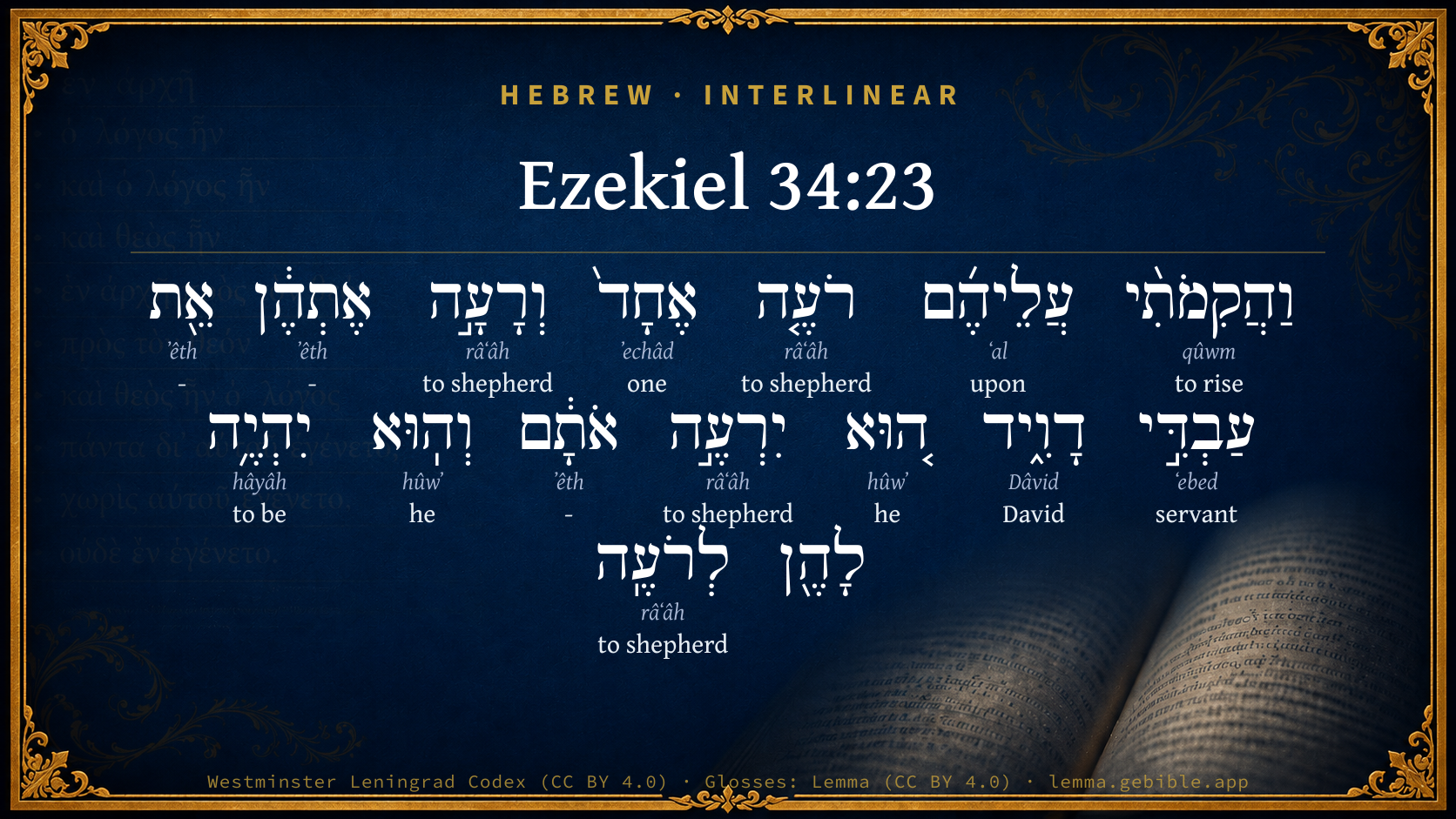
  1. וַהֲקִמֹתִ֨י qûwm H6965 “and · to rise” Conjunction + Verb, Hiphil, Sequential Perfect, 1st Person, Common, Singular
  2. עֲלֵיהֶ֜ם ʻal H5921 “upon · them” Preposition + Suffix, Personal, 3rd Person, Masculine, Plural
  3. אֶחָד֙ ʼechâd H259 “one” Adjective, Cardinal number, Masculine, Singular, Absolute
  4. וְרָעָ֣ה râʻâh H7462 “and · to shepherd” Conjunction + Verb, Qal, Sequential Perfect, 3rd Person, Masculine, Singular
  5. אֶתְהֶ֔ן ʼêth H853 “- · them” Particle, Direct Object + Suffix, Personal, 3rd Person, Feminine, Plural
  6. אֵ֖ת ʼêth H853 “-” Particle, Direct Object
  7. עַבְדִּ֣י ʻebed H5650 “servant · my” Noun, Common, Masculine, Singular, Construct + Suffix, Personal, 1st Person, Common, Singular
  8. דָוִ֑יד Dâvid H1732 “David” Noun, Proper
  9. ה֚וּא hûwʼ H1931 “he” Pronoun, Personal, 3rd Person, Masculine, Singular
  10. יִרְעֶ֣ה râʻâh H7462 “to shepherd” Verb, Qal, Imperfect, 3rd Person, Masculine, Singular
  11. אֹתָ֔ם ʼêth H853 “- · them” Particle, Direct Object + Suffix, Personal, 3rd Person, Masculine, Plural
  12. וְהֽוּא hûwʼ H1931 “and · he” Conjunction + Pronoun, Personal, 3rd Person, Masculine, Singular
  13. יִהְיֶ֥ה hâyâh H1961 “to be” Verb, Qal, Imperfect, 3rd Person, Masculine, Singular
  14. לְרֹעֶֽה râʻâh H7462 “to/for · shepherding” Preposition + Verb, Qal, Participle Active, Masculine, Singular, Absolute

About this verse

These counts appear in no published source. They are computed here, from the morphology-tagged text and Lemma’s own curated glosses. What Lemma adds →

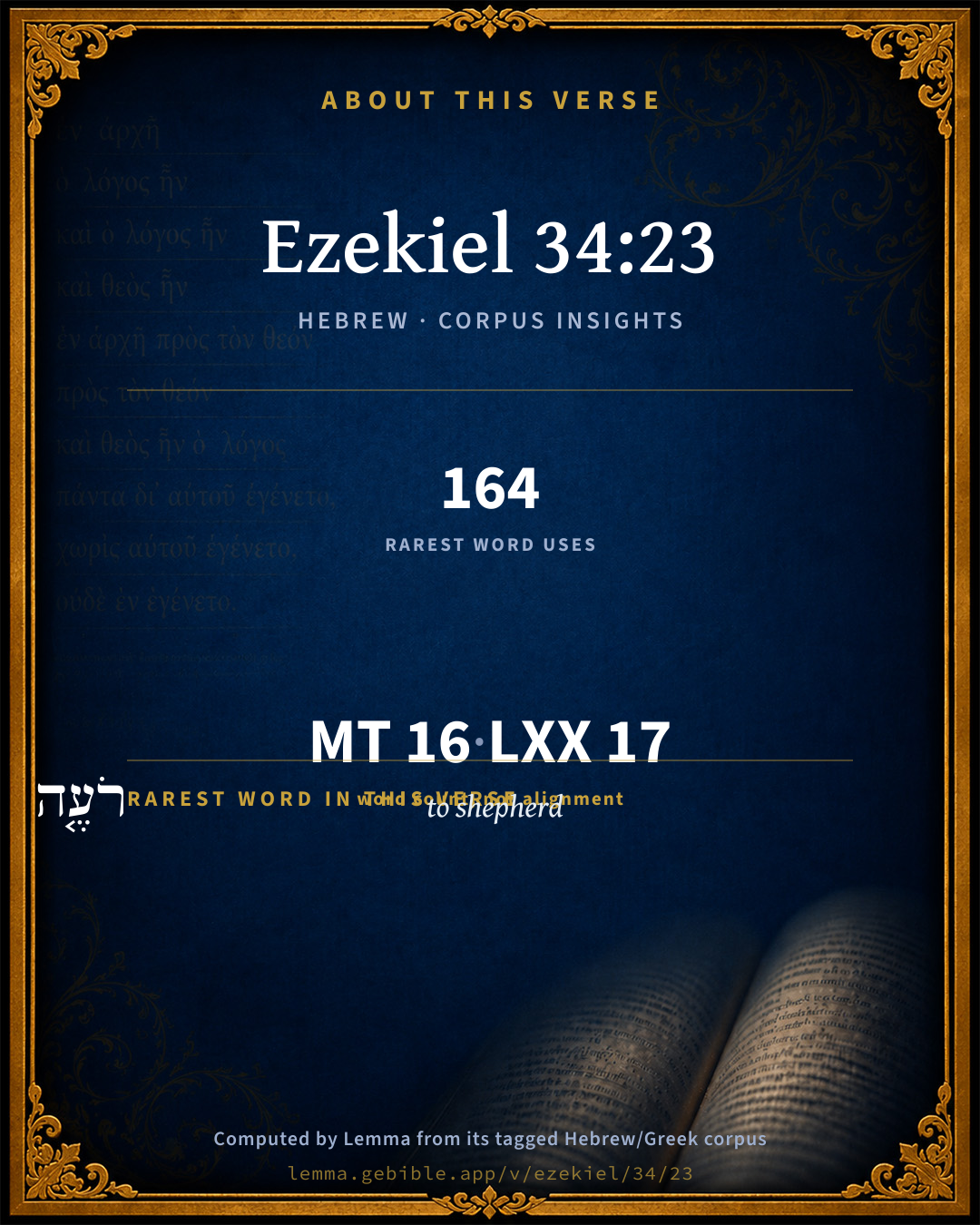
16
words
9
distinct lemmas
Prophets
section

Grammatical profile

  • 6 verbs
  • 2 nouns
  • 1 adjective
  • 2 pronouns
  • 2 prepositions
  • 3 particles

Verb forms

  • וַהֲקִמֹתִ֨י Hiphil · Sequential Perfect
  • רֹעֶ֤ה Qal · Participle Active
  • וְרָעָ֣ה Qal · Sequential Perfect
  • יִרְעֶ֣ה Qal · Imperfect
  • יִהְיֶ֥ה Qal · Imperfect
  • לְרֹעֶֽה Qal · Participle Active

Repetition

Words recur within this verse — often emphatic in Hebrew:

  • רֹעֶ֤ה to shepherd H7462 ×4
  • ה֚וּא he H1931 ×2

Hebrew & Septuagint length

In English translation the verse runs 27 words from the Hebrew and 24 from the Septuagint (LXX English) — closely comparable.

A rough comparison of the two English renderings, which tokenize alike — not a word-level alignment.

Word counts can differ between the Hebrew and the Greek without any difference in meaning — e.g. the Hebrew direct-object marker אֵת has no separate Greek word, and Greek often adds the article ὁ.

In the original languages it is 16 Hebrew tokens and 17 Greek tokens — but the two are counted differently (Hebrew bundles its prefixes and suffixes into one token; the Greek is in lemma form), so that isn’t a like-for-like length.

Cross-references

15

Topical passages linked to Ezekiel 34:23 in the Treasury of Scripture Knowledge — connected by theme and wording, ordered by reader-vote popularity; previews shown in the World English Bible.

  • Jeremiah 30:9 but they shall serve Yahweh their God, and David their king, whom I will raise up to them.
  • Ezekiel 37:24–25 My servant David shall be king over them; and they all shall have one shepherd: they shall also walk in my ordinances, and observe my statutes, and do them.
  • Isaiah 40:11 He will feed his flock like a shepherd, he will gather the lambs in his arm, and carry them in his bosom, [and] will gently lead those who have their young.
  • Hosea 3:5 Afterward the children of Israel shall return, and seek Yahweh their God, and David their king, and shall come with trembling to Yahweh and to his blessings in the last days.
  • John 10:11 I am the good shepherd. The good shepherd lays down his life for the sheep.
  • Ecclesiastes 12:11 The words of the wise are like goads; and like nails well fastened are words from the masters of assemblies, which are given from one shepherd.
  • Isaiah 55:3–4 Turn your ear, and come to me; hear, and your soul shall live: and I will make an everlasting covenant with you, even the sure mercies of David.
  • Jeremiah 23:4–6 I will set up shepherds over them, who shall feed them; and they shall fear no more, nor be dismayed, neither shall any be lacking, says Yahweh.
  • 1 Peter 5:4 When the chief Shepherd is revealed, you will receive the crown of glory that doesn't fade away.
  • Revelation 22:16 I, Jesus, have sent my angel to testify these things to you for the assemblies. I am the root and the offspring of David; the Bright and Morning Star."
  • Isaiah 11:1 There shall come forth a shoot out of the stock of Jesse, and a branch out of his roots shall bear fruit.
  • Micah 5:2–5 But you, Bethlehem Ephrathah, Being small among the clans of Judah, Out of you one will come forth to me that is to be ruler in Israel; Whose goings forth are from of old, from everlasting.
  • Zechariah 13:7 "Awake, sword, against my shepherd, And against the man who is close to me," says Yahweh of Hosts. Strike the shepherd, and the sheep will be scattered; And I will turn my hand against the little ones.
  • Hebrews 13:20 Now may the God of peace, who brought again from the dead the great shepherd of the sheep with the blood of an eternal covenant, our Lord Jesus,
  • 1 Peter 2:25 For you were going astray like sheep; but are now returned to the Shepherd and Overseer of your souls.

Cross-references courtesy of OpenBible.info (CC BY 4.0).

Hebrew and Greek witnesses Masoretic Hebrew ↔ Greek Septuagint

The same verse in the two great witnesses to the Old Testament, shown verse-for-verse.

These are two independent witnesses, not word-aligned to each other, and the Septuagint is shown in lemma (dictionary) form.

Hebrew Ezekiel 34:23 Masoretic · Westminster Leningrad Codex

וַהֲקִמֹתִ֨י עֲלֵיהֶ֜ם רֹעֶ֤ה אֶחָד֙ וְרָעָ֣ה אֶתְהֶ֔ן אֵ֖ת עַבְדִּ֣י דָוִ֑יד ה֚וּא יִרְעֶ֣ה אֹתָ֔ם וְהֽוּא יִהְיֶ֥ה לָהֶ֖ן לְרֹעֶֽה

I will set up one shepherd over them, and he shall feed them, even my servant David; he shall feed them, and he shall be their shepherd.

World English Bible · Public Domain

Greek LXX Ezekiel 34:23 Septuagint · lemma form

καί ἀναἵστημι ἐπί αὐτός ποιμήν εἷς καί ποιμαίνω αὐτός ὁ δοῦλος ἐγώ δαυίδ καί εἰμί αὐτός ποιμήν

And I will raise up one shepherd over them, and he shall tend them, even my servant David, and he shall be their shepherd;

LXX2012 (modern English Septuagint) · Public Domain

On this verse, Whedon's Commentary on the Bible discusses the Septuagint’s reading. Read the note in Commentary ↓

Hebrew: Westminster Leningrad Codex (CC BY 4.0). Greek: Septuagint (public domain); English from LXX2012 (modern English Septuagint) (Public Domain). How the Septuagint differs from the Hebrew →

Targum (Aramaic paraphrase)

1

The Targum is the ancient Jewish Aramaic paraphrase of the Hebrew Scriptures — an interpretive translation, not the Hebrew text itself. Onkelos (literal) and Pseudo-Jonathan (expansive) render the Torah, and Jonathan the Prophets. Coverage is partial: where no permissively-licensed English translation exists for a verse, only the Aramaic is shown. This is verse-level text, not a word-by-word alignment to the Hebrew.

  1. Targum Jonathan Prophets (Joshua–Malachi)
    וְאָקֵים עֲלֵיהוֹן פַּרְנֵס חַד וִיפַרְנֵיס יַתְהוֹן וְהוּא יְהֵי לְהוֹן לְפַרְנֵס:

    (no public-domain English translation for this verse)

    Targum Jonathan — Aramaic: “Mikraot Gedolot” (public domain). English: “Sefaria Community Translation” (CC0 1.0 (public-domain dedication)); “London "Chaldee Paraphrase," 1871” (public domain). Text via Sefaria.

Commentary

Notes on Ezekiel 34:23 from classic Christian and Jewish commentators (each source and its license shown beneath its notes). The classic Christian expositions comment on the surrounding passage and are grouped to its opening verse, so a note may address several verses; the Jewish commentaries on the Tanakh (Rashi and others) are per-verse, so they appear only where the commentator wrote on this verse.

Lemma curates 59 commentaries, every one of them public domain or Creative Commons licensed, each selected and text-cleaned for this edition rather than reprinted as found. About our sources →

Trapp's Complete Commentary

John Trapp

Eze 34:23 And I will set up one shepherd over them, and he shall feed them, [even] my servant David; he shall feed them, and he shall be their shepherd.

Ver. 23. And I will set up one shepherd.] Who, indeed, is the only shepherd. Magistrates and ministers are shepherds; but Christ is the "good shepherd"; {Joh 10:11} the "great shepherd and bishop of souls"; {1Pe 2:25 Heb 13:20} the true shepherd, above all for skill, love, and power; above Jacob, above David, of whom he descended, and by whose name he is here called. {so Jer 30:9 Hos 3:5 Eze 37:24}

Even my servant David,] i.e., Christ, the son and successor of David, not David George as that odious heretic who died at Basil blasphemously applied this text to himself, as if he had been the man here intended. The Jews themselves confess that Messiah is here meant.

He shall feed them.] This is thus repeated, as that which containeth a world of comfort. It showeth also that Christ will do it to the utmost. Jacob was a sedulous shepherd; Christ much more.

John Trapp, A Commentary or Exposition upon All the Books of the Old and New Testament (1647–1656) — public domain. Text from a community e-Sword module.

The Biblical Illustrator

Joseph S. Exell

Eze_34:23

Even My servant David; he shall feed them.

The Davidic ruler

The meaning cannot be that David would in person revive and reappear. It is more doubtful whether the prophet means that the line or family of David would again occupy the throne or that a single person would be king. It is possible that this question was not strictly before his mind; it is the character of the ruler that he thinks of. The Oriental mind hardly distinguishes between an ancient personage and one who appears in his power and spirit; when it compares it identifies. The new prince over the people will be David, the servant of the Lord. Both the person and the reign of David were idealised. He was not in general terms but in truth the man after Gods own heart. His rule was not merely extensive; it was universal. He gave the people victory and secured them peace--he was a leader and commander of the people. Such shall be the king of the restored community when Jehovah is indeed the God of Israel. (A. B. Davidson, D. D.)

The Biblical Illustrator, edited by Joseph S. Exell (c. 1880s–1900s) — public domain. Text from a community e-Sword module.

Joseph Benson's Commentary

Eze 34:23-25. And I will set up one Shepherd — That is, the Messiah, “the true Shepherd, who hath given himself this name both in the prophets and in the gospel, and who hath perfectly fulfilled all the duties, the characters whereof have been before described. He is called David, because he sprung from David according to the flesh; because he possessed eminently and really all those qualities which the Scriptures give to David as the type of the Messiah; and because he was the person in whom all the promises made to David were fulfilled. Though this prophecy was in a great measure completed when Christ, by the preaching of the gospel, gathered into one the children of God, among whom were many of the lost sheep of Israel, yet it will receive a further completion at the general conversion of the Jews.” — Calmet. I the Lord will be their God — I will renew my covenant with them, and receive them again into my protection. I will be a God all-sufficient for them, and they shall not, as formerly, have recourse to any other. And my servant David a prince among them — To reduce them to their allegiance, to receive their homage, and to reign over them, in them, and for them. Observe, reader, those, and those only, that have the Lord Jesus for their Prince, have the Lord Jehovah for their God. And I will make with them a covenant of peace — The covenant of grace is this covenant of peace; in it God is at peace with penitent and obedient believers, speaks peace to them, and assures them of peace with him, and of all good, even all the good they need to make them happy. This peace is through Jesus Christ, who hath procured it for us by his merits, and imparts it to us by his Spirit. He is the peace predicted by Mic 5:5. Peace to men was announced at his birth; his gospel is the gospel of peace, and he himself is the God and King of peace: in short, he it is who pacifieth all things and reconciles and unites in one Jews and Gentiles, God and man, heaven and earth. And I will cause the evil beasts to cease out of the land — Persecutors shall no more distress my church, nor infidels seduce them. They shall dwell safely in the wilderness, and sleep in the woods — They shall be perfectly safe, by night as well as by day, under my protection. He alludes to the circumstance of the eastern shepherds frequently lying abroad in the fields with their flocks during the night, without a tent to shelter them.

Joseph Benson's Commentary on the Old and New Testaments (1811–1818) — public domain. Text from a community e-Sword module.

Keil & Delitzsch

C. F. Keil & F. Delitzsch

Appointment of David as Shepherd, and Blessing of the People

Eze 34:23. And I will raise up one shepherd over them, who shall feed them, my servant David; he will feed them, and he will be to them a shepherd. Eze 34:24. And I, Jehovah, will be God to them, and my servant David prince in the midst of them: I, Jehovah, have spoken it. Eze 34:25. And I will make a covenant of peace with them, and destroy the evil beasts out of the land, so that they will dwell safely in the desert and sleep in the forests. Eze 34:26. And I will make them and the places round my hill a blessing, and cause the rain to fall in its season: showers of blessing shall there be. Eze 34:27. The tree of the field will give its fruit, and the land will give its produce, and they will be safe in their land, and will know that I am Jehovah, when I break their yoke-bars in pieces, and deliver them out of the hand of those who made them servants. Eze 34:28. They will be no more a prey to the nations, and the wild beasts will not devour them; but they will dwell safely, and no one will terrify them. Eze 34:29. And I will raise up for them a plantation for a name, so that they will no more be swept away by famine in the land, and shall no longer bear the disgrace of the heathen nations. Eze 34:30. And they shall know that I, Jehovah, their God, am with them, and they are my people, the house of Israel, is the saying of the Lord Jehovah. Eze 34:31. And ye are my sheep, the flock of my pasture; ye are men, I am your God, is the saying of the Lord Jehovah. - God will cause to stand up, raise up, one single shepherd over His flock. הקים, the standing expression for the rising up of a person in history through the interposition of God (cf. Deu 18:15; Sa2 7:12, and other passages). רעה, not unicus, singularis, a shepherd unique in his kind, but one shepherd, in contrast not only with the many bad shepherds, but with the former division of the people into two kingdoms, each with its own separate king. Compare Eze 37:24 with Jer 28:6, where it is expressly said that the David to be raised up is to feed Israel and Judah, the two peoples that had been divided before. "My servant David:" Jehovah calls him עבדּי, not merely with reference to the obedience rendered (Hvernick), but also with regard to his election (Isa 42:1; Hengstenberg). There is no necessity to refute the assertion of Hitzig, David Strauss, and others, that Ezekiel expected the former King David to be raised from the dead. The reference is to the sprout of David (Jer 23:5), already called simply David in Hos 3:5 and Jer 30:9. In Eze 34:24 the relation of Jehovah to this David is more precisely defined: Jehovah will then be God to His people, and David be prince in the midst of them. The last words point back to Sa2 7:8. Through the government of David, Jehovah will become in truth God of His people Israel; for David will feed the people in perfect unity with Jehovah, - will merely carry out the will of Jehovah, and not place himself in opposition to God, like the bad shepherds, because, as is therewith presupposed, he is connected with God by unity of nature.

In Eze 34:25. the thought is carried out still further, - how God will become God to His people, and prove Himself to be its covenant God through the pastoral fidelity of the future David. God will fully accomplish the covenant mercies promised to Israel. The making of the covenant of peace need not be restricted, in accordance with Hos 2:20 (18), to a covenant which God would make with the beasts in favour of His people. The thought is a more comprehensive one here, and, according to Lev 26:4-6, the passage which Ezekiel had in his mind involves all the salvation which God had included in His promises to His people: viz., (1) the extermination of everything that could injure Israel, of all the wild beasts, so that they would be able to sleep securely in the deserts and the forests (Eze 34:25, compare Lev 26:6); (2) the pouring out of an abundant rain, so that the field and land would yield rich produce (Eze 34:26, Eze 34:27; cf. Lev 26:4-5). "I make them, the Israelites, and the surroundings of my hill, a blessing." גּבעתי, the hill of Jehovah, is, according to Isa 31:4, Mount Zion, the temple-mountains, including the city of Jerusalem. The surroundings of this hill are the land of Israel, that lay around it. But Zion, with the land around, is not mentioned in the place of the inhabitants; and still less are we to understand by the surroundings of the hill the heathen nations, as Hengstenberg does, in opposition both to the context and the usage of the language. The thought is simply that the Lord will make both the people and the land a blessing (Hvernick, Kliefoth). בּרכה, a blessing, is stronger than "blessed" (cf. Gen 12:2). The blessing is brought by the rain in its season, which fertilizes the earth. This will take place when the Lord breaks the yokes laid upon His people. These words are from Lev 26:13, where they refer to the deliverance of Israel from the bondage of Egypt; and they are transferred by Ezekiel to the future redemption of Israel from the bondage of the heathen. For עבדים , compare Exo 1:14. This thought is carried out still further in Eze 34:28; and then, in Eze 34:29, all that has been said is summed up in the thoughts, "I raise up for them a plantation for a name," etc. מטּע, a plantation, as in Eze 17:7; not a land for planting (Hitzig). לשׁם, for a name, i.e., not for the glory of God (De Wette); but the plantation, which the Lord will cause to grow by pouring down showers of blessing (Eze 34:26), is to bring renown to the Israelites, namely, among the heathen, who will see from this that Israel is a people blessed by its God. This explanation of the words is supplied by the following clause: they shall no more be swept away by famine in the land, and no more bear the disgrace of the heathen, i.e., the disgrace which the heathen heaped upon Israel when in distress (compare Zep 3:19; Jer 13:11; and the primary passage, Deut. 26:29). From this blessing they will learn that Jehovah their God is with them, and Israel is His people. The promise concludes in Eze 34:31 with these words, which set a seal upon the whole: "Ye are my flock, the flock of my pasture (lit., my pasture-flock; צאן , Jer 23:1, the flock fed by God Himself); men are ye, I am your God." That these last words to not serve merely as an explanation of the figurative expression "flock," is a fact of which no proof is needed. The figure of a flock was intelligible to every one. The words "call attention to the depth and greatness of the divine condescension, and meet the objection of men of weak faith, that man, who is taken from the earth האדמה, and returns to it again, is incapable of so intimate a connection with God" (Hengstenberg).

If we take another survey, in conclusion, of the contents of our prophecy, the following are the three features of the salvation promised to the people of Israel: - (1) The Lord will liberate His people from the hand of the bad shepherds, and He Himself will feed it as His flock; (2) He will gather it together from its dispersion, bring it back to the land of Israel and feed it there, will take charge of the sheep in need of help, and destroy the fat and strong sheep by which the weak ones are oppressed; (3) He will raise up the future David for a shepherd, and under his care He will bestow upon His people the promised covenant blessings in richest measure. These saving acts of God for His people, however, are not depicted according to their several details and historical peculiarities, as Kliefoth has correctly observed, nor are they narrated in the chronological order in which they would follow one another in history; but they are grouped together according to their general design and character, and their essential features. If, then, we seek for the fulfilment, the Lord raised up His servant David as a shepherd to Israel, by sending Jesus Christ, who came to seek and to save that which was lost (Luk 19:10; Mat 18:11), and who calls Himself the Good Shepherd with obvious reference to this and other prophetic declarations of a similar kind (Joh 10:11.). But the sending of Christ was preceded by the gathering of Israel out of the Babylonian exile, by which God had already taken charge of His flock, Yet, inasmuch as only a small portion of Israel received the Messiah, who appeared in Jesus, as its shepherd, there fell upon the unbelieving Israel a new judgment of dispersion among all nations, which continues still, so that a gathering together still awaits the people of Israel at some future time. No distinction is made in the prophecy before us between these two judgments of dispersion, which are associated with the twofold gathering of Israel; but they are grouped together as one, so that although their fulfilment commenced with the deliverance of Israel from the Babylonian captivity and the coming of Jesus Christ as the Good Shepherd of the family of David, it was only realized in that portion of Israel, numerically the smallest portion, which was willing to be gathered and fed by Jesus Christ, and the full realization will only be effected when that conversion of Israel shall take place, which the Apostle Paul foretells in Rom 11:25. - For further remarks on the ultimate fulfilment, we refer the reader to a later page.

Keil & Delitzsch — Biblical Commentary on the Old Testament (1861–1891) — public domain (CC PDM 1.0). Text via the HelloAO Bible API. (Old Testament only.)

Tyndale Open Study Notes

Tyndale Open Resources

34:23-24 one shepherd, my servant David: God planned to raise up David’s offspring to succeed him (2 Sam 7:12-16). This “new David,” like the first one, would be the Lord’s servant, a man after God’s own heart, and a good shepherd of his people.

Tyndale Open Study Notes — © Tyndale Open Resources, licensed CC BY-SA 4.0. Text via the HelloAO Bible API.

Geneva Bible (1599)

Geneva Bible translators

Meaning Christ, of whom David was a figure, Jer. 30:9; Hos. 3:5.

Geneva Bible (1599) marginal notes — public domain. Text via Bolls.life.

Jamieson, Fausset & Brown

Robert Jamieson, A. R. Fausset & David Brown

set up--that is, raise up by divine appointment; alluding to the declaration of God to David, "I will set up thy seed after thee" (Sa2 7:12); and, "Yet have I set My king on My holy hill of Zion" (Psa 2:6; compare Act 2:30; Act 13:23).

one shepherd--literally, "a Shepherd, one": singularly and pre-eminently one: the only one of His kind, to whom none is comparable (Sol 5:10). The Lord Jesus refers to this prophecy (Joh 10:14), "I am THE Good Shepherd." Also "one" as uniting in one the heretofore divided kingdoms of Israel and Judah, and also "gathering together in one all things in Christ, both which are in heaven and on earth" (Eph 1:10); thus healing worse breaches than that between Israel and Judah (Col 1:20). "God by Him reconciling all things unto Himself, whether things in earth or in heaven."

David--the antitypical David, Messiah, of the seed of David, which no other king after the captivity was: who was fully, what David was only in a degree, "the man after God's own heart." Also, David means beloved: Messiah was truly God's beloved Son (Isa 42:1; Mat 3:17). Shepherd means King, rather than religious instructor; in this pre-eminently He was the true David, who was the Shepherd King (Luk 1:32-33). Messiah is called "David" in Isa 55:3-4; Jer 30:9; Hos 3:5.

Jamieson, Fausset & Brown — Commentary Critical and Explanatory on the Whole Bible (1871) — public domain (CC PDM 1.0). Text via the HelloAO Bible API.

Adam Clarke's Commentary

Verse 23. I will set up one Shepherd - my servant David] DAVID, king of Israel, had been dead upwards of four hundred years; and from that time till now there never was a ruler of any kind, either in the Jewish Church or state, of the name of David. This, then, must be some typical person; and from the texts marked in the margin we understand that Jesus Christ alone is meant, as both Old and New TESTAMENTS agree in this. And from this one Shepherd all Christian ministers must derive their authority to teach, and their grace to teach effectually.

By the kind providence of God it appears that he has not permitted any apostolic succession to be preserved, lest the members of his Church should seek that in an uninterrupted succession which must be found in the HEAD alone. The papists or Roman Catholics, who boast of an uninterrupted succession, which is a mere fable that never was and never can be proved, have raised up another head, the POPE. And I appeal to themselves, in the fear of God, whether they do not in heart and in speech trace up all their authority to him, and only compliment Christ as having appointed Peter to be the first bishop of Rome, (which is an utter falsity, for he was never appointed to such an office there, nor ever held such an office in that city, nor, in their sense, any where else;) and they hold also that the popes of Rome are not so much Peter's successors as God's vicars; and thus both God and Peter are nearly lost sight of in their papal enumerations. With them the authority of the Church is all in all; the authority of Christ is seldom mentioned.

Adam Clarke's Commentary on the Bible (1810–1826) — public domain. Text from a community e-Sword/MySword module.

Ellicott's Commentary for English Readers

(23) Set up one shepherd.—He is one both with reference to the many evil rulers who have gone before (and this implies the perpetuity of His rule), and also with reference to the two kingdoms of Israel, which are hereafter to be for evermore united in the one Church of God. Obviously this prophecy can find its accomplishment in no merely human ruler.

My servant David.—The name of David is here put simply, as in Eze_34:24, Eze_37:24-25; Jer_30:9; Hos_3:5, instead of the more usual designations of the Messiah as the Son, the Branch, the Offspring of David; but there can be no possible doubt of the meaning, any more than of who is meant by Elijah in Mal_4:5, in view of our Lord’s own interpretation in Mat_11:14; Mat_17:11-14. Yet it should be remembered, if any one should incline to understand this whole prophecy literally, that if one part is to be so understood the rest must be taken in the same way; if we are to think that the prophet here foretells the literal restoration of the two kingdoms of Israel to their own land, and their union under one governor, then that governor must be David himself. The absurdity of such a supposition is one important element in showing that the whole is to be understood of a promise of spiritual blessings, and of the gathering of God’s people into His Church as one flock under their Almighty Shepherd. (Comp. Joh_10:14-18.) David, as the head of the theocracy and the ancestor of our Lord after the flesh, constantly appears in the Scriptures as the type of the Messiah, and there can be no reasonable doubt that this prophecy must have been so understood, even at the time when it was uttered.

A Bible Commentary for English Readers, edited by Charles John Ellicott (1878–1897) — public domain. Text from a community e-Sword module.

The Cambridge Bible for Schools and Colleges

gen. ed. J. J. S. Perowne

23. my servant David] The meaning cannot be that David would in person revive and reappear. It is more doubtful whether the prophet means that the line or family of David would again occupy the throne or that a single person would be king. It is possible that this question was not strictly before his mind; it is the character of the ruler that he thinks of. The oriental mind hardly distinguishes between an ancient personage and one who appears in his power and spirit; when it compares it identifies. The new prince over the people will be David, the servant of the Lord. Both the person and the reign of David were idealized. He was not in general terms but in truth the man after God’s own heart. His rule was not merely extensive, it was universal. He gave the people victory and secured them peace—he was a leader and commander of the peoples (Isa_55:4; Psa_18:43). Such shall be the king of the restored community when Jehovah is indeed the God of Israel. For it is to be noted that in Messianic prophecy it is Jehovah who saves the people (Eze_34:22 and preceding verses); then he appoints a shepherd over the restored community, who feeds them in righteousness and peace. The Messiah is the king of the saved community, whom he rules in the fear of the Lord with all royal and godly qualities; and the virtues of his character, fruit of the spirit of the Lord, communicate themselves to those whom he rules (Isaiah 11). It is possible that the phrase “one shepherd” is to be interpreted as in Eze_37:24, with the meaning that the two kingdoms shall be one, and that this is part of the meaning of the term “David,” cf. Hos_1:11; Hos_3:5; Amo_9:11. See more fully ch. 37.

23–28. Instead of the many worthless shepherds of old there shall in the future be one good shepherd, even David, and Jehovah shall in truth be God of Israel.

The Cambridge Bible for Schools and Colleges (gen. ed. J. J. S. Perowne; Cambridge University Press, 1878–1918) — public domain. Text from a community e-Sword module.

John Gill's Exposition

And I the Lord will be their God,.... The God of them Christ is the shepherd of, and whom he feeds; the sheep and poor of the flock: this is the great blessing of the everlasting covenant, and than which there cannot be a greater, to have the Lord, the everlasting and unchangeable Jehovah, to be a covenant God and Father:

and my servant David a Prince among them; who should reside among them, dwell with them, by granting them his spiritual presence, and so rule over them, protect and defend them; even he who is the Prince of the kings of the earth, and is exalted, a Prince and a Saviour of his people Israel; he is such a Shepherd as that he is a Prince; and such a Prince as that he is a Saviour and under whose princely government is the greatest safety:

I the Lord have spoken it; and therefore it shall assuredly be. The Targum is,

"I the Lord have decreed it in my word;''

he had determined it within himself, and promised it in covenant, and spoke of it in prophecy, and it should be fulfilled.

John Gill's Exposition of the Whole Bible (1746–1763) — public domain (CC PDM 1.0). Text via the HelloAO Bible API.

Haydock's Catholic Bible Commentary

David; Christ, who is of the house of David. (Calmet) --- That king had been dead long before, so that no Jew or heretic can deny but that the Messias is here meant, as [in] chap. xxxvii. 24., &c. (Worthington) --- He possessed eminently all the virtues of David, and was of his seed. Zorobabel, &c., cannot be understood, as we have no proof that the governors after the captivity were chosen from the tribe of Juda, chap. xxi. 27.

George Leo Haydock (1774–1849), Haydock's Catholic Family Bible and Commentary, 1859 edition — public domain. Excludes Psalms (Douay-Rheims chapter numbering differs from Protestant) and Deuterocanonical books (Catholic canon only).

Matthew Poole's English Annotations

I will set; advance, establish, and make great; thus I will appoint and set up.

One shepherd: formerly their many shepherds destroyed, as Jer 12:10; now this one shall save. Literally and historically Zerubbabel may be somewhat intended, but principally and plenarily, as Christ is intended here, so in him it was accomplished; for he is the great, good, chief, only Shepherd, that laid down his life for his sheep.

Feed them; give them best, most abundant, and most seasonable food, he also shall govern them in righteousness, and with equity.

My servant David; Messiah, (as Kimchi on the place,) of the seed of David, the beloved One, who was typified by David, and in other places called by this name, as Isa 37:35; Jer 30:9; Eze 37:24; Hos 3:5.

He shall do all the office of a good and faithful shepherd, and that for ever. I will trust them in his hands, for he will keep them, that not one of them shall be lost, but shall go in and out under his hand, and find pasture.

Matthew Poole's English Annotations on the Holy Bible (1683–1685) — public domain. Text from a community e-Sword/MySword module.

Whedon's Commentary on the Bible

Daniel D. Whedon

23-31. The Messianic hope of the coming of my servant David — the ideal prince (compare Eze_37:22; Eze_37:24; Psa_78:70-71; Isa_56:3-8; 1Ki_9:9; 1Ki_11:4) — who shall shepherd the people and make them to dwell in safety in the wilderness (the uninhabited pasture country) and sleep even in the woods — the native home of wild beasts (Eze_34:25; compare Lev_26:6) — closes each prophetic “vision” of the future. The second David of Ezekiel towers high above all the pictures of princes for whom former prophets had longed. This is Ezekiel’s “portrait of the Messiah” (compare Jer_30:9, and Delitzsch, Old Testament History of Redemption): Jehovah will save his people (Eze_34:22); be their God (Eze_34:24; compare Eze_37:27); make with them a new covenant of everlasting peace (compare Isaiah 11; Jer_31:31; Hos_2:20); and pour blessed showers upon the new Israel who resides upon his holy hill (compare Eze_20:40; Eze_47:12). He will break their yoke (Eze_34:27), deliver them from all enemies, at home and abroad (Eze_34:28), “establish” for them a prosperous “plantation” (not plant) which shall be renowned for its fertility throughout all lands (Eze_34:29; compare Eze_39:13; Isa_55:13; Joe_2:21-27; Psa_67:6; Psa_71:16), and will be to them a good shepherd evermore (Eze_34:31). LXX. omits are men in Eze_34:31.

For apt remarks concerning duties of pastor to people compare Adam Clarke, in loco.

Daniel D. Whedon (gen. ed.), Commentary on the Old and New Testaments (1874–1909) — public domain. Text from a community e-Sword module.

The Pulpit Commentary

And I will set up one Shepherd over them. Here, more than ever, we have an anticipation of our Lord"s teaching in Joh_10:1-18.

He claims to be the Fulfiller, as of the prediction of Isa_40:11 and Jer_23:1-3, so also of this. He, the "Son of David," is the David that inherits that among other promises. It has to be noted, however, that Ezekiel"s words paint, less distinctly than those of the earlier prophets, the picture of an individual Messianic king, and seem rather to point, as do those of, (Zec_12:10 I do not now discuss the date of that prophecy) to a line of true rulers, each faithfully representing the ideal David as the faithful Ruler, the true Shepherd of his people. (Psa_78:71; comp. Eze_37:24 Eze_45:8, Eze_45:9)

The one shepherd.

In place of the many unworthy shepherds who have fattened themselves by spoiling the flock of Israel, God will now give his people one good Shepherd, reviving the royal line of David. The shepherd of Bethlehem had been a true protector of his people. He is to appear again in his great Descendant. No doubt Ezekiel"s contemporary readers would look for a restoration of the temporal monarchy, as Christ"s disciples looked for it. (Act_1:6) But such a restoration was never accomplished. The prophecy is fulfilled in a higher though an unexpected way by Christ as our good Shepherd.

I THE PERSON OF THE SHEPHERD. "My servant David." Jesus Christ is the only person to whom these words can apply. Not only was he of the family of David; he realized to the full the ideal that David set forth in broken lights and failed to attain himself. He is the true David, the true Shepherd-King. Thus amid the sorrows of the exile, the disconsolate captives are cheered by a vision of the coming Christ, though as yet but vaguely and dimly discerned. We, with fuller knowledge, can turn from our disappointments and failures and find consolation in the Christ who has come and who is ever in our midst. Perhaps if the old shepherds had not been so unworthy, this wonderful prediction of the new Shepherd would not have been made. The disappointments of worldly confidence drive us to Christ. When earthly friends "fail or leave us," we need the true Friend who "sticketh closer than a brother." If Christian ministers have been unworthy, Christ abides faithful. Perhaps too much confidence was given to the human instruments; then the shock of discovering this to be misplaced may not be wholly hurtful; it may help the Church to look away from men and trust only in Christ.

II THE APPOINTMENT OF THE SHEPHERD. He is set up by God. God sent Christ. It is God"s will that his scattered sheep should be restored. That was stated earlier (see vers. 11, 12). Now we see how it is to be done. Christ is to be the new Shepherd who will seek and find the lost sheep. He comes to us thus with all the authority of his Father. He is called God"s "Servant a remarkable and unusual expression for the Messiah. This reminds us of "the Servant of the Lord" in the latter part of Isaiah. The name was recalled by St. Peter when preaching to the Jews. (Act_3:13) St. Paul tells us that in his great humiliation Christ took on him the form of a servant. (Php_2:7) This agrees with the whole spirit of the life of our Lord, who came not to do his own will, but the will of him that sent him. It implies a rebuke of the bad shepherds, who had only pleased themselves and so neglected their Master"s interests. They were too proud to consider themselves servants. But the great Son of David is willing to be a Servant.

III THE WORK OF THE SHEPHERD.

1. He rules the flock. He is "set over" the sheep. The shepherd has authority over the flock. They are required to follow him. He shuts them up in the fold at night. Christ is King, as the Greater David. He is appointed to rule his flock as the Shepherd and Bishop of souls. If we would profit by his care we must obey his voice.

2. He feeds the flock. They would starve in the wilderness. The shepherd can lead them into the green pastures. He can supply them with winter stores. Christ feeds his people with his own body and blood.

3. He saves the flock. Though not stated in this verse, and perhaps not directly following from the preceding verses, this is very prominent in our Lord"s own description of his work. By the sacrifice of his own life he saves his sheep. (Joh_10:15) The favorite picture of the persecuted early Christians, on the walls of the catacombs at Rome, is perhaps the choicest of all representations of Christ viz. the good Shepherd.

Vers. 23, 24A pastor and a prince.

Christians cannot fail to recognize the Messianic reference of this portion of prophecy. The language employed not only exactly depicts him who is "Immanuel, God with us;" it is so exalted that it is not possible to refer it to any inferior being, to any under-shepherd of the flock, any overseer and ruler in the Church subject to human infirmities and failings.

I THE SOLE SUPREMACY OF CHRIST OVER THE FLOCK. The "one Shepherd," God"s "servant David," who can this be but Christ? For he is the Head of the new humanity, who has made both one. "There shall be one flock and one Shepherd." This is no other than the one Mediator between God and man, the Man Christ Jesus.

II THE SACRIFICIAL DEATH OF CHRIST FOR HIS FLOCK. Christ"s people are a purchased possession; he laid down his life for the sheep. Thus he proved his love; thus he accomplished the gracious purposes of his Father; thus he effected the deliverance of his ransomed ones from the power of the enemy. All that the Savior does for his people is comprehended in and follows from his identification of himself with them in his incarnation and sacrifice.

III THE PERPETUAL SWAY OF CHRIST OVER HIS FLOCK. God"s servant is appointed to be, not only the pastor, but the prince, of the redeemed. His rule is marked by justice and equity, and at the same time by benignity and compassion. He is the Prince of righteousness and the Prince of peace. His dominion shall be universal sea to sea, and from the river unto the ends of the earth." His dominion shall be imperishable from one generation to another, "and of the increase of his government there shall be no end.

APPLICATION. These representations of Christ summon all the members of his flock to accept with gratitude his pastoral provision and care; and to submit with cheerfulness to his just and gracious rule. T.

Vers. 23-41The golden age of peace.

Predictions of Divine retribution, added to bitter experience of misfortune, had well-nigh filled the souls of the people with despair. And despair is a critical condition for man. It may lead to self-abandonment, to the wildest excesses of vice and devilry. Will God make no interposition on their behalf? Must their only prospect be midnight, unrelieved by a single star? No! over the black cloud God again flings the bow of gracious promise. Black midnight shall be followed by a roseate dawn. The old order shall give place to a new. A nobler kingdom shall be set up.

I A NEW KING. He is described as "my servant David." This description is not to be accepted literally, but symbolically. The people could not understand the magnificent purpose of God by any other language. As God stoops to our infantile state by describing heaven to us in language borrowed from earth, so did he portray the era of Messiah"s reign by language borrowed from the most prosperous events in their past career. Despite all his failings, David had been their most illustrious sovereign. His reign had brought them prosperity and honor and great enlargement. They shall have another David a better David. In reality, as well as in name, he shall be the "Beloved," even "the Man after God"s own heart." God shall make the appointment, therefore questions touching its wisdom may well be silenced. The King of their King is God, therefore the new Monarch shall be a true Shepherd, viz. one who will care more for the flock than for himself. The spirit of his reign shall be love.

II A NEW CHARTER OF INCORPORATION. "I will make them a covenant of peace." For centuries past they had tasted the horrors and the misery of war. Civil strife and foreign invasion had made the beauteous land a desolation. War between man and man had been incessant, because the whole nation was at war with God. The influence, the virtue, the spirit of the new King were designed to spread until they had permeated the whole nation. Love to God would produce benevolence to each other. Further, it was an act of incomparable condescension on the part of God to make such a covenant with men, particularly with such rebellious men. For a covenant is a contract which brings" obligation on both parties entering into its and which deprives them of a portion of their liberty. So, in amazing kindness to men, and that he may lift them up, God freely brings himself under obligation, and gives to undeserving men a right they did not before possess. This gracious covenant embraced the most precious interests of the true Israel, and was appointed as a root of prosperity and joy. And the conclusion of the covenant was guaranteed. "I," said God, "I will make" it. Hence it included the solution of men"s opposition. It deals with men in their internal nature as well as in their outward conduct. Divine love will gradually melt all hostility, and will fertilize human nature with heavenly grace. "They shall be my people.

III A NEW ERA OF PROSPERITY. A long catalogue of beneficial effects are specified.

1. Civic concord. "I will cause the evil beasts to cease." By evil beasts we may properly understand unprincipled and oppressive men. A gracious influence shall touch and remodel the characters of men. "The wolf shall dwell with the lamb, and the leopard shall lie down with the kid." Instead of an instinct to injure, there shall be an instinct to benefit each other.

2. Personal security. "They shall dwell safely even in the wilderness, and sleep in the woods." The security shall be perfect. The former haunts of robbers shall become the abodes of peace. The very deserts shall resound with the merry laughter of children and with the songs of honest swains.

3. Agricultural fertility. "The tree of the field shall yield its fruit, and the land shall yield her increase." Often in the olden time they sowed a bushel and reaped a peck; but this resulted from God"s displeasure. Now crops shall be prolific. The barren hills shall smile with the olive and the vine. The valleys shall be robed with russet corn. The table of every cottager shall be laden with plenty.

4. Seasonable communications of good. I will cause the shower to come down in its season." As in most lands rain is essential to fertility, so in Messiah"s kingdom the descent of spiritual influence is essential to a fruitful piety. The windows of heaven shall in due season open, and plentifully irrigate the souls of suppliants. Out of the inexhaustible storehouse a gracious supply shall, come.

5. Unprecedented, blessing shall be given. I will raise up for them a plantation of renown. This seems to indicate some useful product of a most beneficent kind "a plantation" remarkable, and that shall bring them high renown. Without question, gifts and graces have been bestowed upon men in this gospel age unheard of in former years; and richer donations of grace are yet in store.

6. Honor. For long and dreary centuries they had borne the reproach of the heathen. They had been the tools of rival kings the laughing-stock of the Gentiles. Now this shall be reversed. In proportion to the depth of their dishonor shall be the height of their exaltation. Not false and meretricious honor shall they have, but that tame honor which is the fruit of righteousness.

7. Intimate friendship with God. Their knowledge of God shall be deep and experimental. They shall have something better than theoretical and speculative knowledge. They shall have the full assurance that God is among them. They shall feel that God has a proprietorship in them, and that they have a proprietorship in God. God is their God. "The house of Israel are my people, saith the Lord God." This is supreme joy, the beginning of heaven, when God dwells in us and we dwell in God. The union is organic, inseparable. D.

Vers. 23, 24. One greater than David.

Certainly this prophecy finds its fulfillment in the coming of the Messiah. He was to be the "great Shepherd," the "chief Shepherd," the "good Shepherd" of the sheep. He was to be to the people of God all, and very much more than all, that David had been in his time. We have thus before us the persons and the work of David and of his "greater Son." The Son of David excelled his human prototype in

I THE GOOD PLEASURE HE GAVE TO THE FATHER. David was a man of God"s own choice, was "the man after his own heart." But there were times when God"s pleasure in him was withdrawn; one time when "the thing that David had done displeased the Lord," and that in no slight degree. But there never was an hour in the life of Jesus Christ when he was not the "beloved Son, in whom the Father was well pleased.

II THE COMPLETENESS OF HIS CHARACTER. David"s character, all things considered, was a very fine one; he was a man we can admire. He was brave, generous, affectionate, devout; he loved the people over whom he reigned, and strove to serve them well. But there were grave defects in his character, showing themselves occasionally in serious mistakes or positive transgressions. But the David of Ezekiel"s prophecy was One whose character lacked nothing whatever. Each one of his attributes was complemented and completed by its opposite gentleness by holiness, sensitiveness by firmness, piety by activity, etc. Once, as it has been well said, and only once, the plant of our humanity bore a perfect flower, and that was when Jesus was born in Bethlehem. In him all the elements that go to make up an absolutely perfect human character met and blended. He was the Son of man, "perfect and entire, wanting nothing." "He was holy, harmless, undefiled;" "and in him was no sin;" "in his mouth no guile was found.

III THE GREAT WORK HE WROUGHT. David did a very good work. He welded the twelve tribes of Israel into one strong nation; he defeated and drove away his country"s enemies; he extended the borders of the land and made Jerusalem a praise and Judah a power in the earth; he bound the people in strong bonds to the worship and service of Jehovah; he wrought for the intelligence and the morality of the people. That was much; but a large part of it was soon undone by unwise or unworthy successors; the kingdom he formed and strengthened was soon cleft in twain, and before very long it was dissolved. How incomparably greater is the work that Jesus wrought!

1. He spoke that truth concerning God and man and human life and character which the world will always want to learn.

2. He lived that life of love and purity, of blamelessness and beauty, of piety and sweetness, in which the world will always find its one faultless instance.

3. He endured those sorrows and died that death which constitute the world"s redemption.

4. He left behind him a message of mercy, an invitation to eternal life which is the world"s great, hope and heritage. It is in his gospel that the real fulfillment of the prophet"s promises are to be found (vers. 25-30).

IV HIS PERSONAL RELATION TO MANKIND. David is a very interesting historical character, whose life we like to study; and we are thankful for the privilege of reading and singing his imperishable psalms. But Jesus Christ, apart from the truth he spoke and the example he left us, is himself the Divine Savior in whom we trust, the Divine Friend we love, the Divine Lord we live to serve. C.

The Pulpit Commentary (1880–1919), ed. H.D.M. Spence-Jones & Joseph S. Exell — public domain. Text from a community e-Sword module.

John Wesley's Explanatory Notes

One shepherd - Christ, the great good, chief, only shepherd, that laid down his life for his sheep. My servant David - The seed of David, the beloved one, who was typified by David, and is in other places called by his name, as Jer. xxx, 9 chap. xxxvii, 24 Isaiah xxxvii, 35 Hosea iii, 5. He shall feed - Do all the office of a good and faithful shepherd, and that forever.

John Wesley, Explanatory Notes Upon the Whole Bible (1754–1765) — public domain. Text via the GEBible commentary corpus.

Kretzmann's Popular Commentary

Paul E. Kretzmann

The Messiah as the true Shepherd

v. 23. And I will set up one Shepherd over them, and He shall feed them, a singular and preeminent one, the Messiah, who claims this honor for himself, Joh 10:14, even My Servant David, the king who was often named as the antitype of Jesus Christ; He shall feed them, and He shall be their Shepherd, the one truly fit to be the Ruler and Protector of His people.

v. 24. And I, the Lord, will be their God, once more occupying this position over against them, and My Servant David, the great Son of David, a Prince among them, as a Ruler in the best sense of the word; I, the Lord, have spoken it.

v. 25. And I will make with them a covenant of peace, namely, by virtue of the atonement of the Savior, Rom 5:1, and will cause the evil beasts, the various enemies who tried to hinder the course of the Gospel, to cease out of the land; and they shall dwell safely in the wilderness, secure in the very midst of the heathen world, as in the case of missionaries, and sleep in the woods, in places where they would ordinarily be in the greatest danger of their lives.

v. 26. And I will make them and the places round about My hill a blessing, literally, "I give them [the people of God] and the environments of My hill as a blessing"; for this is the function of the Church of God in all its congregations, the visible exponents of the invisible communion of saints; and I will cause the shower to come down in his season, there shall be showers of blessing, namely, through the Gospel-message proclaimed in the Church.

v. 27. And the tree of the field shall yield her fruit, and the earth shall yield her increase, the believers being rich in good works as the outgrowth of faith, and they shall be safe in their land, leading a quiet and peaceable life in all godliness and honesty, and shall know that I am the Lord when I have broken the bands of their yoke, that of their spiritual oppression as He broke the yoke of Egypt, Lev 26:13, and delivered them out of the hand of those that served themselves of them, the oppressors who exploited them, including the false teachers of all times.

v. 28. And they shall no more be a prey to the heathen, to the enemies of God everywhere, neither shall the beast of the land devour them, said of the various dangers threatening the existence of the Lord’s Church; but they shall dwell safely, in the security afforded by God’s almighty hand, and none shall make them afraid, causing trepidation and terror within the Church.

v. 29. And I will raise up for them a plant of renown, literally, "a plantation for a name," the expression evidently including both the Messiah Himself, as the Branch of the Lord, Isa 11:1; Jer 23:6, and the Church founded by him as a garden of the Lord, Isa 60:21, and they shall be no more consumed with hunger in the land, namely, with the spiritual hunger which can be satisfied only with the Gospel of God’s grace and mercy, neither bear the shame of the heathen any more, for the mockery of the enemies would finally cease.

v. 30. Thus shall they know that I, the Lord, their God, am with them, and that they, even the house of Israel, those who are Israelites in truth, by faith in the one Redeemer, are My people, saith the Lord God.

v. 31. And ye My flock, the flock of My pasture, who have derived all their spiritual food and strength from the Lord alone, are men, enrolled under His banner and standing up for the truth of His Gospel, and I am your God, saith the Lord God. This is the preliminary restoration of tile Garden of Eden, in the Church of Christ here on earth, the full consummation and glory being reserved for the Church Triumphant.

Paul E. Kretzmann, Popular Commentary of the Bible (1921–1924) — public domain. Text from a community e-Sword module.

Rashi

Rabbi Shlomo Yitzchaki (Rashi)

My servant David A king [who will come] from his descendants.

Rashi on the Tanakh — English translations: “The Judaica Press complete Tanach with Rashi, translated by A. J. Rosenberg” (CC BY 4.0); “Pentateuch with Rashi's commentary by M. Rosenbaum and A.M. Silbermann, 1929-1934” (public domain); “The Metsudah Tanach series, Lakewood, N.J” (CC BY 4.0); and “The Book of Joshua, Metsudah Publications, 1997” (CC BY 4.0). Text via Sefaria.

Lesson kit

Teaching starters — assembled from the data on this page, not authored interpretation. Every prompt links to the verse data it draws on. Edit before teaching.

Ezekiel, in the Prophets, opens this verse with 16 words (9 distinct Hebrew lemmas). Its most distinctive word is râʻâh (“to shepherd”). A historical commentator’s framing appears above. Read the whole chapter for the surrounding context.

Discussion questions

  1. How does “to shepherd” (râʻâh) shape what this verse is saying?
  2. How does Jeremiah 30:9, which shares this passage’s theme, read alongside this verse?
  3. What does the repetition of “to shepherd” (4× in this one verse) do in this verse?
  4. These translations render this verse differently. What is at stake in choosing one wording over another?
  5. «וַהֲקִמֹתִ֨י» is a Hiphil Sequential Perfect verb. How does that grammatical form shape the action described?
  6. Compare how Trapp's Complete Commentary and The Biblical Illustrator read this verse. Where do they agree or differ?

Things to notice

Reading settings

Reading text

Shown beneath each verse's original-language words.

Old Testament
Old Testament edition

Read the OT as the Masoretic Hebrew (MT) or the Greek Septuagint (LXX).

English shown for the Greek Septuagint (in the Hebrew ↔ Greek comparison).

Comparing translations? Open the Compare panel on any verse page to stack up to four side by side.