
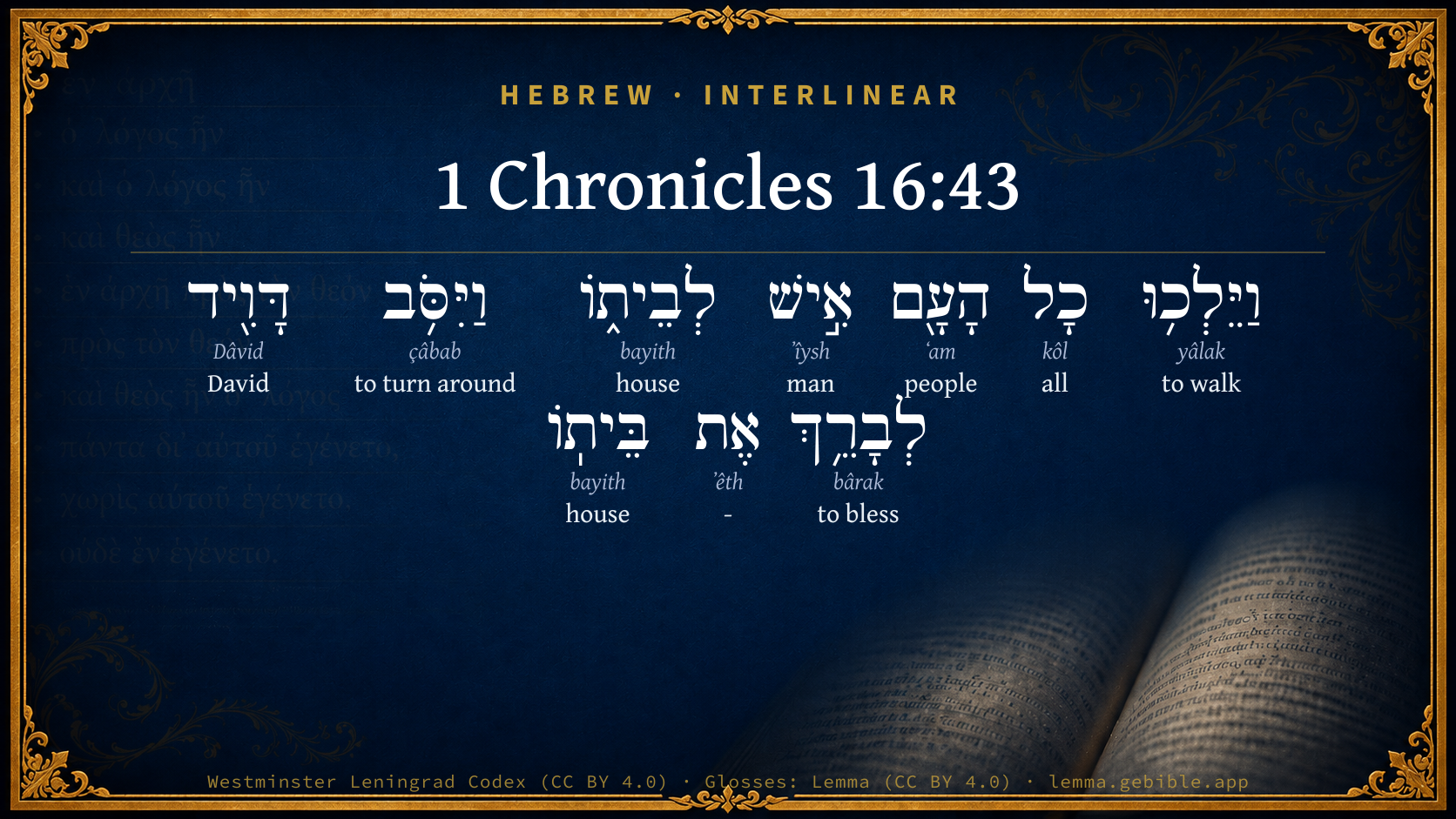
1 Chronicles 16:43

Hebrew (Westminster Leningrad Codex) 1 Chronicles 16:43 appears in the Hebrew Old Testament. The text above is from the Westminster Leningrad Codex. Each word links to its Strong’s number, a concise gloss, and parsing drawn from the Open Scriptures Hebrew Bible morphology. Click any word for its full Brown-Driver-Briggs (BDB) entry.
Download image
Cite this verse

1 Chronicles 16:43 (World English Bible). Public Domain. Lemma interlinear Bible study tool, https://lemma.gebible.app/v/1-chronicles/16/43.

Show BibTeX & RIS
BibTeX
RIS
English Translation
All the people departed every man to his house: and David returned to bless his house.
World English Bible · Public Domain
Download a study sheet

One document with this verse’s original text, its word-by-word gloss line, the meaning frame, cross-references with their text, attributed commentary, and full source and license credits — printable, and it pastes into notes with its structure intact.

This verse Autodidact and up

Study sheet (.html) Plain text (.txt)

A passage Seminary Student

Up to 50 verses in one chapter. A passage sheet keeps up to 6 commentary sources and 12 cross-references per verse, in the order this page ranks them, and says so on the sheet whenever that leaves anything out. Ask for a single verse and you get the Autodidact verse sheet above.

Everything on this page stays free to read, with no account — the sheet is a download of what is already on screen, not access to it.

Want to remove ads? Support Godless Engineer
Compare translations 3

The same verse in 3 English versions, stacked beneath the original-language interlinear above. Click any original word for its lexicon entry.

Each is an independent rendering of the whole verse — the interlinear is not word-aligned to these translations.

Highlighted words mark where these versions differ — a whole-verse word diff, not a word-by-word alignment.

  • World English Bible Public Domain
    All the people departed every man to his house: and David returned to bless his house.
  • King James Version Public Domain
    And all the people departed every man to his house: and David returned to bless his house.
  • unfoldingWord Literal Text CC BY-SA 4.0
    And all of the people went, a man to his house, and David returned to bless his house.

unfoldingWord Literal Text — © unfoldingWord, licensed CC BY-SA 4.0. Word-aligned USFM3 via Door43 (git.door43.org/unfoldingWord/en_ult).

Versions to compare (up to 4)

3 of 4 selected

Show all 18 translations

Every available English version of this verse, each an independent rendering of the whole verse.

  • World English Bible Public Domain
    All the people departed every man to his house: and David returned to bless his house.
  • Berean Standard Bible Public Domain
    Then all the people departed for their homes, and David returned home to bless his household.
  • Majority Standard Bible Public Domain
    Then all the people departed for their homes, and David returned home to bless his household.
  • King James Version Public Domain
    And all the people departed every man to his house: and David returned to bless his house.
  • American Standard Version (1901) Public Domain
    And all the people departed every man to his house: and David returned to bless his house.
  • Revised Version (1885) Public Domain
    And all the people departed every man to his house: and David returned to bless his house.
  • Geneva Bible (1599) Public Domain
    And all the people departed, euerie man to his house: and Dauid returned to blesse his house.
  • Douay-Rheims (1899) Public Domain
    And all the people returned to their houses: and David to bless also his own house.
  • Young's Literal Translation Public Domain
    And all the people go, each to his house, and David turneth round to bless his house.
  • Literal Standard Version CC BY-SA 4.0
    And all the people go, each to his house, and David turns around to bless his house.
  • Unlocked Literal Bible CC BY-SA 4.0
    Then all the people returned to their homes, and David returned to bless his own household.
  • unfoldingWord Literal Text CC BY-SA 4.0
    And all of the people went, a man to his house, and David returned to bless his house.
  • Darby Bible Public Domain
    And all the people departed every one to his house; and David returned to bless his household.
  • World Messianic Bible Public Domain
    All the people departed, each man to his house; and David returned to bless his house.
  • Webster's Bible Public Domain
    And all the people departed every man to his house: and David returned to bless his house.
  • Free Bible Version CC BY-SA 4.0
    Then all the people went home, and David went to bless his family.
  • Bible in Basic English Public Domain
    And all the people went away, every man to his house; and David went back to give a blessing to his family.
  • JPS Tanakh (1917) Public Domain
    And all the people departed every man to his house; and David returned to bless his house.

Literal Standard Version (2020), Covenant Press — licensed CC BY-SA 4.0. Text via the HelloAO Bible API (eBible.org). Unlocked Literal Bible (unfoldingWord) — licensed CC BY-SA 4.0. Text via the HelloAO Bible API (eBible.org). unfoldingWord Literal Text — © unfoldingWord, licensed CC BY-SA 4.0. Word-aligned USFM3 via Door43 (git.door43.org/unfoldingWord/en_ult). Free Bible Version, Dr. Jonathan Gallagher — licensed CC BY-SA 4.0. Text via the HelloAO Bible API (eBible.org).

Word by word

More ways to search: Search by grammar → Find every occurrence → Compare this word →

Practice this passage: Drill this verse → Learn its vocabulary →

וַיִּסֹּ֥ב
çâbab
H5437
“and · to turn around”
Conjunction + Verb, Qal, Sequential Imperfect, 3rd Person, Masculine, Singular
Part of Speech
Conjunction + Verb
Stem
Qal
Form
Sequential Imperfect
Person
3rd Person
Gender
Masculine
Number
Singular
Full BDB Definition

Origin: a primitive root

TWOT: 1456

to turn, turn about or around or aside or back or towards, go about or around, surround, encircle, change direction - (Qal) - to turn, turn about, be brought round, change - to march or walk around, go partly around, circle about, skirt, make a round, make a circuit, go about to, surround, encompass - (Niphal) - to turn oneself, close round, turn round - to be turned over to - (Piel) to turn about, change, transform - (Poel) - to encompass, surround - to come about, assemble round - to march, go about - to enclose, envelop - (Hiphil) - to turn, cause to turn, turn back, reverse, bring over, turn into, bring round - to cause to go around, surround, encompass - (Hophal) - to be turned - to be surrounded
  1. וַיֵּלְכ֥וּ yâlak H3212 “and · to walk” Conjunction + Verb, Qal, Sequential Imperfect, 3rd Person, Masculine, Plural
  2. כָל kôl H3605 “all of” Noun, Common, Masculine, Singular, Construct
  3. הָעָ֖ם ʻam H5971 “the · people” Particle, Definite Article + Noun, Common, Masculine, Singular, Absolute
  4. אִ֣ישׁ ʼîysh H376 “man” Noun, Common, Masculine, Singular, Absolute
  5. לְבֵית֑וֹ bayith H1004 “to/for · house · his” Preposition + Noun, Common, Masculine, Singular, Construct + Suffix, Personal, 3rd Person, Masculine, Singular
  6. דָּוִ֖יד Dâvid H1732 “David” Noun, Proper
  7. לְבָרֵ֥ךְ bârak H1288 “to bless” Preposition + Verb, Piel, Infinitive Construct
  8. אֶת ʼêth H853 “-” Particle, Direct Object
  9. בֵּיתֽוֹ bayith H1004 “house · his” Noun, Common, Masculine, Singular, Construct + Suffix, Personal, 3rd Person, Masculine, Singular

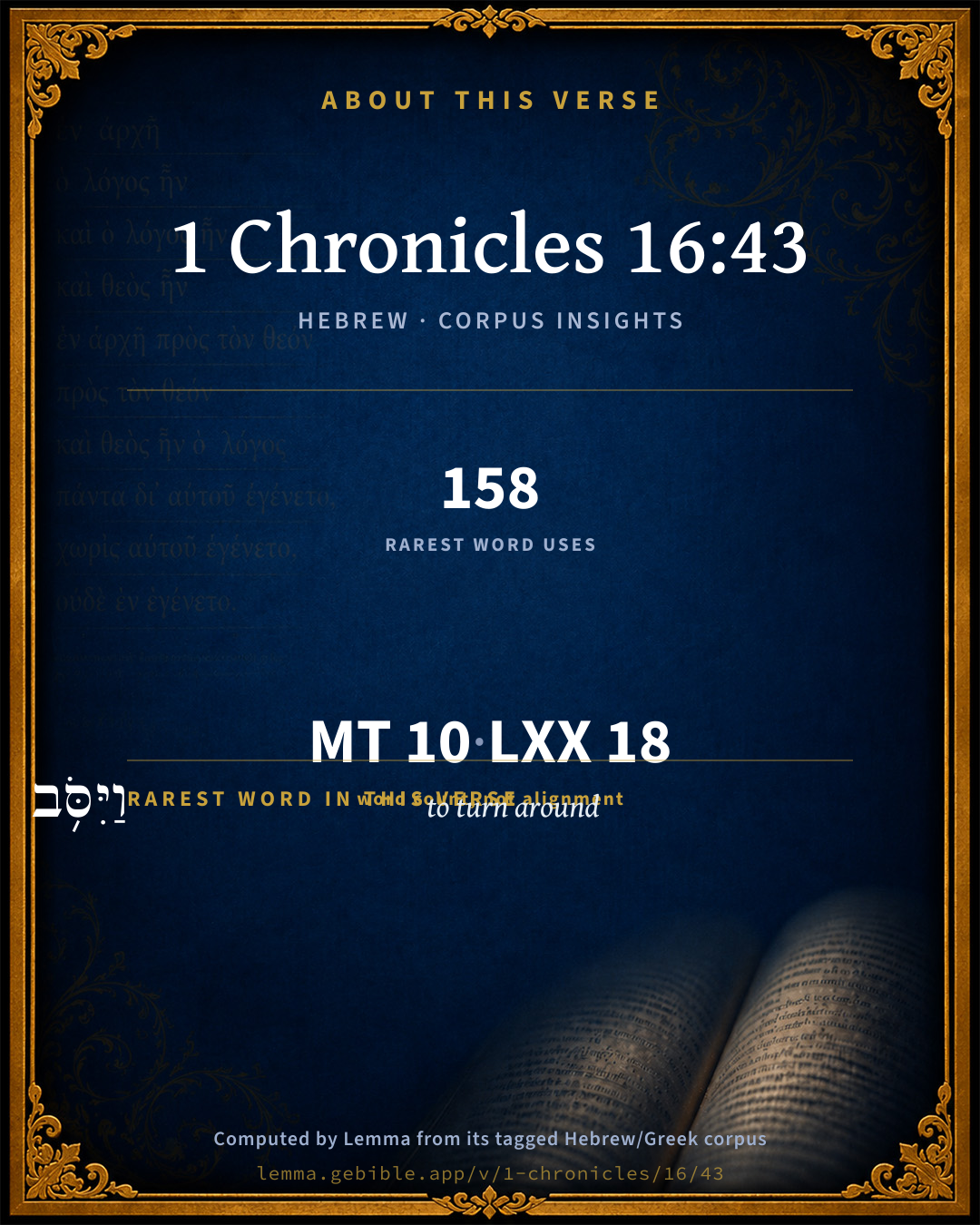
About this verse

These counts appear in no published source. They are computed here, from the morphology-tagged text and Lemma’s own curated glosses. What Lemma adds →

10
words
9
distinct lemmas
Historical
section

Grammatical profile

  • 3 verbs
  • 6 nouns
  • 1 particle

Verb forms

  • וַיֵּלְכ֥וּ Qal · Sequential Imperfect
  • וַיִּסֹּ֥ב Qal · Sequential Imperfect
  • לְבָרֵ֥ךְ Piel · Infinitive Construct

Repetition

A word recurs within this verse — often emphatic in Hebrew:

  • לְבֵית֑וֹ house H1004 ×2

Hebrew & Septuagint length

In English translation the verse runs 16 words from the Hebrew and 17 from the Septuagint (LXX English) — closely comparable.

A rough comparison of the two English renderings, which tokenize alike — not a word-level alignment.

Word counts can differ between the Hebrew and the Greek without any difference in meaning — e.g. the Hebrew direct-object marker אֵת has no separate Greek word, and Greek often adds the article ὁ.

In the original languages it is 10 Hebrew tokens and 18 Greek tokens — but the two are counted differently (Hebrew bundles its prefixes and suffixes into one token; the Greek is in lemma form), so that isn’t a like-for-like length.

Cross-references

5

Topical passages linked to 1 Chronicles 16:43 in the Treasury of Scripture Knowledge — connected by theme and wording, ordered by reader-vote popularity; previews shown in the World English Bible.

  • 2 Samuel 6:19–20 He dealt among all the people, even among the whole multitude of Israel, both to men and women, to everyone a cake of bread, and a portion [of flesh], and a cake of raisins. So all the people departed everyone to his house.
  • 1 Kings 8:66 On the eighth day he sent the people away; and they blessed the king, and went to their tents joyful and glad of heart for all the goodness that Yahweh had shown to David his servant, and to Israel his people.
  • Genesis 18:19 For I have known him, to the end that he may command his children and his household after him, that they may keep the way of Yahweh, to do righteousness and justice; to the end that Yahweh may bring on Abraham that which he has spoken of him."
  • Joshua 24:15 If it seem evil to you to serve Yahweh, choose you this day whom you will serve; whether the gods which your fathers served that were beyond the River, or the gods of the Amorites, in whose land you dwell: but as for me and my house, we will serve Yahweh.
  • Psalms 101:2 I will be careful to live a blameless life. When will you come to me? I will walk within my house with a blameless heart.

Cross-references courtesy of OpenBible.info (CC BY 4.0).

Hebrew and Greek witnesses Masoretic Hebrew ↔ Greek Septuagint

The same verse in the two great witnesses to the Old Testament, shown verse-for-verse.

These are two independent witnesses, not word-aligned to each other, and the Septuagint is shown in lemma (dictionary) form.

Hebrew 1 Chronicles 16:43 Masoretic · Westminster Leningrad Codex

וַיֵּלְכ֥וּ כָל הָעָ֖ם אִ֣ישׁ לְבֵית֑וֹ וַיִּסֹּ֥ב דָּוִ֖יד לְבָרֵ֥ךְ אֶת בֵּיתֽוֹ

All the people departed every man to his house: and David returned to bless his house.

World English Bible · Public Domain

Greek LXX 1 Chronicles 16:43 Septuagint · lemma form

καί πορεύομαι ἅπας ὁ λαός ἕκαστος εἰς ὁ οἶκος αὐτός καί ἐπιστρέφω δαυίδ ὁ εὐλογέω ὁ οἶκος αὐτός

And all the people went every one to his home: and David returned to bless his house.

LXX2012 (modern English Septuagint) · Public Domain

Hebrew: Westminster Leningrad Codex (CC BY 4.0). Greek: Septuagint (public domain); English from LXX2012 (modern English Septuagint) (Public Domain). How the Septuagint differs from the Hebrew →

Commentary

Notes on 1 Chronicles 16:43 from classic Christian and Jewish commentators (each source and its license shown beneath its notes). The classic Christian expositions comment on the surrounding passage and are grouped to its opening verse, so a note may address several verses; the Jewish commentaries on the Tanakh (Rashi and others) are per-verse, so they appear only where the commentator wrote on this verse.

Lemma curates 59 commentaries, every one of them public domain or Creative Commons licensed, each selected and text-cleaned for this edition rather than reprinted as found. About our sources →

Trapp's Complete Commentary

John Trapp

1Ch 16:43 And all the people departed every man to his house: and David returned to bless his house.

Ver. 43. And David returned to bless his house.] See on 2Sa 6:20.

John Trapp, A Commentary or Exposition upon All the Books of the Old and New Testament (1647–1656) — public domain. Text from a community e-Sword module.

The Biblical Illustrator

Joseph S. Exell

1Ch_16:43

And all the people departed, every man to his house

On family worship

Public exercises of religion, when properly conducted, have a happy tendency to prepare the mind for those of a more private nature.

Our text tells us that David returned to bless his house--that is, to present them to God in prayer and entreat His blessing upon them. This suggests the duty of family prayer.

I. This duty is a practice by which good men have been distinguished in every age.

II. Family prayer is a natural and necessary acknowledgment of the dependence of families upon God, and of the innumerable obligations they are under to His goodness.

III. This duty is enforced by its tendency, under the blessing of God, to form the minds of children and servants to the love and practice of religion.

IV. Family worship may be expected to have a most beneficial influence on the character and conduct of the heads of families themselves.

V. Probable pleas which will be urged for the neglect of this duty.

1. Want of ability. Answer--

(1) Forms of prayer may be used with advantage.

(2) The plea of mental inability will not stand the test of examination, unless it include an incapacity to read.

(3) It is more than probable that those who complain of this inability have never made the trial, and consequently never can form any accurate judgment of their qualifications.

2. Want of time. Consider on what principle this plea depends: that religion is not the grand concern; that there is something more important than the service of God; that the pleasing and glorifying our Maker is not the great end of human existence--a fatal delusion, a soul-destroying mistake.

3. It has been neglected so long that they know not how to begin.

VI. Hints on the practice.

1. Let it ever be joined with reading the Scriptures.

2. Let it be constant.

3. Attend with a full decision of mind, with the utmost seriousness.

4. Seek the aid of the Spirit. (Robert Hall, M. A.)

Davids attention to his household

I. The work in which he had been engaged: the bringing up the ark to Jerusalem. A glorious work--

1. In itself.

2. As typical of Christs ascension into heaven (Psa_24:1-10; Psa_47:1-9; Psa_68:1-35; Psa_132:1-18.).

II. The work to which he returned: to bless his house.

1. To obtain blessings for them by his prayers.

2. To render himself a blessing to them by his conduct.

Learn--

1. How highly we are privileged. The ark, even the Lord Jesus Christ Himself, is present in the midst of us.

2. In what way we should improve our privileges. We should endeavour to communicate the benefit of them to others. (Skeletons of Sermons.)

Domestic duties

We cannot always live in public; it is true that we have tent work to do, temple work etc., but when all that is external or public has been done, every man must bless his own home, make his own children glad, make his own hearthstone as bright as he possibly can, and fill his own house with music and gladness. (J. Parker, D. D.)

The Biblical Illustrator, edited by Joseph S. Exell (c. 1880s–1900s) — public domain. Text from a community e-Sword module.

Geneva Bible (1599)

Geneva Bible translators

Declaring that after our duty to God we are chiefly bound to our own house, for the which as for all other things we ought to pray unto God, and instruct our families to praise his Name.

Geneva Bible (1599) marginal notes — public domain. Text via Bolls.life.

Ellicott's Commentary for English Readers

(43) This verse is a duplicate of 2Sa_6:19-20 a.

Departed.—Plural; Samuel has singular.

Returned.—Rather, went round (1Ch_10:14). Samuel has “returned,” which in Hebrew is very similar.

The incident which in 2Sa_6:20-23 here follows (Michal’s encounter with David) is omitted by the chronicler as a matter of purely domestic interest, and therefore out of place in his history, which is mainly concerned with the sacred institutions. 1Ch_15:29, however, plainly implies the story.

A Bible Commentary for English Readers, edited by Charles John Ellicott (1878–1897) — public domain. Text from a community e-Sword module.

Haydock's Catholic Bible Commentary

Bless, or feast, (Du Hamel) with his family, on part of the sacred victims. (Haydock)

George Leo Haydock (1774–1849), Haydock's Catholic Family Bible and Commentary, 1859 edition — public domain. Excludes Psalms (Douay-Rheims chapter numbering differs from Protestant) and Deuterocanonical books (Catholic canon only).

The Pulpit Commentary

Ver. 43. (See 2Sa_6:19, 2Sa_6:20)

The Pulpit Commentary (1880–1919), ed. H.D.M. Spence-Jones & Joseph S. Exell — public domain. Text from a community e-Sword module.

Lesson kit

Teaching starters — assembled from the data on this page, not authored interpretation. Every prompt links to the verse data it draws on. Edit before teaching.

1 Chronicles, in the Historical, opens this verse with 10 words (9 distinct Hebrew lemmas). Its most distinctive word is çâbab (“to turn around”). A historical commentator’s framing appears above. Read the whole chapter for the surrounding context.

Discussion questions

  1. How does “to turn around” (çâbab) shape what this verse is saying?
  2. How does 2 Samuel 6:19–20, which shares this passage’s theme, read alongside this verse?
  3. What does the repetition of “house” (2× in this one verse) do in this verse?
  4. These translations render this verse differently. What is at stake in choosing one wording over another?
  5. «וַיֵּלְכ֥וּ» is a Qal Sequential Imperfect verb. How does that grammatical form shape the action described?
  6. Compare how Trapp's Complete Commentary and The Biblical Illustrator read this verse. Where do they agree or differ?

Things to notice

Reading settings

Reading text

Shown beneath each verse's original-language words.

Old Testament
Old Testament edition

Read the OT as the Masoretic Hebrew (MT) or the Greek Septuagint (LXX).

English shown for the Greek Septuagint (in the Hebrew ↔ Greek comparison).

Comparing translations? Open the Compare panel on any verse page to stack up to four side by side.