
2 Chronicles 10:16

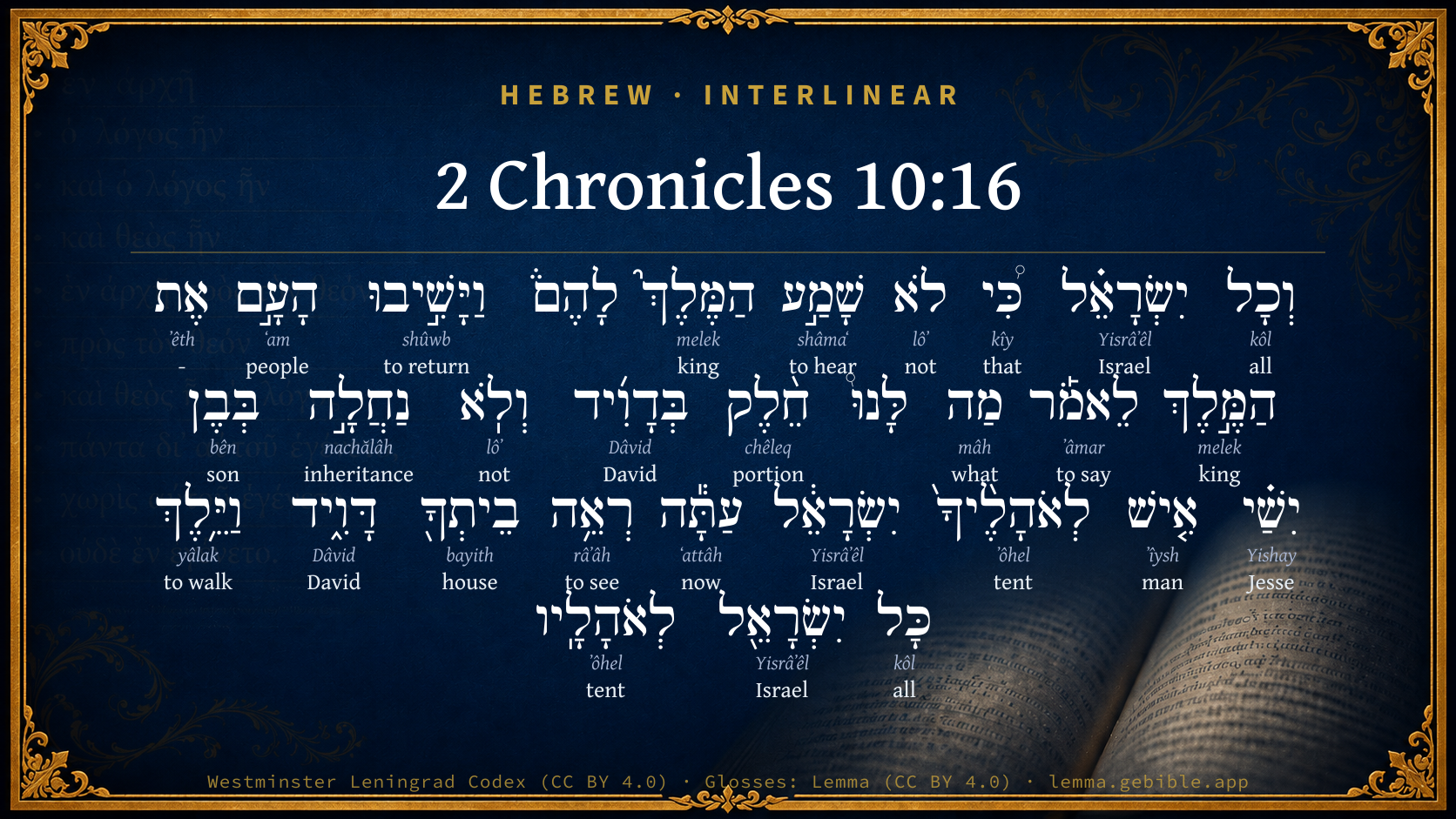
Hebrew (Westminster Leningrad Codex) 2 Chronicles 10:16 appears in the Hebrew Old Testament. The text above is from the Westminster Leningrad Codex. Each word links to its Strong’s number, a concise gloss, and parsing drawn from the Open Scriptures Hebrew Bible morphology. Click any word for its full Brown-Driver-Briggs (BDB) entry.
Download image
Cite this verse

2 Chronicles 10:16 (World English Bible). Public Domain. Lemma interlinear Bible study tool, https://lemma.gebible.app/v/2-chronicles/10/16.

Show BibTeX & RIS
BibTeX
RIS
English Translation
When all Israel saw that the king didn't listen to them, the people answered the king, saying, What portion have we in David? neither have we inheritance in the son of Jesse: every man to your tents, Israel: now see to your own house, David. So all Israel departed to their tents.
World English Bible · Public Domain
Download a study sheet

One document with this verse’s original text, its word-by-word gloss line, the meaning frame, cross-references with their text, attributed commentary, and full source and license credits — printable, and it pastes into notes with its structure intact.

This verse Autodidact and up

Study sheet (.html) Plain text (.txt)

A passage Seminary Student

Up to 50 verses in one chapter. A passage sheet keeps up to 6 commentary sources and 12 cross-references per verse, in the order this page ranks them, and says so on the sheet whenever that leaves anything out. Ask for a single verse and you get the Autodidact verse sheet above.

Everything on this page stays free to read, with no account — the sheet is a download of what is already on screen, not access to it.

Want to remove ads? Support Godless Engineer
Compare translations 3

The same verse in 3 English versions, stacked beneath the original-language interlinear above. Click any original word for its lexicon entry.

Each is an independent rendering of the whole verse — the interlinear is not word-aligned to these translations.

Highlighted words mark where these versions differ — a whole-verse word diff, not a word-by-word alignment.

  • World English Bible Public Domain
    When all Israel saw that the king didn't listen to them, the people answered the king, saying, What portion have we in David? neither have we inheritance in the son of Jesse: every man to your tents, Israel: now see to your own house, David. So all Israel departed to their tents.
  • King James Version Public Domain
    And when all Israel saw that the king would not hearken unto them, the people answered the king, saying, What portion have we in David? and we have none inheritance in the son of Jesse: every man to your tents, O Israel: and now, David, see to thine own house. So all Israel went to their tents.
  • unfoldingWord Literal Text CC BY-SA 4.0
    And all Israel saw that the king did not listen to them, and the people answered the king, saying, “What for us is a portion with David? And no inheritance with the son of Jesse. Each to your tents, Israel! Now, see your house, David.” And all Israel went to his tents.

unfoldingWord Literal Text — © unfoldingWord, licensed CC BY-SA 4.0. Word-aligned USFM3 via Door43 (git.door43.org/unfoldingWord/en_ult).

Versions to compare (up to 4)

3 of 4 selected

Show all 18 translations

Every available English version of this verse, each an independent rendering of the whole verse.

  • World English Bible Public Domain
    When all Israel saw that the king didn't listen to them, the people answered the king, saying, What portion have we in David? neither have we inheritance in the son of Jesse: every man to your tents, Israel: now see to your own house, David. So all Israel departed to their tents.
  • Berean Standard Bible Public Domain
    When all Israel saw that the king had refused to listen to them, they answered the king: “What portion do we have in David, and what inheritance in the son of Jesse? To your tents, O Israel! Look now to your own house, O David!” So all the Israelites went home,
  • Majority Standard Bible Public Domain
    When all Israel saw that the king had refused to listen to them, they answered the king: “What portion do we have in David, and what inheritance in the son of Jesse? To your tents, O Israel! Look now to your own house, O David!” So all the Israelites went home,
  • King James Version Public Domain
    And when all Israel saw that the king would not hearken unto them, the people answered the king, saying, What portion have we in David? and we have none inheritance in the son of Jesse: every man to your tents, O Israel: and now, David, see to thine own house. So all Israel went to their tents.
  • American Standard Version (1901) Public Domain
    And when all Israel saw that the king hearkened not unto them, the people answered the king, saying, What portion have we in David? neither have we inheritance in the son of Jesse: every man to your tents, O Israel: now see to thine own house, David. So all Israel departed unto their tents.
  • Revised Version (1885) Public Domain
    And when all Israel saw that the king hearkened not unto them, the people answered the king, saying, What portion have we in David? neither have we inheritance in the son of Jesse: every man to your tents, O Israel: now see to thine own house, David. So all Israel departed unto their tents.
  • Geneva Bible (1599) Public Domain
    So when all Isarael sawe that the King would not heare them, the people answered the King, saying, What portion haue we in Dauid? for we haue none inheritance in the sonue of Ishai. O Israel, euery man to your tents: now see to thine owne house, Dauid. So all Israel departed to their tents.
  • Douay-Rheims (1899) Public Domain
    And all the people upon the king's speaking roughly, said thus unto him: We have no part in David, nor inheritance in the son of Isai. Return to thy dwellings, O Israel, and do thou, O David, feed thy own house. And Israel went away to their dwellings.
  • Young's Literal Translation Public Domain
    And all Israel have seen that the king hath not hearkened to them, and the people send back `to' the king, saying, `What portion have we in David? yea, there is no inheritance in a son of Jesse; each to thy tents, O Israel; now, see thy house -- David,' and all Israel go to their tents.
  • Literal Standard Version CC BY-SA 4.0
    And all Israel have seen that the king has not listened to them, and the people send back [word to] the king, saying, “What portion do we have in David? Indeed, there is no inheritance in a son of Jesse; [go], each to your tents, O Israel! Now see your house, O David!” And all [in] Israel go to their tents.
  • Unlocked Literal Bible CC BY-SA 4.0
    When all Israel saw that the king did not listen to them, the people answered him and said, “What share do we have in David? We have no inheritance in the son of Jesse! Each of you should go back to his tent, Israel. Now see to your own house, David.” So all Israel returned to their tents.
  • unfoldingWord Literal Text CC BY-SA 4.0
    And all Israel saw that the king did not listen to them, and the people answered the king, saying, “What for us is a portion with David? And no inheritance with the son of Jesse. Each to your tents, Israel! Now, see your house, David.” And all Israel went to his tents.
  • Darby Bible Public Domain
    And all Israel saw that the king hearkened not to them; and the people answered the king saying, What portion have we in David? and [we have] no inheritance in the son of Jesse: every man to your tents, O Israel. Now see to thine own house, David! And all Israel went to their tents.
  • World Messianic Bible Public Domain
    When all Israel saw that the king didn’t listen to them, the people answered the king, saying, “What portion do we have in David? We don’t have an inheritance in the son of Jesse! Every man to your tents, Israel! Now see to your own house, David.” So all Israel departed to their tents.
  • Webster's Bible Public Domain
    And when all Israel saw that the king would not hearken to them, the people answered the king, saying, What portion have we in David? and we have no inheritance in the son of Jesse: every man to your tents, O Israel: and now, David, see to thy own house. So all Israel went to their tents.
  • Free Bible Version CC BY-SA 4.0
    When all the Israelites saw that the king wasn't listening to them, they told the king: “What share do we have in David, and what part do we have in the son of Jesse? Go home, Israel! You're on your own, house of David!” So all the Israelites went home.
  • Bible in Basic English Public Domain
    And when all Israel saw that the king would give no attention to them, the people in answer said to the king, What part have we in David? what is our heritage in the son of Jesse? every man to your tents, O Israel; now see to your house, David. So all Israel went to their tents.
  • JPS Tanakh (1917) Public Domain
    And when all Israel saw that the king hearkened not unto them, the people answered the king, saying: 'What portion have we in David? neither have we inheritance in the son of Jesse; every man to your tents, O Israel; now see to thine own house, David.' So all Israel departed unto their tents.

Literal Standard Version (2020), Covenant Press — licensed CC BY-SA 4.0. Text via the HelloAO Bible API (eBible.org). Unlocked Literal Bible (unfoldingWord) — licensed CC BY-SA 4.0. Text via the HelloAO Bible API (eBible.org). unfoldingWord Literal Text — © unfoldingWord, licensed CC BY-SA 4.0. Word-aligned USFM3 via Door43 (git.door43.org/unfoldingWord/en_ult). Free Bible Version, Dr. Jonathan Gallagher — licensed CC BY-SA 4.0. Text via the HelloAO Bible API (eBible.org).

Word by word

More ways to search: Search by grammar → Find every occurrence → Compare this word →

Practice this passage: Drill this verse → Learn its vocabulary →

יִשַׁ֗י
Yishay
H3448
“Jesse”
Noun, Proper
Part of Speech
Noun
Type
Proper
Full BDB Definition

Origin: from the same as H3426

TWOT: 926

Jesse = "I possess" - son of Boaz and the father of king David
  1. וְכָל kôl H3605 “and · all of” Conjunction + Noun, Common, Masculine, Singular, Construct
  2. יִשְׂרָאֵ֗ל Yisrâʼêl H3478 “Israel” Noun, Proper
  3. כִּ֠י kîy H3588 “that” Conjunction
  4. לֹא lôʼ H3808 “not” Particle, Negative
  5. שָׁמַ֣ע shâmaʻ H8085 “to hear” Verb, Qal, Perfect, 3rd Person, Masculine, Singular
  6. הַמֶּלֶךְ֮ melek H4428 “the · king” Particle, Definite Article + Noun, Common, Masculine, Singular, Absolute
  7. וַיָּשִׁ֣יבוּ shûwb H7725 “and · to return” Conjunction + Verb, Hiphil, Sequential Imperfect, 3rd Person, Masculine, Plural
  8. הָעָ֣ם ʻam H5971 “the · people” Particle, Definite Article + Noun, Common, Masculine, Singular, Absolute
  9. אֶת ʼêth H853 “-” Particle, Direct Object
  10. הַמֶּ֣לֶךְ melek H4428 “the · king” Particle, Definite Article + Noun, Common, Masculine, Singular, Absolute
  11. לֵאמֹ֡ר ʼâmar H559 “to say” Preposition + Verb, Qal, Infinitive Construct
  12. מַה mâh H4100 “what” Particle, Interrogative
  13. חֵ֨לֶק chêleq H2506 “portion” Noun, Common, Masculine, Singular, Absolute
  14. בְּדָוִ֜יד Dâvid H1732 “in/at · David” Preposition + Noun, Proper
  15. וְלֹֽא lôʼ H3808 “and · not” Conjunction + Particle, Negative
  16. נַחֲלָ֣ה nachălâh H5159 “inheritance” Noun, Common, Feminine, Singular, Absolute
  17. בְּבֶן bên H1121 “in/at · son of” Preposition + Noun, Common, Masculine, Singular, Construct
  18. אִ֤ישׁ ʼîysh H376 “man” Noun, Common, Masculine, Singular, Absolute
  19. לְאֹהָלֶ֨יךָ֙ ʼôhel H168 “to/for · tents · your” Preposition + Noun, Common, Masculine, Plural, Construct + Suffix, Personal, 2nd Person, Masculine, Singular
  20. יִשְׂרָאֵ֔ל Yisrâʼêl H3478 “Israel” Noun, Proper
  21. עַתָּ֕ה ʻattâh H6258 “now” Adverb
  22. רְאֵ֥ה râʼâh H7200 “see” Verb, Qal, Imperative, 2nd Person, Masculine, Singular
  23. בֵיתְךָ֖ bayith H1004 “house · your” Noun, Common, Masculine, Singular, Construct + Suffix, Personal, 2nd Person, Masculine, Singular
  24. דָּוִ֑יד Dâvid H1732 “David” Noun, Proper
  25. וַיֵּ֥לֶךְ yâlak H3212 “and · to walk” Conjunction + Verb, Qal, Sequential Imperfect, 3rd Person, Masculine, Singular
  26. כָּל kôl H3605 “all of” Noun, Common, Masculine, Singular, Construct
  27. יִשְׂרָאֵ֖ל Yisrâʼêl H3478 “Israel” Noun, Proper
  28. לְאֹהָלָֽיו ʼôhel H168 “to/for · tents · his” Preposition + Noun, Common, Masculine, Plural, Construct + Suffix, Personal, 3rd Person, Masculine, Singular

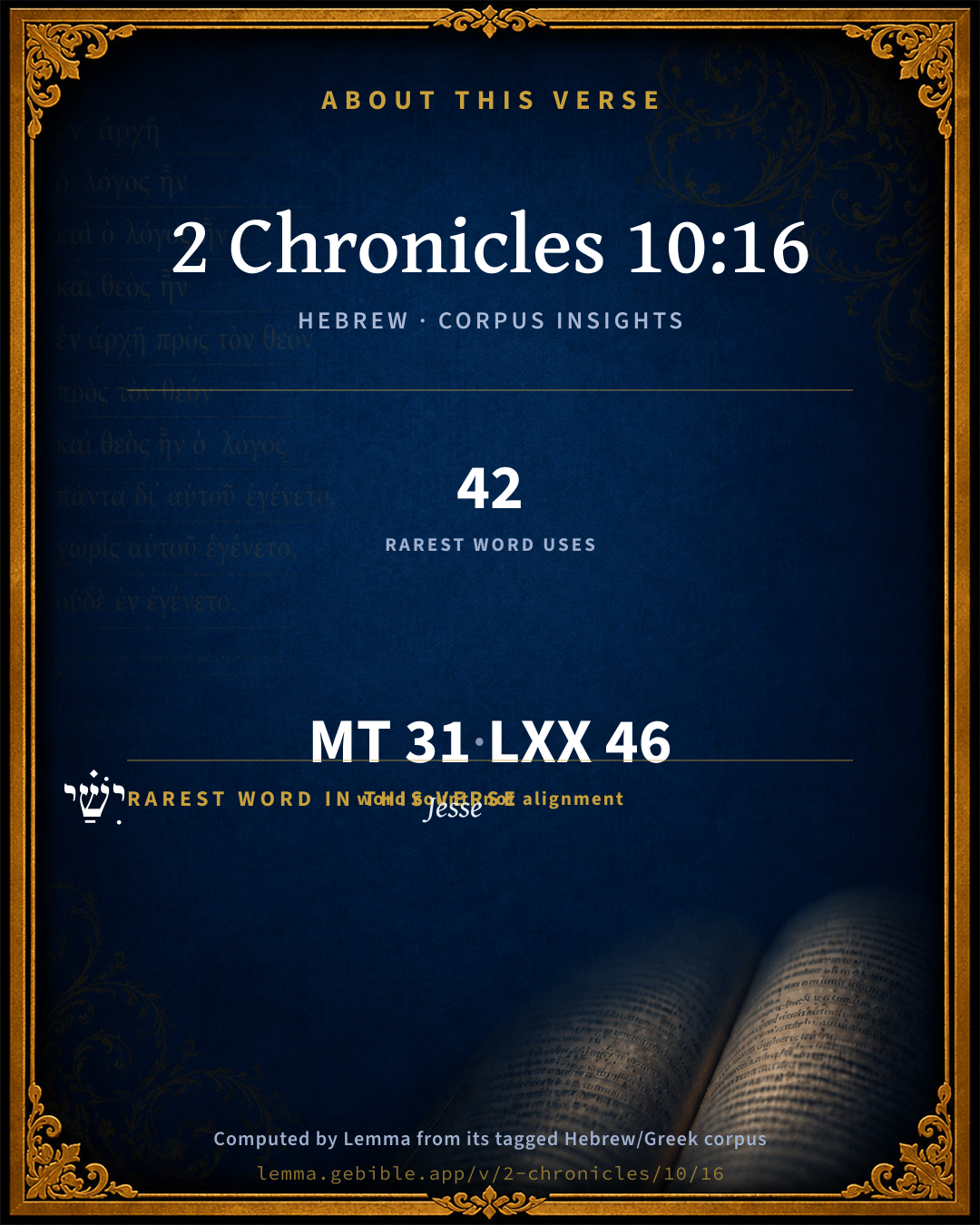
About this verse

These counts appear in no published source. They are computed here, from the morphology-tagged text and Lemma’s own curated glosses. What Lemma adds →

31
words
22
distinct lemmas
Historical
section

Shared distinctive vocabulary

יִשַׁ֗י Jesse H3448 occurs in 39 verses of the Hebrew Bible. Also found in:

Grammatical profile

  • 5 verbs
  • 18 nouns
  • 2 prepositions
  • 1 conjunction
  • 1 adverb
  • 4 particles

Verb forms

  • שָׁמַ֣ע Qal · Perfect
  • וַיָּשִׁ֣יבוּ Hiphil · Sequential Imperfect
  • לֵאמֹ֡ר Qal · Infinitive Construct
  • רְאֵ֥ה Qal · Imperative
  • וַיֵּ֥לֶךְ Qal · Sequential Imperfect

Repetition

Words recur within this verse — often emphatic in Hebrew:

  • יִשְׂרָאֵ֗ל Israel H3478 ×3
  • וְכָל all H3605 ×2
  • הַמֶּלֶךְ֮ king H4428 ×2
  • בְּדָוִ֜יד David H1732 ×2
  • לְאֹהָלֶ֨יךָ֙ tent H168 ×2
  • לֹא not H3808 ×2

Hebrew & Septuagint length

In English translation the verse runs 52 words from the Hebrew and 47 from the Septuagint (LXX English) — closely comparable.

A rough comparison of the two English renderings, which tokenize alike — not a word-level alignment.

Word counts can differ between the Hebrew and the Greek without any difference in meaning — e.g. the Hebrew direct-object marker אֵת has no separate Greek word, and Greek often adds the article ὁ.

In the original languages it is 31 Hebrew tokens and 46 Greek tokens — but the two are counted differently (Hebrew bundles its prefixes and suffixes into one token; the Greek is in lemma form), so that isn’t a like-for-like length.

Cross-references

33

Topical passages linked to 2 Chronicles 10:16 in the Treasury of Scripture Knowledge — connected by theme and wording, ordered by reader-vote popularity; previews shown in the World English Bible.

  • 2 Samuel 20:1 There happened to be there a base fellow, whose name was Sheba, the son of Bichri, a Benjamite: and he blew the trumpet, and said, We have no portion in David, neither have we inheritance in the son of Jesse: every man to his tents, Israel.
  • 2 Chronicles 10:19 So Israel rebelled against the house of David to this day.
  • Judges 8:35 neither shown they kindness to the house of Jerubbaal, [who is] Gideon, according to all the goodness which he had shown to Israel.
  • 1 Samuel 20:27 It happened on the next day after the new moon, [which was] the second [day], that David's place was empty: and Saul said to Jonathan his son, Why doesn't the son of Jesse come to meat, neither yesterday, nor today?
  • 1 Samuel 20:30–31 Then Saul's anger was kindled against Jonathan, and he said to him, You son of a perverse rebellious woman, don't I know that you have chosen the son of Jesse to your own shame, and to the shame of your mother's nakedness?
  • 1 Samuel 22:7 Saul said to his servants who stood about him, Hear now, you Benjamites; will the son of Jesse give everyone of you fields and vineyards, will he make you all captains of thousands and captains of hundreds,
  • 1 Samuel 22:9 Then answered Doeg the Edomite, who stood by the servants of Saul, and said, I saw the son of Jesse coming to Nob, to Ahimelech the son of Ahitub.
  • 1 Samuel 22:13 Saul said to him, Why have you conspired against me, you and the son of Jesse, in that you have given him bread, and a sword, and have inquired of God for him, that he should rise against me, to lie in wait, as at this day?
  • 2 Samuel 7:15–16 but my loving kindness shall not depart from him, as I took it from Saul, whom I put away before you.
  • 2 Samuel 15:13 There came a messenger to David, saying, The hearts of the men of Israel are after Absalom.
  • 2 Samuel 16:11 David said to Abishai, and to all his servants, Behold, my son, who came forth from my bowels, seeks my life: how much more [may] this Benjamite now [do it]? let him alone, and let him curse; for Yahweh has invited him.
  • 1 Kings 11:13 However I will not tear away all the kingdom; but I will give one tribe to your son, for David my servant's sake, and for Jerusalem's sake which I have chosen.
  • 1 Kings 11:34–39 However I will not take the whole kingdom out of his hand; but I will make him prince all the days of his life, for David my servant's sake whom I chose, who kept my commandments and my statutes;
  • 1 Kings 12:16–17 When all Israel saw that the king didn't listen to them, the people answered the king, saying, What portion have we in David? neither have we inheritance in the son of Jesse: to your tents, Israel: now see to your own house, David. So Israel departed to their tents.
  • 1 Chronicles 17:14 but I will settle him in my house and in my kingdom forever; and his throne shall be established forever.
  • Psalms 2:1–6 Why do the nations rage, And the peoples plot a vain thing?
  • Psalms 76:10 Surely the wrath of man praises you. The survivors of your wrath are restrained.
  • Psalms 89:29–37 I will also make his seed endure forever, And his throne as the days of heaven.
  • Psalms 132:17 There I will make the horn of David to bud. I have ordained a lamp for my anointed.
  • Isaiah 9:6–7 For to us a child is born, to us a son is given; and the government shall be on his shoulder: and his name shall be called Wonderful, Counselor, Mighty God, Everlasting Father, Prince of Peace.
  • Isaiah 11:1 There shall come forth a shoot out of the stock of Jesse, and a branch out of his roots shall bear fruit.
  • Jeremiah 33:20–21 Thus says Yahweh: If you can break my covenant of the day, and my covenant of the night, so that there shall not be day and night in their season;
  • Jeremiah 33:25–26 Thus says Yahweh: If my covenant of day and night fails, if I have not appointed the ordinances of heaven and earth;
  • Ezekiel 37:24–25 My servant David shall be king over them; and they all shall have one shepherd: they shall also walk in my ordinances, and observe my statutes, and do them.
  • Amos 9:11 In that day I will raise up the tent of David who is fallen, and close up its breaches, and I will raise up its ruins, and I will build it as in the days of old;
  • Luke 19:27 But bring those enemies of mine who didn't want me to reign over them here, and kill them before me.'"
  • John 6:66 At this, many of his disciples went back, and walked no more with him.
  • John 7:53 Everyone went to his own house,
  • Acts 2:30 Therefore, being a prophet, and knowing that God had sworn with an oath to him that of the fruit of his body, according to the flesh, he would raise up the Christ to sit on his throne,
  • 1 Corinthians 15:25 For he must reign until he has put all his enemies under his feet.
  • Revelation 22:16 I, Jesus, have sent my angel to testify these things to you for the assemblies. I am the root and the offspring of David; the Bright and Morning Star."
  • Luke 1:32–33 He will be great, and will be called the Son of the Most High. The Lord God will give him the throne of his father, David,
  • Luke 19:14 But his citizens hated him, and sent an envoy after him, saying, 'We don't want this man to reign over us.'

Cross-references courtesy of OpenBible.info (CC BY 4.0).

Hebrew and Greek witnesses Masoretic Hebrew ↔ Greek Septuagint

The same verse in the two great witnesses to the Old Testament, shown verse-for-verse.

These are two independent witnesses, not word-aligned to each other, and the Septuagint is shown in lemma (dictionary) form.

Hebrew 2 Chronicles 10:16 Masoretic · Westminster Leningrad Codex

וְכָל יִשְׂרָאֵ֗ל כִּ֠י לֹא שָׁמַ֣ע הַמֶּלֶךְ֮ לָהֶם֒ וַיָּשִׁ֣יבוּ הָעָ֣ם אֶת הַמֶּ֣לֶךְ לֵאמֹ֡ר מַה לָּנוּ֩ חֵ֨לֶק בְּדָוִ֜יד וְלֹֽא נַחֲלָ֣ה בְּבֶן יִשַׁ֗י אִ֤ישׁ לְאֹהָלֶ֨יךָ֙ יִשְׂרָאֵ֔ל עַתָּ֕ה רְאֵ֥ה בֵיתְךָ֖ דָּוִ֑יד וַיֵּ֥לֶךְ כָּל יִשְׂרָאֵ֖ל לְאֹהָלָֽיו

When all Israel saw that the king didn't listen to them, the people answered the king, saying, What portion have we in David? neither have we inheritance in the son of Jesse: every man to your tents, Israel: now see to your own house, David. So all Israel departed to their tents.

World English Bible · Public Domain

Greek LXX 2 Chronicles 10:16 Septuagint · lemma form

καί πᾶς ἰσραήλ ὅτι οὐ ἀκούω ὁ βασιλεύς αὐτός καί ἀποκρίνω ὁ λαός πρός ὁ βασιλεύς λέγω τίς ἐγώ μερίς ἐν δαυίδ καί κληρονομία ἐν υἱός ιεσσαι εἰς ὁ σκήνωμα σύ ἰσραήλ νῦν βλέπω ὁ οἶκος σύ δαυίδ καί πορεύομαι πᾶς ἰσραήλ εἰς ὁ σκήνωμα αὐτός

for the king did not listen to them. And the people answered the king, saying, What portion have we in David, or inheritance in the son of Jessae? to your tents, O Israel: now see to your own house, David. So all Israel went to their tents.

LXX2012 (modern English Septuagint) · Public Domain

On this verse, Ellicott's Commentary for English Readers discusses the Septuagint’s reading. Read the note in Commentary ↓

Hebrew: Westminster Leningrad Codex (CC BY 4.0). Greek: Septuagint (public domain); English from LXX2012 (modern English Septuagint) (Public Domain). How the Septuagint differs from the Hebrew →

Commentary

Notes on 2 Chronicles 10:16 from classic Christian and Jewish commentators (each source and its license shown beneath its notes). The classic Christian expositions comment on the surrounding passage and are grouped to its opening verse, so a note may address several verses; the Jewish commentaries on the Tanakh (Rashi and others) are per-verse, so they appear only where the commentator wrote on this verse.

Lemma curates 59 commentaries, every one of them public domain or Creative Commons licensed, each selected and text-cleaned for this edition rather than reprinted as found. About our sources →

Trapp's Complete Commentary

John Trapp

2Ch 10:16 And when all Israel [saw] that the king would not hearken unto them, the people answered the king, saying, What portion have we in David? and [we have] none inheritance in the son of Jesse: every man to your tents, O Israel: [and] now, David, see to thine own house. So all Israel went to their tents.

Ver. 16. So all Israel went to their tents.] Revolted from Rehoboam, as likewise, upon a like discontent, did the Saracens from Heraclius the Roman emperor, soon overrunning Syria, Egypt, Persia, and other flourishing kingdoms, now in the possession of the Turks. {a}

{a} Paul. Aemyl.

John Trapp, A Commentary or Exposition upon All the Books of the Old and New Testament (1647–1656) — public domain. Text from a community e-Sword module.

Tyndale Open Study Notes

Tyndale Open Resources

10:16 The people responded using words that were the converse of a poetic saying the Chronicler had used earlier (1 Chr 12:18); there, the people of the southern tribes of Benjamin and Judah (1 Chr 12:16) showed growing support for David.

Tyndale Open Study Notes — © Tyndale Open Resources, licensed CC BY-SA 4.0. Text via the HelloAO Bible API.

Adam Clarke's Commentary

Verse 16. To your tents, O Israel] "To your cities, O Israel." - Targum.

Now, David, see to thine own house.] "Now, David, rule over the men of thy own house." - Targum.

Adam Clarke's Commentary on the Bible (1810–1826) — public domain. Text from a community e-Sword/MySword module.

Ellicott's Commentary for English Readers

(16) And when all Israel saw.—Now all Israel had seen. Kings: “And all Israel saw.” The chronicler makes a new start. (The word “saw” is wanting in very many Hebrew MSS., and in LXX., Vulg., and Targ., and some Hebrew editions.)

Answered.—Returned the king—scil., a word, which Kings supplies.

Every man to your tents, O Israel.—Literally, A man (’îsh) to thy tents, &c. The word “man” is probably spurious, being due to a repetition of the letters of the preceding proper name Jesse (Heb., Yishai or Ishai). Kings, LXX., Vulg. are without it, but Syriac has it.

See to thine own house—i.e., govern Judah, thine own tribe. Vulg., “pasce domum tuam.”

A Bible Commentary for English Readers, edited by Charles John Ellicott (1878–1897) — public domain. Text from a community e-Sword module.

The Cambridge Bible for Schools and Colleges

gen. ed. J. J. S. Perowne

16–19 (= 1Ki_12:16-19). The Revolt

16. And we have none inheritance] R.V. neither have we inheritance. Contrast the language of the ten tribes after the collapse of Absalom’s rebellion: We have ten parts in the king (2Sa_19:43).

to your tents] See note on 2Ch_7:10.

And now, David, see to thine own house] R.V. now see to thine own house, David.

went] R.V. departed.

The Cambridge Bible for Schools and Colleges (gen. ed. J. J. S. Perowne; Cambridge University Press, 1878–1918) — public domain. Text from a community e-Sword module.

Haydock's Catholic Bible Commentary

People. Hebrew, "and when all Israel saw that the king would not hearken unto them, the people answered the king, saying: What portion have we in David?" (Protestants) --- Dwellings. Many ancient Latin manuscripts here insert 3 Kings xii. 20. (Lyranus, &c.) (Calmet)

George Leo Haydock (1774–1849), Haydock's Catholic Family Bible and Commentary, 1859 edition — public domain. Excludes Psalms (Douay-Rheims chapter numbering differs from Protestant) and Deuterocanonical books (Catholic canon only).

The Pulpit Commentary

What portion have we in David?. (see 2Sa_20:1) To your tents, O Israel; i.e. there is nothing more to be done here; all may as well go home. The use, and especially repeated use, of the names, David, Jesse, David, plainly speaks tribe rivalry, if not jealousy.

The Pulpit Commentary (1880–1919), ed. H.D.M. Spence-Jones & Joseph S. Exell — public domain. Text from a community e-Sword module.

John Wesley's Explanatory Notes

See to thine own house - When public affairs are in a ferment, violent proceedings do but make ill worse. Many have been driven to the mischief they did not intend, by being too severely dealt with.

John Wesley, Explanatory Notes Upon the Whole Bible (1754–1765) — public domain. Text via the GEBible commentary corpus.

Scofield Reference Notes

C. I. Scofield

Israel

"Israel," the ten tribes other than Judah and Benjamin, often called "Israel" in distinction from Judah. The division of the kingdom marks an epoch of great importance in the history of the nation. Henceforth it is "a kingdom divided against itself." Mat 12:25. The two kingdoms are to be reunited in the future kingdom.; Isa 11:10-13; Jer 23:5; Jer 23:6; Eze 37:15-28. See "Kingdom" (O.T.), (See Scofield "Gen 1:26") See Scofield "Zec 12:8". (N.T.),; Luk 1:31; 1Co 15:28. "Israel,"; Gen 12:2; Gen 12:3; Rom 11:26.

The Scofield Reference Bible (1917 edition), notes by C. I. Scofield — public domain. Text from a community e-Sword module.

unfoldingWord translationNotes

Door43 World Missions Community

all Israel

Here "Israel" is a metonym for the men of Israel. The word "all" is a generalization. AT: "the men of Israel" (See: Metonymy and Hyperbole and Generalization)

the king did not listen to them

Here "listen to the people" represents not caring about what they said or about actually doing what they asked. AT: "the king did not do what they had asked him to do" or "the king ignored them" (See: Metonymy)

What share do we have in David? We have no inheritance in the son of Jesse

The people use this question and statement to imply that since they do not belong to David's family, they are not obligated to support David's grandson, King Rehoboam. AT: "We have no share in David. We will not have anything to do with the descendants of the son of Jesse" (See: Rhetorical Question and Assumed Knowledge and Implicit Information)

What share do we have in David?

Having a share in someone represents being his descendants and receiving the good things that descendants receive. AT: "We do not belong to the family of David" (See: Metonymy)

We have no inheritance in the son of Jesse

"Son of Jesse" here is a metonym for David, a son of Jesse. Having an inheritance in someone represents being his descendants and receiving the good things that descendants receive. AT: "We will not receive any inheritance from the son of Jesse" or "We will have nothing to do with the his descendants" (See: Metonymy)

Each of you should go back to his tent

"Tent" here is a metonym representing people's homes. AT: "Go to your homes, people of Israel" (See: Metonymy)

Now see to your own house, David

Here "see to" is an idiom meaning to take care of something, and "house" is a metonym for David's lineage of power and prestige. AT: "Now take care of your own kingdom, descendant of David" (See: Idiom and Metonymy)

translationWords

Israel

David

inherit

Jesse

tent

house

unfoldingWord translationNotes — © Distant Shores Media and the Door43 World Missions Community, licensed CC BY-SA 4.0. Source: git.door43.org/Door43/en_tn.

Rashi

Rabbi Shlomo Yitzchaki (Rashi)

Each man to your homes, O Israel This refers back to, “What share do we have in David?” Why should we leave our homes and follow him? Not so, but all Israel, return each man to his home.

Now see your house, David This refers back to, “And no heritage in Jesse’s son,” i.e., we have no heritage in him, but in the Temple in Jerusalem, where we sacrifice and appear on the three Pilgrimage Festivals.

see your house, David We do not need it to go there. Let it be yours alone. (But all this does not appeal to me) but, “See your house, David we have no desire either in you or in your Temple.”

Rashi on the Tanakh — English translations: “The Judaica Press complete Tanach with Rashi, translated by A. J. Rosenberg” (CC BY 4.0); “Pentateuch with Rashi's commentary by M. Rosenbaum and A.M. Silbermann, 1929-1934” (public domain); “The Metsudah Tanach series, Lakewood, N.J” (CC BY 4.0); and “The Book of Joshua, Metsudah Publications, 1997” (CC BY 4.0). Text via Sefaria.

Lesson kit

Teaching starters — assembled from the data on this page, not authored interpretation. Every prompt links to the verse data it draws on. Edit before teaching.

2 Chronicles, in the Historical, opens this verse with 31 words (22 distinct Hebrew lemmas). Its most distinctive word is Yishay (“Jesse”). A historical commentator’s framing appears above. Read the whole chapter for the surrounding context.

Discussion questions

  1. How does “Jesse” (Yishay) shape what this verse is saying?
  2. Ruth 4:17 shares the word «Jesse» with this verse. How do the two illuminate each other?
  3. “Israel” occurs 3× in this one verse. What is the effect of the repetition?
  4. These translations render this verse differently. What is at stake in choosing one wording over another?
  5. The verb «שָׁמַ֣ע» is Qal Perfect. How does its form color the action?
  6. Reading how Trapp's Complete Commentary and Tyndale Open Study Notes read this verse, where do the two commentators agree and where do they part?

Things to notice

Reading settings

Reading text

Shown beneath each verse's original-language words.

Old Testament
Old Testament edition

Read the OT as the Masoretic Hebrew (MT) or the Greek Septuagint (LXX).

English shown for the Greek Septuagint (in the Hebrew ↔ Greek comparison).

Comparing translations? Open the Compare panel on any verse page to stack up to four side by side.