

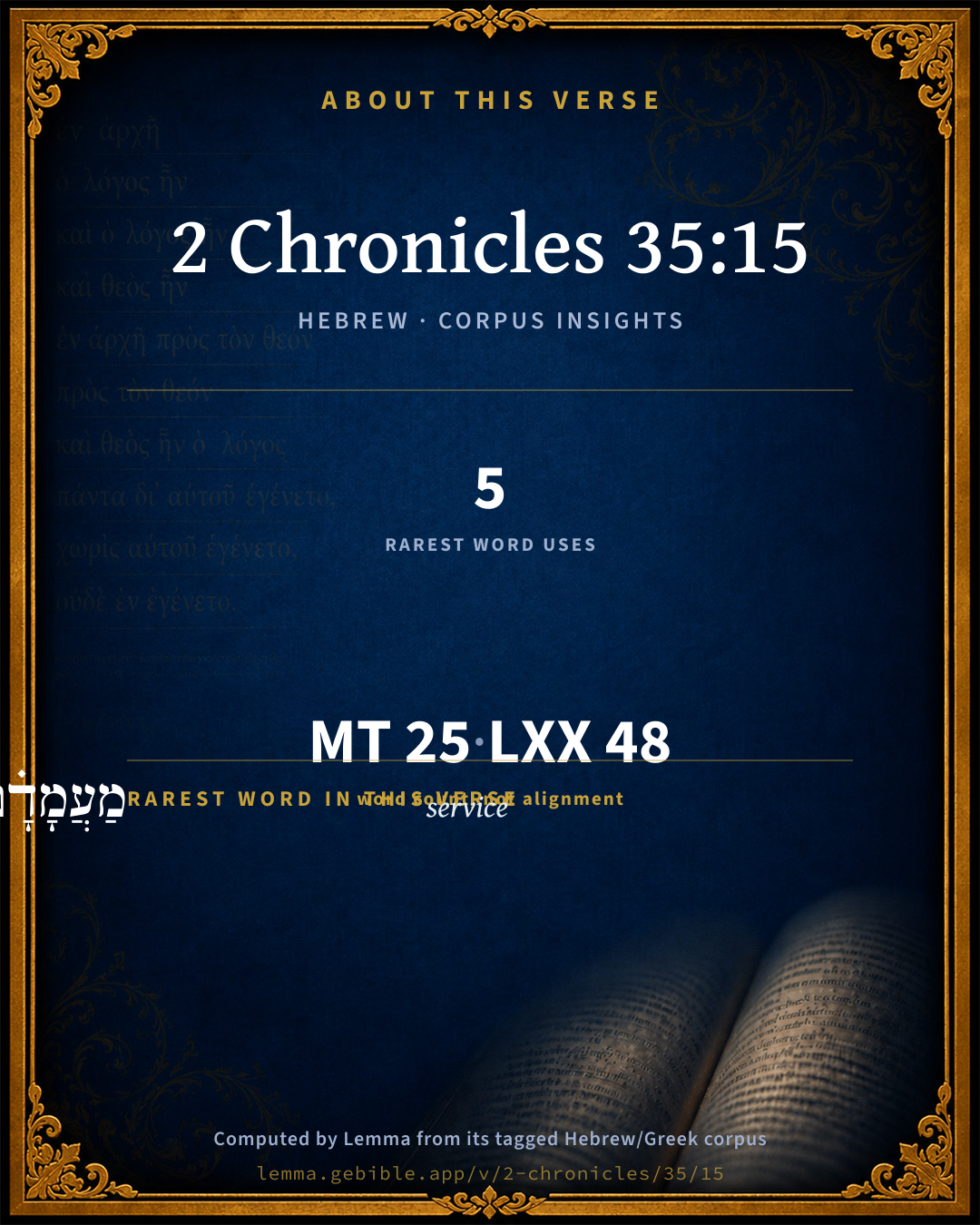
2 Chronicles 35:15

Hebrew (Westminster Leningrad Codex) 2 Chronicles 35:15 appears in the Hebrew Old Testament. The text above is from the Westminster Leningrad Codex. Each word links to its Strong’s number, a concise gloss, and parsing drawn from the Open Scriptures Hebrew Bible morphology. Click any word for its full Brown-Driver-Briggs (BDB) entry.
Download image
Cite this verse

2 Chronicles 35:15 (World English Bible). Public Domain. Lemma interlinear Bible study tool, https://lemma.gebible.app/v/2-chronicles/35/15.

Show BibTeX & RIS
BibTeX
RIS
English Translation
The singers the sons of Asaph were in their place, according to the commandment of David, and Asaph, and Heman, and Jeduthun the king's seer; and the porters were at every gate: they didn't need to depart from their service; for their brothers the Levites prepared for them.
World English Bible · Public Domain
Download a study sheet

One document with this verse’s original text, its word-by-word gloss line, the meaning frame, cross-references with their text, attributed commentary, and full source and license credits — printable, and it pastes into notes with its structure intact.

This verse Autodidact and up

Study sheet (.html) Plain text (.txt)

A passage Seminary Student

Up to 50 verses in one chapter. A passage sheet keeps up to 6 commentary sources and 12 cross-references per verse, in the order this page ranks them, and says so on the sheet whenever that leaves anything out. Ask for a single verse and you get the Autodidact verse sheet above.

Everything on this page stays free to read, with no account — the sheet is a download of what is already on screen, not access to it.

Want to remove ads? Support Godless Engineer
Compare translations 3

The same verse in 3 English versions, stacked beneath the original-language interlinear above. Click any original word for its lexicon entry.

Each is an independent rendering of the whole verse — the interlinear is not word-aligned to these translations.

Highlighted words mark where these versions differ — a whole-verse word diff, not a word-by-word alignment.

  • World English Bible Public Domain
    The singers the sons of Asaph were in their place, according to the commandment of David, and Asaph, and Heman, and Jeduthun the king's seer; and the porters were at every gate: they didn't need to depart from their service; for their brothers the Levites prepared for them.
  • King James Version Public Domain
    And the singers the sons of Asaph were in their place, according to the commandment of David, and Asaph, and Heman, and Jeduthun the king's seer; and the porters waited at every gate; they might not depart from their service; for their brethren the Levites prepared for them.
  • unfoldingWord Literal Text CC BY-SA 4.0
    And the singers, the sons of Asaph, in their place, according to the commandment of David, and Asaph, and Heman, and Jeduthun, the seer of the king, and the gatekeepers for gate and gate. It was not for them to turn aside from their place because their brothers, the Levites, prepared for them.

unfoldingWord Literal Text — © unfoldingWord, licensed CC BY-SA 4.0. Word-aligned USFM3 via Door43 (git.door43.org/unfoldingWord/en_ult).

Versions to compare (up to 4)

3 of 4 selected

Show all 18 translations

Every available English version of this verse, each an independent rendering of the whole verse.

  • World English Bible Public Domain
    The singers the sons of Asaph were in their place, according to the commandment of David, and Asaph, and Heman, and Jeduthun the king's seer; and the porters were at every gate: they didn't need to depart from their service; for their brothers the Levites prepared for them.
  • Berean Standard Bible Public Domain
    The singers, the descendants of Asaph, were at their stations according to the command of David, Asaph, Heman, and Jeduthun the king’s seer. And the gatekeepers at each gate did not need to leave their position, because their fellow Levites made preparations for them.
  • Majority Standard Bible Public Domain
    The singers, the descendants of Asaph, were at their stations according to the command of David, Asaph, Heman, and Jeduthun the king’s seer. And the gatekeepers at each gate did not need to leave their posts, because their fellow Levites made preparations for them.
  • King James Version Public Domain
    And the singers the sons of Asaph were in their place, according to the commandment of David, and Asaph, and Heman, and Jeduthun the king's seer; and the porters waited at every gate; they might not depart from their service; for their brethren the Levites prepared for them.
  • American Standard Version (1901) Public Domain
    And the singers the sons of Asaph were in their place, according to the commandment of David, and Asaph, and Heman, and Jeduthun the king's seer; and the porters were at every gate: they needed not to depart from their service; for their brethren the Levites prepared for them.
  • Revised Version (1885) Public Domain
    And the singers the sons of Asaph were in their place, according to the commandment of David, and Asaph, and Heman, and Jeduthun the king’s seer; and the porters were at every gate: they needed not to depart from their service, for their brethren the Levites prepared for them.
  • Geneva Bible (1599) Public Domain
    And the singers the sonnes of Asaph stoode in their standing according to the commandement of Dauid, and Asaph, and Heman, and Ieduthun the Kings Seer: and the porters at euery gate, who might not depart from their seruice: therefore their brethren the Leuites prepared for them.
  • Douay-Rheims (1899) Public Domain
    And the singers the sons of Asaph stood in their order, according to the commandment of David, and Asaph, and Heman, and Idithun the prophets of the king: and the porters kept guard at every gate, so as not to depart one moment from their service: and therefore their brethren the Levites prepared meats for them.
  • Young's Literal Translation Public Domain
    And the singers, sons of Asaph, `are' on their station, according to the command of David, and Asaph, and Heman, and Jeduthun seer of the king, and the gate keepers `are' at gate and gate; it is not for them to turn aside from off their service, for their brethren the Levites have prepared for them.
  • Literal Standard Version CC BY-SA 4.0
    And the singers, sons of Asaph, [are] on their station according to the command of David, and Asaph, and Heman, and Jeduthun seer of the king, and the gatekeepers [are] at every gate; it is not for them to turn aside from off their service, for their brothers the Levites have prepared for them.
  • Unlocked Literal Bible CC BY-SA 4.0
    The singers, the descendants of Asaph, were in their place, as directed by David, Asaph, Heman, and Jeduthun the king's seer, and the guards were at every gate. They did not have to leave their post, because their brothers the Levites made preparations for them.
  • unfoldingWord Literal Text CC BY-SA 4.0
    And the singers, the sons of Asaph, in their place, according to the commandment of David, and Asaph, and Heman, and Jeduthun, the seer of the king, and the gatekeepers for gate and gate. It was not for them to turn aside from their place because their brothers, the Levites, prepared for them.
  • Darby Bible Public Domain
    And the singers, the sons of Asaph, were in their place, according to the commandment of David, and Asaph, and Heman, and Jeduthun the king's seer; and the doorkeepers were at every gate; they had not to depart from their service, for their brethren the Levites prepared for them.
  • World Messianic Bible Public Domain
    The singers, the sons of Asaph, were in their place, according to the commandment of David, Asaph, Heman, and Jeduthun the king’s seer; and the gatekeepers were at every gate. They didn’t need to depart from their service, because their brothers the Levites prepared for them.
  • Webster's Bible Public Domain
    And the singers the sons of Asaph were in their place, according to the commandment of David, and Asaph, and Heman, and Jeduthun the king's seer; and the porters waited at every gate; they might not depart from their service; for their brethren the Levites prepared for them.
  • Free Bible Version CC BY-SA 4.0
    The singers, the descendants of Asaph, were in their places following the instructions given by David, Asaph, Heman, and Jeduthun, the king's seer. The gatekeepers in charge at each gate did not need to leave, because their fellow Levites provided for them.
  • Bible in Basic English Public Domain
    And the sons of Asaph, the makers of melody, were in their places, as ordered by David and Asaph and Heman and Jeduthun, the king's seer; and the door-keepers were stationed at every door: there was no need for them to go away from their places, for their brothers the Levites made ready for them.
  • JPS Tanakh (1917) Public Domain
    And the singers the sons of Asaph were in their place, according to the commandment of David, and Asaph, and Heman, and Jeduthun the king's seer; and the porters were at every gate; they needed not to depart from their service, for their brethren the Levites prepared for them.

Literal Standard Version (2020), Covenant Press — licensed CC BY-SA 4.0. Text via the HelloAO Bible API (eBible.org). Unlocked Literal Bible (unfoldingWord) — licensed CC BY-SA 4.0. Text via the HelloAO Bible API (eBible.org). unfoldingWord Literal Text — © unfoldingWord, licensed CC BY-SA 4.0. Word-aligned USFM3 via Door43 (git.door43.org/unfoldingWord/en_ult). Free Bible Version, Dr. Jonathan Gallagher — licensed CC BY-SA 4.0. Text via the HelloAO Bible API (eBible.org).

Word by word

More ways to search: Search by grammar → Find every occurrence → Compare this word →

Practice this passage: Drill this verse → Learn its vocabulary →

מַעֲמָדָ֗ם
maʻămâd
H4612
“service · their”
Noun, Common, Masculine, Singular, Construct + Suffix, Personal, 3rd Person, Masculine, Plural
Part of Speech
Noun
Type
Common
Gender
Masculine
Number
Singular
State
Construct
Full BDB Definition

Origin: from H5975

TWOT: 1637d

attendance, office, function, service - station, office, post - office, function - service
  1. וְהַמְשֹֽׁרֲרִ֨ים shîyr H7891 “and · the · singing” Conjunction + Particle, Definite Article + Verb, Polel, Participle Active, Masculine, Plural, Absolute
  2. בְּנֵי bên H1121 “sons of” Noun, Common, Masculine, Plural, Construct
  3. אָסָ֜ף ʼÂçâph H623 “Asaph” Noun, Proper
  4. עַל ʻal H5921 “upon” Preposition
  5. כְּמִצְוַ֤ת mitsvâh H4687 “like/as · commandment of” Preposition + Noun, Common, Feminine, Singular, Construct
  6. דָּוִיד֙ Dâvid H1732 “David” Noun, Proper
  7. וְאָסָ֞ף ʼÂçâph H623 “and · Asaph” Conjunction + Noun, Proper
  8. וְהֵימָ֤ן Hêymân H1968 “and · Heman” Conjunction + Noun, Proper
  9. וִֽידֻתוּן֙ Yᵉdûwthûwn H3038 “and · Jeduthun” Conjunction + Noun, Proper
  10. חוֹזֵ֣ה chôzeh H2374 “seer of” Noun, Common, Masculine, Singular, Construct
  11. הַמֶּ֔לֶךְ melek H4428 “the · king” Particle, Definite Article + Noun, Common, Masculine, Singular, Absolute
  12. וְהַשֹּׁעֲרִ֖ים shôwʻêr H7778 “and · the · gatekeepers” Conjunction + Particle, Definite Article + Noun, Common, Masculine, Plural, Absolute
  13. לְשַׁ֣עַר shaʻar H8179 “to/for · gate” Preposition + Noun, Common, Masculine, Singular, Absolute
  14. וָשָׁ֑עַר shaʻar H8179 “and · gate” Conjunction + Noun, Common, Masculine, Singular, Absolute
  15. אֵ֣ין ʼayin H369 “nothing” Particle, Negative
  16. לָסוּר֙ çûwr H5493 “to turn aside” Preposition + Verb, Qal, Infinitive Construct
  17. מֵעַ֣ל ʻal H5921 “from · upon” Preposition + Preposition
  18. עֲבֹֽדָתָ֔ם ʻăbôdâh H5656 “service · their” Noun, Common, Feminine, Singular, Construct + Suffix, Personal, 3rd Person, Masculine, Plural
  19. כִּֽי kîy H3588 “that” Conjunction
  20. אֲחֵיהֶ֥ם ʼâch H251 “brothers · their” Noun, Common, Masculine, Plural, Construct + Suffix, Personal, 3rd Person, Masculine, Plural
  21. הַלְוִיִּ֖ם Lêvîyîy H3881 “the · Levites” Particle, Definite Article + Noun, Gentilic, Masculine, Plural, Absolute
  22. הֵכִ֥ינוּ kûwn H3559 “to be established” Verb, Hiphil, Perfect, 3rd Person, Common, Plural

About this verse

These counts appear in no published source. They are computed here, from the morphology-tagged text and Lemma’s own curated glosses. What Lemma adds →

25
words
20
distinct lemmas
Historical
section

Notable vocabulary

The rarest word here is מַעֲמָדָ֗ם service H4612 — appearing just 5 times in the whole Hebrew Bible.

Shared distinctive vocabulary

מַעֲמָדָ֗ם service H4612 occurs in 5 verses of the Hebrew Bible. Also found in:

Grammatical profile

  • 3 verbs
  • 16 nouns
  • 4 prepositions
  • 1 conjunction
  • 1 particle

Verb forms

  • וְהַמְשֹֽׁרֲרִ֨ים Polel · Participle Active
  • לָסוּר֙ Qal · Infinitive Construct
  • הֵכִ֥ינוּ Hiphil · Perfect

Repetition

Words recur within this verse — often emphatic in Hebrew:

  • אָסָ֜ף Asaph H623 ×2
  • עַל upon H5921 ×2
  • לְשַׁ֣עַר gate H8179 ×2

Hebrew & Septuagint length

In English translation the verse runs 48 words from the Hebrew and 60 from the Septuagint (LXX English) — closely comparable.

A rough comparison of the two English renderings, which tokenize alike — not a word-level alignment.

Word counts can differ between the Hebrew and the Greek without any difference in meaning — e.g. the Hebrew direct-object marker אֵת has no separate Greek word, and Greek often adds the article ὁ.

In the original languages it is 25 Hebrew tokens and 48 Greek tokens — but the two are counted differently (Hebrew bundles its prefixes and suffixes into one token; the Greek is in lemma form), so that isn’t a like-for-like length.

Cross-references

9

Topical passages linked to 2 Chronicles 35:15 in the Treasury of Scripture Knowledge — connected by theme and wording, ordered by reader-vote popularity; previews shown in the World English Bible.

  • 1 Chronicles 9:17–19 The porters: Shallum, and Akkub, and Talmon, and Ahiman, and their brothers (Shallum was the chief),
  • 1 Chronicles 25:1–7 Moreover, David and the captains of the host set apart for the service certain of the sons of Asaph, and of Heman, and of Jeduthun, who should prophesy with harps, with psalteries, and with cymbals: and the number of those who did the work according to their service was:
  • 1 Chronicles 26:12–19 Of these were the divisions of the doorkeepers, even of the chief men, having offices like their brothers, to minister in the house of Yahweh.
  • 1 Chronicles 16:41–42 and with them Heman and Jeduthun, and the rest who were chosen, who were mentioned by name, to give thanks to Yahweh, because his loving kindness endures forever;
  • 1 Chronicles 23:5 and four thousand were doorkeepers; and four thousand praised Yahweh with the instruments which I made, [said David], for giving praise.
  • 2 Chronicles 29:25–26 He set the Levites in the house of Yahweh with cymbals, with psalteries, and with harps, according to the commandment of David, and of Gad the king's seer, and Nathan the prophet; for the commandment was of Yahweh by his prophets.
  • Psalms 77:1 My cry goes to God! Indeed, I cry to God for help, And for him to listen to me.
  • Psalms 78:1 Hear my law, my people. Turn your ears to the words of my mouth.
  • Psalms 79:1 God, the nations have come into your inheritance. They have defiled your holy temple. They have laid Jerusalem in heaps.

Cross-references courtesy of OpenBible.info (CC BY 4.0).

Hebrew and Greek witnesses Masoretic Hebrew ↔ Greek Septuagint

The same verse in the two great witnesses to the Old Testament, shown verse-for-verse.

These are two independent witnesses, not word-aligned to each other, and the Septuagint is shown in lemma (dictionary) form.

Hebrew 2 Chronicles 35:15 Masoretic · Westminster Leningrad Codex

וְהַמְשֹֽׁרֲרִ֨ים בְּנֵי אָסָ֜ף עַל מַעֲמָדָ֗ם כְּמִצְוַ֤ת דָּוִיד֙ וְאָסָ֞ף וְהֵימָ֤ן וִֽידֻתוּן֙ חוֹזֵ֣ה הַמֶּ֔לֶךְ וְהַשֹּׁעֲרִ֖ים לְשַׁ֣עַר וָשָׁ֑עַר אֵ֣ין לָהֶ֗ם לָסוּר֙ מֵעַ֣ל עֲבֹֽדָתָ֔ם כִּֽי אֲחֵיהֶ֥ם הַלְוִיִּ֖ם הֵכִ֥ינוּ לָהֶֽם

The singers the sons of Asaph were in their place, according to the commandment of David, and Asaph, and Heman, and Jeduthun the king's seer; and the porters were at every gate: they didn't need to depart from their service; for their brothers the Levites prepared for them.

World English Bible · Public Domain

Greek LXX 2 Chronicles 35:15 Septuagint · lemma form

καί ὁ ψαλτῳδός υἱός ασαφ ἐπί ὁ στάσις αὐτός κατά ὁ ἐντολή δαυίδ καί ασαφ καί αιμαν καί ιδιθων ὁ προφήτης ὁ βασιλεύς καί ὁ ἄρχων καί ὁ πυλωρός πύλη καί πύλη οὐ εἰμί αὐτός κινέω ἀπό ὁ λειτουργία ἅγιος ὅτι ὁ ἀδελφός αὐτός ὁ λευείτης ἑτοιμάζω αὐτός

And the sons of Asaph the psalm-singers were at their post according to the commands of David, and Asaph, and Aeman, and Idithom, the prophets of the king: also, the chiefs and the porters of the several gates; —it was not for them to stir from the service of the holy things, for their brethren the Levites prepared for them.

LXX2012 (modern English Septuagint) · Public Domain

Hebrew: Westminster Leningrad Codex (CC BY 4.0). Greek: Septuagint (public domain); English from LXX2012 (modern English Septuagint) (Public Domain). How the Septuagint differs from the Hebrew →

Commentary

Notes on 2 Chronicles 35:15 from classic Christian and Jewish commentators (each source and its license shown beneath its notes). The classic Christian expositions comment on the surrounding passage and are grouped to its opening verse, so a note may address several verses; the Jewish commentaries on the Tanakh (Rashi and others) are per-verse, so they appear only where the commentator wrote on this verse.

Lemma curates 59 commentaries, every one of them public domain or Creative Commons licensed, each selected and text-cleaned for this edition rather than reprinted as found. About our sources →

Trapp's Complete Commentary

John Trapp

2Ch 35:15 And the singers the sons of Asaph [were] in their place, according to the commandment of David, and Asaph, and Heman, and Jeduthun the king’s seer; and the porters [waited] at every gate; they might not depart from their service; for their brethren the Levites prepared for them.

Ver. 15. According to the commandment.] Which to obey was their meat and drink. See 1Ch 25:1, &c.

John Trapp, A Commentary or Exposition upon All the Books of the Old and New Testament (1647–1656) — public domain. Text from a community e-Sword module.

Geneva Bible (1599)

Geneva Bible translators

Meaning hereby his Prophet, because he appointed the Psalms and prophecies which were to be sung.

Geneva Bible (1599) marginal notes — public domain. Text via Bolls.life.

Jamieson, Fausset & Brown

Robert Jamieson, A. R. Fausset & David Brown

And the singers . . ., were in their place--While the priests and people were so much engaged, the choir was not idle. They had to sing certain Psalms, namely, the hundred thirteenth to the hundred eighteenth inclusive, once, twice, and even a third time, during the continuance of each company of offerers. As they could not leave their posts, for the singing was resumed as every fresh company entered, the Levites prepared for them also; for the various bands relieved each other in turn, and while the general choir was doing duty, a portion of the tuneful brethren, relieved for a time, partook of the viands that were brought them.

Jamieson, Fausset & Brown — Commentary Critical and Explanatory on the Whole Bible (1871) — public domain (CC PDM 1.0). Text via the HelloAO Bible API.

Ellicott's Commentary for English Readers

(15) And the singers the sons of Asaph were in their place.—“At their post” or station (1Ch_23:28). The “sons” of Heman and Jeduthun are omitted for brevity.

According to the commandment . . . king’s seer.—Comp. 1Ch_25:1-6.

They might not depart.—Rather, they had no need to depart from their service (i.e., to leave their posts), in order to prepare their own passover and the subsequent meals, “for their brethren the Levites had prepared for them,” and brought it to them at their several stations.

A Bible Commentary for English Readers, edited by Charles John Ellicott (1878–1897) — public domain. Text from a community e-Sword module.

The Cambridge Bible for Schools and Colleges

gen. ed. J. J. S. Perowne

15. the singers] Cp. 1Ch_25:1 ff.

waited at every gate; they might not depart] R.V. were at every gate: they needed not to depart.

The Cambridge Bible for Schools and Colleges (gen. ed. J. J. S. Perowne; Cambridge University Press, 1878–1918) — public domain. Text from a community e-Sword module.

John Gill's Exposition

And the singers the sons of Asaph were in their place,.... In the court of the priests, singing and playing on their instruments while the sacrifices were offering:

according to the commandment of David, and Asaph, and Heman, and Jeduthun the king's seer; the same with Ethan; and everyone were seers, as Jarchi interprets it, that is, the three last:

and the porters waited at every gate; such of the Levites as were in, that post and office:

they might not depart from their service; to let people in and out, that came for their passover lamb, and share in their other offerings:

for their brethren the Levites prepared for them; because they were not at leisure to prepare for themselves.

John Gill's Exposition of the Whole Bible (1746–1763) — public domain (CC PDM 1.0). Text via the HelloAO Bible API.

Albert Barnes' Notes on the Bible

They might not depart - The singers and porters remained at their posts, while other Levites sacrificed for them and brought them their share of the lambs.

Albert Barnes' Notes on the Bible (1834–1885) — public domain. Text from a community e-Sword/MySword module.

Haydock's Catholic Bible Commentary

Prophets. Heb. "seer." But Sept., &c. read in the plural. These were "prophets of the king," (H.) or masters of music. C. --- Vulgate might insinuate that these three gave orders, as well as David. But they were in office under him, as people of the same name were, probably, under Josias. H.

George Leo Haydock (1774–1849), Haydock's Catholic Family Bible and Commentary, 1859 edition — public domain. Excludes Psalms (Douay-Rheims chapter numbering differs from Protestant) and Deuterocanonical books (Catholic canon only).

The Pulpit Commentary

To the marginal references of 1Ch_25:9:26.; add 2Ch 6:33-46.

The Pulpit Commentary (1880–1919), ed. H.D.M. Spence-Jones & Joseph S. Exell — public domain. Text from a community e-Sword module.

unfoldingWord translationNotes

Door43 World Missions Community

as directed by David, Asaph, Heman, and Jeduthun the king's seer

This can be stated in active form. AT: "as David, Asaph, Heman, and Jeduthun the king's seer had directed them" (See: Active or Passive)

Heman ... Jeduthun

These are the names of men. (See: How to Translate Names)

translationWords

Asaph

gate

brother

unfoldingWord translationNotes — © Distant Shores Media and the Door43 World Missions Community, licensed CC BY-SA 4.0. Source: git.door43.org/Door43/en_tn.

Rashi

Rabbi Shlomo Yitzchaki (Rashi)

the king’s seer Each one was a seer.

Rashi on the Tanakh — English translations: “The Judaica Press complete Tanach with Rashi, translated by A. J. Rosenberg” (CC BY 4.0); “Pentateuch with Rashi's commentary by M. Rosenbaum and A.M. Silbermann, 1929-1934” (public domain); “The Metsudah Tanach series, Lakewood, N.J” (CC BY 4.0); and “The Book of Joshua, Metsudah Publications, 1997” (CC BY 4.0). Text via Sefaria.

Lesson kit

Teaching starters — assembled from the data on this page, not authored interpretation. Every prompt links to the verse data it draws on. Edit before teaching.

2 Chronicles, in the Historical, opens this verse with 25 words (20 distinct Hebrew lemmas). Its most distinctive word is maʻămâd (“service”). A historical commentator’s framing appears above. Read the whole chapter for the surrounding context.

Discussion questions

  1. How does “service” (maʻămâd) shape what this verse is saying?
  2. 1 Kings 10:5 shares the word «service» with this verse. How do the two illuminate each other?
  3. “Asaph” occurs 2× in this one verse. What is the effect of the repetition?
  4. The translations on this page render this verse differently — a whole-verse word diff, not a word-by-word alignment. What might account for the different wordings?
  5. The verb «וְהַמְשֹֽׁרֲרִ֨ים» is Polel Participle Active. How does its form color the action?
  6. Reading how Trapp's Complete Commentary and Geneva Bible (1599) read this verse, where do the two commentators agree and where do they part?

Things to notice

Reading settings

Reading text

Shown beneath each verse's original-language words.

Old Testament
Old Testament edition

Read the OT as the Masoretic Hebrew (MT) or the Greek Septuagint (LXX).

English shown for the Greek Septuagint (in the Hebrew ↔ Greek comparison).

Comparing translations? Open the Compare panel on any verse page to stack up to four side by side.