
2 Chronicles 5:2

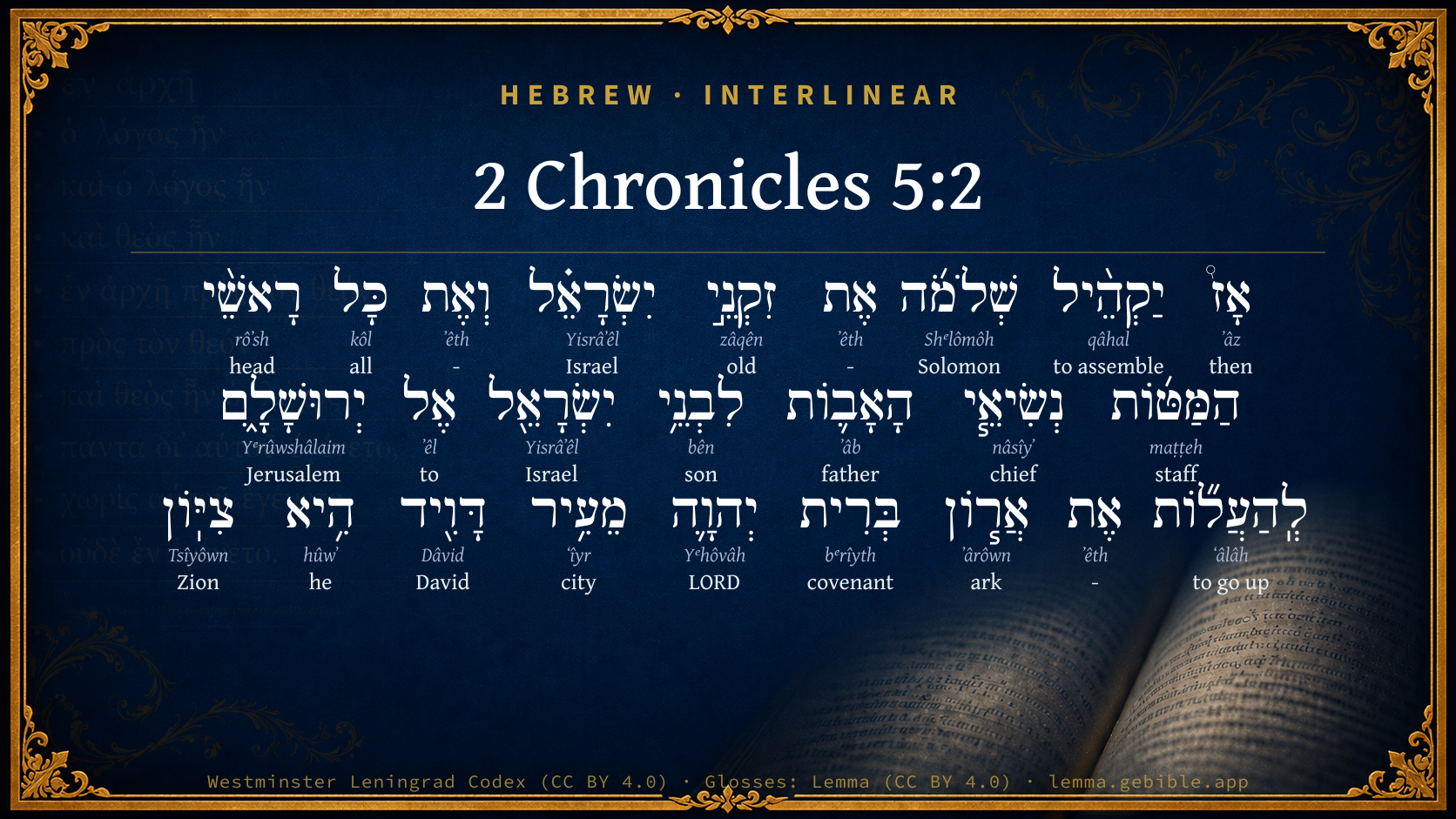
Hebrew (Westminster Leningrad Codex) 2 Chronicles 5:2 appears in the Hebrew Old Testament. The text above is from the Westminster Leningrad Codex. Each word links to its Strong’s number, a concise gloss, and parsing drawn from the Open Scriptures Hebrew Bible morphology. Click any word for its full Brown-Driver-Briggs (BDB) entry.
Download image
Cite this verse

2 Chronicles 5:2 (World English Bible). Public Domain. Lemma interlinear Bible study tool, https://lemma.gebible.app/v/2-chronicles/5/2.

Show BibTeX & RIS
BibTeX
RIS
English Translation
Then Solomon assembled the elders of Israel, and all the heads of the tribes, the princes of the fathers' [houses] of the children of Israel, to Jerusalem, to bring up the ark of the covenant of Yahweh out of the city of David, which is Zion.
World English Bible · Public Domain
Download a study sheet

One document with this verse’s original text, its word-by-word gloss line, the meaning frame, cross-references with their text, attributed commentary, and full source and license credits — printable, and it pastes into notes with its structure intact.

This verse Autodidact and up

Study sheet (.html) Plain text (.txt)

A passage Seminary Student

Up to 50 verses in one chapter. A passage sheet keeps up to 6 commentary sources and 12 cross-references per verse, in the order this page ranks them, and says so on the sheet whenever that leaves anything out. Ask for a single verse and you get the Autodidact verse sheet above.

Everything on this page stays free to read, with no account — the sheet is a download of what is already on screen, not access to it.

Want to remove ads? Support Godless Engineer
Compare translations 3

The same verse in 3 English versions, stacked beneath the original-language interlinear above. Click any original word for its lexicon entry.

Each is an independent rendering of the whole verse — the interlinear is not word-aligned to these translations.

Highlighted words mark where these versions differ — a whole-verse word diff, not a word-by-word alignment.

  • World English Bible Public Domain
    Then Solomon assembled the elders of Israel, and all the heads of the tribes, the princes of the fathers' [houses] of the children of Israel, to Jerusalem, to bring up the ark of the covenant of Yahweh out of the city of David, which is Zion.
  • King James Version Public Domain
    Then Solomon assembled the elders of Israel, and all the heads of the tribes, the chief of the fathers of the children of Israel, unto Jerusalem, to bring up the ark of the covenant of the LORD out of the city of David, which is Zion.
  • unfoldingWord Literal Text CC BY-SA 4.0
    Then Solomon assembled the elders of Israel, and all the heads of the tribes, the leaders of the fathers of the sons of Israel to Jerusalem, to bring up the Box of the covenant of Yahweh from the city of David, that is, Zion.

unfoldingWord Literal Text — © unfoldingWord, licensed CC BY-SA 4.0. Word-aligned USFM3 via Door43 (git.door43.org/unfoldingWord/en_ult).

Versions to compare (up to 4)

3 of 4 selected

Show all 18 translations

Every available English version of this verse, each an independent rendering of the whole verse.

  • World English Bible Public Domain
    Then Solomon assembled the elders of Israel, and all the heads of the tribes, the princes of the fathers' [houses] of the children of Israel, to Jerusalem, to bring up the ark of the covenant of Yahweh out of the city of David, which is Zion.
  • Berean Standard Bible Public Domain
    At that time Solomon assembled in Jerusalem the elders of Israel—all the tribal heads and family leaders of the Israelites—to bring up the ark of the covenant of the LORD from Zion, the City of David.
  • Majority Standard Bible Public Domain
    At that time Solomon assembled in Jerusalem the elders of Israel—all the tribal heads and family leaders of the Israelites—to bring up the ark of the covenant of the LORD from Zion, the City of David.
  • King James Version Public Domain
    Then Solomon assembled the elders of Israel, and all the heads of the tribes, the chief of the fathers of the children of Israel, unto Jerusalem, to bring up the ark of the covenant of the LORD out of the city of David, which is Zion.
  • American Standard Version (1901) Public Domain
    Then Solomon assembled the elders of Israel, and all the heads of the tribes, the princes of the fathers' `houses' of the children of Israel, unto Jerusalem, to bring up the ark of the covenant of Jehovah out of the city of David, which is Zion.
  • Revised Version (1885) Public Domain
    Then Solomon assembled the elders of Israel, and all the heads of the tribes, the princes of the fathers’ houses of the children of Israel, unto Jerusalem, to bring up the ark of the covenant of the LORD out of the city of David, which is Zion.
  • Geneva Bible (1599) Public Domain
    Then Salomon assembled the Elders of Israel, and all the heads of the tribes, the chiefe fathers of the children of Israel vnto Ierusalem to bring vp the Arke of the couenant of the Lord from the citie of Dauid, which is Zion.
  • Douay-Rheims (1899) Public Domain
    And after this he gathered together the ancients of Israel, and all the princes of the tribes, and the heads of the families, of the children of Israel to Jerusalem, to bring the ark of the covenant of the Lord out of the city of David, which is Sion.
  • Young's Literal Translation Public Domain
    Then doth Solomon assemble the elders of Israel, and all the heads of the tribes, princes of the fathers of the sons of Israel, unto Jerusalem, to bring up the ark of the covenant of Jehovah from the city of David -- it `is' Zion.
  • Literal Standard Version CC BY-SA 4.0
    Then Solomon assembles the elderly of Israel, and all the heads of the tribes, princes of the fathers of the sons of Israel, to Jerusalem, to bring up the Ark of the Covenant of YHWH from the City of David—it [is] Zion.
  • Unlocked Literal Bible CC BY-SA 4.0
    Then Solomon assembled the elders of Israel, all the heads of the tribes, and the leaders of the families of the people of Israel, in Jerusalem, to bring up the ark of the covenant of Yahweh from the city of David, that is, Zion.
  • unfoldingWord Literal Text CC BY-SA 4.0
    Then Solomon assembled the elders of Israel, and all the heads of the tribes, the leaders of the fathers of the sons of Israel to Jerusalem, to bring up the Box of the covenant of Yahweh from the city of David, that is, Zion.
  • Darby Bible Public Domain
    Then Solomon assembled the elders of Israel, and all the heads of the tribes, the princes of the fathers of the children of Israel, to Jerusalem, to bring up the ark of the covenant of Jehovah out of the city of David, which is Zion.
  • World Messianic Bible Public Domain
    Then Solomon assembled the elders of Israel and all the heads of the tribes, the princes of the fathers’ households of the children of Israel, to Jerusalem, to bring up the ark of the LORD’s covenant out of David’s city, which is Zion.
  • Webster's Bible Public Domain
    Then Solomon assembled the elders of Israel, and all the heads of the tribes, the chief of the fathers of the children of Israel, to Jerusalem, to bring up the ark of the covenant of the LORD from the city of David, which is Zion.
  • Free Bible Version CC BY-SA 4.0
    Then Solomon summoned to Jerusalem the elders of Israel—all the heads of the tribes and family leaders of the Israelites—to bring the Ark of the Lord's Agreement from Zion, the City of David.
  • Bible in Basic English Public Domain
    Then Solomon sent for all the responsible men of Israel, all the chiefs of the tribes and the heads of families of the children of Israel, to come to Jerusalem and take the ark of the Lord's agreement up out of the town of David, which is Zion.
  • JPS Tanakh (1917) Public Domain
    Then Solomon assembled the elders of Israel, and all the heads of the tribes, the princes of the fathers' houses of the children of Israel, unto Jerusalem, to bring up the ark of the covenant of the LORD out of the city of David, which is Zion.

Literal Standard Version (2020), Covenant Press — licensed CC BY-SA 4.0. Text via the HelloAO Bible API (eBible.org). Unlocked Literal Bible (unfoldingWord) — licensed CC BY-SA 4.0. Text via the HelloAO Bible API (eBible.org). unfoldingWord Literal Text — © unfoldingWord, licensed CC BY-SA 4.0. Word-aligned USFM3 via Door43 (git.door43.org/unfoldingWord/en_ult). Free Bible Version, Dr. Jonathan Gallagher — licensed CC BY-SA 4.0. Text via the HelloAO Bible API (eBible.org).

Word by word

More ways to search: Search by grammar → Find every occurrence → Compare this word →

Practice this passage: Drill this verse → Learn its vocabulary →

יַקְהֵ֨יל
qâhal
H6950
“to assemble”
Verb, Hiphil, Imperfect, 3rd Person, Masculine, Singular
Part of Speech
Verb
Stem
Hiphil
Form
Imperfect
Person
3rd Person
Gender
Masculine
Number
Singular
Full BDB Definition

Origin: a primitive root

TWOT: 1991

to assemble, gather - (Niphal) to assemble - for religious reasons - for political reasons - (Hiphil) to summon an assembly - for war, judgment - for religious purposes
  1. אָז֩ ʼâz H227 “then” Adverb
  2. שְׁלֹמֹ֜ה Shᵉlômôh H8010 “Solomon” Noun, Proper
  3. אֶת ʼêth H853 “-” Particle, Direct Object
  4. זִקְנֵ֣י zâqên H2205 “old of” Adjective, Adjective, Masculine, Plural, Construct
  5. יִשְׂרָאֵ֗ל Yisrâʼêl H3478 “Israel” Noun, Proper
  6. וְאֶת ʼêth H853 “and · -” Conjunction + Particle, Direct Object
  7. כָּל kôl H3605 “all of” Noun, Common, Masculine, Singular, Construct
  8. רָאשֵׁ֨י rôʼsh H7218 “heads of” Noun, Common, Masculine, Plural, Construct
  9. הַמַּטּ֜וֹת maṭṭeh H4294 “the · staffs” Particle, Definite Article + Noun, Common, Masculine, Plural, Absolute
  10. נְשִׂיאֵ֧י nâsîyʼ H5387 “chiefs of” Noun, Common, Masculine, Plural, Construct
  11. הָאָב֛וֹת ʼâb H1 “the · fathers” Particle, Definite Article + Noun, Common, Masculine, Plural, Absolute
  12. לִבְנֵ֥י bên H1121 “to/for · sons of” Preposition + Noun, Common, Masculine, Plural, Construct
  13. יִשְׂרָאֵ֖ל Yisrâʼêl H3478 “Israel” Noun, Proper
  14. אֶל ʼêl H413 “to” Preposition
  15. יְרוּשָׁלִָ֑ם Yᵉrûwshâlaim H3389 “Jerusalem” Noun, Proper
  16. לְֽהַעֲל֞וֹת ʻâlâh H5927 “to go up” Preposition + Verb, Hiphil, Infinitive Construct
  17. אֶת ʼêth H853 “-” Particle, Direct Object
  18. אֲר֧וֹן ʼârôwn H727 “ark of” Noun, Common, Both, Singular, Construct
  19. בְּרִית bᵉrîyth H1285 “covenant of” Noun, Common, Feminine, Singular, Construct
  20. יְהוָ֛ה Yᵉhôvâh H3068 “LORD” Noun, Proper
  21. מֵעִ֥יר ʻîyr H5892 “from · city of” Preposition + Noun, Common, Feminine, Singular, Construct
  22. דָּוִ֖יד Dâvid H1732 “David” Noun, Proper
  23. הִ֥יא hûwʼ H1931 “he” Pronoun, Personal, 3rd Person, Feminine, Singular
  24. צִיּֽוֹן Tsîyôwn H6726 “Zion” Noun, Proper

About this verse

These counts appear in no published source. They are computed here, from the morphology-tagged text and Lemma’s own curated glosses. What Lemma adds →

25
words
22
distinct lemmas
Historical
section

Shared distinctive vocabulary

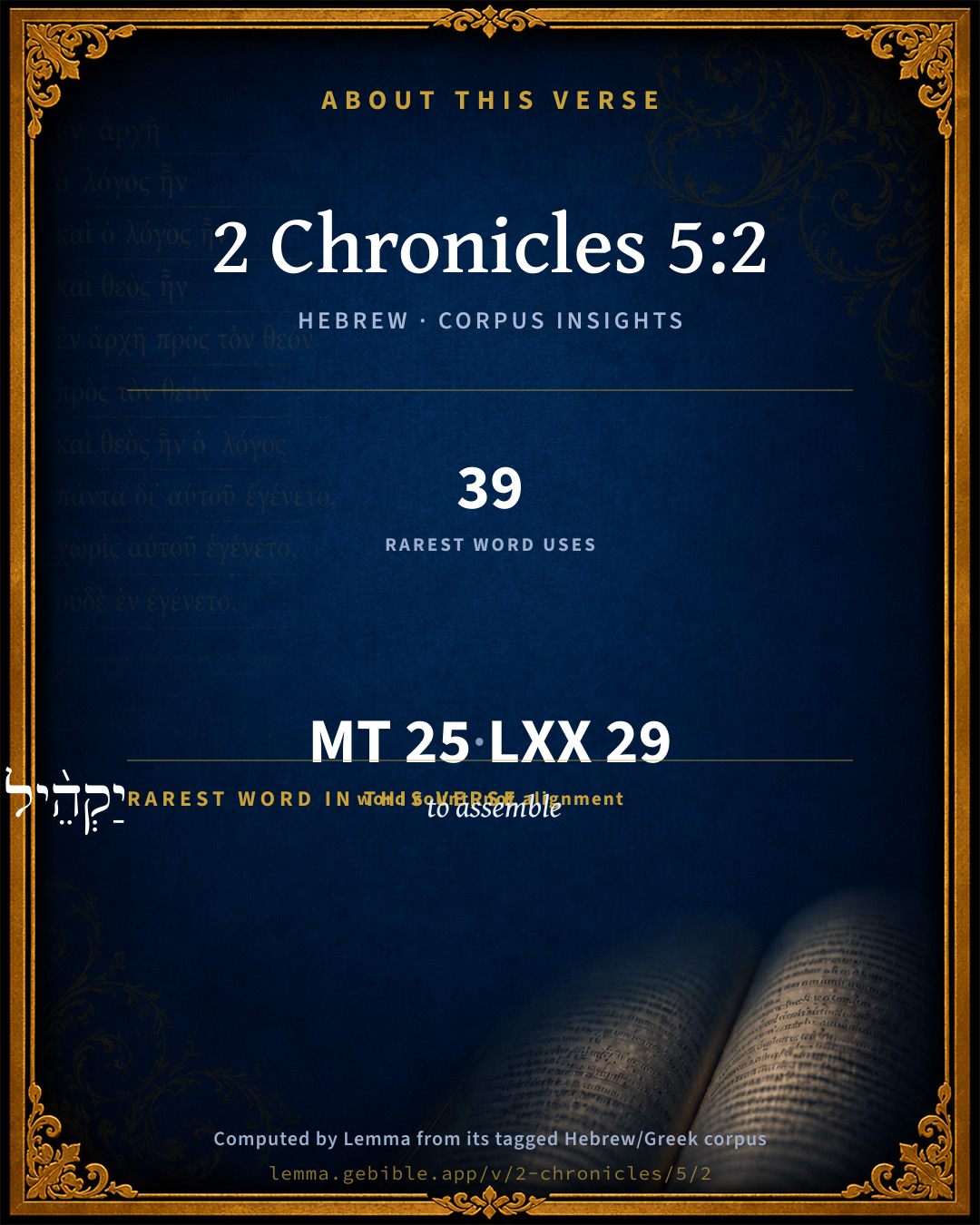
יַקְהֵ֨יל to assemble H6950 occurs in 39 verses of the Hebrew Bible. Also found in:

Grammatical profile

  • 2 verbs
  • 16 nouns
  • 1 adjective
  • 1 pronoun
  • 1 preposition
  • 1 adverb
  • 3 particles

Verb forms

  • יַקְהֵ֨יל Hiphil · Imperfect
  • לְֽהַעֲל֞וֹת Hiphil · Infinitive Construct

Repetition

A word recurs within this verse — often emphatic in Hebrew:

  • יִשְׂרָאֵ֗ל Israel H3478 ×2

Hebrew & Septuagint length

In English translation the verse runs 46 words from the Hebrew and 48 from the Septuagint (LXX English) — closely comparable.

A rough comparison of the two English renderings, which tokenize alike — not a word-level alignment.

Word counts can differ between the Hebrew and the Greek without any difference in meaning — e.g. the Hebrew direct-object marker אֵת has no separate Greek word, and Greek often adds the article ὁ.

In the original languages it is 25 Hebrew tokens and 29 Greek tokens — but the two are counted differently (Hebrew bundles its prefixes and suffixes into one token; the Greek is in lemma form), so that isn’t a like-for-like length.

Cross-references

18

Topical passages linked to 2 Chronicles 5:2 in the Treasury of Scripture Knowledge — connected by theme and wording, ordered by reader-vote popularity; previews shown in the World English Bible.

  • 2 Samuel 6:12 It was told king David, saying, Yahweh has blessed the house of Obed-edom, and all that pertains to him, because of the ark of God. David went and brought up the ark of God from the house of Obed-edom into the city of David with joy.
  • 2 Chronicles 1:4 But David had brought the ark of God up from Kiriath Jearim to [the place] that David had prepared for it; for he had pitched a tent for it at Jerusalem.
  • Numbers 10:33 They set forward from the Mount of Yahweh three days' journey; and the ark of the covenant of Yahweh went before them three days' journey, to seek out a resting-place for them.
  • Numbers 10:36 When it rested, he said, Return, Yahweh, to the ten thousands of the thousands of Israel.
  • 2 Samuel 5:7 Nevertheless David took the stronghold of Zion; the same is the city of David.
  • 1 Kings 8:1–11 Then Solomon assembled the elders of Israel, and all the heads of the tribes, the princes of the fathers' [houses] of the children of Israel, to king Solomon in Jerusalem, to bring up the ark of the covenant of Yahweh out of the city of David, which is Zion.
  • 1 Chronicles 15:12 and said to them, You are the heads of the fathers' [houses] of the Levites: sanctify yourselves, both you and your brothers, that you may bring up the ark of Yahweh, the God of Israel, to [the place] that I have prepared for it.
  • 1 Chronicles 15:25 So David, and the elders of Israel, and the captains over thousands, went to bring up the ark of the covenant of Yahweh out of the house of Obed-edom with joy.
  • 1 Chronicles 16:1 They brought in the ark of God, and set it in the midst of the tent that David had pitched for it: and they offered burnt offerings and peace-offerings before God.
  • 1 Chronicles 24:6 Shemaiah the son of Nethanel the scribe, who was of the Levites, wrote them in the presence of the king, and the princes, and Zadok the priest, and Ahimelech the son of Abiathar, and the heads of the fathers' [houses] of the priests and of the Levites; one fathers' house being taken for Eleazar, and one taken for Ithamar.
  • 1 Chronicles 24:31 These likewise cast lots even as their brothers the sons of Aaron in the presence of David the king, and Zadok, and Ahimelech, and the heads of the fathers' [houses] of the priests and of the Levites; the fathers' [houses] of the chief even as those of his younger brother.
  • 1 Chronicles 26:26 This Shelomoth and his brothers were over all the treasures of the dedicated things, which David the king, and the heads of the fathers' [houses], the captains over thousands and hundreds, and the captains of the host, had dedicated.
  • 1 Chronicles 28:1 David assembled all the princes of Israel, the princes of the tribes, and the captains of the companies who served the king by division, and the captains of thousands, and the captains of hundreds, and the rulers over all the substance and possessions of the king and of his sons, with the officers, and the mighty men, even all the mighty men of valor, to Jerusalem.
  • 2 Chronicles 5:1 Thus all the work that Solomon did for the house of Yahweh was finished. Solomon brought in the things that David his father had dedicated, even the silver, and the gold, and all the vessels, and put them in the treasuries of the house of God.
  • 2 Chronicles 5:12 also the Levites who were the singers, all of them, even Asaph, Heman, Jeduthun, and their sons and their brothers, arrayed in fine linen, with cymbals and psalteries and harps, stood at the east end of the altar, and with them one hundred twenty priests sounding with trumpets;)
  • Psalms 2:6 "Yet I have set my king on my holy hill of Zion."
  • Psalms 87:2 Yahweh loves the gates of Zion more than all the dwellings of Jacob.
  • Psalms 132:13–17 For Yahweh has chosen Zion. He has desired it for his habitation.

Cross-references courtesy of OpenBible.info (CC BY 4.0).

Hebrew and Greek witnesses Masoretic Hebrew ↔ Greek Septuagint

The same verse in the two great witnesses to the Old Testament, shown verse-for-verse.

These are two independent witnesses, not word-aligned to each other, and the Septuagint is shown in lemma (dictionary) form.

Hebrew 2 Chronicles 5:2 Masoretic · Westminster Leningrad Codex

אָז֩ יַקְהֵ֨יל שְׁלֹמֹ֜ה אֶת זִקְנֵ֣י יִשְׂרָאֵ֗ל וְאֶת כָּל רָאשֵׁ֨י הַמַּטּ֜וֹת נְשִׂיאֵ֧י הָאָב֛וֹת לִבְנֵ֥י יִשְׂרָאֵ֖ל אֶל יְרוּשָׁלִָ֑ם לְֽהַעֲל֞וֹת אֶת אֲר֧וֹן בְּרִית יְהוָ֛ה מֵעִ֥יר דָּוִ֖יד הִ֥יא צִיּֽוֹן

Then Solomon assembled the elders of Israel, and all the heads of the tribes, the princes of the fathers' [houses] of the children of Israel, to Jerusalem, to bring up the ark of the covenant of Yahweh out of the city of David, which is Zion.

World English Bible · Public Domain

Greek LXX 2 Chronicles 5:2 Septuagint · lemma form

τότε ἐκκλησιάζω σαλωμών ὁ πρεσβύτερος ἰσραήλ καί πᾶς ὁ ἄρχων ὁ φυλή ὁ ἡγέομαι πατριά υἱός ἰσραήλ εἰς ἰερουσαλήμ ὁ ἀναφέρω κιβωτός διαθήκη κύριος ἐκ πόλις δαυίδ οὗτος σιων

Then Solomon assembled all the elders of Israel, and all the heads of the tribes, even the leaders of the families of the children of Israel, to Jerusalem, to bring up the ark of the covenant of the Lord out of the city of David, —this is Sion.

LXX2012 (modern English Septuagint) · Public Domain

On this verse, Ellicott's Commentary for English Readers discusses the Septuagint’s reading. Read the note in Commentary ↓

Hebrew: Westminster Leningrad Codex (CC BY 4.0). Greek: Septuagint (public domain); English from LXX2012 (modern English Septuagint) (Public Domain). How the Septuagint differs from the Hebrew →

Commentary

Notes on 2 Chronicles 5:2 from classic Christian and Jewish commentators (each source and its license shown beneath its notes). The classic Christian expositions comment on the surrounding passage and are grouped to its opening verse, so a note may address several verses; the Jewish commentaries on the Tanakh (Rashi and others) are per-verse, so they appear only where the commentator wrote on this verse.

Lemma curates 59 commentaries, every one of them public domain or Creative Commons licensed, each selected and text-cleaned for this edition rather than reprinted as found. About our sources →

Jamieson, Fausset & Brown

Robert Jamieson, A. R. Fausset & David Brown

BRINGING UP OF THE ARK OF THE COVENANT. (Ch2 5:2-13)

Then Solomon assembled . . . in the feast which was in the seventh month--The feast of the dedication of the temple was on the eighth day of that month. This is related, word for word, the same as in Kg1 8:1-10.

Jamieson, Fausset & Brown — Commentary Critical and Explanatory on the Whole Bible (1871) — public domain (CC PDM 1.0). Text via the HelloAO Bible API.

Trapp's Complete Commentary

John Trapp

2Ch 5:2 Then Solomon assembled the elders of Israel, and all the heads of the tribes, the chief of the fathers of the children of Israel, unto Jerusalem, to bring up the ark of the covenant of the LORD out of the city of David, which [is] Zion.

Ver. 2. Then Solomon assembled, &c.] See for this whole chapter following, 1Ki 8:1-12. {See Trapp on "1Ki 8:1"} &c

John Trapp, A Commentary or Exposition upon All the Books of the Old and New Testament (1647–1656) — public domain. Text from a community e-Sword module.

The Biblical Illustrator

Joseph S. Exell

2Ch_5:2-10

To bring up the ark of the covenant of the Lord.

The removal of the ark

I. The time of its removal.

1. Remarkable in itself. The building finished in November was not dedicated until the October of the following year. Feast of Tabernacles most suitable time to dedicate temple.

2. Remarkable in its influence. The magnitude of the event is marked by the fact that now for the first time since the Exodus we have the year and month recorded (Stanley)

.

II. The method of its removal. Similar to the ceremony of removing from the house of Obed-edom.

III. The ceremonies which accompanied its removal.

IV. The solemn deposit in its resting-place. (J. Wolfendale.)

The Biblical Illustrator, edited by Joseph S. Exell (c. 1880s–1900s) — public domain. Text from a community e-Sword module.

Keil & Delitzsch

C. F. Keil & F. Delitzsch

The first part of the celebration was the transfer of the ark from Mount Zion to the temple (Ch2 5:2-14), and in connection with this we have the words in which Solomon celebrates the entry of the Lord into the new temple (Ch2 6:1-11). This section has been already commented on in the remarks on 1 Kings 8:1-21, and we have here, consequently, only to set down briefly those discrepancies between our account and that other, which have any influence upon the meaning. - In Ch2 5:3 the name of the month, האתנים בּירח (Kg1 8:2), with which the supplementary clause, "that is the seventh month," is there connected, is omitted, so that we must either change החדשׁ into בּחרשׁ, or supply the name of the month; for the festival is not the seventh month, but was held in that month.

Keil & Delitzsch — Biblical Commentary on the Old Testament (1861–1891) — public domain (CC PDM 1.0). Text via the HelloAO Bible API. (Old Testament only.)

unfoldingWord translationNotes

Door43 World Missions Community

assembled the elders of Israel

"called together the leaders of Israel"

all the heads of the tribes

Here "heads" is a metaphor for the most important part of something. AT: "all the leaders of the tribes" (See: Metaphor)

All the men of Israel

This may refer either 1) to the people whom Solomon called to Jerusalem and who are listed in 2Ch 5:2 or 2) generally to those who traveled to Jerusalem for the feast, not necessarily to every male person who lived in Israel. (See: Hyperbole and Generalization)

at the feast, which was in the seventh month

This is the Festival of Shelters which is on the fifteenth day of the seventh month of the Hebrew calendar. This is near the beginning of October on Western calendars. (See: Hebrew Months and Ordinal Numbers and Assumed Knowledge and Implicit Information)

translationWords

elder

head

Israel

tribe

family

people group

Jerusalem

ark of the covenant

Yahweh

city of David

Zion

king

feast

unfoldingWord translationNotes — © Distant Shores Media and the Door43 World Missions Community, licensed CC BY-SA 4.0. Source: git.door43.org/Door43/en_tn.

Geneva Bible (1599)

Geneva Bible translators

Read 2 Sam. 6:12.

Geneva Bible (1599) marginal notes — public domain. Text via Bolls.life.

Ellicott's Commentary for English Readers

(2) The chief of the fathers.—Rather, the chiefs of the clans (father-houses). Vulg., “capita familiarum;” LXX., τοὺς ἠγουμένους πατριῶν.

Elders . . . heads.—Or, sheikhs . . . ameers.

Zion.—Syr. and Arab., Hebron.

In the feast which was in the seventh month.—Heb., in the feast; that (is) the seventh month. The words “in the month of Ethanim” (Kings) have been accidentally omitted before the expression rendered “in the feast.” The Authorised version suggests another mode of emending the text. (Comp. Neh_8:14.) Syr., “in the month of the fruits (’ebbô) of the feast of Tabernacles; that is the seventh month.” The LXX. had the present faulty Hebrew.

A Bible Commentary for English Readers, edited by Charles John Ellicott (1878–1897) — public domain. Text from a community e-Sword module.

The Cambridge Bible for Schools and Colleges

gen. ed. J. J. S. Perowne

2–10 (= 1Ki_8:1-9). The Ark brought into the Sanctuary

This section is taken almost verbatim from 1 Kings.

2. Then Solomon assembled] The same verb in the Hebrew as in 1Ch_15:3 (see note there) and in 1Ch_28:1.

the chief of the fathers] R.V. the princes of the fathers’ houses.

the city of David] See 1Ch_11:5, note on the castle of Zion.

The Cambridge Bible for Schools and Colleges (gen. ed. J. J. S. Perowne; Cambridge University Press, 1878–1918) — public domain. Text from a community e-Sword module.

Haydock's Catholic Bible Commentary

Ark. Another was not made, as that was most sacred and excellent. (Worthington)

George Leo Haydock (1774–1849), Haydock's Catholic Family Bible and Commentary, 1859 edition — public domain. Excludes Psalms (Douay-Rheims chapter numbering differs from Protestant) and Deuterocanonical books (Catholic canon only).

Matthew Poole's English Annotations

Of this and the following verses, See Poole "1Ki 8:1", &c.

Matthew Poole's English Annotations on the Holy Bible (1683–1685) — public domain. Text from a community e-Sword/MySword module.

The Pulpit Commentary

Comparing the language of this and the following verse with that used on the occasion of David"s bringing up of the ark to Zion, found 2Sa_6:1 1Ch 13. and 15., some have thought that a considerable difference of tone is perceptible, and that indication is given of the intention, or at any rate a feeling, even if more or less unconscious, on the part of Solomon, that times were ripe for a demonstration, that should partake less of the enthusiasm of the mass, so far as his own summons might be concerned, and more of the form and dignity of the chief and representative men of the nation. This view can hardly be pressed. The very word "wherefore" in ver. 3 goes far to discredit it. And any difference that may be apparent in the language is far more probably and easily attributable to the old cause of the narrower, though intenser, interest of the writer of Chronicles.

Vers. 2-13.

Bringing in the ark.

It was fitting enough that the ark which had been in the ancient tabernacle should be brought with much ceremony into the new temple. It linked the past and the future, and it associated two things which must be constantly kept together. It suggests to us

I THE TRUE NATIONAL CONTINUITY. This was not found at all in the permanence of one form of government, for that had passed from a theocracy to a monarchy; nor was it found only or even chiefly in the descent by blood of one generation from another; nor in the continuance of the same social customs. It was found in the faithfulness of the people to the Lord their God; in the perpetuity of the national faith and, consequently, of the national morals and habits of life. The code of religious and ethical law which God gave to them through Moses was to remain the statute law of the realm. It was to be placed, on the most solemn occasion, under the most striking and memorable conditions, in the most sacred place of the sacred building in the holy city (vers. 7-10). The nation that changes its faith is itself changed; it is not the same, but another nation. The people that remain loyal to their God and true to their ancient convictions are the same people, however their institutions and customs may be modified by "time and change.

II THE TWO GREAT COUNTERPARTS OF DIVINE SERVICE. Much was made of the altar of sacrifice; indeed, the temple was the place of sacrifice. There, and there only, could offerings be presented and sin be expiated. But in the most holy place, beneath the "mercy-seat," at the very point where the blood was sprinkled on the great Day of Atonement, was the ark which held the tables of stone; and on these was inscribed the epitome of law, the demand for obedience. Sacrifice (or worship, as it is now) and obedience are the two great complementary parts of the service of God (see homily on. (2Ch_1:3-5)

III THE BEST SERVICE OF WORLDLY DIGNITY. We learn (ver. 2) that "the elders of Israel, and all the heads of the tribes," assembled on this occasion; they lent the weight of their social dignity to it. They did well to do this. There is nothing in which any kind of earthly distinction can be so well engaged as in promoting the piety of the people, in attaching them more firmly to their sacred principles, connecting them with and committing them to the service of the living God. Sad is it indeed when rank uses its influence to undermine the faith; admirable and honourable is it when exalted station spends its strength in advancing the devotion and the integrity of the people.

IV THE JOYOUSNESS THAT BELONGS TO DIVINE WORSHIP. It was surely right that the first act of worship associated with the temple should be accompanied by a feast rather than by a fast (ver. 3). It was right that the choir should unite "in praising and thanking the Lord" (ver. 13). In the service of One to whom such ascription can be rendered as is offered to the Lord (ver, 13), the sound of holy gladness should be the prevailing note.

V THE NEARNESS OF HUMAN APPROACH AND DIVINE MANIFESTATION. (Vers. 13, 14.) Let us draw nigh unto God in praise and prayer, and he will draw nigh unto us in the best proofs of his presence, in the most valuable manifestations of his power and grace. C.

The Pulpit Commentary (1880–1919), ed. H.D.M. Spence-Jones & Joseph S. Exell — public domain. Text from a community e-Sword module.

Scofield Reference Notes

C. I. Scofield

Then Solomon

(See Scofield "1Ki 8:1").

The Scofield Reference Bible (1917 edition), notes by C. I. Scofield — public domain. Text from a community e-Sword module.

Rashi

Rabbi Shlomo Yitzchaki (Rashi)

Then Solomon assembled the elders of Israel He conducted [the matter] with the attribute of wisdom, in that he gathered the elders, and not the youths, [which was] better than David [had done,] who gathered even the youths, as it is written, “And David assembled all the leaders of Israel...Jerusalem” (I Chron. 28:1).

Rashi on the Tanakh — English translations: “The Judaica Press complete Tanach with Rashi, translated by A. J. Rosenberg” (CC BY 4.0); “Pentateuch with Rashi's commentary by M. Rosenbaum and A.M. Silbermann, 1929-1934” (public domain); “The Metsudah Tanach series, Lakewood, N.J” (CC BY 4.0); and “The Book of Joshua, Metsudah Publications, 1997” (CC BY 4.0). Text via Sefaria.

Lesson kit

Teaching starters — assembled from the data on this page, not authored interpretation. Every prompt links to the verse data it draws on. Edit before teaching.

2 Chronicles, in the Historical, opens this verse with 25 words (22 distinct Hebrew lemmas). Its most distinctive word is qâhal (“to assemble”). A historical commentator’s framing appears above. Read the whole chapter for the surrounding context.

Discussion questions

  1. The word qâhal carries the sense “to assemble.” How does it shape the verse?
  2. How does Exodus 32:1, which shares the word «to assemble», read alongside this verse?
  3. What does the repetition of “Israel” (2× in this one verse) do in this verse?
  4. These translations render this verse differently. What is at stake in choosing one wording over another?
  5. «יַקְהֵ֨יל» is a Hiphil Imperfect verb. How does that grammatical form shape the action described?
  6. Compare how Jamieson, Fausset & Brown and Trapp's Complete Commentary read this verse. Where do they agree or differ?

Things to notice

Reading settings

Reading text

Shown beneath each verse's original-language words.

Old Testament
Old Testament edition

Read the OT as the Masoretic Hebrew (MT) or the Greek Septuagint (LXX).

English shown for the Greek Septuagint (in the Hebrew ↔ Greek comparison).

Comparing translations? Open the Compare panel on any verse page to stack up to four side by side.