
1 Chronicles 19:18

Hebrew (Westminster Leningrad Codex) 1 Chronicles 19:18 appears in the Hebrew Old Testament. The text above is from the Westminster Leningrad Codex. Each word links to its Strong’s number, a concise gloss, and parsing drawn from the Open Scriptures Hebrew Bible morphology. Click any word for its full Brown-Driver-Briggs (BDB) entry.
Download image
Cite this verse

1 Chronicles 19:18 (World English Bible). Public Domain. Lemma interlinear Bible study tool, https://lemma.gebible.app/v/1-chronicles/19/18.

Show BibTeX & RIS
BibTeX
RIS
English Translation
The Syrians fled before Israel; and David killed of the Syrians [the men of] seven thousand chariots, and forty thousand footmen, and killed Shophach the captain of the host.
World English Bible · Public Domain
Download a study sheet

One document with this verse’s original text, its word-by-word gloss line, the meaning frame, cross-references with their text, attributed commentary, and full source and license credits — printable, and it pastes into notes with its structure intact.

This verse Autodidact and up

Study sheet (.html) Plain text (.txt)

A passage Seminary Student

Up to 50 verses in one chapter. A passage sheet keeps up to 6 commentary sources and 12 cross-references per verse, in the order this page ranks them, and says so on the sheet whenever that leaves anything out. Ask for a single verse and you get the Autodidact verse sheet above.

Everything on this page stays free to read, with no account — the sheet is a download of what is already on screen, not access to it.

Want to remove ads? Support Godless Engineer
Compare translations 3

The same verse in 3 English versions, stacked beneath the original-language interlinear above. Click any original word for its lexicon entry.

Each is an independent rendering of the whole verse — the interlinear is not word-aligned to these translations.

Highlighted words mark where these versions differ — a whole-verse word diff, not a word-by-word alignment.

  • World English Bible Public Domain
    The Syrians fled before Israel; and David killed of the Syrians [the men of] seven thousand chariots, and forty thousand footmen, and killed Shophach the captain of the host.
  • King James Version Public Domain
    But the Syrians fled before Israel; and David slew of the Syrians seven thousand men which fought in chariots, and forty thousand footmen, and killed Shophach the captain of the host.
  • unfoldingWord Literal Text CC BY-SA 4.0
    And Aram fled from the face of Israel, and David killed from Aram 7,000 charioteers and 40,000 men on foot. And he killed Shobach, the commander of the army.

unfoldingWord Literal Text — © unfoldingWord, licensed CC BY-SA 4.0. Word-aligned USFM3 via Door43 (git.door43.org/unfoldingWord/en_ult).

Versions to compare (up to 4)

3 of 4 selected

Show all 18 translations

Every available English version of this verse, each an independent rendering of the whole verse.

  • World English Bible Public Domain
    The Syrians fled before Israel; and David killed of the Syrians [the men of] seven thousand chariots, and forty thousand footmen, and killed Shophach the captain of the host.
  • Berean Standard Bible Public Domain
    But the Arameans fled before Israel, and David killed seven thousand of their charioteers and forty thousand foot soldiers. He also killed Shophach the commander of their army.
  • Majority Standard Bible Public Domain
    But the Arameans fled before Israel, and David killed seven thousand of their charioteers and forty thousand foot soldiers. He also killed Shophach the commander of their army.
  • King James Version Public Domain
    But the Syrians fled before Israel; and David slew of the Syrians seven thousand men which fought in chariots, and forty thousand footmen, and killed Shophach the captain of the host.
  • American Standard Version (1901) Public Domain
    And the Syrians fled before Israel; and David slew of the Syrians `the men of' seven thousand chariots, and forty thousand footmen, and killed Shophach the captain of the host.
  • Revised Version (1885) Public Domain
    And the Syrians fled before Israel; and David slew of the Syrians the men of seven thousand chariots, and forty thousand footmen, and killed Shophach the captain of the host.
  • Geneva Bible (1599) Public Domain
    But the Aramites fled before Israel, and Dauid destroyed of the Aramites seuen thousand charets, and fourtie thousand footemen, and killed Shophach the captaine of the hoste.
  • Douay-Rheims (1899) Public Domain
    But the Syrian fled before Israel: and David slew of the Syrians seven thousand chariots, and forty thousand footmen, and Sophach the general of the army.
  • Young's Literal Translation Public Domain
    and Aram fleeth from the face of Israel, and David slayeth of Aram seven thousand charioteers, and forty thousand footmen, and Shophach head of the host he hath put to death.
  • Literal Standard Version CC BY-SA 4.0
    and Aram flees from the face of Israel, and David slays seven thousand charioteers and forty thousand footmen of Aram, and he has put Shophach head of the host to death.
  • Unlocked Literal Bible CC BY-SA 4.0
    The Arameans fled from Israel, and David killed seven thousand Aramean charioteers and forty thousand foot soldiers. He also killed Shophak, the commander of the army.
  • unfoldingWord Literal Text CC BY-SA 4.0
    And Aram fled from the face of Israel, and David killed from Aram 7,000 charioteers and 40,000 men on foot. And he killed Shobach, the commander of the army.
  • Darby Bible Public Domain
    And the Syrians fled from before Israel; and David slew of the Syrians seven thousand [in] chariots, and forty thousand footmen, and slew Shophach the captain of the host.
  • World Messianic Bible Public Domain
    The Syrians fled before Israel; and David killed of the Syrian men seven thousand charioteers and forty thousand footmen, and also killed Shophach the captain of the army.
  • Webster's Bible Public Domain
    But the Syrians fled before Israel; and David slew of the Syrians seven thousand men who fought in chariots, and forty thousand footmen, and killed Shophach the captain of the host.
  • Free Bible Version CC BY-SA 4.0
    But the Aramean army ran away from the Israelites, and David killed 7,000 charioteers and 40,000 infantry, as well as Shobach, their army commander.
  • Bible in Basic English Public Domain
    And the Aramaeans went in flight before Israel; and David put to the sword the men of seven thousand Aramaean war-carriages and forty thousand footmen, and put to death Shophach, the captain of the army.
  • JPS Tanakh (1917) Public Domain
    And the Arameans fled before Israel; and David slew of the Arameans the men of seven thousand chariots, and forty thousand footmen, and killed Shophach the captain of the host.

Literal Standard Version (2020), Covenant Press — licensed CC BY-SA 4.0. Text via the HelloAO Bible API (eBible.org). Unlocked Literal Bible (unfoldingWord) — licensed CC BY-SA 4.0. Text via the HelloAO Bible API (eBible.org). unfoldingWord Literal Text — © unfoldingWord, licensed CC BY-SA 4.0. Word-aligned USFM3 via Door43 (git.door43.org/unfoldingWord/en_ult). Free Bible Version, Dr. Jonathan Gallagher — licensed CC BY-SA 4.0. Text via the HelloAO Bible API (eBible.org).

Word by word

More ways to search: Search by grammar → Find every occurrence → Compare this word →

Practice this passage: Drill this verse → Learn its vocabulary →

שׁוֹפַ֥ךְ
Shôwphâk
H7780
“Shophach”
Noun, Proper
Part of Speech
Noun
Type
Proper
Full BDB Definition

Origin: from H8210

TWOT: None

Shophach = "expansion" - the general of Hadarezer - also 'Shobach'
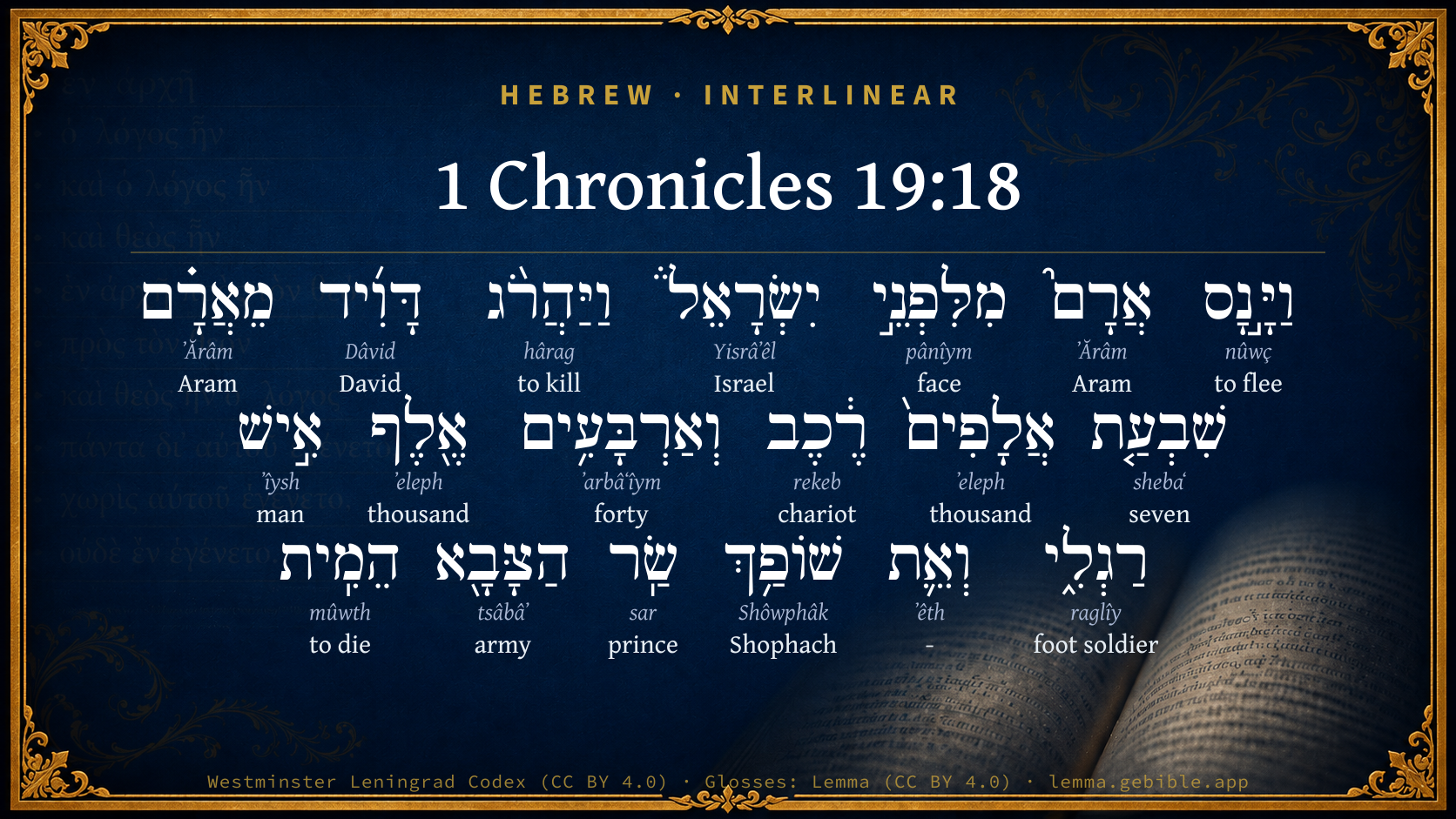
  1. וַיָּ֣נָס nûwç H5127 “and · to flee” Conjunction + Verb, Qal, Sequential Imperfect, 3rd Person, Masculine, Singular
  2. אֲרָם֮ ʼĂrâm H758 “Aram” Noun, Proper
  3. מִלִּפְנֵ֣י pânîym H6440 “from · to/for · face(s) of” Preposition + Preposition + Noun, Common, Both, Plural, Construct
  4. יִשְׂרָאֵל֒ Yisrâʼêl H3478 “Israel” Noun, Proper
  5. וַיַּהֲרֹ֨ג hârag H2026 “and · to kill” Conjunction + Verb, Qal, Sequential Imperfect, 3rd Person, Masculine, Singular
  6. דָּוִ֜יד Dâvid H1732 “David” Noun, Proper
  7. מֵאֲרָ֗ם ʼĂrâm H758 “from · Aram” Preposition + Noun, Proper
  8. שִׁבְעַ֤ת shebaʻ H7651 “seven” Adjective, Cardinal number, Masculine, Singular, Construct
  9. אֲלָפִים֙ ʼeleph H505 “thousand” Adjective, Cardinal number, Both, Plural, Absolute
  10. רֶ֔כֶב rekeb H7393 “chariot” Noun, Common, Masculine, Singular, Absolute
  11. וְאַרְבָּעִ֥ים ʼarbâʻîym H705 “and · forty” Conjunction + Adjective, Cardinal number, Both, Plural, Absolute
  12. אֶ֖לֶף ʼeleph H505 “thousand” Adjective, Cardinal number, Both, Singular, Absolute
  13. אִ֣ישׁ ʼîysh H376 “man” Noun, Common, Masculine, Singular, Absolute
  14. רַגְלִ֑י raglîy H7273 “foot soldier” Adjective, Adjective, Masculine, Singular, Absolute
  15. וְאֵ֛ת ʼêth H853 “and · -” Conjunction + Particle, Direct Object
  16. שַֽׂר sar H8269 “prince of” Noun, Common, Masculine, Singular, Construct
  17. הַצָּבָ֖א tsâbâʼ H6635 “the · army” Particle, Definite Article + Noun, Common, Both, Singular, Absolute
  18. הֵמִֽית mûwth H4191 “to die” Verb, Hiphil, Perfect, 3rd Person, Masculine, Singular

About this verse

These counts appear in no published source. They are computed here, from the morphology-tagged text and Lemma’s own curated glosses. What Lemma adds →

19
words
17
distinct lemmas
Historical
section

Notable vocabulary

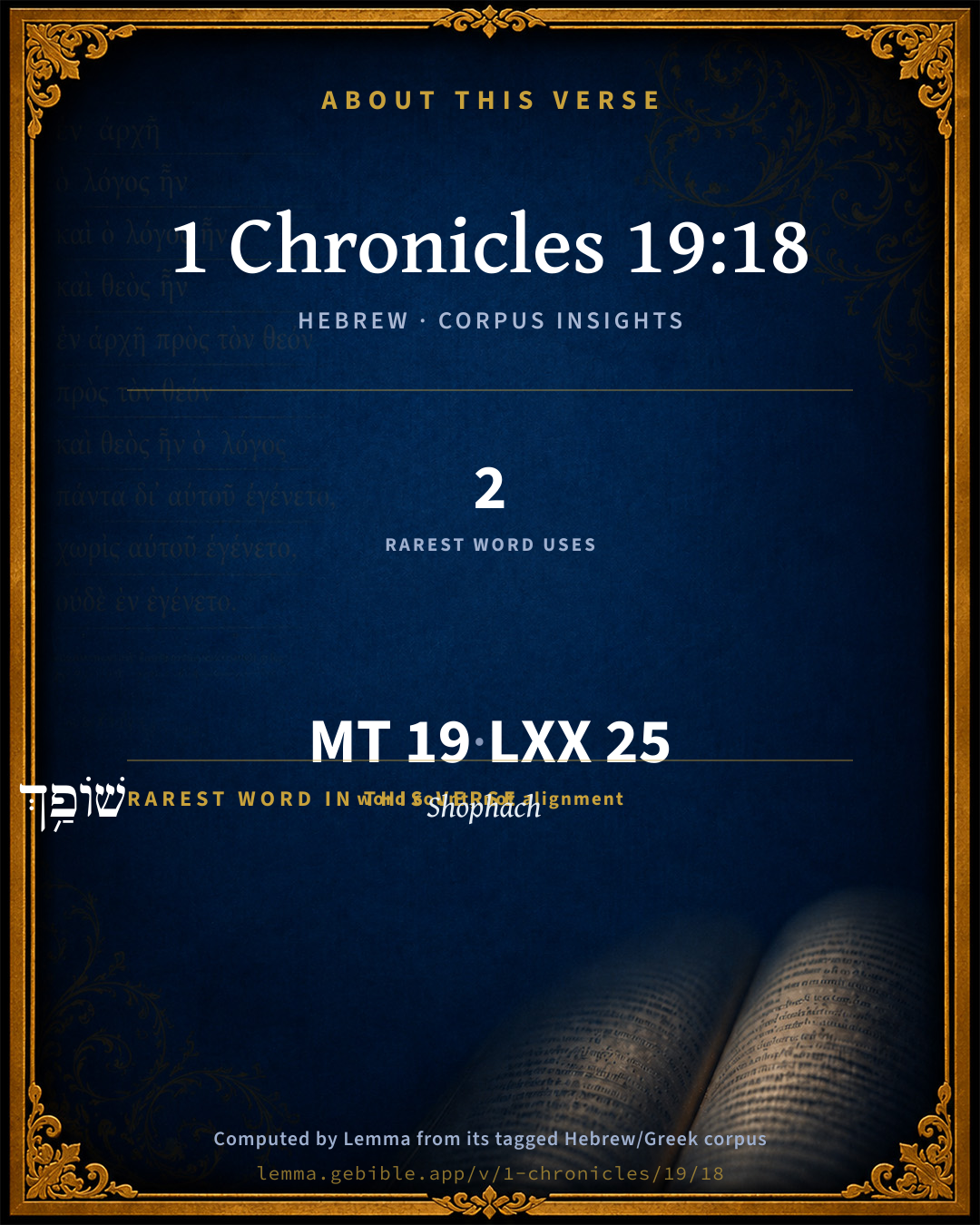
The rarest word here is שׁוֹפַ֥ךְ Shophach H7780 — appearing just 2 times in the whole Hebrew Bible.

Shared distinctive vocabulary

שׁוֹפַ֥ךְ Shophach H7780 occurs in 2 verses of the Hebrew Bible. Also found in:

Grammatical profile

  • 3 verbs
  • 10 nouns
  • 5 adjectives
  • 1 particle

Verb forms

  • וַיָּ֣נָס Qal · Sequential Imperfect
  • וַיַּהֲרֹ֨ג Qal · Sequential Imperfect
  • הֵמִֽית Hiphil · Perfect

Repetition

Words recur within this verse — often emphatic in Hebrew:

  • אֲרָם֮ Aram H758 ×2
  • אֲלָפִים֙ thousand H505 ×2

Hebrew & Septuagint length

In English translation the verse runs 29 words from the Hebrew and 31 from the Septuagint (LXX English) — closely comparable.

A rough comparison of the two English renderings, which tokenize alike — not a word-level alignment.

Word counts can differ between the Hebrew and the Greek without any difference in meaning — e.g. the Hebrew direct-object marker אֵת has no separate Greek word, and Greek often adds the article ὁ.

In the original languages it is 19 Hebrew tokens and 25 Greek tokens — but the two are counted differently (Hebrew bundles its prefixes and suffixes into one token; the Greek is in lemma form), so that isn’t a like-for-like length.

Cross-references

5

Topical passages linked to 1 Chronicles 19:18 in the Treasury of Scripture Knowledge — connected by theme and wording, ordered by reader-vote popularity; previews shown in the World English Bible.

  • 2 Samuel 10:18 The Syrians fled before Israel; and David killed of the Syrians [the men of] seven hundred chariots, and forty thousand horsemen, and struck Shobach the captain of their host, so that he died there.
  • 1 Chronicles 19:13–14 Be of good courage, and let us play the man for our people, and for the cities of our God: and Yahweh do that which seems him good.
  • Psalms 18:32 The God who arms me with strength, and makes my way perfect?
  • Psalms 33:16 There is no king saved by the multitude of a host. A mighty man is not delivered by great strength.
  • Psalms 46:11 Yahweh of Hosts is with us. The God of Jacob is our refuge. Selah.

Cross-references courtesy of OpenBible.info (CC BY 4.0).

Hebrew and Greek witnesses Masoretic Hebrew ↔ Greek Septuagint

The same verse in the two great witnesses to the Old Testament, shown verse-for-verse.

These are two independent witnesses, not word-aligned to each other, and the Septuagint is shown in lemma (dictionary) form.

Hebrew 1 Chronicles 19:18 Masoretic · Westminster Leningrad Codex

וַיָּ֣נָס אֲרָם֮ מִלִּפְנֵ֣י יִשְׂרָאֵל֒ וַיַּהֲרֹ֨ג דָּוִ֜יד מֵאֲרָ֗ם שִׁבְעַ֤ת אֲלָפִים֙ רֶ֔כֶב וְאַרְבָּעִ֥ים אֶ֖לֶף אִ֣ישׁ רַגְלִ֑י וְאֵ֛ת שׁוֹפַ֥ךְ שַֽׂר הַצָּבָ֖א הֵמִֽית

The Syrians fled before Israel; and David killed of the Syrians [the men of] seven thousand chariots, and forty thousand footmen, and killed Shophach the captain of the host.

World English Bible · Public Domain

Greek LXX 1 Chronicles 19:18 Septuagint · lemma form

καί φεύγω σύρος ἀπό πρόσωπον δαυίδ καί ἀποκτείνω δαυίδ ἀπό ὁ σύρος ἑπτά χιλιάς ἅρμα καί τεσσαράκοντα χιλιάς πεζός καί ὁ σωφαχ ἀρχιστράτηγος δύναμις ἀποκτείνω

And the Syrians fled from before Israel; and David killed of the Syrians seven thousand riders in chariots, and forty thousand infantry, and he killed Sophath the commander-in-chief of the forces.

LXX2012 (modern English Septuagint) · Public Domain

Hebrew: Westminster Leningrad Codex (CC BY 4.0). Greek: Septuagint (public domain); English from LXX2012 (modern English Septuagint) (Public Domain). How the Septuagint differs from the Hebrew →

Commentary

Notes on 1 Chronicles 19:18 from classic Christian and Jewish commentators (each source and its license shown beneath its notes). The classic Christian expositions comment on the surrounding passage and are grouped to its opening verse, so a note may address several verses; the Jewish commentaries on the Tanakh (Rashi and others) are per-verse, so they appear only where the commentator wrote on this verse.

Lemma curates 59 commentaries, every one of them public domain or Creative Commons licensed, each selected and text-cleaned for this edition rather than reprinted as found. About our sources →

Geneva Bible (1599)

Geneva Bible translators

For this place, read 2 Sam. 10:18.

Geneva Bible (1599) marginal notes — public domain. Text via Bolls.life.

Jamieson, Fausset & Brown

Robert Jamieson, A. R. Fausset & David Brown

David slew of the Syrians seven thousand men--(Compare Sa2 10:18, which has seven hundred chariots). Either the text in one of the books is corrupt [KEIL, DAVIDSON], or the accounts must be combined, giving this result--seven thousand horsemen, seven thousand chariots, and forty thousand footmen [KENNICOTT, HOUBIGANT, CALMET].

Next: 1 Chronicles Chapter 20

Jamieson, Fausset & Brown — Commentary Critical and Explanatory on the Whole Bible (1871) — public domain (CC PDM 1.0). Text via the HelloAO Bible API.

Adam Clarke's Commentary

Verse 18. Forty thousand footmen] See this number accounted for in Clarke's note on "2Sa 10:18".

Adam Clarke's Commentary on the Bible (1810–1826) — public domain. Text from a community e-Sword/MySword module.

Ellicott's Commentary for English Readers

(18) Seven thousand men which fought in chariots, and forty thousand footmen.—Heb., seven thousand chariotry (rèkeb), &c. Samuel reads, “seven hundred chariots, and forty thousand horse-men.” Such deviations seem to indicate independent sources. We can hardly choose between the two accounts; but “horsemen” may be more correct than “footmen.” (See 1Ch_18:4-5.)

And killed Shophach . . .—Abridged statement. (Comp. 2Sa_10:18.)

A Bible Commentary for English Readers, edited by Charles John Ellicott (1878–1897) — public domain. Text from a community e-Sword module.

The Cambridge Bible for Schools and Colleges

gen. ed. J. J. S. Perowne

18. seven thousand men which fought in chariots] R.V. the men of seven, thousand chariots. 2Sa_10:18, the men of seven hundred chariots.

forty thousand footmen] 2Sa_10:18, forty thousand horsemen. Swarms of horsemen have usually formed the strength of armies raised on the eastern bank of the Euphrates; the statement of 2 Sam, may therefore be more accurate than that of 1 Chr.

The Cambridge Bible for Schools and Colleges (gen. ed. J. J. S. Perowne; Cambridge University Press, 1878–1918) — public domain. Text from a community e-Sword module.

Haydock's Catholic Bible Commentary

Chariots. Literally, "chariot." 2 Kings has only 700, and 40,000 horsemen. (Calmet) --- Ten men might be in each chariot. (Du Hamel)

George Leo Haydock (1774–1849), Haydock's Catholic Family Bible and Commentary, 1859 edition — public domain. Excludes Psalms (Douay-Rheims chapter numbering differs from Protestant) and Deuterocanonical books (Catholic canon only).

The Pulpit Commentary

Seven thousand men which fought in chariots. The parallel passage has the men of seven hundred chariots. There could not be ton fighting men to a chariot. The reading of Samuel is more likely to be correct than our present reading. Forty thousand footmen. The parallel place shows "horsemen."

The Pulpit Commentary (1880–1919), ed. H.D.M. Spence-Jones & Joseph S. Exell — public domain. Text from a community e-Sword module.

unfoldingWord translationNotes

Door43 World Missions Community

killed seven thousand ... forty thousand

" killed 7,000 ... 40,000" (See: Numbers)

they were defeated by Israel

This can be stated in active form. AT: "Israel had defeated them" (See: Active or Passive)

they made peace with David and served them

They made the peace agreement with David as the king, and served the Israelites.

translationWords

Aram

David

chariot

commander

king

servant

peace

servant

Ammon

unfoldingWord translationNotes — © Distant Shores Media and the Door43 World Missions Community, licensed CC BY-SA 4.0. Source: git.door43.org/Door43/en_tn.

Lesson kit

Teaching starters — assembled from the data on this page, not authored interpretation. Every prompt links to the verse data it draws on. Edit before teaching.

1 Chronicles, in the Historical, opens this verse with 19 words (17 distinct Hebrew lemmas). Its most distinctive word is Shôwphâk (“Shophach”). A historical commentator’s framing appears above. Read the whole chapter for the surrounding context.

Discussion questions

  1. The word Shôwphâk carries the sense “Shophach.” How does it shape the verse?
  2. 1 Chronicles 19:16 shares the word «Shophach» with this verse. How do the two illuminate each other?
  3. “Aram” occurs 2× in this one verse. What is the effect of the repetition?
  4. These translations render this verse differently. What is at stake in choosing one wording over another?
  5. The verb «וַיָּ֣נָס» is Qal Sequential Imperfect. How does its form color the action?
  6. Reading how Geneva Bible (1599) and Jamieson, Fausset & Brown read this verse, where do the two commentators agree and where do they part?

Things to notice

Reading settings

Reading text

Shown beneath each verse's original-language words.

Old Testament
Old Testament edition

Read the OT as the Masoretic Hebrew (MT) or the Greek Septuagint (LXX).

English shown for the Greek Septuagint (in the Hebrew ↔ Greek comparison).

Comparing translations? Open the Compare panel on any verse page to stack up to four side by side.