
2 Chronicles 13:5

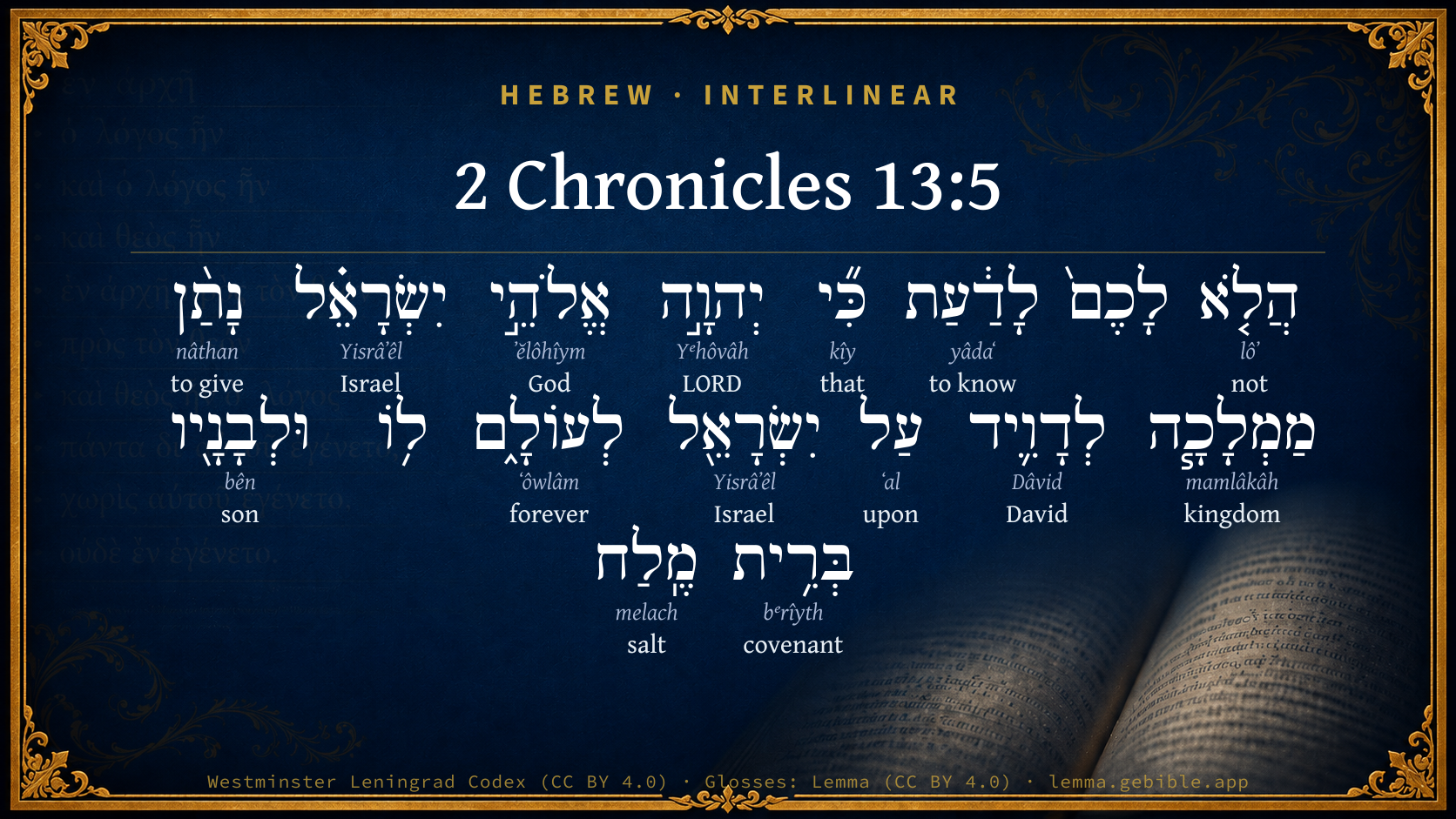
Hebrew (Westminster Leningrad Codex) 2 Chronicles 13:5 appears in the Hebrew Old Testament. The text above is from the Westminster Leningrad Codex. Each word links to its Strong’s number, a concise gloss, and parsing drawn from the Open Scriptures Hebrew Bible morphology. Click any word for its full Brown-Driver-Briggs (BDB) entry.
Download image
Cite this verse

2 Chronicles 13:5 (World English Bible). Public Domain. Lemma interlinear Bible study tool, https://lemma.gebible.app/v/2-chronicles/13/5.

Show BibTeX & RIS
BibTeX
RIS
English Translation
Ought you not to know that Yahweh, the God of Israel, gave the kingdom over Israel to David forever, even to him and to his sons by a covenant of salt?
World English Bible · Public Domain
Download a study sheet

One document with this verse’s original text, its word-by-word gloss line, the meaning frame, cross-references with their text, attributed commentary, and full source and license credits — printable, and it pastes into notes with its structure intact.

This verse Autodidact and up

Study sheet (.html) Plain text (.txt)

A passage Seminary Student

Up to 50 verses in one chapter. A passage sheet keeps up to 6 commentary sources and 12 cross-references per verse, in the order this page ranks them, and says so on the sheet whenever that leaves anything out. Ask for a single verse and you get the Autodidact verse sheet above.

Everything on this page stays free to read, with no account — the sheet is a download of what is already on screen, not access to it.

Want to remove ads? Support Godless Engineer
Compare translations 3

The same verse in 3 English versions, stacked beneath the original-language interlinear above. Click any original word for its lexicon entry.

Each is an independent rendering of the whole verse — the interlinear is not word-aligned to these translations.

Highlighted words mark where these versions differ — a whole-verse word diff, not a word-by-word alignment.

  • World English Bible Public Domain
    Ought you not to know that Yahweh, the God of Israel, gave the kingdom over Israel to David forever, even to him and to his sons by a covenant of salt?
  • King James Version Public Domain
    Ought ye not to know that the LORD God of Israel gave the kingdom over Israel to David for ever, even to him and to his sons by a covenant of salt?
  • unfoldingWord Literal Text CC BY-SA 4.0
    Is it not to you all to know that Yahweh, the God of Israel, gave the kingdom to David over Israel forever, to him and to his sons, a covenant of salt?

unfoldingWord Literal Text — © unfoldingWord, licensed CC BY-SA 4.0. Word-aligned USFM3 via Door43 (git.door43.org/unfoldingWord/en_ult).

Versions to compare (up to 4)

3 of 4 selected

Show all 18 translations

Every available English version of this verse, each an independent rendering of the whole verse.

  • World English Bible Public Domain
    Ought you not to know that Yahweh, the God of Israel, gave the kingdom over Israel to David forever, even to him and to his sons by a covenant of salt?
  • Berean Standard Bible Public Domain
    Do you not know that the LORD, the God of Israel, has given the kingship of Israel to David and his descendants forever by a covenant of salt?
  • Majority Standard Bible Public Domain
    Do you not know that the LORD, the God of Israel, has given the kingship of Israel to David and his descendants forever by a covenant of salt?
  • King James Version Public Domain
    Ought ye not to know that the LORD God of Israel gave the kingdom over Israel to David for ever, even to him and to his sons by a covenant of salt?
  • American Standard Version (1901) Public Domain
    Ought ye not to know that Jehovah, the God of Israel, gave the kingdom over Israel to David for ever, even to him and to his sons by a covenant of salt?
  • Revised Version (1885) Public Domain
    Ought ye not to know that the LORD, the God of Israel, gave the kingdom over Israel to David for ever, even to him and to his sons by a covenant of salt?
  • Geneva Bible (1599) Public Domain
    Ought you not to know that the Lord God of Israel hath giuen the kingdome ouer Israel to Dauid for euer, euen to him and to his sonnes by a couenant of salt?
  • Douay-Rheims (1899) Public Domain
    Do you not know that the Lord God of Israel gave to David the kingdom over Israel for ever, to him and to his sons by a covenant of salt?
  • Young's Literal Translation Public Domain
    Is it not for you to know that Jehovah, God of Israel, hath given the kingdom to David over Israel to the age, to him and to his sons -- a covenant of salt?
  • Literal Standard Version CC BY-SA 4.0
    Is it not for you to know that YHWH, God of Israel, has given the kingdom over Israel to David for all time, to him and to his sons—a covenant of salt?
  • Unlocked Literal Bible CC BY-SA 4.0
    Do you not know that Yahweh, the God of Israel, gave the rule over Israel to David forever, to him and to his sons by a formal covenant?
  • unfoldingWord Literal Text CC BY-SA 4.0
    Is it not to you all to know that Yahweh, the God of Israel, gave the kingdom to David over Israel forever, to him and to his sons, a covenant of salt?
  • Darby Bible Public Domain
    Ought ye not to know that Jehovah the God of Israel gave the kingdom over Israel to David for ever, to him and to his sons [by] a covenant of salt?
  • World Messianic Bible Public Domain
    Ought you not to know that the LORD, the God of Israel, gave the kingdom over Israel to David forever, even to him and to his sons by a covenant of salt?
  • Webster's Bible Public Domain
    Ought ye not to know that the LORD God of Israel gave the kingdom over Israel to David for ever, even to him and to his sons by a covenant of salt?
  • Free Bible Version CC BY-SA 4.0
    Don't you understand that the Lord, the God of Israel, gave the kingdom of Israel to David and his descendants forever by a binding agreement?
  • Bible in Basic English Public Domain
    Is it not clear to you that the Lord, the God of Israel, gave the rule over Israel to David and to his sons for ever, by an agreement made with salt?
  • JPS Tanakh (1917) Public Domain
    ought ye not to know that the LORD, the God of Israel, gave the kingdom over Israel to David for ever, even to him and to his sons by a covenant of salt?

Literal Standard Version (2020), Covenant Press — licensed CC BY-SA 4.0. Text via the HelloAO Bible API (eBible.org). Unlocked Literal Bible (unfoldingWord) — licensed CC BY-SA 4.0. Text via the HelloAO Bible API (eBible.org). unfoldingWord Literal Text — © unfoldingWord, licensed CC BY-SA 4.0. Word-aligned USFM3 via Door43 (git.door43.org/unfoldingWord/en_ult). Free Bible Version, Dr. Jonathan Gallagher — licensed CC BY-SA 4.0. Text via the HelloAO Bible API (eBible.org).

Word by word

More ways to search: Search by grammar → Find every occurrence → Compare this word →

Practice this passage: Drill this verse → Learn its vocabulary →

מֶֽלַח
melach
H4417
“salt”
Noun, Common, Masculine, Singular, Absolute
Part of Speech
Noun
Type
Common
Gender
Masculine
Number
Singular
State
Absolute
Full BDB Definition

Origin: from H4414

TWOT: 1197a

salt
  1. הֲלֹ֤א lôʼ H3808 “not” Particle, Interrogative + Particle, Negative
  2. לָדַ֔עַת yâdaʻ H3045 “to know” Preposition + Verb, Qal, Infinitive Construct
  3. כִּ֞י kîy H3588 “that” Conjunction
  4. יְהוָ֣ה Yᵉhôvâh H3068 “LORD” Noun, Proper
  5. אֱלֹהֵ֣י ʼĕlôhîym H430 “God(s) of” Noun, Common, Masculine, Plural, Construct
  6. יִשְׂרָאֵ֗ל Yisrâʼêl H3478 “Israel” Noun, Proper
  7. נָתַ֨ן nâthan H5414 “to give” Verb, Qal, Perfect, 3rd Person, Masculine, Singular
  8. מַמְלָכָ֧ה mamlâkâh H4467 “kingdom” Noun, Common, Feminine, Singular, Absolute
  9. לְדָוִ֛יד Dâvid H1732 “to/for · David” Preposition + Noun, Proper
  10. עַל ʻal H5921 “upon” Preposition
  11. יִשְׂרָאֵ֖ל Yisrâʼêl H3478 “Israel” Noun, Proper
  12. לְעוֹלָ֑ם ʻôwlâm H5769 “to/for · forever” Preposition + Noun, Common, Masculine, Singular, Absolute
  13. וּלְבָנָ֖יו bên H1121 “and · to/for · sons · his” Conjunction + Preposition + Noun, Common, Masculine, Plural, Construct + Suffix, Personal, 3rd Person, Masculine, Singular
  14. בְּרִ֥ית bᵉrîyth H1285 “covenant of” Noun, Common, Feminine, Singular, Construct

About this verse

These counts appear in no published source. They are computed here, from the morphology-tagged text and Lemma’s own curated glosses. What Lemma adds →

17
words
14
distinct lemmas
Historical
section

Shared distinctive vocabulary

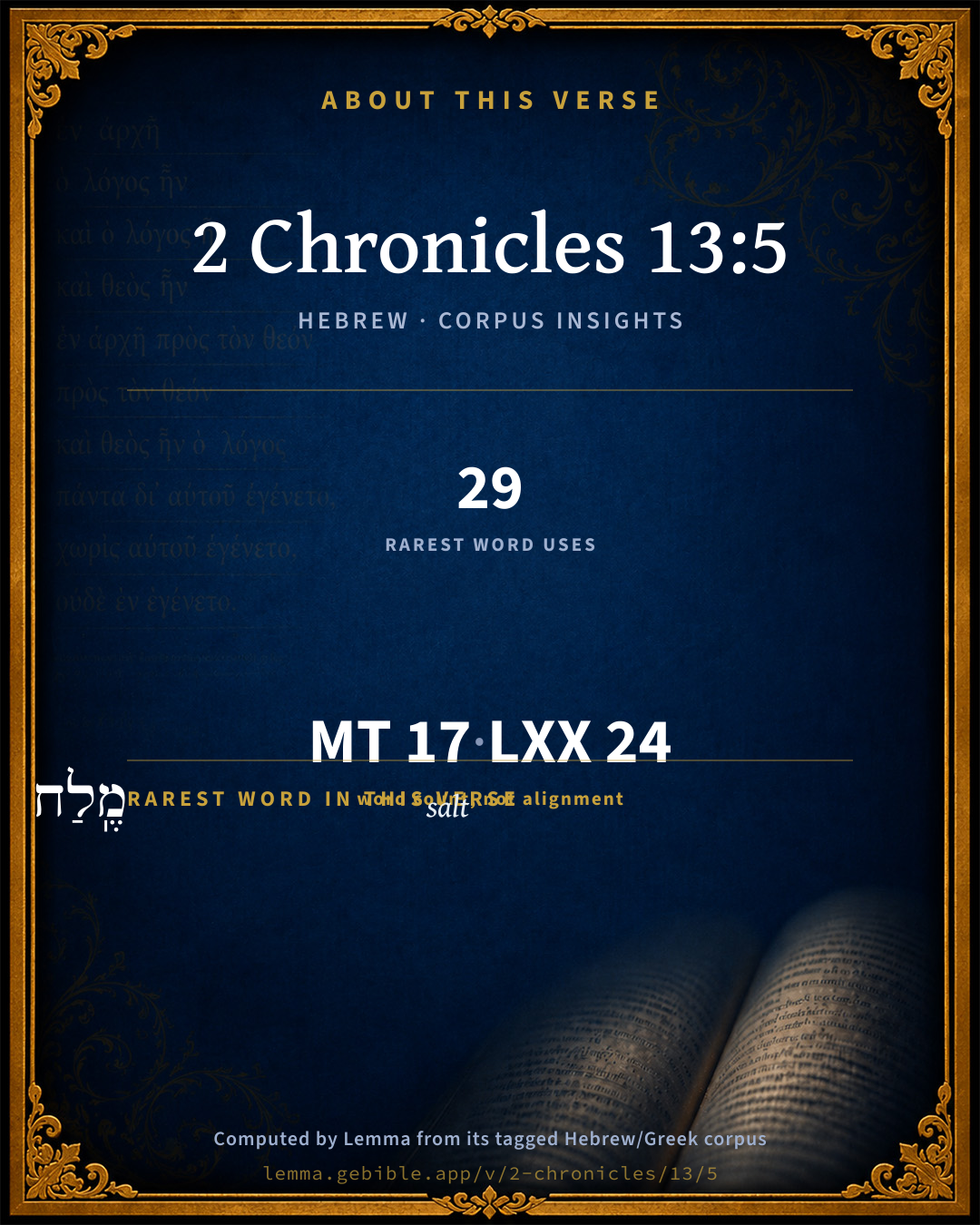
מֶֽלַח salt H4417 occurs in 26 verses of the Hebrew Bible. Also found in:

Grammatical profile

  • 2 verbs
  • 10 nouns
  • 3 prepositions
  • 1 conjunction
  • 1 particle

Verb forms

  • לָדַ֔עַת Qal · Infinitive Construct
  • נָתַ֨ן Qal · Perfect

Repetition

A word recurs within this verse — often emphatic in Hebrew:

  • יִשְׂרָאֵ֗ל Israel H3478 ×2

Hebrew & Septuagint length

In English translation the verse runs 31 words from the Hebrew and 32 from the Septuagint (LXX English) — closely comparable.

A rough comparison of the two English renderings, which tokenize alike — not a word-level alignment.

Word counts can differ between the Hebrew and the Greek without any difference in meaning — e.g. the Hebrew direct-object marker אֵת has no separate Greek word, and Greek often adds the article ὁ.

In the original languages it is 17 Hebrew tokens and 24 Greek tokens — but the two are counted differently (Hebrew bundles its prefixes and suffixes into one token; the Greek is in lemma form), so that isn’t a like-for-like length.

Cross-references

22

Topical passages linked to 2 Chronicles 13:5 in the Treasury of Scripture Knowledge — connected by theme and wording, ordered by reader-vote popularity; previews shown in the World English Bible.

  • Numbers 18:19 All the heave-offerings of the holy things, which the children of Israel offer to Yahweh, have I given you, and your sons and your daughters with you, as a portion forever: it is a covenant of salt forever before Yahweh to you and to your seed with you.
  • Leviticus 2:13 Every offering of your meal offering you shall season with salt; neither shall you allow the salt of the covenant of your God to be lacking from your meal offering. With all your offerings you shall offer salt.
  • 2 Samuel 7:12–16 When your days are fulfilled, and you shall sleep with your fathers, I will set up your seed after you, who shall proceed out of your bowels, and I will establish his kingdom.
  • Mark 9:49–50 For everyone will be salted with fire, and every sacrifice will be seasoned with salt.
  • 1 Kings 8:20 Yahweh has established his word that he spoke; for I am risen up in the room of David my father, and sit on the throne of Israel, as Yahweh promised, and have built the house for the name of Yahweh, the God of Israel.
  • Psalms 89:19–37 Then you spoke in vision to your saints, And said, "I have bestowed strength on the warrior. I have exalted a young man from the people.
  • Luke 1:31–33 Behold, you will conceive in your womb, and bring forth a son, and will call his name 'Jesus.'
  • 1 Chronicles 17:11 It shall happen, when your days are fulfilled that you must go to be with your fathers, that I will set up your seed after you, who shall be of your sons; and I will establish his kingdom.
  • 1 Chronicles 17:14 but I will settle him in my house and in my kingdom forever; and his throne shall be established forever.
  • 1 Chronicles 28:4–5 However Yahweh, the God of Israel, chose me out of all the house of my father to be king over Israel forever: for he has chosen Judah to be prince; and in the house of Judah, the house of my father; and among the sons of my father he took pleasure in me to make me king over all Israel;
  • Jeremiah 33:21–22 then may also my covenant be broken with David my servant, that he shall not have a son to reign on his throne; and with the Levites the priests, my ministers.
  • Ezekiel 43:24 You shall bring them near before Yahweh, and the priests shall cast salt on them, and they shall offer them up for a burnt offering to Yahweh.
  • Daniel 4:25–32 that you shall be driven from men, and your dwelling shall be with the animals of the field, and you shall be made to eat grass as oxen, and shall be wet with the dew of the sky, and seven times shall pass over you; until you know that the Most High rules in the kingdom of men, and gives it to whoever he will.
  • Proverbs 1:29 Because they hated knowledge, And didn't choose the fear of Yahweh.
  • Jeremiah 27:5–7 I have made the earth, the men and the animals that are on the surface of the earth, by my great power and by my outstretched arm; and I give it to whom it seems right to me.
  • Jeremiah 33:26 then will I also cast away the seed of Jacob, and of David my servant, so that I will not take of his seed to be rulers over the seed of Abraham, Isaac, and Jacob: for I will cause their captivity to return, and will have mercy on them.
  • Judges 11:21–24 Yahweh, the God of Israel, delivered Sihon and all his people into the hand of Israel, and they struck them: so Israel possessed all the land of the Amorites, the inhabitants of that country.
  • 1 Samuel 16:1 Yahweh said to Samuel, How long will you mourn for Saul, seeing I have rejected him from being king over Israel? fill your horn with oil, and go: I will send you to Jesse the Bethlehemite; for I have provided me a king among his sons.
  • 1 Samuel 16:12 He sent, and brought him in. Now he was ruddy, and withal of a beautiful face, and goodly to look on. Yahweh said, Arise, anoint him; for this is he.
  • Nehemiah 5:9 Also I said, The thing that you do is not good: ought you not to walk in the fear of our God, because of the reproach of the nations our enemies?
  • Daniel 5:18 You king, the Most High God gave Nebuchadnezzar your father the kingdom, and greatness, and glory, and majesty:
  • 2 Peter 3:5 For this they willfully forget, that there were heavens from of old, and an earth formed out of water and amid water, by the word of God;

Cross-references courtesy of OpenBible.info (CC BY 4.0).

Hebrew and Greek witnesses Masoretic Hebrew ↔ Greek Septuagint

The same verse in the two great witnesses to the Old Testament, shown verse-for-verse.

These are two independent witnesses, not word-aligned to each other, and the Septuagint is shown in lemma (dictionary) form.

Hebrew 2 Chronicles 13:5 Masoretic · Westminster Leningrad Codex

הֲלֹ֤א לָכֶם֙ לָדַ֔עַת כִּ֞י יְהוָ֣ה אֱלֹהֵ֣י יִשְׂרָאֵ֗ל נָתַ֨ן מַמְלָכָ֧ה לְדָוִ֛יד עַל יִשְׂרָאֵ֖ל לְעוֹלָ֑ם ל֥וֹ וּלְבָנָ֖יו בְּרִ֥ית מֶֽלַח

Ought you not to know that Yahweh, the God of Israel, gave the kingdom over Israel to David forever, even to him and to his sons by a covenant of salt?

World English Bible · Public Domain

Greek LXX 2 Chronicles 13:5 Septuagint · lemma form

οὐ σύ γιγνώσκω ὅτι κύριος ὁ θεός ἰσραήλ δίδωμι βασιλεία ἐπί ὁ ἰσραήλ εἰς ὁ αἰών ὁ δαυίδ καί ὁ υἱός αὐτός διαθήκη ἅλς

Is it not for you to know that the Lord God of Israel has given a king over Israel for ever to David, and to his sons, by a covenant of salt?

LXX2012 (modern English Septuagint) · Public Domain

On this verse, Ellicott's Commentary for English Readers discusses the Septuagint’s reading. Read the note in Commentary ↓

Hebrew: Westminster Leningrad Codex (CC BY 4.0). Greek: Septuagint (public domain); English from LXX2012 (modern English Septuagint) (Public Domain). How the Septuagint differs from the Hebrew →

Commentary

Notes on 2 Chronicles 13:5 from classic Christian and Jewish commentators (each source and its license shown beneath its notes). The classic Christian expositions comment on the surrounding passage and are grouped to its opening verse, so a note may address several verses; the Jewish commentaries on the Tanakh (Rashi and others) are per-verse, so they appear only where the commentator wrote on this verse.

Lemma curates 59 commentaries, every one of them public domain or Creative Commons licensed, each selected and text-cleaned for this edition rather than reprinted as found. About our sources →

Trapp's Complete Commentary

John Trapp

2Ch 13:5 Ought ye not to know that the LORD God of Israel gave the kingdom over Israel to David for ever, [even] to him and to his sons by a covenant of salt?

Ver. 5. Ought ye not to know?] q.d., How can ye be ignorant? and how dare you go against your knowledge? Is it not a grievous sin so to do

By a covenant of salt,] i.e., Perpetual and inviolable, solemn - as with sacrifice - and sure. See on Num 18:19. That exposition of Sanchez is somewhat strange and far fetched: that God’s covenant with the house of David was conditional, and therefore to be taken with a grain of salt; viz., that they should have the kingdom for ever, if they kept touch with him, &c.

John Trapp, A Commentary or Exposition upon All the Books of the Old and New Testament (1647–1656) — public domain. Text from a community e-Sword module.

Joseph Benson's Commentary

2Ch 13:5. By a covenant of salt — A perpetual covenant. The reason of this mode of expression seems to arise from the preserving nature of salt; which, therefore, was made a symbol of friendship and fidelity. It is most likely, that in all solemn covenants which were confirmed by sacrifice, it was an ancient custom to offer salt with the sacrifice, to denote the faith and perpetuity of the covenant; so that, in this view, a covenant of salt will signify a covenant confirmed by sacrifice. See note on Num 18:19.

Joseph Benson's Commentary on the Old and New Testaments (1811–1818) — public domain. Text from a community e-Sword module.

Tyndale Open Study Notes

Tyndale Open Resources

13:5 a lasting covenant: Literally a covenant of salt. Salt was required with a grain offering (Lev 2:13). The social and religious background for this phrase is unknown. However, salt was used as a preservative and provided an apt metaphor for a permanent covenant.

Tyndale Open Study Notes — © Tyndale Open Resources, licensed CC BY-SA 4.0. Text via the HelloAO Bible API.

Geneva Bible (1599)

Geneva Bible translators

And therefore whosoever doth usurp it or take it from that stock, transgresseth the ordinance of the Lord. Thus like an hypocrite he allegeth the word of God for his advantage.

That is, perpetual because that thing which is salted, is preserved from corruption: he meaneth also that it was made solemnly, and confirmed by offering of sacrifices, where as they used salt according as was ordained, Num. 18:19.

Geneva Bible (1599) marginal notes — public domain. Text via Bolls.life.

Adam Clarke's Commentary

Verse 5. By a covenant of salt?] For ever. "For as the waters of the sea never grow sweet, neither shall the dominion depart from the house of David." - Targum. See Clarke on Nu 18:19.

Adam Clarke's Commentary on the Bible (1810–1826) — public domain. Text from a community e-Sword/MySword module.

Ellicott's Commentary for English Readers

(5) Ought ye not to know.—Literally, is it not to you to know? A construction characteristic of the chronicler. Abijah contrasts the moral position of his adversaries with his own, asserting (1) that their separate political existence is itself an act of rebellion against Jehovah; (2) that they have abolished the only legitimate form of worship, and established in its place an illegal cultus and priesthood; whereas (3) he and his people have maintained the orthodox ritual and ministry, and are therefore assured of the divine support.

By a covenant of salt.—As or after the manner of a covenant of salt, i.e., a firm and unalterable compact (see Num_18:19). According to ancient custom, salt was indispensable at formal meals for the ratification of friendship and alliance; and only a “salt treaty “was held to be secure. Salt therefore accompanied sacrifices, as being, in fact, so many renewals of the covenant between man and God. (Lev_2:13; Eze_43:24; Lev_24:7 in the LXX.)

The antique phrase, “covenant of salt,” is otherwise important, as bearing on the authenticity of this speech.

A Bible Commentary for English Readers, edited by Charles John Ellicott (1878–1897) — public domain. Text from a community e-Sword module.

The Cambridge Bible for Schools and Colleges

gen. ed. J. J. S. Perowne

5. a covenant of salt] Salt was necessary for the efficacy of a sacrifice (Lev_2:13), so that Covenant of salt became a phrase for a sure covenant (Num_18:19). The sacredness of the bond which is acknowledged among the Arabs between two persons who have “eaten salt” together as host and guest is common knowledge. It is not however necessary that salt should be taken; any food, e.g. milk, will serve (W. R. Smith, Religion of the Semites, p. 270).

The Cambridge Bible for Schools and Colleges (gen. ed. J. J. S. Perowne; Cambridge University Press, 1878–1918) — public domain. Text from a community e-Sword module.

John Gill's Exposition

Yet Jeroboam the son of Nebat, the servant of Solomon the son of David, is risen up,.... Notwithstanding it was well known the kingdom was entailed on the posterity of David by an everlasting covenant; Abijah calls Jeroboam Solomon's servant, by way of great contempt, as Jarchi observes, he being the general receiver of his tax in the tribe of Ephraim, Kg1 11:28.

and hath rebelled against his lord; his rightful king and sovereign; the charge is no less than high treason.

John Gill's Exposition of the Whole Bible (1746–1763) — public domain (CC PDM 1.0). Text via the HelloAO Bible API.

Haydock's Catholic Bible Commentary

A covenant of salt. That is, a firm and perpetual covenant. See Numbers xviii. 19. (Challoner) (Worthington) --- It seems this covenant was to be inviolable; and it had its effect, notwithstanding the crimes of many of the kings. The Arabs still regard the partaking of bread and salt as the most sacred covenant. (Calmet) --- "The ancients prayed when they placed salt before their guests, that, as salt partook of two natures, so they might be cemented together in concord." (Tzetzez on Lycoph.) (Haydock) --- Abia speaks with much prudence, and with an air of piety, though his heart was corrupt, 3 Kings xv. 3. That of his adversary was still more so; and God granted victory to the former, to reward even the appearance of virtue in the king, and the sincere piety of some of his followers.

George Leo Haydock (1774–1849), Haydock's Catholic Family Bible and Commentary, 1859 edition — public domain. Excludes Psalms (Douay-Rheims chapter numbering differs from Protestant) and Deuterocanonical books (Catholic canon only).

Matthew Poole's English Annotations

i.e. By a perpetual covenant, which thy usurpation can not disannul. For the phrase, See Poole "Num 18:19".

Matthew Poole's English Annotations on the Holy Bible (1683–1685) — public domain. Text from a community e-Sword/MySword module.

Whedon's Commentary on the Bible

Daniel D. Whedon

5. A covenant of salt — The meat-offering was a standing memorial of God’s covenant with man, and could never be lawfully offered without salt.

Lev_2:13. Salt, the symbol of perpetuity and incorruptibility, became therefore proverbially associated with the Israelitish notion of a sacred and inviolable covenant. Hence “a covenant of salt” is equivalent to “a holy and inviolable covenant.” Compare Num_18:19.

Daniel D. Whedon (gen. ed.), Commentary on the Old and New Testaments (1874–1909) — public domain. Text from a community e-Sword module.

The Pulpit Commentary

Vers. 5-12. The idea of Abijah in this religious harangue, addressed or supposed to be addressed to the kingdom of the ten tribes, was good, and the execution was spirited. While, however, he preaches well to others, there are not wanting signs that he can blind himself as to some failure of practice on his own part. The points of the argument running through his harangue are correct, skilfully chosen, and well and religiously thrust home on the heart of his supposed audience. The practical trust of himself and his army are testified to in vers. 14, 15, and abundantly rewarded. This sequel-practical trust is the best credential of the sincerity of his foregoing appeal and harangue.

Gave the kingdom to David for ever. With the thrice-repeated "for ever" of what we call 2Sa_7:13-16, and the very emphatic language of the fifteenth verse in that passage, in the memory of Abijah, no one can say he was not justified by the letter and to the letter in what he now says. At the same time, how is it that Abijah does not in all fairness quote the matter of 2Ch_6:16 last clause, and of its parallel, 1Ki_8:25 last clause, and of Psa_89:28-37 Psa_132:12? Covenant of salt (see Lev_2:13; Num_18:19; Mar_9:49) The use of salt was ordered first for the meal offerings, which, consisting mainly of flour, did not need it as an antiseptic; afterwards it was ordered for "all" offerings, including the "burnt offering:" as surely as leaven was proscribed, salt was prescribed. (Lev_2:11) "The covenant of salt" meant the imperish-ableness and irrevocableness of the engagement made between the two parties to the covenant The widespread and deeply significant use of it among other and heathen nations is remarkable indeed, and is attested by Pliny ("Hist. Nah 31:41) in forcible words: "Nulla (sacra) conficiuntur sine mola salsa" (Her., 2Sa 3:200; Virgil, "AEn.," 2:133; Hom., " Iliad," 1:449). Some think it a sufficient explanation of the text, "covenant of salt," that, especially in the East, solemn engagements and vows were often recognized and strengthened by hospitalities, as shown to guests, and of these salt was an indispensable element. It is true that some of the ancient indications and descriptions of friendship and close friendships turned on phrases (similar ones, indeed, still existing) into which the word "salt" entered, but that these phrases arose from the fact that salt was so general a constituent of human food seems insufficient explanation, where we can find one of a more direct and more directly religious, or, as the case might be (e.g. with heathen sacrifices), superstitious birth. Religion and superstition between them have been the most world-wide, incalculable, and untraceable originators and disseminators of half the possible phrases of human language!

The Pulpit Commentary (1880–1919), ed. H.D.M. Spence-Jones & Joseph S. Exell — public domain. Text from a community e-Sword module.

John Wesley's Explanatory Notes

Of salt - By a perpetual covenant.

John Wesley, Explanatory Notes Upon the Whole Bible (1754–1765) — public domain. Text via the GEBible commentary corpus.

Rashi

Rabbi Shlomo Yitzchaki (Rashi)

a covenant of salt with endurance and permanence. And now -

Rashi on the Tanakh — English translations: “The Judaica Press complete Tanach with Rashi, translated by A. J. Rosenberg” (CC BY 4.0); “Pentateuch with Rashi's commentary by M. Rosenbaum and A.M. Silbermann, 1929-1934” (public domain); “The Metsudah Tanach series, Lakewood, N.J” (CC BY 4.0); and “The Book of Joshua, Metsudah Publications, 1997” (CC BY 4.0). Text via Sefaria.

Lesson kit

Teaching starters — assembled from the data on this page, not authored interpretation. Every prompt links to the verse data it draws on. Edit before teaching.

2 Chronicles, in the Historical, opens this verse with 17 words (14 distinct Hebrew lemmas). Its most distinctive word is melach (“salt”). A historical commentator’s framing appears above. Read the whole chapter for the surrounding context.

Discussion questions

  1. The word melach carries the sense “salt.” How does it shape the verse?
  2. How does Genesis 14:3, which shares the word «salt», read alongside this verse?
  3. What does the repetition of “Israel” (2× in this one verse) do in this verse?
  4. These translations render this verse differently. What is at stake in choosing one wording over another?
  5. «לָדַ֔עַת» is a Qal Infinitive Construct verb. How does that grammatical form shape the action described?
  6. Compare how Trapp's Complete Commentary and Joseph Benson's Commentary read this verse. Where do they agree or differ?

Things to notice

Reading settings

Reading text

Shown beneath each verse's original-language words.

Old Testament
Old Testament edition

Read the OT as the Masoretic Hebrew (MT) or the Greek Septuagint (LXX).

English shown for the Greek Septuagint (in the Hebrew ↔ Greek comparison).

Comparing translations? Open the Compare panel on any verse page to stack up to four side by side.