

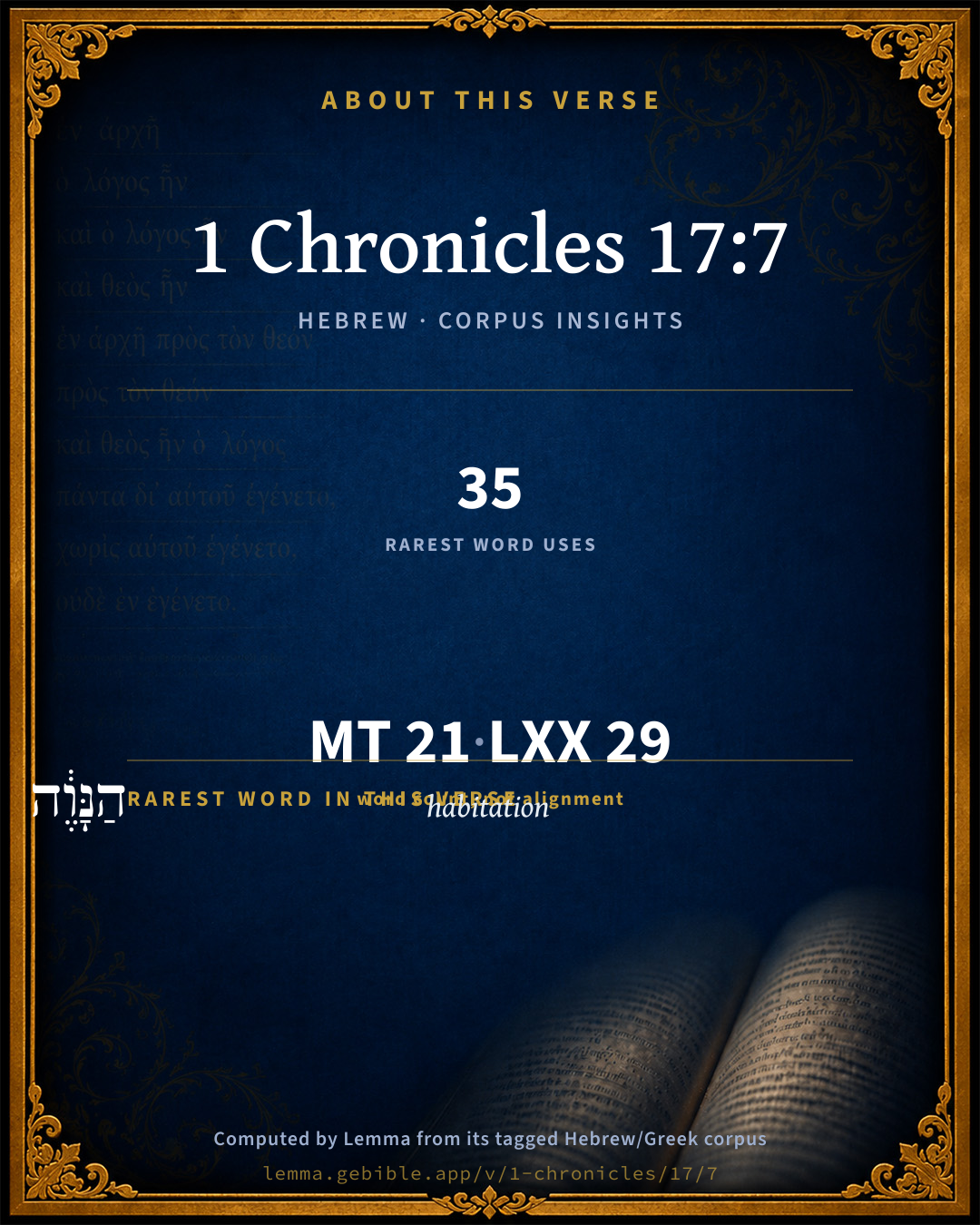
1 Chronicles 17:7

Hebrew (Westminster Leningrad Codex) 1 Chronicles 17:7 appears in the Hebrew Old Testament. The text above is from the Westminster Leningrad Codex. Each word links to its Strong’s number, a concise gloss, and parsing drawn from the Open Scriptures Hebrew Bible morphology. Click any word for its full Brown-Driver-Briggs (BDB) entry.
Download image
Cite this verse

1 Chronicles 17:7 (World English Bible). Public Domain. Lemma interlinear Bible study tool, https://lemma.gebible.app/v/1-chronicles/17/7.

Show BibTeX & RIS
BibTeX
RIS
English Translation
Now therefore thus shall you tell my servant David, Thus says Yahweh of Hosts, I took you from the sheep pen, from following the sheep, that you should be prince over my people Israel:
World English Bible · Public Domain
Download a study sheet

One document with this verse’s original text, its word-by-word gloss line, the meaning frame, cross-references with their text, attributed commentary, and full source and license credits — printable, and it pastes into notes with its structure intact.

This verse Autodidact and up

Study sheet (.html) Plain text (.txt)

A passage Seminary Student

Up to 50 verses in one chapter. A passage sheet keeps up to 6 commentary sources and 12 cross-references per verse, in the order this page ranks them, and says so on the sheet whenever that leaves anything out. Ask for a single verse and you get the Autodidact verse sheet above.

Everything on this page stays free to read, with no account — the sheet is a download of what is already on screen, not access to it.

Want to remove ads? Support Godless Engineer
Compare translations 3

The same verse in 3 English versions, stacked beneath the original-language interlinear above. Click any original word for its lexicon entry.

Each is an independent rendering of the whole verse — the interlinear is not word-aligned to these translations.

Highlighted words mark where these versions differ — a whole-verse word diff, not a word-by-word alignment.

  • World English Bible Public Domain
    Now therefore thus shall you tell my servant David, Thus says Yahweh of Hosts, I took you from the sheep pen, from following the sheep, that you should be prince over my people Israel:
  • King James Version Public Domain
    Now therefore thus shalt thou say unto my servant David, Thus saith the LORD of hosts, I took thee from the sheepcote, even from following the sheep, that thou shouldest be ruler over my people Israel:
  • unfoldingWord Literal Text CC BY-SA 4.0
    And now, thus you shall say to my servant, to David, ‘Thus says Yahweh of Armies, “I, I took you from the pasture, from after the flock, to be a leader over my people Israel.

unfoldingWord Literal Text — © unfoldingWord, licensed CC BY-SA 4.0. Word-aligned USFM3 via Door43 (git.door43.org/unfoldingWord/en_ult).

Versions to compare (up to 4)

3 of 4 selected

Show all 18 translations

Every available English version of this verse, each an independent rendering of the whole verse.

  • World English Bible Public Domain
    Now therefore thus shall you tell my servant David, Thus says Yahweh of Hosts, I took you from the sheep pen, from following the sheep, that you should be prince over my people Israel:
  • Berean Standard Bible Public Domain
    Now then, you are to tell My servant David that this is what the LORD of Hosts says: I took you from the pasture, from following the flock, to be the ruler over My people Israel.
  • Majority Standard Bible Public Domain
    Now then, you are to tell My servant David that this is what the LORD of Hosts says: I took you from the pasture, from following the flock, to be the ruler over My people Israel.
  • King James Version Public Domain
    Now therefore thus shalt thou say unto my servant David, Thus saith the LORD of hosts, I took thee from the sheepcote, even from following the sheep, that thou shouldest be ruler over my people Israel:
  • American Standard Version (1901) Public Domain
    Now therefore thus shalt thou say unto my servant David, Thus saith Jehovah of hosts, I took thee from the sheepcote, from following the sheep, that thou shouldest be prince over my people Israel:
  • Revised Version (1885) Public Domain
    Now therefore thus shalt thou say unto my servant David, Thus saith the LORD of hosts, I took thee from the sheepcote, from following the sheep, that thou shouldest be prince over my people Israel:
  • Geneva Bible (1599) Public Domain
    Nowe therefore thus shalt thou say vnto my seruant Dauid, Thus saith the Lord of hostes, I tooke thee from the sheepecoat and from following the sheepe, that thou shouldest bee a prince ouer my people Israel.
  • Douay-Rheims (1899) Public Domain
    Now therefore thus shalt thou say to my servant David: Thus saith the Lord of hosts: I took thee from the pastures, from following the flock, that thou shouldst be ruler of my people Israel.
  • Young's Literal Translation Public Domain
    `And now, thus dost thou say to My servant, to David, Thus said Jehovah of Hosts, I have taken thee from the habitation, from after the sheep, to be leader over My people Israel,
  • Literal Standard Version CC BY-SA 4.0
    And now, thus you say to My servant, to David, Thus said YHWH of Hosts: I have taken you from the habitation, from after the sheep, to be leader over My people Israel,
  • Unlocked Literal Bible CC BY-SA 4.0
    “Now then, tell my servant David, 'This is what Yahweh of hosts says: I took you from the pasture, from following the sheep, so that you would be ruler over my people Israel.
  • unfoldingWord Literal Text CC BY-SA 4.0
    And now, thus you shall say to my servant, to David, ‘Thus says Yahweh of Armies, “I, I took you from the pasture, from after the flock, to be a leader over my people Israel.
  • Darby Bible Public Domain
    And now, thus shalt thou say unto my servant David, Thus saith Jehovah of hosts: I took thee from the pasture-grounds, from following the sheep, to be prince over my people Israel;
  • World Messianic Bible Public Domain
    “Now therefore, you shall tell my servant David, ‘The LORD of Hosts says, “I took you from the sheep pen, from following the sheep, to be prince over my people Israel.
  • Webster's Bible Public Domain
    Now therefore thus shalt thou say to my servant David, Thus saith the LORD of hosts, I took thee from the sheep-cote, even from following the sheep, that thou shouldst be ruler over my people Israel:
  • Free Bible Version CC BY-SA 4.0
    So then, go and tell my servant David this is what the Lord Almighty says. It was me who took you from the fields, from looking after sheep, to become a leader of my people Israel.
  • Bible in Basic English Public Domain
    So now, say to my servant David, The Lord of armies says, I took you from the fields, from keeping sheep, so that you might be a ruler over my people Israel;
  • JPS Tanakh (1917) Public Domain
    Now therefore thus shalt thou say unto My servant David: Thus saith the LORD of hosts: I took thee from the sheepcote, from following the sheep, that thou shouldest be prince over My people Israel;

Literal Standard Version (2020), Covenant Press — licensed CC BY-SA 4.0. Text via the HelloAO Bible API (eBible.org). Unlocked Literal Bible (unfoldingWord) — licensed CC BY-SA 4.0. Text via the HelloAO Bible API (eBible.org). unfoldingWord Literal Text — © unfoldingWord, licensed CC BY-SA 4.0. Word-aligned USFM3 via Door43 (git.door43.org/unfoldingWord/en_ult). Free Bible Version, Dr. Jonathan Gallagher — licensed CC BY-SA 4.0. Text via the HelloAO Bible API (eBible.org).

Word by word

More ways to search: Search by grammar → Find every occurrence → Compare this word →

Practice this passage: Drill this verse → Learn its vocabulary →

הַנָּוֶ֔ה
nâveh
H5116
“the · habitation”
Particle, Definite Article + Noun, Common, Both, Singular, Absolute
Part of Speech
Particle + Noun
Type
Common
Gender
Both
Number
Singular
State
Absolute
Full BDB Definition

Origin: from H5115

TWOT: 1322a , 1322b , 1322c

abode, habitation, abode of shepherds or flocks, pasture (noun masculine) - abode (of sheep) - abode (of shepherds) - meadow - habitation - dwelling, abiding (adjective)
  1. וְ֠עַתָּה ʻattâh H6258 “and · now” Conjunction + Adverb
  2. כֹּֽה kôh H3541 “thus” Adverb
  3. תֹאמַ֞ר ʼâmar H559 “to say” Verb, Qal, Imperfect, 2nd Person, Masculine, Singular
  4. לְעַבְדִּ֣י ʻebed H5650 “to/for · servant · my” Preposition + Noun, Common, Masculine, Singular, Construct + Suffix, Personal, 1st Person, Common, Singular
  5. לְדָוִ֗יד Dâvid H1732 “to/for · David” Preposition + Noun, Proper
  6. כֹּ֤ה kôh H3541 “thus” Adverb
  7. אָמַר֙ ʼâmar H559 “to say” Verb, Qal, Perfect, 3rd Person, Masculine, Singular
  8. יְהוָ֣ה Yᵉhôvâh H3068 “LORD” Noun, Proper
  9. צְבָא֔וֹת tsâbâʼ H6635 “armies” Noun, Common, Both, Plural, Absolute
  10. אֲנִ֤י ʼănîy H589 “I” Pronoun, Personal, 1st Person, Common, Singular
  11. לְקַחְתִּ֨יךָ֙ lâqach H3947 “to take · you” Verb, Qal, Perfect, 1st Person, Common, Singular + Suffix, Personal, 2nd Person, Masculine, Singular
  12. מִן min H4480 “from” Preposition
  13. מִֽן min H4480 “from” Preposition
  14. אַחֲרֵ֖י ʼachar H310 “after” Preposition
  15. הַצֹּ֑אן tsôʼn H6629 “the · flock” Particle, Definite Article + Noun, Common, Both, Singular, Absolute
  16. לִהְי֣וֹת hâyâh H1961 “to be” Preposition + Verb, Qal, Infinitive Construct
  17. נָגִ֔יד nâgîyd H5057 “ruler” Noun, Common, Masculine, Singular, Absolute
  18. עַ֖ל ʻal H5921 “upon” Preposition
  19. עַמִּ֥י ʻam H5971 “people · my” Noun, Common, Masculine, Singular, Construct + Suffix, Personal, 1st Person, Common, Singular
  20. יִשְׂרָאֵֽל Yisrâʼêl H3478 “Israel” Noun, Proper

About this verse

These counts appear in no published source. They are computed here, from the morphology-tagged text and Lemma’s own curated glosses. What Lemma adds →

21
words
18
distinct lemmas
Historical
section

Shared distinctive vocabulary

הַנָּוֶ֔ה habitation H5116 occurs in 34 verses of the Hebrew Bible. Also found in:

Grammatical profile

  • 4 verbs
  • 9 nouns
  • 1 pronoun
  • 4 prepositions
  • 3 adverbs

Verb forms

  • תֹאמַ֞ר Qal · Imperfect
  • אָמַר֙ Qal · Perfect
  • לְקַחְתִּ֨יךָ֙ Qal · Perfect
  • לִהְי֣וֹת Qal · Infinitive Construct

Repetition

Words recur within this verse — often emphatic in Hebrew:

  • כֹּֽה thus H3541 ×2
  • תֹאמַ֞ר to say H559 ×2
  • מִן from H4480 ×2

Hebrew & Septuagint length

In English translation the verse runs 34 words from the Hebrew and 33 from the Septuagint (LXX English) — closely comparable.

A rough comparison of the two English renderings, which tokenize alike — not a word-level alignment.

Word counts can differ between the Hebrew and the Greek without any difference in meaning — e.g. the Hebrew direct-object marker אֵת has no separate Greek word, and Greek often adds the article ὁ.

In the original languages it is 21 Hebrew tokens and 29 Greek tokens — but the two are counted differently (Hebrew bundles its prefixes and suffixes into one token; the Greek is in lemma form), so that isn’t a like-for-like length.

Cross-references

10

Topical passages linked to 1 Chronicles 17:7 in the Treasury of Scripture Knowledge — connected by theme and wording, ordered by reader-vote popularity; previews shown in the World English Bible.

  • 2 Samuel 6:21 David said to Michal, [It was] before Yahweh, who chose me above your father, and above all his house, to appoint me prince over the people of Yahweh, over Israel: therefore will I play before Yahweh.
  • Exodus 3:1–10 Now Moses was keeping the flock of Jethro, his father-in-law, the priest of Midian, and he led the flock to the back of the wilderness, and came to God's mountain, to Horeb.
  • Psalms 78:70–71 He also chose David his servant, And took him from the sheepfolds;
  • 1 Samuel 16:11–12 Samuel said to Jesse, Are here all your children? He said, There remains yet the youngest, and, behold, he is keeping the sheep. Samuel said to Jesse, Send and get him; for we will not sit down until he come here.
  • 1 Samuel 17:15 Now David went back and forth from Saul to feed his father's sheep at Bethlehem.
  • 2 Samuel 7:8 Now therefore thus shall you tell my servant David, Thus says Yahweh of Hosts, I took you from the sheep pen, from following the sheep, that you should be prince over my people, over Israel;
  • Amos 7:14–15 Then Amos answered Amaziah, "I was no prophet, neither was I a prophet's son; but I was a herdsman, and a farmer of sycamore trees;
  • Matthew 2:6 'You Bethlehem, land of Judah, Are in no way least among the princes of Judah: For out of you shall come forth a governor, Who shall shepherd my people, Israel.'"
  • Matthew 4:18–22 Walking by the sea of Galilee, he saw two brothers: Simon, who is called Peter, and Andrew, his brother, casting a net into the sea; for they were fishermen.
  • Luke 5:10 and so also were James and John, sons of Zebedee, who were partners with Simon. Jesus said to Simon, "Don't be afraid. From now on you will be catching people alive."

Cross-references courtesy of OpenBible.info (CC BY 4.0).

Hebrew and Greek witnesses Masoretic Hebrew ↔ Greek Septuagint

The same verse in the two great witnesses to the Old Testament, shown verse-for-verse.

These are two independent witnesses, not word-aligned to each other, and the Septuagint is shown in lemma (dictionary) form.

Hebrew 1 Chronicles 17:7 Masoretic · Westminster Leningrad Codex

וְ֠עַתָּה כֹּֽה תֹאמַ֞ר לְעַבְדִּ֣י לְדָוִ֗יד כֹּ֤ה אָמַר֙ יְהוָ֣ה צְבָא֔וֹת אֲנִ֤י לְקַחְתִּ֨יךָ֙ מִן הַנָּוֶ֔ה מִֽן אַחֲרֵ֖י הַצֹּ֑אן לִהְי֣וֹת נָגִ֔יד עַ֖ל עַמִּ֥י יִשְׂרָאֵֽל

Now therefore thus shall you tell my servant David, Thus says Yahweh of Hosts, I took you from the sheep pen, from following the sheep, that you should be prince over my people Israel:

World English Bible · Public Domain

Greek LXX 1 Chronicles 17:7 Septuagint · lemma form

καί νῦν οὕτως εἶπον ὁ δοῦλος ἐγώ δαυίδ ὅδε λέγω κύριος παντοκράτωρ λαμβάνω σύ ἐκ ὁ μάνδρα ἐξόπισθεν ὁ ποίμνιον ὁ εἰμί εἰς ἡγέομαι ἐπί ὁ λαός ἐγώ ἰσραήλ

And now thus shall you say to my servant David, Thus says the Lord Almighty, I took you from the sheepfold, from following the flocks, to be a ruler over my people Israel:

LXX2012 (modern English Septuagint) · Public Domain

Hebrew: Westminster Leningrad Codex (CC BY 4.0). Greek: Septuagint (public domain); English from LXX2012 (modern English Septuagint) (Public Domain). How the Septuagint differs from the Hebrew →

Commentary

Notes on 1 Chronicles 17:7 from classic Christian and Jewish commentators (each source and its license shown beneath its notes). The classic Christian expositions comment on the surrounding passage and are grouped to its opening verse, so a note may address several verses; the Jewish commentaries on the Tanakh (Rashi and others) are per-verse, so they appear only where the commentator wrote on this verse.

Lemma curates 59 commentaries, every one of them public domain or Creative Commons licensed, each selected and text-cleaned for this edition rather than reprinted as found. About our sources →

The Biblical Illustrator

Joseph S. Exell

1Ch_17:7-11

Thus saith the Lord of hosts, I took thee from the sheepcote.

God in personal life

I. God elevates men from the lowest to the highest station in life.

II. God helps men to do the work for which they are elevated.

1. By His constant presence.

2. By continual victories.

III. God honours men for faithful performance of the work to which they are elevated.

1. Honoured in reputed life.

2. Honoured in peaceful death. (James Wolfendale.)

From the sheepfold to the throne

David is thus presented to our thought as the type of youths rising from lowly to lofty positions, and rising by virtue of conditions and qualities essentially the same. What are these conditions and qualities? To say that God chose David and put this high honour on him does not at all answer the question. Why did the Divine choice fall on him? Gods choice of agents and bestowment of honours are not made capriciously, without ground of personal merit in the subject. Our task is to study the human elements, to estimate the subjective factors in this problem of growth and greatness. David was the man after Gods own heart, not absolutely, but because he was the best of his nation and age for the work he was called to do.

I. There was in David a substantial ground of personal worth, of susceptibilities and tendencies upon which to build a life of greatness.

II. His life was swayed by a great purpose.

III. He had great courage.

1. Physical.

2. Moral.

IV. He exhibited, through all these years of preparation and development, great fidelity to trusts imposed.

V. He had great faith in God.

VI. All his estimable qualities were fed and fired by habitual and genuine religious devotion. (C. H. Payne, D. D.)

The remembrance of our early history should be a stimulus to gratitude

While many Americans are looking up their remote ancestors to provide themselves with a crest and coat of arms, a few follow the example of early English families and adopt some emblem which suggests a noteworthy incident in their own history. One millionaire, not ashamed of the source of his wealth, has a derrick engraved on his seal. Another family enriched by the manufacture of furniture has adopted a tree as a crest. The most interesting of these modern symbols, perhaps, is found engraved on the plate and books of a family of Pennsylvania Friends, who would probably be unwilling to call it a crest. It is a cat carrying a rabbit in its mouth. There is a legend to explain it. The first of a family to emigrate to this country was the father of eleven children. He sailed in the same year as Penn, and died on the voyage, leaving his wife to land alone with her helpless flock. She had a grant of land, but no money. They took refuge, as did many of the first emigrants to America, in a cave dug out of the side of a hill. Winter came on. Provisions failed. The widow saw her children grow pale and weak for want of food. The day arrived at last when there was not a grain of meal in the barrel. She fell on her knees and prayed in an agony of supplication. When she arose she smiled, her children said afterwards, as if she had seen an angel coming with bread. Going out she saw no angel, but the cat with a freshly killed rabbit in its mouth. The rabbit made a good meal, of which pussy, we may be sure, had a full share. The family, which has been a prosperous and influential one, preserves this symbol of their early history to commemorate their gratitude to God. (Daily Paper.)

The Biblical Illustrator, edited by Joseph S. Exell (c. 1880s–1900s) — public domain. Text from a community e-Sword module.

Geneva Bible (1599)

Geneva Bible translators

Of a shepherd of sheep I made thee a shepherd of men: so that thou camest not to this dignity through thine own merits, but by my pure grace.

Geneva Bible (1599) marginal notes — public domain. Text via Bolls.life.

Jamieson, Fausset & Brown

Robert Jamieson, A. R. Fausset & David Brown

Thus saith the Lord of hosts, I took thee from the sheepcote--a round tower of rude construction, high walled, but open at the top, in which sheep are often enclosed at night to protect them from wild beasts. The meaning is, I elevated you to the throne from a humble condition solely by an act of divine grace, and not from any antecedent merits of your own (see on Sa1 16:11), and I enabled you to acquire renown, equal or superior to any other monarch. Your reign will ever be afterwards regarded as the best and brightest era in the history of Israel, for it will secure to the nation a settled inheritance of prosperity and peace, without any of the oppressions or disorders that afflicted them in early times.

Jamieson, Fausset & Brown — Commentary Critical and Explanatory on the Whole Bible (1871) — public domain (CC PDM 1.0). Text via the HelloAO Bible API.

Ellicott's Commentary for English Readers

(7) I took thee from the sheepcote . . .—Comp. Psa_78:70-72. The pronoun is emphatic: “I it was who took thee from the pasture.”

From following.—Heb., from behind. Samuel has the older form of this preposition.

That thou shouldest be.—That thou mightest become.

Ruler.—Nâgîd (1Ch_9:11; 1Ch_9:20). (Comp. 1Ch_11:2.)

A Bible Commentary for English Readers, edited by Charles John Ellicott (1878–1897) — public domain. Text from a community e-Sword module.

The Cambridge Bible for Schools and Colleges

gen. ed. J. J. S. Perowne

7. sheepcote] Better as R.V. mg. pasture.

ruler] R.V. prince. Cp. 1Ch_5:2, note.

The Cambridge Bible for Schools and Colleges (gen. ed. J. J. S. Perowne; Cambridge University Press, 1878–1918) — public domain. Text from a community e-Sword module.

The Pulpit Commentary

I took thee. (So 1Sa_16:11, 1Sa_16:12; 2Sa_7:8; Ps 78 Ps 79) The sheepcote. The Hebrew hzn strictly signifies a resting or place of resting. Hence the habitation of men or of animals, and in particular the pasture in which flocks lie down and rest (Psa_23:2, plural construction; Job_5:24; Hos_9:13; Jer_23:3 Jer_49:20) The sheepcote was sometimes a tower, with roughly built high wall, exposed to the sky at the top, used for protection from wild beasts at night; sometimes the sheepfold was a larger low building of different shape, to which a fenced courtyard was adjacent, where the peril of cold or of wild beast was less imminent. The word of our present passage, however, cannot be compared with these places; comp. rather Exo_15:13; 2Sa_15:25; Isa_33:20 Isa_65:10; Hos_9:13, as above.

Vers. 7-11.

Assurance of favour.

The Lord acknowledged the goodness of David"s wish to build him a house, even when refusing permission for that wish to be gratified. And the Lord made this occurrence an opportunity for expressing his regard for his servant. Reminding David of his past faithfulness, he assured him of continued favour. He who had been so distinguished by marks of Divine interest and approval in the past, could not fail to place confidence in the expression of an unchanging kindness. This passage is remarkable as representing the favour of God revealed in especial fulness and richness.

I David was assured of God"s favour, TO HIMSELF PERSONALLY. We are told that the poet-king was "a man after God"s heart." Certainly, all his life through he was the object of singular kindness and forbearance. Elevation from a lowly to the loftiest station, assistance against all his enemies, an honourable reputation, an established throne, such were the instances of Divine favour which David received at the Lord"s hands. Prosperity and power, wealth and fame, followed a youth of romantic adventure and hardships and vicissitudes. That outward prosperity shall attend every one of the Lord"s people is what no intelligent person can expect; but every true Christian may" rejoice in the assurance of that loving-kindness which is "better than life," of that faithfulness which never leaves, never forsakes, those who confide in it.

II FAVOUR WAS PROMISED TO DAVID"S POSTERITY. All men, and especially nobles and kings, count the prosperity and advancement of their children as part of their own well-being. The reader of Aristotle"s "Ethics" is aware that the ancient Athenians were wont to consider a man"s happiness as bound up with the good fortune of his children. David had won a throne by his ability and valour; it was natural that he should desire to have a successor upon that throne who should maintain the renown and the power of the founder of the royal house. Hence the assurance, "The Lord will build thee a house," was one peculiarly welcome to the son of Jesse. No true Christian can be indifferent as to the welfare of his children. Nothing gives such a one greater joy than to see his sons and daughters walking in the truth. He sins if he sets his heart upon their temporal advancement and prosperity. But he is right in seeking and in praying for their salvation. When God"s favour brings them to fellowship with Christ, it seems to him that his "cup runneth over.

III FAVOUR WAS PROMISED TO DAVID"S PEOPLE. When the Lord sent to his servant a message of mercy and a promise of peace and blessing, he perfected the grace by a large and liberal declaration of his intentions of favour toward Israel Monarch and subjects were to be alike blessed. Israel should be planted, should not be moved or wasted, and should be victorious over all enemies. When a nation is assured of Divine care and protection, "blessed is the people that is in such a case." For his is the blessing that maketh rich, and with it he addeth no sorrow. A true patriot will desire for his country, not only wealth and renown and power, but the righteousness which "exalteth a nation." Such prosperity as, in the ninth and eleventh verses, was promised to Israel, could not but be welcome. When we implore the Divine favour, let it not be for ourselves alone, but for "our kindred according to the flesh." The king, the statesman, the reformer, rejoices when his country"s good is secured, when the smile of the Almighty rests upon the land "from the beginning unto the end of the year." The prayer of every true patriot should be, "God be merciful unto us, and bless us, and cause his face to shine upon us. T.

Vers. 7, 8.

God in individual history.

In what way the Lord communicated with Nathan we do not know; but the sacred history represents him as choosing the prophet as the means of making known to the king his holy will. On this occasion, Nathan was directed to preface his divinely given instructions by the remarkable declaration of the text; to remind David that God had been near him, had been with him, all his life through. General truths of the most vital interest are propounded in these simple words.

I DIVINE PROVIDENCE HAS CARE OF EACH HUMAN LIFE. A very childish notion of providence is that God concerns himself with the affairs of nations and Churches, bat cannot condescend to interest himself in individuals. This misconception arises from too mean a view of the omnipresent and omniscient Supreme. Well may we exclaim, "What is man, that thou art mindful of him?

II DIVINE PROVIDENCE CAN SUMMON FROM THE LOWLIEST TO THE LOFTIEST STATION. David was raised from the sheepcote to the throne. And his is but one of many similar cases of marvellous exaltation. God"s election of his servants for work which he has for them to do calls for our amazed admiration; he finds and fashions instruments for every service. And Scripture is full of examples of the exercise of his sovereign prerogative. He exalts the lowly and abases the proud. He proves his royalty by choosing those whom men would have passed by, and the event ever honours and attests his wisdom.

III DIVINE PROVIDENCE CAN ACCOMPLISH ITS PURPOSES NOTWITHSTANDING ALL OBSTACLES. The Lord reminded David of his presence, of his protecting and delivering care and mercy, of the prosperity which he had vouchsafed to his servant. When God takes a work in hand, he suffers nothing to thwart him. Obstacles disappear; opposition is disarmed; enemies are defeated. When God designates a man for a special service, he imparts all needful qualifications; he removes every hindrance to efficiency; he gets himself glory in the glory of his servant.

PRACTICAL LESSONS.

1. Be content with your lot; high or low, it is what an all-wise Father hasappointed.

2. Be grateful for the past, remembering the way by which he has led you.

3. Be trustful for the future.

Father, I know that all my life Is portioned out for me, And the changes that will surely come I do not fear to see: But I ask thee for a present mind, Intent on pleasing thee.

T.

Vers. 7-15.

Three spiritual necessities.

The message which Nathan was charged to deliver to David calls before us three necessities of our spiritual nature, which apply to all men everywhere, in every position, and in all ages. We have need of

I AN OPEN MIND TO RECEIVE GOD"S SPECIAL TEACHING. Nathan was familiar with the broad and general principles of religious truth. He was an enlightened servant of Jehovah a prophet whose inspiration was from on high. But he needed a special vision (ver. 15) to see the truth which was to be declared on this occasion. Until he received that vision he was under the impression that David would do well to carry out his pious purpose (ver. 2), but from that time he discouraged and, indeed, arrested the intention of the king. If such a man as he, with whose spirit God was in close communion, needed to be instructed on particular occasions, how much more do we? Our general knowledge of Divine truth, even taken in connection with an abiding relation to the Spirit of God, (1Co_6:19) does not ensure to us an understanding of special questions without special illumination from the Source of all wisdom. Again and again we need to have the quick eye to see the pointing of the Divine finger, the open ear to hear the Divine voice, the sensitive heart to respond to the Divine touch. This in respect to our temporal affairs, to the government of the home, to the ordering of the Church of Christ.

II. A READY REMEMBRANCE OF GOD"S PAST MERCIES. (Vers. 7, 8) David was to Be disappointed in being denied the gratification of this strong wish of his heart; but he was to remember what great things God had done for him, taking him from the sheepcote and placing him on the throne, attending his steps as Guardian and Guide, giving him the victory over his enemies, raising him to a position of eminence even among kings. It was a small thing to be denied this one desire. We should carry about us at all times such a sense of the great blessings God has given us the endowments, the deliverances, the recoveries, the bestowments of our whole past course that at any time this may weigh down and bury out of our sight any small disappointment which the Ruler of our lives may permit us to suffer. A strong and full sense of mercies in the past will silence the first sigh of discontentment, will turn it into a song of holy gratitude.

III AN AN INTELLIGENT GRASP OF DIVINE PROMISES. It may be that we may need more than a view of past mercies: we may require a prospect of good things to come. God graciously provided David with beth. He intimated to him through Nathan that he was intending to do great things for him. He would

(1) consolidate the kingdom of Israel so that it should become strong and safe (ver. 9);

(2) multiply his victories over his enemies (ver. 10);

(3) establish his dynasty (vers. 10, 14);

(4) give his son the privilege which he was withholding from him (vers. 11, 12);

(5) show to this son of his a fatherly patience (ver. 13).

These were very great promises, amply sufficient to compensate for one disappointment. What large promises does God make to us! "Exceeding great and precious" they are. (2Pe_1:4) They begin with his guidance and presence through life, and they culminate in everlasting joy and glory at his right hand. We often need to have recourse to the promises of our Divine Saviour. When we do resort to them, and do draw upon them, we find a bountiful sufficiency for all our need. C.

Vers. 7-10.

God"s grace magnified in David"s history.

Every age of the world and every nation has had its prominent men, its striking instances of Divine endowment and special mission. But we mistake such special cases if we assume that they are intended to absorb our attention, or merely to magnify individuals. They are always designed to be impressive illustrations of great principles which are surely working, though not so manifestly working, in the smaller and the quieter spheres. The" great" is never set before us for its own sake, but always

(1) to show us what "almighty grace can do;" and

(2) to make solemn the possibilities of our smaller and feebler lives.

The mission of all biographies is expressed in two sentences from St. Paul"s writings: "They glorified God in me"; (Gal_1:24) "For this cause I obtained mercy, that in me first Jesus Christ might show forth all long-suffering, for a pattern to them which should hereafter believe on him to life everlasting". (1Ti_1:16) David is set before us as a striking instance of Divine grace overshadowing, guiding, and sanctifying a whole life. God reminds him in these verses of his "gracious goodness" which had ever rested upon him; and with the remembrance comforts him under the refusal of his request which God judged it necessary to send. In this light the life of David may be reviewed.

I THE SOVEREIGNTY OF GRACE IN DAVID"S SELECTION. Carefully distinguish between sovereignty and favouritism. There is "no respect of persons" with God. He elects, not upon particular affections for an individual, but upon omniscience of fitness for particular work. Election is not to privilege but to service, and to privilege through the service. Here, in the case of David, Divine sovereignty is seen in the selection of one who was not at all in men"s thoughts, and was indeed in circumstances which seemed to indicate unsuitability. David was the youngest of his family, somewhat despised by his grown-up brothers, and engaged in simple shepherding work among the hills of Judah. Yet God estimated character, and found in the young shepherd the founder of a kingdom and a dynasty. Illustrate the Divine call of men to be poets, artists, preachers, reformers, and rulers; and show that now, as truly as ever, God calls those he needs to come up out of lowly and unknown places to do his work. And he may have need of us.

II THE FAITHFULNESS OF GRACE IN DAVID"S PROSPERITY. "Faithful is he who calleth you, who also will do it." To the position to which he was called David in due time attained; because, whenever God bids a man do a thing, he gives the needed grace for the doing. If he tells a man with a helpless hand to "stretch forth his hand," he gives the strength for such stretching forth. Trace in David"s life how all hindrances and difficulties were surely overcome; his "enemies were cut off," his throne established, and his name honoured (ver. 8).

III THE BENEDICTIONS OF GRACE RESTING ON OTHERS FOR DAVID"S SAKE, It is one of the best signs of Divine acceptance of us that others are blessed through us. This exceeding joy our Lord Jesus Christ had. For his life-work of loving service he was "highly exalted." So David was the means of settling the people, introducing all the advantages of order and good government, and restoring to full vigour the worshipping side of the national religious life.

IV THE CONTINUANCE OF GRACE OF DAVID"S DESCENDANTS. The man who lives in the grace of God himself may be sure that not only God"s grace will abide when he is gone, but that the grace will still use his influence and example, as agency, for the blessing of the children for a long while to come (vers. 10-12). Apply to that exceeding great grace which is manifested in our personal redemption. That grace, we may be sure, will cover and hallow all our lives, and all our children"s lives, even as it did the life of David, and the story of his descendants. R.T.

The Pulpit Commentary (1880–1919), ed. H.D.M. Spence-Jones & Joseph S. Exell — public domain. Text from a community e-Sword module.

unfoldingWord translationNotes

Door43 World Missions Community

General Information:

Yahweh describes his promises to King David through the prophet Nathan.

Now

This does not mean "at this moment," but is used to draw attention to the important point that follows.

tell my servant David

Yahweh is still telling the prophet Nathan what he should tell David.

I took you from the pasture

David's job as a shepherd is referred to by the place he watched his sheep. AT: "I took you from your job as a shepherd" (See: Metonymy)

pasture

an area of land where animals feed on the grass. See how you translated this word in 1 Chronicles 4:39 and 4:40.

I have been with you

Here "with you" means that Yahweh has helped and blessed David. (See: Idiom)

cut off all your enemies

Yahweh destroying David's enemies is spoken of as if Yahweh cut them off, as one would cut a piece of cloth or cut a branch from a tree. (See: Metaphor)

I will make you a name

Here "name" represents a person's reputation. AT: "I will make your name to be great and well known" (See: Metonymy)

the great ones

The phrase "great ones" means famous persons.

translationWords

Yahweh of hosts

ewe

rule

people of God

cut off

adversary

name

earth

unfoldingWord translationNotes — © Distant Shores Media and the Door43 World Missions Community, licensed CC BY-SA 4.0. Source: git.door43.org/Door43/en_tn.

Rashi

Rabbi Shlomo Yitzchaki (Rashi)

So said the Lord of Hosts For that which entered your mind I shall repay you.

from the sheepcote the dwelling of the shepherds and the sheepfolds.

Rashi on the Tanakh — English translations: “The Judaica Press complete Tanach with Rashi, translated by A. J. Rosenberg” (CC BY 4.0); “Pentateuch with Rashi's commentary by M. Rosenbaum and A.M. Silbermann, 1929-1934” (public domain); “The Metsudah Tanach series, Lakewood, N.J” (CC BY 4.0); and “The Book of Joshua, Metsudah Publications, 1997” (CC BY 4.0). Text via Sefaria.

Lesson kit

Teaching starters — assembled from the data on this page, not authored interpretation. Every prompt links to the verse data it draws on. Edit before teaching.

1 Chronicles, in the Historical, opens this verse with 21 words (18 distinct Hebrew lemmas). Its most distinctive word is nâveh (“habitation”). A historical commentator’s framing appears above. Read the whole chapter for the surrounding context.

Discussion questions

  1. What does “habitation” (nâveh) contribute to the verse as a whole?
  2. Exodus 15:13 shares the word «habitation» with this verse. How do the two illuminate each other?
  3. “thus” occurs 2× in this one verse. What is the effect of the repetition?
  4. These translations render this verse differently; the difference is in the English rendering, not the original. What questions does that raise?
  5. The verb «תֹאמַ֞ר» is Qal Imperfect. How does its form color the action?
  6. Reading how The Biblical Illustrator and Geneva Bible (1599) read this verse, where do the two commentators agree and where do they part?

Things to notice

Reading settings

Reading text

Shown beneath each verse's original-language words.

Old Testament
Old Testament edition

Read the OT as the Masoretic Hebrew (MT) or the Greek Septuagint (LXX).

English shown for the Greek Septuagint (in the Hebrew ↔ Greek comparison).

Comparing translations? Open the Compare panel on any verse page to stack up to four side by side.