
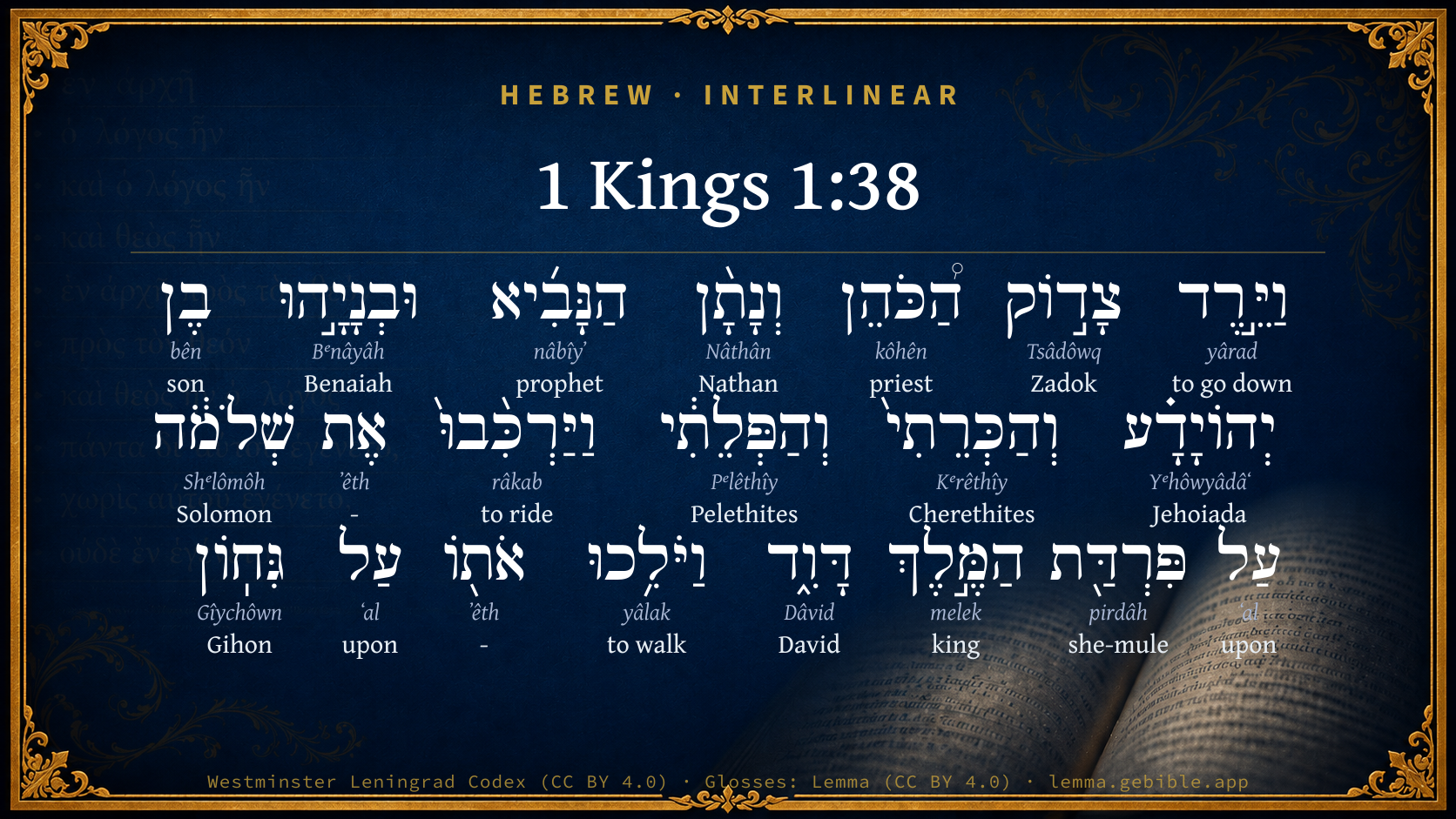
1 Kings 1:38

Hebrew (Westminster Leningrad Codex) 1 Kings 1:38 appears in the Hebrew Old Testament. The text above is from the Westminster Leningrad Codex. Each word links to its Strong’s number, a concise gloss, and parsing drawn from the Open Scriptures Hebrew Bible morphology. Click any word for its full Brown-Driver-Briggs (BDB) entry.
Download image
Cite this verse

1 Kings 1:38 (World English Bible). Public Domain. Lemma interlinear Bible study tool, https://lemma.gebible.app/v/1-kings/1/38.

Show BibTeX & RIS
BibTeX
RIS
English Translation
So Zadok the priest, and Nathan the prophet, and Benaiah the son of Jehoiada, and the Cherethites and the Pelethites, went down, and caused Solomon to ride on king David's mule, and brought him to Gihon.
World English Bible · Public Domain
Download a study sheet

One document with this verse’s original text, its word-by-word gloss line, the meaning frame, cross-references with their text, attributed commentary, and full source and license credits — printable, and it pastes into notes with its structure intact.

This verse Autodidact and up

Study sheet (.html) Plain text (.txt)

A passage Seminary Student

Up to 50 verses in one chapter. A passage sheet keeps up to 6 commentary sources and 12 cross-references per verse, in the order this page ranks them, and says so on the sheet whenever that leaves anything out. Ask for a single verse and you get the Autodidact verse sheet above.

Everything on this page stays free to read, with no account — the sheet is a download of what is already on screen, not access to it.

Want to remove ads? Support Godless Engineer
Compare translations 3

The same verse in 3 English versions, stacked beneath the original-language interlinear above. Click any original word for its lexicon entry.

Each is an independent rendering of the whole verse — the interlinear is not word-aligned to these translations.

Highlighted words mark where these versions differ — a whole-verse word diff, not a word-by-word alignment.

  • World English Bible Public Domain
    So Zadok the priest, and Nathan the prophet, and Benaiah the son of Jehoiada, and the Cherethites and the Pelethites, went down, and caused Solomon to ride on king David's mule, and brought him to Gihon.
  • King James Version Public Domain
    So Zadok the priest, and Nathan the prophet, and Benaiah the son of Jehoiada, and the Cherethites, and the Pelethites, went down, and caused Solomon to ride upon king David's mule, and brought him to Gihon.
  • unfoldingWord Literal Text CC BY-SA 4.0
    Then Zadok the priest and Nathan the prophet and Benaiah, the son of Jehoiada, and the Cherethite and the Pelethite went down, and they made Solomon ride on the female mule of King David. And they brought him to Gihon.

unfoldingWord Literal Text — © unfoldingWord, licensed CC BY-SA 4.0. Word-aligned USFM3 via Door43 (git.door43.org/unfoldingWord/en_ult).

Versions to compare (up to 4)

3 of 4 selected

Show all 18 translations

Every available English version of this verse, each an independent rendering of the whole verse.

  • World English Bible Public Domain
    So Zadok the priest, and Nathan the prophet, and Benaiah the son of Jehoiada, and the Cherethites and the Pelethites, went down, and caused Solomon to ride on king David's mule, and brought him to Gihon.
  • Berean Standard Bible Public Domain
    Then Zadok the priest, Nathan the prophet, and Benaiah son of Jehoiada, along with the Cherethites and Pelethites, went down and set Solomon on King David’s mule, and they escorted him to Gihon.
  • Majority Standard Bible Public Domain
    Then Zadok the priest, Nathan the prophet, and Benaiah son of Jehoiada, along with the Cherethites and Pelethites, went down and set Solomon on King David’s mule, and they escorted him to Gihon.
  • King James Version Public Domain
    So Zadok the priest, and Nathan the prophet, and Benaiah the son of Jehoiada, and the Cherethites, and the Pelethites, went down, and caused Solomon to ride upon king David's mule, and brought him to Gihon.
  • American Standard Version (1901) Public Domain
    So Zadok the priest, and Nathan the prophet, and Benaiah the son of Jehoiada, and the Cherethites and the Pelethites, went down, and caused Solomon to ride upon king David's mule, and brought him to Gihon.
  • Revised Version (1885) Public Domain
    So Zadok the priest, and Nathan the prophet, and Benaiah the son of Jehoiada, and the Cherethites and the Pelethites, went down, and caused Solomon to ride upon king David’s mule, and brought him to Gihon.
  • Geneva Bible (1599) Public Domain
    So Zadok the Priest, and Nathan the Prophet, and Benaiah the sonne of Iehoiada, and the Cherethites and the Pelethites went downe and caused Salomon to ride vpon king Dauids mule, and brought him to Gihon.
  • Douay-Rheims (1899) Public Domain
    So Sadoc the priest, and Nathan the prophet went down, and Banaias the son of Joiada, and the Cerethi, and Phelethi: and they set Solomon upon the mule of king David, and brought him to Gihon.
  • Young's Literal Translation Public Domain
    And Zadok the priest goeth down, and Nathan the prophet, and Benaiah son of Jehoiada, and the Cherethite, and the Pelethite, and they cause Solomon to ride on the mule of king David, and cause him to go unto Gihon,
  • Literal Standard Version CC BY-SA 4.0
    And Zadok the priest goes down, and Nathan the prophet, and Benaiah son of Jehoiada, and the Cherethite, and the Pelethite, and they cause Solomon to ride on the mule of King David, and cause him to go to Gihon,
  • Unlocked Literal Bible CC BY-SA 4.0
    So Zadok the priest, Nathan the prophet, Benaiah son of Jehoiada, and the Kerethites and the Pelethites went down and had Solomon ride upon King David's mule; they brought him to Gihon.
  • unfoldingWord Literal Text CC BY-SA 4.0
    Then Zadok the priest and Nathan the prophet and Benaiah, the son of Jehoiada, and the Cherethite and the Pelethite went down, and they made Solomon ride on the female mule of King David. And they brought him to Gihon.
  • Darby Bible Public Domain
    And Zadok the priest, and Nathan the prophet, and Benaiah the son of Jehoiada, and the Cherethites and the Pelethites went down, and caused Solomon to ride upon king David's mule, and brought him to Gihon.
  • World Messianic Bible Public Domain
    So Zadok the priest, Nathan the prophet, Benaiah the son of Jehoiada, and the Cherethites and the Pelethites went down and had Solomon ride on King David’s mule, and brought him to Gihon.
  • Webster's Bible Public Domain
    So Zadok the priest, and Nathan the prophet, and Benaiah the son of Jehoiada, and the Cherethites, and the Pelethites, went down, and caused Solomon to ride upon king David's mule, and brought him to Gihon.
  • Free Bible Version CC BY-SA 4.0
    Zadok the priest, Nathan the prophet, and Benaiah, son of Jehoiada, together with the Cherethites and Pelethites, went and placed Solomon on King David's mule, and led him down to the Gihon Spring.
  • Bible in Basic English Public Domain
    So Zadok the priest, and Nathan the prophet, and Benaiah, the son of Jehoiada, and the Cherethites and the Pelethites, went down and put Solomon on King David's beast and took him to Gihon.
  • JPS Tanakh (1917) Public Domain
    So Zadok the priest, and Nathan the prophet, and Benaiah the son of Jehoiada, and the Cherethites and the Pelethites, went down, and caused Solomon to ride upon king David's mule, and brought him to Gihon.

Literal Standard Version (2020), Covenant Press — licensed CC BY-SA 4.0. Text via the HelloAO Bible API (eBible.org). Unlocked Literal Bible (unfoldingWord) — licensed CC BY-SA 4.0. Text via the HelloAO Bible API (eBible.org). unfoldingWord Literal Text — © unfoldingWord, licensed CC BY-SA 4.0. Word-aligned USFM3 via Door43 (git.door43.org/unfoldingWord/en_ult). Free Bible Version, Dr. Jonathan Gallagher — licensed CC BY-SA 4.0. Text via the HelloAO Bible API (eBible.org).

Word by word

More ways to search: Search by grammar → Find every occurrence → Compare this word →

Practice this passage: Drill this verse → Learn its vocabulary →

פִּרְדַּ֖ת
pirdâh
H6506
“she-mule of”
Noun, Common, Feminine, Singular, Construct
Part of Speech
Noun
Type
Common
Gender
Feminine
Number
Singular
State
Construct
Full BDB Definition

Origin: from H6505

TWOT: 1807b

she-mule, mule
  1. וַיֵּ֣רֶד yârad H3381 “and · to go down” Conjunction + Verb, Qal, Sequential Imperfect, 3rd Person, Masculine, Singular
  2. צָד֣וֹק Tsâdôwq H6659 “Zadok” Noun, Proper
  3. הַ֠כֹּהֵן kôhên H3548 “the · priest” Particle, Definite Article + Noun, Common, Masculine, Singular, Absolute
  4. וְנָתָ֨ן Nâthân H5416 “and · Nathan” Conjunction + Noun, Proper
  5. הַנָּבִ֜יא nâbîyʼ H5030 “the · prophet” Particle, Definite Article + Noun, Common, Masculine, Singular, Absolute
  6. וּבְנָיָ֣הוּ Bᵉnâyâh H1141 “and · Benaiah” Conjunction + Noun, Proper
  7. בֶן bên H1121 “son of” Noun, Common, Masculine, Singular, Construct
  8. יְהוֹיָדָ֗ע Yᵉhôwyâdâʻ H3077 “Jehoiada” Noun, Proper
  9. וְהַכְּרֵתִי֙ Kᵉrêthîy H3774 “and · the · Cherethites” Conjunction + Particle, Definite Article + Noun, Gentilic, Masculine, Singular, Absolute
  10. וְהַפְּלֵתִ֔י Pᵉlêthîy H6432 “and · the · Pelethites” Conjunction + Particle, Definite Article + Noun, Gentilic, Masculine, Singular, Absolute
  11. וַיַּרְכִּ֨בוּ֙ râkab H7392 “and · to ride” Conjunction + Verb, Hiphil, Sequential Imperfect, 3rd Person, Masculine, Plural
  12. אֶת ʼêth H853 “-” Particle, Direct Object
  13. שְׁלֹמֹ֔ה Shᵉlômôh H8010 “Solomon” Noun, Proper
  14. עַל ʻal H5921 “upon” Preposition
  15. הַמֶּ֣לֶךְ melek H4428 “the · king” Particle, Definite Article + Noun, Common, Masculine, Singular, Absolute
  16. דָּוִ֑ד Dâvid H1732 “David” Noun, Proper
  17. וַיֹּלִ֥כוּ yâlak H3212 “and · to walk” Conjunction + Verb, Hiphil, Sequential Imperfect, 3rd Person, Masculine, Plural
  18. אֹת֖וֹ ʼêth H853 “- · him” Particle, Direct Object + Suffix, Personal, 3rd Person, Masculine, Singular
  19. עַל ʻal H5921 “upon” Preposition
  20. גִּחֽוֹן Gîychôwn H1521 “Gihon” Noun, Proper

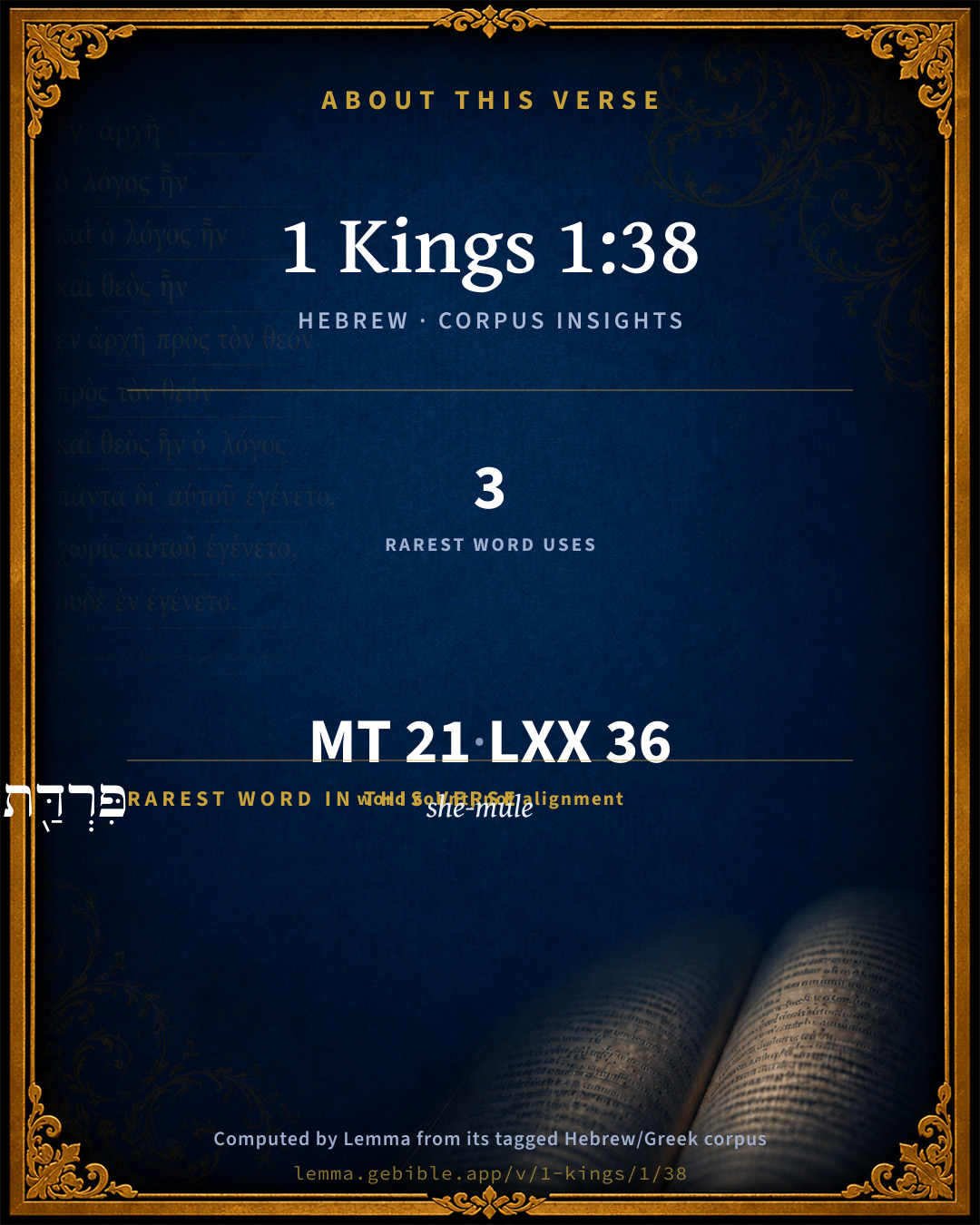
About this verse

These counts appear in no published source. They are computed here, from the morphology-tagged text and Lemma’s own curated glosses. What Lemma adds →

21
words
19
distinct lemmas
Historical
section

Notable vocabulary

The rarest word here is פִּרְדַּ֖ת she-mule H6506 — appearing just 3 times in the whole Hebrew Bible.

Shared distinctive vocabulary

פִּרְדַּ֖ת she-mule H6506 occurs in 3 verses of the Hebrew Bible. Also found in:

Grammatical profile

  • 3 verbs
  • 14 nouns
  • 2 prepositions
  • 2 particles

Verb forms

  • וַיֵּ֣רֶד Qal · Sequential Imperfect
  • וַיַּרְכִּ֨בוּ֙ Hiphil · Sequential Imperfect
  • וַיֹּלִ֥כוּ Hiphil · Sequential Imperfect

Repetition

A word recurs within this verse — often emphatic in Hebrew:

Hebrew & Septuagint length

In English translation the verse runs 36 words from the Hebrew and 37 from the Septuagint (LXX English) — closely comparable.

A rough comparison of the two English renderings, which tokenize alike — not a word-level alignment.

Word counts can differ between the Hebrew and the Greek without any difference in meaning — e.g. the Hebrew direct-object marker אֵת has no separate Greek word, and Greek often adds the article ὁ.

In the original languages it is 21 Hebrew tokens and 36 Greek tokens — but the two are counted differently (Hebrew bundles its prefixes and suffixes into one token; the Greek is in lemma form), so that isn’t a like-for-like length.

Cross-references

9

Topical passages linked to 1 Kings 1:38 in the Treasury of Scripture Knowledge — connected by theme and wording, ordered by reader-vote popularity; previews shown in the World English Bible.

  • 2 Samuel 8:18 and Benaiah the son of Jehoiada [was over] the Cherethites and the Pelethites; and David's sons were chief ministers.
  • 1 Kings 1:8 But Zadok the priest, and Benaiah the son of Jehoiada, and Nathan the prophet, and Shimei, and Rei, and the mighty men who belonged to David, were not with Adonijah.
  • 1 Samuel 30:14 We made a raid on the South of the Cherethites, and on that which belongs to Judah, and on the South of Caleb; and we burned Ziklag with fire.
  • 2 Samuel 15:18 All his servants passed on beside him; and all the Cherethites, and all the Pelethites, and all the Gittites, six hundred men who came after him from Gath, passed on before the king.
  • 2 Samuel 20:20–23 Joab answered, Far be it, far be it from me, that I should swallow up or destroy.
  • 1 Kings 1:26 But he hasn't called me, even me your servant, and Zadok the priest, and Benaiah the son of Jehoiada, and your servant Solomon.
  • 1 Kings 1:33 The king said to them, Take with you the servants of your lord, and cause Solomon my son to ride on my own mule, and bring him down to Gihon:
  • 1 Chronicles 18:17 and Benaiah the son of Jehoiada was over the Cherethites and the Pelethites; and the sons of David were chief about the king.
  • Zephaniah 2:5 Woe to the inhabitants of the sea coast, the nation of the Cherethites! The word of Yahweh is against you, Canaan, the land of the Philistines. I will destroy you, that there will be no inhabitant.

Cross-references courtesy of OpenBible.info (CC BY 4.0).

Hebrew and Greek witnesses Masoretic Hebrew ↔ Greek Septuagint

The same verse in the two great witnesses to the Old Testament, shown verse-for-verse.

These are two independent witnesses, not word-aligned to each other, and the Septuagint is shown in lemma (dictionary) form.

Hebrew 1 Kings 1:38 Masoretic · Westminster Leningrad Codex

וַיֵּ֣רֶד צָד֣וֹק הַ֠כֹּהֵן וְנָתָ֨ן הַנָּבִ֜יא וּבְנָיָ֣הוּ בֶן יְהוֹיָדָ֗ע וְהַכְּרֵתִי֙ וְהַפְּלֵתִ֔י וַיַּרְכִּ֨בוּ֙ אֶת שְׁלֹמֹ֔ה עַל פִּרְדַּ֖ת הַמֶּ֣לֶךְ דָּוִ֑ד וַיֹּלִ֥כוּ אֹת֖וֹ עַל גִּחֽוֹן

So Zadok the priest, and Nathan the prophet, and Benaiah the son of Jehoiada, and the Cherethites and the Pelethites, went down, and caused Solomon to ride on king David's mule, and brought him to Gihon.

World English Bible · Public Domain

Greek LXX 1 Kings 1:38 Septuagint · lemma form

καί καταβαίνω σαδωκ ὁ ἱερεύς καί ναθαν ὁ προφήτης καί βαναιας υἱός ιωδαε καί ὁ χερεθθι καί ὁ φελεθθι καί ἐπι καταἵζω ὁ σαλωμών ἐπί ὁ ἡμίονος ὁ βασιλεύς δαυίδ καί ἀποἄγω αὐτός εἰς ὁ γιων

And Sadoc the priest went down, and Nathan the prophet, and Banaeas son of Jodae, and the Cherethite, and the Phelethite, and they mounted Solomon upon the mule of king David, and led him away to Gion.

LXX2012 (modern English Septuagint) · Public Domain

On this verse, The Pulpit Commentary discusses the Septuagint’s reading. Read the note in Commentary ↓

Hebrew: Westminster Leningrad Codex (CC BY 4.0). Greek: Septuagint (public domain); English from LXX2012 (modern English Septuagint) (Public Domain). How the Septuagint differs from the Hebrew →

Targum (Aramaic paraphrase)

1

The Targum is the ancient Jewish Aramaic paraphrase of the Hebrew Scriptures — an interpretive translation, not the Hebrew text itself. Onkelos (literal) and Pseudo-Jonathan (expansive) render the Torah, and Jonathan the Prophets. Coverage is partial: where no permissively-licensed English translation exists for a verse, only the Aramaic is shown. This is verse-level text, not a word-by-word alignment to the Hebrew.

  1. Targum Jonathan Prophets (Joshua–Malachi)
    וּנְחַת צָדוֹק כַּהֲנָא וְנָתָן נְבִיָא וּבְנָיָהוּ בַר יְהוֹיָדָע וְקַשָׁתַיָא וְקַלָעַיָא וְאַרְכִּיבוּ יַת שְׁלֹמֹה עַל כּוּדַנְתָּא דְמַלְכָּא דָוִד וְאוֹבִילוּ יָתֵיהּ לְשִׁילוֹחָא:

    (no public-domain English translation for this verse)

    Targum Jonathan — Aramaic: “Mikraot Gedolot” (public domain). English: “Sefaria Community Translation” (CC0 1.0 (public-domain dedication)); “London "Chaldee Paraphrase," 1871” (public domain). Text via Sefaria.

Commentary

Notes on 1 Kings 1:38 from classic Christian and Jewish commentators (each source and its license shown beneath its notes). The classic Christian expositions comment on the surrounding passage and are grouped to its opening verse, so a note may address several verses; the Jewish commentaries on the Tanakh (Rashi and others) are per-verse, so they appear only where the commentator wrote on this verse.

Lemma curates 59 commentaries, every one of them public domain or Creative Commons licensed, each selected and text-cleaned for this edition rather than reprinted as found. About our sources →

Trapp's Complete Commentary

John Trapp

1Ki 1:38 So Zadok the priest, and Nathan the prophet, and Benaiah the son of Jehoiada, and the Cherethites, and the Pelethites, went down, and caused Solomon to ride upon king David’s mule, and brought him to Gihon.

Ver. 38. And brought him to Gihon.] See on 1Ki 1:33.

John Trapp, A Commentary or Exposition upon All the Books of the Old and New Testament (1647–1656) — public domain. Text from a community e-Sword module.

Tyndale Open Study Notes

Tyndale Open Resources

1:38 The king’s bodyguard were foreign mercenaries from Crete; they served David throughout his reign (2 Sam 8:18; 15:18; 20:7).

Tyndale Open Study Notes — © Tyndale Open Resources, licensed CC BY-SA 4.0. Text via the HelloAO Bible API.

Ellicott's Commentary for English Readers

(38) The Cherethites, and the Pelethites.—See 2Sa_8:18; 2Sa_15:28; 2Sa_20:7; 2Sa_20:23. The body-guard-perhaps of foreign troops—“the executioners and runners” (as some render them) to carry out the King’s commands.

A Bible Commentary for English Readers, edited by Charles John Ellicott (1878–1897) — public domain. Text from a community e-Sword module.

The Cambridge Bible for Schools and Colleges

gen. ed. J. J. S. Perowne

38. the Cherethites and the Pelethites] The former of these names is found 1Sa_30:14 as the name of a people to the south of the Philistines. Hence it has been held by some that the second name, Pelethites, must also be of the same character, and that probably it is connected with the word ‘Philistine.’ It seems not impossible that David from his early residence in the country of the Philistines may have attached a body of men to him from among those peoples and constituted them his first body-guard (Josephus calls them σωματοφύλακες), which while retaining their old title would after the king’s accession be recruited from any of his most trusty supporters. We need not suppose therefore that though called by the old name they were largely composed of aliens. The older interpretations, connecting the words with Hebrew verbs, have been ‘executioners and runners’; and the Targum interprets them as ‘archers and slingers’ and in one place as ‘nobles and common soldiers.’ They are clearly to be identified with ‘the mighty men’ mentioned in 1Ki_1:8 as not being with Adonijah.

The Cambridge Bible for Schools and Colleges (gen. ed. J. J. S. Perowne; Cambridge University Press, 1878–1918) — public domain. Text from a community e-Sword module.

John Gill's Exposition

So Zadok the priest, and Nathan the prophet, and Benaiah the son of Jehoiada,.... The three men that David sent for on this occasion:

and the Cherethites and the Pelethites; not the sanhedrim, as Ben Gersom, but David's guards, over whom Benaiah was: these

went down; from Jerusalem;

and caused Solomon to ride upon King David's mule; as he had ordered:

and brought him to Gihon; or Siloah, as the Targum; hence the Jews say (e), they do not anoint a king but at a fountain; but this is the only instance of it.

(e) T. Bab. Ceritot, fol. 5. 2.

John Gill's Exposition of the Whole Bible (1746–1763) — public domain (CC PDM 1.0). Text via the HelloAO Bible API.

Whedon's Commentary on the Bible

Daniel D. Whedon

38. Cherethites, and the Pelethites — See note on 2Sa_8:18.

Daniel D. Whedon (gen. ed.), Commentary on the Old and New Testaments (1874–1909) — public domain. Text from a community e-Sword module.

The Pulpit Commentary

So Zadok the priest, and Nathan the prophet, and Benaiah the son of Jehoiada, and the Cherethites, and the Pelethites these were the royal bodyguard Swmatofulakev Josephus calls them who were commanded by Benaiah. (2Sa_8:18 2Sa_15:18 2Sa_20:23 2Sa_23:28) But while their functions are pretty well understood, great difference of opinion exists as to the origin or meaning of the words. By some they are supposed to be Gentile names. A tribe of Cherethites is mentioned 1Sa_30:14. (Cf. Eze_25:16; Zep_2:5) and in close connexion with the Philistines (ver. 16). Hence Cherethite has been thought to be another name for Philistine; and as the LXX and Syr. render the word "Cretans," it has been conjectured that the Philistines had their origin from Crete. They did come from Caphtor, and that is probably Crete (see Gen_10:14; Jer_47:4; Amo_9:7; Deu_2:23) ytileP again, is not unlike ytiVliP In favor of this view is the fact that David certainly had a bodyguard of foreign mercenaries, (2Sa_15:18) where the "Gittites" are connected with the Cherethites. Nor does it make against it that "two designations" would thus "be employed side by side for one and the same people as if we should speak of Britons and Englishmen (Bahr). For the names look like a paronomasia of which the Jews were very fond and a trick of this kind would at once account for the tautology. (Since writing this, I find the same idea has already occurred to Ewald.) But the other view, adopted by Gesenius, is that the names are names of office and function. Cherethite he would derive from kr"t; cut, slay; and by Cherethites he would understand "executioners," which the royal bodyguard were in ancient despotisms Gen_39:1, Hebrews; Dan_2:14, etc. (See on 1Ki_2:25) In the Pelethites (tlP swiftness) he would see the public couriers (aggaroi) of Eastern men. archies. (see Heb 8:98 and. 2Ch_30:6) We see the guard discharging the function first named in 2Ki_10:25 2Ki_11:4, 2Ki_11:8; and the latter in 1Ki_14:27 (marg. went down i.e., from the palace on Mount Zion and caused Solomon to ride upon King David"s mule, and brought him to l cf. 2:26 Gihon Chald., Syr., Arab., Shiloha)

The Pulpit Commentary (1880–1919), ed. H.D.M. Spence-Jones & Joseph S. Exell — public domain. Text from a community e-Sword module.

Keil & Delitzsch

C. F. Keil & F. Delitzsch

The anointing of Solomon was carried out immediately, as the king had commanded. On the Crethi and Plethi see at Sa2 8:18. "The oil-horn out of the tent" (i.e., a vessel made of horn and containing oil) was no doubt one which held the holy anointing oil, with which the priests and the vessels of the sanctuary were anointed (see Exo 30:22.). The tent (האהל), however, is not the tabernacle at Gibeon, but the tent set up by David for the ark of the covenant upon Mount Zion (Sa2 6:17). For even though Zadok was appointed high priest at the tabernacle at Gibeon, and Abiathar, who held with Adonijah, at the ark of the covenant, the two high priests were not so unfriendly towards one another, that Zadok could not have obtained admission to the ark of the covenant in Abiathar's absence to fetch away the anointing oil.

Keil & Delitzsch — Biblical Commentary on the Old Testament (1861–1891) — public domain (CC PDM 1.0). Text via the HelloAO Bible API. (Old Testament only.)

unfoldingWord translationNotes

Door43 World Missions Community

General Information:

The people of Israel anoint Solomon as king over Israel.

Kerethites ... Pelethites

These are names of people groups. (See: How to Translate Names)

Gihon

This is the name of a spring, where fresh water comes out of the ground. (See: How to Translate Names)

took the horn of oil out of the tent

This means the priest took the special animal horn filled with olive oil that was kept in Yahweh's special tent.

took the horn of oil

Possible meanings are 1) the horn of an animal filled with olive oil or 2) a container that had replaced the original horn, but the people still called it a horn. AT: "took a container of oil"

all the people

This is a generalization. (See: Hyperbole and Generalization)

translationWords

horn

oil

tent of meeting

flute

joy

joy

earth

unfoldingWord translationNotes — © Distant Shores Media and the Door43 World Missions Community, licensed CC BY-SA 4.0. Source: git.door43.org/Door43/en_tn.

Rashi

Rabbi Shlomo Yitzchaki (Rashi)

And the archers and the sling shooters. [Targum] Yonoson rendered, “the archers and the sling shooters.” But our Rabbis maintained [that it refers to] the Urim and Tumim.

Rashi on the Tanakh — English translations: “The Judaica Press complete Tanach with Rashi, translated by A. J. Rosenberg” (CC BY 4.0); “Pentateuch with Rashi's commentary by M. Rosenbaum and A.M. Silbermann, 1929-1934” (public domain); “The Metsudah Tanach series, Lakewood, N.J” (CC BY 4.0); and “The Book of Joshua, Metsudah Publications, 1997” (CC BY 4.0). Text via Sefaria.

Lesson kit

Teaching starters — assembled from the data on this page, not authored interpretation. Every prompt links to the verse data it draws on. Edit before teaching.

1 Kings, in the Historical, opens this verse with 21 words (19 distinct Hebrew lemmas). Its most distinctive word is pirdâh (“she-mule”). A historical commentator’s framing appears above. Read the whole chapter for the surrounding context.

Discussion questions

  1. What does “she-mule” (pirdâh) contribute to the verse as a whole?
  2. How does 1 Kings 1:33, which shares the word «she-mule», read alongside this verse?
  3. What does the repetition of “upon” (2× in this one verse) do in this verse?
  4. These translations render this verse differently; the difference is in the English rendering, not the original. What questions does that raise?
  5. «וַיֵּ֣רֶד» is a Qal Sequential Imperfect verb. How does that grammatical form shape the action described?
  6. Compare how Trapp's Complete Commentary and Tyndale Open Study Notes read this verse. Where do they agree or differ?

Things to notice

Reading settings

Reading text

Shown beneath each verse's original-language words.

Old Testament
Old Testament edition

Read the OT as the Masoretic Hebrew (MT) or the Greek Septuagint (LXX).

English shown for the Greek Septuagint (in the Hebrew ↔ Greek comparison).

Comparing translations? Open the Compare panel on any verse page to stack up to four side by side.