
Ezra 3:10

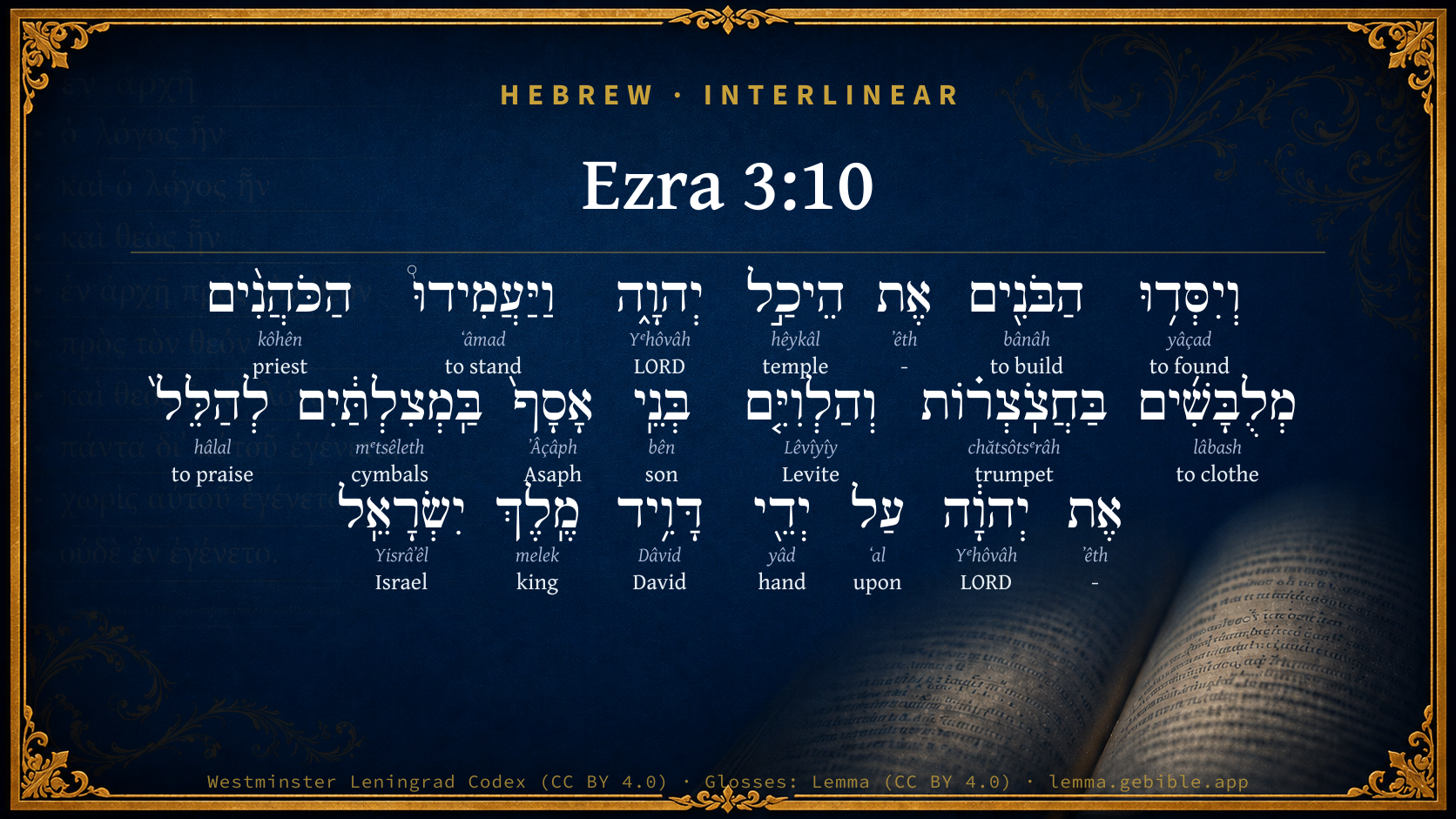
Hebrew (Westminster Leningrad Codex) Ezra 3:10 appears in the Hebrew Old Testament. The text above is from the Westminster Leningrad Codex. Each word links to its Strong’s number, a concise gloss, and parsing drawn from the Open Scriptures Hebrew Bible morphology. Click any word for its full Brown-Driver-Briggs (BDB) entry.
Download image
Cite this verse

Ezra 3:10 (World English Bible). Public Domain. Lemma interlinear Bible study tool, https://lemma.gebible.app/v/ezra/3/10.

Show BibTeX & RIS
BibTeX
RIS
English Translation
When the builders laid the foundation of the temple of Yahweh, they set the priests in their clothing with trumpets, and the Levites the sons of Asaph with cymbals, to praise Yahweh, after the order of David king of Israel.
World English Bible · Public Domain
Download a study sheet

One document with this verse’s original text, its word-by-word gloss line, the meaning frame, cross-references with their text, attributed commentary, and full source and license credits — printable, and it pastes into notes with its structure intact.

This verse Autodidact and up

Study sheet (.html) Plain text (.txt)

A passage Seminary Student

Up to 50 verses in one chapter. A passage sheet keeps up to 6 commentary sources and 12 cross-references per verse, in the order this page ranks them, and says so on the sheet whenever that leaves anything out. Ask for a single verse and you get the Autodidact verse sheet above.

Everything on this page stays free to read, with no account — the sheet is a download of what is already on screen, not access to it.

Want to remove ads? Support Godless Engineer
Compare translations 3

The same verse in 3 English versions, stacked beneath the original-language interlinear above. Click any original word for its lexicon entry.

Each is an independent rendering of the whole verse — the interlinear is not word-aligned to these translations.

Highlighted words mark where these versions differ — a whole-verse word diff, not a word-by-word alignment.

  • World English Bible Public Domain
    When the builders laid the foundation of the temple of Yahweh, they set the priests in their clothing with trumpets, and the Levites the sons of Asaph with cymbals, to praise Yahweh, after the order of David king of Israel.
  • King James Version Public Domain
    And when the builders laid the foundation of the temple of the LORD, they set the priests in their apparel with trumpets, and the Levites the sons of Asaph with cymbals, to praise the LORD, after the ordinance of David king of Israel.
  • unfoldingWord Literal Text CC BY-SA 4.0
    Then the ones who were building laid the foundation of the temple of Yahweh. And they caused to stand the clothed priests with the trumpets, and the Levites, the sons of Asaph, with the cymbals, to praise Yahweh in accordance with the hands of David, the king of Israel.

unfoldingWord Literal Text — © unfoldingWord, licensed CC BY-SA 4.0. Word-aligned USFM3 via Door43 (git.door43.org/unfoldingWord/en_ult).

Versions to compare (up to 4)

3 of 4 selected

Show all 18 translations

Every available English version of this verse, each an independent rendering of the whole verse.

  • World English Bible Public Domain
    When the builders laid the foundation of the temple of Yahweh, they set the priests in their clothing with trumpets, and the Levites the sons of Asaph with cymbals, to praise Yahweh, after the order of David king of Israel.
  • Berean Standard Bible Public Domain
    When the builders had laid the foundation of the temple of the LORD, the priests in their apparel with trumpets, and the Levites (the sons of Asaph) with cymbals, took their positions to praise the LORD, as David king of Israel had prescribed.
  • Majority Standard Bible Public Domain
    When the builders had laid the foundation of the temple of the LORD, the priests in their apparel with trumpets, and the Levites (the sons of Asaph) with cymbals, took their positions to praise the LORD, as David king of Israel had prescribed.
  • King James Version Public Domain
    And when the builders laid the foundation of the temple of the LORD, they set the priests in their apparel with trumpets, and the Levites the sons of Asaph with cymbals, to praise the LORD, after the ordinance of David king of Israel.
  • American Standard Version (1901) Public Domain
    And when the builders laid the foundation of the temple of Jehovah, they set the priests in their apparel with trumpets, and the Levites the sons of Asaph with cymbals, to praise Jehovah, after the order of David king of Israel.
  • Revised Version (1885) Public Domain
    And when the builders laid the foundation of the temple of the LORD, they set the priests in their apparel with trumpets, and the Levites the sons of Asaph with cymbals, to praise the LORD, after the order of David king of Israel.
  • Geneva Bible (1599) Public Domain
    And when the builders layed the foundation of the Temple of the Lord, they appoynted the Priestes in their apparel with trumpets, and the Leuites the sonnes of Asaph with cymbales, to prayse the Lord, after the ordinance of Dauid King of Israel.
  • Douay-Rheims (1899) Public Domain
    And when the masons laid the foundations of the temple of the Lord, the priests stood in their ornaments with trumpets: and the Levites the sons of Asaph with cymbals, to praise God by the hands of David king of Israel.
  • Young's Literal Translation Public Domain
    And those building have founded the temple of Jehovah, and they appoint the priests, clothed, with trumpets, and the Levites, sons of Asaph, with cymbals, to praise Jehovah, by means of `the instruments of' David king of Israel.
  • Literal Standard Version CC BY-SA 4.0
    And those building have founded the temple of YHWH, and they appoint the priests, clothed, with trumpets, and the Levites, sons of Asaph, with cymbals, to praise YHWH, by means of [the instruments of] David king of Israel.
  • Unlocked Literal Bible CC BY-SA 4.0
    The builders laid a foundation for Yahweh's temple. This enabled the priests to stand in their garments with trumpets, and the Levites, sons of Asaph, to praise Yahweh with cymbals, just as the hand of David, king of Israel had commanded.
  • unfoldingWord Literal Text CC BY-SA 4.0
    Then the ones who were building laid the foundation of the temple of Yahweh. And they caused to stand the clothed priests with the trumpets, and the Levites, the sons of Asaph, with the cymbals, to praise Yahweh in accordance with the hands of David, the king of Israel.
  • Darby Bible Public Domain
    And when the builders laid the foundation of the temple of Jehovah, they set the priests in their apparel, with trumpets, and the Levites the sons of Asaph, with cymbals, to praise Jehovah according to the directions of David king of Israel.
  • World Messianic Bible Public Domain
    When the builders laid the foundation of the LORD’s temple, they set the priests in their vestments with shofars, with the Levites the sons of Asaph with cymbals, to praise the LORD, according to the directions of David king of Israel.
  • Webster's Bible Public Domain
    And when the builders laid the foundation of the temple of the LORD, they set the priests in their apparel with trumpets, and the Levites the sons of Asaph with cymbals, to praise the LORD, after the ordinance of David king of Israel.
  • Free Bible Version CC BY-SA 4.0
    When the builders laid the foundation of the Lord's Temple, the priests dressed in their special clothes and carrying trumpets, and the Levites (the sons of Asaph) carrying cymbals, all took their places to praise the Lord, following the instructions given by King David of Israel.
  • Bible in Basic English Public Domain
    And when the builders put in position the base of the Temple of the Lord, the priests, dressed in their robes, took their places with horns, and the Levites, the sons of Asaph, with brass instruments, to give praise to the Lord in the way ordered by David, king of Israel.
  • JPS Tanakh (1917) Public Domain
    And when the builders laid the foundation of the temple of the LORD, they set the priests in their apparel with trumpets, and the Levites the sons of Asaph with cymbals, to praise the LORD, according to the direction of David king of Israel.

Literal Standard Version (2020), Covenant Press — licensed CC BY-SA 4.0. Text via the HelloAO Bible API (eBible.org). Unlocked Literal Bible (unfoldingWord) — licensed CC BY-SA 4.0. Text via the HelloAO Bible API (eBible.org). unfoldingWord Literal Text — © unfoldingWord, licensed CC BY-SA 4.0. Word-aligned USFM3 via Door43 (git.door43.org/unfoldingWord/en_ult). Free Bible Version, Dr. Jonathan Gallagher — licensed CC BY-SA 4.0. Text via the HelloAO Bible API (eBible.org).

Word by word

More ways to search: Search by grammar → Find every occurrence → Compare this word →

Practice this passage: Drill this verse → Learn its vocabulary →

בַּֽמְצִלְתַּ֔יִם
mᵉtsêleth
H4700
“in/at the · cymbals”
Preposition, Determined + Noun, Common, Feminine, Dual, Absolute
Part of Speech
Preposition + Noun
Type
Common
Gender
Feminine
Number
Dual
State
Absolute
Full BDB Definition

Origin: from H6750

TWOT: 1919f

cymbals
  1. וְיִסְּד֥וּ yâçad H3245 “and · to found” Conjunction + Verb, Piel, Perfect, 3rd Person, Common, Plural
  2. הַבֹּנִ֖ים bânâh H1129 “the · building” Particle, Definite Article + Verb, Qal, Participle Active, Masculine, Plural, Absolute
  3. אֶת ʼêth H853 “-” Particle, Direct Object
  4. הֵיכַ֣ל hêykâl H1964 “temple of” Noun, Common, Masculine, Singular, Construct
  5. יְהוָ֑ה Yᵉhôvâh H3068 “LORD” Noun, Proper
  6. וַיַּעֲמִידוּ֩ ʻâmad H5975 “and · to stand” Conjunction + Verb, Hiphil, Sequential Imperfect, 3rd Person, Masculine, Plural
  7. הַכֹּהֲנִ֨ים kôhên H3548 “the · priests” Particle, Definite Article + Noun, Common, Masculine, Plural, Absolute
  8. מְלֻבָּשִׁ֜ים lâbash H3847 “clothed” Verb, Pual, Participle Passive, Masculine, Plural, Absolute
  9. בַּחֲצֹֽצְר֗וֹת chătsôtsᵉrâh H2689 “in/at the · trumpets” Preposition, Determined + Noun, Common, Feminine, Plural, Absolute
  10. וְהַלְוִיִּ֤ם Lêvîyîy H3881 “and · the · Levites” Conjunction + Particle, Definite Article + Noun, Gentilic, Masculine, Plural, Absolute
  11. בְּנֵֽי bên H1121 “sons of” Noun, Common, Masculine, Plural, Construct
  12. אָסָף֙ ʼÂçâph H623 “Asaph” Noun, Proper
  13. לְהַלֵּל֙ hâlal H1984 “to praise” Preposition + Verb, Piel, Infinitive Construct
  14. אֶת ʼêth H853 “-” Particle, Direct Object
  15. יְהוָ֔ה Yᵉhôvâh H3068 “LORD” Noun, Proper
  16. עַל ʻal H5921 “upon” Preposition
  17. יְדֵ֖י yâd H3027 “hands of” Noun, Common, Both, Dual, Construct
  18. דָּוִ֥יד Dâvid H1732 “David” Noun, Proper
  19. מֶֽלֶךְ melek H4428 “king of” Noun, Common, Masculine, Singular, Construct
  20. יִשְׂרָאֵֽל Yisrâʼêl H3478 “Israel” Noun, Proper

About this verse

These counts appear in no published source. They are computed here, from the morphology-tagged text and Lemma’s own curated glosses. What Lemma adds →

21
words
19
distinct lemmas
Historical
section

Notable vocabulary

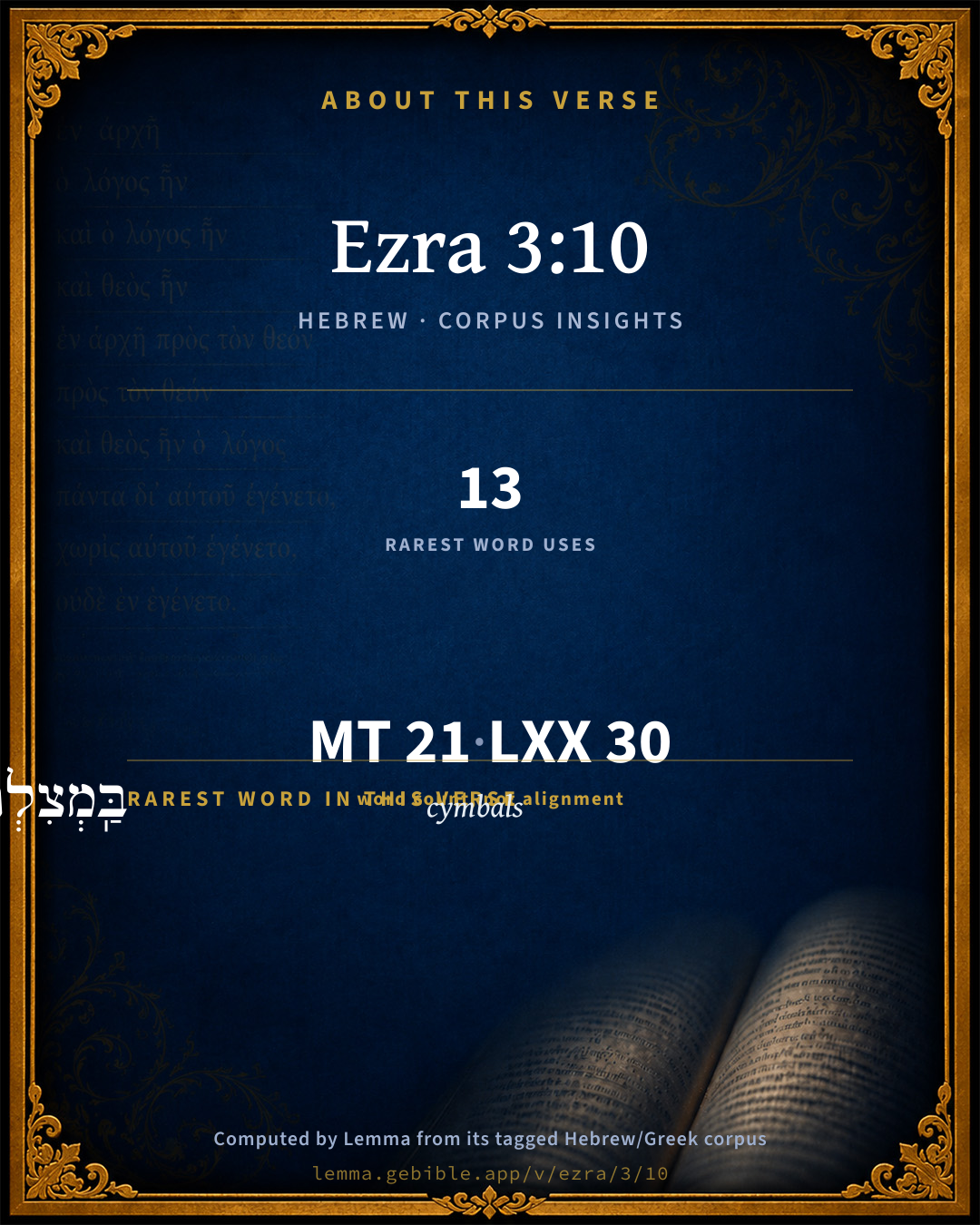
The rarest word here is בַּֽמְצִלְתַּ֔יִם cymbals H4700 — appearing just 13 times in the whole Hebrew Bible.

Shared distinctive vocabulary

בַּֽמְצִלְתַּ֔יִם cymbals H4700 occurs in 13 verses of the Hebrew Bible. Also found in:

Grammatical profile

  • 5 verbs
  • 13 nouns
  • 1 preposition
  • 2 particles

Verb forms

  • וְיִסְּד֥וּ Piel · Perfect
  • הַבֹּנִ֖ים Qal · Participle Active
  • וַיַּעֲמִידוּ֩ Hiphil · Sequential Imperfect
  • מְלֻבָּשִׁ֜ים Pual · Participle Passive
  • לְהַלֵּל֙ Piel · Infinitive Construct

Repetition

A word recurs within this verse — often emphatic in Hebrew:

  • יְהוָ֑ה LORD H3068 ×2

Hebrew & Septuagint length

In English translation the verse runs 40 words from the Hebrew and 43 from the Septuagint (LXX English) — closely comparable.

A rough comparison of the two English renderings, which tokenize alike — not a word-level alignment.

Word counts can differ between the Hebrew and the Greek without any difference in meaning — e.g. the Hebrew direct-object marker אֵת has no separate Greek word, and Greek often adds the article ὁ.

In the original languages it is 21 Hebrew tokens and 30 Greek tokens — but the two are counted differently (Hebrew bundles its prefixes and suffixes into one token; the Greek is in lemma form), so that isn’t a like-for-like length.

Cross-references

15

Topical passages linked to Ezra 3:10 in the Treasury of Scripture Knowledge — connected by theme and wording, ordered by reader-vote popularity; previews shown in the World English Bible.

  • 1 Chronicles 25:1–7 Moreover, David and the captains of the host set apart for the service certain of the sons of Asaph, and of Heman, and of Jeduthun, who should prophesy with harps, with psalteries, and with cymbals: and the number of those who did the work according to their service was:
  • Exodus 28:40–42 "You shall make coats for Aaron's sons, and you shall make sashes for them and headbands shall you make for them, for glory and for beauty.
  • 1 Samuel 22:18 The king said to Doeg, Turn you, and fall on the priests. Doeg the Edomite turned, and he fell on the priests, and he killed on that day eighty-five persons who wore a linen ephod.
  • 1 Chronicles 6:31–48 These are they whom David set over the service of song in the house of Yahweh, after that the ark had rest.
  • 1 Chronicles 15:24 Shebaniah, and Joshaphat, and Nethanel, and Amasai, and Zechariah, and Benaiah, and Eliezer, the priests, did blow the trumpets before the ark of God: and Obed-edom and Jehiah were doorkeepers for the ark.
  • 1 Chronicles 15:27 David was clothed with a robe of fine linen, and all the Levites who bore the ark, and the singers, and Chenaniah the master of the song [with] the singers: and David had on him an ephod of linen.
  • 1 Chronicles 16:4–7 He appointed certain of the Levites to minister before the ark of Yahweh, and to celebrate and to thank and praise Yahweh, the God of Israel:
  • 1 Chronicles 16:37 So he left there, before the ark of the covenant of Yahweh, Asaph and his brothers, to minister before the ark continually, as every day's work required;
  • 1 Chronicles 16:42 and with them Heman and Jeduthun [with] trumpets and cymbals for those that should sound aloud, and [with] instruments for the songs of God; and the sons of Jeduthun to be at the gate.
  • 1 Chronicles 23:5 and four thousand were doorkeepers; and four thousand praised Yahweh with the instruments which I made, [said David], for giving praise.
  • 2 Chronicles 29:25–26 He set the Levites in the house of Yahweh with cymbals, with psalteries, and with harps, according to the commandment of David, and of Gad the king's seer, and Nathan the prophet; for the commandment was of Yahweh by his prophets.
  • 2 Chronicles 35:15 The singers the sons of Asaph were in their place, according to the commandment of David, and Asaph, and Heman, and Jeduthun the king's seer; and the porters were at every gate: they didn't need to depart from their service; for their brothers the Levites prepared for them.
  • Nehemiah 12:24–26 The chiefs of the Levites: Hashabiah, Sherebiah, and Jeshua the son of Kadmiel, with their brothers over against them, to praise and give thanks, according to the commandment of David the man of God, watch next to watch.
  • Zechariah 4:10 Indeed, who despises the day of small things? For these seven shall rejoice, and shall see the plumb line in the hand of Zerubbabel. These are the eyes of Yahweh, which run back and forth through the whole earth."
  • Numbers 10:1–10 Yahweh spoke to Moses, saying,

Cross-references courtesy of OpenBible.info (CC BY 4.0).

Hebrew and Greek witnesses Masoretic Hebrew ↔ Greek Septuagint

The same verse in the two great witnesses to the Old Testament, shown verse-for-verse.

These are two independent witnesses, not word-aligned to each other, and the Septuagint is shown in lemma (dictionary) form.

Hebrew Ezra 3:10 Masoretic · Westminster Leningrad Codex

וְיִסְּד֥וּ הַבֹּנִ֖ים אֶת הֵיכַ֣ל יְהוָ֑ה וַיַּעֲמִידוּ֩ הַכֹּהֲנִ֨ים מְלֻבָּשִׁ֜ים בַּחֲצֹֽצְר֗וֹת וְהַלְוִיִּ֤ם בְּנֵֽי אָסָף֙ בַּֽמְצִלְתַּ֔יִם לְהַלֵּל֙ אֶת יְהוָ֔ה עַל יְדֵ֖י דָּוִ֥יד מֶֽלֶךְ יִשְׂרָאֵֽל

When the builders laid the foundation of the temple of Yahweh, they set the priests in their clothing with trumpets, and the Levites the sons of Asaph with cymbals, to praise Yahweh, after the order of David king of Israel.

World English Bible · Public Domain

Greek LXX Ezra 3:10 Septuagint · lemma form

καί θεμελιόω ὁ οἰκοδομέω ὁ οἶκος κύριος καί ἵστημι ὁ ἱερεύς στολίζω ἐν σάλπιγξ καί ὁ λευείτης υἱός ασαφ ἐν κυμβάλον ὁ αἰνέω ὁ κύριος ἐπί χείρ δαυίδ βασιλεύς ἰσραήλ

And they laid a foundation for building the house of the Lord: and the priests in their robes stood with trumpets and the Levites the sons of Asaph with cymbals, to praise the Lord, according to the order of David king of Israel.

LXX2012 (modern English Septuagint) · Public Domain

In the Septuagint this is one book — Esdras B (2 Esdras): Ezra is chapters 1–10, Nehemiah 11–23.

On this verse, The Cambridge Bible for Schools and Colleges discusses the Septuagint’s reading. Read the note in Commentary ↓

Hebrew: Westminster Leningrad Codex (CC BY 4.0). Greek: Septuagint (public domain); English from LXX2012 (modern English Septuagint) (Public Domain). How the Septuagint differs from the Hebrew →

Commentary

Notes on Ezra 3:10 from classic Christian and Jewish commentators (each source and its license shown beneath its notes). The classic Christian expositions comment on the surrounding passage and are grouped to its opening verse, so a note may address several verses; the Jewish commentaries on the Tanakh (Rashi and others) are per-verse, so they appear only where the commentator wrote on this verse.

Lemma curates 59 commentaries, every one of them public domain or Creative Commons licensed, each selected and text-cleaned for this edition rather than reprinted as found. About our sources →

The Cambridge Bible for Schools and Colleges

gen. ed. J. J. S. Perowne

10. And when the builders &c.] By ‘the builders’ is clearly meant the workmen, not, as some commentators, Zerubbabel and Jeshua.

they set the priests &c.] So also R.V. text. (1) According to this reading, (a) the subject of the verb must be the leaders of the people (as described in Ezr_3:2); (b) the word ‘set’ in the Hebrew is the same as ‘appointed’ in Ezr_3:8 (see note); (c) and a parallelism may be noted between Ezr_3:8-11. Ezr_3:8; Ezr_3:10 describe the appointment (8) of the Levites, (10) of the priests; Ezr_3:9; Ezr_3:11 the work (9) of the Levites, (11) of the priests.

But the parallelism in other respects breaks down. In Ezr_3:8, the subject of the first clause (‘Zerubbabel &c. began’) is also the subject of the second (‘and they appointed’). In Ezr_3:10 the subject of the first clause cannot (except by the very unlikely interpretation which identifies ‘the builders’ with Zerubbabel and Jeshua) be taken as the subject of the second. Again in Ezr_3:8, after the word ‘appointed’ we find the sign of the accusative before ‘the Levites’ (so also in 1Ch_15:17-18). In Ezr_3:10 its absence is very noteworthy, when taken in conjunction with the evidence for the other reading.

(2) According to some MSS. and ancient versions the priests stood, R.V. margin. This reading is supported by thirteen Hebrew MSS. (according to Kennicott and de Rossi), by the LXX. (ἔστησαν), by the Vulgate (steterunt), and by the parallel version in 1Es_5:59 (‘and the priests stood’ &c.). It is more likely to have been the original reading, and to have been altered by the insertion of a single small letter (yôdh) so as to correspond with the form which appears in Ezr_3:8, ‘appointed’. Supposing the received text to be the original, we have to account for (α) the omission of this letter in the authorities quoted above, (β) the absence of the sign of the accusative, (γ) the statement that Zerubbabel, Jeshua, and the priests appointed the priests.

Adopting the intransitive ‘stood’, (α) we are able to account for the common text by the supposition that it is a reproduction of the form used a few lines above; (β) the construction is perfectly simple, cf. 2Ch_29:26; 2Ch_35:10; (γ) though the parallelism of verses is lost, the order of the sentences is less artificial; with the introduction of the foundation of the Temple a fresh subject is started; (δ) in the ceremonies of the Temple the priests would be independent, ‘they stood’: the expression ‘they caused to stand or set’, though suitable as applied to ‘the Levites’, the subordinate order (Ezr_3:8), is less suitable as applied to ‘the priests’.

in their apparel] literally ‘arrayed’ or ‘vestured’, i.e. in their priestly garments, cf. Ezr_2:69. In the similar description given in 1Ch_5:12 the same word receives closer definition ‘arrayed in white linen’ or ‘byssus’.

with trumpets] as in 1Ch_15:24; 1Ch_16:6; 2Ch_5:12. The priests were specially commissioned to blow the sacred trumpets. Num_10:8.

with cymbals] David assigned the instrumental music to the Levites, the cymbals especially to the sons of Asaph. Compare 1Ch_25:1 with 1Ch_16:4-5; 1Ch_25:6.

after the ordinance of David king of Israel] R.V. after the order of &c. The same phrase occurs in 1Ch_25:2, ‘after the order of the king’, (R.V. marg. Heb. ‘by the hands of the king’).

The Cambridge Bible for Schools and Colleges (gen. ed. J. J. S. Perowne; Cambridge University Press, 1878–1918) — public domain. Text from a community e-Sword module.

Trapp's Complete Commentary

John Trapp

Ezr 3:10 And when the builders laid the foundation of the temple of the LORD, they set the priests in their apparel with trumpets, and the Levites the sons of Asaph with cymbals, to praise the LORD, after the ordinance of David king of Israel.

Ver. 10. With trumpets] These were used on all occasions of rejoicing.

With cymbals] Instruments of a shrill sound used also by the heathens at offering of their sacrifices (Aelian.). So, in imitation of the Urim and Thummim, Exo 28:30, the Egyptian high priest wore about his neck a sapphire stone which was called Aληθεια. Satan Dei Mimus ut et Momus. See before, Ezr 3:7.

After the ordinance of David] He very much added to the Church music. He likewise anticipated the age of the priests, entering into their service five years earlier than the Mosaical appointment.

John Trapp, A Commentary or Exposition upon All the Books of the Old and New Testament (1647–1656) — public domain. Text from a community e-Sword module.

Joseph Benson's Commentary

Ezr 3:10. To praise the Lord — The priests, with the trumpets appointed by Moses, and the Levites, with cymbals appointed by David, made up a concert of praise at the laying of the foundation of the temple, to assist the singing of that everlasting hymn which will never be out of date, and for which our tongues should never be out of tune, the burden of Psalms 136. Whatever our condition is, let it be owned that God is good; and whatever fails, that his mercy fails not.

Joseph Benson's Commentary on the Old and New Testaments (1811–1818) — public domain. Text from a community e-Sword module.

Tyndale Open Study Notes

Tyndale Open Resources

3:10-11 The music at this dedication ceremony sounded similar to the singing when Solomon first brought the Ark into the Temple (2 Chr 5:12-13). Both events caused the worshipers to givesing praise and thanks . . . to the Lord for his faithful covenant love and goodness. • as King David had prescribed: See 1 Chr 25:1-7.

Tyndale Open Study Notes — © Tyndale Open Resources, licensed CC BY-SA 4.0. Text via the HelloAO Bible API.

Adam Clarke's Commentary

Verse 10. After the ordinance of David] With psalms which he composed, acting in the manner which he directed.

Adam Clarke's Commentary on the Bible (1810–1826) — public domain. Text from a community e-Sword/MySword module.

Ellicott's Commentary for English Readers

(10) After the ordinance of David, king of Israel.—All goes back to earlier times. As the first offerings on the altar were according to what was “written in the law of Moses, the man of God,” so the musical ceremonial of this foundation is according to the precedent of David (see 1 Chronicles 6, 1Ch_16:25). The trumpets belonged to the priests, the cymbals to the Levites, in the ancient ordinances of worship.

A Bible Commentary for English Readers, edited by Charles John Ellicott (1878–1897) — public domain. Text from a community e-Sword module.

John Gill's Exposition

And when the builders laid the foundation of the temple of the Lord,.... The masons, whose work it was, Ezr 3:7

they set the priests in their apparel with trumpets; these were set in a proper place by the prince and the high priest, in their priestly garments, with trumpets in their hands to blow with, as the foundation was laying:

and the Levites the sons of Asaph, with cymbals to praise the Lord, after the ordinance of David king of Israel; these were instruments of brass, and made a tinkling sound, and were by the order of David; and the persons that made use of them; and the songs of praise they were played upon unto; all by his appointment, as well as harps and psalteries, which might now be used, though not expressed; see Ch1 15:16. So the Messenians, when the walls of their city were raised by Epaminondas, and their houses and temples erected, attended it with sacrifices and prayer, and with piping and singing (b).

(b) Pausan. Messenica, sive, l. 4. p. 368.

John Gill's Exposition of the Whole Bible (1746–1763) — public domain (CC PDM 1.0). Text via the HelloAO Bible API.

Albert Barnes' Notes on the Bible

They set the priests - Or, according to another reading, “The priests stood.”

The Levites the sons of Asaph - i. e., “such of the Levites as were descendants of Asaph.” It would seem as if no descendants of Heman or Jeduthun had returned.

Albert Barnes' Notes on the Bible (1834–1885) — public domain. Text from a community e-Sword/MySword module.

Haydock's Catholic Bible Commentary

Hands; compositions, (Haydock) or ordinances. (Worthington) --- The 135th Psalm was sung, (Calmet) or the 117th. (Vatable)

George Leo Haydock (1774–1849), Haydock's Catholic Family Bible and Commentary, 1859 edition — public domain. Excludes Psalms (Douay-Rheims chapter numbering differs from Protestant) and Deuterocanonical books (Catholic canon only).

Matthew Poole's English Annotations

After the ordinance of David, Heb. by or according to the hands of David, i.e. in such manner and with such psalms, or songs, and instruments as God hath appointed by the hands or ministry of David.

Matthew Poole's English Annotations on the Holy Bible (1683–1685) — public domain. Text from a community e-Sword/MySword module.

Whedon's Commentary on the Bible

Daniel D. Whedon

10. To praise the Lord — Not only in evidence of their joy and gratitude, but also to thrill the builders and all the people with inspiration and enthusiasm.

After the ordinance of David — Literally, at the hands of David; that is, according to his direction or example in providing for appropriate temple services. See 1Ch_6:31; 1Ch_16:4; 1Ch_25:1.

Daniel D. Whedon (gen. ed.), Commentary on the Old and New Testaments (1874–1909) — public domain. Text from a community e-Sword module.

The Pulpit Commentary

When the builders (Zerubbabel and Jeshua) laid the foundation of the temple, they set the priests in their apparel the rich apparel, designed "for glory and for beauty," which the law required, (Exo_28:40 Exo_40:27-29) and which the people had recently provided (Ezr_2:69) With trumpets. To blow with trumpets was always the duty of the priests (Num_10:8 Num_31:6; Jos_6:4; 1Ch_15:24 1Ch_16:6; 2Ch_5:12) to praise God with cymbals the task of the Levites. (1Ch_15:16, 19 16:5; 2Ch_5:12, 13 29:25, etc.) perhaps because the trumpet was regarded as the instrument of greater dignity. After the ordinance of David. David"s ordinance on the subject is first expressed briefly in 1Ch_15:16; afterwards, more fully, in vers. 17-21 of the same chapter. The musical service of Zerubbabel fell short of the "ordinance of David," since it comprised neither psalteries nor harps, which were an essential part of David"s system. Apparently, the musical skill of the Levites had declined under the depressing circumstances of the captivity. (see Psa_137:2)

The Pulpit Commentary (1880–1919), ed. H.D.M. Spence-Jones & Joseph S. Exell — public domain. Text from a community e-Sword module.

unfoldingWord translationNotes

Door43 World Missions Community

laid a foundation

"foundation" in this sense was more than just the stone blocks to support the temple walls. It included the entire temple floor set in stone. This enabled all the temple worshipers to wear their special garments and keep them clean.

their garments

"their special robes"

cymbals

two thin, round metal plates that are hit together to make a loud sound (See: Translate Unknowns)

the hand of David ... had commanded

The hand of a king is a metonym for the power to give commands. AT: "as David ... had commanded" (See: Metonymy)

thankfulness

A feeling and expression of appreciation and gratitude for the kindness of another.

His covenant faithfulness to Israel endures forever

The abstract noun "faithfulness" can be stated as "faithfully" or "faithful." AT: "He faithfully loves Israel forever" or "He is always faithful to his covenant with Israel" (See: Abstract Nouns)

translationWords

found

Yahweh

temple

priest

trumpet

Levi

Asaph

David

king

Israel

praise

covenant faithfulness

unfoldingWord translationNotes — © Distant Shores Media and the Door43 World Missions Community, licensed CC BY-SA 4.0. Source: git.door43.org/Door43/en_tn.

Rashi

Rabbi Shlomo Yitzchaki (Rashi)

And...laid the foundation וְיִסְדוּ This is the strong conjugation of יְסוֹד, like (Ezek. 25:4): “and they will settle (וְיִשְּׁבוּ) their palaces.” Just as וְיִשְּׁבוּ is derived from ישּׁב so is וְיִסְדוּ derived from יסד, and their meaning is, וְיִסְדוּ וְיִשְּׁבוּ in the intensive conjugation with two “yud”s, one for the [continuous] action and one for the radical, and their meaning is that they were laying the foundation, they were settling.

And the builders laid the foundation And the builders were laying the foundation [see above] of the Temple of the Lord at the time [that] they were harmonizing in their song, and they stationed the priests attired with elegant garments with trumpets in their hands to sound them.

and the Levites the sons of Asaph were the singers.

with cymbals Heb. בַּמְצִלְתַּיִם, like (Ps. 150:9): “with loud sounding cymbals (בְּצִלְצְלֵי שָּׁמַע).” They are musical instruments.

through David for they were harmonizing and singing songs of David, the king of Israel.

Rashi on the Tanakh — English translations: “The Judaica Press complete Tanach with Rashi, translated by A. J. Rosenberg” (CC BY 4.0); “Pentateuch with Rashi's commentary by M. Rosenbaum and A.M. Silbermann, 1929-1934” (public domain); “The Metsudah Tanach series, Lakewood, N.J” (CC BY 4.0); and “The Book of Joshua, Metsudah Publications, 1997” (CC BY 4.0). Text via Sefaria.

Lesson kit

Teaching starters — assembled from the data on this page, not authored interpretation. Every prompt links to the verse data it draws on. Edit before teaching.

Ezra, in the Historical, opens this verse with 21 words (19 distinct Hebrew lemmas). Its most distinctive word is mᵉtsêleth (“cymbals”). A historical commentator’s framing appears above. Read the whole chapter for the surrounding context.

Discussion questions

  1. The word mᵉtsêleth carries the sense “cymbals.” How does it shape the verse?
  2. 1 Chronicles 13:8 shares the word «cymbals» with this verse. How do the two illuminate each other?
  3. “LORD” occurs 2× in this one verse. What is the effect of the repetition?
  4. The translations on this page render this verse differently — a whole-verse word diff, not a word-by-word alignment. What might account for the different wordings?
  5. The verb «וְיִסְּד֥וּ» is Piel Perfect. How does its form color the action?
  6. Reading how The Cambridge Bible for Schools and Colleges and Trapp's Complete Commentary read this verse, where do the two commentators agree and where do they part?

Things to notice

Reading settings

Reading text

Shown beneath each verse's original-language words.

Old Testament
Old Testament edition

Read the OT as the Masoretic Hebrew (MT) or the Greek Septuagint (LXX).

English shown for the Greek Septuagint (in the Hebrew ↔ Greek comparison).

Comparing translations? Open the Compare panel on any verse page to stack up to four side by side.