
2 Chronicles 29:25

Hebrew (Westminster Leningrad Codex) 2 Chronicles 29:25 appears in the Hebrew Old Testament. The text above is from the Westminster Leningrad Codex. Each word links to its Strong’s number, a concise gloss, and parsing drawn from the Open Scriptures Hebrew Bible morphology. Click any word for its full Brown-Driver-Briggs (BDB) entry.
Download image
Cite this verse

2 Chronicles 29:25 (World English Bible). Public Domain. Lemma interlinear Bible study tool, https://lemma.gebible.app/v/2-chronicles/29/25.

Show BibTeX & RIS
BibTeX
RIS
English Translation
He set the Levites in the house of Yahweh with cymbals, with psalteries, and with harps, according to the commandment of David, and of Gad the king's seer, and Nathan the prophet; for the commandment was of Yahweh by his prophets.
World English Bible · Public Domain
Download a study sheet

One document with this verse’s original text, its word-by-word gloss line, the meaning frame, cross-references with their text, attributed commentary, and full source and license credits — printable, and it pastes into notes with its structure intact.

This verse Autodidact and up

Study sheet (.html) Plain text (.txt)

A passage Seminary Student

Up to 50 verses in one chapter. A passage sheet keeps up to 6 commentary sources and 12 cross-references per verse, in the order this page ranks them, and says so on the sheet whenever that leaves anything out. Ask for a single verse and you get the Autodidact verse sheet above.

Everything on this page stays free to read, with no account — the sheet is a download of what is already on screen, not access to it.

Want to remove ads? Support Godless Engineer
Compare translations 3

The same verse in 3 English versions, stacked beneath the original-language interlinear above. Click any original word for its lexicon entry.

Each is an independent rendering of the whole verse — the interlinear is not word-aligned to these translations.

Highlighted words mark where these versions differ — a whole-verse word diff, not a word-by-word alignment.

  • World English Bible Public Domain
    He set the Levites in the house of Yahweh with cymbals, with psalteries, and with harps, according to the commandment of David, and of Gad the king's seer, and Nathan the prophet; for the commandment was of Yahweh by his prophets.
  • King James Version Public Domain
    And he set the Levites in the house of the LORD with cymbals, with psalteries, and with harps, according to the commandment of David, and of Gad the king's seer, and Nathan the prophet: for so was the commandment of the LORD by his prophets.
  • unfoldingWord Literal Text CC BY-SA 4.0
    And he stationed the Levites in the house of Yahweh with cymbals, with harps, and with lyres, according to the commandment of David and Gad, the seer of the king, and Nathan the prophet, for by the hand of Yahweh was the commandment by the hand of his prophets.

unfoldingWord Literal Text — © unfoldingWord, licensed CC BY-SA 4.0. Word-aligned USFM3 via Door43 (git.door43.org/unfoldingWord/en_ult).

Versions to compare (up to 4)

3 of 4 selected

Show all 18 translations

Every available English version of this verse, each an independent rendering of the whole verse.

  • World English Bible Public Domain
    He set the Levites in the house of Yahweh with cymbals, with psalteries, and with harps, according to the commandment of David, and of Gad the king's seer, and Nathan the prophet; for the commandment was of Yahweh by his prophets.
  • Berean Standard Bible Public Domain
    Hezekiah stationed the Levites in the house of the LORD with cymbals, harps, and lyres according to the command of David, of Gad the king’s seer, and of Nathan the prophet. For the command had come from the LORD through His prophets.
  • Majority Standard Bible Public Domain
    Hezekiah stationed the Levites in the house of the LORD with cymbals, harps, and lyres according to the command of David, of Gad the king’s seer, and of Nathan the prophet. For the command had come from the LORD through His prophets.
  • King James Version Public Domain
    And he set the Levites in the house of the LORD with cymbals, with psalteries, and with harps, according to the commandment of David, and of Gad the king's seer, and Nathan the prophet: for so was the commandment of the LORD by his prophets.
  • American Standard Version (1901) Public Domain
    And he set the Levites in the house of Jehovah with cymbals, with psalteries, and with harps, according to the commandment of David, and of Gad the king's seer, and Nathan the prophet; for the commandment was of Jehovah by his prophets.
  • Revised Version (1885) Public Domain
    And he set the Levites in the house of the LORD with cymbals with psalteries, and with harps, according to the commandment of David, and of Gad the king’s seer, and Nathan the prophet: for the commandment was of the LORD by his prophets.
  • Geneva Bible (1599) Public Domain
    He appointed also the Leuites in the house of the Lord with cymbales, with violes, and with harpes, according to the commandement of Dauid, and Gad the Kings Seer, and Nathan the Prophet: for the commandement was by the hande of the Lord, and by the hande of his Prophets.
  • Douay-Rheims (1899) Public Domain
    And he set the Levites in the house of the Lord with cymbals, and psalteries, and harps according to the regulation of David the king, and of Gad the seer, and of Nathan the prophet: for it was the commandment of the Lord by the hand of his prophets.
  • Young's Literal Translation Public Domain
    And he appointeth the Levites in the house of Jehovah with cymbals, with psalteries, and with harps, by the command of David, and of Gad, seer of the king, and of Nathan the prophet, for by the hand of Jehovah `is' the command, by the hand of His prophets;
  • Literal Standard Version CC BY-SA 4.0
    And he appoints the Levites in the house of YHWH with cymbals, with psalteries, and with harps, by the command of David, and of Gad, seer of the king, and of Nathan the prophet, for the command [is] by the hand of YHWH, by the hand of His prophets;
  • Unlocked Literal Bible CC BY-SA 4.0
    Hezekiah placed the Levites in the house of Yahweh with cymbals, harps, and lyres, arranging them by the command of David, Gad, the king's seer, and Nathan, the prophet, for the command was from Yahweh by means of his prophets.
  • unfoldingWord Literal Text CC BY-SA 4.0
    And he stationed the Levites in the house of Yahweh with cymbals, with harps, and with lyres, according to the commandment of David and Gad, the seer of the king, and Nathan the prophet, for by the hand of Yahweh was the commandment by the hand of his prophets.
  • Darby Bible Public Domain
    And he set the Levites in the house of Jehovah with cymbals, with lutes, and with harps, according to the commandment of David, and of Gad the king's seer, and of Nathan the prophet; for the commandment was of Jehovah through his prophets.
  • World Messianic Bible Public Domain
    He set the Levites in the LORD’s house with cymbals, with stringed instruments, and with harps, according to the commandment of David, of Gad the king’s seer, and Nathan the prophet; for the commandment was from the LORD by his prophets.
  • Webster's Bible Public Domain
    And he set the Levites in the house of the LORD with cymbals, with psalteries, and with harps, according to the commandment of David, and of Gad the king's seer, and Nathan the prophet: for so was the commandment of the LORD by his prophets.
  • Free Bible Version CC BY-SA 4.0
    Hezekiah had the Levites stand in the Lord's Temple with cymbals, harps, and lyres, following the instructions of David, Gad the king's seer, and Nathan the prophet. The instructions had come from the Lord through His prophets.
  • Bible in Basic English Public Domain
    Then he put the Levites in their places in the house of the Lord, with brass and corded instruments of music as ordered by David and Gad, the king's seer, and Nathan the prophet: for the order was the Lord's, given by his prophets.
  • JPS Tanakh (1917) Public Domain
    And he set the Levites in the house of the LORD with cymbals, with psalteries, and with harps, according to the commandment of David, and of Gad the king's seer, and Nathan the prophet; for the commandment was of the LORD by His prophets.

Literal Standard Version (2020), Covenant Press — licensed CC BY-SA 4.0. Text via the HelloAO Bible API (eBible.org). Unlocked Literal Bible (unfoldingWord) — licensed CC BY-SA 4.0. Text via the HelloAO Bible API (eBible.org). unfoldingWord Literal Text — © unfoldingWord, licensed CC BY-SA 4.0. Word-aligned USFM3 via Door43 (git.door43.org/unfoldingWord/en_ult). Free Bible Version, Dr. Jonathan Gallagher — licensed CC BY-SA 4.0. Text via the HelloAO Bible API (eBible.org).

Word by word

More ways to search: Search by grammar → Find every occurrence → Compare this word →

Practice this passage: Drill this verse → Learn its vocabulary →

בִּמְצִלְתַּ֨יִם֙
mᵉtsêleth
H4700
“in/at · cymbals”
Preposition + Noun, Common, Feminine, Dual, Absolute
Part of Speech
Preposition + Noun
Type
Common
Gender
Feminine
Number
Dual
State
Absolute
Full BDB Definition

Origin: from H6750

TWOT: 1919f

cymbals
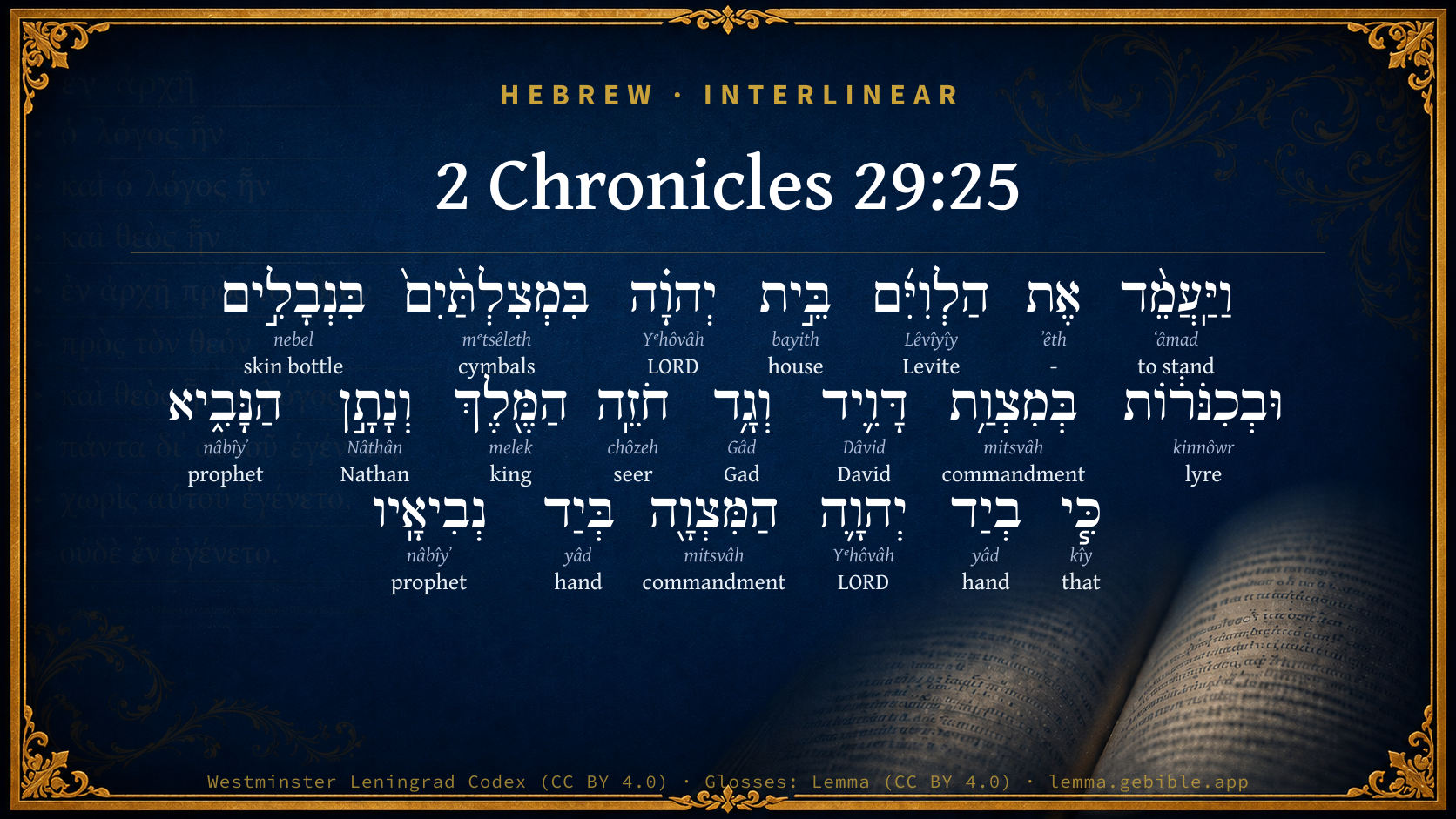
  1. וַיַּֽעֲמֵ֨ד ʻâmad H5975 “and · to stand” Conjunction + Verb, Hiphil, Sequential Imperfect, 3rd Person, Masculine, Singular
  2. אֶת ʼêth H853 “-” Particle, Direct Object
  3. הַלְוִיִּ֜ם Lêvîyîy H3881 “the · Levites” Particle, Definite Article + Noun, Gentilic, Masculine, Plural, Absolute
  4. בֵּ֣ית bayith H1004 “house of” Noun, Common, Masculine, Singular, Construct
  5. יְהוָ֗ה Yᵉhôvâh H3068 “LORD” Noun, Proper
  6. בִּנְבָלִ֣ים nebel H5035 “in/at · skin bottles” Preposition + Noun, Common, Masculine, Plural, Absolute
  7. וּבְכִנֹּר֔וֹת kinnôwr H3658 “and · in/at · lyres” Conjunction + Preposition + Noun, Common, Masculine, Plural, Absolute
  8. בְּמִצְוַ֥ת mitsvâh H4687 “in/at · commandment of” Preposition + Noun, Common, Feminine, Singular, Construct
  9. דָּוִ֛יד Dâvid H1732 “David” Noun, Proper
  10. וְגָ֥ד Gâd H1410 “and · Gad” Conjunction + Noun, Proper
  11. חֹזֵֽה chôzeh H2374 “seer of” Noun, Common, Masculine, Singular, Construct
  12. הַמֶּ֖לֶךְ melek H4428 “the · king” Particle, Definite Article + Noun, Common, Masculine, Singular, Absolute
  13. וְנָתָ֣ן Nâthân H5416 “and · Nathan” Conjunction + Noun, Proper
  14. הַנָּבִ֑יא nâbîyʼ H5030 “the · prophet” Particle, Definite Article + Noun, Common, Masculine, Singular, Absolute
  15. כִּ֧י kîy H3588 “that” Conjunction
  16. בְיַד yâd H3027 “in/at · hand of” Preposition + Noun, Common, Both, Singular, Construct
  17. יְהוָ֛ה Yᵉhôvâh H3068 “LORD” Noun, Proper
  18. הַמִּצְוָ֖ה mitsvâh H4687 “the · commandment” Particle, Definite Article + Noun, Common, Feminine, Singular, Absolute
  19. בְּיַד yâd H3027 “in/at · hand of” Preposition + Noun, Common, Both, Singular, Construct
  20. נְבִיאָֽיו nâbîyʼ H5030 “prophets · his” Noun, Common, Masculine, Plural, Construct + Suffix, Personal, 3rd Person, Masculine, Singular

About this verse

These counts appear in no published source. They are computed here, from the morphology-tagged text and Lemma’s own curated glosses. What Lemma adds →

21
words
17
distinct lemmas
Historical
section

Notable vocabulary

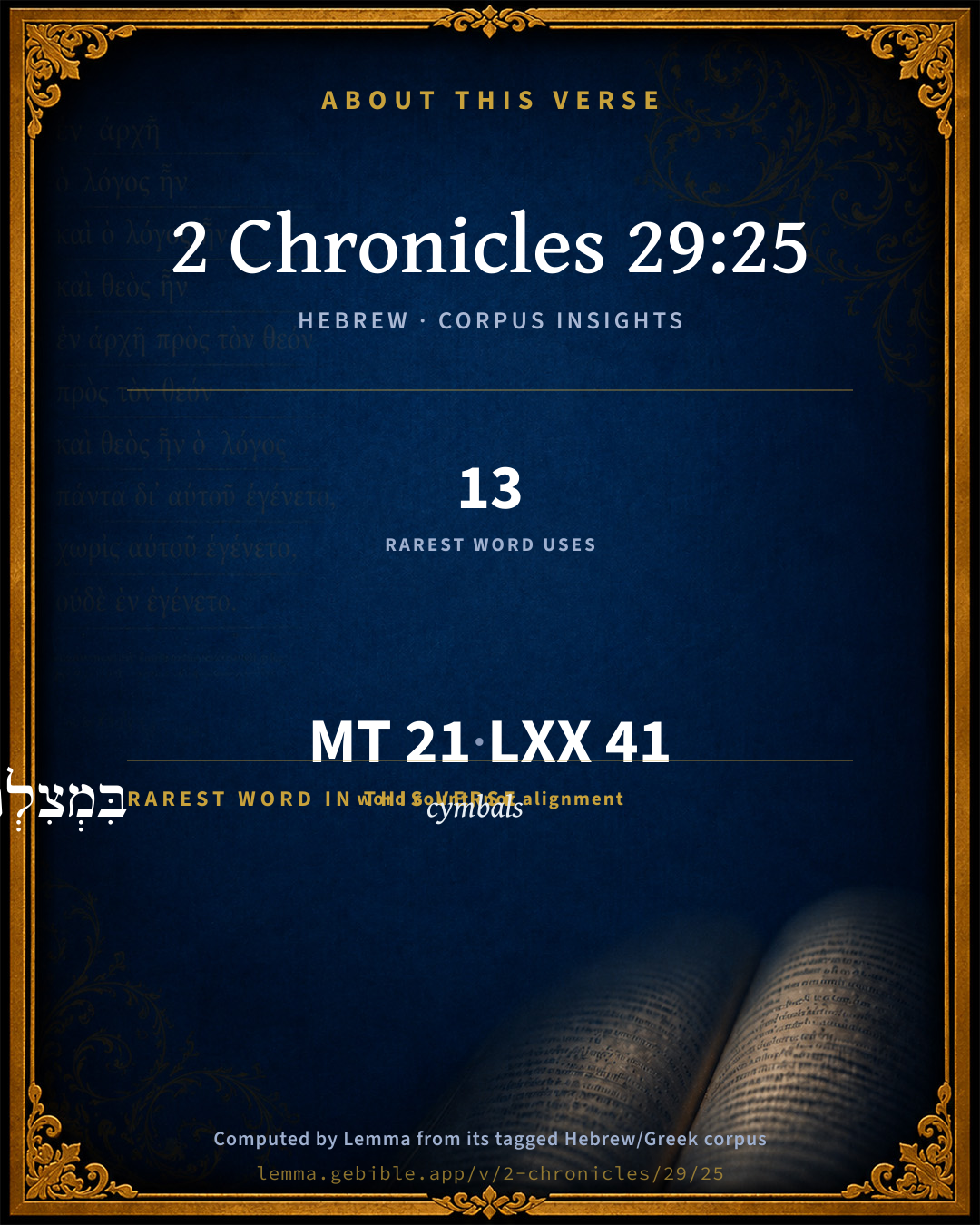
The rarest word here is בִּמְצִלְתַּ֨יִם֙ cymbals H4700 — appearing just 13 times in the whole Hebrew Bible.

Shared distinctive vocabulary

בִּמְצִלְתַּ֨יִם֙ cymbals H4700 occurs in 13 verses of the Hebrew Bible. Also found in:

Grammatical profile

  • 1 verb
  • 18 nouns
  • 1 conjunction
  • 1 particle

Verb forms

  • וַיַּֽעֲמֵ֨ד Hiphil · Sequential Imperfect

Repetition

Words recur within this verse — often emphatic in Hebrew:

  • יְהוָ֗ה LORD H3068 ×2
  • בְּמִצְוַ֥ת commandment H4687 ×2
  • הַנָּבִ֑יא prophet H5030 ×2
  • בְיַד hand H3027 ×2

Hebrew & Septuagint length

In English translation the verse runs 41 words from the Hebrew and 50 from the Septuagint (LXX English) — closely comparable.

A rough comparison of the two English renderings, which tokenize alike — not a word-level alignment.

Word counts can differ between the Hebrew and the Greek without any difference in meaning — e.g. the Hebrew direct-object marker אֵת has no separate Greek word, and Greek often adds the article ὁ.

In the original languages it is 21 Hebrew tokens and 41 Greek tokens — but the two are counted differently (Hebrew bundles its prefixes and suffixes into one token; the Greek is in lemma form), so that isn’t a like-for-like length.

Cross-references

16

Topical passages linked to 2 Chronicles 29:25 in the Treasury of Scripture Knowledge — connected by theme and wording, ordered by reader-vote popularity; previews shown in the World English Bible.

  • 2 Chronicles 8:14 He appointed, according to the ordinance of David his father, the divisions of the priests to their service, and the Levites to their offices, to praise, and to minister before the priests, as the duty of every day required; the doorkeepers also by their divisions at every gate: for so had David the man of God commanded.
  • 1 Chronicles 23:5 and four thousand were doorkeepers; and four thousand praised Yahweh with the instruments which I made, [said David], for giving praise.
  • 2 Samuel 24:11 When David rose up in the morning, the word of Yahweh came to the prophet Gad, David's seer, saying,
  • 1 Chronicles 9:33 These are the singers, heads of fathers' [houses] of the Levites, [who lived] in the chambers [and were] free [from other service]; for they were employed in their work day and night.
  • 1 Chronicles 15:16–22 David spoke to the chief of the Levites to appoint their brothers the singers, with instruments of music, psalteries and harps and cymbals, sounding aloud and lifting up the voice with joy.
  • 1 Chronicles 16:4–5 He appointed certain of the Levites to minister before the ark of Yahweh, and to celebrate and to thank and praise Yahweh, the God of Israel:
  • 1 Chronicles 16:42 and with them Heman and Jeduthun [with] trumpets and cymbals for those that should sound aloud, and [with] instruments for the songs of God; and the sons of Jeduthun to be at the gate.
  • 1 Chronicles 25:1–7 Moreover, David and the captains of the host set apart for the service certain of the sons of Asaph, and of Heman, and of Jeduthun, who should prophesy with harps, with psalteries, and with cymbals: and the number of those who did the work according to their service was:
  • 2 Chronicles 35:15 The singers the sons of Asaph were in their place, according to the commandment of David, and Asaph, and Heman, and Jeduthun the king's seer; and the porters were at every gate: they didn't need to depart from their service; for their brothers the Levites prepared for them.
  • 2 Chronicles 30:12 Also on Judah came the hand of God to give them one heart, to do the commandment of the king and of the princes by the word of Yahweh.
  • 2 Samuel 7:2–4 that the king said to Nathan the prophet, See now, I dwell in a house of cedar, but the ark of God dwells within curtains.
  • 2 Samuel 12:1–7 Yahweh sent Nathan to David. He came to him, and said to him, "There were two men in one city; the one rich, and the other poor.
  • 1 Chronicles 21:9 Yahweh spoke to Gad, David's seer, saying,
  • 1 Chronicles 28:12 and the pattern of all that he had by the Spirit, for the courts of the house of Yahweh, and for all the surrounding rooms, for the treasuries of the house of God, and for the treasuries of the dedicated things;
  • 1 Chronicles 28:19 All this, [said David], have I been made to understand in writing from the hand of Yahweh, even all the works of this pattern.
  • 1 Chronicles 29:29 Now the acts of David the king, first and last, behold, they are written in the history of Samuel the seer, and in the history of Nathan the prophet, and in the history of Gad the seer,

Cross-references courtesy of OpenBible.info (CC BY 4.0).

Hebrew and Greek witnesses Masoretic Hebrew ↔ Greek Septuagint

The same verse in the two great witnesses to the Old Testament, shown verse-for-verse.

These are two independent witnesses, not word-aligned to each other, and the Septuagint is shown in lemma (dictionary) form.

Hebrew 2 Chronicles 29:25 Masoretic · Westminster Leningrad Codex

וַיַּֽעֲמֵ֨ד אֶת הַלְוִיִּ֜ם בֵּ֣ית יְהוָ֗ה בִּמְצִלְתַּ֨יִם֙ בִּנְבָלִ֣ים וּבְכִנֹּר֔וֹת בְּמִצְוַ֥ת דָּוִ֛יד וְגָ֥ד חֹזֵֽה הַמֶּ֖לֶךְ וְנָתָ֣ן הַנָּבִ֑יא כִּ֧י בְיַד יְהוָ֛ה הַמִּצְוָ֖ה בְּיַד נְבִיאָֽיו

He set the Levites in the house of Yahweh with cymbals, with psalteries, and with harps, according to the commandment of David, and of Gad the king's seer, and Nathan the prophet; for the commandment was of Yahweh by his prophets.

World English Bible · Public Domain

Greek LXX 2 Chronicles 29:25 Septuagint · lemma form

καί ἵστημι ὁ λευείτης ἐν οἶκος κύριος ἐν κύμβαλον καί ἐν νάβλα καί ἐν κινύρα κατά ὁ ἐντολή δαυίδ ὁ βασιλεύς καί γαδ ὁ ὁράω ὁ βασιλεύς καί ναθαν ὁ προφήτης ὅτι διά ἐντολή κύριος ὁ πρόσταγμα ἐν χείρ ὁ προφήτης

And he stationed the Levites in the house of the Lord with cymbals, and lutes, and harps, according to the commandment of king David, and of Gad the king's seer, and Nathan the prophet: for by the commandment of the Lord the order was in the hand of the prophets.

LXX2012 (modern English Septuagint) · Public Domain

Hebrew: Westminster Leningrad Codex (CC BY 4.0). Greek: Septuagint (public domain); English from LXX2012 (modern English Septuagint) (Public Domain). How the Septuagint differs from the Hebrew →

Commentary

Notes on 2 Chronicles 29:25 from classic Christian and Jewish commentators (each source and its license shown beneath its notes). The classic Christian expositions comment on the surrounding passage and are grouped to its opening verse, so a note may address several verses; the Jewish commentaries on the Tanakh (Rashi and others) are per-verse, so they appear only where the commentator wrote on this verse.

Lemma curates 59 commentaries, every one of them public domain or Creative Commons licensed, each selected and text-cleaned for this edition rather than reprinted as found. About our sources →

Trapp's Complete Commentary

John Trapp

2Ch 29:25 And he set the Levites in the house of the LORD with cymbals, with psalteries, and with harps, according to the commandment of David, and of Gad the king’s seer, and Nathan the prophet: for [so was] the commandment of the LORD by his prophets.

Ver. 25. According to the commandment of the Lord.] Heb., By the hand of the Lord, by the hand of his prophets; to note, say the Hebrews here, that precepts delivered by the prophets are the very precepts of God himself.

John Trapp, A Commentary or Exposition upon All the Books of the Old and New Testament (1647–1656) — public domain. Text from a community e-Sword module.

Geneva Bible (1599)

Geneva Bible translators

This thing was not appointed of man, but it was the commandment of God.

Geneva Bible (1599) marginal notes — public domain. Text via Bolls.life.

Adam Clarke's Commentary

Verse 25. With cymbals, with psalteries] Moses had not appointed any musical instruments to be used in the divine worship; there was nothing of the kind under the first tabernacle. The trumpets or horns then used were not for song nor for praise, but as we use bells, i.e., to give notice to the congregation of what they were called to perform, c. But David did certainly introduce many instruments of music into God's worship, for which we have already seen he was solemnly reproved by the prophet Amos, Am 6:1-6. Here, however, the author of this book states he had the commandment of the prophet Nathan, and Gad the king's seer and this is stated to have been the commandment of the Lord by his prophets: but the Syriac and Arabic give this a different turn - "Hezekiah appointed the Levites in the house of the Lord, with instruments of music, and the sound of harps, and with the HYMNS of DAVID, and the HYMNS of GAD, the king's prophet, and of NATHAN, the king's prophet: for David sang the praises of the Lord his God, as from the mouth of the prophets." It was by the hand or commandment of the Lord and his prophets that the Levites should praise the Lord; for so the Hebrew text may be understood: and it was by the order of David that so many instruments of music should be introduced into the Divine service. But were it even evident, which it is not, either from this or any other place in the sacred writings, that instruments of music were prescribed by Divine authority under the law, could this be adduced with any semblance of reason, that they ought to be used in Christian worship? No: the whole spirit, soul, and genius of the Christian religion are against this: and those who know the Church of God best, and what constitutes its genuine spiritual state, know that these things have been introduced as a substitute for the life and power of religion; and that where they prevail most, there is least of the power of Christianity. Away with such portentous baubles from the worship of that infinite Spirit who requires his followers to worship him in spirit and in truth, for to no such worship are those instruments friendly. See the texts in the margin; also the use of the trumpets in the sanctuary, Nu 10:2, &c., and the notes there.

Adam Clarke's Commentary on the Bible (1810–1826) — public domain. Text from a community e-Sword/MySword module.

Ellicott's Commentary for English Readers

(25) He set.—Stationed, appointed. Hezekiah restored the ancient choral worship as established by David (1Ch_23:5; 1Ch_23:25).

Psalteries.—Nĕbâlîm, a kind of harp; Greek, νάβλα. νάβλίον.

Harps.—Kinnôrôth. Greek, κινύρα, a sort of lyre, or cittern, or guitar.

Gad . . . Nathan.—1Ch_29:29. This is the only place where the institution of the Levitical minstrelsy is ascribed to the injunctions of prophets; but the thing is probable in itself, considering that no important step, whether in civil or ecclesiastical matters, would be likely to be taken by an Israelite king without consulting the Divine will by means of the royal prophets, as we know, from the cuneiform documents, was the uniform practice with the Assyrian and Babylonian sovereigns. Moreover, prophecy was intimately connected with music. (See on 1Ch_25:1.)

For so was . . .—For by the hand of Jehovah was the commandment; to wit, by the hand of his prophets. David’s command was obeyed because it was Divine, having emanated from the prophets who represented Jehovah. (Comp. 2Ch_29:15, supra.)

A Bible Commentary for English Readers, edited by Charles John Ellicott (1878–1897) — public domain. Text from a community e-Sword module.

The Cambridge Bible for Schools and Colleges

gen. ed. J. J. S. Perowne

25. so was the commandment of the Lord by his prophets] Render, the commandment was by (through) the LORD, even by (through) his prophets. The Chronicler urges the point that David’s arrangements for Temple song were by inspiration; cp. 1Ch_28:19.

The Cambridge Bible for Schools and Colleges (gen. ed. J. J. S. Perowne; Cambridge University Press, 1878–1918) — public domain. Text from a community e-Sword module.

John Gill's Exposition

And Hezekiah commanded to offer the burnt offering upon the altar,.... Which was wholly devoted to the Lord, and was an acknowledgment of his sovereignty over them, and of his goodness to them:

and when the burnt offering began, the song of the Lord began also with trumpets, and with the instruments ordained by David king of Israel; and this was done at the time of the pouring out of the drink offering, which always attended the burnt offering; for this is a rule with the Jews, that they do not say the song but over the drink offering (o).

(o) T. Bab. Eracin, fol. 12. 1.

John Gill's Exposition of the Whole Bible (1746–1763) — public domain (CC PDM 1.0). Text via the HelloAO Bible API.

Haydock's Catholic Bible Commentary

Prophet. Moses had not required music, except on some occasions, Num. x. 10. But David acted by God’s authority. The institution was designed to promote piety, and a love for religious meetings. Such sacred ceremonies are not to be considered as human inventions, for it was, &c. They command our utmost respect. C.

George Leo Haydock (1774–1849), Haydock's Catholic Family Bible and Commentary, 1859 edition — public domain. Excludes Psalms (Douay-Rheims chapter numbering differs from Protestant) and Deuterocanonical books (Catholic canon only).

The Pulpit Commentary

(see 1Ch_16:4 1Ch_21:23:5 1Ch_25:1, 6 29:29; 2Ch_5:12)

The Pulpit Commentary (1880–1919), ed. H.D.M. Spence-Jones & Joseph S. Exell — public domain. Text from a community e-Sword module.

unfoldingWord translationNotes

Door43 World Missions Community

the house of Yahweh

The word "house" represents the temple. AT: "the temple of Yahweh" (See: Metonymy)

cymbals

two thin, round metal plates that are hit together to make a loud sound. See how you translated this in 2 Chronicles 5:12. (See: Translate Unknowns)

arranging them by the command of David, Gad, the king's seer, and Nathan, the prophet

The word "command" can be translated with a verbal phrase. AT: "arranging the Levites as David, Gad, the king's seer, and Nathan, the prophet had commanded" (See: Abstract Nouns)

for the command was from Yahweh by means of his prophets

The word "command" can be translated with a verbal phrase. AT: "for Yahweh had commanded this through his prophets" (See: Abstract Nouns)

translationWords

harp

lute

David

Gad

prophet

Nathan

trumpet

unfoldingWord translationNotes — © Distant Shores Media and the Door43 World Missions Community, licensed CC BY-SA 4.0. Source: git.door43.org/Door43/en_tn.

Rashi

Rabbi Shlomo Yitzchaki (Rashi)

for by the hand of the Lord was the commandment, by the hand of His prophets that the Levites should play musical instruments. It is not written in the Torah that a sacrifice requires musical accompaniment (lit., song), but it is the commandment of the Lord, which He commanded through His prophets to accompany the sacrifice with song. Our Rabbis explained in Tractate Arachin (11a): From where do we derive that the Levites are required to play musical instruments? For it is written (Num. 4:47): “the service of the service.” Which is a service that requires another service with it? This is music with a musical instrument. “And the service of raising” may also be correctly explained in reference to song, as it is written (I Chron. 15:22): “And Chenaniah, the leader of the Levites in song (בְּמַשָּׂא) etc. because he was an expert,” for he was appointed to raise the voice of the melody of the song.

Rashi on the Tanakh — English translations: “The Judaica Press complete Tanach with Rashi, translated by A. J. Rosenberg” (CC BY 4.0); “Pentateuch with Rashi's commentary by M. Rosenbaum and A.M. Silbermann, 1929-1934” (public domain); “The Metsudah Tanach series, Lakewood, N.J” (CC BY 4.0); and “The Book of Joshua, Metsudah Publications, 1997” (CC BY 4.0). Text via Sefaria.

Lesson kit

Teaching starters — assembled from the data on this page, not authored interpretation. Every prompt links to the verse data it draws on. Edit before teaching.

2 Chronicles, in the Historical, opens this verse with 21 words (17 distinct Hebrew lemmas). Its most distinctive word is mᵉtsêleth (“cymbals”). A historical commentator’s framing appears above. Read the whole chapter for the surrounding context.

Discussion questions

  1. What does “cymbals” (mᵉtsêleth) contribute to the verse as a whole?
  2. 1 Chronicles 13:8 shares the word «cymbals» with this verse. How do the two illuminate each other?
  3. “LORD” occurs 2× in this one verse. What is the effect of the repetition?
  4. These translations render this verse differently. What is at stake in choosing one wording over another?
  5. The verb «וַיַּֽעֲמֵ֨ד» is Hiphil Sequential Imperfect. How does its form color the action?
  6. Reading how Trapp's Complete Commentary and Geneva Bible (1599) read this verse, where do the two commentators agree and where do they part?

Things to notice

Reading settings

Reading text

Shown beneath each verse's original-language words.

Old Testament
Old Testament edition

Read the OT as the Masoretic Hebrew (MT) or the Greek Septuagint (LXX).

English shown for the Greek Septuagint (in the Hebrew ↔ Greek comparison).

Comparing translations? Open the Compare panel on any verse page to stack up to four side by side.