Ezekiel 34:24

Hebrew (Westminster Leningrad Codex) Ezekiel 34:24 appears in the Hebrew Old Testament. The text above is from the Westminster Leningrad Codex. Each word links to its Strong’s number, a concise gloss, and parsing drawn from the Open Scriptures Hebrew Bible morphology. Click any word for its full Brown-Driver-Briggs (BDB) entry.
Download image
Cite this verse

Ezekiel 34:24 (World English Bible). Public Domain. Lemma interlinear Bible study tool, https://lemma.gebible.app/v/ezekiel/34/24.

Show BibTeX & RIS
BibTeX
RIS
English Translation
I, Yahweh, will be their God, and my servant David prince among them; I, Yahweh, have spoken it.
World English Bible · Public Domain
Download a study sheet

One document with this verse’s original text, its word-by-word gloss line, the meaning frame, cross-references with their text, attributed commentary, and full source and license credits — printable, and it pastes into notes with its structure intact.

This verse Autodidact and up

Study sheet (.html) Plain text (.txt)

A passage Seminary Student

Up to 50 verses in one chapter. A passage sheet keeps up to 6 commentary sources and 12 cross-references per verse, in the order this page ranks them, and says so on the sheet whenever that leaves anything out. Ask for a single verse and you get the Autodidact verse sheet above.

Everything on this page stays free to read, with no account — the sheet is a download of what is already on screen, not access to it.

Want to remove ads? Support Godless Engineer
Compare translations 3

The same verse in 3 English versions, stacked beneath the original-language interlinear above. Click any original word for its lexicon entry.

Each is an independent rendering of the whole verse — the interlinear is not word-aligned to these translations.

Highlighted words mark where these versions differ — a whole-verse word diff, not a word-by-word alignment.

  • World English Bible Public Domain
    I, Yahweh, will be their God, and my servant David prince among them; I, Yahweh, have spoken it.
  • King James Version Public Domain
    And I the LORD will be their God, and my servant David a prince among them; I the LORD have spoken it.
  • unfoldingWord Literal Text CC BY-SA 4.0
    For I, Yahweh, will be their God, and my servant David will be a prince among them—I, Yahweh, have declared this.

unfoldingWord Literal Text — © unfoldingWord, licensed CC BY-SA 4.0. Word-aligned USFM3 via Door43 (git.door43.org/unfoldingWord/en_ult).

Versions to compare (up to 4)

3 of 4 selected

Show all 18 translations

Every available English version of this verse, each an independent rendering of the whole verse.

  • World English Bible Public Domain
    I, Yahweh, will be their God, and my servant David prince among them; I, Yahweh, have spoken it.
  • Berean Standard Bible Public Domain
    I, the LORD, will be their God, and My servant David will be a prince among them. I, the LORD, have spoken.
  • Majority Standard Bible Public Domain
    I, the LORD, will be their God, and My servant David will be a prince among them. I, the LORD, have spoken.
  • King James Version Public Domain
    And I the LORD will be their God, and my servant David a prince among them; I the LORD have spoken it.
  • American Standard Version (1901) Public Domain
    And I, Jehovah, will be their God, and my servant David prince among them; I, Jehovah, have spoken it.
  • Revised Version (1885) Public Domain
    And I the LORD will be their God, and my servant David prince among them; I the LORD have spoken it.
  • Geneva Bible (1599) Public Domain
    And I the Lord will be their God, and my seruant Dauid shalbe the prince amog them. I the Lord haue spoken it.
  • Douay-Rheims (1899) Public Domain
    And I the Lord will be their God: and my servant David the prince in the midst of them: I the Lord have spoken it.
  • Young's Literal Translation Public Domain
    And I, Jehovah, I am their God, And My servant David prince in their midst, I, Jehovah, have spoken.
  • Literal Standard Version CC BY-SA 4.0
    And I, YHWH, I am their God, || And My servant David [is] prince in their midst, || I, YHWH, have spoken.
  • Unlocked Literal Bible CC BY-SA 4.0
    For I, Yahweh, will be their God, and my servant David will be a prince among them—I, Yahweh, have declared this.
  • unfoldingWord Literal Text CC BY-SA 4.0
    For I, Yahweh, will be their God, and my servant David will be a prince among them—I, Yahweh, have declared this.
  • Darby Bible Public Domain
    And I Jehovah will be their God, and my servant David a prince in their midst: I Jehovah have spoken [it].
  • World Messianic Bible Public Domain
    I, the LORD, will be their God, and my servant David prince among them. I, the LORD, have spoken it.
  • Webster's Bible Public Domain
    And I the LORD will be their God, and my servant David a prince among them; I the LORD have spoken it.
  • Free Bible Version CC BY-SA 4.0
    I the Lord will be their God, and my servant David will be their leader. I the Lord have spoken.
  • Bible in Basic English Public Domain
    And I the Lord will be their God and my servant David their ruler; I the Lord have said it.
  • JPS Tanakh (1917) Public Domain
    And I the LORD will be their God, and My servant David prince among them; I the LORD have spoken.

Literal Standard Version (2020), Covenant Press — licensed CC BY-SA 4.0. Text via the HelloAO Bible API (eBible.org). Unlocked Literal Bible (unfoldingWord) — licensed CC BY-SA 4.0. Text via the HelloAO Bible API (eBible.org). unfoldingWord Literal Text — © unfoldingWord, licensed CC BY-SA 4.0. Word-aligned USFM3 via Door43 (git.door43.org/unfoldingWord/en_ult). Free Bible Version, Dr. Jonathan Gallagher — licensed CC BY-SA 4.0. Text via the HelloAO Bible API (eBible.org).

Word by word

More ways to search: Search by grammar → Find every occurrence → Compare this word →

Practice this passage: Drill this verse → Learn its vocabulary →

נָשִׂ֣יא
nâsîyʼ
H5387
“chief”
Noun, Common, Masculine, Singular, Absolute
Part of Speech
Noun
Type
Common
Gender
Masculine
Number
Singular
State
Absolute
Full BDB Definition

Origin: from H5375

TWOT: 1421b , 1421c

one lifted up, chief, prince, captain, leader - rising mist, vapour
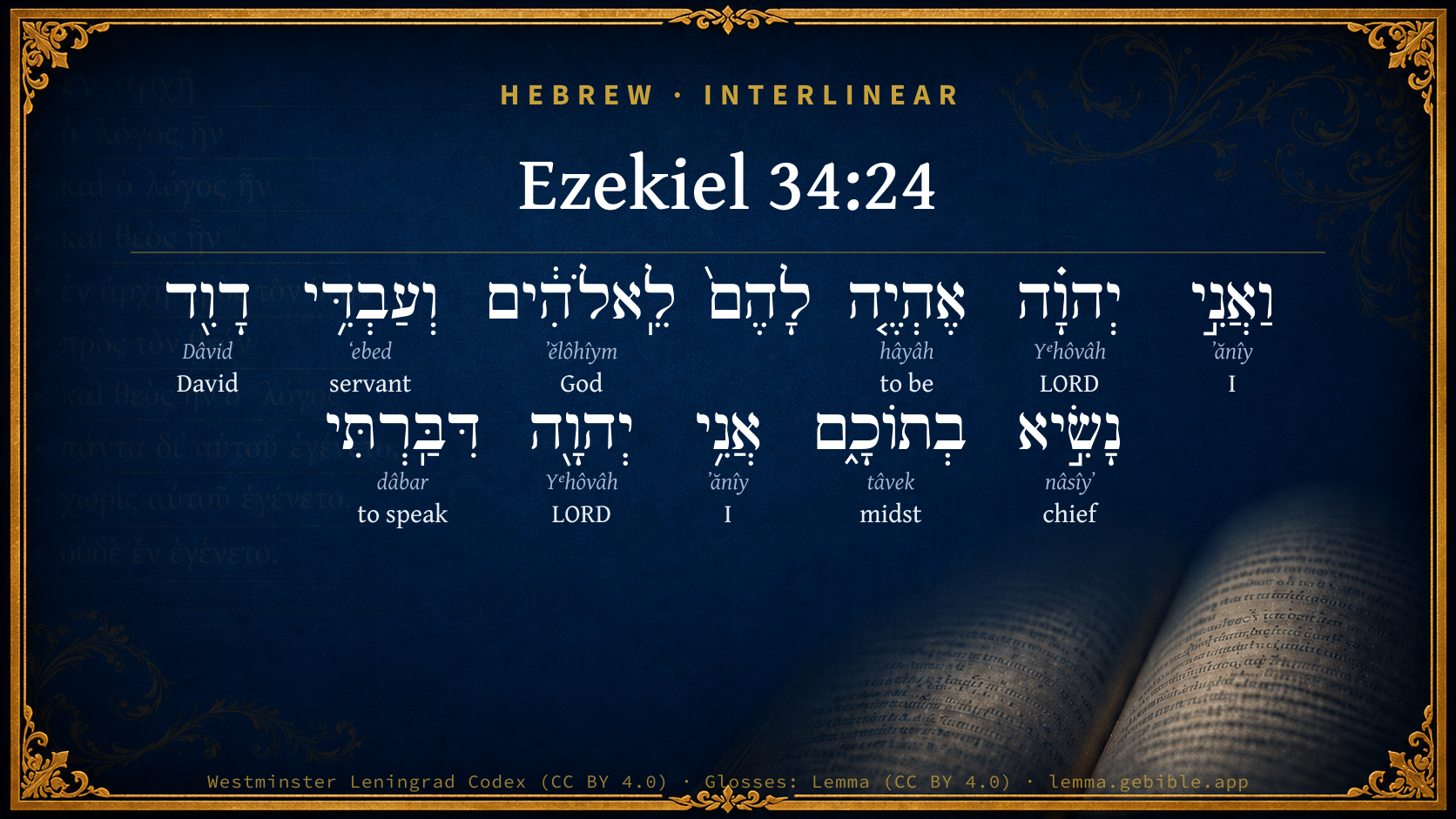
  1. וַאֲנִ֣י ʼănîy H589 “and · I” Conjunction + Pronoun, Personal, 1st Person, Common, Singular
  2. יְהוָ֗ה Yᵉhôvâh H3068 “LORD” Noun, Proper
  3. אֶהְיֶ֤ה hâyâh H1961 “to be” Verb, Qal, Imperfect, 1st Person, Common, Singular
  4. לֵֽאלֹהִ֔ים ʼĕlôhîym H430 “to/for · God(s)” Preposition + Noun, Common, Masculine, Plural, Absolute
  5. וְעַבְדִּ֥י ʻebed H5650 “and · servant · my” Conjunction + Noun, Common, Masculine, Singular, Construct + Suffix, Personal, 1st Person, Common, Singular
  6. דָוִ֖ד Dâvid H1732 “David” Noun, Proper
  7. בְתוֹכָ֑ם tâvek H8432 “in/at · midst · their” Preposition + Noun, Common, Masculine, Singular, Construct + Suffix, Personal, 3rd Person, Masculine, Plural
  8. אֲנִ֥י ʼănîy H589 “I” Pronoun, Personal, 1st Person, Common, Singular
  9. יְהוָ֖ה Yᵉhôvâh H3068 “LORD” Noun, Proper
  10. דִּבַּֽרְתִּי dâbar H1696 “to speak” Verb, Piel, Perfect, 1st Person, Common, Singular

About this verse

These counts appear in no published source. They are computed here, from the morphology-tagged text and Lemma’s own curated glosses. What Lemma adds →

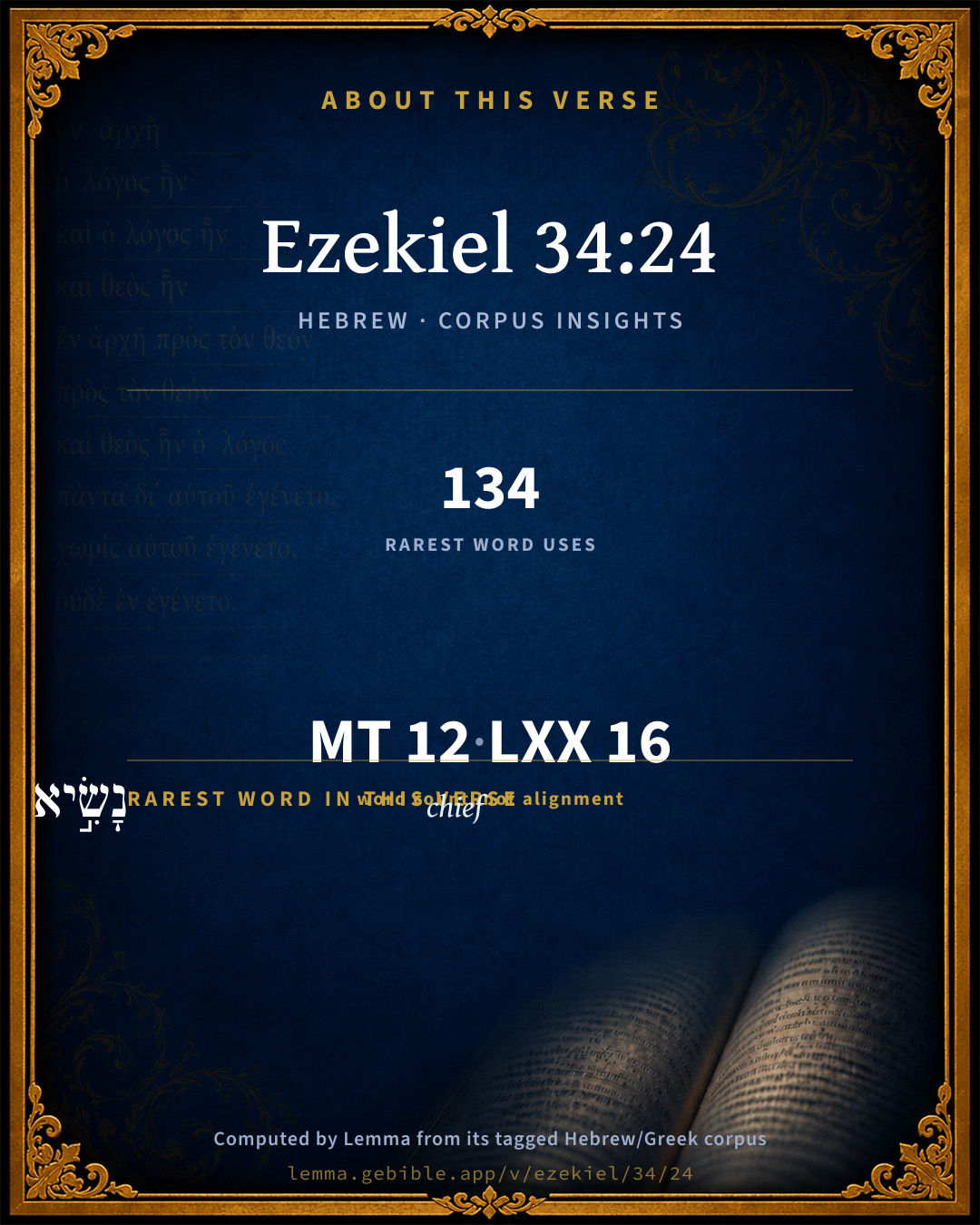
12
words
9
distinct lemmas
Prophets
section

Grammatical profile

  • 2 verbs
  • 7 nouns
  • 2 pronouns
  • 1 preposition

Verb forms

  • אֶהְיֶ֤ה Qal · Imperfect
  • דִּבַּֽרְתִּי Piel · Perfect

Repetition

Words recur within this verse — often emphatic in Hebrew:

  • יְהוָ֗ה LORD H3068 ×2
  • וַאֲנִ֣י I H589 ×2

Hebrew & Septuagint length

In English translation the verse runs 18 words from the Hebrew and 25 from the Septuagint (LXX English) — closely comparable.

A rough comparison of the two English renderings, which tokenize alike — not a word-level alignment.

Word counts can differ between the Hebrew and the Greek without any difference in meaning — e.g. the Hebrew direct-object marker אֵת has no separate Greek word, and Greek often adds the article ὁ.

In the original languages it is 12 Hebrew tokens and 16 Greek tokens — but the two are counted differently (Hebrew bundles its prefixes and suffixes into one token; the Greek is in lemma form), so that isn’t a like-for-like length.

Cross-references

27

Topical passages linked to Ezekiel 34:24 in the Treasury of Scripture Knowledge — connected by theme and wording, ordered by reader-vote popularity; previews shown in the World English Bible.

  • Jeremiah 23:5–6 Behold, the days come, says Yahweh, that I will raise to David a righteous Branch, and he shall reign as king and deal wisely, and shall execute justice and righteousness in the land.
  • Jeremiah 31:33 But this is the covenant that I will make with the house of Israel after those days, says Yahweh: I will put my law in their inward parts, and in their heart will I write it; and I will be their God, and they shall be my people:
  • Ezekiel 36:28 You shall dwell in the land that I gave to your fathers; and you shall be my people, and I will be your God.
  • Ezekiel 37:27 My tent also shall be with them; and I will be their God, and they shall be my people.
  • Revelation 21:3 I heard a loud voice out of heaven saying, "Behold, God's dwelling is with people, and he will dwell with them, and they will be his people, and God himself will be with them as their God.
  • Exodus 29:45–46 I will dwell among the children of Israel, and will be their God.
  • Isaiah 43:2–3 When you pass through the waters, I will be with you; and through the rivers, they shall not overflow you: when you walk through the fire, you shall not be burned, neither shall the flame kindle on you.
  • Ezekiel 37:23 neither shall they defile themselves any more with their idols, nor with their detestable things, nor with any of their transgressions; but I will save them out of all their dwelling-places, in which they have sinned, and will cleanse them: so shall they be my people, and I will be their God.
  • Matthew 28:18 Jesus came to them and spoke to them, saying, "All authority has been given to me in heaven and on earth.
  • Joshua 5:13–15 It happened, when Joshua was by Jericho, that he lifted up his eyes and looked, and, behold, there stood a man over against him with his sword drawn in his hand: and Joshua went to him, and said to him, Are you for us, or for our adversaries?
  • Psalms 2:6 "Yet I have set my king on my holy hill of Zion."
  • Isaiah 9:6–7 For to us a child is born, to us a son is given; and the government shall be on his shoulder: and his name shall be called Wonderful, Counselor, Mighty God, Everlasting Father, Prince of Peace.
  • Jeremiah 30:9 but they shall serve Yahweh their God, and David their king, whom I will raise up to them.
  • Jeremiah 31:1 At that time, says Yahweh, will I be the God of all the families of Israel, and they shall be my people.
  • Jeremiah 32:38 and they shall be my people, and I will be their God:
  • Jeremiah 33:15–17 In those days, and at that time, will I cause a Branch of righteousness to grow up to David; and he shall execute justice and righteousness in the land.
  • Ezekiel 34:30–31 They shall know that I, Yahweh, their God am with them, and that they, the house of Israel, are my people, says the Lord Yahweh.
  • Ezekiel 39:22 So the house of Israel shall know that I am Yahweh their God, from that day and forward.
  • Micah 5:2 But you, Bethlehem Ephrathah, Being small among the clans of Judah, Out of you one will come forth to me that is to be ruler in Israel; Whose goings forth are from of old, from everlasting.
  • Zechariah 13:9 I will bring the third part into the fire, And will refine them as silver is refined, And will test them like gold is tested. They will call on my name, and I will hear them. I will say, 'It is my people;' And they will say, 'Yahweh is my God.'"
  • Luke 1:31–33 Behold, you will conceive in your womb, and bring forth a son, and will call his name 'Jesus.'
  • Acts 5:31 God exalted him with his right hand to be a Prince and a Savior, to give repentance to Israel, and remission of sins.
  • 1 Corinthians 15:25 For he must reign until he has put all his enemies under his feet.
  • Ephesians 1:21–22 far above all rule, and authority, and power, and dominion, and every name that is named, not only in this age, but also in that which is to come.
  • Philippians 2:9–11 Therefore God also highly exalted him, and gave to him the name which is above every name;
  • Hebrews 2:9–10 But we see him who has been made a little lower than the angels, Jesus, because of the suffering of death crowned with glory and honor, that by the grace of God he should taste of death for everyone.
  • Revelation 19:13–16 He is clothed in a garment sprinkled with blood. His name is called "The Word of God."

Cross-references courtesy of OpenBible.info (CC BY 4.0).

Hebrew and Greek witnesses Masoretic Hebrew ↔ Greek Septuagint

The same verse in the two great witnesses to the Old Testament, shown verse-for-verse.

These are two independent witnesses, not word-aligned to each other, and the Septuagint is shown in lemma (dictionary) form.

Hebrew Ezekiel 34:24 Masoretic · Westminster Leningrad Codex

וַאֲנִ֣י יְהוָ֗ה אֶהְיֶ֤ה לָהֶם֙ לֵֽאלֹהִ֔ים וְעַבְדִּ֥י דָוִ֖ד נָשִׂ֣יא בְתוֹכָ֑ם אֲנִ֥י יְהוָ֖ה דִּבַּֽרְתִּי

I, Yahweh, will be their God, and my servant David prince among them; I, Yahweh, have spoken it.

World English Bible · Public Domain

Greek LXX Ezekiel 34:24 Septuagint · lemma form

καί ἐγώ κύριος εἰμί αὐτός εἰς θεός καί δαυίδ ἐν μέσος αὐτός ἄρχων ἐγώ κύριος λαλέω

and I the Lord will be to them a God, and David a prince in the midst of them; I the Lord have spoken it.

LXX2012 (modern English Septuagint) · Public Domain

On this verse, The Cambridge Bible for Schools and Colleges discusses the Septuagint’s reading. Read the note in Commentary ↓

Hebrew: Westminster Leningrad Codex (CC BY 4.0). Greek: Septuagint (public domain); English from LXX2012 (modern English Septuagint) (Public Domain). How the Septuagint differs from the Hebrew →

Targum (Aramaic paraphrase)

1

The Targum is the ancient Jewish Aramaic paraphrase of the Hebrew Scriptures — an interpretive translation, not the Hebrew text itself. Onkelos (literal) and Pseudo-Jonathan (expansive) render the Torah, and Jonathan the Prophets. Coverage is partial: where no permissively-licensed English translation exists for a verse, only the Aramaic is shown. This is verse-level text, not a word-by-word alignment to the Hebrew.

  1. Targum Jonathan Prophets (Joshua–Malachi)
    וַאֲנָא יְיָ אֶהֱוֵי לְהוֹן לֵאלָהָא וְעַבְדִי דָוִד מַלְכָּא בֵינֵיהוֹן אֲנָא יְיָ גְזָרֵית בְּמֵימְרִי:

    (no public-domain English translation for this verse)

    Targum Jonathan — Aramaic: “Mikraot Gedolot” (public domain). English: “Sefaria Community Translation” (CC0 1.0 (public-domain dedication)); “London "Chaldee Paraphrase," 1871” (public domain). Text via Sefaria.

Commentary

Notes on Ezekiel 34:24 from classic Christian and Jewish commentators (each source and its license shown beneath its notes). The classic Christian expositions comment on the surrounding passage and are grouped to its opening verse, so a note may address several verses; the Jewish commentaries on the Tanakh (Rashi and others) are per-verse, so they appear only where the commentator wrote on this verse.

Lemma curates 59 commentaries, every one of them public domain or Creative Commons licensed, each selected and text-cleaned for this edition rather than reprinted as found. About our sources →

Trapp's Complete Commentary

John Trapp

Eze 34:24 And I the LORD will be their God, and my servant David a prince among them; I the LORD have spoken [it].

Ver. 24. And I the Lord will be their God.] This is that beehive of heavenly honey we so oft meet with in the Old Testament, which therefore those sectaries have so little reason to reject.

And my servant David a prince among them.] Captain of the Lord’s hosts, {Jos 6:2} captain also of his people’s salvation, {Heb 2:10} Messiah the prince. {Dan 9:25}

John Trapp, A Commentary or Exposition upon All the Books of the Old and New Testament (1647–1656) — public domain. Text from a community e-Sword module.

Jamieson, Fausset & Brown

Robert Jamieson, A. R. Fausset & David Brown

my servant--implying fitness for ruling in the name of God, not pursuing a self-chosen course, as other kings, but acting as the faithful administrator of the will of God; Messiah realized fully this character (Psa 40:7-8; Isa 42:1; Isa 49:3, Isa 49:6; Isa 53:11; Phi 2:7), which David typically and partially represented (Act 13:36); so He is the fittest person to wield the world scepter, abused by all the world kings (Dan 2:34-35, Dan 2:44-45).

Jamieson, Fausset & Brown — Commentary Critical and Explanatory on the Whole Bible (1871) — public domain (CC PDM 1.0). Text via the HelloAO Bible API.

Adam Clarke's Commentary

Verse 24. I the Lord will be their God, and my Servant David a Prince] Here we find God and his Christ are all in all in his Church, and Jesus is still PRINCE among them; and to him the call and qualifications of all genuine pastors belong, and from him they must be derived. And he has blotted out what is called uninterrupted succession, that every Christian minister may seek and receive credentials from himself. Here is the grand reason why the uninterrupted succession cannot be made out. And here is the proof also that the Church that pretends to it, and builds upon it, must be a false Church; for it is founded on a falsity; an uninterrupted succession which does not exist either in history or in fact.

Adam Clarke's Commentary on the Bible (1810–1826) — public domain. Text from a community e-Sword/MySword module.

The Cambridge Bible for Schools and Colleges

gen. ed. J. J. S. Perowne

24. I the Lord … their God] This is the goal towards which all movements strive; when this is reached perfection is attained and the covenant with its aims fully realized, cf. Eze_37:27; Jer_31:31; Exo_29:45. The meaning of the words is very profound, implying closer fellowship and deeper feelings accompanying it than can well be expressed.

David a prince] David is here called “prince”; in Eze_37:22; Eze_37:24 he is named “king” (though LXX. avoids the term). The term “prince” is common in Ezek., and does not imply a dignity inferior to that of royalty.

The Cambridge Bible for Schools and Colleges (gen. ed. J. J. S. Perowne; Cambridge University Press, 1878–1918) — public domain. Text from a community e-Sword module.

John Gill's Exposition

And I will make with them a covenant of peace,...., Such the covenant of grace is, made with Christ from everlasting; in which Jehovah proposed terms of peace, and which Christ undertook to answer, and became the peacemaker; and from this article concerning the peace and reconciliation of men the covenant is so called; see Isa 54:10, this the Lord promises to make known to his people his flock, to show them their interest in it, and to make it good unto them; for otherwise it was made with Christ, and with them in Christ from all eternity. The Septuagint and Arabic versions read,

"I will make with David a covenant of peace:''

and will cause the evil beasts to cease out of the land; which was literally fulfilled when the Jews returned from Babylon; during their captivity, the land being uninhabited, evil beasts increased in it, and possessed it; but upon their return these ceased, being either destroyed, or driven away: but figuratively these design wicked men, who, for the malignity of their nature, manners, and conversation, are called evil beasts, as the Cretians were, Tit 1:12, particularly false teachers may be designed; those grievous wolves that spare not, but wrong the flock; but now shall be no more, being either forced to quit their place, or truly converted; so that the wolf shall dwell with the lamb, and the leopard lie down with the kid; which will be the peaceable and comfortable state of the church in the latter day; when there will be none to hurt and destroy in the Lord's holy mountain, Isa 11:6,

and they shall dwell safely in the wilderness, and sleep in the woods; not only in their houses, but in the fields, and even in the wilderness, and in the woods, where wild beasts used to resort; but now being clear of all, and under the protection of such a Shepherd and Prince as David the servant of the Lord, they shall have no dread upon their mind, no fear of any danger; but dwell in the utmost security, lie down and sleep in peace and safety, the Lord sustaining them; and whom they shall serve without fear of any enemy all their days, in righteousness and holiness, being delivered out of the hands of them all.

John Gill's Exposition of the Whole Bible (1746–1763) — public domain (CC PDM 1.0). Text via the HelloAO Bible API.

Matthew Poole's English Annotations

The Lord; the glorious, gracious, eternal One.

Will be their God; I so put them into Christ’s hand, that still I am and will be their God; yea, I will, through this my servant David, be their God.

My servant; Christ was in this great work his Father’s servant, Isa 42:1; 52:13; Eze 37:24,25. David; as Eze 34:23; Christ, called David there as well as here.

Prince; so Christ is Prince and Saviour to his church, Act 5:31.

I the Lord have spoken it; God seals it with this as his oath unchangeable.

Matthew Poole's English Annotations on the Holy Bible (1683–1685) — public domain. Text from a community e-Sword/MySword module.

John Wesley's Explanatory Notes

My servant - Christ was in this great work his fathers servant, Isaiah xlii, 1.

John Wesley, Explanatory Notes Upon the Whole Bible (1754–1765) — public domain. Text via the GEBible commentary corpus.

Lesson kit

Teaching starters — assembled from the data on this page, not authored interpretation. Every prompt links to the verse data it draws on. Edit before teaching.

Ezekiel, in the Prophets, opens this verse with 12 words (9 distinct Hebrew lemmas). Its most distinctive word is nâsîyʼ (“chief”). A historical commentator’s framing appears above. Read the whole chapter for the surrounding context.

Discussion questions

  1. How does “chief” (nâsîyʼ) shape what this verse is saying?
  2. Jeremiah 23:5–6 shares this passage’s theme. How do the two illuminate each other?
  3. “LORD” occurs 2× in this one verse. What is the effect of the repetition?
  4. The translations on this page render this verse differently — a whole-verse word diff, not a word-by-word alignment. What might account for the different wordings?
  5. The verb «אֶהְיֶ֤ה» is Qal Imperfect. How does its form color the action?
  6. Reading how Trapp's Complete Commentary and Jamieson, Fausset & Brown read this verse, where do the two commentators agree and where do they part?

Things to notice

Reading settings

Reading text

Shown beneath each verse's original-language words.

Old Testament
Old Testament edition

Read the OT as the Masoretic Hebrew (MT) or the Greek Septuagint (LXX).

English shown for the Greek Septuagint (in the Hebrew ↔ Greek comparison).

Comparing translations? Open the Compare panel on any verse page to stack up to four side by side.