1 Chronicles 21:28

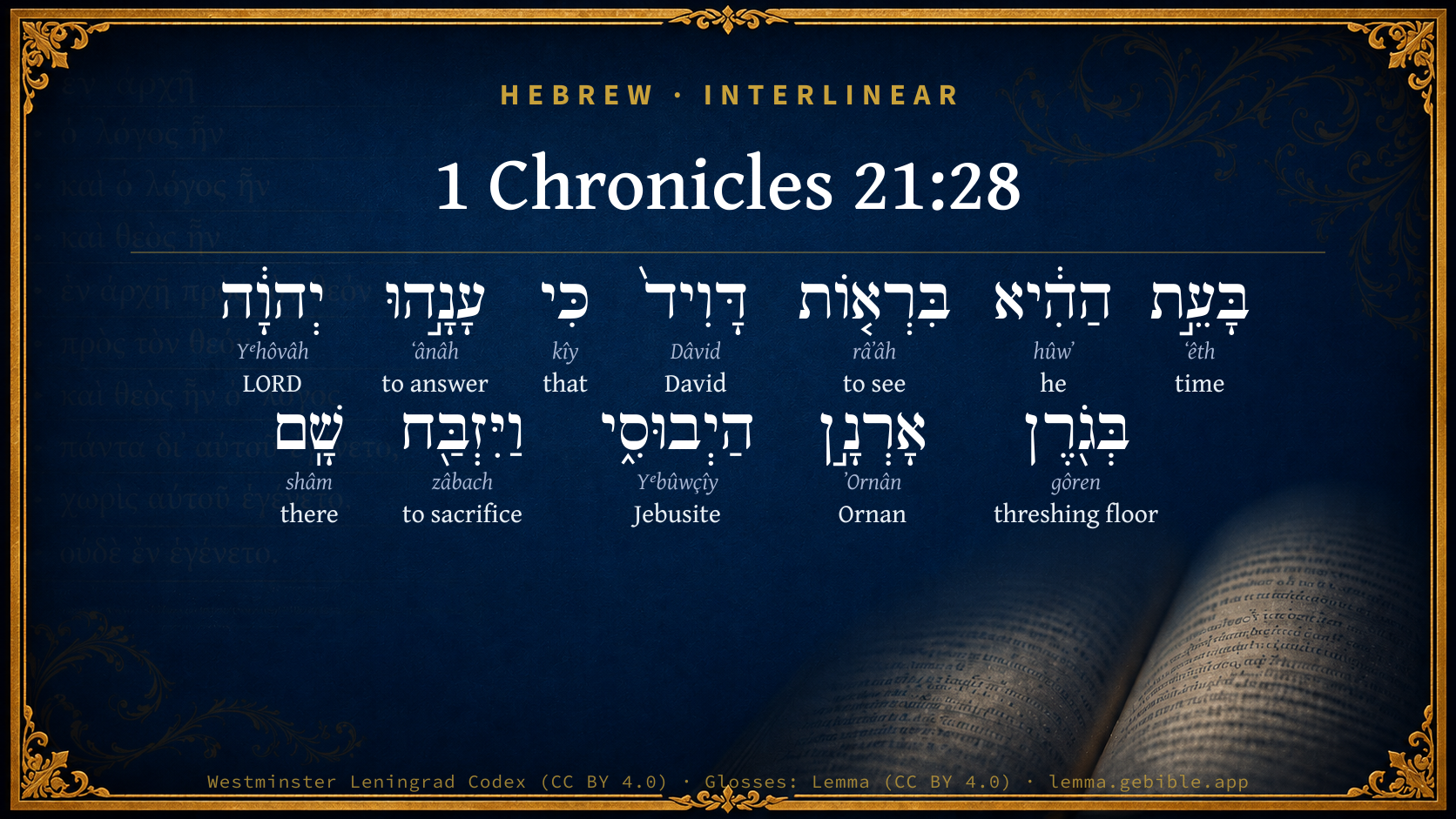
Hebrew (Westminster Leningrad Codex) 1 Chronicles 21:28 appears in the Hebrew Old Testament. The text above is from the Westminster Leningrad Codex. Each word links to its Strong’s number, a concise gloss, and parsing drawn from the Open Scriptures Hebrew Bible morphology. Click any word for its full Brown-Driver-Briggs (BDB) entry.
Download image
Cite this verse

1 Chronicles 21:28 (World English Bible). Public Domain. Lemma interlinear Bible study tool, https://lemma.gebible.app/v/1-chronicles/21/28.

Show BibTeX & RIS
BibTeX
RIS
English Translation
At that time, when David saw that Yahweh had answered him in the threshing floor of Ornan the Jebusite, then he sacrificed there.
World English Bible · Public Domain
Download a study sheet

One document with this verse’s original text, its word-by-word gloss line, the meaning frame, cross-references with their text, attributed commentary, and full source and license credits — printable, and it pastes into notes with its structure intact.

This verse Autodidact and up

Study sheet (.html) Plain text (.txt)

A passage Seminary Student

Up to 50 verses in one chapter. A passage sheet keeps up to 6 commentary sources and 12 cross-references per verse, in the order this page ranks them, and says so on the sheet whenever that leaves anything out. Ask for a single verse and you get the Autodidact verse sheet above.

Everything on this page stays free to read, with no account — the sheet is a download of what is already on screen, not access to it.

Want to remove ads? Support Godless Engineer
Compare translations 3

The same verse in 3 English versions, stacked beneath the original-language interlinear above. Click any original word for its lexicon entry.

Each is an independent rendering of the whole verse — the interlinear is not word-aligned to these translations.

Highlighted words mark where these versions differ — a whole-verse word diff, not a word-by-word alignment.

  • World English Bible Public Domain
    At that time, when David saw that Yahweh had answered him in the threshing floor of Ornan the Jebusite, then he sacrificed there.
  • King James Version Public Domain
    At that time when David saw that the LORD had answered him in the threshingfloor of Ornan the Jebusite, then he sacrificed there.
  • unfoldingWord Literal Text CC BY-SA 4.0
    At that time, when David saw that Yahweh had answered him at the threshing floor of Ornan the Jebusite, then he sacrificed there.

unfoldingWord Literal Text — © unfoldingWord, licensed CC BY-SA 4.0. Word-aligned USFM3 via Door43 (git.door43.org/unfoldingWord/en_ult).

Versions to compare (up to 4)

3 of 4 selected

Show all 18 translations

Every available English version of this verse, each an independent rendering of the whole verse.

  • World English Bible Public Domain
    At that time, when David saw that Yahweh had answered him in the threshing floor of Ornan the Jebusite, then he sacrificed there.
  • Berean Standard Bible Public Domain
    At that time, when David saw that the LORD had answered him at the threshing floor of Ornan the Jebusite, he offered sacrifices there.
  • Majority Standard Bible Public Domain
    At that time, when David saw that the LORD had answered him at the threshing floor of Ornan the Jebusite, he offered sacrifices there.
  • King James Version Public Domain
    At that time when David saw that the LORD had answered him in the threshingfloor of Ornan the Jebusite, then he sacrificed there.
  • American Standard Version (1901) Public Domain
    At that time, when David saw that Jehovah had answered him in the threshing-floor of Ornan the Jebusite, then he sacrificed there.
  • Revised Version (1885) Public Domain
    At that time, when David saw that the LORD had answered him in the threshing-floor of Ornan the Jebusite, then he sacrificed there.
  • Geneva Bible (1599) Public Domain
    At that time when Dauid sawe that the Lord had heard him in the thresshing floore of Ornan the Iebusite, then he sacrificed there.
  • Douay-Rheims (1899) Public Domain
    And the Lord commanded the angel: and he put up his sword again into the sheath.
  • Young's Literal Translation Public Domain
    At that time when David seeth that Jehovah hath answered him in the threshing-floor of Ornan the Jebusite, then he sacrificeth there;
  • Literal Standard Version CC BY-SA 4.0
    At that time, when David sees that YHWH has answered him in the threshing-floor of Ornan the Jebusite, then he sacrifices there;
  • Unlocked Literal Bible CC BY-SA 4.0
    When David saw that Yahweh had answered him at the threshing floor of Ornan the Jebusite, he performed the sacrifice there at that same time.
  • unfoldingWord Literal Text CC BY-SA 4.0
    At that time, when David saw that Yahweh had answered him at the threshing floor of Ornan the Jebusite, then he sacrificed there.
  • Darby Bible Public Domain
    At that time when David saw that Jehovah had answered him in the threshing-floor of Ornan the Jebusite, then he sacrificed there.
  • World Messianic Bible Public Domain
    At that time, when David saw that the LORD had answered him in the threshing floor of Ornan the Jebusite, then he sacrificed there.
  • Webster's Bible Public Domain
    At that time when David saw that the LORD had answered him in the threshing-floor of Ornan the Jebusite, then he sacrificed there.
  • Free Bible Version CC BY-SA 4.0
    When David saw that the Lord had answered him at the threshing floor of Ornan the Jebusite, he offered sacrifices there.
  • Bible in Basic English Public Domain
    At that time, when David saw that the Lord had given him an answer on the grain-floor of Ornan the Jebusite, he made an offering there.
  • JPS Tanakh (1917) Public Domain
    At that time, when David saw that the LORD had answered him in the threshing-floor of Ornan the Jebusite, then he sacrificed there.

Literal Standard Version (2020), Covenant Press — licensed CC BY-SA 4.0. Text via the HelloAO Bible API (eBible.org). Unlocked Literal Bible (unfoldingWord) — licensed CC BY-SA 4.0. Text via the HelloAO Bible API (eBible.org). unfoldingWord Literal Text — © unfoldingWord, licensed CC BY-SA 4.0. Word-aligned USFM3 via Door43 (git.door43.org/unfoldingWord/en_ult). Free Bible Version, Dr. Jonathan Gallagher — licensed CC BY-SA 4.0. Text via the HelloAO Bible API (eBible.org).

Word by word

More ways to search: Search by grammar → Find every occurrence → Compare this word →

Practice this passage: Drill this verse → Learn its vocabulary →

אָרְנָ֣ן
ʼOrnân
H771
“Ornan”
Noun, Proper
Part of Speech
Noun
Type
Proper
Full BDB Definition

Origin: probably from H766

TWOT: None

Ornan = "light was perpetuated: their fir trees" - a Jebusite who sold, to David, a threshing floor for an altar
  1. בָּעֵ֣ת ʻêth H6256 “in/at the · time” Preposition, Determined + Noun, Common, Both, Singular, Absolute
  2. הַהִ֔יא hûwʼ H1931 “the · he” Particle, Definite Article + Pronoun, Personal, 3rd Person, Feminine, Singular
  3. בִּרְא֤וֹת râʼâh H7200 “in/at · to see” Preposition + Verb, Qal, Infinitive Construct
  4. דָּוִיד֙ Dâvid H1732 “David” Noun, Proper
  5. כִּי kîy H3588 “that” Conjunction
  6. עָנָ֣הוּ ʻânâh H6030 “to answer · him” Verb, Qal, Perfect, 3rd Person, Masculine, Singular + Suffix, Personal, 3rd Person, Masculine, Singular
  7. יְהוָ֔ה Yᵉhôvâh H3068 “LORD” Noun, Proper
  8. בְּגֹ֖רֶן gôren H1637 “in/at · threshing floor of” Preposition + Noun, Common, Both, Singular, Construct
  9. הַיְבוּסִ֑י Yᵉbûwçîy H2983 “the · Jebusite” Particle, Definite Article + Noun, Gentilic, Masculine, Singular, Absolute
  10. וַיִּזְבַּ֖ח zâbach H2076 “and · to sacrifice” Conjunction + Verb, Qal, Sequential Imperfect, 3rd Person, Masculine, Singular
  11. שָֽׁם shâm H8033 “there” Adverb

About this verse

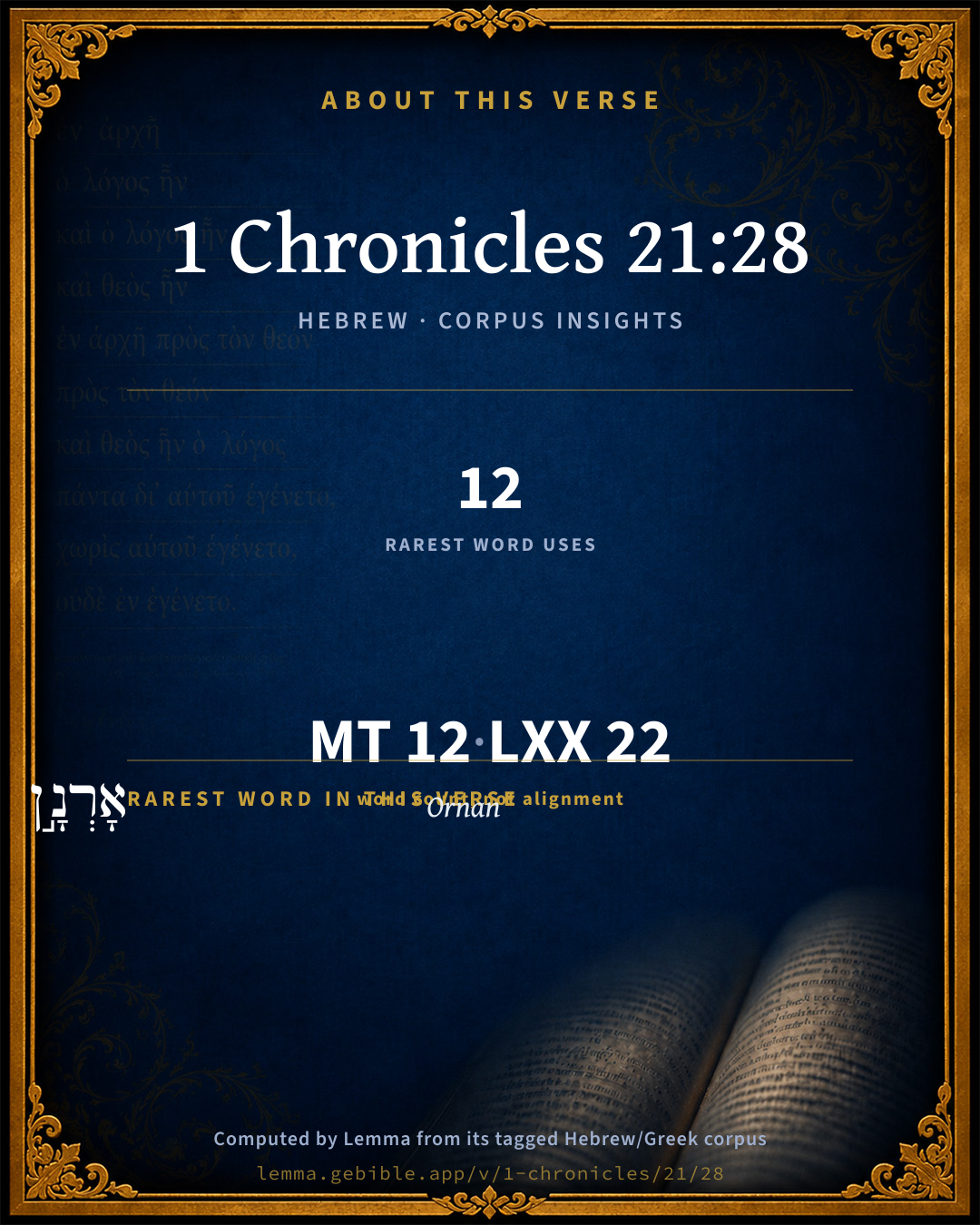
These counts appear in no published source. They are computed here, from the morphology-tagged text and Lemma’s own curated glosses. What Lemma adds →

12
words
12
distinct lemmas
Historical
section

Notable vocabulary

The rarest word here is אָרְנָ֣ן Ornan H771 — appearing just 12 times in the whole Hebrew Bible.

Shared distinctive vocabulary

אָרְנָ֣ן Ornan H771 occurs in 10 verses of the Hebrew Bible. Also found in:

Grammatical profile

  • 3 verbs
  • 6 nouns
  • 1 pronoun
  • 1 conjunction
  • 1 adverb

Verb forms

  • בִּרְא֤וֹת Qal · Infinitive Construct
  • עָנָ֣הוּ Qal · Perfect
  • וַיִּזְבַּ֖ח Qal · Sequential Imperfect

Hebrew & Septuagint length

In English translation the verse runs 23 words from the Hebrew and 23 from the Septuagint (LXX English) — the same length.

A rough comparison of the two English renderings, which tokenize alike — not a word-level alignment.

Word counts can differ between the Hebrew and the Greek without any difference in meaning — e.g. the Hebrew direct-object marker אֵת has no separate Greek word, and Greek often adds the article ὁ.

In the original languages it is 12 Hebrew tokens and 22 Greek tokens — but the two are counted differently (Hebrew bundles its prefixes and suffixes into one token; the Greek is in lemma form), so that isn’t a like-for-like length.

Hebrew and Greek witnesses Masoretic Hebrew ↔ Greek Septuagint

The same verse in the two great witnesses to the Old Testament, shown verse-for-verse.

These are two independent witnesses, not word-aligned to each other, and the Septuagint is shown in lemma (dictionary) form.

Hebrew 1 Chronicles 21:28 Masoretic · Westminster Leningrad Codex

בָּעֵ֣ת הַהִ֔יא בִּרְא֤וֹת דָּוִיד֙ כִּי עָנָ֣הוּ יְהוָ֔ה בְּגֹ֖רֶן אָרְנָ֣ן הַיְבוּסִ֑י וַיִּזְבַּ֖ח שָֽׁם

At that time, when David saw that Yahweh had answered him in the threshing floor of Ornan the Jebusite, then he sacrificed there.

World English Bible · Public Domain

Greek LXX 1 Chronicles 21:28 Septuagint · lemma form

ἐν ὁ καιρός ἐκεῖνος ἐν ὁ ὁράω ὁ δαυίδ ὅτι ἐπιἀκούω αὐτός κύριος ἐν ὁ ἅλων ορνα ὁ ιεβουσαῖος καί θυσιάζω ἐκεῖ

At that time when David saw that the Lord answered him in the threshing floor of Orna the Jebusite, he also sacrificed there.

LXX2012 (modern English Septuagint) · Public Domain

Hebrew: Westminster Leningrad Codex (CC BY 4.0). Greek: Septuagint (public domain); English from LXX2012 (modern English Septuagint) (Public Domain). How the Septuagint differs from the Hebrew →

Commentary

Notes on 1 Chronicles 21:28 from classic Christian and Jewish commentators (each source and its license shown beneath its notes). The classic Christian expositions comment on the surrounding passage and are grouped to its opening verse, so a note may address several verses; the Jewish commentaries on the Tanakh (Rashi and others) are per-verse, so they appear only where the commentator wrote on this verse.

Lemma curates 59 commentaries, every one of them public domain or Creative Commons licensed, each selected and text-cleaned for this edition rather than reprinted as found. About our sources →

The Cambridge Bible for Schools and Colleges

gen. ed. J. J. S. Perowne

Ch. 1Ch_21:28–Ch. 1Ch_22:1. The Selection of the Site of the Temple

28. At that time &c.] The construction of this section must be carefully noted. Ch. 1Ch_21:28 is a protasis to which ch. 1Ch_22:1 is the apodosis, 1Ch_21:29-30 of ch. 21 being a parenthesis. The division of chapters here is unfortunate.

At that time] The phrase is taken up by “Then” of 1Ch_22:1. The Chronicler wishes us to note that David regarded the success of his intercession at the floor of Ornan as an indication that this floor was God’s approved site for the Temple.

then he sacrificed there] Render, and [David had] sacrificed there, (the full stop is wrong, for the sense is continued in 1Ch_22:1).

The Cambridge Bible for Schools and Colleges (gen. ed. J. J. S. Perowne; Cambridge University Press, 1878–1918) — public domain. Text from a community e-Sword module.

Trapp's Complete Commentary

John Trapp

1Ch 21:28 At that time when David saw that the LORD had answered him in the threshingfloor of Ornan the Jebusite, then he sacrificed there.

Ver. 28. Then he sacrificed there.] There Abraham had sacrificed long before {Gen 22:2; Gen 22:9}

John Trapp, A Commentary or Exposition upon All the Books of the Old and New Testament (1647–1656) — public domain. Text from a community e-Sword module.

Joseph Benson's Commentary

1Ch 21:28. Then he sacrificed there — When he perceived that his sacrifice offered there was acceptable to God, he proceeded to offer more sacrifices in that place, and did not go to Gibeon, as otherwise he should have done.

Joseph Benson's Commentary on the Old and New Testaments (1811–1818) — public domain. Text from a community e-Sword module.

Jamieson, Fausset & Brown

Robert Jamieson, A. R. Fausset & David Brown

when David saw that the Lord had answered him . . ., he sacrificed there--or, "he continued to sacrifice there." Perceiving his sacrifice was acceptable, he proceeded to make additional offerings there, and seek favor by prayer and expiatory rites; for the dread of the menacing angel destroying Jerusalem while he was absent in the center of worship at Gibeon, especially reverence for the Divine Being, led him to continue his adorations in that place which God (Ch2 3:1) had hallowed by the tokens of His presence and gracious acceptance.

Next: 1 Chronicles Chapter 22

Jamieson, Fausset & Brown — Commentary Critical and Explanatory on the Whole Bible (1871) — public domain (CC PDM 1.0). Text via the HelloAO Bible API.

Ellicott's Commentary for English Readers

(28) At that time when David saw . . .—The use of Ornan’s threshingfloor as a place of sacrifice was continued from the time of the cessation of the pestilence. The words “then he sacrificed there” refer to this fact. The answer by fire from heaven (1Ch_21:26) was an unmistakable intimation of the Divine will that it should be so. (Comp. also Jos_5:15.)

A Bible Commentary for English Readers, edited by Charles John Ellicott (1878–1897) — public domain. Text from a community e-Sword module.

John Gill's Exposition

For the tabernacle of the Lord, which Moses made,.... Or ordered to be made by the command of God, and according to his direction:

and the altar of burnt offerings, were at that season in the high place at Gibeon; which was four or five miles from Jerusalem, and too far for David to go in that time of extremity; though he must have gone thither to sacrifice, had not the Lord bid him build an altar on the threshingfloor; for there was the altar of burnt offering, on which only, according to the law of Moses, sacrifices were to be offered: this high place is, in the Targum, called the sanctuary, it including, as Kimchi observes, the whole house, the tabernacle, and the altar in it; which had been here, and at Nob, fifty seven years, as the Jewish writers say (n).

(n) Maimon. & Bartenora in Misn. Zebachim, c. 14. sect. 7.

John Gill's Exposition of the Whole Bible (1746–1763) — public domain (CC PDM 1.0). Text via the HelloAO Bible API.

Matthew Poole's English Annotations

When he perceived that his sacrifice there offered was acceptable to God, he proceeded to offer more sacrifices in that place, and did not go to Gibeon, as otherwise he should have done.

Matthew Poole's English Annotations on the Holy Bible (1683–1685) — public domain. Text from a community e-Sword/MySword module.

The Pulpit Commentary

David saw that the Lord had answered him in the threshing-floor. David "saw "this by the fire on the altar, and by the fact that God, at the voice of the angel (ver. 18), had not misdirected him, but had guided him aright. He sacrificed there. This means to say that he thenceforward sacrificed there;" and established there the service of sacrifices. David was so impressed "at that time," by the answer given in fire from heaven, that he began systematically to sacrifice on the site of this threshing-floor, instead of going to the high place at Gibeon, where the altar of burnt offering still stood. To have attempted to go thither would not only have meant a long and wasteful delay, but would also have meant the neglecting of the august omen of the angel present. An awful sanction is thus given to" this place," Moriah, and it becomes" the house of the Lord God," and the place of lawful and established sacrifice.

Ver. 28-ch. Act_8:3, Act_8:4; Php_1:12)

II HOW SUITABLE WAS THE SITE FOR THE TEMPLE OF THE LORD.

1. Taken from a Canaanite, it suggested and predicted the ultimate triumph of the truth of God over all human error. The kingdom of God would rise and stand in every heathen land, as the temple of Jehovah rose and stood on Gentile soil.

2. It was suitable that a threshing-floor should become the base of atemple. Where God gives to us all nourishment for our necessities, there we, in glad response, may well give back to him all worship of the soul, all thanksgiving of heart and tongue, all offerings of the treasury.

III How GODLY ZEAL WILL FIND A REASON AND A SPHERE FOR ITS ACTIVITY. David"s desire to build the temple had been positively disallowed. Any man in his position who had not that work very much at heart would have abandoned all further concern on the subject, and left the matter to his successor. But David"s heart was so full of holy zeal for the "house of the Lord," that he caught with eagerness at the idea of making preparation for it, though he was not permitted to erect it. "This is the house of the Lord God," etc. (ver. 1), and forthwith he pressed into the service masons to hew stones (ver. 2), and prepared abundance of iron and brass, and of cedar (vers. 2-4). Thus his zeal discovered a sphere of activity; nor was he wanting in the discernment of a reason for action. He might have argued that while his advancing age would excuse inaction on his part, the youth of Solomon would ensure and demand the utmost activity. That is the light in which lukewarmness would have viewed it. Not so the king. He argued that, as Solomon his son was young and tender, and the house was to be magnificent, etc. (see ver. 5), he had better bring his experience to the work, that it might be as complete as possible. If we are really in earnest in the work of the Lord, we shall not see the reasons which might be found for our abstention or delay; we shall readily observe strong grounds for immediate and strenuous exertion. What is seen, in this as well as in other spheres, depends far more upon the eye than upon the object.

IV HOW MUCH ROOM THERE IS IN THE FIELD OF HOLY USEFULNESS FOR THE EXPERIENCE OF LATER YEARS. There is good reason why all the work of the Lord should not be left to those who are "young and feeder." By all means let maturity bring its solid strength; and let age, also, bring its varied experience, its gathered and garnered wisdom to the chamber of consultation and the field of labour. "Old age hath yet its honour and its toil," its witness to bear, its counsel to give, its work to finish. C.

Answer to prayer consecrating the place of prayer.

It is noted that David felt the threshing-floor to have become a sacred place, precisely because there he had gained the answer to his prayer. A similar feeling is illustrated in the case of the patriarchs. Abraham erected his altars where the signs of the Divine favour came to him; and Jacob raised his pillow-stone as a pillar, and consecrated his place of vision, Bethel, the house of God. We may recognize instances of the same kind in our own religious experiences. Certain places are, to our feeling, peculiarly sacred, and we know that they have gained their sacredness out of prayer-times, wrestling scenes, and gracious Divine responses. It appears that David had received answer to his prayer under two symbols.

(1) By the descending of heavenly fire for the consuming of his sacrifice, and

(2) by the sight of the angel reverently and obediently putting the great plague-sword back into its scabbard (vers. 26, 27). These outward signs did but assure the fact of God"s gracious answer, and should not be thought of as necessary to the answer, or we may find difficulty in realizing that nowadays God answers our prayers, and gives us of the answer an inward witness and not an outward sign.

I THE FREEDOM OF SPIRITUAL WORSHIP FROM ALL LIMITATIONS OF PLACE. Every place is holy ground. God"s temple-dome is the "arch of yon unmeasured sky;" God"s temple-area is the floor of the whole earth. This point may be illustrated from the large variety of places which the holy men of Scripture made prayer-places: e.g. the inside of an ark, a cave in a mountain, the belly of a fish, etc. Or from the striking language of the Prophet Isaiah: (Isa_66:1) "The heaven is my throne, and the earth is my footstool: where is the house that ye build unto me? and where is the place of my rest?" Or from the teachings of the Lord Jesus Christ, in Joh_4:21-23: "The hour cometh, when neither in thismountain, nor in Jerusalem, shall ye worship the Father The true worshippers shall worship the Father in spirit and in truth," This point being well established and efficiently illustrated, there may be shown

II THE HELPFULNESS THAT MAY LIE IN LOCAL ASSOCIATIONS OF WORSHIP. There is a right and reasonable attachment to particular churches, places, and ordinances. Buildings and rooms gain a sacredness by their devotement to prayer and religious uses. And this feeling is to be encouraged, though we need to be reminded how easily it may become mere sentiment and superstition. The house of God where our fathers worshipped should be sacred to us. The sanctuary where the truth of God"s saving love first came home to our hearts must seem sacred to us. And it should be easier to win reverence, worship, and power of prayer in such consecrated places.

III THIS APPLIES TO A MAN"S PERSONAL RELIGIOUS EXPERIENCES IN HIS PRIVATE RELIGIOUS LIFE. Illustrate from such instances as may be typified by an instance in the life of Luther. That spot in the forest where Alexis was struck down by the lightning, and he himself spared, must have been ever after a sacred spot to him. Or take a case of prayer under some particular pressure, as when a beloved one, in sickness, seemed to be passing away. The place where prayer was offered and answered seems never to lose the hallowing associations. Our lives, indeed, ought to be fall of consecrated spots, where we have raised, again and again, our pillars, inscribing thereon our Ebenezer, "Hitherto hath the Lord helped us.

Impress that if our religion is to be, in any real and vigorous sense, personal, we must have made our own sacred place. The sanctuaries set apart for worship are most precious and most helpful, and the true hearts in all the ages have said, "Lord, I have loved the habitation of thy house." But more is needed. Each man wants a temple of his own, raised in response to Divine goodness personally apprehended a sacred place where, with the fullest emotion, he may offer his sacrifice of love and praise, even as David did. R.T.

The Pulpit Commentary (1880–1919), ed. H.D.M. Spence-Jones & Joseph S. Exell — public domain. Text from a community e-Sword module.

John Wesley's Explanatory Notes

Sacrificed - When he perceived that his sacrifice was acceptable to God, he proceeded to offer more sacrifices in that place.

John Wesley, Explanatory Notes Upon the Whole Bible (1754–1765) — public domain. Text via the GEBible commentary corpus.

Keil & Delitzsch

C. F. Keil & F. Delitzsch

For the tabernacle of the Lord, which Moses made,.... Or ordered to be made by the command of God, and according to his direction:

and the altar of burnt offerings, were at that season in the high place at Gibeon; which was four or five miles from Jerusalem, and too far for David to go in that time of extremity; though he must have gone thither to sacrifice, had not the Lord bid him build an altar on the threshingfloor; for there was the altar of burnt offering, on which only, according to the law of Moses, sacrifices were to be offered: this high place is, in the Targum, called the sanctuary, it including, as Kimchi observes, the whole house, the tabernacle, and the altar in it; which had been here, and at Nob, fifty seven years, as the Jewish writers say (n).

(n) Maimon. & Bartenora in Misn. Zebachim, c. 14. sect. 7.

Keil & Delitzsch — Biblical Commentary on the Old Testament (1861–1891) — public domain (CC PDM 1.0). Text via the HelloAO Bible API. (Old Testament only.)

unfoldingWord translationNotes

Door43 World Missions Community

Ornan

Translate his name as in 1 Chronicles 21:15.

Now at that time ... the angel of Yahweh

Verses 29-30 are background information to explain why David offered this sacrifice at the threshing floor instead of on the altar at the tabernacle. (See: Background Information)

to ask for God's direction

"to ask God to tell him what he should do"

afraid of the sword of the angel of Yahweh

Here "sword" represents being killed by the angel of Yahweh. AT: "afraid he would be killed by the angel of Yahweh" (See: Metonymy)

translationWords

thresh

Jebus

sacrifice

tabernacle

Moses

desert

altar

burnt offering

high place

Gibeon

God

fear

sword

unfoldingWord translationNotes — © Distant Shores Media and the Door43 World Missions Community, licensed CC BY-SA 4.0. Source: git.door43.org/Door43/en_tn.

Rashi

Rabbi Shlomo Yitzchaki (Rashi)

At that time, when David saw that the Lord had answered him This section was not written in II Samuel, but because of David’s honor, it was written here that he made an altar, and all the verses of this section are connected to one another, as if they were all one verse.

Rashi on the Tanakh — English translations: “The Judaica Press complete Tanach with Rashi, translated by A. J. Rosenberg” (CC BY 4.0); “Pentateuch with Rashi's commentary by M. Rosenbaum and A.M. Silbermann, 1929-1934” (public domain); “The Metsudah Tanach series, Lakewood, N.J” (CC BY 4.0); and “The Book of Joshua, Metsudah Publications, 1997” (CC BY 4.0). Text via Sefaria.

Lesson kit

Teaching starters — assembled from the data on this page, not authored interpretation. Every prompt links to the verse data it draws on. Edit before teaching.

1 Chronicles, in the Historical, opens this verse with 12 words (12 distinct Hebrew lemmas). Its most distinctive word is ʼOrnân (“Ornan”). A historical commentator’s framing appears above. Read the whole chapter for the surrounding context.

Discussion questions

  1. What does “Ornan” (ʼOrnân) contribute to the verse as a whole?
  2. 1 Chronicles 21:15 shares the word «Ornan» with this verse. How do the two illuminate each other?
  3. These translations render this verse differently. What is at stake in choosing one wording over another?
  4. The verb «בִּרְא֤וֹת» is Qal Infinitive Construct. How does its form color the action?
  5. Reading how The Cambridge Bible for Schools and Colleges and Trapp's Complete Commentary read this verse, where do the two commentators agree and where do they part?

Things to notice

Reading settings

Reading text

Shown beneath each verse's original-language words.

Old Testament
Old Testament edition

Read the OT as the Masoretic Hebrew (MT) or the Greek Septuagint (LXX).

English shown for the Greek Septuagint (in the Hebrew ↔ Greek comparison).

Comparing translations? Open the Compare panel on any verse page to stack up to four side by side.