1 Chronicles 22:1

Hebrew (Westminster Leningrad Codex) 1 Chronicles 22:1 appears in the Hebrew Old Testament. The text above is from the Westminster Leningrad Codex. Each word links to its Strong’s number, a concise gloss, and parsing drawn from the Open Scriptures Hebrew Bible morphology. Click any word for its full Brown-Driver-Briggs (BDB) entry.
Download image
Cite this verse

1 Chronicles 22:1 (World English Bible). Public Domain. Lemma interlinear Bible study tool, https://lemma.gebible.app/v/1-chronicles/22/1.

Show BibTeX & RIS
BibTeX
RIS
English Translation
Then David said, This is the house of Yahweh God, and this is the altar of burnt-offering for Israel.
World English Bible · Public Domain
Download a study sheet

One document with this verse’s original text, its word-by-word gloss line, the meaning frame, cross-references with their text, attributed commentary, and full source and license credits — printable, and it pastes into notes with its structure intact.

This verse Autodidact and up

Study sheet (.html) Plain text (.txt)

A passage Seminary Student

Up to 50 verses in one chapter. A passage sheet keeps up to 6 commentary sources and 12 cross-references per verse, in the order this page ranks them, and says so on the sheet whenever that leaves anything out. Ask for a single verse and you get the Autodidact verse sheet above.

Everything on this page stays free to read, with no account — the sheet is a download of what is already on screen, not access to it.

Want to remove ads? Support Godless Engineer
Compare translations 3

The same verse in 3 English versions, stacked beneath the original-language interlinear above. Click any original word for its lexicon entry.

Each is an independent rendering of the whole verse — the interlinear is not word-aligned to these translations.

Highlighted words mark where these versions differ — a whole-verse word diff, not a word-by-word alignment.

  • World English Bible Public Domain
    Then David said, This is the house of Yahweh God, and this is the altar of burnt-offering for Israel.
  • King James Version Public Domain
    Then David said, This is the house of the LORD God, and this is the altar of the burnt offering for Israel.
  • unfoldingWord Literal Text CC BY-SA 4.0
    And David said, “This, it the house of Yahweh God, and this the altar for burnt offering for Israel.”

unfoldingWord Literal Text — © unfoldingWord, licensed CC BY-SA 4.0. Word-aligned USFM3 via Door43 (git.door43.org/unfoldingWord/en_ult).

Versions to compare (up to 4)

3 of 4 selected

Show all 18 translations

Every available English version of this verse, each an independent rendering of the whole verse.

  • World English Bible Public Domain
    Then David said, This is the house of Yahweh God, and this is the altar of burnt-offering for Israel.
  • Berean Standard Bible Public Domain
    Then David said, “Here shall be the house of the LORD God, as well as the altar of burnt offering for Israel.”
  • Majority Standard Bible Public Domain
    Then David said, “Here shall be the house of the LORD God, as well as the altar of burnt offering for Israel.”
  • King James Version Public Domain
    Then David said, This is the house of the LORD God, and this is the altar of the burnt offering for Israel.
  • American Standard Version (1901) Public Domain
    Then David said, This is the house of Jehovah God, and this is the altar of burnt-offering for Israel.
  • Revised Version (1885) Public Domain
    Then David said, This is the house of the LORD God, and this is the altar of burnt offering for Israel.
  • Geneva Bible (1599) Public Domain
    And Dauid saide, This is the house of the Lord God, and this is the altar for the burnt offring of Israel.
  • Douay-Rheims (1899) Public Domain
    Then David said: This is the house of God, and this is the altar for the holocaust of Israel.
  • Young's Literal Translation Public Domain
    And David saith, `This is the house of Jehovah God, and this the altar for burnt-offering for Israel.'
  • Literal Standard Version CC BY-SA 4.0
    And David says, “This is the house of YHWH God, and this [is] the altar for burnt-offering for Israel.”
  • Unlocked Literal Bible CC BY-SA 4.0
    Then David said, “This is where the house of Yahweh God will be, with the altar for the burnt offerings of Israel.”
  • unfoldingWord Literal Text CC BY-SA 4.0
    And David said, “This, it the house of Yahweh God, and this the altar for burnt offering for Israel.”
  • Darby Bible Public Domain
    And David said, This is the house of Jehovah Elohim, and this is the altar of burnt-offering for Israel.
  • World Messianic Bible Public Domain
    Then David said, “This is the house of the LORD God, and this is the altar of burnt offering for Israel.”
  • Webster's Bible Public Domain
    Then David said, This is the house of the LORD God, and this is the altar of the burnt-offering for Israel.
  • Free Bible Version CC BY-SA 4.0
    Then David said, “This is where the house of the Lord God will be, and this is the place for the altar of burnt offering for Israel.”
  • Bible in Basic English Public Domain
    Then David said, This is the house of the Lord God, and this is the altar for Israel's burned offerings.
  • JPS Tanakh (1917) Public Domain
    Then David said: 'This is the house of the LORD God, and this is the altar of burnt-offering for Israel.'

Literal Standard Version (2020), Covenant Press — licensed CC BY-SA 4.0. Text via the HelloAO Bible API (eBible.org). Unlocked Literal Bible (unfoldingWord) — licensed CC BY-SA 4.0. Text via the HelloAO Bible API (eBible.org). unfoldingWord Literal Text — © unfoldingWord, licensed CC BY-SA 4.0. Word-aligned USFM3 via Door43 (git.door43.org/unfoldingWord/en_ult). Free Bible Version, Dr. Jonathan Gallagher — licensed CC BY-SA 4.0. Text via the HelloAO Bible API (eBible.org).

Word by word

More ways to search: Search by grammar → Find every occurrence → Compare this word →

Practice this passage: Drill this verse → Learn its vocabulary →

לְעֹלָ֖ה
ʻôlâh
H5930
“to/for · burnt offering”
Preposition + Noun, Common, Feminine, Singular, Absolute
Part of Speech
Preposition + Noun
Type
Common
Gender
Feminine
Number
Singular
State
Absolute
Full BDB Definition

Origin: f act part of H5927

TWOT: 1624c , 1624d

whole burnt offering - ascent, stairway, steps
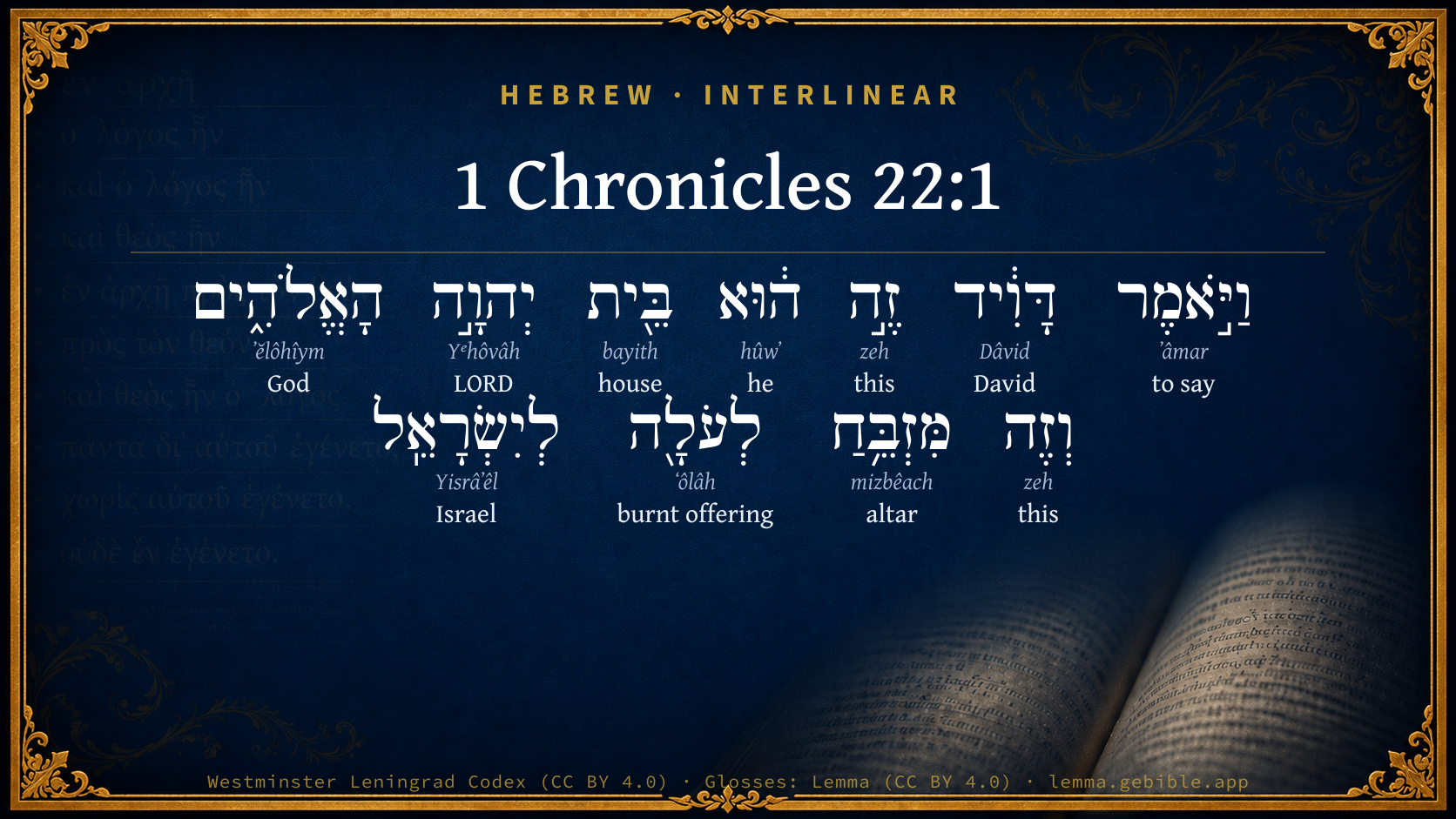
  1. וַיֹּ֣אמֶר ʼâmar H559 “and · to say” Conjunction + Verb, Qal, Sequential Imperfect, 3rd Person, Masculine, Singular
  2. דָּוִ֔יד Dâvid H1732 “David” Noun, Proper
  3. זֶ֣ה zeh H2088 “this” Pronoun, Demonstrative, Masculine, Singular
  4. ה֔וּא hûwʼ H1931 “he” Pronoun, Personal, 3rd Person, Masculine, Singular
  5. בֵּ֖ית bayith H1004 “house of” Noun, Common, Masculine, Singular, Construct
  6. יְהוָ֣ה Yᵉhôvâh H3068 “LORD” Noun, Proper
  7. הָאֱלֹהִ֑ים ʼĕlôhîym H430 “the · God(s)” Particle, Definite Article + Noun, Common, Masculine, Plural, Absolute
  8. וְזֶה zeh H2088 “and · this” Conjunction + Pronoun, Demonstrative, Masculine, Singular
  9. מִּזְבֵּ֥חַ mizbêach H4196 “altar” Noun, Common, Masculine, Singular, Absolute
  10. לְיִשְׂרָאֵֽל Yisrâʼêl H3478 “to/for · Israel” Preposition + Noun, Proper

About this verse

These counts appear in no published source. They are computed here, from the morphology-tagged text and Lemma’s own curated glosses. What Lemma adds →

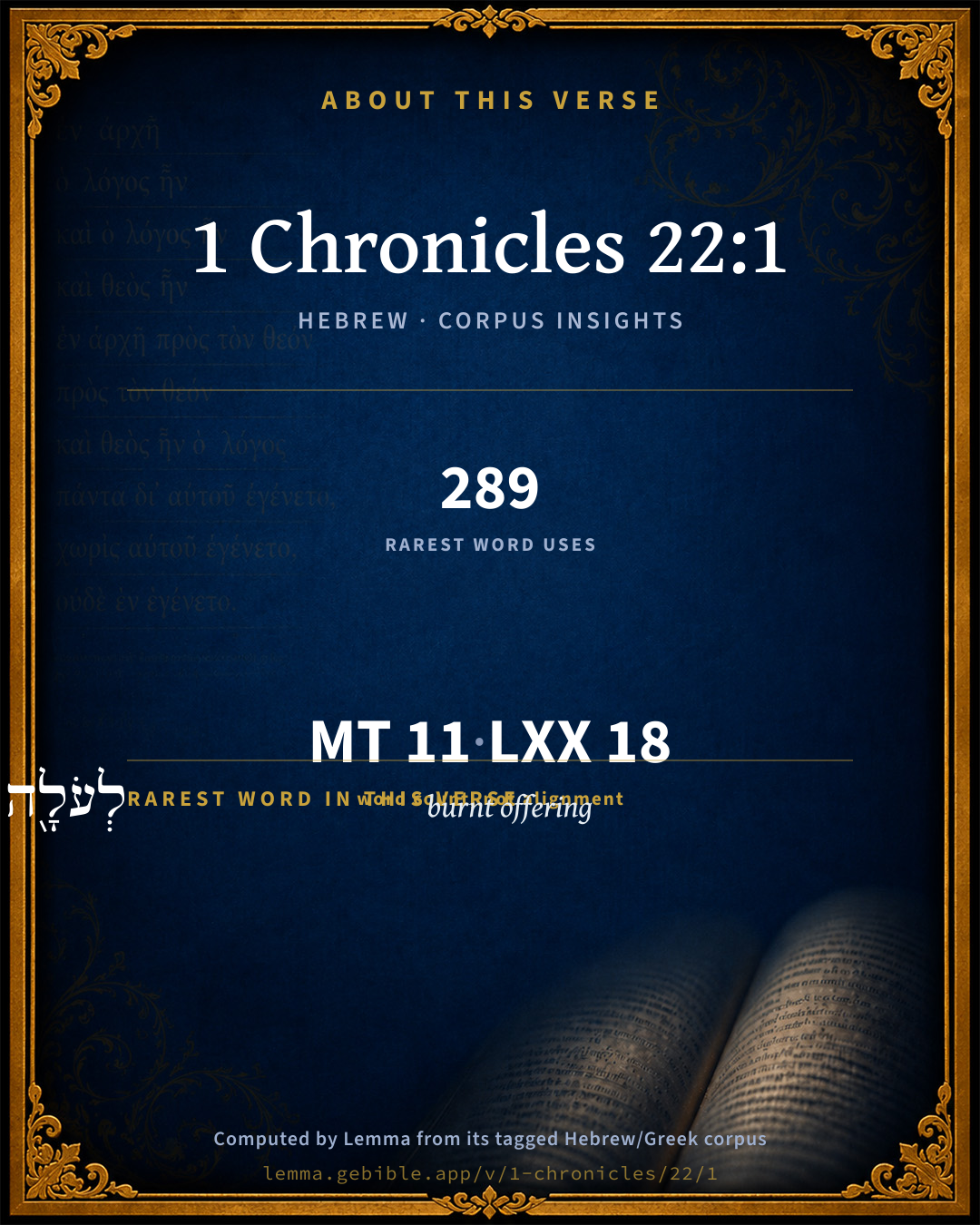
11
words
10
distinct lemmas
Historical
section

Grammatical profile

  • 1 verb
  • 7 nouns
  • 3 pronouns

Verb forms

  • וַיֹּ֣אמֶר Qal · Sequential Imperfect

Repetition

A word recurs within this verse — often emphatic in Hebrew:

  • זֶ֣ה this H2088 ×2

Hebrew & Septuagint length

In English translation the verse runs 19 words from the Hebrew and 22 from the Septuagint (LXX English) — closely comparable.

A rough comparison of the two English renderings, which tokenize alike — not a word-level alignment.

Word counts can differ between the Hebrew and the Greek without any difference in meaning — e.g. the Hebrew direct-object marker אֵת has no separate Greek word, and Greek often adds the article ὁ.

In the original languages it is 11 Hebrew tokens and 18 Greek tokens — but the two are counted differently (Hebrew bundles its prefixes and suffixes into one token; the Greek is in lemma form), so that isn’t a like-for-like length.

Cross-references

13

Topical passages linked to 1 Chronicles 22:1 in the Treasury of Scripture Knowledge — connected by theme and wording, ordered by reader-vote popularity; previews shown in the World English Bible.

  • 2 Chronicles 3:1 Then Solomon began to build the house of Yahweh at Jerusalem on Mount Moriah, where [Yahweh] appeared to David his father, which he made ready in the place that David had appointed, in the threshing floor of Ornan the Jebusite.
  • 1 Chronicles 21:18–28 Then the angel of Yahweh commanded Gad to tell David, that David should go up, and raise an altar to Yahweh in the threshing floor of Ornan the Jebusite.
  • Genesis 28:17 He was afraid, and said, "How dreadful is this place! This is none other than God's house, and this is the gate of heaven."
  • 2 Samuel 24:18 Gad came that day to David, and said to him, Go up, rear an altar to Yahweh in the threshing floor of Araunah the Jebusite.
  • 2 Kings 18:22 But if you tell me, We trust in Yahweh our God; isn't that he whose high places and whose altars Hezekiah has taken away, and has said to Judah and to Jerusalem, You shall worship before this altar in Jerusalem?
  • 2 Chronicles 6:5–6 Since the day that I brought forth my people out of the land of Egypt, I chose no city out of all the tribes of Israel to build a house in, that my name might be there; neither chose I any man to be prince over my people Israel:
  • Deuteronomy 12:5–7 But to the place which Yahweh your God shall choose out of all your tribes, to put his name there, even to his habitation shall you seek, and there you shall come;
  • Deuteronomy 12:11 then it shall happen that to the place which Yahweh your God shall choose, to cause his name to dwell there, there shall you bring all that I command you: your burnt offerings, and your sacrifices, your tithes, and the heave-offering of your hand, and all your choice vows which you vow to Yahweh.
  • 2 Chronicles 32:12 Has not the same Hezekiah taken away his high places and his altars, and commanded Judah and Jerusalem, saying, You shall worship before one altar, and on it shall you burn incense?
  • Psalms 78:60 So that he forsook the tent of Shiloh, The tent which he placed among men;
  • Psalms 78:67–69 Moreover he rejected the tent of Joseph, And didn't choose the tribe of Ephraim,
  • Psalms 132:13–14 For Yahweh has chosen Zion. He has desired it for his habitation.
  • John 4:20–22 Our fathers worshiped in this mountain, and you Jews say that in Jerusalem is the place where people ought to worship."

Cross-references courtesy of OpenBible.info (CC BY 4.0).

Hebrew and Greek witnesses Masoretic Hebrew ↔ Greek Septuagint

The same verse in the two great witnesses to the Old Testament, shown verse-for-verse.

These are two independent witnesses, not word-aligned to each other, and the Septuagint is shown in lemma (dictionary) form.

Hebrew 1 Chronicles 22:1 Masoretic · Westminster Leningrad Codex

וַיֹּ֣אמֶר דָּוִ֔יד זֶ֣ה ה֔וּא בֵּ֖ית יְהוָ֣ה הָאֱלֹהִ֑ים וְזֶה מִּזְבֵּ֥חַ לְעֹלָ֖ה לְיִשְׂרָאֵֽל

Then David said, This is the house of Yahweh God, and this is the altar of burnt-offering for Israel.

World English Bible · Public Domain

Greek LXX 1 Chronicles 22:1 Septuagint · lemma form

καί εἶπον δαυίδ οὗτος εἰμί ὁ οἶκος κύριος ὁ θεός καί οὗτος ὁ θυσιαστήριον εἰς ὁλοκαύτωσις ὁ ἰσραήλ

And David said, This is the house of the Lord God, and this is the altar for whole burnt offering for Israel.

LXX2012 (modern English Septuagint) · Public Domain

Hebrew: Westminster Leningrad Codex (CC BY 4.0). Greek: Septuagint (public domain); English from LXX2012 (modern English Septuagint) (Public Domain). How the Septuagint differs from the Hebrew →

Commentary

Notes on 1 Chronicles 22:1 from classic Christian and Jewish commentators (each source and its license shown beneath its notes). The classic Christian expositions comment on the surrounding passage and are grouped to its opening verse, so a note may address several verses; the Jewish commentaries on the Tanakh (Rashi and others) are per-verse, so they appear only where the commentator wrote on this verse.

Lemma curates 59 commentaries, every one of them public domain or Creative Commons licensed, each selected and text-cleaned for this edition rather than reprinted as found. About our sources →

Matthew Henry's Commentary

Here is, I. The place fixed for the building of the temple (Ch1 22:1): Then David said, by inspiration of God, and as a declaration of his mind, This is the house of the Lord God. If a temple must be built for God, it is fit that it be left to him to choose the ground, for all the earth is his; and this is the ground he makes choice of - ground that pertained to a Jebusite, and perhaps there was not a spot of ground besides, in or about Jerusalem, that did so - a happy presage of the setting up of the gospel temple among the Gentiles. See Act 15:16, Act 15:17. The ground was a threshing-floor; for the church of the living God is his floor, his threshing, and the corn of his floor, Isa 21:10. Christ's fan is in his hand, thoroughly to purge his floor. This is to be the house because this is the altar. The temple was built for the sake of the altar. There were altars long before there were temples.

II. Preparation made for that building. David must not build it, but he would do all he could towards it: He prepared abundantly before his death, Ch1 22:5. This intimates that the consideration of his age and growing infirmities, which showed him his death approaching, quickened him, towards his latter end, to be very diligent in making this preparation. What our hands find to do for God, and our souls, and our generation, let us do it with all our might before our death, because, after death, there is no device nor working. Now we are here told,

1. What induced him to make such preparation. Two things he considered: - (1.) That Solomon was young and tender, and not likely to apply with any great vigour to this business at first; so that, unless he found the wheels set a-going, he would be in danger of losing a great deal of time at first, the rather because, being young, he would be tempted to put it off; whereas, if he found the materials got ready to his hand, the most difficult part of the work would be over, and this would excite and encourage him to go about it in the beginnings of his reign. Note, Those that are aged and experienced should consider those that are young and tender, and provide them what help they can, that they may make the work of God as easy to them as possible. (2.) That the house must be exceedingly magnificent, very stately and sumptuous, strong and beautiful, every thing about it the best in its kind, and for a good reason, since it was intended for the honour of the great God, the Lord of the whole earth, and was to be a type of Christ, in whom all fulness dwells and in whom are hid all treasures. Men were then to be taught by sensible methods. The grandeur of the house would help to affect the worshippers with a holy awe and reverence of God, and would invite strangers to come to see it, and the wonder of the world, who thereby would be brought acquainted with the true God. Therefore it is here designed to be of fame and glory throughout all countries. David foretold this good effect of its being magnificent, Psa 68:29 Because of thy temple at Jerusalem shall kings bring presents unto thee.

2. What preparation he made. In general, he prepared abundantly, as we shall find afterwards; cedar and stones, iron and brass, are here specified, Ch1 22:2-4. Cedar he had from the Tyrians and the Zidonians. The daughter of Tyre shall be there with a gift, Psa 45:12. He also got workmen together, the strangers that were in the land of Israel. Some think that he employed them because they were generally better artists, and more ingenious in manual operations, than the Israelites; or, rather, because he would not employ the free-born Israelites in any thing that looked mean and servile. They were delivered from the bondage of making bricks in Egypt, and must not return to hew stone. These strangers were proselytes to the Jewish religion, but, though not enslaved, they were not of equal dignity with Israelites.

Matthew Henry's Commentary on the Whole Bible (1708–1710) — public domain (CC PDM 1.0). Text via the HelloAO Bible API.

Trapp's Complete Commentary

John Trapp

1Ch 22:1 Then David said, This [is] the house of the LORD God, and this [is] the altar of the burnt offering for Israel.

Ver. 1. This is the house.] This is that very place foretold by Moses. {Deu 12:11}

John Trapp, A Commentary or Exposition upon All the Books of the Old and New Testament (1647–1656) — public domain. Text from a community e-Sword module.

Joseph Benson's Commentary

1Ch 22:1. Then David said — Through the instinct and direction of God’s Spirit, by which as he is said to have had the pattern of the house, porch, altar, &c., (1Ch 28:11-19,) so doubtless he was instructed as to the place where the house should be built. This is the house, &c. — This is the place appointed by God for the building of his temple and altar.

Joseph Benson's Commentary on the Old and New Testaments (1811–1818) — public domain. Text from a community e-Sword module.

The Preacher's Complete Homiletical Commentary

Joseph S. Exell (gen. ed.)

CRITICAL NOTES.] The remaining chapters of this book are peculiar to the chronist. They narrate the arrangements of David for the building of the temple, his religious and political regulations, and his last will and death [Murphy]. This chapter, which consists entirely of new matter, helps to fill up the gap which had been left by the earlier authors between 2 Samuel 24 and 1 Kings 1 [Speak. Com.].

1Ch_22:1-5.—Preparations for the Temple. This, the spot on which the altar was built, he regards as the site of the temple. 1Ch_22:2. Strangers, non-Israelites, descendants of old Canaanites, war captives from whom exacted a tribute of bond-service (2Ch_8:7-10), and war captives (2Ch_2:7) reserved for the great work contemplated [Jamieson]. Masons, stone-cutters. 1Ch_22:3. Joinings, braces or brackets for binding wood or stone. 1Ch_22:4. Zidon, abounded in timber merchants and navigators (cf. 1Ki_5:1; 1Ki_5:15-18; 2Ch_2:16). 1Ch_22:5. Tender, exact age unknown. “It cannot have been more than 24 or 25. It may have been as little as 14 or 15” [Speak. Com.].

1Ch_22:6-16.—Charge to Solomon. 1Ch_22:6. Called, a short time before his death to give him special instructions. 1Ch_22:7. Mind, heart (2Sa_7:1-17). 1Ch_22:8. Blood. This referred to in ch. 1Ch_28:3 and 1Ki_5:17, though not in same terms. Nathan’s message (ch. 1Ch_17:4-14) assigned no ground for prohibition. In form of command here and the first intimation of reason why David must not build. On character of David’s wars, cf. 2Sa_8:2; 2Sa_10:18; 2Sa_12:31; 1Ki_11:16. Sol., “had two names—viz., Solomon, ‘peaceful,’ and Jedidiah, ‘beloved of Jehovah’ (2Sa_12:25). The former name prevailed on account of this prophecy, which attached to the name the promise of a blessing” [Speak. Com.]. Give peace (1Ki_4:20-23; 1Ki_5:4). 1Ch_22:10. Son in peculiar and special manner. 1Ch_22:11. Prosper, literally “The Lord shall be with thee, and thou shalt prosper. But future may have an imperative sense” [Speak. Com.]. 1Ch_22:12. Wisdom (cf. Psa_72:1; Sol.’s prayer, 1Ki_3:5-15). 1Ch_22:13. Strong, words which are found in Deu_4:1; Deu_5:1; Deu_7:4; Deu_11:32; Deu_31:6; Jos_1:7. 1Ch_22:14. Trouble, poverty. “By my strenuous labour, according to Gen_31:42; see the precisely similar expression (ch. 1Ch_29:2), I have prepared with all my might” [Keil]. Talents, taking usual idea of talent, this would be more than eighty millions sterling. Either the talent of smaller value or text corrupted. “The latter is certainly the more probable supposition” [Speak Com.]. 1Ch_22:15. Cunning, i.e., skilful, serfs of ancient kingdoms very numerous (cf. 2Ch_2:17).

1Ch_22:17-19.—Charge to Princes. Members of court, including other sons of David. 1Ch_22:18. Reasons for liberality in giving. 1Ch_22:19. Set, make this your purpose and effort; holy vessels used in tabernacle service.

HOMILETICS

THE BUILDING OF THE TEMPLE.—1Ch_22:1-5

This chapter and the seven which follow are supplementary to the Second Book of Samuel, and fill up the space between the end of that Book and the beginning of the First Book of Kings. Preparations for building going on for twenty-five or thirty years. In times of war and domestic affliction, David accumulated treasure and materials to be handed over to his successor.

I. The work for which he prepared. “This is house of the Lord God.” Its building “exceeding magnifical.”

1. In the costliness of its materials. Iron and brass, timber and stone, gold and silver. In the spiritual temple the materials are human beings, intellectual and immortal spirits. The preparation and forming of these materials into a temple for God includes the calling, regeneration, and consecration of men in Christ, “in whom all the building, fitly framed (exactly fitted) together, groweth into a holy temple in the Lord” (Eph_2:20).

2. In the grandeur of its Design. Not for earthly and inferior objects.

(1) For the honour of the great God, Lord of heaven and earth. “Build an house for the Lord God.”

(2) For the benefit of men. “Of fame and of glory throughout all countries.” Reminding men of God’s existence and claims; the centre of light and purity, bringing heaven down to earth, and securing the triumphs and praise of redeeming grace.

II. The incentives to the performance of this work. There are many.

1. Consider the greatness of the work. More than the erection of a palace, the building of a city, the founding of an empire. A work agreeing with youth and age; affords scope for ambition, enthusiasm, and skill.

2. Divine instructions are given to its performance. God revealed the site, the plan, the ornaments, and all the arrangements for service. When way is known, walk in it. Knowledge given to practice.

3. Good example inspires. “Precepts teach, but examples draw.” Man a creature of imitation by education and habit. A noble example interests, rouses attention, and stimulates to action. Illustrates the possibility and the manner of doing what is enjoined. David set a noble example.

4. The circumstances of others should influence us. “Solomon is young and tender.” Others may not be situated, prepared, blessed as we are, may be weak, aged, and helpless. Consider the wants of the Church—men, money, and materials; the wants of the rising generation—good examples, education, and sympathy; the wants of the world—temples, Bibles, and missionaries. Care for the future, and if you cannot build, gather materials.

PREPARATION FOR THE WORK OF GOD.—1Ch_22:1-5

This needful, urgent, and within the reach of all. I. By personal effort. David earnest, patient, and persevering; getting ready in prosperity and adversity. Warned by shortness of time, infirmity, and approaching end, “prepared abundantly before his death.” II. By initiation of the work. Gather materials, begin or enter some work for God. Forethought is the best security against waste, idleness, and failure. An unfurnished minister, scholar, or church member cannot be “a wise master-builder.” “Prepare thy work without, and make it fit for thyself in the field, and afterwards build thine house.” III. By employment of willing helpers. “Strangers” gathered together and enlisted in the service. Aliens (the non-Israelite population) hewed wood, carried burdens, &c. Often questioned whether help for building sanctuaries, supporting and maintaining religious institutions and worship, should be received from ungodly. But God urges every one to surrender to him. All our possessions are God’s, and should be consecrated to him. Some are willing, others may be induced. Only cherish a liberal, kindly feeling, and they “shall be his servants, that they may know his service, and the service of the kingdoms of the countries.”

“All the means of action—

The shapeless masses, the materials,

Lie everywhere about us. What we need

Is the celestial fire to change the flint

Into transparent crystal, bright and clear” [Longfellow].

DAVID’S CHARGE TO SOLOMON.—1Ch_22:6-16

Something more than dead materials required. Gold and silver nothing without willing hearts and active hands. David would gladly have done the work, but forbidden. Gives a touching and direct charge to incite Solomon to build. Learn—

I. That some originate a good work, but are not permitted to execute it. David himself gives a special reason (1Ch_22:8). Hands stained with blood not fit to build a house of worship, the abode of love and peace. What a lesson! Sin may be forgiven, but a stain left behind. Present acts may influence future character, hinder holy work, decide the lot that should fall to us, or be lost by us. Cruelty and inconsistency will ever deprive of noble work and honour.

II. That others may be called to execute work which they never originated. David prepared, and Solomon used the materials. “One soweth and another reapeth,” and thus the work is carried on under a divine plan. A work for us, and a sphere appointed to do it. What matter middle, beginning, or end? No Christian effort, no man’s life isolated. In our surroundings and duties our life’s purpose is unfolded.

1. They are specially designated for the work. “He shall build an house.” Cyrus called by name to do God’s pleasure, and set captives free (Isa_44:28; Isa_45:1).

2. Opportunities are given them to work. Solomon had rest from enemies, and Israel enjoyed “peace and quietness” in his days. Where God gives opportunity, leisure, and talent he expects work. If not done in time and place, may be left undone, or given to another. “Who knoweth whether thou art come to the kingdom for such a time as this?”

III. That, when called, they should finish the work given them to do. “Arise, therefore, and be doing” (1Ch_22:16).

1. The work is urgent. “Arise, &c.” We are apt to fall into apathy, formalism, and forgetfulness—to be absorbed by earthly cares, or overcome by temptation. Awake to holy zeal, intense concern for the Redeemer’s work.

2. God has promised help. Need of men and money, sanctified intellects and eloquent tongues, broad shoulders and active hands; but with all, and more than all, the Lord’s presence. Do we rely upon this? Are we earnestly desiring and praying for this? “The Lord be with thee, and prosper thee, &c.” (1Ch_22:11).

HOMILETIC HINTS AND SUGGESTIONS

1Ch_22:2. Gather the strangers. A notable type of the calling of the Gentiles; and the like we may say of the temples being built on the ground of a Jebusite, and by the help of Tyrians and Zidonians, and adorned with the spoils of divers nations (chap. 18) [Trapp].

1Ch_22:3. Prepared. Many parents prepare guilt in abundance, hoards and heaps of evil-gotten goods—and there-withal God’s curse—to spend on their lusts, &c. As for pious and charitable uses, they cry out with Judas, Whereto is this waste? [Ibid.].

1Ch_22:5. Magnifical. The second temple was nothing like it, though the glory of it was greater (Haggai 2), by the presence and preaching of Jesus Christ in it [Ibid.].

1Ch_22:9. A son predicted. I. Son of David; so was Christ. II. A man of rest; so was Christ. III. The giver of peace; so was Christ. IV. He had a significant name; so has Jesus Christ. V. He was a glorious king; so is Christ. VI. His great work was the building of the temple; so is the work of Christ [Bib. Museum].

1Ch_22:11-13. A father’s prayer for his son. I. For the possession of moral qualities.

1. “Wisdom and understanding.” Parents should be anxious for the education and religious welfare of children. Inheritance, wealth, and position nothing without this. Wisdom needed to turn all to good account. “Wisdom is the principal thing; therefore get wisdom; and with all thy getting get understanding.”

2. Strength and moral courage. “Be strong and of good courage.” 1Ch_22:13. Enemies and dangers cause “dread.” In possession of sound wisdom and in vital alliance with God we are perfectly safe. Men without understanding and courage, out of place, weak and useless.

“Let not the world see fear and sad mistrust

Govern the motion of a kingly eye” [Shakespeare].

II. For the presence of God. “The Lord be with thee.” A petition often repeated, too little understood; needful and appropriate to all times, undertakings, and places; the wish of every good father, and the prayer of every true Christian for an earnest worker. “Be strong and of good courage; be not afraid, neither be thou dismayed, for the Lord thy God is with thee whithersoever thou goest.” III. For successful undertaking. “Prosper thou and build.” All parents wish success to children in every pursuit, possession of influence and authority, “charge over Israel.” This often selfish, without reverent regard for the Lord’s will. Be anxious for moral integrity and loyal obedience of youth. No prosperity without obedience to “the law of the Lord” and regard for his will. “Then shalt thou prosper, if thou takest heed to fulfil the statutes, &c.”

“ ’Tis not in mortals to command success,

But we’ll do more, Sempronius; we’ll deserve it.”

HOMILETICS

CONDITIONS OF SUCCESSFUL EFFORT.—1Ch_22:11-13

Time procured by our labours or help of others most profitably spent in God’s service, utilising the preparations, improving the advantages, and carrying on the work of predecessors. But success only on certain conditions.

I. Personal fitness. There must be ability, power, capacity, physical, intellectual, and moral.

1. Wisdom to direct. “Wisdom and understanding.” Not worldly policy, human education, “earthly wisdom;” but “wisdom from above” (Jas_3:15-17), that “wisdom profitable to direct” (Ecc_10:10).

2. Strength to work. Weakness, distrust, and hesitancy certain to fail. “Fortune favours the brave.” “Woe unto him that is faint-hearted,” says the son of Sirach. There must be no unfitness in act, heart, or capacity.

II. God’s presence to help in its prosecution. The word only (1Ch_22:12) most suggestive, indicates entire failure without this. Skilful workmen, wise diplomatists, useful materials for work, may be needful, but divine help can never be dispensed with. The wisdom, the royal influence, and the powerful rule of Solomon not sufficient. “The Lord was with Joseph, and he was a prosperous man.”

III. Loyal obedience to God. “Keep the law of the Lord.” Success in departments of nature gained by submission to matter and co-operation with its laws. Our strength lies in “keeping the law.” The throne of kings, the business of merchants, the prosperity of churches, established by obedience. “Observe to do according to all that is written therein; for then thou shalt make thy way prosperous, and then thou shalt have good success.”

THE EARNEST APPEAL.—1Ch_22:17-19

Princes urged to help, to consecrate themselves first, for this the foundation of zeal; then reasons given for liberality in the work. This earnest appeal suggests—

I. That God has a temple to build among men. “Build ye the sanctuary.”

1. A sanctuary to be built. Not by earthly materials, but by “lively (living) stones” (1Pe_2:5). A spiritual temple, a Christian church, as well as a material palace.

2. A sanctuary to be furnished. “Bring the ark and the holy vessels.” Furnished not with pompous ceremonies and burning tapers, but with moral beauty, appropriate rites, spiritual songs, devout attendants, and the presence of God. This the work of Solomon on the throne, courtiers in the palace, and people in the cottage. Gather your materials, and offer your gold and silver; give yourselves, and resolve “to help.”

II. That to this work the Christian Church is called. Not privileged to help in rearing the first or second temple, but earnestly called to this work.

1. Called by favourable circumstances. Land taken, inhabitants overcome, and rest given. Hindrances moved, and opportunities many.

2. Called by the will of God. Expressed in his word, by his servants, and by everything around us.

3. Called by the urgency of the work. “Arise, therefore, and be doing.” Now is the time. Delay risky to yourselves and others. It is sinful in itself, and an evil example to others.

III. That a spirit of active zeal should characterise the prosecution of this work. This designed by God in bestowment of gifts and arrangements of providence. “Now,” because this done for you, “arise, therefore.”

1. The heart should be fixed on it. Not the work of accident nor compulsion. Must be your choice and purpose. Energy, aim, and sympathy must be roused and fixed. Everything within us “set.”

2. Active excitement must be associated with constant labour. Apt to fall into a state of apathy and formalism. Nothing can overcome indolence, temptation, and neglect but holy love, heavenly excitement, and burning zeal. The Church must awake to a lively, intense concern, to adopt, carry out every plan, and become a diligent, faithful, and working Church. Listen to the call, and remember the promise of God. Answer every foe with Nehemiah: “The God of heaven, he will prosper us; therefore we his servants will arise and build.”

HOMILETIC HINTS AND SUGGESTIONS

1Ch_22:12. The qualifications needed. The source from whence they come. The design for which they are given. Keep the law of the Lord thy God.

1. God’s will is a law. Not an opinion, creed, or counsel. Something laid down, revealed, with authority and publicity.

2. This law should be kept. “That thou mayest keep the law.” Not given for mere study, information, or speculation, but for practice in life.

3. Obedience to this law is wisdom. It secures physical health, “length of days and long life.” It improves the powers of mind, and enlarges the sphere of usefulness. It is “a crown of glory,” and the highest possible good, the summum bonum to men. “Wisdom is the principal thing; therefore get wisdom; and with all thy getting get understanding.”

1Ch_22:19. Seeking after God. I. The occasion on which this injunction was given. II. The injunction itself.

1. The great object of our life.

2. In what way we are to prosecute it. And now

(1) Avail yourselves of the opportunities afforded for public usefulness;

(2) Begin with a surrender of your whole souls to God [C. Simeon, M.A]. The Important Search. I. The object searched. “The Lord your God.” An object supremely great and glorious, the perfection of all beings, the fountain of life and glory. Seek his favour, grace, and presence. II. The method of search. Naturally without God, yet our duty and privilege to seek, find, and serve him.

1. Earnestly. “Heart and soul engaged.” No fits and starts, not half-heartedness.

2. Resolutely. “Set your heart.” Nothing accomplished without fixed purpose. God the sublimest object on which we can fix our hearts. He is merciful and loveworthy. “Ye shall seek me and find me, when ye search for me with all your heart.”

ILLUSTRATIONS TO CHAPTER 22

1Ch_22:1-5; 1Ch_22:14-16. David prepared. “Let those things,” says an author, “which are obviously most important and necessary be done first, and the less urgent afterwards. Let not a man begin business by building and expensively furnishing a fine house. Let the land be first cultivated. Let your business, whatever its nature, be faithfully and diligently minded and well-established, as far as human industry can effect, or human foresight calculate. Be content, in the meantime, with inferior accommodation. A man should have property well realised and secured before he enters on schemes of expensive building. He must not, with sanguine infatuation, appropriate the very first proceeds of his trade to the erection of a palace to live in.”

“When we mean to build,

We first survey the plot; then draw the model;

And when we see the figure of the house,

Then must we rate the cost of the erection;

Which, if we find outweighs ability,

What do we then but draw anew the model

In fewer offices, or at least desist

To build at all? &c.” [Shakespeare].

1Ch_22:6-10. A son. If we would “mend the world we should mend ourselves, and teach our children to be not what we are, but what they should be” [W. Penn].

1Ch_22:12-13. Prosper. “Man’s wisdom consists in observing God’s unalterable appointments and suiting himself to them” [Scott]. Then the way of God’s precepts leads to the enjoyment of his promises. Thou meetest him that worketh righteousness.

1Ch_22:18. Be doing. A pious Scotch lady, Mrs. Duncan, remarked, “I feel that my heart is apt to grow to weeds, it needs the safeguard of steady employment.” “Doing nothing is doing ill.” “Life accordingly is a delight, just in the degree that it is consecrated to action, or the conscious, volitional exercise of our noblest capabilities. Action and enjoyment are contingent upon each other; when we are unfit for work we are always incapable of pleasure; work is the wooing by which happiness is won” [L. Grindon].

The Preacher's Complete Homiletical Commentary (gen. ed. Joseph S. Exell; Funk & Wagnalls, c. 1892) — public domain (pre-1929). A full-Bible homiletical/sermon-outline anthology covering 65 of 66 books (2 John is absent from the source module). Text from a community e-Sword module.

Lange's Commentary on the Holy Scriptures

c. David’s Arrangements for the Building of the Temple; other Spiritual and Temporal Regulations; last Will and Death.—Ch. 22–29

α. Provisions for the Building of the Temple: 1 Chronicles 22

1Ch_22:1 And David said, This is the house of the Lord God, and this is the altar of burnt-offering for Israel.

2And David commanded to gather the strangers that were in the land of Israel; and he appointed masons to hew square stones to build the house of God. 3And David prepared iron in abundance for the nails for the doors of 4the gates, and for braces; and brass in abundance without weight. And cedar-trees without number; for the Zidonians and Tyrians brought much cedar-wood to David. 5And David said, Solomon my son is young and tender, and the house to be builded for the Lord must be highly magnifical for name and glory in all countries: I will now prepare for it: and David prepared abundantly before his death.

6And he called for Solomon his son, and charged him to build a house forthe Lord God of Israel. 7And David said to Solomon, My Song of Solomon , 1 had it in mind to build a house unto the name of the Lord my God. 8But the word of the Lord came unto me, saying, Thou hast shed much blood, and made great wars; thou shalt not build a house unto my name, because thou hast shed much blood on the earth in my sight. 9Behold, a son shall be born to thee, who shall be a man of rest; and I will give him rest from all his enemies around; for Solomon shall be his name, and I will give peace and rest unto Israel in his days. 10He shall build a house to my name; and he shall be my son, and I will be his father; and I will establish the throne of his kingdom over Israel for ever. 11Now, my son, the Lord be with thee; and prosper 12thou, and build the house of the Lord thy God, as He hath said of thee. Also the Lord will give thee wisdom and understanding, and ordain thee over Israel, that thou may est keep the law of the Lord thy God. 13Then shalt thou prosper, if thou takest heed to fulfil the statutes and judgments which the Lord commanded Moses concerning Israel: be firm and strong; fear not, nor 14be dismayed. And, behold, in my trouble I have prepared for the house of the Lord a hundred thousand talents of gold, and a thousand thousand talents of silver, and of brass and of iron without weight; for it is in abundance: and I have prepared timber and stone, and thou shalt add thereto. 15And with thee are workers in abundance, hewers and carvers of stone and of timber, and all skilful men in all work. 16Of the gold, the silver, and the brass, and the iron there is no number: arise and do, and the Lord be with thee.

17And David commanded all the princes of Israel to help Solomon his son: 18Is not the Lord your God with you? and hath He not given you rest on every side? For He hath given the inhabitants of the land into my hand;2 19and the land is subdued before the Lord, and before His people. Now give your heart and your soul to seek the Lord your God; and arise and build the sanctuary of the Lord God, to bring the ark of the covenant of the Lord, and the holy vessels of God, into the house that is to be built to the name of the Lord.

EXEGETICAL

1. Connection with the Foregoing Section: 1Ch_22:1.—The present chapter, which opens the second half of David’s history referring to the inner side of his government, is, by its introductory verse, closely connected with the foregoing account of the pestilence, and the consequent elevation of the floor of Oman to be the place of sacrifice for the king. The further accounts, relating directly or indirectly to the security of David’s kingdom for his successor, to the end of the book, are thus in a suitable way connected with the last-mentioned important event in the external history of the government of David.—This is the house of the Lord God, or: “shall be a house of the Lord God.” David gives this determination to the former threshing-floor on the same ground that moved Jacob to consecrate his resting-place at Luz to be a Bethel (Gen_28:17), because Jehovah had there revealed to him His saving presence.

2. The Preparation of Materials for the future Temple: 1Ch_22:2-5.—And David commanded to gather the strangers that were in the land of Israel, the descendants of the Canaanites subdued in the conquest of the land, who lived as bondmen under his government; comp. 2Ch_8:7-10 and 1Ch_2:16-17, where the number of these bondmen under Solomon is stated to be 150,000, whom he employed as bearers and workmen in building the temple.—Masons to hew square stones. Comp. 1 Kings 5:17, 31; also the simple גָּזִית, square stones, 1Ki_6:36; 1Ki_7:9 ff.; Exo_20:25; Isa_9:9.

1Ch_22:3. For the nails for the doors of the gates, and for braces. לַֽמְחַבְּרוֹת, properly, “for joining things” (Sept. στροφεῖς; more correctly Vulg. commissurœ atque juncturœ); comp. 2Ch_34:11, where, however, braces of wood are meant.

1Ch_22:4. For the Zidonians and Tyrians (= Phenicians; comp. Ezr_3:7) brought much cedar-wood to David; this at first naturally, as an article of trade for the exports of Palestine, corn, wine, fruit, etc., not yet by a contract of supply for building the temple, such as Solomon afterwards made with Hiram, 1Ki_5:15 if.

1Ch_22:5. Solomon my son is young and tender. So (נַעַר וָרָךְ, parvulus et delicatus, Vulg.) David names Solomon also, 1Ch_29:1, in one of his last speeches to the people, although, born shortly after the Syrian Ammonite wars (2Sa_12:24), he must have been at this time, shortly before David’s end, above twenty years of age. But even shortly after the beginning of his reign, Solomon calls himself נַעַר קָטוֹן, 1Ki_3:7; comp., for example, also Benjamin, Gen. 43:44; Joshua, Exo_33:11; Rehoboam, 2Ch_13:7, etc.—And the house to be builded for the Lord must be highly magnifical (properly, “great to make”). לְמַעְלָה, properly, “upward,” “above measure great;” comp. on 14:2.—For name and glory in all countries, that it tend to the glory of the Lord in all countries; comp. 14:17.—I will now prepare for it. The meaning of this cheerful offering is somewhat weakened, if, with the Vulg. (prœparabo ergo, etc.) and Luther (“therefore will I make preparation”), we take נָא as a particle of inference.

3. The Charge to Solomon to build the Temple: 1Ch_22:6-16. This charge is obviously to be regarded as given to Solomon shortly before the death of David; see the לִפְנֵי מוֹתוֹ at the close of 1Ch_22:5. The whole address on to 1Ch_22:16, besides being a legacy of the predecessor to his successor, is therefore to be regarded in some measure as parallel to 1Ki_2:2-9, and as essentially contemporary with the contents of 1 Chronicles 28, 24 of our book. On its perhaps not strictly historical but ideal character, which is common to it with those addresses of David in 1 Chronicles 28, 29, see Introd. § 6, No. 6.

1Ch_22:7. On the Keriבְּנִי to be preferred to the Kethibבְּנוֹ, see Crit. Note.—I had it in mind, literally, “I, it was in my heart;” quite so (with the same emphatic position of אֲנִי before עִם לְבָבִי) also 1Ch_28:2. The phrase: “it is or was in my heart,” for: “I have (had) in mind,” appears also in 2Ch_1:11; 2Ch_6:7 f., 9:1, 24:4, 29:10, as in other historical books, Jos_14:7; 1Ki_8:17 f., 10:2.

1Ch_22:8. But the word of the Lord came unto me, saying. What was a historical necessity in the course of David’s government is by this concrete description referred to a definite word of the Lord communicated somewhere and sometime to David, as in 1Ch_28:3 (comp. 1Ki_5:17). It is not necessary to seek a definite place, where such a divine command was at least intimated to him. What Nathan says, 17:4 ff., of David’s wars, concerns only the help which God gave him in these, but does not give prominence to the circumstance that he was by those frequent wars unfitted for building the temple. Comp. also Hengstenb. Gesch. des Reiches Gottes, 3:124.

1Ch_22:9. Behold, a son shall be born to thee. The participle (נוֹלָד) is here in the sense of the future; comp. 1Ch_22:19 and 1Ki_13:2.—Who shall be a man of rest, not a man who makes rest (Jer_51:59; comp. Hitzig on this passage), but, as the sequel shows, a man who enjoys rest, who has the blessings of peace, and therefore rightly bears his name שְׁלֹמֹה. Comp. the description of the profound peace during the reign of Solomon, 1Ki_5:4 f.—On 1Ch_22:10, comp. 1Ch_17:12 f., which prediction of Nathan is briefly repeated in our passage.

1Ch_22:11. The Lord be with thee (comp. 1Ch_22:16; 1Ch_22:18); and prosper thou; comp. 1Ch_22:13; Jos_1:8; and lastly, on דִּבֶּר עַל, to charge any one, 1Ch_22:8 (עָלַי) and 11:10.

1Ch_22:12. Also the Lord will give thee wisdom and understanding; the same terms are so connected in 2Ch_2:11. The fulfilment of this prophecy, as of the similar one of Nathan (2Sa_7:11), see in 1Ki_3:5 ff.—That thou mayest keep the law of the Lord, properly, “and to keep the law,” etc. Comp., on this continuation of the verb fin. by the infin. with לְ, Ew. § 351, c.

1Ch_22:13. If thou takest heed to fulfil (“to do”) the statutes and judgments. The language here frequently coincides with the prescriptions and promises of Deuteronomy; comp. Deu_4:1; Deu_5:1; Deu_7:4; Deu_7:11; Deu_11:32; and respecting the closing admonition: “be firm and strong,” Deu_31:6; Deu_31:8; Jos_1:7, etc.

1Ch_22:14. And behold, in my trouble, etc. So is בְּעָנְיִי to be taken here (comp. Gen_31:42, and the parallel meaning, Gen_39:2), not “in my labour,” as the Sept., Vulg., and Luther have misunderstood the phrase. The following Numbers , 100,000 talents of gold and 1,000,000 talents of silver, are only free from the suspicion of wilful exaggeration by the Chronist or an error of transcription, if we are permitted to introduce a reckoning according to other, that is, smaller units than those customary in the O. T. (comp. Introd. § 6, No. 5). If we reckon the talent (כִּכַּר) of silver at 3000 shekels of silver, according to the usual Mosaic or sacred value of about 2s. 33/8d. each, it would amount to £342, and therefore 1,000,000 such silver talents would make the large sum of £342,000,000; and 100,000 talents of gold, if the gold shekel be sixteen times that of silver, would reach the still higher sum of £547,500,000. The gold and silver thus gathered by David would amount to £889,500,000, a sum incredibly high for the requirements of worship at that time. On the contrary, if we assume, with Keil, that the present shekel is not the sacred (Mosaic) but the civil so-called shekel, after the king’s weight, and that these royal shekels were only half as weighty as the others, and so equal in weight and value to the bekah or Mosaic half-shekel (Exo_38:26),—an assumption that seems to be corroborated by the comparison of 1Ki_10:17 with 2Ch_9:16; 2Ch_9:3 the sum named is reduced by at least a half. That so large a sum gathered and saved by David is not inconceivable, but has its parallel in other high sums of oriental antiquity, Movers (Die Phönizier, ii. 3, p. 45 ff.) and Keil (p. 182 f. of his Comment.) have rendered probable by examples from the history of Persia and Syria, those exceedingly rich countries adjacent to the kingdom of David; comp. the £34,000 of gold and 500,000 talents of silver which Cyrus seized in the conquest of Athens (Varro, in Plin. Hist. Nat. xxxii. 15), the 40,000 talents of uncoined gold and silver and 9000 talents of coined silver which Alexander seized in Susa alone, the 120,000 talents which the same conqueror acquired in Persepolis; likewise the colossal treasures of Syria, with its numerous great idols of solid gold, its gold shields for the servants of Hadadezer, 2Sa_8:7 ff., its gold pins as ornaments of the boots of the common soldiers of an Antiochus the Great, etc. At all events, it is hasty in Bertheau, who, besides, commits a great error in asserting that 5000 millions of thalers (about £750,000,000) would suffice to pay off the debt of all European states, to deny the credibility of the present high numbers, and suppose that they could be “nothing but the first circumlocution of the notion, ‘great, exceedingly great,’—a circumlocution that may still be heard in the mouth of those who have not reflected on the value and import of the numbers, and therefore deal quite freely with thousands and hundred thousands.” Neither the fact that Solomon’s annual revenue amounted only to 666 talents of gold, nor that the queen of Sheba made him a present of 120 talents of gold (comp. 1Ki_10:10; 1Ki_10:14; 2Ch_9:9), is sufficient to confirm this suspicion of a boastful exaggeration as the ground of the present statements. For, besides the 666 talents in gold expressly mentioned in those passages, Solomon must have had still other revenues considerably higher in their total amount (especially from tolls and tributes of the subject nations); but the value of a single gift in money and precious metals cannot in itself be compared with that of a great treasure amassed during several years. And should not David have actually contemplated the foundation of a temple treasure, of which the surplus remaining after defraying the cost of building should be kept in the sanctuary, and saved for covering the future expenses of it (as Solomon actually did after the building was finished with the money remaining over, 2Ch_5:1; 1Ki_7:51), and therefore have accumulated so vast a sum? Comp. that which is expressly reported to this effect, and see Keil’s full discussion of all questions and opinions on this matter (pp. 181–184).—And thou shalt add thereto. That Solomon followed this advice of his father, to add to the building materials, is clear from 2 Chronicles 2, where also the activity of the here (1Ch_22:15, and in 1Ch_22:2) mentioned workers in stone and wood, as well as the “skilful men in all work” (חָכָם, to denote the ingenious mastery in the crafts of building and figuring, as in Bezaleel, Exo_31:3), is again mentioned.

1Ch_22:16. Of the gold, the silver, and the brass, and the iron, there is no number, properly, “for gold,” etc. The לְ before the several words serves to make more prominent that which is hitherto enumerated (Ew. § 310, a). On the following קוּם וַעֲשֵׂה, “arise and do,” comp. Ezr_10:4.

4. Invitation to the Princes of Israel to aid in the building of the Temple: 1Ch_22:17-19.—Is not the Lord your God with you? The remembrance of God’s former grace toward the people is a ground for the invitation. That the words communicated here and in 1Ch_22:19 are David’s words to the princes, is sufficiently clear even without לֵֹאמֹרfrom the foregoing וַֽיְצַו; comp. the same immediate introduction of the address in 23:4. He hath given the inhabitants of the land into my hand, the Canaanites, Jebusites, Philistines; comp. 14:10f., Jos_2:24, as on the following: “the land is subdued,” Jos_18:1, Num_32:22; Num_32:29.

1Ch_22:19. Now give your heart and soul to seek the Lord your God; comp. 2Ch_17:4, Ezr_4:2, where the same construction of דרשׁ with לְ is found, whereas elsewhere it usually has the simple acc. of the object after it (16:12, 21:30, etc.).—To bring the ark of the covenant (15:1; 2Ch_5:2). . . into the house, etc. לְ in לַבַּיִת stands (as in Jos_4:5) for אֶל, and is not perhaps nota accusativi (Berth.), as הֵבִיא is never constructed with the acc. loci, but with אֶל, or with the acc. and ה local. For the future sense of הַנּבְנֶה, comp. on 1Ch_22:9.

Footnotes:

1 בְּנִי, according to the Keri; the Kethib has בְּנוֹ, “unto Solomon his son;” but it scarcely deserves the preference, as בְּנוֹ might easily arise from לִשְׁלֹמֹה בְנוֹ, 1Ch_22:6.

2So the Masoretic text and a part of the mss. of the Sept. (A2 F X: ἐν χειρί μου). But the Sept. cod. Vat, Vulg., Luther, etc.: “into your hands.”

3See Mosis Maimon. Constitutiones de siclis,—quas illustravit, Jo. Esgers, Lugd. Bat. 1718, p. 19, and comp. the remarks on 2Ch_3:3 concerning the relation of the older (sacred or Mosaic) cubit to the shorter civil cubit of later times. [In the text, English money has been substituted for foreign.]

Lange's Commentary on the Holy Scriptures (Critical, Doctrinal, and Homiletical), ed. John Peter Lange, English translation edited by Philip Schaff (1864–1880) — public domain. Text from a community e-Sword module.

The Annotated Bible

Arno C. Gaebelein

IV. PREPARATIONS FOR THE BUILDING OF THE TEMPLE

1. The Preparations and Charge to Solomon

CHAPTER 22

1. The material (1Ch 22:1-5)

2. The charge to Solomon (1Ch 22:6-16)

3. The charge to the princes (1Ch 22:17-19)

God had accepted the sacrifice. The judgment had passed. Prayer had been answered and David, therefore, could truthfully say “this is the house of the LORD God, and this is the altar of the burnt-offering for Israel.” The place had therefore been pointed out on which the temple was to be reared. And from now on up to the twenty-eighth verse of chapter 26 all concerns the house which is to be built. The temple is from now on prominently in the foreground and that which the book of Kings does not mention, David’s great interest in making preparations for it, is recorded in these chapters. And so we see David with great energy making vast preparations. It shows again how grace had worked in his heart. All else seems to have been forgotten by him. Only one desire controls the king, to make provision of everything necessary for the construction of the Temple. And the house, according to David’s conception “must be exceeding magnificent, of fame and of glory throughout all countries.” His heart burned with zeal to glorify Jehovah, whose mercy and grace he knew so well and who had kept and prospered him in all his ways. “I will therefore now make preparation for it,” David said. Then he prepared abundantly before his death. David, making preparation for the temple his son was to put up, is not without a very striking typical meaning. Both David and Solomon are types of our Lord Jesus Christ. David typifies Him in His humiliation and suffering, Solomon in His exaltation and glory. What Christ has done in His grace results in the coming glory. This is foreshadowed in the preparations David made for the house and the glorious reign of his son. If this is kept in mind these historical statements will take on a blessed meaning.

He gathered the strangers (the descendants of the Canaanites) and he set them at work. Stones, iron and timber all were prepared before hand on a large scale. Then he called for Solomon, young and tender in years, and addressed him. First he restated the reason why he had been barred from building the house. Then he recited the promise made to him that his son should have rest and build a house for His name. “For his name shall be Solomon, and I will give peace and quietness unto Israel in his days. He shall build a house for my name.” David believed all the Lord had spoken through Nathan, and, believing the promise, he had made all preparations and was telling his son about it.

Then he exhorted him to build the house, to keep the law of the Lord and to take heed. “Be strong, and of good courage and dread not nor be dismayed.” Once more he speaks of all he had done in preparation of the house of the Lord. Even in the days of trouble and adversity he had prepared for the house and remembered the claims of Jehovah. Immense amounts of gold and silver, the spoils of wars, had been stored up by him. Many millions of dollars in gold and silver were in his possession and devoted for the one object. And Solomon was to add unto it. Then he told him to arise and to be doing. In the same way he commanded the princes of Israel to help his son Solomon.

May this teach us who know the riches of the grace of God in Christ Jesus our Lord, to be as devoted to Him, as zealous to glorify Him, as David was in making these preparations for the building of the temple.

Arno C. Gaebelein, The Annotated Bible (1913–1922) — public domain. Text from a community e-Sword module.

Geneva Bible (1599)

Geneva Bible translators

That is, the place wherein he will be worshipped.

Geneva Bible (1599) marginal notes — public domain. Text via Bolls.life.

Adam Clarke's Commentary

CHAPTER XXII

David makes great preparations for building a temple to the

Lord, 1-5;

gives the necessary directions to Solomon concerning it, 6-16;

and exhorts the princes of Israel to assist in the undertaking,

17-19.

NOTES ON CHAP. XXII

Verse 1. David said, This is the house of the Lord] Till a temple is built for his name, this place shall be considered the temple of God; and on this altar, and not on that at Gibeon, shall the burnt-offerings of Israel be made. David probably thought that this was the place on which God designed that his house should be built; and perhaps it was this that induced him to buy, not only the threshing-floor, but probably some adjacent ground also, as Calmet supposes, that there might be sufficient room for such a building.

Adam Clarke's Commentary on the Bible (1810–1826) — public domain. Text from a community e-Sword/MySword module.

Ellicott's Commentary for English Readers

XXII.

(1) Then.—And.

This is the house.—Better, This is a house of Jehovah, the (true) God, and this (is) an altar of burnt offering for Israel. The verse resumes the narrative suspended at 1Ch_21:28. The place of the apparition is called “a house of God,” as in Gen_28:17. Obviously, we have here the goal of the entire narrative of the census, and the pestilence, which the chronicler would probably have omitted, as he has omitted that of the famine (2 Samuel 21), were it not for the fact that it shows how the site of the Temple was determined.

A Bible Commentary for English Readers, edited by Charles John Ellicott (1878–1897) — public domain. Text from a community e-Sword module.

The Cambridge Bible for Schools and Colleges

gen. ed. J. J. S. Perowne

1. Then] The word refers back to 1Ch_21:28, At that time.

David said] The king acts in conformity with the law contained in Deu_12:5-6.

The Cambridge Bible for Schools and Colleges (gen. ed. J. J. S. Perowne; Cambridge University Press, 1878–1918) — public domain. Text from a community e-Sword module.

John Gill's Exposition

Then David said,.... Within himself, or to some principal persons about him:

this is the house of the Lord God; the place where the temple was to be built, hinted at in Deu 12:5 and elsewhere; the meaning is, here, or in "this" place, shall be the house of God, so Noldius (o), for as yet there were none; but it was now made known to David that here it should be built, and so the words in Ch2 3:1 should be rendered:

then Solomon began to build the house of the Lord in Jerusalem, which was shown to David his father, which he prepared in the place of David, that which he bought in the threshing floor of Ornan the Jebusite: and this is the altar for the burnt offering for Israel; not which he had built here; but this is the place where one should be built for the people of Israel to bring their offerings to, and to be here offered for them by the priests: this he said by a divine impulse upon his mind, or which he concluded from the acceptance of his sacrifice here, signified by fire that came down from heaven and consumed it; and this being in the threshingfloor of the Jebusites, might prefigure the church of God to be built up among the Gentiles.

(o) Ebr. Concord. Part. p. 352. No. 1257.

John Gill's Exposition of the Whole Bible (1746–1763) — public domain (CC PDM 1.0). Text via the HelloAO Bible API.

Albert Barnes' Notes on the Bible

This is the house of the Lord God - The double miracle - that of the angelic appearance and that of the fire from heaven - had convinced David that here he had found the destined site of that “house” which it had been told him that his son should build 1Ch 22:10. Hence, this public announcement.

Albert Barnes' Notes on the Bible (1834–1885) — public domain. Text from a community e-Sword/MySword module.

Haydock's Catholic Bible Commentary

The house. Or the place where the temple shall be built. (Menochius) --- The miraculous fire convinced David that God had made choice of this spot.

George Leo Haydock (1774–1849), Haydock's Catholic Family Bible and Commentary, 1859 edition — public domain. Excludes Psalms (Douay-Rheims chapter numbering differs from Protestant) and Deuterocanonical books (Catholic canon only).

Matthew Poole's English Annotations

Then David said; partly by his observation of this gracious and glorious appearance of God, and his command to erect an altar, and his acceptance of a sacrifice offered in this place; and partly by the instinct and direction of God’s’ Spirit, by which, as he is said to have had the pattern of the house, porch, altar, &c., 1Ch 28:11,12,19; so doubtless he was also instructed as to the place where the house should be built. This is the house of the Lord God; this is the place appointed by God for the building of his temple and altar.

Matthew Poole's English Annotations on the Holy Bible (1683–1685) — public domain. Text from a community e-Sword/MySword module.

Dummelow's Commentary on the Holy Bible

J. R. Dummelow

David's Preparations for the building of the Temple

This chapter is supplementary to the narrative in the earlier books, its contents coming chronologically between 2 Samuel 24 and 1 Kings 1.

1. This is the house] This v. connects with 1Ch_21:28 (1Ch_21:29-30 being parenthetical).

2. The strangers] i.e. the non-Israelite population, who were employed in forced labour upon his building projects: 2Ch_2:17.

9. Solomon.. peace] Heb. Shelômôh.. Shalôm. Peace was the ideal condition appropriate for the building of God's Temple as well as for the advent of Him who was greater than the Temple: Luk_2:14.

14. In my trouble] Some render 'in spite of my trouble,' i.e. in spite of wars and other distractions. David, like other loyal servants of God, was content to pave the way for the accomplishment of a result which he himself would never witness. An hundred thousand, etc.] The weight of gold and silver is so enormous, amounting in intrinsic value to £1,025,000,000 sterling, that great exaggeration may be suspected. The gold that was received annually by Solomon was only 666 talents: 1Ki_10:14.

19. The holy vessels] e.g. the table of shewbread, the candlesticks (or lampstands), with their lamps and snuffers, the cups, basons, and spoons, etc.

J. R. Dummelow, A Commentary on the Holy Bible (Macmillan, 1909) — public domain. Text from a community e-Sword module.

Whedon's Commentary on the Bible

Daniel D. Whedon

1. Then David said — See note on the last verse of the preceding chapter.

Daniel D. Whedon (gen. ed.), Commentary on the Old and New Testaments (1874–1909) — public domain. Text from a community e-Sword module.

The Pulpit Commentary

From the commencement of this chapter to the close of the First Book of the Chronicles we again travel alone, and, with the exception of parallel passages of a merely ordinary character, have no longer the assistance of comparing different descriptions of the same stretches of history. The present chapter relates David"s interested and zealous preparations for the building of the temple (vers. 1-5); his exhortations and solemn charge to his son and successor (vers. 6-16); and afterwards his injunctions to the "princes of Israel" (vers. 17-19) to help Solomon.

This verse evidently belongs to the close of the last" chapter, and should have had its place there. It indicates a deep sense of relief that now visited David"s mind. We can imagine how he had pondered often and long the "place where" of the "exceeding magnificent" house which it was in his heart to build for the Lord. The place was now found, and the more unexpected and "dreadful" (Gen_28:17) the method by which it was arrived at, the more convincing and satisfactory, at all events in some points of view. The extraordinary and impressive designating of this spot was in itself a signal for an active commencement of the work, and made at the same time such commencement practicable. Solomon and many others would afterwards often think, often speak, of the "threshing-finer of Ornan the Jebusite" as the place "which was shown to David his father," and which "David had prepared". (2Ch_3:1) Here, then, he builds "the altar of burnt offering," as, on the neighbouring "hill of Zion," he had reared the "tabernacle for the ark.

HOMILIES BY F. WHITFIELD Vers. 1-5, 14.

David"s preparation for building the temple.

David was now in the last years of his reign, and these were spent in making preparation for the building of the temple. In order to procure the necessary workmen, he commanded to gather together the strangers in the land of Israel or the descendants of the Canaanites whom the Israelites had not destroyed when they took possession of the land, but had reduced to bondage. The number was so considerable that Solomon was able to employ one hundred and fifty thousand of them as labourers and stonecutters. Of these David "set masons to hew wrought stones to build the house of God." Solomon was but a tender youth not yet in his twentieth year and the work to be executed was so great that David determined to make all the preparation he could himself. The materials prepared were many and costly. Iron, brass, and cedar trees; the two former without weight, for they were so abundant. But of gold there was one hundred thousand talents, and of silver one million talents. As the talent was one thousand shekels, and the shekel according to the Mosaic weight worth about two shillings and sixpence, the silver would thus amount to and the gold to This money seems to have been the fruit of the spoils of the wars in which David had been engaged. This enormous sum was at once laid out for the Lord"s house. Thus all the accumulation of David"s life is here consecrated to God. Thus should it be in the life of every true Christian. His money, his talents, his time, his opportunities, are all the Lord"s and are to be consecrated to his service. "Ye are bought with a price." The Christian is in one sense the poorest man in the world, for all he has belongs to the Lord; yet he is the wealthiest, because God himself is his. We have no right to take a walk without it is the Lord"s will, nor spend a penny unless as he would have us do it. When a man becomes the Lord"s, everything he possessed passes over to him who has bought him. And he is but a steward of all he possesses, and soon to be called to give an account of his stewardship. W.

The Pulpit Commentary (1880–1919), ed. H.D.M. Spence-Jones & Joseph S. Exell — public domain. Text from a community e-Sword module.

John Wesley's Explanatory Notes

David prepares for building the temple, ver. 1-5. Instructs Solomon concerning the work, ver. 6-16. Commands the princes to assist him therein, ver. 17-19.

Said - Thro' the instinct and direction of God's spirit, by which as he is said to have had the pattern of the house, porch, altar, &c. chap. xxviii, 11, 12, 19, so doubtless he was instructed as to the place where the house should be built. This - This is the place appointed by God for the building of his temple and altar.

John Wesley, Explanatory Notes Upon the Whole Bible (1754–1765) — public domain. Text via the GEBible commentary corpus.

Keil & Delitzsch

C. F. Keil & F. Delitzsch

Then David said,.... Within himself, or to some principal persons about him:

this is the house of the Lord God; the place where the temple was to be built, hinted at in Deu 12:5 and elsewhere; the meaning is, here, or in "this" place, shall be the house of God, so Noldius (o), for as yet there were none; but it was now made known to David that here it should be built, and so the words in Ch2 3:1 should be rendered:

then Solomon began to build the house of the Lord in Jerusalem, which was shown to David his father, which he prepared in the place of David, that which he bought in the threshing floor of Ornan the Jebusite: and this is the altar for the burnt offering for Israel; not which he had built here; but this is the place where one should be built for the people of Israel to bring their offerings to, and to be here offered for them by the priests: this he said by a divine impulse upon his mind, or which he concluded from the acceptance of his sacrifice here, signified by fire that came down from heaven and consumed it; and this being in the threshingfloor of the Jebusites, might prefigure the church of God to be built up among the Gentiles.

(o) Ebr. Concord. Part. p. 352. No. 1257.

Keil & Delitzsch — Biblical Commentary on the Old Testament (1861–1891) — public domain (CC PDM 1.0). Text via the HelloAO Bible API. (Old Testament only.)

Kretzmann's Popular Commentary

Paul E. Kretzmann

Material and Money Gathered by David

v. 1. Then David said, This is the house of the Lord God, he selected the threshing-floor of Ornan as the site for the Temple, and this is the altar of the burnt offering for Israel. The miraculous sign of the fire from heaven was to David an indication that the Lord wanted the national place of worship erected at this place.

v. 2. And David commanded to gather together the strangers that were in the land of Israel, partly descendants of the former Canaanite nations, partly war captives, as all these people were to be laborers in building the projected Temple; and he set masons to hew wrought stones to build the house of God.

v. 3. And David prepared iron in abundance for the nails for the doors of the gates and for the joinings, for braces and angle-irons; and brass in abundance without weight, all that he had brought to Jerusalem as the plunder of his wars, 1Ch 18:8;

v. 4. also cedar-trees in abundance; for the Zidonians and they of Tyre brought much cedar-wood to David, first as an ordinary article of commerce, later by contract, to furnish lumber for building the Temple.

v. 5. And David said, Solomon, my son, is young and tender, and the house that is to be builded for the Lord must be exceeding magnifical, great above measure, above comparison, of fame and of glory throughout all countries, tending to establish and to spread the glory of the Lord wherever men would hear of it; I will therefore now make preparation for it, in providing materials in both lumber and metals for the construction of the Temple. So David prepared abundantly before his death. All of which should encourage and stimulate the believers of the New Testament to sacrifice freely for the spread of the kingdom of Christ.

Paul E. Kretzmann, Popular Commentary of the Bible (1921–1924) — public domain. Text from a community e-Sword module.

The Sermon Bible

William Robertson Nicoll (ed.)

1Ch 22:5

I. Consider the motive which set David to work in preparing for the building of the Temple. This motive was thankfulness for a great mercy. It was on the threshing-floor of Araunah the Jebusite, in a moment of deep thankfulness to God for His mercy in arresting the pestilence, that David resolved upon building the Temple as a thank-offering. "This," he exclaimed, "is the altar of the Lord God; this is the altar of the burnt-offering for Israel."

II. Observe the high estimate David had formed of what he had set himself to do. His feeling was that if anything were to be attempted by him in the service of God, it must be, so far as he could make it, on a splendid scale. If anything is fatal to greatness in human endeavour, in act, in work, in character, it is a stunted estimate of what we have to do. Our only chance lies in forming a high estimate of what we have to be or to do, and in keeping that estimate well before us.

III. But the great distinction of David’s work of preparation for the Temple is its unselfishness. David did not think of the Temple as having to be built either for his own glory or Solomon’s glory, but for the glory of God. If it was to be built for God’s glory, the important thing was that it should be built when and as it could be built; it did not matter much by whom, if only it should be built for God’s glory. To have had a hand in building it, however small, was a privilege and a joy which carried with it its own reward.

IV. The details of David’s contribution to the future Temple are not recorded for nothing in the Bible. They point to a great truth: the preciousness of work unrecognised by man, unrewarded here; they suggest that in this life of shadows labour and the credit for labour do not always go hand in hand. (1) David’s example at the close of his life suggests to all of us the duty of preparing, so far as we may, for the building up of the house of God in the world after we ourselves have gone. (2) David’s example should encourage all those who are tempted to think that life is a failure because they can only prepare for a work which will be completed by some one else. The Divine Son of David never forgets those who have laboured to promote His cause and His kingdom.

H. P. Liddon, Penny Pulpit, No. 1164 (see also Christian World Pulpit, vol. xxx., p. 88).

1Ch 22:7-8

A fine and delicate sense of the becoming hindered David from building the Temple. A voice within him had whispered, "No: however right and praiseworthy the idea, you are hardly the man to carry it out. Your hands are too stained with blood." When the Divine word came, simply interdicting, it awoke in him at once a Divine perception of the reason and reasonableness of it; and the God-taught, God-chastened spirit within him made him see at once why the work of enshrining the ark, the ark of the holy and awful presence, must not be his.

I. Consider the remarkable self-restraint displayed by David. He who had lived much in camps and on the battlefield, whose will was law through the length and breadth of the land—he could stay himself from prosecuting his darling scheme with the thought of incongruity.

II. (1) The self-restraint of David reveals the intense reality which God was to him, as well as the impression which he had of the character of God. How pure and lofty would be his conception of the almighty Ruler when it struck him as altogether inappropriate and inconsistent that a shrine should be built for Him by one who had been engaged, however patriotically and for the interests of his country, in shedding much human blood. (2) The picture indicates that, although a man of war from his youth, David had never been proud of fighting. He had had dreams perhaps in his father’s fields of quite another sort of career for himself, and could see something far more attractive and desirable; it was not his ideal life; but it was what his lot had rendered inevitable for him and incumbent on him; it was what he had to do, and he did it. (3) Then, once more, observe revealed here the remarkable preservation of David’s higher sensibilities. Neither the tumult and strife of years of warfare, nor the elation of successes gained by bow and spear, had prevailed to coarsen him, to render him gross and dull of soul. He emerges from it all, on the contrary, sensitive enough to answer readily to the whispered suggestions of seemliness, to be restrained and turned back upon the threshold of a coveted enterprise by a sense of the becoming. (4) Although precluded from doing what he had purposed and wished to do, he did not, as is the case with many, make that an excuse for doing nothing; did not, therefore, sulkily fold his hands, and decline to see what there was that he might do. (5) Then see how his true thought and noble aim survived him, and survived him to be ultimately realised. The Temple grew and rose at last in all its wonderful splendour, though he was not there to behold it.

S. A. Tipple, Echoes of Spoken Words, p. 251.

References: 1Ch 22:16.—Clergyman’s Magazine, vol. xiii., p. 18. 1Ch 22:19.—Ibid., vol. ix., p. 16. 1Ch 26:27.—Homiletic Magazine, vol. viii., p. 131. 1Ch 28:6.—Clergyman’s Magazine, vol. x., p. 333.

The Sermon Bible, ed. William Robertson Nicoll (1888–1900) — public domain. Text from a community e-Sword module.

unfoldingWord translationNotes

Door43 World Missions Community

This is where

"This threshing floor is where"

stonecutters

persons who gathered large stones and cut them to the correct size so builders could use the rocks in walls and buildings

translationWords

David

house of God

God

altar

burnt offering

Israel

servant

alien

unfoldingWord translationNotes — © Distant Shores Media and the Door43 World Missions Community, licensed CC BY-SA 4.0. Source: git.door43.org/Door43/en_tn.

Rashi

Rabbi Shlomo Yitzchaki (Rashi)

And David said, etc. from now on, anyone seeking the Lord to offer a sacrifice to Him shall go forth and sacrifice on that altar.

Rashi on the Tanakh — English translations: “The Judaica Press complete Tanach with Rashi, translated by A. J. Rosenberg” (CC BY 4.0); “Pentateuch with Rashi's commentary by M. Rosenbaum and A.M. Silbermann, 1929-1934” (public domain); “The Metsudah Tanach series, Lakewood, N.J” (CC BY 4.0); and “The Book of Joshua, Metsudah Publications, 1997” (CC BY 4.0). Text via Sefaria.

Lesson kit

Teaching starters — assembled from the data on this page, not authored interpretation. Every prompt links to the verse data it draws on. Edit before teaching.

1 Chronicles, in the Historical, opens this verse with 11 words (10 distinct Hebrew lemmas). Its most distinctive word is ʻôlâh (“burnt offering”). A historical commentator’s framing appears above. Read the whole chapter for the surrounding context.

Discussion questions

  1. The word ʻôlâh carries the sense “burnt offering.” How does it shape the verse?
  2. 2 Chronicles 3:1 shares this passage’s theme. How do the two illuminate each other?
  3. “this” occurs 2× in this one verse. What is the effect of the repetition?
  4. The translations on this page render this verse differently — a whole-verse word diff, not a word-by-word alignment. What might account for the different wordings?
  5. The verb «וַיֹּ֣אמֶר» is Qal Sequential Imperfect. How does its form color the action?
  6. Reading how Matthew Henry's Commentary and Trapp's Complete Commentary read this verse, where do the two commentators agree and where do they part?

Things to notice

Reading settings

Reading text

Shown beneath each verse's original-language words.

Old Testament
Old Testament edition

Read the OT as the Masoretic Hebrew (MT) or the Greek Septuagint (LXX).

English shown for the Greek Septuagint (in the Hebrew ↔ Greek comparison).

Comparing translations? Open the Compare panel on any verse page to stack up to four side by side.