
2 Chronicles 2:17

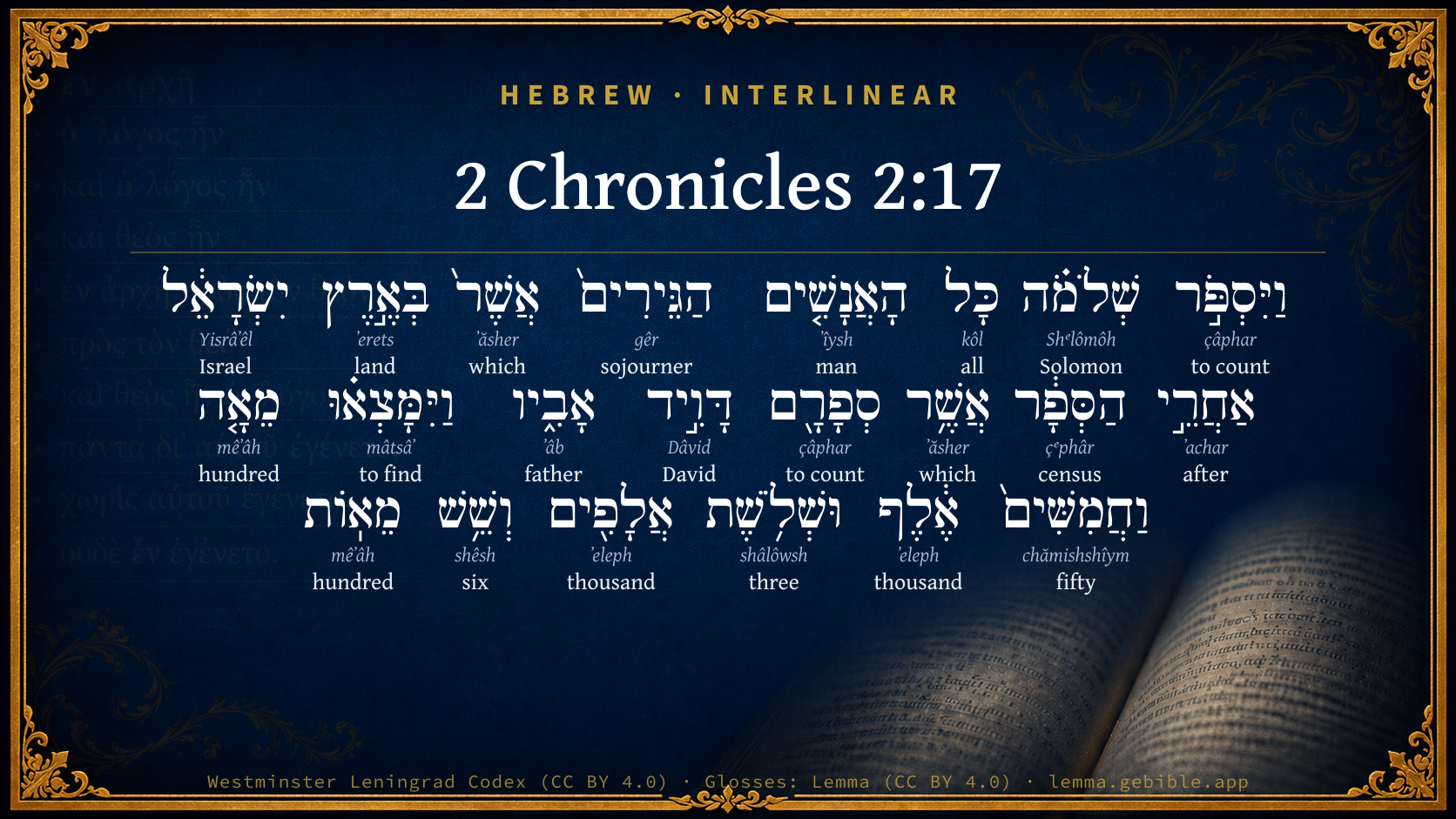
Hebrew (Westminster Leningrad Codex) 2 Chronicles 2:17 appears in the Hebrew Old Testament. The text above is from the Westminster Leningrad Codex. Each word links to its Strong’s number, a concise gloss, and parsing drawn from the Open Scriptures Hebrew Bible morphology. Click any word for its full Brown-Driver-Briggs (BDB) entry.
Download image
Cite this verse

2 Chronicles 2:17 (World English Bible). Public Domain. Lemma interlinear Bible study tool, https://lemma.gebible.app/v/2-chronicles/2/17.

Show BibTeX & RIS
BibTeX
RIS
English Translation
Solomon numbered all the foreigners who were in the land of Israel, after the numbering with which David his father had numbered them; and they were found one hundred fifty-three thousand six hundred.
World English Bible · Public Domain
Highlights
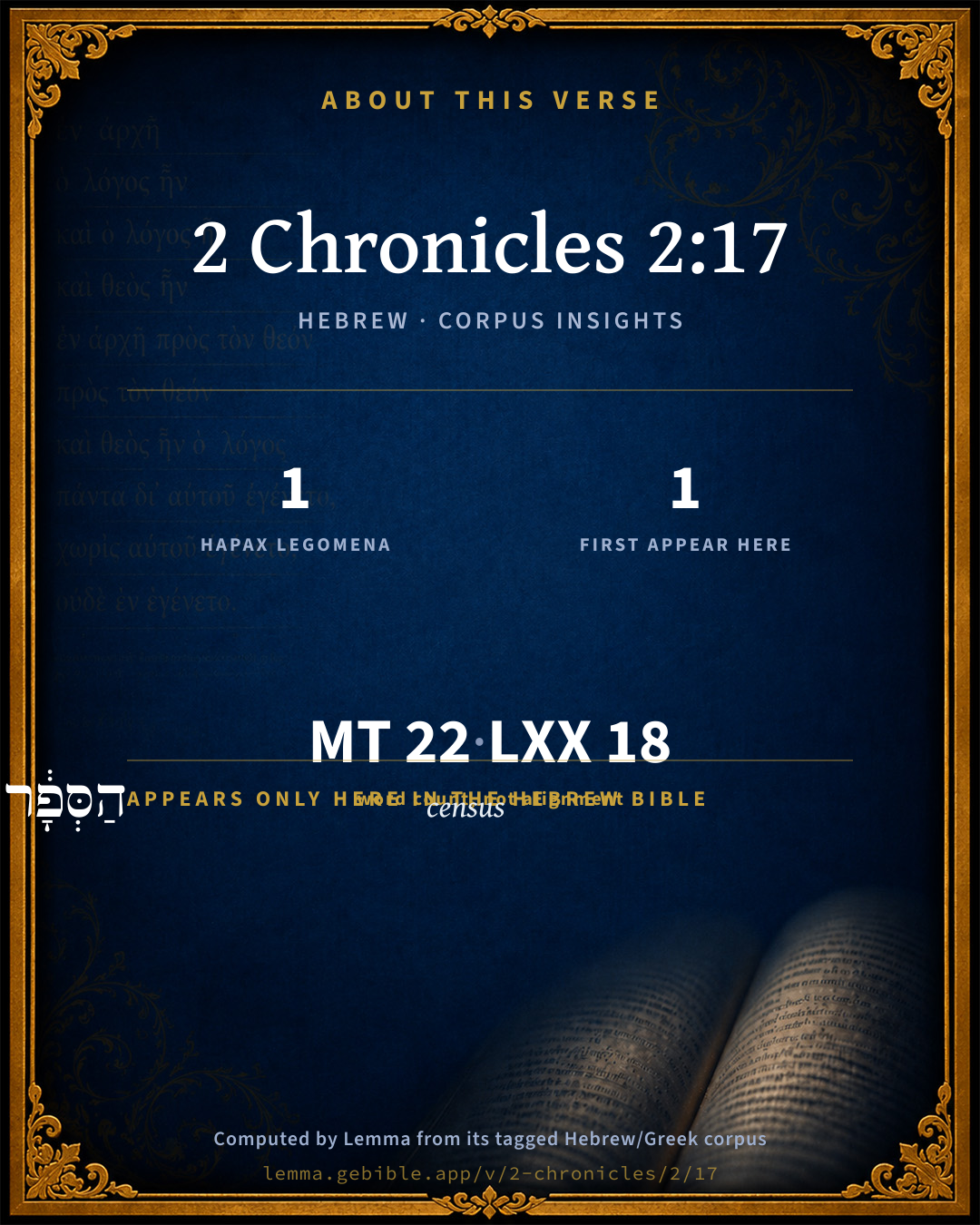
  • 1 hapax legomenon — only here in the Hebrew Bible
  • 1 first appearance in the Hebrew Bible
Full analysis ↓
Download a study sheet

One document with this verse’s original text, its word-by-word gloss line, the meaning frame, cross-references with their text, attributed commentary, and full source and license credits — printable, and it pastes into notes with its structure intact.

This verse Autodidact and up

Study sheet (.html) Plain text (.txt)

A passage Seminary Student

Up to 50 verses in one chapter. A passage sheet keeps up to 6 commentary sources and 12 cross-references per verse, in the order this page ranks them, and says so on the sheet whenever that leaves anything out. Ask for a single verse and you get the Autodidact verse sheet above.

Everything on this page stays free to read, with no account — the sheet is a download of what is already on screen, not access to it.

Want to remove ads? Support Godless Engineer
Compare translations 3

The same verse in 3 English versions, stacked beneath the original-language interlinear above. Click any original word for its lexicon entry.

Each is an independent rendering of the whole verse — the interlinear is not word-aligned to these translations.

Highlighted words mark where these versions differ — a whole-verse word diff, not a word-by-word alignment.

  • World English Bible Public Domain
    Solomon numbered all the foreigners who were in the land of Israel, after the numbering with which David his father had numbered them; and they were found one hundred fifty-three thousand six hundred.
  • King James Version Public Domain
    And Solomon numbered all the strangers that were in the land of Israel, after the numbering wherewith David his father had numbered them; and they were found an hundred and fifty thousand and three thousand and six hundred.
  • unfoldingWord Literal Text CC BY-SA 4.0
    And Solomon counted all the men, the foreigners who were in the land of Israel, after the census that David, his father, had counted them. And there were found 153,600.

unfoldingWord Literal Text — © unfoldingWord, licensed CC BY-SA 4.0. Word-aligned USFM3 via Door43 (git.door43.org/unfoldingWord/en_ult).

Versions to compare (up to 4)

3 of 4 selected

Show all 18 translations

Every available English version of this verse, each an independent rendering of the whole verse.

  • World English Bible Public Domain
    Solomon numbered all the foreigners who were in the land of Israel, after the numbering with which David his father had numbered them; and they were found one hundred fifty-three thousand six hundred.
  • Berean Standard Bible Public Domain
    Solomon numbered all the foreign men in the land of Israel following the census his father David had conducted, and there were found to be 153,600 in all.
  • Majority Standard Bible Public Domain
    Solomon numbered all the foreign men in the land of Israel following the census his father David had conducted, and there were found to be 153,600 in all.
  • King James Version Public Domain
    And Solomon numbered all the strangers that were in the land of Israel, after the numbering wherewith David his father had numbered them; and they were found an hundred and fifty thousand and three thousand and six hundred.
  • American Standard Version (1901) Public Domain
    And Solomon numbered all the sojourners that were in the land of Israel, after the numbering wherewith David his father had numbered them; and they were found a hundred and fifty thousand and three thousand and six hundred.
  • Revised Version (1885) Public Domain
    And Solomon numbered all the strangers that were in the land of Israel, after the numbering wherewith David his father had numbered them; and they were found an hundred and fifty thousand and three thousand and six hundred.
  • Geneva Bible (1599) Public Domain
    And Salomon nombred al the strangers that were in the land of Israel, after the nombring that his father Dauid had nombred them: and they were found an hundreth and three and fiftie thousand, and sixe hundreth.
  • Douay-Rheims (1899) Public Domain
    And Solomon numbered all the proselytes in the land of Israel, after the numbering which David his father had made, and they were found a hundred and fifty-three thousand and six hundred.
  • Young's Literal Translation Public Domain
    And Solomon numbereth all the men, the sojourners who `are' in the land of Israel, after the numbering with which David his father numbered them, and they are found a hundred and fifty thousand, and three thousand, and six hundred;
  • Literal Standard Version CC BY-SA 4.0
    And Solomon numbers all the men, the sojourners who [are] in the land of Israel, after the numbering with which his father David numbered them, and they are found [to be] one hundred and fifty thousand and three thousand and six hundred;
  • Unlocked Literal Bible CC BY-SA 4.0
    Solomon counted all the foreigners who were in the land of Israel, following the method that David, his father, had counted them. They were found to be 153,600.
  • unfoldingWord Literal Text CC BY-SA 4.0
    And Solomon counted all the men, the foreigners who were in the land of Israel, after the census that David, his father, had counted them. And there were found 153,600.
  • Darby Bible Public Domain
    And Solomon numbered all the strangers that were in the land of Israel, after the account that David his father had taken of them, and there were found a hundred and fifty-three thousand six hundred.
  • World Messianic Bible Public Domain
    Solomon counted all the foreigners who were in Eretz-Israel, after the census with which David his father had counted them; and they found one hundred fifty-three thousand six hundred.
  • Webster's Bible Public Domain
    And Solomon numbered all the strangers that were in the land of Israel, after the numbering with which David his father had numbered them; and they were found a hundred and fifty thousand and three thousand and six hundred.
  • Free Bible Version CC BY-SA 4.0
    Solomon had a census taken of all the foreigners in the land of Israel, like the census his father David had conducted, and found there were 153,600.
  • Bible in Basic English Public Domain
    Then Solomon took the number of all the men from strange lands who were living in Israel, as his father David had done; there were a hundred and fifty-three thousand, six hundred.
  • JPS Tanakh (1917) Public Domain
    (2-16) And Solomon numbered all the strangers that were in the land of Israel, after the numbering wherewith David his father had numbered them; and they were found a hundred and fifty thousand and three thousand and six hundred.

Literal Standard Version (2020), Covenant Press — licensed CC BY-SA 4.0. Text via the HelloAO Bible API (eBible.org). Unlocked Literal Bible (unfoldingWord) — licensed CC BY-SA 4.0. Text via the HelloAO Bible API (eBible.org). unfoldingWord Literal Text — © unfoldingWord, licensed CC BY-SA 4.0. Word-aligned USFM3 via Door43 (git.door43.org/unfoldingWord/en_ult). Free Bible Version, Dr. Jonathan Gallagher — licensed CC BY-SA 4.0. Text via the HelloAO Bible API (eBible.org).

Word by word

More ways to search: Search by grammar → Find every occurrence → Compare this word →

Practice this passage: Drill this verse → Learn its vocabulary →

הַסְּפָ֔ר
çᵉphâr
H5610
“the · census”
Particle, Definite Article + Noun, Common, Masculine, Singular, Absolute
Part of Speech
Particle + Noun
Type
Common
Gender
Masculine
Number
Singular
State
Absolute
Full BDB Definition

Origin: from H5608

TWOT: 1540d

census, enumeration
  1. וַיִּסְפֹּ֣ר çâphar H5608 “and · to count” Conjunction + Verb, Qal, Sequential Imperfect, 3rd Person, Masculine, Singular
  2. שְׁלֹמֹ֗ה Shᵉlômôh H8010 “Solomon” Noun, Proper
  3. כָּל kôl H3605 “all of” Noun, Common, Masculine, Singular, Construct
  4. הָאֲנָשִׁ֤ים ʼîysh H376 “the · men” Particle, Definite Article + Noun, Common, Masculine, Plural, Absolute
  5. הַגֵּירִים֙ gêr H1616 “the · sojourners” Particle, Definite Article + Noun, Common, Masculine, Plural, Absolute
  6. אֲשֶׁר֙ ʼăsher H834 “which” Particle, Relative
  7. בְּאֶ֣רֶץ ʼerets H776 “in/at · land of” Preposition + Noun, Common, Both, Singular, Construct
  8. יִשְׂרָאֵ֔ל Yisrâʼêl H3478 “Israel” Noun, Proper
  9. אַחֲרֵ֣י ʼachar H310 “after” Preposition
  10. אֲשֶׁ֥ר ʼăsher H834 “which” Particle, Relative
  11. סְפָרָ֖ם çâphar H5608 “to count · them” Verb, Qal, Perfect, 3rd Person, Masculine, Singular + Suffix, Personal, 3rd Person, Masculine, Plural
  12. דָּוִ֣יד Dâvid H1732 “David” Noun, Proper
  13. אָבִ֑יו ʼâb H1 “father · his” Noun, Common, Masculine, Singular, Construct + Suffix, Personal, 3rd Person, Masculine, Singular
  14. וַיִּמָּצְא֗וּ mâtsâʼ H4672 “and · to find” Conjunction + Verb, Niphal, Sequential Imperfect, 3rd Person, Masculine, Plural
  15. מֵאָ֤ה mêʼâh H3967 “hundred” Adjective, Cardinal number, Both, Singular, Absolute
  16. וַחֲמִשִּׁים֙ chămishshîym H2572 “and · fifty” Conjunction + Adjective, Cardinal number, Both, Plural, Absolute
  17. אֶ֔לֶף ʼeleph H505 “thousand” Adjective, Cardinal number, Both, Singular, Absolute
  18. וּשְׁלֹ֥שֶׁת shâlôwsh H7969 “and · three” Conjunction + Adjective, Cardinal number, Masculine, Singular, Construct
  19. אֲלָפִ֖ים ʼeleph H505 “thousand” Adjective, Cardinal number, Both, Plural, Absolute
  20. וְשֵׁ֥שׁ shêsh H8337 “and · six” Conjunction + Adjective, Cardinal number, Feminine, Singular, Absolute
  21. מֵאֽוֹת mêʼâh H3967 “hundred” Adjective, Cardinal number, Both, Plural, Absolute

About this verse

These counts appear in no published source. They are computed here, from the morphology-tagged text and Lemma’s own curated glosses. What Lemma adds →

22
words
18
distinct lemmas
Historical
section

Notable vocabulary

1 hapax legomenon — a word that appears only here in the entire Hebrew Bible:

  • הַסְּפָ֔ר census H5610

First appearance in Scripture

This word makes its first canonical appearance in the Hebrew Bible here:

  • הַסְּפָ֔ר census H5610

Grammatical profile

  • 3 verbs
  • 9 nouns
  • 7 adjectives
  • 1 preposition
  • 2 particles

Verb forms

  • וַיִּסְפֹּ֣ר Qal · Sequential Imperfect
  • סְפָרָ֖ם Qal · Perfect
  • וַיִּמָּצְא֗וּ Niphal · Sequential Imperfect

Repetition

Words recur within this verse — often emphatic in Hebrew:

  • וַיִּסְפֹּ֣ר to count H5608 ×2
  • מֵאָ֤ה hundred H3967 ×2
  • אֶ֔לֶף thousand H505 ×2
  • אֲשֶׁר֙ which H834 ×2

Hebrew & Septuagint length

In English translation the verse runs 33 words from the Hebrew and 34 from the Septuagint (LXX English) — closely comparable.

A rough comparison of the two English renderings, which tokenize alike — not a word-level alignment.

Word counts can differ between the Hebrew and the Greek without any difference in meaning — e.g. the Hebrew direct-object marker אֵת has no separate Greek word, and Greek often adds the article ὁ.

In the original languages it is 22 Hebrew tokens and 18 Greek tokens — but the two are counted differently (Hebrew bundles its prefixes and suffixes into one token; the Greek is in lemma form), so that isn’t a like-for-like length.

Cross-references

5

Topical passages linked to 2 Chronicles 2:17 in the Treasury of Scripture Knowledge — connected by theme and wording, ordered by reader-vote popularity; previews shown in the World English Bible.

  • 1 Chronicles 22:2 David commanded to gather together the foreigners who were in the land of Israel; and he set masons to hew worked stones to build the house of God.
  • 1 Kings 5:13–16 King Solomon raised a levy out of all Israel; and the levy was thirty thousand men.
  • 1 Kings 9:20–21 As for all the people who were left of the Amorites, the Hittites, the Perizzites, the Hivites, and the Jebusites, who were not of the children of Israel;
  • 2 Chronicles 2:2 Solomon counted out seventy thousand men to bear burdens, and eighty thousand men who were stone cutters in the mountains, and three thousand and six hundred to oversee them.
  • 2 Chronicles 8:7–8 As for all the people who were left of the Hittites, and the Amorites, and the Perizzites, and the Hivites, and the Jebusites, who were not of Israel;

Cross-references courtesy of OpenBible.info (CC BY 4.0).

Hebrew and Greek witnesses Masoretic Hebrew ↔ Greek Septuagint

The same verse in the two great witnesses to the Old Testament, shown verse-for-verse.

These are two independent witnesses, not word-aligned to each other, and the Septuagint is shown in lemma (dictionary) form.

Hebrew 2 Chronicles 2:17 Masoretic · Westminster Leningrad Codex

וַיִּסְפֹּ֣ר שְׁלֹמֹ֗ה כָּל הָאֲנָשִׁ֤ים הַגֵּירִים֙ אֲשֶׁר֙ בְּאֶ֣רֶץ יִשְׂרָאֵ֔ל אַחֲרֵ֣י הַסְּפָ֔ר אֲשֶׁ֥ר סְפָרָ֖ם דָּוִ֣יד אָבִ֑יו וַיִּמָּצְא֗וּ מֵאָ֤ה וַחֲמִשִּׁים֙ אֶ֔לֶף וּשְׁלֹ֥שֶׁת אֲלָפִ֖ים וְשֵׁ֥שׁ מֵאֽוֹת

Solomon numbered all the foreigners who were in the land of Israel, after the numbering with which David his father had numbered them; and they were found one hundred fifty-three thousand six hundred.

World English Bible · Public Domain

Greek LXX 2 Chronicles 2:17 Septuagint · lemma form

καί ποιέω ἐκ αὐτός ἑβδομήκοντα χιλίας νωτοφόρος καί ὀγδοήκοντα χιλίας λατόμος καί τρισχίλιοι ἑξακόσιοι ἐργοδιωκτής ἐπί ὁ λαός

And Solomon gathered all the foreigners that were in the land of Israel, after the numbering with which David his father numbered them; and there were found one hundred and fifty-three thousand six hundred.

LXX2012 (modern English Septuagint) · Public Domain

Hebrew: Westminster Leningrad Codex (CC BY 4.0). Greek: Septuagint (public domain); English from LXX2012 (modern English Septuagint) (Public Domain). How the Septuagint differs from the Hebrew →

Commentary

Notes on 2 Chronicles 2:17 from classic Christian and Jewish commentators (each source and its license shown beneath its notes). The classic Christian expositions comment on the surrounding passage and are grouped to its opening verse, so a note may address several verses; the Jewish commentaries on the Tanakh (Rashi and others) are per-verse, so they appear only where the commentator wrote on this verse.

Lemma curates 59 commentaries, every one of them public domain or Creative Commons licensed, each selected and text-cleaned for this edition rather than reprinted as found. About our sources →

Trapp's Complete Commentary

John Trapp

2Ch 2:17 And Solomon numbered all the strangers that [were] in the land of Israel, after the numbering wherewith David his father had numbered them; and they were found an hundred and fifty thousand and three thousand and six hundred.

Ver. 17. After the numbering.] See 1Ch 22:2.

John Trapp, A Commentary or Exposition upon All the Books of the Old and New Testament (1647–1656) — public domain. Text from a community e-Sword module.

The Biblical Illustrator

Joseph S. Exell

2Ch_2:17-18

And Solomon numbered all the strangers that were in the land of Israel.

Naturalisation of foreigners

I. A good government will tend to make a country attractive to foreigners.

II. Foreigners thus attracted are amenable to the laws of the state.

III. Thus protected, they may contribute materially to the enrichment of a state by the importation of foreign industries. Silk-weavers of Spitalfields.

V. Be kind to strangers. (Bibical Museum.)

Strangers in the city

I. Strangers in a city are in danger from the temptation to explore the underground life of the community. I believe that three-fourths of the young men of our cities are ruined for the simple reason that they went to look at iniquity. In 1794, during the Reign of Terror in Paris, there were people who, to hide from their persecutors, got into the sewers under the city, and went on mile after mile amid the stifling atmosphere, poisoned and exhausted, coming out after a while at the river Seine, where they washed and breathed again the pure air. But, alas! that so many men who attempt to explore underground New York life never come to a river Seine, where they can wash, and they die horribly in the sewers. I stand on a mountain of Colorado, six thousand feet high. There is a man standing beneath me who says, I see a peculiar shelving to this rock, and he bends towards it. I say, Stop, you will fall. He says, No danger; I have a steady hand and foot, and see a peculiar kind of moss. I say, Stand back; but he says, I am not afraid; and he bends farther and farther, and after a while his head whirls and his feet slip--and the eagles know not that it is the macerated flesh of a man they are picking at, but it is. So I have seen men come to the very verge of the life of this city, and they look away down in it. They say, Dont be cowardly. Let us go down. They look farther and farther. I warn them to stand back; but Satan comes behind them, and while they are swinging over the verge, pushes them off. People say they were naturally bad. They were not? They were engaged in exploration. No man can afford to sail so near the coast of eternal fire for the purpose of discovering how hot it is. Stand off from that exploration. If you are a good swimmer, and you see a man drowning, leap for him and bring him ashore; but if you are merely going to jump in to see him drown, stand back.

II. Strangers in a city are in danger from the temptation to desecrate the Sabbath. There is not one in ten who knows how to keep the Lords day when he is away from home and absent from all Christian influences.

III. Strangers in a city are not safe without Christian restraint. (T. De Witt Talmage.)

.

The Biblical Illustrator, edited by Joseph S. Exell (c. 1880s–1900s) — public domain. Text from a community e-Sword module.

Joseph Benson's Commentary

2Ch 2:17. Solomon numbered all the strangers — For David had not only numbered his own people, but afterward the strangers, that Solomon might have a true account of them, and employ them about his buildings. Yet Solomon numbered them again, because death might have made a considerable alteration among them since David’s numbering.

Joseph Benson's Commentary on the Old and New Testaments (1811–1818) — public domain. Text from a community e-Sword module.

Tyndale Open Study Notes

Tyndale Open Resources

2:17-18 The book of Kings explains that all those left from the seven nations were conscripted for labor. Further, no Israelites were conscripted, and Israelites were placed in charge of the laborers (1 Kgs 9:20-23).

Tyndale Open Study Notes — © Tyndale Open Resources, licensed CC BY-SA 4.0. Text via the HelloAO Bible API.

Jamieson, Fausset & Brown

Robert Jamieson, A. R. Fausset & David Brown

Solomon numbered all the strangers, &c.--(See on Kg1 5:13; Kg1 5:18).

Next: 2 Chronicles Chapter 3

Jamieson, Fausset & Brown — Commentary Critical and Explanatory on the Whole Bible (1871) — public domain (CC PDM 1.0). Text via the HelloAO Bible API.

Ellicott's Commentary for English Readers

(17) All the strangers.—The indigenous Canaanite population. (Comp. the use of the term in Gen_23:4; Exo_22:21; Lev_17:8.)

After the numbering.—The word sĕphâr, “reckoning,” “census,” occurs here only in the Old Testament.

Wherewith David his father.—The former census of the native Canaanites, which had taken place by order of David, is briefly recorded in 1Ch_22:2. (Comp. 2Sa_20:24, “and Adoram was over the levy,” from which it appears that the subject population was liable to forced labour under David; comp. also 1Ki_4:6; 1Ki_5:14; 1Ki_12:4-18.)

And they were found.—The total of the numbers here given is 153,600, which is the sum of the figures assigned in the next verse, viz., 70,000 + 80,000 + 8.600.

(17, 18) Solomon’s levy of Canaanite labourers. (A return to the subject of 2Ch_2:2.)

A Bible Commentary for English Readers, edited by Charles John Ellicott (1878–1897) — public domain. Text from a community e-Sword module.

The Cambridge Bible for Schools and Colleges

gen. ed. J. J. S. Perowne

17, 18 [16, 17, Heb.] (cp. 2). Bearers and Hewers

17. David his father] See 1Ch_22:2.

The Cambridge Bible for Schools and Colleges (gen. ed. J. J. S. Perowne; Cambridge University Press, 1878–1918) — public domain. Text from a community e-Sword module.

Albert Barnes' Notes on the Bible

The strangers are the non-Israelite population of the holy land, the descendants (chiefly) of those Canaanites whom the children of Israel did not drive out. The reimposition of the bond-service imposed on the Canaanites at the time of the conquest Jdg 1:28, Jdg 1:30, Jdg 1:33, Jdg 1:35, but discontinued in the period of depression between Joshua and Saul, was (it is clear) due to David, whom Solomon merely imitated in the arrangements described in these verses.

Albert Barnes' Notes on the Bible (1834–1885) — public domain. Text from a community e-Sword/MySword module.

Haydock's Catholic Bible Commentary

Had made, at the commencement of Solomon’s reign, when David put such immense treasures into his hands. The second list was taken when the temple was begun. The proselytes were the remnants of the nations of the natives of Chanaan. The Jews foolishly pretend, (Calmet) that no strangers were allowed to embrace the law of Moses, under David and Solomon, for fear lest they might be influenced by self-interest rather than by the love of religion. (Seldon, Syn. iii. 2, 5.)

George Leo Haydock (1774–1849), Haydock's Catholic Family Bible and Commentary, 1859 edition — public domain. Excludes Psalms (Douay-Rheims chapter numbering differs from Protestant) and Deuterocanonical books (Catholic canon only).

Matthew Poole's English Annotations

Wherewith David his father had numbered them; for David had not only numbered his own people, for which he smarted, 2Sa 24; but afterward he numbered the strangers, not out of vanity, but that Solomon might have a true account of them, and employ them about his buildings, as he saw fit. Yet Solomon thought fit to number them again, because death might have made a considerable alteration among them since David’s numbering of them; and it behoved him to have an exact account of them.

Matthew Poole's English Annotations on the Holy Bible (1683–1685) — public domain. Text from a community e-Sword/MySword module.

The Pulpit Commentary

Strangers. By these are meant those of the former inhabitants and possessors of the land, who had not been extirpated or driven out. Special regulations respecting them are recorded in Jud 1:21-28, 33-36. But these had largely lapsed till, as it appears, David revived themrather trenchantly, and David is now followed by Solomon (2Ch_8:7, 2Ch_8:8; 1Ki_9:20, 1Ki_9:21) The very much milder enforcement of labour upon the Israelites themselves is evident from 1Ki_5:13-16. After the numbering wherewith David his father had numbered them. Of this transaction on the part of David we do not possess any absolutely distinct statement. But the place of it is sufficiently evident, as indicated in 1Ch_22:2.

The Pulpit Commentary (1880–1919), ed. H.D.M. Spence-Jones & Joseph S. Exell — public domain. Text from a community e-Sword module.

John Wesley's Explanatory Notes

The strangers - For David had not only numbered his own people, but afterward the strangers, that Solomon might have a true account of them, and employ them about his buildings. Yet Solomon numbered them again, because death might have made a considerable alteration among them since David's numbering.

John Wesley, Explanatory Notes Upon the Whole Bible (1754–1765) — public domain. Text via the GEBible commentary corpus.

unfoldingWord translationNotes

Door43 World Missions Community

Solomon counted

The readers should understand that Solomon probably commanded other people to do the actual work. AT: "Solomon had his servants count" (See: Metonymy)

They were found to be 153,600

This can be stated in active form. AT: "There were 153,600 foreigners" (See: Active or Passive and Numbers)

153,600

"one hundred and fifty-three thousand six hundred" (See: Numbers)

seventy thousand ... eighty thousand

"70,000 men ... 80,000 men" (See: Numbers)

to carry loads

It is understood that these are loads of materials for building Yahweh's house. AT: "to carry loads of materials" (See: Ellipsis)

3,600

"three thousand six hundred" (See: Numbers)

translationWords

alien

Israel

unfoldingWord translationNotes — © Distant Shores Media and the Door43 World Missions Community, licensed CC BY-SA 4.0. Source: git.door43.org/Door43/en_tn.

Rashi

Rabbi Shlomo Yitzchaki (Rashi)

And he made of them seventy thousand, etc. The reason he mentions them again and mentions the number is that he interrupted the topic; therefore, he had to repeat it again now. And he did not stop until he finished the entire [account of the] building, and he says immediately (3:1): “And Solomon commenced to build, etc.” Now, even with one verse, it is customary to interrupt the topic and [then] to begin [again] with the previous statement, e.g., (Num. 16:6): “Do this: take yourself, etc.” And the morrow, it says (ibid. 16f.): “And Moses said to Korah: You and all your band, etc.,” and he repeats and says, “and let each man take his censer and place, etc.” Since he interrupted with many verses, it was necessary to rewrite it, and how much more so here.

Rashi on the Tanakh — English translations: “The Judaica Press complete Tanach with Rashi, translated by A. J. Rosenberg” (CC BY 4.0); “Pentateuch with Rashi's commentary by M. Rosenbaum and A.M. Silbermann, 1929-1934” (public domain); “The Metsudah Tanach series, Lakewood, N.J” (CC BY 4.0); and “The Book of Joshua, Metsudah Publications, 1997” (CC BY 4.0). Text via Sefaria.

Lesson kit

Teaching starters — assembled from the data on this page, not authored interpretation. Every prompt links to the verse data it draws on. Edit before teaching.

2 Chronicles, in the Historical, opens this verse with 22 words (18 distinct Hebrew lemmas). Its most distinctive word is çᵉphâr (“census”). A historical commentator’s framing appears above. Read the whole chapter for the surrounding context.

Discussion questions

  1. The word çᵉphâr carries the sense “census.” How does it shape the verse?
  2. This verse holds 1 word here found nowhere else in the Hebrew Bible. What might the rare word draw attention to?
  3. The word “census” first appears here in Scripture. What is being introduced at this debut?
  4. 1 Chronicles 22:2 shares this passage’s theme. How do the two illuminate each other?
  5. “to count” occurs 2× in this one verse. What is the effect of the repetition?
  6. The translations on this page render this verse differently — a whole-verse word diff, not a word-by-word alignment. What might account for the different wordings?
  7. The verb «וַיִּסְפֹּ֣ר» is Qal Sequential Imperfect. How does its form color the action?
  8. Reading how Trapp's Complete Commentary and The Biblical Illustrator read this verse, where do the two commentators agree and where do they part?

Things to notice

  • 1 word in this verse appears nowhere else in the Hebrew Bible.
  • 1 word makes its first canonical appearance in Scripture here.
  • This verse counts 22 Hebrew ↔ 18 Greek words.
  • These translations choose different wording for 19 words in this verse.
  • “to count” occurs 2× in this single verse.

Reading settings

Reading text

Shown beneath each verse's original-language words.

Old Testament
Old Testament edition

Read the OT as the Masoretic Hebrew (MT) or the Greek Septuagint (LXX).

English shown for the Greek Septuagint (in the Hebrew ↔ Greek comparison).

Comparing translations? Open the Compare panel on any verse page to stack up to four side by side.