1 Chronicles 18:3

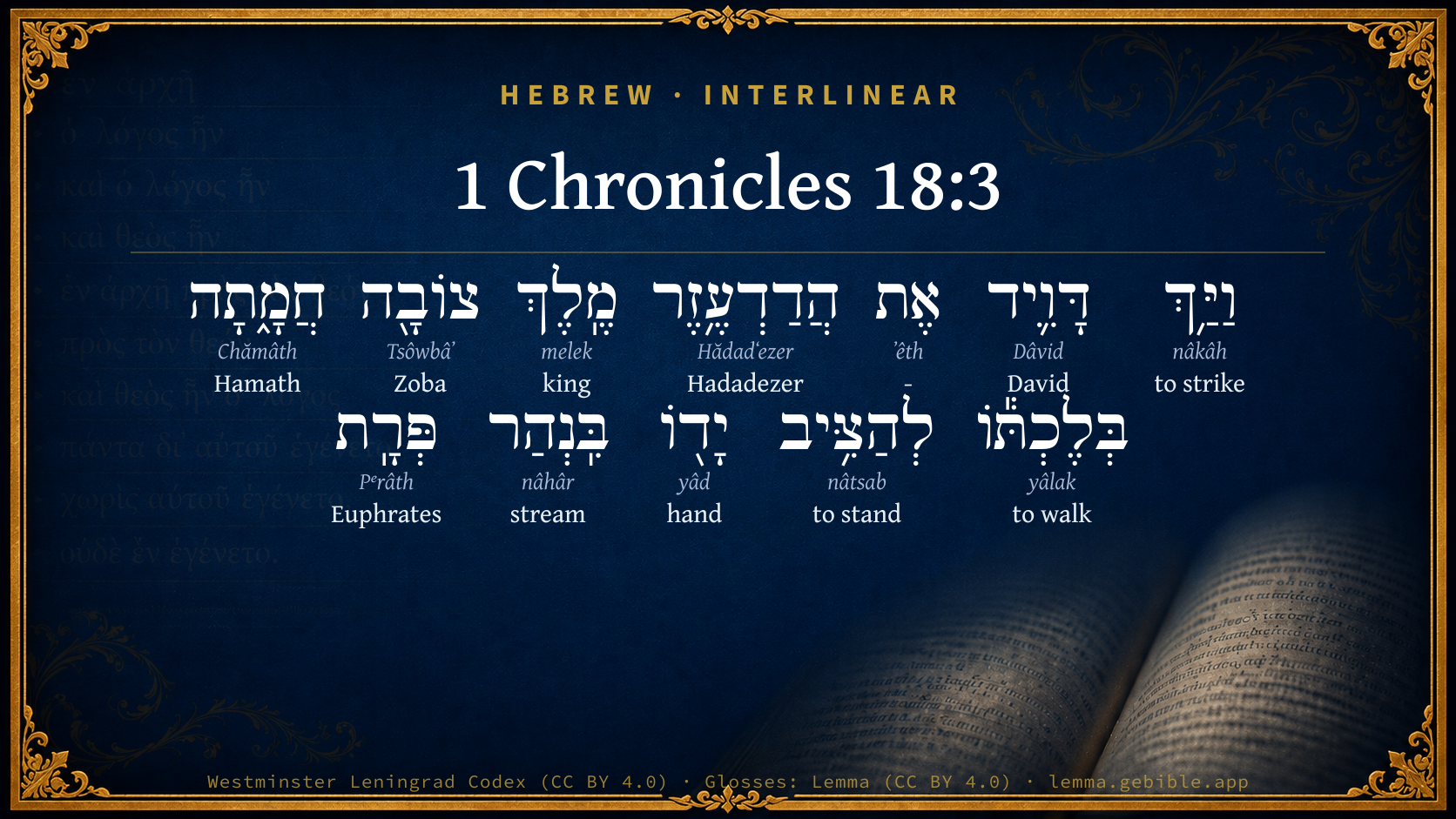
Hebrew (Westminster Leningrad Codex) 1 Chronicles 18:3 appears in the Hebrew Old Testament. The text above is from the Westminster Leningrad Codex. Each word links to its Strong’s number, a concise gloss, and parsing drawn from the Open Scriptures Hebrew Bible morphology. Click any word for its full Brown-Driver-Briggs (BDB) entry.
Download image
Cite this verse

1 Chronicles 18:3 (World English Bible). Public Domain. Lemma interlinear Bible study tool, https://lemma.gebible.app/v/1-chronicles/18/3.

Show BibTeX & RIS
BibTeX
RIS
English Translation
David struck Hadarezer king of Zobah to Hamath, as he went to establish his dominion by the river Euphrates.
World English Bible · Public Domain
Download a study sheet

One document with this verse’s original text, its word-by-word gloss line, the meaning frame, cross-references with their text, attributed commentary, and full source and license credits — printable, and it pastes into notes with its structure intact.

This verse Autodidact and up

Study sheet (.html) Plain text (.txt)

A passage Seminary Student

Up to 50 verses in one chapter. A passage sheet keeps up to 6 commentary sources and 12 cross-references per verse, in the order this page ranks them, and says so on the sheet whenever that leaves anything out. Ask for a single verse and you get the Autodidact verse sheet above.

Everything on this page stays free to read, with no account — the sheet is a download of what is already on screen, not access to it.

Want to remove ads? Support Godless Engineer
Compare translations 3

The same verse in 3 English versions, stacked beneath the original-language interlinear above. Click any original word for its lexicon entry.

Each is an independent rendering of the whole verse — the interlinear is not word-aligned to these translations.

Highlighted words mark where these versions differ — a whole-verse word diff, not a word-by-word alignment.

  • World English Bible Public Domain
    David struck Hadarezer king of Zobah to Hamath, as he went to establish his dominion by the river Euphrates.
  • King James Version Public Domain
    And David smote Hadarezer king of Zobah unto Hamath, as he went to stablish his dominion by the river Euphrates.
  • unfoldingWord Literal Text CC BY-SA 4.0
    And David struck Hadadezer, the king of Zobah Hamath, when he went to establish his hand at the Euphrates River.

unfoldingWord Literal Text — © unfoldingWord, licensed CC BY-SA 4.0. Word-aligned USFM3 via Door43 (git.door43.org/unfoldingWord/en_ult).

Versions to compare (up to 4)

3 of 4 selected

Show all 18 translations

Every available English version of this verse, each an independent rendering of the whole verse.

  • World English Bible Public Domain
    David struck Hadarezer king of Zobah to Hamath, as he went to establish his dominion by the river Euphrates.
  • Berean Standard Bible Public Domain
    As far as Hamath, David also defeated King Hadadezer of Zobah, who had marched out to establish his dominion along the Euphrates River.
  • Majority Standard Bible Public Domain
    As far as Hamath, David also defeated King Hadadezer of Zobah, who had marched out to establish his dominion along the Euphrates River.
  • King James Version Public Domain
    And David smote Hadarezer king of Zobah unto Hamath, as he went to stablish his dominion by the river Euphrates.
  • American Standard Version (1901) Public Domain
    And David smote Hadarezer king of Zobah unto Hamath, as he went to establish his dominion by the river Euphrates.
  • Revised Version (1885) Public Domain
    And David smote Hadarezer king of Zobah unto Hamath, as he went to stablish his dominion by the river Euphrates.
  • Geneva Bible (1599) Public Domain
    And Dauid smote Hadarezer King of Zobah vnto Hamath, as he went to stablish his border by the riuer Perath.
  • Douay-Rheims (1899) Public Domain
    At that time David defeated also Adarezer king of Soba of the land of Hemath, when he went to extend his dominions as far as the river Euphrates.
  • Young's Literal Translation Public Domain
    And David smiteth Hadarezer king of Zobah, at Hamath, in his going to establish his power by the river Phrat,
  • Literal Standard Version CC BY-SA 4.0
    And David strikes Hadarezer king of Zobah, at Hamath, in his going to establish his power by the Euphrates River,
  • Unlocked Literal Bible CC BY-SA 4.0
    David then defeated Hadadezer, king of Zobah at Hamath, as Hadadezer was traveling to establish his rule by the Euphrates River.
  • unfoldingWord Literal Text CC BY-SA 4.0
    And David struck Hadadezer, the king of Zobah Hamath, when he went to establish his hand at the Euphrates River.
  • Darby Bible Public Domain
    And David smote Hadarezer king of Zobah, at Hamath, as he went to establish his dominion by the river Euphrates.
  • World Messianic Bible Public Domain
    David defeated Hadadezer king of Zobah, toward Hamath, as he went to establish his dominion by the river Euphrates.
  • Webster's Bible Public Domain
    And David smote Hadarezer king of Zobah to Hamath, as he went to establish his dominion by the river Euphrates.
  • Free Bible Version CC BY-SA 4.0
    David then defeated Hadadezer, king of Zobah, near Hamath, as he tried to enforce his control along the Euphrates River.
  • Bible in Basic English Public Domain
    Then David overcame Hadadezer, king of Zobah, near Hamath, when he was going to make his power seen by the river Euphrates.
  • JPS Tanakh (1917) Public Domain
    And David smote Hadarezer king of Zobah by Hamath, as he went to establish his dominion at the river Euphrates.

Literal Standard Version (2020), Covenant Press — licensed CC BY-SA 4.0. Text via the HelloAO Bible API (eBible.org). Unlocked Literal Bible (unfoldingWord) — licensed CC BY-SA 4.0. Text via the HelloAO Bible API (eBible.org). unfoldingWord Literal Text — © unfoldingWord, licensed CC BY-SA 4.0. Word-aligned USFM3 via Door43 (git.door43.org/unfoldingWord/en_ult). Free Bible Version, Dr. Jonathan Gallagher — licensed CC BY-SA 4.0. Text via the HelloAO Bible API (eBible.org).

Word by word

More ways to search: Search by grammar → Find every occurrence → Compare this word →

Practice this passage: Drill this verse → Learn its vocabulary →

צוֹבָ֖ה
Tsôwbâʼ
H6678
“Zoba”
Noun, Proper
Part of Speech
Noun
Type
Proper
Full BDB Definition

Origin: from an unused root meaning to station

TWOT: None

Zoba or Zobah = "station" - the name of a portion of Syria which formed a separate kingdom in the times of Saul, David, and Solomon; located northeast of Damascus
  1. וַיַּ֥ךְ nâkâh H5221 “and · to strike” Conjunction + Verb, Hiphil, Sequential Imperfect, 3rd Person, Masculine, Singular
  2. דָּוִ֛יד Dâvid H1732 “David” Noun, Proper
  3. אֶת ʼêth H853 “-” Particle, Direct Object
  4. הֲדַדְעֶ֥זֶר Hădadʻezer H1909 “Hadadezer” Noun, Proper
  5. מֶֽלֶךְ melek H4428 “king of” Noun, Common, Masculine, Singular, Construct
  6. חֲמָ֑תָה Chămâth H2574 “Hamath · toward” Noun, Proper + Suffix, Demonstrative
  7. בְּלֶכְתּ֕וֹ yâlak H3212 “in/at · to walk · him” Preposition + Verb, Qal, Infinitive Construct + Suffix, Personal, 3rd Person, Masculine, Singular
  8. לְהַצִּ֥יב nâtsab H5324 “to stand” Preposition + Verb, Hiphil, Infinitive Construct
  9. יָד֖וֹ yâd H3027 “hand · his” Noun, Common, Both, Singular, Construct + Suffix, Personal, 3rd Person, Masculine, Singular
  10. בִּֽנְהַר nâhâr H5104 “in/at · stream of” Preposition + Noun, Common, Masculine, Singular, Construct
  11. פְּרָֽת Pᵉrâth H6578 “Euphrates” Noun, Proper

About this verse

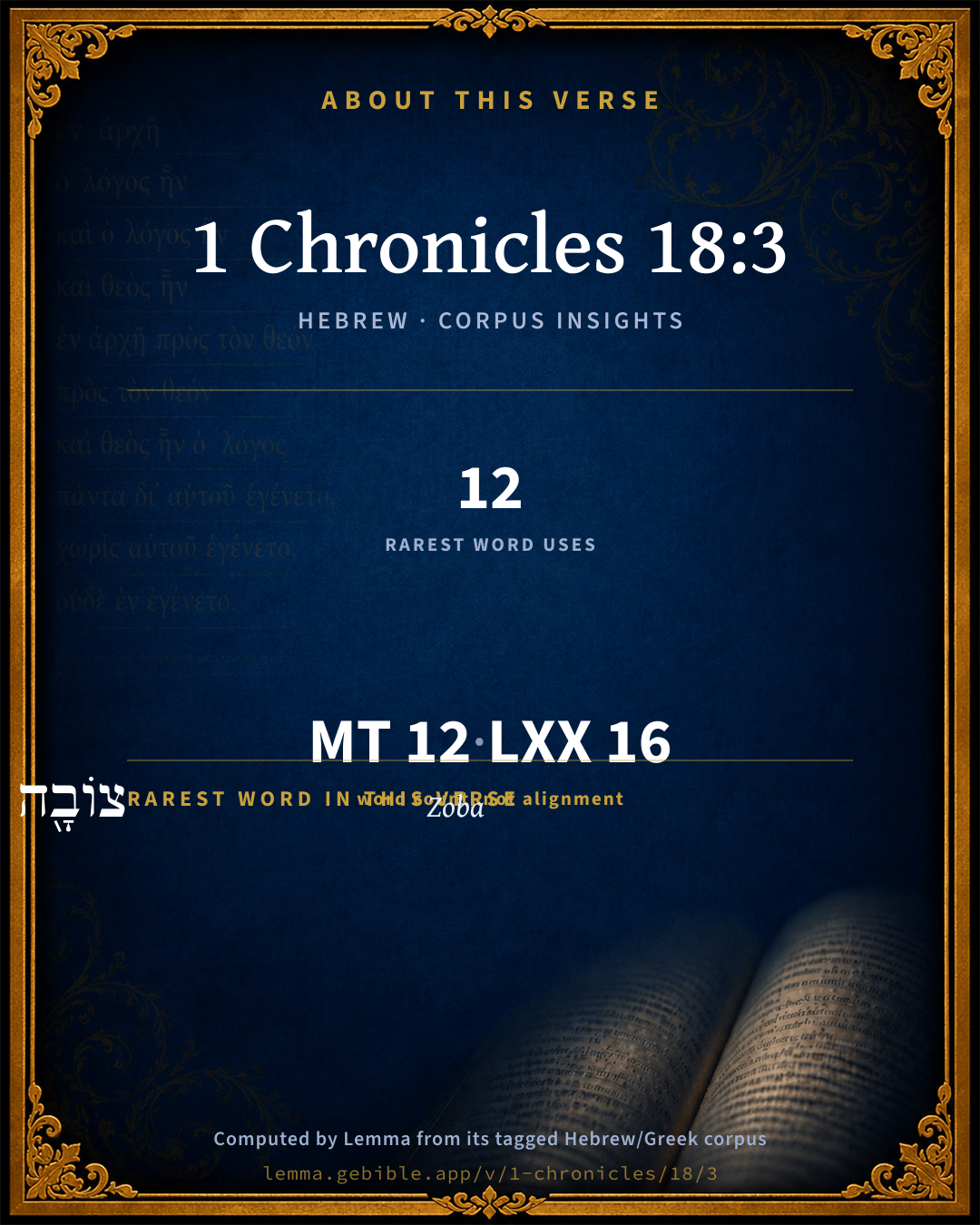
These counts appear in no published source. They are computed here, from the morphology-tagged text and Lemma’s own curated glosses. What Lemma adds →

12
words
12
distinct lemmas
Historical
section

Notable vocabulary

The rarest word here is צוֹבָ֖ה Zoba H6678 — appearing just 12 times in the whole Hebrew Bible.

Shared distinctive vocabulary

צוֹבָ֖ה Zoba H6678 occurs in 12 verses of the Hebrew Bible. Also found in:

Grammatical profile

  • 3 verbs
  • 8 nouns
  • 1 particle

Verb forms

  • וַיַּ֥ךְ Hiphil · Sequential Imperfect
  • בְּלֶכְתּ֕וֹ Qal · Infinitive Construct
  • לְהַצִּ֥יב Hiphil · Infinitive Construct

Hebrew & Septuagint length

In English translation the verse runs 19 words from the Hebrew and 20 from the Septuagint (LXX English) — closely comparable.

A rough comparison of the two English renderings, which tokenize alike — not a word-level alignment.

Word counts can differ between the Hebrew and the Greek without any difference in meaning — e.g. the Hebrew direct-object marker אֵת has no separate Greek word, and Greek often adds the article ὁ.

In the original languages it is 12 Hebrew tokens and 16 Greek tokens — but the two are counted differently (Hebrew bundles its prefixes and suffixes into one token; the Greek is in lemma form), so that isn’t a like-for-like length.

Cross-references

6

Topical passages linked to 1 Chronicles 18:3 in the Treasury of Scripture Knowledge — connected by theme and wording, ordered by reader-vote popularity; previews shown in the World English Bible.

  • Psalms 60:1 God, you have rejected us. You have broken us down. You have been angry. Restore us, again.
  • 2 Samuel 8:3 David struck also Hadadezer the son of Rehob, king of Zobah, as he went to recover his dominion at the River.
  • Genesis 15:18 In that day Yahweh made a covenant with Abram, saying, "To your seed have I given this land, from the river of Egypt to the great river, the river Euphrates:
  • Exodus 23:31 I will set your border from the Red Sea even to the sea of the Philistines, and from the wilderness to the River; for I will deliver the inhabitants of the land into your hand, and you shall drive them out before you.
  • 2 Samuel 10:6 When the children of Ammon saw that they were become odious to David, the children of Ammon sent and hired the Syrians of Beth Rehob, and the Syrians of Zobah, twenty thousand footmen, and the king of Maacah with one thousand men, and the men of Tob twelve thousand men.
  • 1 Samuel 14:47 Now when Saul had taken the kingdom over Israel, he fought against all his enemies on every side, against Moab, and against the children of Ammon, and against Edom, and against the kings of Zobah, and against the Philistines: and wherever he turned himself, he put [them] to the worse.

Cross-references courtesy of OpenBible.info (CC BY 4.0).

Hebrew and Greek witnesses Masoretic Hebrew ↔ Greek Septuagint

The same verse in the two great witnesses to the Old Testament, shown verse-for-verse.

These are two independent witnesses, not word-aligned to each other, and the Septuagint is shown in lemma (dictionary) form.

Hebrew 1 Chronicles 18:3 Masoretic · Westminster Leningrad Codex

וַיַּ֥ךְ דָּוִ֛יד אֶת הֲדַדְעֶ֥זֶר מֶֽלֶךְ צוֹבָ֖ה חֲמָ֑תָה בְּלֶכְתּ֕וֹ לְהַצִּ֥יב יָד֖וֹ בִּֽנְהַר פְּרָֽת

David struck Hadarezer king of Zobah to Hamath, as he went to establish his dominion by the river Euphrates.

World English Bible · Public Domain

Greek LXX 1 Chronicles 18:3 Septuagint · lemma form

καί πατάσσω δαυίδ ὁ αδρααζαρ βασιλεύς σουβα ημαθ πορεύομαι αὐτός ἐπιἵστημι χείρ αὐτός ἐπί ποταμός εὐφράτης

And David struck Adraazar king of Suba of Emath, as he was going to establish power toward the river Euphrates.

LXX2012 (modern English Septuagint) · Public Domain

Hebrew: Westminster Leningrad Codex (CC BY 4.0). Greek: Septuagint (public domain); English from LXX2012 (modern English Septuagint) (Public Domain). How the Septuagint differs from the Hebrew →

Commentary

Notes on 1 Chronicles 18:3 from classic Christian and Jewish commentators (each source and its license shown beneath its notes). The classic Christian expositions comment on the surrounding passage and are grouped to its opening verse, so a note may address several verses; the Jewish commentaries on the Tanakh (Rashi and others) are per-verse, so they appear only where the commentator wrote on this verse.

Lemma curates 59 commentaries, every one of them public domain or Creative Commons licensed, each selected and text-cleaned for this edition rather than reprinted as found. About our sources →

Jamieson, Fausset & Brown

Robert Jamieson, A. R. Fausset & David Brown

DAVID SMITES HADADEZER AND THE SYRIANS. (Ch1 18:3-17)

Hadarezer--or, "Hadadezer" (Sa2 8:3), which was probably the original form of the name, was derived from Hadad, a Syrian deity. It seems to have become the official and hereditary title of the rulers of that kingdom.

Zobah--Its situation is determined by the words "unto" or "towards Hamath," a little to the northeast of Damascus, and is supposed by some to be the same place as in earlier times was called Hobah (Gen 14:15). Previous to the rise of Damascus, Zobah was the capital of the kingdom which held supremacy among the petty states of Syria.

as he went to stablish his dominion by the river Euphrates--Some refer this to David, who was seeking to extend his possessions in one direction towards a point bordering on the Euphrates, in accordance with the promise (Gen 15:18; Num 24:17). But others are of opinion that, as David's name is mentioned (Ch1 18:4), this reference is most applicable to Hadadezer.

Jamieson, Fausset & Brown — Commentary Critical and Explanatory on the Whole Bible (1871) — public domain (CC PDM 1.0). Text via the HelloAO Bible API.

Joseph Benson's Commentary

1Ch 18:3. David smote Hadarezer, as he went to establish his dominion — Such is the uncertainty of this world, that many times men lose their wealth and power, then when they think to confirm them. The meaning of the words, however, may be, that as David went to establish his own dominion, this king of Zobah came out to oppose him, and therefore David smote him. See on 2Sa 8:3.

Joseph Benson's Commentary on the Old and New Testaments (1811–1818) — public domain. Text from a community e-Sword module.

Geneva Bible (1599)

Geneva Bible translators

Or, Hadadezer.

Or, Euphrates.

Geneva Bible (1599) marginal notes — public domain. Text via Bolls.life.

Ellicott's Commentary for English Readers

(3) Hadarezer.—Samuel, “Hadadezer” (Hadad is help), which is correct. Hadad was a Syrian god, identical with Dadda (Rimmon), worshipped from the Euphrates to Edom and North Arabia. Comp. the royal names Benhadad and Abdadad (i.e., servant of Hadad, like Obadiah, servant of Iahu), which last occurs on Syrian coins, and the Notes on 2Ki_5:18; 1Ch_1:46. Samuel adds. “son of Rehob.”

Zobah unto Hamath.—Rather, Zobah towards Hamath. The word (Hãmáthâh; not in Samuel) defines the position of Zobah. (Comp. 2Sa_8:8; Eze_47:16.) The town of Zobah lay somewhere near Emesa (Horns), and not far from the present Yabrûd, north-east of Damascus. (The Assyrian monarch Assurbanipal mentions the towns of Yabrudu and Cubiti—i.e., Zobah—in his Annals.) Its kings are spoken of in 1Sa_14:47. Hadadezer appears to have brought the whole country under a single sceptre.

Hamath.—See 1Ch_13:5, and 2Ch_8:4. The town lay in the valley of the Upper Orontes, west of Zobah, and north of Hermon and Damascus.

As he (Hadadezer) went.—The occasion intended appears to be that whereof the particulars are given at 1Ch_19:16-19.

To stablish his dominion.—Heb., to set up his hand—i.e., “his power.” Samuel has a different word, to recover his power, or repeat his attack.

The river Euphrates.—The Hebrew text of Samuel has “the river.” Our text explains.

A Bible Commentary for English Readers, edited by Charles John Ellicott (1878–1897) — public domain. Text from a community e-Sword module.

The Cambridge Bible for Schools and Colleges

gen. ed. J. J. S. Perowne

3. Hadarezer] So spelt in 2Sa_10:16-19, but in 2Sa_8:3-12, Hadadezer, the right form (as inscriptions shew).

Zobah unto Hamath] Render as R.V. mg. Zobah by Hamath, the position of Zobah being fixed by the note that it was near Hamath.

Hamath] The modern Hama on the Orontes, midway between Antioch and Damascus, but somewhat further to the E. than either. Bädeker, p. 396; Kirkpatrick on 2Sa_8:9.

as he went to stablish his dominion] He refers to David. 2Sa_8:3 reads, to recover his dominion (R.V.). Saul had probably gained some dominion on the Euphrates in his war with Zobah (1Sa_14:47), which was lost in the confusion which followed his death. David now recovers it.

The Cambridge Bible for Schools and Colleges (gen. ed. J. J. S. Perowne; Cambridge University Press, 1878–1918) — public domain. Text from a community e-Sword module.

Haydock's Catholic Bible Commentary

Adarezer, or Adadezer, 2 Kings. --- When he, the king of Soba, went to extend. Hebrew, "to strengthened his hand on the," &c. --- Hand often denotes power, extent, possession.

George Leo Haydock (1774–1849), Haydock's Catholic Family Bible and Commentary, 1859 edition — public domain. Excludes Psalms (Douay-Rheims chapter numbering differs from Protestant) and Deuterocanonical books (Catholic canon only).

The Pulpit Commentary

Ver. 3. Hadarezer; in the parallel places, Hadadezer; though our present form is found both in Samuel (e.g. 2Sa_10:16) and in other places in Chronicles, yet in all these places some manuscripts show Hadadezer (see Gesenius, "Lexicon," sub voce). Zobah. Part of Syria, east of Hamath, and for the most part of Coelo-Syria, north of Damascus, and stretching in the direction of the Euphrates. Possibly it is one with Ptolemy"s Zake (1Sa_14:47; 2Sa_8:3-10 2Sa_10:9; 1Ki_11:23-25) Hamath. In the valley of the Orontes, the northern boundary of the Holy Land. It is traceable from the time of the Exodus (Gen_10:18; Num_13:21 Num_34:8) to that of the Prophet Amos. (Amo_6:12) Though in Zobah, it is probably not the Hamath-Zobah of 2Sa_8:3. To stablish his dominion. In the parallel place, "to restore," i.e. , no doubt, to endeavour to do so, and that against the growing force of David. He had already suffered at the hand of Saul. (1Sa_14:47, 1Sa_14:48)

The Pulpit Commentary (1880–1919), ed. H.D.M. Spence-Jones & Joseph S. Exell — public domain. Text from a community e-Sword module.

unfoldingWord translationNotes

Door43 World Missions Community

David then defeated Hadadezer

Here David and Hadadezer are spoken of as if they were alone, but the reader should understand that these kings represent their armies that were with them. AT: "David and his army then defeated the army of Hadadezer" (See: Metonymy)

Hadadezer

This is the name of a man. (See: How to Translate Names)

Zobah

This is the name of a country.

was traveling to establish his rule by the Euphrates River

"was going to the Euphrates river to conquer people in that area"

a thousand chariots

"1,000 chariots" (See: Numbers)

seven thousand horsemen

These are soldiers who rode on horses. "7,000 horsemen" (See: Numbers)

twenty thousand footmen

These are soldiers who walked. "20,000 footmen" (See: Numbers)

hamstrung all the chariot horses

David had his soldiers cut the hamstring muscles on the backs of the horses' thighs so they would no longer be able to run.

reserved

to keep for a special use

a hundred chariots

"100 chariots" (See: Numbers)

translationWords

Hamath

rule

Euphrates River

chariot

horseman

unfoldingWord translationNotes — © Distant Shores Media and the Door43 World Missions Community, licensed CC BY-SA 4.0. Source: git.door43.org/Door43/en_tn.

Rashi

Rabbi Shlomo Yitzchaki (Rashi)

And David smote Hadadezer, king of Zobah, in Hamath The war took place in Hamath, and in Hamath David smote them.

in Hamath - Heb. חֲמָתָה, like לְחַמָת, to Hamath.

to establish his power Its meaning is: when he went to establish his power, to restore his boundary and to establish it by the Euphrates River, for he was restoring to the boundary (sic) of the Euphrates River. An example is (Sam. II 18:18): “And Absalom took and established for himself in his lifetime, etc., and he called it Yad Absalom,” meaning the power of the boundary of Absalom. Another explanation of, “and he called it Yad Absalom”: Absalom engraved the form of the length of his hand in the middle of the monument, as it is written in that verse, that he said that this engraving was engraved after the shape of Absalom’s hand. (I heard this from Isaac the son of Rabbi Samuel in Narbonne.)

Rashi on the Tanakh — English translations: “The Judaica Press complete Tanach with Rashi, translated by A. J. Rosenberg” (CC BY 4.0); “Pentateuch with Rashi's commentary by M. Rosenbaum and A.M. Silbermann, 1929-1934” (public domain); “The Metsudah Tanach series, Lakewood, N.J” (CC BY 4.0); and “The Book of Joshua, Metsudah Publications, 1997” (CC BY 4.0). Text via Sefaria.

Lesson kit

Teaching starters — assembled from the data on this page, not authored interpretation. Every prompt links to the verse data it draws on. Edit before teaching.

1 Chronicles, in the Historical, opens this verse with 12 words (12 distinct Hebrew lemmas). Its most distinctive word is Tsôwbâʼ (“Zoba”). A historical commentator’s framing appears above. Read the whole chapter for the surrounding context.

Discussion questions

  1. How does “Zoba” (Tsôwbâʼ) shape what this verse is saying?
  2. How does 1 Samuel 14:47, which shares the word «Zoba», read alongside this verse?
  3. These translations render this verse differently. What is at stake in choosing one wording over another?
  4. «וַיַּ֥ךְ» is a Hiphil Sequential Imperfect verb. How does that grammatical form shape the action described?
  5. Compare how Jamieson, Fausset & Brown and Joseph Benson's Commentary read this verse. Where do they agree or differ?

Things to notice

Reading settings

Reading text

Shown beneath each verse's original-language words.

Old Testament
Old Testament edition

Read the OT as the Masoretic Hebrew (MT) or the Greek Septuagint (LXX).

English shown for the Greek Septuagint (in the Hebrew ↔ Greek comparison).

Comparing translations? Open the Compare panel on any verse page to stack up to four side by side.