
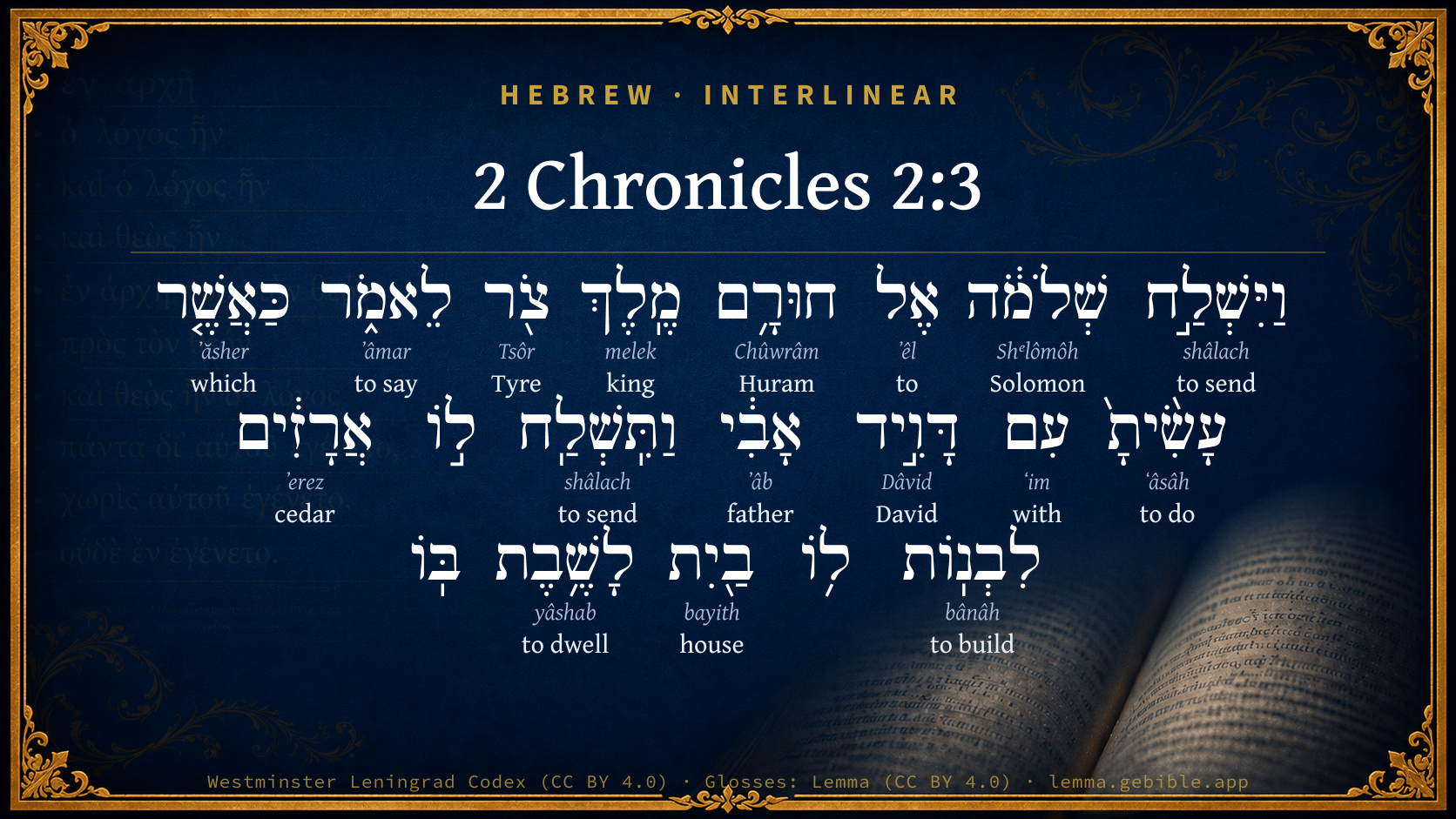
2 Chronicles 2:3

Hebrew (Westminster Leningrad Codex) 2 Chronicles 2:3 appears in the Hebrew Old Testament. The text above is from the Westminster Leningrad Codex. Each word links to its Strong’s number, a concise gloss, and parsing drawn from the Open Scriptures Hebrew Bible morphology. Click any word for its full Brown-Driver-Briggs (BDB) entry.
Download image
Cite this verse

2 Chronicles 2:3 (World English Bible). Public Domain. Lemma interlinear Bible study tool, https://lemma.gebible.app/v/2-chronicles/2/3.

Show BibTeX & RIS
BibTeX
RIS
English Translation
Solomon sent to Huram the king of Tyre, saying, As you dealt with David my father, and sent him cedars to build him a house in which to dwell, [even so deal with me].
World English Bible · Public Domain
Download a study sheet

One document with this verse’s original text, its word-by-word gloss line, the meaning frame, cross-references with their text, attributed commentary, and full source and license credits — printable, and it pastes into notes with its structure intact.

This verse Autodidact and up

Study sheet (.html) Plain text (.txt)

A passage Seminary Student

Up to 50 verses in one chapter. A passage sheet keeps up to 6 commentary sources and 12 cross-references per verse, in the order this page ranks them, and says so on the sheet whenever that leaves anything out. Ask for a single verse and you get the Autodidact verse sheet above.

Everything on this page stays free to read, with no account — the sheet is a download of what is already on screen, not access to it.

Want to remove ads? Support Godless Engineer
Compare translations 3

The same verse in 3 English versions, stacked beneath the original-language interlinear above. Click any original word for its lexicon entry.

Each is an independent rendering of the whole verse — the interlinear is not word-aligned to these translations.

Highlighted words mark where these versions differ — a whole-verse word diff, not a word-by-word alignment.

  • World English Bible Public Domain
    Solomon sent to Huram the king of Tyre, saying, As you dealt with David my father, and sent him cedars to build him a house in which to dwell, [even so deal with me].
  • King James Version Public Domain
    And Solomon sent to Huram the king of Tyre, saying, As thou didst deal with David my father, and didst send him cedars to build him an house to dwell therein, even so deal with me.
  • unfoldingWord Literal Text CC BY-SA 4.0
    And Solomon sent to Hiram, the king of Tyre, saying, “Just as you did with David my father and sent to him cedars to build for himself a house to dwell in it.

unfoldingWord Literal Text — © unfoldingWord, licensed CC BY-SA 4.0. Word-aligned USFM3 via Door43 (git.door43.org/unfoldingWord/en_ult).

Versions to compare (up to 4)

3 of 4 selected

Show all 18 translations

Every available English version of this verse, each an independent rendering of the whole verse.

  • World English Bible Public Domain
    Solomon sent to Huram the king of Tyre, saying, As you dealt with David my father, and sent him cedars to build him a house in which to dwell, [even so deal with me].
  • Berean Standard Bible Public Domain
    Then Solomon sent word to Hiram king of Tyre: “Do for me as you did for my father David when you sent him cedars to build himself a house to live in.
  • Majority Standard Bible Public Domain
    Then Solomon sent word to Hiram king of Tyre: “Do for me as you did for my father David when you sent him cedars to build himself a house to live in.
  • King James Version Public Domain
    And Solomon sent to Huram the king of Tyre, saying, As thou didst deal with David my father, and didst send him cedars to build him an house to dwell therein, even so deal with me.
  • American Standard Version (1901) Public Domain
    And Solomon sent to Huram the king of Tyre, saying, As thou didst deal with David my father, and didst send him cedars to build him a house to dwell therein, `even so deal with me'.
  • Revised Version (1885) Public Domain
    And Solomon sent to Huram the king of Tyre, saying, As thou didst deal with David my father, and didst send him cedars to build him an house to dwell therein, even so deal with me.
  • Geneva Bible (1599) Public Domain
    And Salomon sent to Huram the king of Tyrus, saying, As thou hast done to Dauid my father, and didst sende him cedar trees to buylde him an house to dwell in, so do to me.
  • Douay-Rheims (1899) Public Domain
    He sent also to Hiram king of Tyre, saying: As thou didst with David my father, and didst send him cedars, to build him a house, in which he dwelt:
  • Young's Literal Translation Public Domain
    And Solomon sendeth unto Huram king of Tyre, saying, `When thou hast dealt with David my father, then thou dost send to him cedars to build for him a house to dwell in;
  • Literal Standard Version CC BY-SA 4.0
    And Solomon sends to Huram king of Tyre, saying, “When you have dealt with my father David, then you send cedars to him to build a house for him to dwell in;
  • Unlocked Literal Bible CC BY-SA 4.0
    Solomon sent a message to Hiram, the king of Tyre, saying, “As you did with David my father, sending him cedar logs to build a house to live in, do the same with me.
  • unfoldingWord Literal Text CC BY-SA 4.0
    And Solomon sent to Hiram, the king of Tyre, saying, “Just as you did with David my father and sent to him cedars to build for himself a house to dwell in it.
  • Darby Bible Public Domain
    And Solomon sent to Huram king of Tyre, saying, As thou didst deal with David my father, and didst send him cedars to build him a house to dwell therein [so do for me].
  • World Messianic Bible Public Domain
    Solomon sent to Huram the king of Tyre, saying, “As you dealt with David my father, and sent him cedars to build him a house in which to dwell, so deal with me.
  • Webster's Bible Public Domain
    And Solomon sent to Huram the king of Tyre, saying, As thou didst deal with David my father, and didst send him cedars to build him a house to dwell in it, even so deal with me.
  • Free Bible Version CC BY-SA 4.0
    Solomon sent a message to Hiram, king of Tyre, telling him,
  • Bible in Basic English Public Domain
    And Solomon sent to Huram, king of Tyre, saying, As you did for my father David, sending him cedar-trees for the building of his house,
  • JPS Tanakh (1917) Public Domain
    (2-2) And Solomon sent to Huram the king of Tyre, saying: 'As thou didst deal with David my father, and didst send him cedars to build him a house to dwell therein, even so deal with me.

Literal Standard Version (2020), Covenant Press — licensed CC BY-SA 4.0. Text via the HelloAO Bible API (eBible.org). Unlocked Literal Bible (unfoldingWord) — licensed CC BY-SA 4.0. Text via the HelloAO Bible API (eBible.org). unfoldingWord Literal Text — © unfoldingWord, licensed CC BY-SA 4.0. Word-aligned USFM3 via Door43 (git.door43.org/unfoldingWord/en_ult). Free Bible Version, Dr. Jonathan Gallagher — licensed CC BY-SA 4.0. Text via the HelloAO Bible API (eBible.org).

Word by word

More ways to search: Search by grammar → Find every occurrence → Compare this word →

Practice this passage: Drill this verse → Learn its vocabulary →

חוּרָ֥ם
Chûwrâm
H2361
“Huram”
Noun, Proper
Part of Speech
Noun
Type
Proper
Full BDB Definition

Origin: probably from H2353

TWOT: None

Huram = "noble born" - son of Bela and grandson of Benjamin - king of Tyre allied with David and Solomon; alternate spelling for 'Hiram' - a chief architect of Solomon's temple; alternate spelling for 'Hiram'
  1. וַיִּשְׁלַ֣ח shâlach H7971 “and · to send” Conjunction + Verb, Qal, Sequential Imperfect, 3rd Person, Masculine, Singular
  2. שְׁלֹמֹ֔ה Shᵉlômôh H8010 “Solomon” Noun, Proper
  3. אֶל ʼêl H413 “to” Preposition
  4. מֶֽלֶךְ melek H4428 “king of” Noun, Common, Masculine, Singular, Construct
  5. צֹ֖ר Tsôr H6865 “Tyre” Noun, Proper
  6. לֵאמֹ֑ר ʼâmar H559 “to say” Preposition + Verb, Qal, Infinitive Construct
  7. כַּאֲשֶׁ֤ר ʼăsher H834 “like/as · which” Preposition + Particle, Relative
  8. עָשִׂ֨יתָ֙ ʻâsâh H6213 “to do” Verb, Qal, Perfect, 2nd Person, Masculine, Singular
  9. עִם ʻim H5973 “with” Preposition
  10. דָּוִ֣יד Dâvid H1732 “David” Noun, Proper
  11. אָבִ֔י ʼâb H1 “father · my” Noun, Common, Masculine, Singular, Construct + Suffix, Personal, 1st Person, Common, Singular
  12. וַתִּֽשְׁלַֽח shâlach H7971 “and · to send” Conjunction + Verb, Qal, Sequential Imperfect, 2nd Person, Masculine, Singular
  13. אֲרָזִ֔ים ʼerez H730 “cedars” Noun, Common, Masculine, Plural, Absolute
  14. לִבְנֽוֹת bânâh H1129 “to build” Preposition + Verb, Qal, Infinitive Construct
  15. בַ֖יִת bayith H1004 “house” Noun, Common, Masculine, Singular, Absolute
  16. לָשֶׁ֥בֶת yâshab H3427 “to dwell” Preposition + Verb, Qal, Infinitive Construct

About this verse

These counts appear in no published source. They are computed here, from the morphology-tagged text and Lemma’s own curated glosses. What Lemma adds →

20
words
16
distinct lemmas
Historical
section

Notable vocabulary

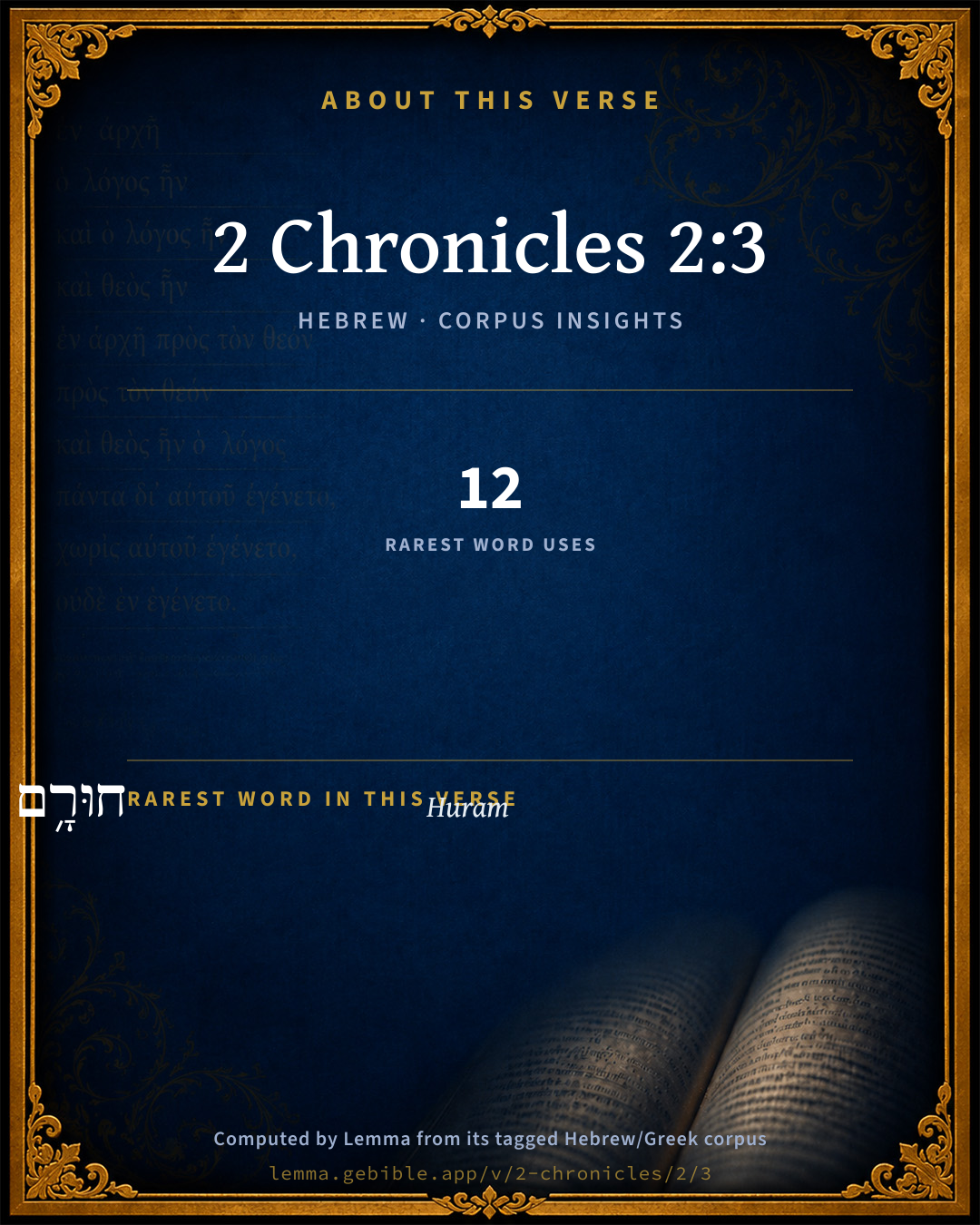
The rarest word here is חוּרָ֥ם Huram H2361 — appearing just 12 times in the whole Hebrew Bible.

Shared distinctive vocabulary

חוּרָ֥ם Huram H2361 occurs in 11 verses of the Hebrew Bible. Also found in:

Grammatical profile

  • 6 verbs
  • 8 nouns
  • 5 prepositions
  • 1 particle

Verb forms

  • וַיִּשְׁלַ֣ח Qal · Sequential Imperfect
  • לֵאמֹ֑ר Qal · Infinitive Construct
  • עָשִׂ֨יתָ֙ Qal · Perfect
  • וַתִּֽשְׁלַֽח Qal · Sequential Imperfect
  • לִבְנֽוֹת Qal · Infinitive Construct
  • לָשֶׁ֥בֶת Qal · Infinitive Construct

Repetition

A word recurs within this verse — often emphatic in Hebrew:

  • וַיִּשְׁלַ֣ח to send H7971 ×2

Hebrew & Septuagint length

In English translation the verse runs 34 words from the Hebrew and 32 from the Septuagint (LXX English) — closely comparable.

A rough comparison of the two English renderings, which tokenize alike — not a word-level alignment.

Word counts can differ between the Hebrew and the Greek without any difference in meaning — e.g. the Hebrew direct-object marker אֵת has no separate Greek word, and Greek often adds the article ὁ.

Cross-references

3

Topical passages linked to 2 Chronicles 2:3 in the Treasury of Scripture Knowledge — connected by theme and wording, ordered by reader-vote popularity; previews shown in the World English Bible.

  • 1 Chronicles 14:1 Hiram king of Tyre sent messengers to David, and cedar trees, and masons, and carpenters, to build him a house.
  • 2 Samuel 5:11 Hiram king of Tyre sent messengers to David, and cedar trees, and carpenters, and masons; and they built David a house.
  • 1 Kings 5:1–11 Hiram king of Tyre sent his servants to Solomon; for he had heard that they had anointed him king in the room of his father: for Hiram was ever a lover of David.

Cross-references courtesy of OpenBible.info (CC BY 4.0).

Hebrew and Greek witnesses Masoretic Hebrew ↔ Greek Septuagint

The same verse in the two great witnesses to the Old Testament, shown verse-for-verse.

These are two independent witnesses, not word-aligned to each other, and the Septuagint is shown in lemma (dictionary) form.

Hebrew 2 Chronicles 2:3 Masoretic · Westminster Leningrad Codex

וַיִּשְׁלַ֣ח שְׁלֹמֹ֔ה אֶל חוּרָ֥ם מֶֽלֶךְ צֹ֖ר לֵאמֹ֑ר כַּאֲשֶׁ֤ר עָשִׂ֨יתָ֙ עִם דָּוִ֣יד אָבִ֔י וַתִּֽשְׁלַֽח ל֣וֹ אֲרָזִ֔ים לִבְנֽוֹת ל֥וֹ בַ֖יִת לָשֶׁ֥בֶת בּֽוֹ

Solomon sent to Huram the king of Tyre, saying, As you dealt with David my father, and sent him cedars to build him a house in which to dwell, [even so deal with me].

World English Bible · Public Domain

Greek LXX 2 Chronicles 2:3 Septuagint · lemma form

καί ἰδού ἐγώ ὁ υἱός αὐτός οἰκοδομέω οἶκος ὁ ὄνομα κύριος θεός ἐγώ ἁγιάζω αὐτός αὐτός ὁ θυμιάω ἀπέναντι αὐτός θυμίαμα καί πρόθεσις διά πᾶς καί ὁ ἀναφέρω ὁλοκαύτωμα διά πᾶς ὁ πρωί καί ὁ δείλη καί ἐν ὁ σάββατον καί ἐν ὁ νουμηνία καί ἐν ὁ ἑορτή ὁ κύριος θεός ἐγώ εἰς ὁ αἰών οὗτος ἐπί ὁ ἰσραήλ

And Solomon sent to Chiram king of Tyre, saying, Whereas you did deal favourably with David my father, and did send him cedars to build for himself a house to dwell in,

LXX2012 (modern English Septuagint) · Public Domain

On this verse, The Pulpit Commentary discusses the Septuagint’s reading. Read the note in Commentary ↓

Hebrew: Westminster Leningrad Codex (CC BY 4.0). Greek: Septuagint (public domain); English from LXX2012 (modern English Septuagint) (Public Domain). How the Septuagint differs from the Hebrew →

Commentary

Notes on 2 Chronicles 2:3 from classic Christian and Jewish commentators (each source and its license shown beneath its notes). The classic Christian expositions comment on the surrounding passage and are grouped to its opening verse, so a note may address several verses; the Jewish commentaries on the Tanakh (Rashi and others) are per-verse, so they appear only where the commentator wrote on this verse.

Lemma curates 59 commentaries, every one of them public domain or Creative Commons licensed, each selected and text-cleaned for this edition rather than reprinted as found. About our sources →

Jamieson, Fausset & Brown

Robert Jamieson, A. R. Fausset & David Brown

HIS MESSAGE TO HURAM FOR SKILFUL ARTIFICERS. (Ch2 2:3-10)

Solomon sent to Huram--The correspondence was probably conducted on both sides in writing (Ch2 2:11; also see on Kg1 5:8).

As thou didst deal with David my father--This would seem decisive of the question whether the Huram then reigning in Tyre was David's friend (see on Kg1 5:1-6). In opening the business, Solomon grounded his request for Tyrian aid on two reasons: 1. The temple he proposed to build must be a solid and permanent building because the worship was to be continued in perpetuity; and therefore the building materials must be of the most durable quality. 2. It must be a magnificent structure because it was to be dedicated to the God who was greater than all gods; and, therefore, as it might seem a presumptuous idea to erect an edifice for a Being "whom the heaven and the heaven of heavens do not contain," it was explained that Solomon's object was not to build a house for Him to dwell in, but a temple in which His worshippers might offer sacrifices to His honor. No language could be more humble and appropriate than this. The pious strain of sentiment was such as became a king of Israel.

Jamieson, Fausset & Brown — Commentary Critical and Explanatory on the Whole Bible (1871) — public domain (CC PDM 1.0). Text via the HelloAO Bible API.

Trapp's Complete Commentary

John Trapp

2Ch 2:3 And Solomon sent to Huram the king of Tyre, saying, As thou didst deal with David my father, and didst send him cedars to build him an house to dwell therein, [even so deal with me].

Ver. 3. And Solomon sent to Huram.] See on 1Ki 5:1.

As thou didst deal with David my father.] By this thankful acknowledgment he seeketh to ingratiate. Gratiarum actio est ad plus dandum invitatio.

John Trapp, A Commentary or Exposition upon All the Books of the Old and New Testament (1647–1656) — public domain. Text from a community e-Sword module.

Joseph Benson's Commentary

2Ch 2:3. And Solomon sent to Huram — Or Hiram, as he is called in the first book of Kings where we learn that he first sent to Solomon to congratulate him on his accession to the throne, and then Solomon sent to him.

Joseph Benson's Commentary on the Old and New Testaments (1811–1818) — public domain. Text from a community e-Sword module.

Geneva Bible (1599)

Geneva Bible translators

Or, Hiram.

Geneva Bible (1599) marginal notes — public domain. Text via Bolls.life.

Adam Clarke's Commentary

Verse 3. Solomon sent to Huram] This man's name is written חירם Chiram in Kings; and in Chronicles, חורם Churam: there is properly no difference, only a י yod and a ו vau interchanged. See on 1Kg 5:2.

Adam Clarke's Commentary on the Bible (1810–1826) — public domain. Text from a community e-Sword/MySword module.

Ellicott's Commentary for English Readers

(3) And Solomon sent to Huram.—Comp. 1Ki_5:2-11, from which we learn that Huram or Hiram had first sent to congratulate Solomon upon his accession. The account here agrees generally with the parallel passage of the older work. The variations which present themselves only prove that the chronicler has made independent use of his sources.

Huram.—In Kings the name is spelt Hiram (1Ki_5:1-2; 1Ki_5:7) and Hirom (1Ki_5:10; 1Ki_5:18, Hebr.). (Comp. 1Ch_14:1.) Whether the Tyrian name Sirômos (Herod. vii. 98) is another form of Hiram, as Bertheau supposes, is more than doubtful. It is interesting to find that the king of Tyre bore this name in the time of Tiglath-pileser II., to whom he paid tribute (B.C. 738), along with Menahem of Samaria. (Assyr. Hi-ru-um-mu, to which the Hîrôm of 1Ki_5:10; 1Ki_5:18 comes very near.)

As thou didst deal . . . dwell therein.—See 1Ch_14:1. The sense requires the clause, added by our translators, in italics, “Even so deal with me,” after the Vulg. “sic fac mecum.” 1Ki_5:3 makes Solomon refer to the wars which hindered David from building the Temple.

A Bible Commentary for English Readers, edited by Charles John Ellicott (1878–1897) — public domain. Text from a community e-Sword module.

The Cambridge Bible for Schools and Colleges

gen. ed. J. J. S. Perowne

3. Huram] Another form of Hiram (1Ki_5:1 [15, Heb.]) which is a shortened form of Ahiram (Hebrew, Aḥ “brother” and râm “exalted”). Yet another form is Hirom (1Ki_5:10; see R.V. mg.). The Phœnician language is written with even fewer vowel signs than are found in ancient Hebrew; hence the uncertainty in the form of this name.

didst send him cedars] See 1Ch_14:1 = 2Sa_5:11.

3–10 [2–9, Heb.] (= 1Ki_5:2-6). Solomon’s Message to Huram

This passage is much fuller in Chron. than in 1 Kings, which offers no parallel to Solomon’s language with regard to the Temple; 2Ch_2:4-6. Again 2Ch_2:7 (the request for a “cunning man”) has no nearer parallel than 1Ki_7:13. For 2Ch_2:10 also there is no strict parallel in 1 Kings.

The Cambridge Bible for Schools and Colleges (gen. ed. J. J. S. Perowne; Cambridge University Press, 1878–1918) — public domain. Text from a community e-Sword module.

John Gill's Exposition

Behold, I build an house to the name of the Lord my God,.... Am about to do it, and determined upon it, see Ch2 2:1,

to dedicate it to him; to set it apart for sacred service to him:

and to burn before him sweet incense; on the altar of incense:

and for the continual shewbread; the loaves of shewbread, which were continually on the shewbread table; which, and the altar of incense, both were set in the holy place in the tabernacle, and so to be in the temple:

and for the burnt offerings morning and evening; the daily sacrifice: on the sabbaths, and on the new moons, and on the solemn feasts of the Lord our God: at which seasons, besides the daily sacrifice, additional burnt offerings were offered, and all on the brasen altar in the court: this is an ordinance

for ever unto Israel: to offer the above sacrifices, even for a long time to come, until the Messiah comes; and therefore Solomon suggests, as Jarchi and Kimchi think, that a good strong house ought to be built.

John Gill's Exposition of the Whole Bible (1746–1763) — public domain (CC PDM 1.0). Text via the HelloAO Bible API.

Albert Barnes' Notes on the Bible

Huram, the form used throughout Chronicles (except 1Ch 14:1) for the name both of the king and of the artisan whom he lent to Solomon 2Ch 2:13; 2Ch 4:11, 2Ch 4:16, is a late corruption of the true native word, Hiram (marginal note and reference).

Albert Barnes' Notes on the Bible (1834–1885) — public domain. Text from a community e-Sword/MySword module.

Matthew Poole's English Annotations

Which words may be commodiously understood from the nature of the thing, and from the following words, such ellipses being frequent in the Hebrew. Or, without any ellipsis, the sense, being here suspended, is completed 2Ch 2:7, so send me, &c., the 4th, 5th, and 6th verses being inserted by way of parenthesis, to usher in and enforce his following request.

Matthew Poole's English Annotations on the Holy Bible (1683–1685) — public domain. Text from a community e-Sword/MySword module.

Whedon's Commentary on the Bible

Daniel D. Whedon

3. Huram — The original and more correct form of the name was Hiram. Comp. 2Sa_5:11.

Daniel D. Whedon (gen. ed.), Commentary on the Old and New Testaments (1874–1909) — public domain. Text from a community e-Sword module.

The Pulpit Commentary

Huram. So the name is spelt, whether of Tyrian king or Tyrian workman, in Chronicles, except, perhaps, in 1Ch_14:1. Elsewhere the name is written yhi, or sometimes instead of Geseuius draws attention to Josephus"s Greek rendering of the name, Eirwmov, with whom agree Menander, a historian of Ephesus, in a fragment respecting Hiram (Josephus, "Contra Apion," 1:18); and Dius, a fragment of whose history of the Phoenicians telling of Solomon and Hiram, Josephus also is the means of preserving ("Contra Apion,"1:17). The Septuagint write the name Ciram; the Alexandrian, Ceiram; the Vulgate, Hiram. The name of Hiram"s father was Abibaal. Hiram himself began to reign, according to Menander, when nineteen years of age, reigned thirty-four years (B.C. 1023-990), and died therefore at the age of fifty-three. Of Hiram and his reign in Tyre very little is known beyond what is so familiar to us from the Bible history of David and Solomon. The city of Tyre is among the most ancient. Though it is not mentioned in Homer, yet the Sidonians, who lived in such close connection with the Tyrians, are mentioned there ("Iliad.," 6:290; 23. 743; "Odys., " 4:84; 22:424), whilst Virgil calls Tyre the Sidonian city, Sidon being twenty miles distant ("AEn.," 1:12, 677; 4:545). The modern name of Tyre is Sur. The city was situate on the east coast of the Mediterranean, in Phoenicia, about seventy-four geographical miles north of Joppa, while the road distance from Joppa to Jerusalem was thirty-two miles. The first Bible mention of Tyre is in Jos_19:29. After that the more characteristic mentions of it are 2Sa_5:11, with all its parallels; 2Sa_24:7 Isa_23:1, 7 Eze_26:2 Eze_27:1-8; Zec_9:2, Zec_9:3. Tyre was celebrated for its working in copper and brass, and by no means only for its cedar and timber felling. The good terms and intimacy subsisting between Solomon and the King of Tyre speak themselves very plainly in Bible history, without leaving us dependent on doubtful history, or tales of such as Josephus ("Ant.," 8:5. "Contra Apion," 1:17). For the timber, metals, workmen, given by Hiram to Solomon, Solomon gave to Hiram corn and oil, ceded to him some cities, and the use of some ports on the Red Sea (1Ki_9:11-14, 1Ki_9:25-28; 1Ki_10:21-23. See also 1Ki_16:31) As thou didst deal with David and didst send him cedars. To this vers. 7 and 8 are the apodosis manifestly, while vers. 4, 5, 6 should be enclosed in brackets.

The Pulpit Commentary (1880–1919), ed. H.D.M. Spence-Jones & Joseph S. Exell — public domain. Text from a community e-Sword module.

Rashi

Rabbi Shlomo Yitzchaki (Rashi)

to devote to Him for some purpose.

to burn before Him incense which is a way of honor[ing Him], and this is repeated further (verse 5): “but to burn incense before Him.”

making this permanent over Israel Therefore, I request of you to send to me [material] for a good and strong House, because it is required perpetually for Israel to offer up their sacrifice(s) in this House, which I am building.

Rashi on the Tanakh — English translations: “The Judaica Press complete Tanach with Rashi, translated by A. J. Rosenberg” (CC BY 4.0); “Pentateuch with Rashi's commentary by M. Rosenbaum and A.M. Silbermann, 1929-1934” (public domain); “The Metsudah Tanach series, Lakewood, N.J” (CC BY 4.0); and “The Book of Joshua, Metsudah Publications, 1997” (CC BY 4.0). Text via Sefaria.

Lesson kit

Teaching starters — assembled from the data on this page, not authored interpretation. Every prompt links to the verse data it draws on. Edit before teaching.

2 Chronicles, in the Historical, opens this verse with 20 words (16 distinct Hebrew lemmas). Its most distinctive word is Chûwrâm (“Huram”). A historical commentator’s framing appears above. Read the whole chapter for the surrounding context.

Discussion questions

  1. What does “Huram” (Chûwrâm) contribute to the verse as a whole?
  2. How does 1 Chronicles 8:5, which shares the word «Huram», read alongside this verse?
  3. What does the repetition of “to send” (2× in this one verse) do in this verse?
  4. These translations render this verse differently. What is at stake in choosing one wording over another?
  5. «וַיִּשְׁלַ֣ח» is a Qal Sequential Imperfect verb. How does that grammatical form shape the action described?
  6. Compare how Jamieson, Fausset & Brown and Trapp's Complete Commentary read this verse. Where do they agree or differ?

Things to notice

Reading settings

Reading text

Shown beneath each verse's original-language words.

Old Testament
Old Testament edition

Read the OT as the Masoretic Hebrew (MT) or the Greek Septuagint (LXX).

English shown for the Greek Septuagint (in the Hebrew ↔ Greek comparison).

Comparing translations? Open the Compare panel on any verse page to stack up to four side by side.