Psalms 18:50

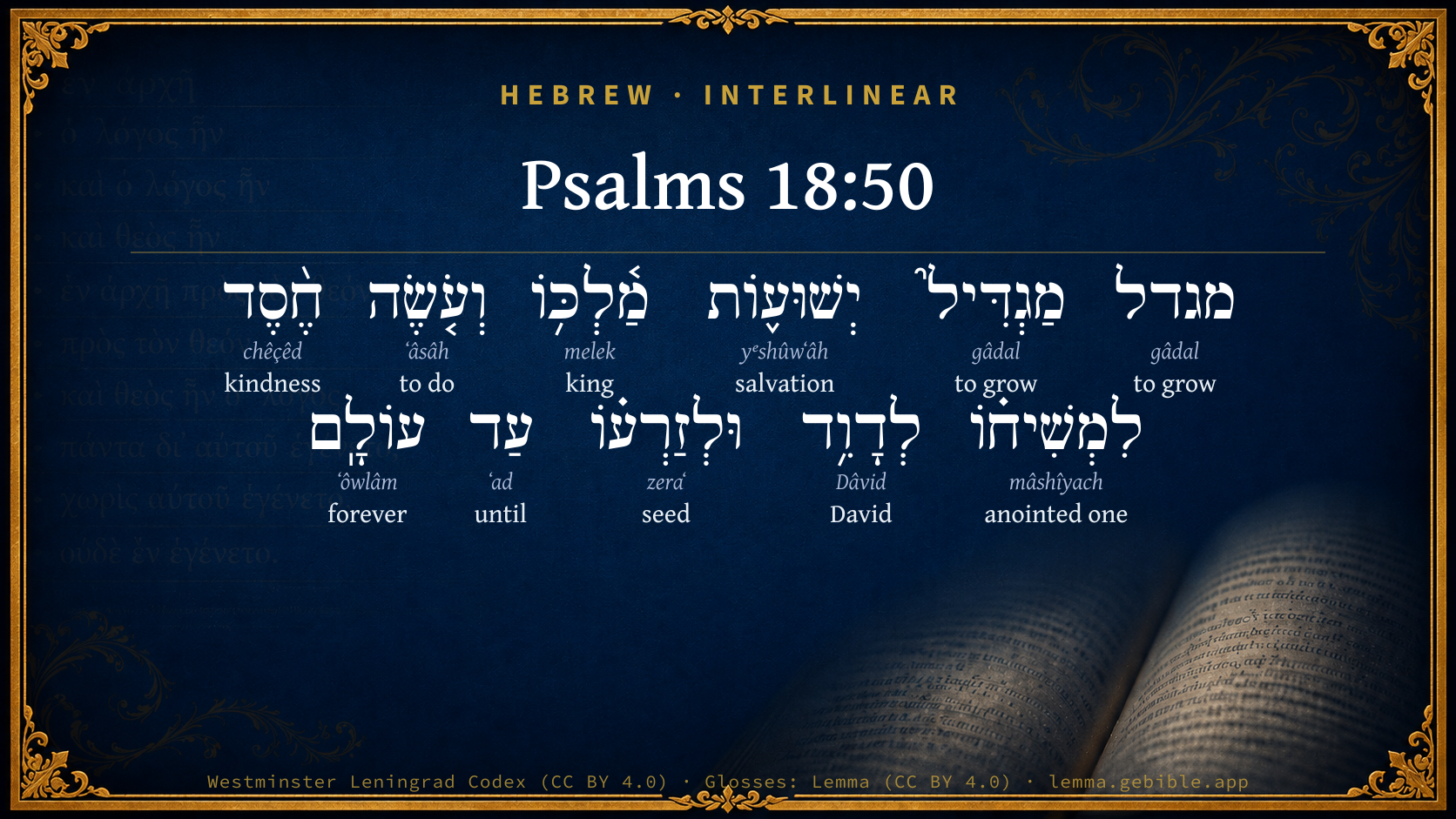
Hebrew (Westminster Leningrad Codex) Psalms 18:50 appears in the Hebrew Old Testament. The text above is from the Westminster Leningrad Codex. Each word links to its Strong’s number, a concise gloss, and parsing drawn from the Open Scriptures Hebrew Bible morphology. Click any word for its full Brown-Driver-Briggs (BDB) entry.
Download image
Cite this verse

Psalms 18:50 (World English Bible). Public Domain. Lemma interlinear Bible study tool, https://lemma.gebible.app/v/psalms/18/50.

Show BibTeX & RIS
BibTeX
RIS
English Translation
He gives great deliverance to his king, And shows loving kindness to his anointed, To David and to his seed, forevermore.
World English Bible · Public Domain
Download a study sheet

One document with this verse’s original text, its word-by-word gloss line, the meaning frame, cross-references with their text, attributed commentary, and full source and license credits — printable, and it pastes into notes with its structure intact.

This verse Autodidact and up

Study sheet (.html) Plain text (.txt)

A passage Seminary Student

Up to 50 verses in one chapter. A passage sheet keeps up to 6 commentary sources and 12 cross-references per verse, in the order this page ranks them, and says so on the sheet whenever that leaves anything out. Ask for a single verse and you get the Autodidact verse sheet above.

Everything on this page stays free to read, with no account — the sheet is a download of what is already on screen, not access to it.

Want to remove ads? Support Godless Engineer
Compare translations 3

The same verse in 3 English versions, stacked beneath the original-language interlinear above. Click any original word for its lexicon entry.

Each is an independent rendering of the whole verse — the interlinear is not word-aligned to these translations.

Highlighted words mark where these versions differ — a whole-verse word diff, not a word-by-word alignment.

  • World English Bible Public Domain
    He gives great deliverance to his king, And shows loving kindness to his anointed, To David and to his seed, forevermore.
  • King James Version Public Domain
    Great deliverance giveth he to his king; and sheweth mercy to his anointed, to David, and to his seed for evermore.
  • unfoldingWord Literal Text CC BY-SA 4.0
    the one magnifying the salvation of his king and doing covenant faithfulness to his anointed, to David, and to his seed until forever.”

unfoldingWord Literal Text — © unfoldingWord, licensed CC BY-SA 4.0. Word-aligned USFM3 via Door43 (git.door43.org/unfoldingWord/en_ult).

Versions to compare (up to 4)

3 of 4 selected

Show all 18 translations

Every available English version of this verse, each an independent rendering of the whole verse.

  • World English Bible Public Domain
    He gives great deliverance to his king, And shows loving kindness to his anointed, To David and to his seed, forevermore.
  • Berean Standard Bible Public Domain
    Great salvation He brings to His king. He shows loving devotion to His anointed, to David and his descendants forever.
  • Majority Standard Bible Public Domain
    Great salvation He brings to His king. He shows loving devotion to His anointed, to David and his descendants forever.
  • King James Version Public Domain
    Great deliverance giveth he to his king; and sheweth mercy to his anointed, to David, and to his seed for evermore.
  • American Standard Version (1901) Public Domain
    Great deliverance giveth he to his king, And showeth lovingkindness to his anointed, To David and to his seed, for evermore. Psalm 19 For the Chief Musician. A Psalm of David.
  • Revised Version (1885) Public Domain
    Great deliverance giveth he to his king; and sheweth lovingkindness to his anointed, to David and to his seed, for evermore.
  • Geneva Bible (1599) Public Domain
    Great deliuerances giueth hee vnto his King, and sheweth mercie to his anoynted, euen to Dauid, and to his seede for euer.
  • Douay-Rheims (1899) Public Domain
    Therefore will I give glory to thee, O Lord, among the nations, and I will sing a psalm to thy name.
  • Young's Literal Translation Public Domain
    Magnifying the salvation of His king, And doing kindness to His anointed, To David, and to his seed -- unto the age!
  • Literal Standard Version CC BY-SA 4.0
    Magnifying the salvation of His king, || And doing kindness to His anointed, || To David, and to his seed—for all time!
  • Unlocked Literal Bible CC BY-SA 4.0
    God gives great victory to his king, and he shows his covenant loyalty to his anointed one, to David and to his descendants forever.
  • unfoldingWord Literal Text CC BY-SA 4.0
    the one magnifying the salvation of his king and doing covenant faithfulness to his anointed, to David, and to his seed until forever.”
  • Darby Bible Public Domain
    [It is he] who giveth great deliverances to his king, and sheweth loving-kindness to his anointed, to David, and to his seed for evermore.
  • World Messianic Bible Public Domain
    He gives great deliverance to his king, and shows loving kindness to his anointed, to David and to his offspring, forever more.
  • Webster's Bible Public Domain
    \\18:49\\Therefore will I give thanks to thee, O LORD, among the heathen, and sing praises to thy name.
  • Free Bible Version CC BY-SA 4.0
    You have saved the king so often, showing your trustworthy love to David, your anointed, and to his descendants forever.
  • Bible in Basic English Public Domain
    Great salvation does he give to his king; he has mercy on the king of his selection, David, and on his seed for ever.
  • JPS Tanakh (1917) Public Domain
    (18-51) Great salvation giveth He to His king; and showeth mercy to His anointed, to David and to his seed, for evermore.

Literal Standard Version (2020), Covenant Press — licensed CC BY-SA 4.0. Text via the HelloAO Bible API (eBible.org). Unlocked Literal Bible (unfoldingWord) — licensed CC BY-SA 4.0. Text via the HelloAO Bible API (eBible.org). unfoldingWord Literal Text — © unfoldingWord, licensed CC BY-SA 4.0. Word-aligned USFM3 via Door43 (git.door43.org/unfoldingWord/en_ult). Free Bible Version, Dr. Jonathan Gallagher — licensed CC BY-SA 4.0. Text via the HelloAO Bible API (eBible.org).

Word by word

More ways to search: Search by grammar → Find every occurrence → Compare this word →

Practice this passage: Drill this verse → Learn its vocabulary →

לִמְשִׁיח֗וֹ
mâshîyach
H4899
“to/for · anointed one · his”
Preposition + Noun, Common, Masculine, Singular, Construct + Suffix, Personal, 3rd Person, Masculine, Singular
Part of Speech
Preposition + Noun
Type
Common
Gender
Masculine
Number
Singular
State
Construct
Full BDB Definition

Origin: from H4886

TWOT: 1255c

anointed, anointed one - of the Messiah, Messianic prince - of the king of Israel - of the high priest of Israel - of Cyrus - of the patriarchs as anointed kings
  1. מגדל gâdal H1431 “growing” Verb, Piel, Participle Active, Masculine, Singular, Absolute
  2. מַגְדִּיל֮ gâdal H1431 “growing” Verb, Hiphil, Participle Active, Masculine, Singular, Absolute
  3. יְשׁוּע֪וֹת yᵉshûwʻâh H3444 “deliverances of” Noun, Common, Feminine, Plural, Construct
  4. מַ֫לְכּ֥וֹ melek H4428 “king · his” Noun, Common, Masculine, Singular, Construct + Suffix, Personal, 3rd Person, Masculine, Singular
  5. וְעֹ֤שֶׂה ʻâsâh H6213 “and · doing” Conjunction + Verb, Qal, Participle Active, Masculine, Singular, Absolute
  6. חֶ֨סֶד chêçêd H2617 “kindness” Noun, Common, Masculine, Singular, Absolute
  7. לְדָוִ֥ד Dâvid H1732 “to/for · David” Preposition + Noun, Proper
  8. וּלְזַרְע֗וֹ zeraʻ H2233 “and · to/for · seed · his” Conjunction + Preposition + Noun, Common, Masculine, Singular, Construct + Suffix, Personal, 3rd Person, Masculine, Singular
  9. עַד ʻad H5704 “until” Preposition
  10. עוֹלָֽם ʻôwlâm H5769 “forever” Noun, Common, Masculine, Singular, Absolute

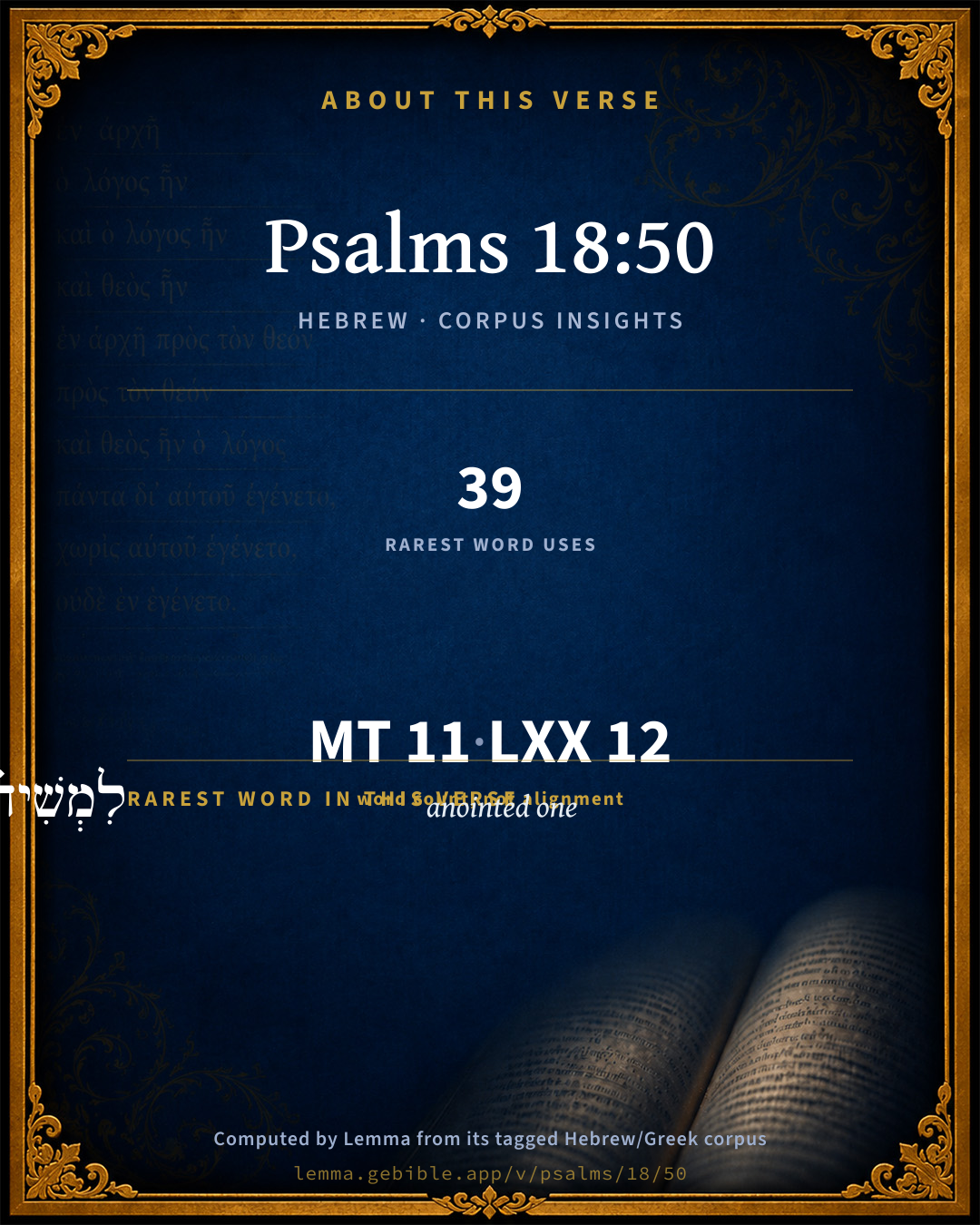
About this verse

These counts appear in no published source. They are computed here, from the morphology-tagged text and Lemma’s own curated glosses. What Lemma adds →

11
words
10
distinct lemmas
Wisdom
section

Shared distinctive vocabulary

לִמְשִׁיח֗וֹ anointed one H4899 occurs in 38 verses of the Hebrew Bible. Also found in:

Grammatical profile

  • 3 verbs
  • 7 nouns
  • 1 preposition

Verb forms

  • מגדל Piel · Participle Active
  • מַגְדִּיל֮ Hiphil · Participle Active
  • וְעֹ֤שֶׂה Qal · Participle Active

Repetition

A word recurs within this verse — often emphatic in Hebrew:

  • מגדל to grow H1431 ×2

Hebrew & Septuagint length

In English translation the verse runs 21 words from the Hebrew and 19 from the Septuagint (LXX English) — closely comparable.

A rough comparison of the two English renderings, which tokenize alike — not a word-level alignment.

Word counts can differ between the Hebrew and the Greek without any difference in meaning — e.g. the Hebrew direct-object marker אֵת has no separate Greek word, and Greek often adds the article ὁ.

In the original languages it is 11 Hebrew tokens and 12 Greek tokens — but the two are counted differently (Hebrew bundles its prefixes and suffixes into one token; the Greek is in lemma form), so that isn’t a like-for-like length.

Cross-references

19

Topical passages linked to Psalms 18:50 in the Treasury of Scripture Knowledge — connected by theme and wording, ordered by reader-vote popularity; previews shown in the World English Bible.

  • Psalms 144:10 You are he who gives salvation to kings, Who rescues David, his servant, from the deadly sword.
  • 2 Samuel 7:13 He shall build a house for my name, and I will establish the throne of his kingdom forever.
  • Psalms 89:3–4 "I have made a covenant with my chosen one, I have sworn to David, my servant,
  • Psalms 132:10 For your servant David's sake, Don't turn away the face of your anointed one.
  • Psalms 78:71–72 From following the ewes that have their young, He brought him to be the shepherd of Jacob, his people, And Israel, his inheritance.
  • Isaiah 9:6–7 For to us a child is born, to us a son is given; and the government shall be on his shoulder: and his name shall be called Wonderful, Counselor, Mighty God, Everlasting Father, Prince of Peace.
  • Luke 1:31–33 Behold, you will conceive in your womb, and bring forth a son, and will call his name 'Jesus.'
  • Acts 2:34–36 For David didn't ascend into the heavens, but he says himself, 'The Lord said to my Lord, "Sit by my right hand,
  • Romans 11:29 For the gifts and the calling of God are irrevocable.
  • Luke 1:69 And has raised up a horn of salvation for us in the house of his servant David
  • Galatians 3:16 Now the promises were spoken to Abraham and to his seed. He doesn't say, "To seeds," as of many, but as of one, "To your seed," which is Christ.
  • Philippians 2:9–11 Therefore God also highly exalted him, and gave to him the name which is above every name;
  • 1 Samuel 2:10 Those who strive with Yahweh shall be broken to pieces; Against them will he thunder in the sky: Yahweh will judge the ends of the earth; He will give strength to his king, Exalt the horn of his anointed.
  • 1 Chronicles 17:11–14 It shall happen, when your days are fulfilled that you must go to be with your fathers, that I will set up your seed after you, who shall be of your sons; and I will establish his kingdom.
  • 1 Chronicles 17:27 and now it has pleased you to bless the house of your servant, that it may continue forever before you: for you, Yahweh, have blessed, and it is blessed forever.
  • Psalms 2:6 "Yet I have set my king on my holy hill of Zion."
  • Psalms 89:20–38 I have found David, my servant. I have anointed him with my holy oil,
  • 1 Samuel 16:1 Yahweh said to Samuel, How long will you mourn for Saul, seeing I have rejected him from being king over Israel? fill your horn with oil, and go: I will send you to Jesse the Bethlehemite; for I have provided me a king among his sons.
  • Romans 1:3 concerning his Son, who was born of the seed of David according to the flesh,

Cross-references courtesy of OpenBible.info (CC BY 4.0).

Hebrew and Greek witnesses Masoretic Hebrew ↔ Greek Septuagint

The same verse in the two great witnesses to the Old Testament, shown verse-for-verse.

You’re reading Greek Psalm 17 (Hebrew Psalm 18). The Septuagint counts the superscription, so verse numbers can differ from the Hebrew — chapter-level alignment, not verse-by-verse. Numbering follows Rahlfs.

These are two independent witnesses, not word-aligned to each other, and the Septuagint is shown in lemma (dictionary) form.

Hebrew Psalms 18:50 Masoretic · Westminster Leningrad Codex

מגדל מַגְדִּיל֮ יְשׁוּע֪וֹת מַ֫לְכּ֥וֹ וְעֹ֤שֶׂה חֶ֨סֶד לִמְשִׁיח֗וֹ לְדָוִ֥ד וּלְזַרְע֗וֹ עַד עוֹלָֽם

He gives great deliverance to his king, And shows loving kindness to his anointed, To David and to his seed, forevermore.

World English Bible · Public Domain

Greek LXX Greek Psalm 17:50 Septuagint · lemma form

διά οὗτος ἐκὁμολογέω σύ ἐν ἔθνος κύριος καί ὁ ὄνομα σύ ψάλλω

God magnifies the deliverances of his king; and deals mercifully with David his anointed, and his seed, for ever.

LXX2012 (modern English Septuagint) · Public Domain

Hebrew: Westminster Leningrad Codex (CC BY 4.0). Greek: Septuagint (public domain); English from LXX2012 (modern English Septuagint) (Public Domain). How the Septuagint differs from the Hebrew →

Commentary

Notes on Psalms 18:50 from classic Christian and Jewish commentators (each source and its license shown beneath its notes). The classic Christian expositions comment on the surrounding passage and are grouped to its opening verse, so a note may address several verses; the Jewish commentaries on the Tanakh (Rashi and others) are per-verse, so they appear only where the commentator wrote on this verse.

Lemma curates 59 commentaries, every one of them public domain or Creative Commons licensed, each selected and text-cleaned for this edition rather than reprinted as found. About our sources →

Adam Clarke's Commentary

Verse 50. Great deliverance giveth he to his king] David was a king of God's appointment, and was peculiarly favoured by him. Literally, He is magnifying the salvations of his king. He not only delivers, but follows up those deliverances with innumerable blessings.

Showeth mercy - to David] I have no claim upon his bounty. I deserve nothing from him, but he continues to show mercy.

To his seed] His posterity. So the words זרע zera and σπερμα, in the Old and New Testament, should be universally translated. The common translation is totally improper, and now more so than formerly, when anatomy was less understood.

For evermore.] עד עולם ad olam, for ever; through all duration of created worlds. And more - the eternity that is beyond time. This shows that another David is meant, with another kind of posterity, and another sort of kingdom. From the family of David came the man Christ Jesus; his posterity are the genuine Christians; his kingdom, in which they are subjects, is spiritual. This government shall last through all time, for Christianity will continue to prevail till the end of the world: and it will be extended through eternity; for that is the kingdom of glory in which Jesus reigns on the throne of his Father, and in which his followers shall reign with him for ever and ever.

It has already been remarked that this whole Psalm has been understood as relating to the passion and victories of CHRIST, and the success of the Gospel in the earth. In this way Bishop Horne has understood and paraphrased it; and in the same way it is considered by the ancient Psalter, so often mentioned. Many of the primitive fathers and modern interpreters have taken the same view of it. Those passages which I judged to have this meaning I have pointed out, and have only to add that, as David was a type of Christ, many things spoken of him primarily, refer to our Lord ultimately; but much judgment and caution are required in their application. To apply the whole Psalm in this way appears to me very injudicious, and often derogatory from the majesty of Christ. Let this be my excuse for not following the same track in which many of my predecessors have gone.

ANALYSIS OF THE EIGHTEENTH PSALM

David's Επινικιον or song of triumph after his conquest of ail his enemies.

This Psalm may be divided into four parts: -

I. David shows what God is to his servants, and the effect it wrought upon him, Ps 18:1-3.

II. The great danger in which he was from the power and multitude of his enemies, Ps 18:4-28.

III. His glorious victories, and their consequences, Ps 18:29-45.

IV. His thanksgiving for those victories, Ps 18:46-50.

I. What God is to his servants, and to him especially. 1. Strength. 2. Rock. 3. Fortress. 4. Deliverer. 5. Tower. 6. Buckler. 7. Horn of salvation. 8. High tower, Ps 18:1; Ps 18:2. (See the notes.)

The effect it wrought in him. It produced, 1. Love: "I will love the Lord." 2. Confidence: "In him will I trust." 3. The spirit of prayer: "I will call on the Lord." The fruit of all which was his safety: "So shall I be saved from mine enemies," Ps 18:3.

II. The great dangers in which he was, and of his escape.

1. His danger was great; for, 1. He was encompassed with the sorrows of death. 2. Was terrified with the floods of ungodly men. 3. Surrounded by the sorrows of hell. And, 4. Prevented by the snares of death, Ps 18:4-5.

2. He shows how he behaved in these dangers, and from whom he sought for help: 1. "He called upon the Lord." 2. "He cried unto his God."

3. He shows the goodness of God to him, and his readiness to help him: 1. "He heard me out of his holy temple." 2. "My cry came into his ears."

4. The cause of his escape was the immediate hand of God, who testified his presence by many supernatural signs. 1. EARTHQUAKES: "The earth shook and trembled." 2. HILLS and mountains were moved from their places: "The hills moved," c., Ps 18:7. 3. SMOKE came out of his nostrils. 4. A consuming FIRE came out of his mouth and became permanent, for coals were kindled by it, Ps 18:8. 5. A THICK DARKNESS announced his presence; and the atmosphere was greatly confused: "He bowed the heavens; darkness was under his feet," Ps 18:9. 6. There were mighty winds and tempests: "He flew on the wings of the wind," Ps 18:10. 7. There were violent inundations, with blackness of the atmosphere, dark waters, thick clouds of the sky, Ps 18:11. 8. Great THUNDERS: "The Lord thundered; the Highest gave his voice." 9. There was great HAIL, and FIERY METEORS: "Hailstones and coals of fire," Ps 18:12; Ps 18:13. 10. Tremendous LIGHTNINGS, and fearful CHASMS opened in the earth: "He sent out," c., Ps 18:14; Ps 18:15.

5. He reckons up his deliverances, with the manner and causes: -

1. "He took, he drew me out of many waters," Ps 18:16.

2. He did this in a supernatural way: "He sent from above," ib.

6. He describes his enemies from whom God delivered him. 1. They were very numerous, compared to many waters, Ps 18:16: "He drew me out of many waters." 2. They were very strong. 3. Full of malice. 4. Too strong for him. 5. INSIDIOUS and CRUEL: 'They prevented me in the day of my calamity," Ps 18:17-18.

7. But God was his STAY: and the causes which moved God to help him were, 1. His own good will: "Because he delighted in me." 2. David's innocence which he declares, Ps 18:20-25.

8. And then, ab hypothesi, from his own particular case, he takes occasion to discourse in thesi, that this is not only true in David's person, but shall be verified in all that are upright as he was: which he proves from the nature and usual manner of God's proceedings with good and bad men, Ps 18:25-28.

III. David's glorious VICTORIES, and their CONSEQUENCES, Ps 18:28-46.

1. His victory he expresses and amplifies many ways:-

1. From the opposition which he conquered. Nor troops nor walls hindered, Ps 18:29.

2. From God's singular protection. He was his Buckler, his Rock.

3. From his armour. He was made fleet; and had military knowledge, strength, and defence, from God, Ps 18:33.

4. From his safety. He was not wounded in the battle.

5. From his success. He routed his enemies; they fled, and he pursued, Ps 18:37.

6. From the greatness of the victory. It was a complete conquest; for his enemies were taken, or consumed, or wounded, so as to be unable to rally. They fell under his feet; their necks were brought down, Ps 18:38-42.

7. From the cause. All was of God; he takes nothing to himself. THOU hast girded me. THOU hast subdued. THOU hast given me, c.

2. The consequences of these victories were the propagation and enlargement of David's kingdom:-

1. Before these victories there were murmurings and insurrections among his people: but now, being conqueror, they are all quiet: "Thou hast delivered me from the strivings of the people," Ps 18:43.

2. He was exalted to be head of the heathen: Moabites, Ammonites, c., served him, Ps 18:44.

3. People whom he had not known became tributary to him: "Aliens shall serve me," Ps 18:44.

4. This, it is true, they did out of fear, not affection. They dissembled in their fidelity and several fell off: but still they were obliged to submit, Ps 18:45.

IV. David's THANKSGIVING. This is the main scope of the Psalm to celebrate and extol the name and mercy of God for his victories. This has two parts: 1. His present thanksgiving. 2. His profession for the future.

1. He magnifies God: "The Lord liveth; and blessed be my Rock; and let the God of my salvation be exalted;" Ps 18:46. And to this end, in the two next verses, he makes mention again of his victories, and attributes the whole success to God, Ps 18:47-48.

2. He professes still to do it; he will not cease even among the heathen: "Therefore will I give thanks," Ps 18:49.

3. And he shows how much reason he had to do so: because, 1. He had great deliverances. 2. He was the man of God's choice; his king - his anointed. 3. This goodness was to survive him, and go to his posterity: "To David, and to his seed." 4. It was to have no end: it was to be for evermore, Ps 18:50.

Here the true David and the spiritual seed are referred to; and for this the reader is requested to examine the notes, and the remark before this analysis.

Adam Clarke's Commentary on the Bible (1810–1826) — public domain. Text from a community e-Sword/MySword module.

Trapp's Complete Commentary

John Trapp

Psa 18:50 Great deliverance giveth he to his king; and sheweth mercy to his anointed, to David, and to his seed for evermore.

Ver. 50. Great deliverance giveth he to his king] In Samuel it is, He is the tower of salvation for his king. This tower is Messias, say the Jewish doctors, Qui est turris salutis. Oh that those poor creatures would once run to that strong tower and be safe.

To David and to his seed for evermore] That is, to Christ (who was made of the seed of David, according to the flesh, Rom 1:3 Act 13:23), and to all faithful Christians, who are called Christ’s seed, Isa 53:10 Psa 72:17. Filiabitur nomine eius, the name of Christ shall endure for ever, it shall be begotten as one generation is begotten of another; there shall be a succession of it to the world’s end.

John Trapp, A Commentary or Exposition upon All the Books of the Old and New Testament (1647–1656) — public domain. Text from a community e-Sword module.

The Biblical Illustrator

Joseph S. Exell

Psa_18:50

Great deliverance giveth He to the King.

Great deliverances

This is Christs resurrection Psalm. It is a Psalm of deliverance or salvation--the two words are the same. This deliverance is one of love, power, and righteousness. The whole history of the Bible from beginning to end pertains to what God calls deliverance. First of all, we have King Davids history, the history of deliverance. Secondly, we have in Israels history a history of deliverance. Thirdly, in Messiahs history we have a history of deliverance. Fourthly, in the Churchs history we have a history of deliverance. And lastly, in the history of each individual man we have a history of deliverance. It is deliverance from first to last. (A. Bonar.)

.

Psa_19:1-14

The Biblical Illustrator, edited by Joseph S. Exell (c. 1880s–1900s) — public domain. Text from a community e-Sword module.

J. A. Alexander on Psalms

Joseph Addison Alexander

51. (Psa 18:50). Making great the salvations of his King, and doing kindness to his Anointed, to David, and to his seed unto eternity. We have here another instance of the favourite construction which connects a sentence with the foregoing context by means of a participle agreeing with the subject of a previous sentence; see above, Psa 18:31 (30), Psa 18:32 (31), Psa 18:33 (32), Psa 18:34 (33), Psa 18:49 (48). Making great salvations, saving often and signally. The plural form conveys the idea of fulness and completeness. As the phrase His Anointed might have seemed to designate David exclusively, he shews its comprehensive import by expressly adding David and his seed, from which it clearly follows that the Messiah or Anointed One here mentioned is a complex or ideal person, and that Jesus Christ, far from being excluded, is, in fact, the principal person comprehended, as the last and greatest of the royal line of the promises were especially given, in whom alone they are completely verified, and of whom alone the last words of this psalm could be uttered, in their true and strongest sense, without a falsehood or without absurdity. In this conclusion, as in other portions of the psalm, there is a clear though tacit reference to the promise in 2Sa 7:12-16; 2Sa 7:25-26, where several of the very same expressions are employed. Compare also Psa 28:8, Psa 84:10 (9), and Psalms 89, passim.

Another copy of this psalm is found recorded near the close of David's history (2 Sam. ch. 22.), which confirms the intimation in the title, that it was not composed in reference to any particular occasion, but in a general retrospection of the miseries of his whole life. The two texts often differ, both in form and substance, which has led some to suppose, that one is an erroneous transcript of the other. But this conclusion is for bidden by the uniform consistency of each considered in itself, as well as by the obvious indications of design in the particular variations, which may be best explained by supposing, that David himself, for reasons not recorded, prepared a twofold form of this sublime composition, which is the less improbable, as there are other unambiguous traces of the same process in the Old Testament, and in the writings of David himself. See below, the exposition of Psalms 53., and compare that of Isaiah, ch. 36—39. If this be a correct hypothesis, the two forms of the eighteenth psalm may be treated as distinct and independent compositions; and it has therefore been thought most advisable, both for the purpose of saving room and of avoiding the confusion which a parallel interpretation might have caused, to confine the exposition in this volume to that form of the psalm, which was preserved in the Psalter for permanent use in public worship, and which exhibits strong internal proofs of being the original or first conception, although both are equally authentic and inspired.

Joseph Addison Alexander, The Psalms Translated and Explained (1850) — public domain. Text from a community e-Sword module.

Tyndale Open Study Notes

Tyndale Open Resources

18:50 God appointed David, his anointed ruler, to bring order into God’s world (see Ps 2). Both David and his descendants received this responsibility.

Tyndale Open Study Notes — © Tyndale Open Resources, licensed CC BY-SA 4.0. Text via the HelloAO Bible API.

Geneva Bible (1599)

Geneva Bible translators

This did not properly appertain to Solomon, but to Jesus Christ.

Geneva Bible (1599) marginal notes — public domain. Text via Bolls.life.

John Calvin's Commentaries

50. He worketh great deliverances, etc This concluding verse clearly shows why God had exercised such goodness and liberality towards David, namely, because he had anointed him to be king. By calling himself God’s king, David testifies that he had not rashly rushed into that office, nor was thrust into it by conspiracies and wicked intrigues, but, on the contrary, reigned by lawful right, inasmuch as it was the will of God that he should be king. This he proves by the ceremony of anointing; for God, in anointing him by the hand of Samuel, had asserted his right to reign not less than if he had visibly stretched forth his hand from heaven to place and establish him on the royal throne. This election, he says, was confirmed by a continued series of great deliverances; and from this it follows, that all who enter on any course without having the call of God, are chargeable with avowedly making war against him. At the same time, he attributes these deliverances to the goodness of God as their cause, to teach us, that that kingdom was founded purely and simply upon the good pleasure of God. Farther, from the concluding sentence of the psalm, it appears, as I have said before, that David does not here so much recount by way of history the singular and varied instances of the grace of God which he had personally experienced, as predict the everlasting duration of his kingdom. And it is to be observed, that by the word seed we are not to understand all his descendants indiscriminately; but we are to consider it as particularly referring to that successor of David of whom God had spoken in 2 Samuel 7:12, promising that he would be a father to him. As it had been predicted that his kingdom would continue as long as the sun and the moon should shine in the heavens, the prophecy must necessarily be viewed as descending to him who was to be king not for a time, but for ever. David, therefore, commends his seed to us, as honored by that remarkable promise, which fully applies neither to Solomon nor to any other of his successors, but to the only begotten Son of God; as the apostle, in his Epistle to the Hebrews, (Hebrews 1:4,) teaches us, that this is a dignity in which he excels the angels. In conclusion, we shall then only duly profit in the study of this psalm, when we are led by the contemplation of the shadow and type to him who is the substance.

John Calvin's Commentaries (1540-1563) — public domain. Text from the Calvin Translation Society English edition (1840s-50s) via the Christian Classics Ethereal Library (ccel.org). Calvin's coverage is partial (roughly two-thirds of the Bible); uncommented books and verses are honest gaps, never fabricated. The 19th-century editor's footnotes and remarks are omitted so the notes are faithfully Calvin's own voice.

Ellicott's Commentary for English Readers

(50) This verse is by many treated as a late liturgical addition to the hymn. The change to the third person is certainly somewhat suggestive of this, but by no means conclusive.

The question of the relation of the two copies of this hymn to each other is far too complicated and difficult for discussion here. Each has been again and again claimed as the original. The best explanation of the variations is that the compositions were independent copies of some original, and that the psalm, like many others, was altered in preparation for the choir use.

A Bible Commentary for English Readers, edited by Charles John Ellicott (1878–1897) — public domain. Text from a community e-Sword module.

The Cambridge Bible for Schools and Colleges

gen. ed. J. J. S. Perowne

50. These closing words may be due to a later poet, who thus sums up the lessons of the Psalm. But they may well be David’s own. He drops the first person, and surveys his own life from without, in the light of the great promise of 2Sa_7:12-16. These are the deliverances Jehovah has wrought for the king of His choice; this is a sample of the lovingkindness which He has shewn to His Anointed, and will shew to his seed for evermore. The words reach forward to the perfect life, and the world-wide victories, of the Christ, the Son of David.

Great deliverance &c.] Lit. He magnifieth the salvations of his king. Cp. Psa_20:6. The Kthîbh and the Versions in 2 Sam. have the same reading: but the Qrç, which the A.V. follows, has “He is a tower of deliverance for his king.” Cp. Psa_61:3; Pro_18:10.The consonants of the two words, as originally written defectively and without vowels, are identical.

mercy] lovingkindness. Cp. Psa_17:7; 2Sa_7:15.

The Cambridge Bible for Schools and Colleges (gen. ed. J. J. S. Perowne; Cambridge University Press, 1878–1918) — public domain. Text from a community e-Sword module.

Albert Barnes' Notes on the Bible

Great deliverance giveth he to his king - To David, as king. The word in the original, which is rendered “deliverance,” means properly salvations, and is here in the plural number. It refers not to one act of divine interposition, but to the many acts (referred to in the psalm) in which God had interposed to save him from danger and from death. The phrase “to his king” refers to the fact that God had appointed him to reign, and to administer the government for him. He did not reign on his own account, but he reigned for God, and with a view to do his will.

And showeth mercy to his anointed - To him who had been set apart to the kingly office by a solemn act of anointing. Compare 1Sa 16:13; 2Sa 2:4-7; 2Sa 5:3, 2Sa 5:17; 2Sa 12:7; compare 2Ki 9:3, 2Ki 9:6,2Ki 9:12. It is in allusion to this custom that the Messiah is called the Anointed, or the Christ. See the note at Mat 1:1.

To David, and to his seed - To his descendants, or posterity. There is an undoubted reference here to the promises made to David in regard to his successors on the throne. See 2Sa 7:12-16, 2Sa 7:25-26, and Ps. 89:19-37.

Forevermore - This expresses the confident expectation of David that the government would remain in his family to the latest times. This expectation was founded on such promises as that in 2Sa 7:12-13 : “I will set up thy seed after thee, which shall proceed out of thy bowels, and I will establish his kingdom; he shall build an house for my name, and I will establish the throne of his kingdom forever.” Also 2Sa 7:16 : “And thine house and thy kingdom shall be established forever before thee; thy throne shall be established forever.” See also Psa 89:36 : “His seed shall endure forever, and his throne as the sun before me.” The perpetuity of this kingdom is found, in fact, in the reign of the Messiah, a descendant of David, in whose eternal reign these promises will receive an ample fulfillment. See Isa 9:7. Compare Luk 1:32-33. The temporal reign passed wholly away in the process of time from the descendants of David; the spiritual reign is perpetual in the Messiah. How far David understood this it is not important to inquire, and it would be impossible to determine. It is sufficient for the proper understanding of the place to remember

(a) that there will have been a strict fulfillment of the promise, according to the full import of the language, in the Messiah, the Son of David; and

(b) that, however this may have been understood by David who recorded the promise, the real author of the promise was the Holy Spirit, and that the real meaning of the promise, as thus recorded, was that it should be fulfilled as it has been.

In this, as in all other cases, the inquiry to be made in interpreting the language is not how the sacred penman understood it, but what was meant by the real author, the Spirit of God - and whether the prediction, according to that meaning, has been fulfilled. When a man employs an amanuensis, the inquiry in regard to what is written is not how the amanuensis understood it, but how he who dictated what was written intended it should be understood. Applying this principle, the prediction here and elsewhere, in regard to the perpetuity of the reign of David and his posterity, has been, and is, fulfilled in the most ample manner. “Great David’s greater Son” shall reign forever and ever.

Albert Barnes' Notes on the Bible (1834–1885) — public domain. Text from a community e-Sword/MySword module.

Matthew Poole's English Annotations

To his king; to the king whom God himself chose, and anointed, or constituted.

To his seed; to all his posterity, and especially to the Messias, who is called David’s Seed, Act 13:23; Rom 1:3; and his Son, Psa 89:27; 90:1, compared with Mat 22:42; and the Seed by way of eminency, Gal 3:16; and God’s Anointed and King, Psa 2:2.

Matthew Poole's English Annotations on the Holy Bible (1683–1685) — public domain. Text from a community e-Sword/MySword module.

Whedon's Commentary on the Bible

Daniel D. Whedon

50. Great deliverance giveth he to his king—Hebrew, magnifying the salvations of his king. In the parallel place (2Sa_22:51) the Keri, or Hebrew margin, reads, “tower of salvations,” and this is the sense here. God had been to him a tower of salvations, or deliverances.

Anointed— Same as his king in the previous line, and David in the following, but pre-eminently belonging to Christ, who also is called David. Eze_34:23-24.

His seed—That is, Jesus. Act_13:23.

For evermore— Hebrew, To eternity, eternity, two of the strongest Hebrew words denoting endless duration, and applicable, in its true sense, only to Christ.

Daniel D. Whedon (gen. ed.), Commentary on the Old and New Testaments (1874–1909) — public domain. Text from a community e-Sword module.

The Pulpit Commentary

Great deliverance giveth he to his king; literally, he magnifies salutations to his king. The primary reference seems to be to the gracious message which God sent to David by Nathan when he had brought the tabernacle into Jerusalem, and purposed to build a "house" worthy of it. (see 2Sa_7:8-16) God had then "saluted" David as "his servant" (ver. 5), and sent him a message of the most gracious character, even promising the kingdom to him and to his seed "for ever" (vers. 13, 16). And showeth mercy to his anointed, to David. No doubt David is primarily intended, both by the "king" of the first clause, and by the "anointed" of the second; but the combination of the two, and the immediate mention of the "seed" which is to reign "for ever," carry the passage beyond the psalmist individually, and give to the conclusion of the psalm, at any rate, a semi-Messianic character. As Hengstenberg says, "Psalms of this kind are distinguished from those which may more strictly be called Messianic, only by this that in the latter the Messiah exclusively is brought into view, while here he is presented to our notice only as a member of the seed of David" ("Commentary on the Psalms," vol. 1. p. 324, Engl. trans.).

The Pulpit Commentary (1880–1919), ed. H.D.M. Spence-Jones & Joseph S. Exell — public domain. Text from a community e-Sword module.

John Wesley's Explanatory Notes

His king - To the king whom God himself chose and anointed, and to all his posterity; and especially to the Messiah, who is called David's seed, Acts xiii, 23 Rom. i, 3.

John Wesley, Explanatory Notes Upon the Whole Bible (1754–1765) — public domain. Text via the GEBible commentary corpus.

unfoldingWord translationNotes

Door43 World Missions Community

victory to his king

By using the words "his king," David is referring to himself as king. (See: First, Second, or Third Person)

he shows his covenant loyalty to his anointed one ... to his descendants forever

"he faithfully loves me as he promised in his covenant, and he will love my descendants forever"

translationWords

king

covenant faithfulness

anoint

David

descend

eternity

unfoldingWord translationNotes — © Distant Shores Media and the Door43 World Missions Community, licensed CC BY-SA 4.0. Source: git.door43.org/Door43/en_tn.

Lesson kit

Teaching starters — assembled from the data on this page, not authored interpretation. Every prompt links to the verse data it draws on. Edit before teaching.

Psalms, in the Wisdom, opens this verse with 11 words (10 distinct Hebrew lemmas). Its most distinctive word is mâshîyach (“anointed one”). A historical commentator’s framing appears above. Read the whole chapter for the surrounding context.

Discussion questions

  1. How does “anointed one” (mâshîyach) shape what this verse is saying?
  2. Leviticus 4:3 shares the word «anointed one» with this verse. How do the two illuminate each other?
  3. “to grow” occurs 2× in this one verse. What is the effect of the repetition?
  4. The translations on this page render this verse differently — a whole-verse word diff, not a word-by-word alignment. What might account for the different wordings?
  5. The verb «מגדל» is Piel Participle Active. How does its form color the action?
  6. Reading how Adam Clarke's Commentary and Trapp's Complete Commentary read this verse, where do the two commentators agree and where do they part?

Things to notice

Reading settings

Reading text

Shown beneath each verse's original-language words.

Old Testament
Old Testament edition

Read the OT as the Masoretic Hebrew (MT) or the Greek Septuagint (LXX).

English shown for the Greek Septuagint (in the Hebrew ↔ Greek comparison).

Comparing translations? Open the Compare panel on any verse page to stack up to four side by side.