
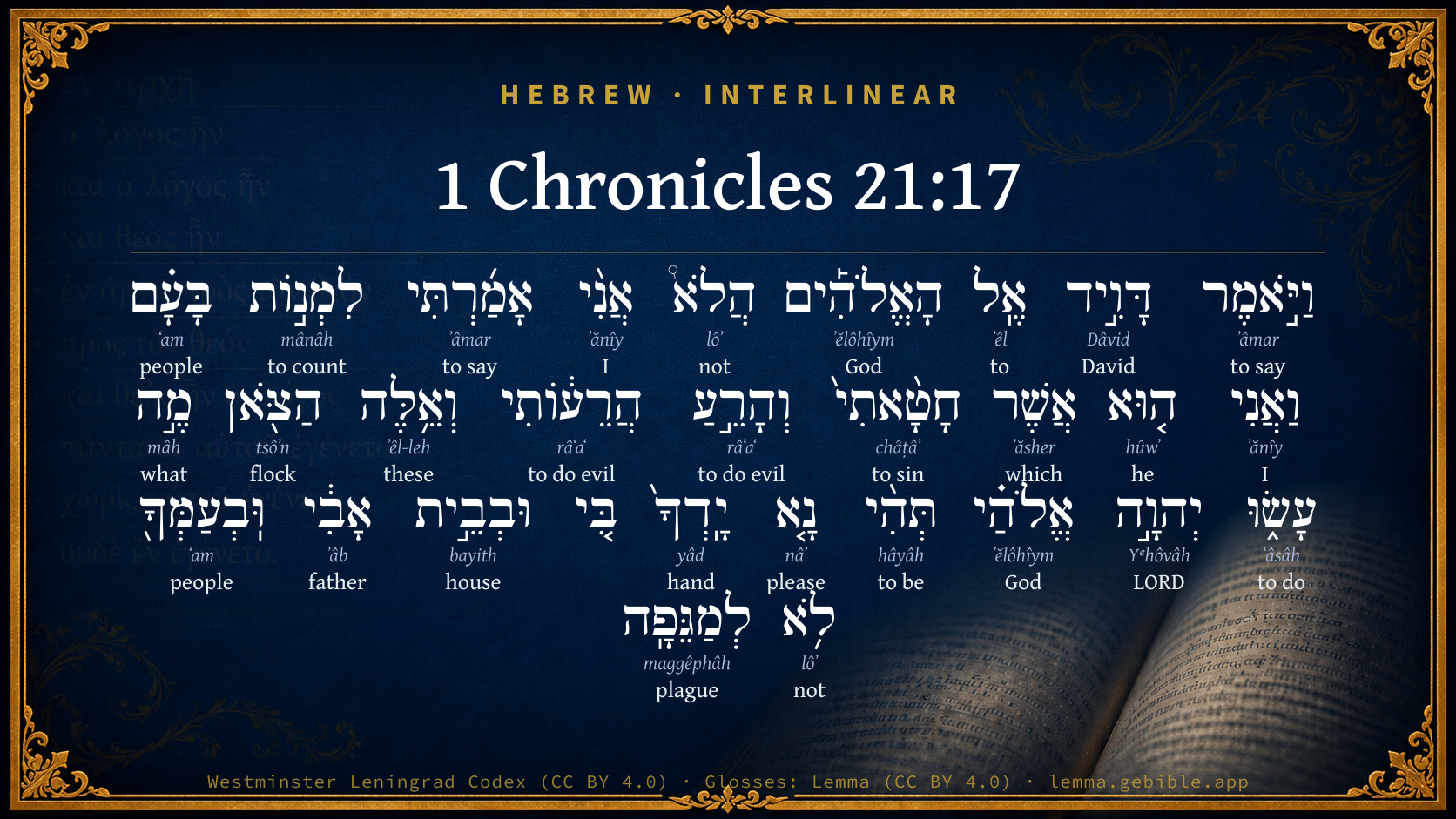
1 Chronicles 21:17

Hebrew (Westminster Leningrad Codex) 1 Chronicles 21:17 appears in the Hebrew Old Testament. The text above is from the Westminster Leningrad Codex. Each word links to its Strong’s number, a concise gloss, and parsing drawn from the Open Scriptures Hebrew Bible morphology. Click any word for its full Brown-Driver-Briggs (BDB) entry.
Download image
Cite this verse

1 Chronicles 21:17 (World English Bible). Public Domain. Lemma interlinear Bible study tool, https://lemma.gebible.app/v/1-chronicles/21/17.

Show BibTeX & RIS
BibTeX
RIS
English Translation
David said to God, Isn't it I who commanded the people to be numbered? It is even I who have sinned and done very wickedly; but these sheep, what have they done? Please let your hand, O Yahweh my God, be against me, and against my father's house; but not against your people, that they should be plagued.
World English Bible · Public Domain
Download a study sheet

One document with this verse’s original text, its word-by-word gloss line, the meaning frame, cross-references with their text, attributed commentary, and full source and license credits — printable, and it pastes into notes with its structure intact.

This verse Autodidact and up

Study sheet (.html) Plain text (.txt)

A passage Seminary Student

Up to 50 verses in one chapter. A passage sheet keeps up to 6 commentary sources and 12 cross-references per verse, in the order this page ranks them, and says so on the sheet whenever that leaves anything out. Ask for a single verse and you get the Autodidact verse sheet above.

Everything on this page stays free to read, with no account — the sheet is a download of what is already on screen, not access to it.

Want to remove ads? Support Godless Engineer
Compare translations 3

The same verse in 3 English versions, stacked beneath the original-language interlinear above. Click any original word for its lexicon entry.

Each is an independent rendering of the whole verse — the interlinear is not word-aligned to these translations.

Highlighted words mark where these versions differ — a whole-verse word diff, not a word-by-word alignment.

  • World English Bible Public Domain
    David said to God, Isn't it I who commanded the people to be numbered? It is even I who have sinned and done very wickedly; but these sheep, what have they done? Please let your hand, O Yahweh my God, be against me, and against my father's house; but not against your people, that they should be plagued.
  • King James Version Public Domain
    And David said unto God, Is it not I that commanded the people to be numbered? even I it is that have sinned and done evil indeed; but as for these sheep, what have they done? let thine hand, I pray thee, O LORD my God, be on me, and on my father's house; but not on thy people, that they should be plagued.
  • unfoldingWord Literal Text CC BY-SA 4.0
    And David said to God, “ not I, I said to muster the people? And I he who sinned, and doing wrong, I have done wrong. But these sheep, what have they done? Yahweh my God, please let your hand be against me and against the house of my father, but a plague not on your people.”

unfoldingWord Literal Text — © unfoldingWord, licensed CC BY-SA 4.0. Word-aligned USFM3 via Door43 (git.door43.org/unfoldingWord/en_ult).

Versions to compare (up to 4)

3 of 4 selected

Show all 18 translations

Every available English version of this verse, each an independent rendering of the whole verse.

  • World English Bible Public Domain
    David said to God, Isn't it I who commanded the people to be numbered? It is even I who have sinned and done very wickedly; but these sheep, what have they done? Please let your hand, O Yahweh my God, be against me, and against my father's house; but not against your people, that they should be plagued.
  • Berean Standard Bible Public Domain
    And David said to God, “Was it not I who gave the order to count the people? I am the one who has sinned and acted wickedly. But these sheep, what have they done? O LORD my God, please let Your hand fall upon me and my father’s house, but do not let this plague remain upon Your people.”
  • Majority Standard Bible Public Domain
    And David said to God, “Was it not I who gave the order to count the people? I am the one who has sinned and acted wickedly. But these sheep, what have they done? O LORD my God, please let Your hand fall upon me and my father’s house, but do not let this plague remain upon Your people.”
  • King James Version Public Domain
    And David said unto God, Is it not I that commanded the people to be numbered? even I it is that have sinned and done evil indeed; but as for these sheep, what have they done? let thine hand, I pray thee, O LORD my God, be on me, and on my father's house; but not on thy people, that they should be plagued.
  • American Standard Version (1901) Public Domain
    And David said unto God, Is it not I that commanded the people to be numbered? even I it is that have sinned and done very wickedly; but these sheep, what have they done? let thy hand, I pray thee, O Jehovah my God, be against me, and against my father's house; but not against thy people, that they should be plagued.
  • Revised Version (1885) Public Domain
    And David said unto God, Is it not I that commanded the people to be numbered? even I it is that have sinned and done very wickedly; but these sheep, what have they done? let thine hand, I pray thee, O LORD my God, be against me, and against my father’s house; but not against thy people, that they should be plagued.
  • Geneva Bible (1599) Public Domain
    And Dauid said vnto God, Is it not I that commanded to nomber the people? It is euen I that haue sinned and haue committed euil, but these sheepe what haue they done? O Lord my God, I beseech thee, let thine hande be on me and on my fathers house, and not on thy people for their destruction.
  • Douay-Rheims (1899) Public Domain
    And David lifting up his eyes, saw the angel of the Lord standing between heaven and earth, with a drawn sword in his hand, turned against Jerusalem: and both he and the ancients clothed in haircloth, fell down flat on the ground.
  • Young's Literal Translation Public Domain
    And David saith unto God, `Did not I -- I say to number the people? Yea, I it `is' who have sinned, and done great evil: and these, the flock, what did they? O Jehovah, my God, let, I pray Thee, Thy hand be on me, and on the house of my father, and not on Thy people -- to be plagued.'
  • Literal Standard Version CC BY-SA 4.0
    And David says to God, “Did I not command to number the people? Indeed, it [is] I who have sinned, and done great evil: and these, the flock, what did they do? O YHWH, my God, please let Your hand be on me, and on the house of my father, and not on Your people—to be plagued.”
  • Unlocked Literal Bible CC BY-SA 4.0
    David said to God, “Is it not I that commanded that the army be numbered? I did this wicked thing. But these sheep, what have they done? Yahweh my God! Let your hand strike me and my family, but do not let the plague remain on your people.”
  • unfoldingWord Literal Text CC BY-SA 4.0
    And David said to God, “ not I, I said to muster the people? And I he who sinned, and doing wrong, I have done wrong. But these sheep, what have they done? Yahweh my God, please let your hand be against me and against the house of my father, but a plague not on your people.”
  • Darby Bible Public Domain
    And David said to God, Is it not I that commanded the people to be numbered? It is I that have sinned and done evil; but these sheep, what have they done? Let thy hand, I pray thee, Jehovah my God, be on me and on my father's house; but not on thy people, that they should be smitten.
  • World Messianic Bible Public Domain
    David said to God, “Isn’t it I who commanded the people to be counted? It is even I who have sinned and done very wickedly; but these sheep, what have they done? Please let your hand, O LORD my God, be against me and against my father’s house; but not against your people, that they should be plagued.”
  • Webster's Bible Public Domain
    And David said to God, Is it not I that commanded the people to be numbered? even I it is that have sinned and done evil indeed; but as for these sheep, what have they done? let thy hand, I pray thee, O LORD my God, be on me, and on my father's house; but not on thy people, that they should be afflicted.
  • Free Bible Version CC BY-SA 4.0
    David said to God, “Wasn't it me who ordered the census of the people? I'm the one who has sinned and acted wickedly. But these sheep, what have they done? Lord my God, please punish me and my family, but don't punish your people with this plague.”
  • Bible in Basic English Public Domain
    And David said to God, Was it not I who gave the order for the people to be numbered? It is I who have done the sin and the great wrong; but these are only sheep; what have they done? let your hand, O Lord God, be lifted up against me and against my family, but not against your people to send disease on them.
  • JPS Tanakh (1917) Public Domain
    And David said unto God: 'Is it not I that commanded the people to be numbered? even I it is that have sinned and done very wickedly; but these sheep, what have they done? let Thy hand, I pray Thee, O LORD my God, be against me, and against my father's house; but not against Thy people, that they should be plagued.'

Literal Standard Version (2020), Covenant Press — licensed CC BY-SA 4.0. Text via the HelloAO Bible API (eBible.org). Unlocked Literal Bible (unfoldingWord) — licensed CC BY-SA 4.0. Text via the HelloAO Bible API (eBible.org). unfoldingWord Literal Text — © unfoldingWord, licensed CC BY-SA 4.0. Word-aligned USFM3 via Door43 (git.door43.org/unfoldingWord/en_ult). Free Bible Version, Dr. Jonathan Gallagher — licensed CC BY-SA 4.0. Text via the HelloAO Bible API (eBible.org).

Word by word

More ways to search: Search by grammar → Find every occurrence → Compare this word →

Practice this passage: Drill this verse → Learn its vocabulary →

לְמַגֵּפָֽה
maggêphâh
H4046
“to/for · plague”
Preposition + Noun, Common, Feminine, Singular, Absolute
Part of Speech
Preposition + Noun
Type
Common
Gender
Feminine
Number
Singular
State
Absolute
Full BDB Definition

Origin: from H5062

TWOT: 1294b

blow, slaughter, plague, pestilence, strike, smite - blow (fatal stroke) - slaughter (of battle) - plague, pestilence (divine judgment)
  1. וַיֹּ֣אמֶר ʼâmar H559 “and · to say” Conjunction + Verb, Qal, Sequential Imperfect, 3rd Person, Masculine, Singular
  2. דָּוִ֣יד Dâvid H1732 “David” Noun, Proper
  3. אֶֽל ʼêl H413 “to” Preposition
  4. הָאֱלֹהִ֡ים ʼĕlôhîym H430 “the · God(s)” Particle, Definite Article + Noun, Common, Masculine, Plural, Absolute
  5. הֲלֹא֩ lôʼ H3808 “not” Particle, Interrogative + Particle, Negative
  6. אֲנִ֨י ʼănîy H589 “I” Pronoun, Personal, 1st Person, Common, Singular
  7. אָמַ֜רְתִּי ʼâmar H559 “to say” Verb, Qal, Perfect, 1st Person, Common, Singular
  8. לִמְנ֣וֹת mânâh H4487 “to count” Preposition + Verb, Qal, Infinitive Construct
  9. בָּעָ֗ם ʻam H5971 “in/at the · people” Preposition, Determined + Noun, Common, Masculine, Singular, Absolute
  10. וַאֲנִי ʼănîy H589 “and · I” Conjunction + Pronoun, Personal, 1st Person, Common, Singular
  11. ה֤וּא hûwʼ H1931 “he” Pronoun, Personal, 3rd Person, Masculine, Singular
  12. אֲשֶׁר ʼăsher H834 “which” Particle, Relative
  13. חָטָ֨אתִי֙ châṭâʼ H2398 “to sin” Verb, Qal, Perfect, 1st Person, Common, Singular
  14. וְהָרֵ֣עַ râʻaʻ H7489 “and · to do evil” Conjunction + Verb, Hiphil, Infinitive Absolute
  15. הֲרֵע֔וֹתִי râʻaʻ H7489 “to do evil” Verb, Hiphil, Perfect, 1st Person, Common, Singular
  16. וְאֵ֥לֶּה ʼêl-leh H428 “and · these” Conjunction + Pronoun, Demonstrative, Common, Plural
  17. הַצֹּ֖אן tsôʼn H6629 “the · flock” Particle, Definite Article + Noun, Common, Both, Singular, Absolute
  18. מֶ֣ה mâh H4100 “what” Particle, Interrogative
  19. עָשׂ֑וּ ʻâsâh H6213 “to do” Verb, Qal, Perfect, 3rd Person, Common, Plural
  20. יְהוָ֣ה Yᵉhôvâh H3068 “LORD” Noun, Proper
  21. אֱלֹהַ֗י ʼĕlôhîym H430 “God(s) · my” Noun, Common, Masculine, Plural, Construct + Suffix, Personal, 1st Person, Common, Singular
  22. תְּהִ֨י hâyâh H1961 “to be” Verb, Qal, Jussive, 3rd Person, Feminine, Singular
  23. נָ֤א nâʼ H4994 “please” Particle, Exhortation
  24. יָֽדְךָ֙ yâd H3027 “hand · your” Noun, Common, Both, Singular, Construct + Suffix, Personal, 2nd Person, Masculine, Singular
  25. וּבְבֵ֣ית bayith H1004 “and · in/at · house of” Conjunction + Preposition + Noun, Common, Masculine, Singular, Construct
  26. אָבִ֔י ʼâb H1 “father · my” Noun, Common, Masculine, Singular, Construct + Suffix, Personal, 1st Person, Common, Singular
  27. וּֽבְעַמְּךָ֖ ʻam H5971 “and · in/at · people · your” Conjunction + Preposition + Noun, Common, Masculine, Singular, Construct + Suffix, Personal, 2nd Person, Masculine, Singular
  28. לֹ֥א lôʼ H3808 “not” Particle, Negative

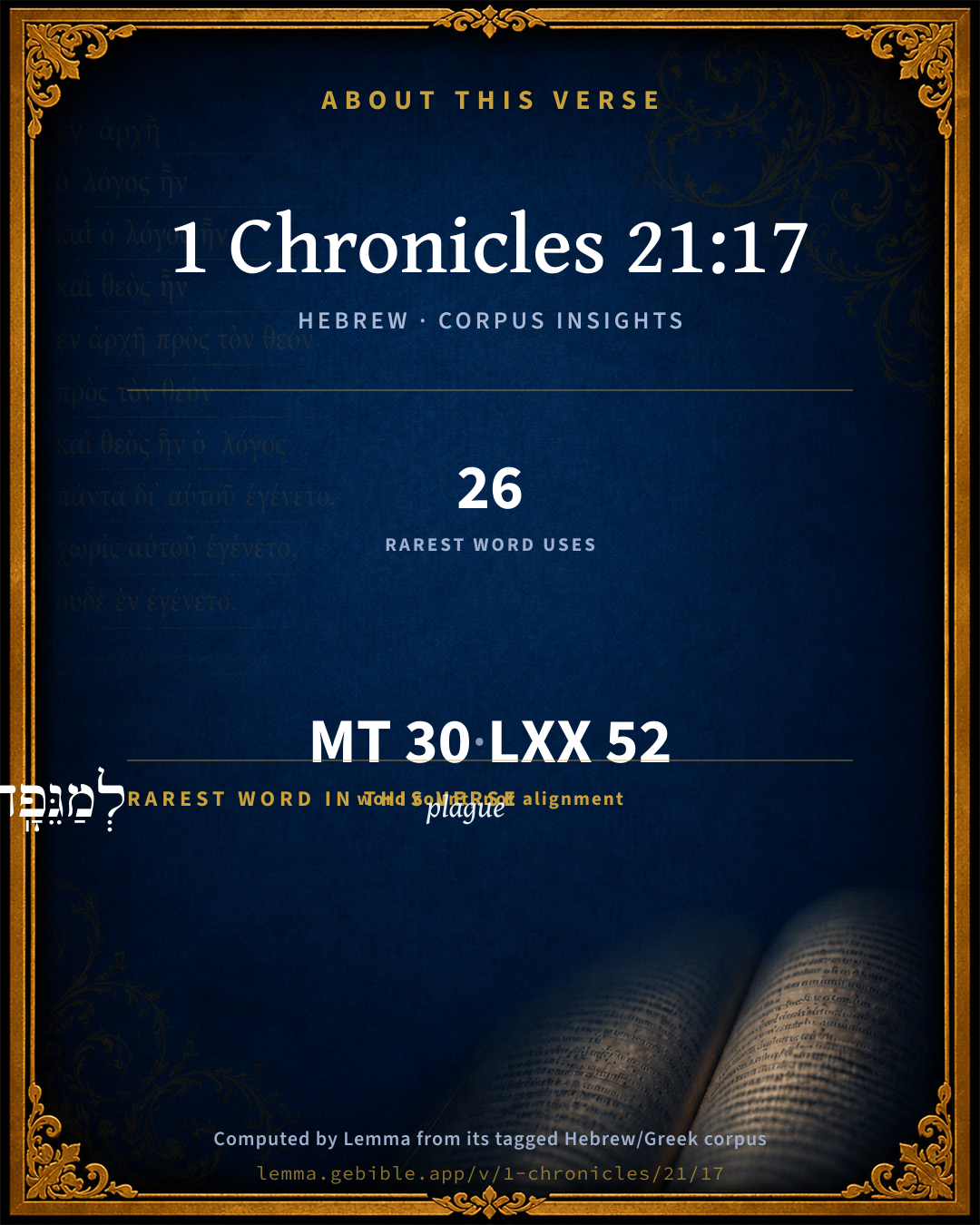
About this verse

These counts appear in no published source. They are computed here, from the morphology-tagged text and Lemma’s own curated glosses. What Lemma adds →

30
words
23
distinct lemmas
Historical
section

Shared distinctive vocabulary

לְמַגֵּפָֽה plague H4046 occurs in 25 verses of the Hebrew Bible. Also found in:

Grammatical profile

  • 8 verbs
  • 11 nouns
  • 4 pronouns
  • 2 prepositions
  • 5 particles

Verb forms

  • וַיֹּ֣אמֶר Qal · Sequential Imperfect
  • אָמַ֜רְתִּי Qal · Perfect
  • לִמְנ֣וֹת Qal · Infinitive Construct
  • חָטָ֨אתִי֙ Qal · Perfect
  • וְהָרֵ֣עַ Hiphil · Infinitive Absolute
  • הֲרֵע֔וֹתִי Hiphil · Perfect
  • עָשׂ֑וּ Qal · Perfect
  • תְּהִ֨י Qal · Jussive

Repetition

Words recur within this verse — often emphatic in Hebrew:

  • וַיֹּ֣אמֶר to say H559 ×2
  • הָאֱלֹהִ֡ים God H430 ×2
  • בָּעָ֗ם people H5971 ×2
  • וְהָרֵ֣עַ to do evil H7489 ×2
  • הֲלֹא֩ not H3808 ×2
  • אֲנִ֨י I H589 ×2

Hebrew & Septuagint length

In English translation the verse runs 58 words from the Hebrew and 56 from the Septuagint (LXX English) — closely comparable.

A rough comparison of the two English renderings, which tokenize alike — not a word-level alignment.

Word counts can differ between the Hebrew and the Greek without any difference in meaning — e.g. the Hebrew direct-object marker אֵת has no separate Greek word, and Greek often adds the article ὁ.

In the original languages it is 30 Hebrew tokens and 52 Greek tokens — but the two are counted differently (Hebrew bundles its prefixes and suffixes into one token; the Greek is in lemma form), so that isn’t a like-for-like length.

Cross-references

19

Topical passages linked to 1 Chronicles 21:17 in the Treasury of Scripture Knowledge — connected by theme and wording, ordered by reader-vote popularity; previews shown in the World English Bible.

  • Ezekiel 16:63 that you may remember, and be confounded, and never open your mouth any more, because of your shame, when I have forgiven you all that you have done, says the Lord Yahweh.
  • Genesis 44:33 Now therefore, please let your servant stay instead of the boy, a bondservant to my lord; and let the boy go up with his brothers.
  • Exodus 20:5 you shall not bow yourself down to them, nor serve them, for I, Yahweh your God, am a jealous God, visiting the iniquity of the fathers on the children, on the third and on the fourth generation of those who hate me,
  • Exodus 32:32–33 Yet now, if you will, forgive their sin-- and if not, please blot me out of your book which you have written."
  • Joshua 22:18 that you must turn away this day from following Yahweh? and it will be, seeing you rebel today against Yahweh, that tomorrow he will be angry with the whole congregation of Israel.
  • 2 Samuel 7:8 Now therefore thus shall you tell my servant David, Thus says Yahweh of Hosts, I took you from the sheep pen, from following the sheep, that you should be prince over my people, over Israel;
  • 2 Samuel 12:10 Now therefore the sword will never depart from your house, because you have despised me, and have taken the wife of Uriah the Hittite to be your wife.'
  • 2 Samuel 24:1 Again the anger of Yahweh was kindled against Israel, and he moved David against them, saying, Go, number Israel and Judah.
  • 2 Samuel 24:17 David spoke to Yahweh when he saw the angel who struck the people, and said, Behold, I have sinned, and I have done perversely; but these sheep, what have they done? Please let your hand be against me, and against my father's house.
  • 1 Kings 22:17 He said, I saw all Israel scattered on the mountains, as sheep that have no shepherd: and Yahweh said, These have no master; let them return every man to his house in peace.
  • 1 Chronicles 21:8 David said to God, I have sinned greatly, in that I have done this thing: but now, put away, I beg you, the iniquity of your servant; for I have done very foolishly.
  • Psalms 44:11 You have made us like sheep for food, And have scattered us among the nations.
  • Psalms 51:4 Against you, and you only, have I sinned, And done that which is evil in your sight; That you may be proved right when you speak, And justified when you judge.
  • Psalms 51:14 Deliver me from bloodguiltiness, O God, the God of my salvation. My tongue shall sing aloud of your righteousness.
  • Psalms 74:1 God, why have you rejected us forever? Why does your anger smolder against the sheep of your pasture?
  • Isaiah 39:7–8 Of your sons who shall issue from you, whom you shall father, shall they take away; and they shall be eunuchs in the palace of the king of Babylon.
  • John 10:11–12 I am the good shepherd. The good shepherd lays down his life for the sheep.
  • Romans 9:3 For I could wish that I myself were accursed from Christ for my brothers' sake, my relatives according to the flesh,
  • 1 John 3:16 By this we know love, because he laid down his life for us. And we ought to lay down our lives for the brothers.

Cross-references courtesy of OpenBible.info (CC BY 4.0).

Hebrew and Greek witnesses Masoretic Hebrew ↔ Greek Septuagint

The same verse in the two great witnesses to the Old Testament, shown verse-for-verse.

These are two independent witnesses, not word-aligned to each other, and the Septuagint is shown in lemma (dictionary) form.

Hebrew 1 Chronicles 21:17 Masoretic · Westminster Leningrad Codex

וַיֹּ֣אמֶר דָּוִ֣יד אֶֽל הָאֱלֹהִ֡ים הֲלֹא֩ אֲנִ֨י אָמַ֜רְתִּי לִמְנ֣וֹת בָּעָ֗ם וַאֲנִי ה֤וּא אֲשֶׁר חָטָ֨אתִי֙ וְהָרֵ֣עַ הֲרֵע֔וֹתִי וְאֵ֥לֶּה הַצֹּ֖אן מֶ֣ה עָשׂ֑וּ יְהוָ֣ה אֱלֹהַ֗י תְּהִ֨י נָ֤א יָֽדְךָ֙ בִּ֚י וּבְבֵ֣ית אָבִ֔י וּֽבְעַמְּךָ֖ לֹ֥א לְמַגֵּפָֽה

David said to God, Isn't it I who commanded the people to be numbered? It is even I who have sinned and done very wickedly; but these sheep, what have they done? Please let your hand, O Yahweh my God, be against me, and against my father's house; but not against your people, that they should be plagued.

World English Bible · Public Domain

Greek LXX 1 Chronicles 21:17 Septuagint · lemma form

καί εἶπον δαυίδ πρός ὁ θεός οὐ ἐγώ εἶπον ὁ ἀριθμέω ἐν ὁ λαός καί ἐγώ εἰμί ὁ ἁμαρτάνω κακοποιέω κακοποιέω καί οὗτος ὁ πρόβατον τίς ποιέω κύριος ὁ θεός γίγνομαι ὁ χείρ σύ ἐν ἐγώ καί ἐν ὁ οἶκος ὁ πατήρ ἐγώ καί μή ἐν ὁ λαός σύ εἰς ἀπώλεια κύριος

And David said to God, Was it not I that gave orders to number the people? and I am the guilty one; I have greatly sinned: but these sheep, what have they done? O Lord God, let your hand be upon me, and upon my father's house, and not on your people for destruction, O Lord!

LXX2012 (modern English Septuagint) · Public Domain

Hebrew: Westminster Leningrad Codex (CC BY 4.0). Greek: Septuagint (public domain); English from LXX2012 (modern English Septuagint) (Public Domain). How the Septuagint differs from the Hebrew →

Commentary

Notes on 1 Chronicles 21:17 from classic Christian and Jewish commentators (each source and its license shown beneath its notes). The classic Christian expositions comment on the surrounding passage and are grouped to its opening verse, so a note may address several verses; the Jewish commentaries on the Tanakh (Rashi and others) are per-verse, so they appear only where the commentator wrote on this verse.

Lemma curates 59 commentaries, every one of them public domain or Creative Commons licensed, each selected and text-cleaned for this edition rather than reprinted as found. About our sources →

Trapp's Complete Commentary

John Trapp

1Ch 21:17 And David said unto God, [Is it] not I [that] commanded the people to be numbered? even I it is that have sinned and done evil indeed; but [as for] these sheep, what have they done? let thine hand, I pray thee, O LORD my God, be on me, and on my father’s house; but not on thy people, that they should be plagued.

Ver. 17. See on 2Sa 24:17.

John Trapp, A Commentary or Exposition upon All the Books of the Old and New Testament (1647–1656) — public domain. Text from a community e-Sword module.

Geneva Bible (1599)

Geneva Bible translators

Thus he both showeth a true repentance and a fatherly care toward his people, which desireth God to spare them, and to punish him and his.

Geneva Bible (1599) marginal notes — public domain. Text via Bolls.life.

Ellicott's Commentary for English Readers

(17) And David said unto God.—Sam., “Jehovah.” Samuel adds, “when he saw the angel that smote the people” (see our 1Ch_21:16); “and he said.”

Is it not I that commanded the people to be numbered?—Literally, to number the people. In Samuel these words are wanting. They may have been added by the chronicler for the sake of clearness. “though they may also have formed part of the original narrative.

Even I it is that have sinned and done evil indeed.—Samuel reads, “Lo, I” (different pronoun) “have sinned, and I have dealt crookedly.” Our text here may be paraphrastic, but hardly a corruption of the older one.

But as for these sheep, what . . . father’s house.—Verbatim as in Samuel, save that the appeal, “O Lord my God,” is wanting there. (Literally, But these, the sheep. The king was the shepherd.)

But not on thy people, that they should be plagued.—Literally, and on thy people, not for a plague. The strangeness of this order makes it likely that these words comprise two marginal notes, or glosses, which have crept into the text. They are not read in Samuel.

A Bible Commentary for English Readers, edited by Charles John Ellicott (1878–1897) — public domain. Text from a community e-Sword module.

The Cambridge Bible for Schools and Colleges

gen. ed. J. J. S. Perowne

17. let thine hand … be on me] Cp. Moses’ intercession in Exo_32:32; but Moses was innocent, David guilty.

The Cambridge Bible for Schools and Colleges (gen. ed. J. J. S. Perowne; Cambridge University Press, 1878–1918) — public domain. Text from a community e-Sword module.

The Pulpit Commentary

Sin taken home.

It is a most pathetic scene. The angel of the Lord, who had smitten with his destroying sword "throughout all the coasts of Israel," was passing by the threshing-floor of the Jebusite. His drawn sword was stretched out over Jerusalem; yet it fell not, for he was bidden to "stay his hand." The king and his princes and counsellors, clad in sackcloth, were prostrate in penitence and supplication before the vision before the Lord. And David was taking the sin to himself, and invoking the penalty upon himself, as he bowed low before the righteous Judge and Avenger. We observe in David"s language

I A SPIRIT DIFFERENT FROM THAT OFTEN OBSERVABLE IN MEN"S CONFESSIONS. There is no sign of:

1. A disposition to shift the sin upon others.

2. Or of a willingness that others should bear the penalty of the sin,

3. Or of a tendency to extenuate the guile of sinful action. We observe

II A FRANK AND FULL CONFESSION OF PERSONAL GUILT. This includes:

1. An acknowledgment of his own offence.

2. A submission to the Divine wisdom and justice. He is willing that thehand of God, that is, the chastening and afflicting hand, should fall upon him and inflict the strokes which he is well aware he merits.

III COMPASSION AND INTERCESSION FOR THE UNOFFENDING SUFFERERS. How truly is this David"s language! Under the influence of deep emotion he speaks, as men are wont to do in such circumstances, the language of his youth. His poor subjects are, to his view, like guileless, helpless sheep, scattered and smitten. He implores that in compassion it may please the Lord to save them.

IV THE RECOGNITION BY THE LORD OF THIS SPIRIT AND LANGUAGE. David"s attitude was pleasing to the Lord. Reconciliation ensued. An altar was built, and sacrifices offered and accepted. And the angel of the Lord "put up his sword again into the sheath thereof. T.

Conviction of personal sin.

For the particular character of David"s sin reference may be made to the sketch given on ver. 2. And for the kind of conviction which David cherished when acts of sin were brought home to him, illustration may be taken from Psalm 51. His sin might have been the sin of David the man; as was his sin in the matter of Bathsheba. Or it might have been the sin of David the king; and so God regarded it, adjusting his judgments accordingly. When convicted, it is a point of exceeding nobility in David that he seeks to bring the whole responsibility upon himself, asking God to treat the sin as that of the man, not of the king. We may fix attention upon this point. In this instance David stood for and acted for the nation, without the nation"s consent. It is a most solemn thing for parents, masters, magistrates, etc., that they cannot always separate the official character from their acts; and they are responsible for the well-being of the children, the servants, or the citizens, whom they represent. Placed in such relations, men may act in ways that do not carry the feeling or wish of those for whom they stand; and so they may be the means of bringing upon them undeserved Divine judgments. The case of Jonah may be compared. The sailors" lives were imperilled by his act, though in it they had taken no share.

I MAN MAY BE OFFICIALLY Or even by his temporary relations THE CAUSE OF THE INNOCENT SUFFERING,

II SUCH CASES MUST ALWAYS BE REGARDED AS EXCEEDINGLY PERPLEXING AND PAINFUL. See Asaph"s psalms, and the discussions in the Book of Job.

III. THE RIGHT-HEARTED MAN WILL EARNESTLY SEEK TO HAVE THE SUFFERING LIMITED TO HIMSELF, and to this end will be ready fully to acknowledge his personal guilt.

Impress that our relationships give the overwhelmingly painful character to our sins. R.T.

The Pulpit Commentary (1880–1919), ed. H.D.M. Spence-Jones & Joseph S. Exell — public domain. Text from a community e-Sword module.

Rashi

Rabbi Shlomo Yitzchaki (Rashi)

but these sheep, what have they done for they are like sheep brought to the slaughter, who cannot be saved from slaughter because they are destined for it.

Rashi on the Tanakh — English translations: “The Judaica Press complete Tanach with Rashi, translated by A. J. Rosenberg” (CC BY 4.0); “Pentateuch with Rashi's commentary by M. Rosenbaum and A.M. Silbermann, 1929-1934” (public domain); “The Metsudah Tanach series, Lakewood, N.J” (CC BY 4.0); and “The Book of Joshua, Metsudah Publications, 1997” (CC BY 4.0). Text via Sefaria.

Lesson kit

Teaching starters — assembled from the data on this page, not authored interpretation. Every prompt links to the verse data it draws on. Edit before teaching.

1 Chronicles, in the Historical, opens this verse with 30 words (23 distinct Hebrew lemmas). Its most distinctive word is maggêphâh (“plague”). A historical commentator’s framing appears above. Read the whole chapter for the surrounding context.

Discussion questions

  1. What does “plague” (maggêphâh) contribute to the verse as a whole?
  2. Exodus 9:14 shares the word «plague» with this verse. How do the two illuminate each other?
  3. “to say” occurs 2× in this one verse. What is the effect of the repetition?
  4. These translations render this verse differently; the difference is in the English rendering, not the original. What questions does that raise?
  5. The verb «וַיֹּ֣אמֶר» is Qal Sequential Imperfect. How does its form color the action?
  6. Reading how Trapp's Complete Commentary and Geneva Bible (1599) read this verse, where do the two commentators agree and where do they part?

Things to notice

Reading settings

Reading text

Shown beneath each verse's original-language words.

Old Testament
Old Testament edition

Read the OT as the Masoretic Hebrew (MT) or the Greek Septuagint (LXX).

English shown for the Greek Septuagint (in the Hebrew ↔ Greek comparison).

Comparing translations? Open the Compare panel on any verse page to stack up to four side by side.