1 Chronicles 6:31

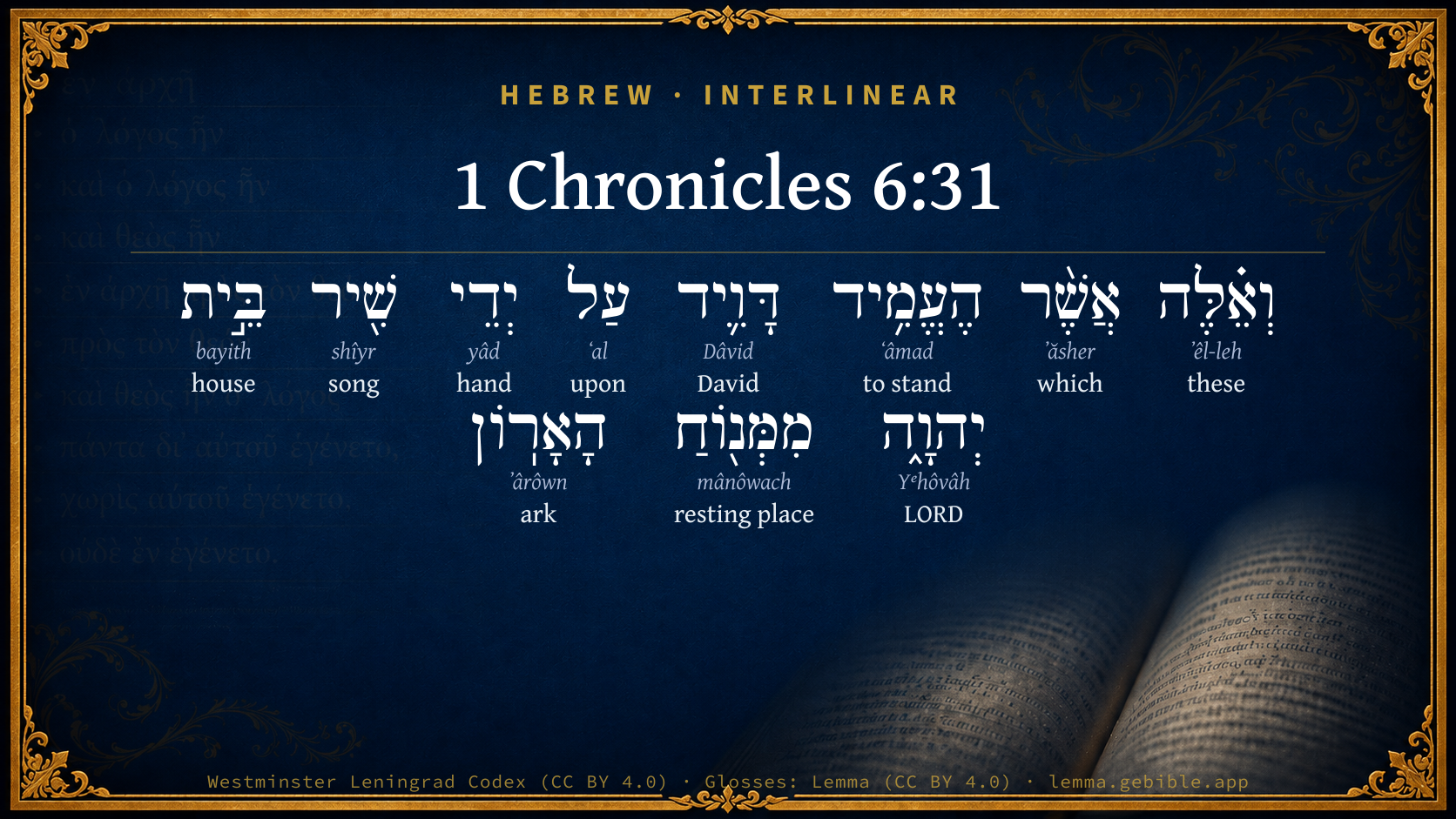
Hebrew (Westminster Leningrad Codex) 1 Chronicles 6:31 appears in the Hebrew Old Testament. The text above is from the Westminster Leningrad Codex. Each word links to its Strong’s number, a concise gloss, and parsing drawn from the Open Scriptures Hebrew Bible morphology. Click any word for its full Brown-Driver-Briggs (BDB) entry.
Download image
Cite this verse

1 Chronicles 6:31 (World English Bible). Public Domain. Lemma interlinear Bible study tool, https://lemma.gebible.app/v/1-chronicles/6/31.

Show BibTeX & RIS
BibTeX
RIS
English Translation
These are they whom David set over the service of song in the house of Yahweh, after that the ark had rest.
World English Bible · Public Domain
Download a study sheet

One document with this verse’s original text, its word-by-word gloss line, the meaning frame, cross-references with their text, attributed commentary, and full source and license credits — printable, and it pastes into notes with its structure intact.

This verse Autodidact and up

Study sheet (.html) Plain text (.txt)

A passage Seminary Student

Up to 50 verses in one chapter. A passage sheet keeps up to 6 commentary sources and 12 cross-references per verse, in the order this page ranks them, and says so on the sheet whenever that leaves anything out. Ask for a single verse and you get the Autodidact verse sheet above.

Everything on this page stays free to read, with no account — the sheet is a download of what is already on screen, not access to it.

Want to remove ads? Support Godless Engineer
Compare translations 3

The same verse in 3 English versions, stacked beneath the original-language interlinear above. Click any original word for its lexicon entry.

Each is an independent rendering of the whole verse — the interlinear is not word-aligned to these translations.

Highlighted words mark where these versions differ — a whole-verse word diff, not a word-by-word alignment.

  • World English Bible Public Domain
    These are they whom David set over the service of song in the house of Yahweh, after that the ark had rest.
  • King James Version Public Domain
    And these are they whom David set over the service of song in the house of the LORD, after that the ark had rest.
  • unfoldingWord Literal Text CC BY-SA 4.0
    And these whom David made stand over the hands of song the house of Yahweh after the resting of the Box.

unfoldingWord Literal Text — © unfoldingWord, licensed CC BY-SA 4.0. Word-aligned USFM3 via Door43 (git.door43.org/unfoldingWord/en_ult).

Versions to compare (up to 4)

3 of 4 selected

Show all 18 translations

Every available English version of this verse, each an independent rendering of the whole verse.

  • World English Bible Public Domain
    These are they whom David set over the service of song in the house of Yahweh, after that the ark had rest.
  • Berean Standard Bible Public Domain
    These are the men David put in charge of the music in the house of the LORD after the ark rested there.
  • Majority Standard Bible Public Domain
    These are the men David put in charge of the music in the house of the LORD after the ark rested there.
  • King James Version Public Domain
    And these are they whom David set over the service of song in the house of the LORD, after that the ark had rest.
  • American Standard Version (1901) Public Domain
    And these are they whom David set over the service of song in the house of Jehovah, after that the ark had rest.
  • Revised Version (1885) Public Domain
    And these are they whom David set over the service of song in the house of the LORD, after that the ark had rest.
  • Geneva Bible (1599) Public Domain
    And these be they whom Dauid set for to sing in the house of the Lord, after that the Arke had rest.
  • Douay-Rheims (1899) Public Domain
    These are they, whom David set over the singing men of the house of the Lord, after that the p ark was placed:
  • Young's Literal Translation Public Domain
    And these `are' they whom David stationed over the parts of the song of the house of Jehovah, from the resting of the ark,
  • Literal Standard Version CC BY-SA 4.0
    And these [are] they whom David stationed over the parts of the song of the house of YHWH, from the resting of the Ark,
  • Unlocked Literal Bible CC BY-SA 4.0
    These are the names of the men whom David put in charge of music in the house of Yahweh, after the ark came to rest there.
  • unfoldingWord Literal Text CC BY-SA 4.0
    And these whom David made stand over the hands of song the house of Yahweh after the resting of the Box.
  • Darby Bible Public Domain
    And these are they whom David set over the service of song in the house of Jehovah after that the ark was in rest.
  • World Messianic Bible Public Domain
    These are they whom David set over the service of song in the LORD’s house after the ark came to rest there.
  • Webster's Bible Public Domain
    And these are they whom David set over the service of song in the house of the LORD, after that the ark had rest.
  • Free Bible Version CC BY-SA 4.0
    These are the musicians David appointed to direct the music in the house of the Lord once the Ark had been placed there.
  • Bible in Basic English Public Domain
    And these are those whom David made responsible for the music in the house of the Lord, after the ark had rest.
  • JPS Tanakh (1917) Public Domain
    (6-16) And these are they whom David set over the service of song in the house of the LORD, after that the ark had rest.

Literal Standard Version (2020), Covenant Press — licensed CC BY-SA 4.0. Text via the HelloAO Bible API (eBible.org). Unlocked Literal Bible (unfoldingWord) — licensed CC BY-SA 4.0. Text via the HelloAO Bible API (eBible.org). unfoldingWord Literal Text — © unfoldingWord, licensed CC BY-SA 4.0. Word-aligned USFM3 via Door43 (git.door43.org/unfoldingWord/en_ult). Free Bible Version, Dr. Jonathan Gallagher — licensed CC BY-SA 4.0. Text via the HelloAO Bible API (eBible.org).

Word by word

More ways to search: Search by grammar → Find every occurrence → Compare this word →

Practice this passage: Drill this verse → Learn its vocabulary →

מִמְּנ֖וֹחַ
mânôwach
H4494
“from · resting place of”
Preposition + Noun, Common, Both, Singular, Construct
Part of Speech
Preposition + Noun
Type
Common
Gender
Both
Number
Singular
State
Construct
Full BDB Definition

Origin: from H5117

TWOT: 1323e

resting place, state or condition of rest, place - resting place - rest, repose, condition of rest - coming to rest
  1. וְאֵ֗לֶּה ʼêl-leh H428 “and · these” Conjunction + Pronoun, Demonstrative, Common, Plural
  2. אֲשֶׁ֨ר ʼăsher H834 “which” Particle, Relative
  3. הֶעֱמִ֥יד ʻâmad H5975 “to stand” Verb, Hiphil, Perfect, 3rd Person, Masculine, Singular
  4. דָּוִ֛יד Dâvid H1732 “David” Noun, Proper
  5. עַל ʻal H5921 “upon” Preposition
  6. יְדֵי yâd H3027 “hands of” Noun, Common, Both, Dual, Construct
  7. שִׁ֖יר shîyr H7892 “song” Noun, Common, Both, Singular, Absolute
  8. בֵּ֣ית bayith H1004 “house of” Noun, Common, Masculine, Singular, Construct
  9. יְהוָ֑ה Yᵉhôvâh H3068 “LORD” Noun, Proper
  10. הָאָרֽוֹן ʼârôwn H727 “the · ark” Particle, Definite Article + Noun, Common, Both, Singular, Absolute

About this verse

These counts appear in no published source. They are computed here, from the morphology-tagged text and Lemma’s own curated glosses. What Lemma adds →

11
words
11
distinct lemmas
Historical
section

Notable vocabulary

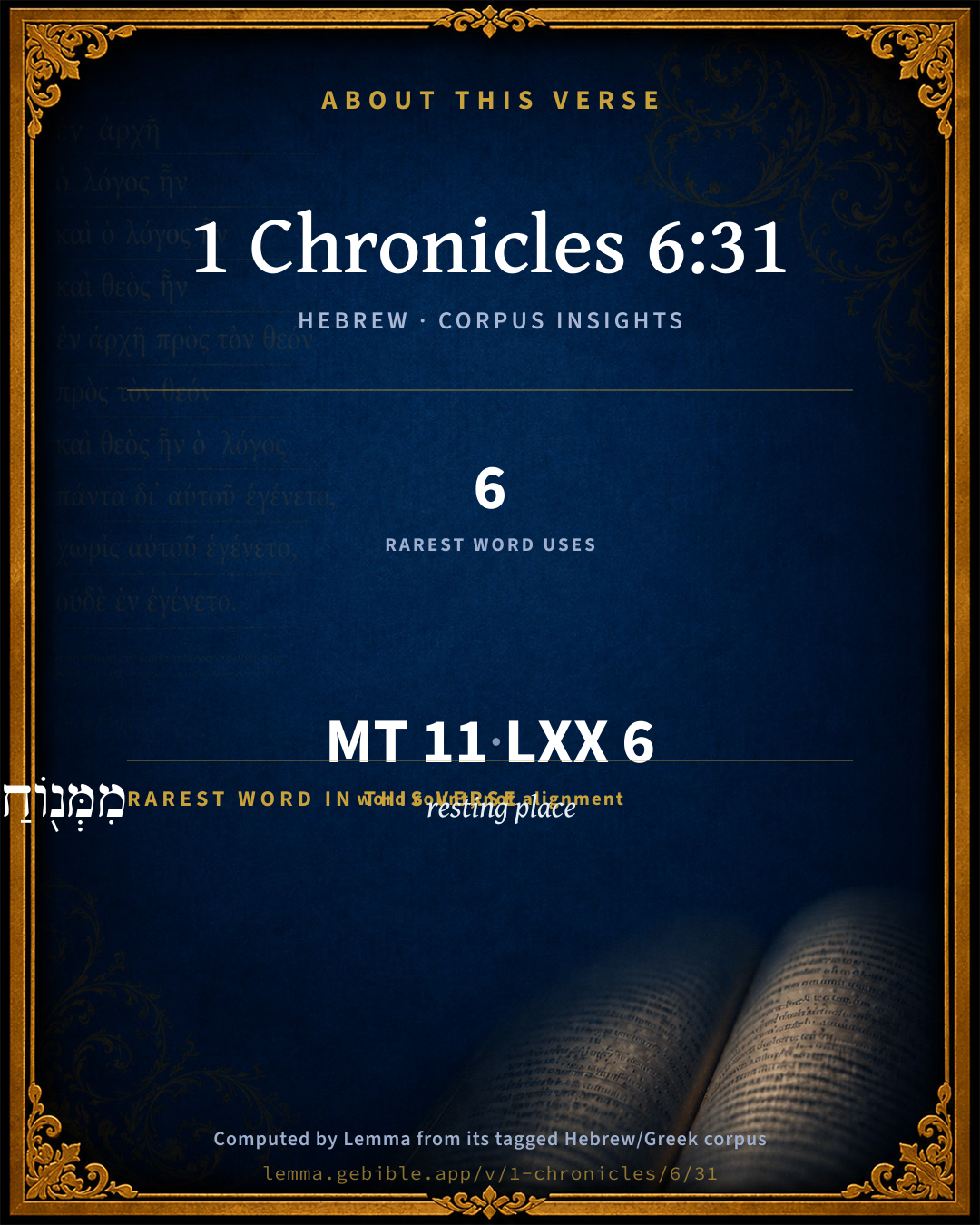
The rarest word here is מִמְּנ֖וֹחַ resting place H4494 — appearing just 6 times in the whole Hebrew Bible.

Shared distinctive vocabulary

מִמְּנ֖וֹחַ resting place H4494 occurs in 6 verses of the Hebrew Bible. Also found in:

Grammatical profile

  • 1 verb
  • 7 nouns
  • 1 pronoun
  • 1 preposition
  • 1 particle

Verb forms

  • הֶעֱמִ֥יד Hiphil · Perfect

Hebrew & Septuagint length

In English translation the verse runs 22 words from the Hebrew and 26 from the Septuagint (LXX English) — closely comparable.

A rough comparison of the two English renderings, which tokenize alike — not a word-level alignment.

Word counts can differ between the Hebrew and the Greek without any difference in meaning — e.g. the Hebrew direct-object marker אֵת has no separate Greek word, and Greek often adds the article ὁ.

In the original languages it is 11 Hebrew tokens and 6 Greek tokens — but the two are counted differently (Hebrew bundles its prefixes and suffixes into one token; the Greek is in lemma form), so that isn’t a like-for-like length.

Cross-references

7

Topical passages linked to 1 Chronicles 6:31 in the Treasury of Scripture Knowledge — connected by theme and wording, ordered by reader-vote popularity; previews shown in the World English Bible.

  • 2 Samuel 6:17 They brought in the ark of Yahweh, and set it in its place, in the midst of the tent that David had pitched for it; and David offered burnt offerings and peace-offerings before Yahweh.
  • 1 Chronicles 15:16–22 David spoke to the chief of the Levites to appoint their brothers the singers, with instruments of music, psalteries and harps and cymbals, sounding aloud and lifting up the voice with joy.
  • 1 Chronicles 15:25–16:1 So David, and the elders of Israel, and the captains over thousands, went to bring up the ark of the covenant of Yahweh out of the house of Obed-edom with joy.
  • 1 Chronicles 16:4–6 He appointed certain of the Levites to minister before the ark of Yahweh, and to celebrate and to thank and praise Yahweh, the God of Israel:
  • Psalms 132:8 Arise, Yahweh, into your resting place; You, and the ark of your strength.
  • Psalms 132:14 "This is my resting place forever. Here I will live, for I have desired it.
  • 1 Chronicles 25:1–31 Moreover, David and the captains of the host set apart for the service certain of the sons of Asaph, and of Heman, and of Jeduthun, who should prophesy with harps, with psalteries, and with cymbals: and the number of those who did the work according to their service was:

Cross-references courtesy of OpenBible.info (CC BY 4.0).

Hebrew and Greek witnesses Masoretic Hebrew ↔ Greek Septuagint

The same verse in the two great witnesses to the Old Testament, shown verse-for-verse.

These are two independent witnesses, not word-aligned to each other, and the Septuagint is shown in lemma (dictionary) form.

Hebrew 1 Chronicles 6:31 Masoretic · Westminster Leningrad Codex

וְאֵ֗לֶּה אֲשֶׁ֨ר הֶעֱמִ֥יד דָּוִ֛יד עַל יְדֵי שִׁ֖יר בֵּ֣ית יְהוָ֑ה מִמְּנ֖וֹחַ הָאָרֽוֹן

These are they whom David set over the service of song in the house of Yahweh, after that the ark had rest.

World English Bible · Public Domain

Greek LXX 1 Chronicles 6:31 Septuagint · lemma form

υἱός αμασαι υἱός βανι υἱός σεμμηρ

And these were the men whom David set over the service of the singers in the house of the Lord when the ark was at rest.

LXX2012 (modern English Septuagint) · Public Domain

Hebrew: Westminster Leningrad Codex (CC BY 4.0). Greek: Septuagint (public domain); English from LXX2012 (modern English Septuagint) (Public Domain). How the Septuagint differs from the Hebrew →

Commentary

Notes on 1 Chronicles 6:31 from classic Christian and Jewish commentators (each source and its license shown beneath its notes). The classic Christian expositions comment on the surrounding passage and are grouped to its opening verse, so a note may address several verses; the Jewish commentaries on the Tanakh (Rashi and others) are per-verse, so they appear only where the commentator wrote on this verse.

Lemma curates 59 commentaries, every one of them public domain or Creative Commons licensed, each selected and text-cleaned for this edition rather than reprinted as found. About our sources →

Matthew Henry's Commentary

When the Levites were first ordained in the wilderness much of the work then appointed them lay in carrying and taking care of the tabernacle and the utensils of it, while they were in their march through the wilderness. In David's time their number was increased; and, though the greater part of them was dispersed all the nation over, to teach the people the good knowledge of the Lord, yet those that attended the house of God were so numerous that there was not constant work for them all; and therefore David, by special commission and direction from God, new-modelled the Levites, as we shall find in the latter part of this book. Here we are told what the work was which he assigned them.

I. Singing-work, Ch1 6:31. David was raised up on high to be the sweet psalmist of Israel (Sa2 23:1), not only to pen psalms, but to appoint the singing of them in the house of the Lord (not so much because he was musical as because he was devout), and this he did after that the ark had rest. While that was in captivity, obscure, and unsettled, the harps were hung upon the willow-trees: singing was then thought unseasonable (when the bridegroom is taken away they shall fast); but the harps being resumed, and the songs revived, at the bringing up of the ark, they were continued afterwards. For we should rejoice as much in the prolonging of our spiritual privileges as in the restoring of them. When the service of the ark was much superseded by its rest they had other work cut out for them (for Levites should never be idle) and were employed in the service of song. Thus when the people of God come to the rest which remains for them above they shall take leave of all their burdens and be employed in everlasting songs. These singers kept up that service in the tabernacle till the temple was built, and then they waited on their office there, Ch1 6:32. When they came to that stately magnificent house they kept as close both to their office and to their order as they had done in the tabernacle. It is a pity that the preferment of the Levites should ever make them remiss in their business. We have here an account of the three great masters who were employed in the service of the sacred song, with their respective families; for they waited with their children, that is, such as descended from them or were allied to them, Ch1 6:33. Heman, Asaph, and Ethan, were the three that were appointed to this service, one of each of the three houses of the Levites, that there might be an equality in the distribution of this work and honour, and that every one might know his post, such an admirable order was there in this choir service. 1. Of the house of Kohath was Heman with his family (Ch1 6:33), a man of a sorrowful spirit, if it be the same Heman that penned the 88th psalm, and yet a singer. He was the grandson of Samuel the prophet, the son of Joel, of whom it is said that he walked not in the ways of Samuel (Sa1 8:2, Sa1 8:3); but it seems, though the son did not, the grandson did. Thus does the blessing entailed on the seed of the upright sometimes pass over one generation and fasten upon the next. And this Heman, though the grandson of that mighty prince, did not think it below him to be a precentor in the house of God. David himself was willing to be a door-keeper. Rather we may look upon this preferment of the grandson in the church as a recompense for the humble modest resignation which the grandfather made of his authority in the state. Many such ways God has of making up his people's losses and balancing their disgraces. Perhaps David, in making Heman the chief, had some respect to his old friend Samuel. 2. Of the house of Gershom was Asaph, called his brother, because in the same office and of the same tribe, though of another family. He was posted on Heman's right hand in the choir, Ch1 6:39. Several of the psalms bear his name, being either penned by him or tuned by him as the chief musician. It is plain that he was the penman of some psalms; for we read of those that praised the Lord in the words of David and of Asaph. He was a seer as well as a singer, Ch2 29:30. His pedigree is traced up here, through names utterly unknown, as high as Levi, Ch1 6:39-43. 3. Of the house of Merari was Ethan (Ch1 6:44), who was appointed to Heman's left hand. His pedigree is also traced up to Levi, Ch1 6:47. If these were the Heman and Ethan that penned the 88th and 89th psalms, there appears no reason here why they should be called Ezrahites (see the titles of those psalms), as there does why those should be called so who are mentioned Ch1 2:6, and who were the sons of Zerah.

II. There was serving-work, abundance of service to be done in the tabernacle of the house of God (Ch1 6:48), to provide water and fuel, - to wash and sweep, and carry out ashes, - to kill, and flay, and boil the sacrifices; and to all such services there were Levites appointed, those of other families, or perhaps those that were not fit to be singers, that had either no good voice or no good ear. As every one has received the gift, so let him minister. Those that could not sing must not therefore be laid aside as good for nothing; though they were not fit for that service, there was other service they might be useful in.

III. There was sacrificing-work, and that was to be done by the priests only, Ch1 6:49. They only were to sprinkle the blood and burn the incense; as for the work of the most holy place, that was to be done by the high priest only. Each had his work, and they both needed one another and both helped one another in it. Concerning the work of the priests we are here told, 1. What was the end they were to have in their eye. They were to make an atonement for Israel, to mediate between the people and God; not to magnify and enrich themselves, but to serve the public. They were ordained for men. 2. What was the rule they were to have in their eye. They presided in God's house, yet must do as they were bidden, according to all that God commanded. That law the highest are subject to.

Matthew Henry's Commentary on the Whole Bible (1708–1710) — public domain (CC PDM 1.0). Text via the HelloAO Bible API.

The Biblical Illustrator

Joseph S. Exell

1Ch_6:31; 1Ch_6:48

And these are they whom David let over the service of song lit the house of the Lord.

The ministry of song

I. Song an element of Christian worship.

II. Song an expression of human feeling.

III. Song a power for which its possessors are responsible. (J. Wolfendale.)

Religious worship

I. Worship varied in its forms.

II. Lively in its spirit.

III. Orderly in its method.

IV. Universal in its participation. (J. Wolfendale.)

.

The Biblical Illustrator, edited by Joseph S. Exell (c. 1880s–1900s) — public domain. Text from a community e-Sword module.

Joseph Benson's Commentary

1Ch 6:31. And these — Whose names follow, are they whom David set over the service — Appointed to minister to God by singing songs of praise in his house; after that the ark had rest — After David had brought it from the house of Obed-edom, and settled it in Jerusalem, 2Sa 8:17.

Joseph Benson's Commentary on the Old and New Testaments (1811–1818) — public domain. Text from a community e-Sword module.

Tyndale Open Study Notes

Tyndale Open Resources

6:31-47 This genealogy names the lead singers from Kohath (6:33), Gershon (6:39), and Merari (6:44), the chief Levitical families.

Tyndale Open Study Notes — © Tyndale Open Resources, licensed CC BY-SA 4.0. Text via the HelloAO Bible API.

Geneva Bible (1599)

Geneva Bible translators

After it was brought to that place where the Temple should be built and was no more carried to and fro.

Geneva Bible (1599) marginal notes — public domain. Text via Bolls.life.

Adam Clarke's Commentary

Verse 31. After that the ark had rest.] The Targum says, "These are they whom David set over the service of the singing, in the house of the sanctuary, or tabernacle of the Lord, at the time in which the ark was brought into it;" that is, when it was brought from the house of Obed-edom.

Adam Clarke's Commentary on the Bible (1810–1826) — public domain. Text from a community e-Sword/MySword module.

Ellicott's Commentary for English Readers

(31) Set over the service of song.—Literally, made stand by the sides (hands) of song, as if to minister to the sacred music. (Comp. 1Ch_25:2-3, where the same peculiar phrase recurs, and Psa_123:2, “as the eyes of slaves are unto the hand of their Lord.” Comp. also the common heading of the Psalms, “to the conductor or precentor;” Authorised Version, “chief musician.”)

In the house of the Lord.—In David’s time, a tent, as next verse declares.

After that the ark had rest.—Perhaps locative: at the restin-place of the Ark (comp. Gen_8:9). From the time of its capture by the Philistines (2Sa_6:17), the Ark had no certain dwelling till it was lodged in the tent which David spread for it on Mount Zion.

A Bible Commentary for English Readers, edited by Charles John Ellicott (1878–1897) — public domain. Text from a community e-Sword module.

The Cambridge Bible for Schools and Colleges

gen. ed. J. J. S. Perowne

31, 32 (= 16, 17 according to the Heb. division). David’s Singers

31. the ark had rest] i.e. was brought into the city of David for a permanent resting-place.

The Cambridge Bible for Schools and Colleges (gen. ed. J. J. S. Perowne; Cambridge University Press, 1878–1918) — public domain. Text from a community e-Sword module.

John Gill's Exposition

And his brother Asaph,.... That is, Heman's brother; so Asaph was, as he was a descendant from the same original ancestor Levi, yet in the line of Gershon; and as being of the same office, a precentor, or chief singer:

who stood on his right hand; he was next to Heman; Heman stood in the middle, which was the most honourable (h), and Asaph on his right hand, and Ethan, after mentioned, on his left; even Asaph, whose name is often met with in the book of Psalms; and his genealogy here stands thus, as traced up to Levi, viz. Berechiah, Shimea, Michael, Baaseiah, Malchiah, Ethni, Zerah, Adaiah, Ethan, Zimmah, Shimei, Jahath, Gershon, Levi.

(h) "Alecto stetit in mediis----", Claudian in Rufin. l. 1. ver. 41. Vid. Barthii Animadv. in ib.

John Gill's Exposition of the Whole Bible (1746–1763) — public domain (CC PDM 1.0). Text via the HelloAO Bible API.

Albert Barnes' Notes on the Bible

The genealogies of David’s three chief singers, Heman, Asaph, and Ethan or Jeduthun.

1Ch 6:32

They waited on their office - On the establishment and continuance of the choral service in the temple, see 2Ch 5:12, 2Ch 29:27-30; 2Ch 35:15.

1Ch 6:33

Heman - In general Asaph takes precedence of Heman and Jeduthun, but here Heman is placed first, because his family, that of the Kohathites, had the highest priestly rank, being the family which furnished the high priests (see 1Ch 6:2-15).

Shemuel - i. e. “Samuel.” Our translators have here given the Hebrew, while elsewhere they give uniformlv the Greek, form of the name. We learn by this genealogy that Heman was Samuel’s grandson.

1Ch 6:39

His brother Asaph - Not “brother” in the ordinary sense of the term, since Asaph was the son of Berachiah, and a Gershonite, not a Kohathite. “Brother” here may mean “fellow-craftsman” (compare 1Ch 25:7).

1Ch 6:44

Ethan - Or Jeduthun (see the margin). Corruption will scarcely account for the two forms of the name, since Ethan is used persistently up to a certain point 1Ch 15:19, after which we have uniformly “Jeduthun.” The case seems to be rather one in which a new name was taken after a while, which thenceforth superseded the old. Compare Abraham, Sarah, Joshua, Jehoiakim, Zedekiah, etc.

Albert Barnes' Notes on the Bible (1834–1885) — public domain. Text from a community e-Sword/MySword module.

Haydock's Catholic Bible Commentary

The singing. Hebrew, "the hands or places of the canticle," the two tribunes on each side of the altar. Heman presided over the band in the middle, while Asaph directed those on the right, and Ethan those on the left, ver. 33, 39, and 44. (Calmet) --- Placed. Hebrew, "rested," as before David’s time it had been carried about. He erected a tabernacle for it on Sion, and directed the Levites to attend in order, (chap. xxv.) so that some should be present every day (Menochius) to honour God, both by instruments and vocal music, while the priests performed their sacred functions with the utmost decency.

George Leo Haydock (1774–1849), Haydock's Catholic Family Bible and Commentary, 1859 edition — public domain. Excludes Psalms (Douay-Rheims chapter numbering differs from Protestant) and Deuterocanonical books (Catholic canon only).

Matthew Poole's English Annotations

These are they, whose names here follow.

The service, Heb. the hands. Hand put for ministry or service, which is commonly performed by the hand. Thus God is frequently said to speak or command things by the hand (i.e. the ministry) of Moses. Compare 2Ch 29:27.

After that the ark had rest; which was in David’s time, 2Sa 6:17.

Matthew Poole's English Annotations on the Holy Bible (1683–1685) — public domain. Text from a community e-Sword/MySword module.

Whedon's Commentary on the Bible

Daniel D. Whedon

31. Whom David set over the service of song — See on 1Ch_15:16.

Daniel D. Whedon (gen. ed.), Commentary on the Old and New Testaments (1874–1909) — public domain. Text from a community e-Sword module.

The Pulpit Commentary

Vers. 31-48. In the early verses of this section we may notice, if not the first beginning, yet some of the earliest crystallization of the forms of religious services. It was given to David to settle the ark after its travels through the wilderness, its sojourn in various places since then, doubtless always within the care of some Levitical family (except when taken by enemies, (1Sa_4:11 1Sa 5:, 1Sa_5:6) and in especial its prolonged twenty years" sojourn.at Kirjath-jearim (1Sa_7:1, 1Sa_7:2; 2Sa_6:1-19; 1Ch_13:3-14 1Ch_15:1-3 1Ch_17:5) It now had rest, though its place of rest was only within "curtains" (2Sa_7:2; 1Ch_17:1) i.e. in a special separate tent prepared for it by David, which tent was probably the suggestion, and as it were the nucleus, of the coming grand temple itself the house of God. The event was naturally one of great joy and thanksgiving, of which David himself was the chief leader (2Sa_6:17-21; 1Ch_16:1-3) but it appears also that it furnished the occasion of appointing fixed choir conductors, leaders of the service of song". (1Ch_16:4-7, 1Ch_16:37, 1Ch_16:41, 42 25:1-7)

The service of Song.

The ministry of psalmody, in its definite organization, was instituted by David. The occasion of this was when the ark was placed, as in a resting-place, in the tabernacle of the congregation. The arrangements then made were the germ of the more elaborate temple service under Solomon. From the time of David, "the sweet singer of Israel," "the service of song in the house of the Lord" occupied an important position in the religious observances of Israel. To justify this, consider that

I SINGING IS THE NATURAL EXPRESSION OF EMOTION. The outburst of joy, the fervour and rapture of love, the pathos of sorrow, find their form and utterance in song.

II MAN"S NATURE MAKES SONG THE SUITABLE EXPRESSION OF RELIGIOUS FEELING. The highest form of human feeling impels to the expression vocally appropriate. Psalmody, especially choral and congregational psalmody, forms the most inspiriting vehicle of religious gratitude, adoration, and praise.

III SCRIPTURE HISTORY RECORDS SEVERAL DEVELOPMENTS OF PSALMODY. The lyric outbursts of joy which took place when the Lord confounded Pharaoh and delivered his chosen people, were the first recorded instances. But David himself was the true leader of psalmody, both Hebrew and Christian. Christ and his disciples "sang a hymn," and Paul and Silas sang praises at midnight in the gaol of Philippi. The early Christians were accustomed to sing God"s praises in their social assemblies.

IV SCRIPTURE REPRESENTS THE SERVICE OF SONG AS ACCEPTABLE TO GOD. Presuming that the service, the homage, the love, are sincere, the inspired writers summon all God"s people to join in thus celebrating his praises. "Sing ye praises; praise God, all ye people," is the admonition of the psalmist; and the apostle thus directs us: "Is any merry? let him sing psalms.

V SCRIPTURE SANCTIONS THE CONSECRATION TO PSALMODY OF LABOUR, ART, AND DEVOTION. We find that, under the old dispensation, there was a regular ministry consecrated to "the service of song." It would be strange if it were lawful to spend time, money, strength, skill, upon exercises intended to give pleasure to men, and at the same time unlawful to offer aught to God save that which cost us nothing. God will have our best; and when we have offered this, of his own have we given him.

VI SCRIPTURE REMINDS US THAT THE EFFICACY AND ACCEPTABLENESS OF THE SERVICE OF SONG DEPEND UPON THE WORSHIPPER"S SPIRITUALITY AND SINCERITY. The form without the substance, the art without the spirit, the song without the love and faith it should express, these are vain and worthless. Let us offer acceptable sacrifices, the fruit of our lips, giving thanks unto his Name.

T.

The service of song in the house of the Lord.

The "house of the Lord" is the place whither we go primarily to worship him. So, at least, it should be. We may have learnt to go thither in order to enjoy, sacred oratory or even for some less honourable purpose. The primary end of service in the sanctuary is the worship of God; and the service of song should be regarded as one most important feature of public worship. In sacred song we present ourselves to God in every attitude which our souls can assume toward him, and if we went and sang together with the heart as well as with the voice, and then returned, we should have rendered an acceptable offering and gained a valuable blessing. If "the service of song in the house of the Lord" be perfect, or as perfect as it is possible to make it, there will be

I AN APPROACH TO GOD IN EVERY VARIETY OF SPIRITUAL ACCESS. In our hymns:

1. We shall adore him, as when we sing, "Great God, how infinite art thou!" etc., or "My God, how wonderful thou art!" etc.

2. We shall praise and bless him, as when we sing, "Oh for a thousand tongues to sing," etc.

3. We shall confess cur sin to him, as when we sing, "Oppressed with sin and woe," etc.

4. We shall make supplication to him; for there is no essential distinction between "praise" and "prayer." In the latter we frequently bless God for his mercies, while in the former we often supplicate him for his blessing, as when we sing, "Guide me, O thou great Jehovah," etc.

5. We shall reconsecrate ourselves to him, as when we sing, "My Saviour, I am thine," etc., or Lord, in the strength of grace," etc.

6. We shall intercede with him on behalf of others, as when we sing, "O Spirit of the living God," etc.

II A SACRED SUMMONS, AS IN HIS HOLY PRESENCE, TO FIDELITY AND DEVOTION. We shall call upon ourselves and one another to illustrate our truest and highest convictions as Christian men and the soldiers of Christ, as when we sing, "Stand up, stand up for Jesus!" etc., or "Ye servants of the Lord," etc. We shall have holy and elevating fellowship with the whole Church of Christ, as when we sing, "Come, let us join our friends above," etc.

III SPIRITUAL AS WELL AS VOCAL PARTICIPATION. Our service of song will be only a hollow sound, unmusical in the Master"s ear, if we rise no higher than the harmony of blending voices. There must be living, spiritual sympathy. All souls must join together as well as all tongues. In this great matter of the service of song, as in all other things, "the Lord looketh upon the heart." We must "make melody in our hearts" unto him, or the sound of our song will rise no higher than the roof of our building; it will not reach his throne.

IV UNIVERSAL PARTICIPATION. Choral singing may find its place in the new dispensation as it did in the old; but it must take the "lower room." Congregational psalmody is the desideratum, the perfect thing, the standard at which to aim. "Every creature in heaven and on the earth" did John hear saying, "Blessing, and honour, and glory" etc.; (Rev_5:13) "A great multitude, which no man could number... stood.., and cried with a loud voice, saying, Salvation to our God," etc.. (Rev_7:9, Rev_7:10) Let the Church on earth anticipate the Church in heaven, by every voice, the voice of a great multitude, being heard in the accents of praise, participating in "the service of song in the house of the Lord." This will be:

1. A source of joy to each participant.

2. A service to fellow-worshippers.

3. An acceptable offering to the Saviour. C.

HOMILIES BY F. WHITFIELD

Vers. 31-48.

Priesthood and service.

In the rather lengthy genealogy of the priesthood in this chapter, there is much instruction. The children of God have each their appointed service in the vineyard of the Lord. We have here four kinds of service

(1) The service of rest (ver. 31);

(2) the service of song (ver. 31);

(3) the service of waiting (vers. 32, 33);

(4) the service of work (ver. 48).

This is the Divine order of every believer"s service.

I THE SERVICE BEST. Christ Jesus, the true Ark, rests in his own finished work on the cross. "This man, after he had offered one sacrifice for sins for ever, sat down on the right hand of the throne of God." His people find their rest also in that finished work. "We which have believed do enter into rest." This is the first in the Divine order. There can be no service of song till we know the service of rest. You cannot praise.God till you know your sins are forgiven. You have nothing to praise him for. This, then, is the first service in which you are called to engage the service of rest. Rest in Jesus, rest in his finished work for your soul, rest in his full and free and ever. lasting salvation. Header, have you thus found rest in Christ?

II THE SERVICE OF SONG. After the service of rest, you can enter on the service of song. And what is that song? "There is therefore now no condemnation to them that are in Christ Jesus;" "Unto him that loved us, and washed us from our sins in his own blood, and hath made us kings and priests unto God and his Father; to him be glory and dominion for ever and ever. Amen; Worthy is the Lamb that was slain to receive power, and riches, and wisdom, and strength, and honour, and glory, and blessing." These are some of the notes in that service of song which they can sing who have entered on the service of rest. Reader, can you sing them?

III Next is THE SERVICE OF WAITING; for "They also serve who only stand and wait." Indeed, it is one of the highest services in which the redeemed soul can engage. What is this service of waiting? It is that spirit that waits upon God continually, in each day and each hour looking up and saying, "Lord, what wilt thou have me to do?" It is renouncing our own will, our own way, our own inclination, our own pleasure, and as "the eyes of servants look unto the hand of their masters, and as the eyes of a maiden unto the hand of her mistress, so our eyes wait upon the Lord our God." The cloud may tarry long, but wait for it. Waiting time is not only never lost time, but it is most blessed discipline for the soul. "For the vision is yet for an appointed time, but at the end it shall speak, and not lie: though it tarry, wait for it; because it will surely come, it will not tarry". (Hab_2:3) Reader, are you waiting thus upon God?

IV Lastly, we have THE SERVICE OF WORK. Mark what is said of this: "Their brethren also the Levites were appointed unto all manner of service of the tabernacle of the house of God" (ver. 48). Yes, "all manner of service." There are all kinds of work in the great spiritual temple of God, and work for all. And this work may be of the very humblest kind. One day the disciples may be summoned to hold converse with Moses and Elias, and to behold their Saviour transfigured. What a privilege! some will say. A few days afterwards they are sent to unloose a colt and foal to do what had all the appearance of an act of robbery! Yet it is the same Master who sends on both errands. Some of the eminent ones of Israel, while passing through the wilderness with the tabernacle, had to spend whole years in taking care of pins, others in taking care of curtains, some of boards, and bars, and pillars, and sockets. (Nu 3) Yet all was God"s work. It was to the Lord they did it, not to man. Look not at the work, but at the Master. It is the Master that makes the meanest service grand and noble. "Whatsoever ye do, do it heartily, as to the Lord, and not unto men; knowing that of the Lord ye shall receive the reward of the inheritance: for ye serve the Lord Christ." This makes the "cup of cold water" grand. Jesus! this makes a tattered thought glorious. Jesus! this ennobles every work, makes the meanest honourable, the smallest great. And the mightiest work that has not this motive is lighter than the small dust of the balance. Reader, never forget the Spirit"s order of service: resting, praising, waiting, working. W.

Vers. 31, 32.

The ministry of song.

To King David is traced the ordering and arranging of the service of song in connection with Divine worship, but we are hardly justified in regarding him as the originator of sacred music and song. Miriam"s chant, and the songs of Moses, Deborah, Hannah, etc., indicate previous culture of both the gifts of poetry and of music, and the relation in which both stood to public acts of worship. In the earlier Mosaic system there was the clanging of cymbals and blowing of trumpets on special occasions, but probably the connection of intelligent words of trust and praise with the musical chant, in which the worshippers may unite, led by a trained choir, must be traced to David. It is one of his great achievements that he helped to make Divine worship more interesting and attractive, lifting it from the sacrifice of things to the sacrifice of praise, the utterance to God of thankful, trustful, and loving feelings; man offering to God the sacrifice of his own emotions, and finding such sacrifice accounted a "sweet savour." It will at once be recognized that the poetical and musical endowments of David prepared him to serve his God and his fellows in this particular ministry. And his own practice and culture of the gifts enlarged his preparation, and so his fitness for the work, when the providential time for it came. The service of song was commenced in the new tabernacle erected by David on Mount Zion, but probably not until after the ark was restored and made to rest within it; and the service was greatly extended and elaborated to fit in with the more gorgeous surroundings of Solomon"s temple. Many of the psalms were composed for use in the public worship, and are arranged for solo and chorus, or for answering choruses. "David put the musical part of the service under the direction of Asaph. Distinctions are made between the different kinds of instruments for which different psalms were suited, indicating that bands composed of stringed instruments, and other bands composed of wind instruments, were employed. We have also notices of trained men and women singers. The singing was managed by responses, or by solo and chorus, many of the psalms lending themselves readily to these forms of music." Taking the references in these verses as suggestive of a general truth, we dwell on

I THE FACT THAT SONG IS A DIVINE GIFT. Among the pagans it was so recognized, as it was also in David"s time. It is singular to find how small a place poetry and music took in the apostolic Church. The power of song is found characteristic of individuals, and it often follows in family lines, as is illustrated in the cases of Asaph and Heman. It becomes, for the individual, the entrusted talent, the inspired gift, the faculty which is to be put out to the Lord"s use, the speciality which gives a man his niche and his work.

II SUCH A GIFT MAY BE CONSECRATED TO THE DIVINE SERVICE. It has its distinctly fitting place in relation to public service; and the modern developments of worship give it a most prominent and important place. This is true of all forms that public worship takes, and may be precisely illustrated in relation to each form. The importance of song as attracting to the house of God, as interesting and spiritually benefiting those engaged in worship, add as finding audible expression for devout feeling, should be fully enforced. It therefore becomes the duty of all who have the gift to lay it on the altar of God"s service in the sanctuary.

III SUCH A GIFT MAY BE USED FOR THE COMFORT AND,HELP OF OTHERS. There is a sphere for the ministry of song in our homes, in society, at sick-beds, in visiting the poor, and among the children. Illustrate by references to Philip Phillips, the singing pilgrim, and to Ira Sankey, the companion of D. L. Moody.

IV SUCH A GIFT MAY BE TRAINED AND SET IN ORDER FOR THE MOST EFFICIENT SERVICE, both in public worship and in private spheres. We are responsible to God for faithful and wise use of such a gift, and for the efficient culture of it. Impress on all who have the endowment the duty of using it for all gracious and loving and helpful ends in all the spheres where they may be set. R.T.

The Pulpit Commentary (1880–1919), ed. H.D.M. Spence-Jones & Joseph S. Exell — public domain. Text from a community e-Sword module.

Keil & Delitzsch

C. F. Keil & F. Delitzsch

And his brother Asaph,.... That is, Heman's brother; so Asaph was, as he was a descendant from the same original ancestor Levi, yet in the line of Gershon; and as being of the same office, a precentor, or chief singer:

who stood on his right hand; he was next to Heman; Heman stood in the middle, which was the most honourable (h), and Asaph on his right hand, and Ethan, after mentioned, on his left; even Asaph, whose name is often met with in the book of Psalms; and his genealogy here stands thus, as traced up to Levi, viz. Berechiah, Shimea, Michael, Baaseiah, Malchiah, Ethni, Zerah, Adaiah, Ethan, Zimmah, Shimei, Jahath, Gershon, Levi.

(h) "Alecto stetit in mediis----", Claudian in Rufin. l. 1. ver. 41. Vid. Barthii Animadv. in ib.

Keil & Delitzsch — Biblical Commentary on the Old Testament (1861–1891) — public domain (CC PDM 1.0). Text via the HelloAO Bible API. (Old Testament only.)

unfoldingWord translationNotes

Door43 World Missions Community

the house of Yahweh

"where people met with Yahweh" This was a tent in David's time.

the ark came to rest there

"the people of Israel placed the ark there"

the tabernacle, the tent of meeting

Possible meanings are 1) that "the tent of meeting" and "the tabernacle" are two names for the same thing or 2) the tabernacle is part of the tent of meeting, "the sanctuary of the tent of meeting"

They fulfilled their duties

"They did their work" or "They did their various kinds of work"

according to the instructions given to them

This can be stated in active form. AT: "according to the instructions that David gave them" or "according to the instructions they received" (See: Active or Passive)

translationWords

David

house of God

ark of the covenant

servant

tabernacle

tent

Solomon

Jerusalem

unfoldingWord translationNotes — © Distant Shores Media and the Door43 World Missions Community, licensed CC BY-SA 4.0. Source: git.door43.org/Door43/en_tn.

Lesson kit

Teaching starters — assembled from the data on this page, not authored interpretation. Every prompt links to the verse data it draws on. Edit before teaching.

1 Chronicles, in the Historical, opens this verse with 11 words (11 distinct Hebrew lemmas). Its most distinctive word is mânôwach (“resting place”). A historical commentator’s framing appears above. Read the whole chapter for the surrounding context.

Discussion questions

  1. How does “resting place” (mânôwach) shape what this verse is saying?
  2. How does Genesis 8:9, which shares the word «resting place», read alongside this verse?
  3. These translations render this verse differently; the difference is in the English rendering, not the original. What questions does that raise?
  4. «הֶעֱמִ֥יד» is a Hiphil Perfect verb. How does that grammatical form shape the action described?
  5. Compare how Matthew Henry's Commentary and The Biblical Illustrator read this verse. Where do they agree or differ?

Things to notice

Reading settings

Reading text

Shown beneath each verse's original-language words.

Old Testament
Old Testament edition

Read the OT as the Masoretic Hebrew (MT) or the Greek Septuagint (LXX).

English shown for the Greek Septuagint (in the Hebrew ↔ Greek comparison).

Comparing translations? Open the Compare panel on any verse page to stack up to four side by side.