
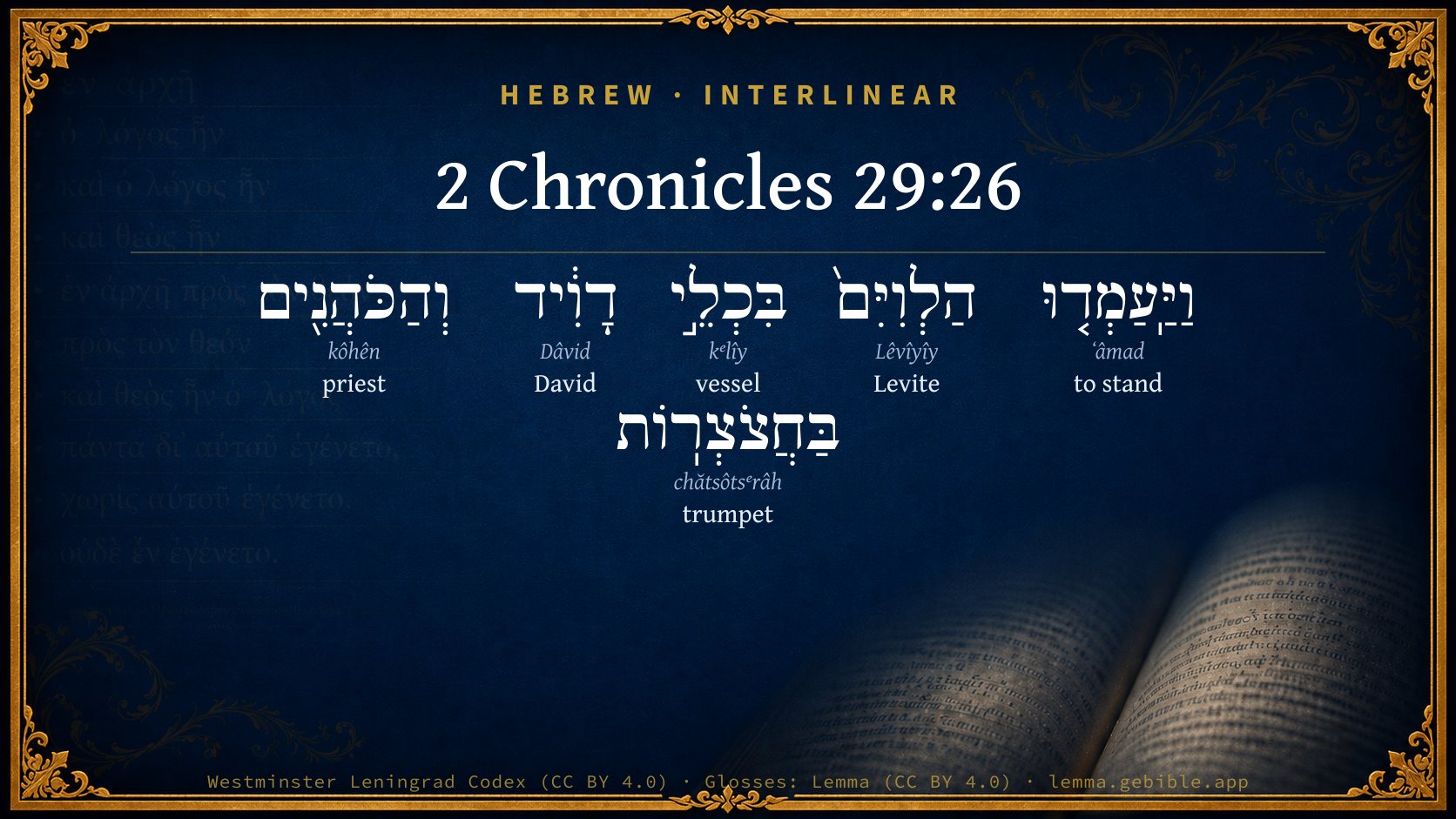
2 Chronicles 29:26

Hebrew (Westminster Leningrad Codex) 2 Chronicles 29:26 appears in the Hebrew Old Testament. The text above is from the Westminster Leningrad Codex. Each word links to its Strong’s number, a concise gloss, and parsing drawn from the Open Scriptures Hebrew Bible morphology. Click any word for its full Brown-Driver-Briggs (BDB) entry.
Download image
Cite this verse

2 Chronicles 29:26 (World English Bible). Public Domain. Lemma interlinear Bible study tool, https://lemma.gebible.app/v/2-chronicles/29/26.

Show BibTeX & RIS
BibTeX
RIS
English Translation
The Levites stood with the instruments of David, and the priests with the trumpets.
World English Bible · Public Domain
Download a study sheet

One document with this verse’s original text, its word-by-word gloss line, the meaning frame, cross-references with their text, attributed commentary, and full source and license credits — printable, and it pastes into notes with its structure intact.

This verse Autodidact and up

Study sheet (.html) Plain text (.txt)

A passage Seminary Student

Up to 50 verses in one chapter. A passage sheet keeps up to 6 commentary sources and 12 cross-references per verse, in the order this page ranks them, and says so on the sheet whenever that leaves anything out. Ask for a single verse and you get the Autodidact verse sheet above.

Everything on this page stays free to read, with no account — the sheet is a download of what is already on screen, not access to it.

Want to remove ads? Support Godless Engineer
Compare translations 3

The same verse in 3 English versions, stacked beneath the original-language interlinear above. Click any original word for its lexicon entry.

Each is an independent rendering of the whole verse — the interlinear is not word-aligned to these translations.

Highlighted words mark where these versions differ — a whole-verse word diff, not a word-by-word alignment.

  • World English Bible Public Domain
    The Levites stood with the instruments of David, and the priests with the trumpets.
  • King James Version Public Domain
    And the Levites stood with the instruments of David, and the priests with the trumpets.
  • unfoldingWord Literal Text CC BY-SA 4.0
    And the Levites stood with the instruments of David and the priests with the trumpets.

unfoldingWord Literal Text — © unfoldingWord, licensed CC BY-SA 4.0. Word-aligned USFM3 via Door43 (git.door43.org/unfoldingWord/en_ult).

Versions to compare (up to 4)

3 of 4 selected

Show all 18 translations

Every available English version of this verse, each an independent rendering of the whole verse.

  • World English Bible Public Domain
    The Levites stood with the instruments of David, and the priests with the trumpets.
  • Berean Standard Bible Public Domain
    The Levites stood with the instruments of David, and the priests with the trumpets.
  • Majority Standard Bible Public Domain
    The Levites stood with the instruments of David, and the priests with the trumpets.
  • King James Version Public Domain
    And the Levites stood with the instruments of David, and the priests with the trumpets.
  • American Standard Version (1901) Public Domain
    And the Levites stood with the instruments of David, and the priests with the trumpets.
  • Revised Version (1885) Public Domain
    And the Levites stood with the instruments of David, and the priests with the trumpets.
  • Geneva Bible (1599) Public Domain
    And the Leuites stood with the instruments of Dauid, and the Priests with the trumpets.
  • Douay-Rheims (1899) Public Domain
    And the Levites stood, with the instruments of David, and the priests with trumpets.
  • Young's Literal Translation Public Domain
    and the Levites stand with the instruments of David, and the priests with the trumpets.
  • Literal Standard Version CC BY-SA 4.0
    and the Levites stand with the instruments of David, and the priests with the trumpets.
  • Unlocked Literal Bible CC BY-SA 4.0
    The Levites stood with the instruments of David, and the priests with the trumpets.
  • unfoldingWord Literal Text CC BY-SA 4.0
    And the Levites stood with the instruments of David and the priests with the trumpets.
  • Darby Bible Public Domain
    And the Levites stood with the instruments of David, and the priests with the trumpets.
  • World Messianic Bible Public Domain
    The Levites stood with David’s instruments, and the priests with the shofars.
  • Webster's Bible Public Domain
    And the Levites stood with the instruments of David, and the priests with the trumpets.
  • Free Bible Version CC BY-SA 4.0
    The Levites stood with the musical instruments provided by David, with the priests holding their trumpets.
  • Bible in Basic English Public Domain
    So the Levites took their places with David's instruments, and the priests with their horns.
  • JPS Tanakh (1917) Public Domain
    And the Levites stood with the instruments of David, and the priests with the trumpets.

Literal Standard Version (2020), Covenant Press — licensed CC BY-SA 4.0. Text via the HelloAO Bible API (eBible.org). Unlocked Literal Bible (unfoldingWord) — licensed CC BY-SA 4.0. Text via the HelloAO Bible API (eBible.org). unfoldingWord Literal Text — © unfoldingWord, licensed CC BY-SA 4.0. Word-aligned USFM3 via Door43 (git.door43.org/unfoldingWord/en_ult). Free Bible Version, Dr. Jonathan Gallagher — licensed CC BY-SA 4.0. Text via the HelloAO Bible API (eBible.org).

Word by word

More ways to search: Search by grammar → Find every occurrence → Compare this word →

Practice this passage: Drill this verse → Learn its vocabulary →

About this verse

These counts appear in no published source. They are computed here, from the morphology-tagged text and Lemma’s own curated glosses. What Lemma adds →

6
words
6
distinct lemmas
Historical
section

Shared distinctive vocabulary

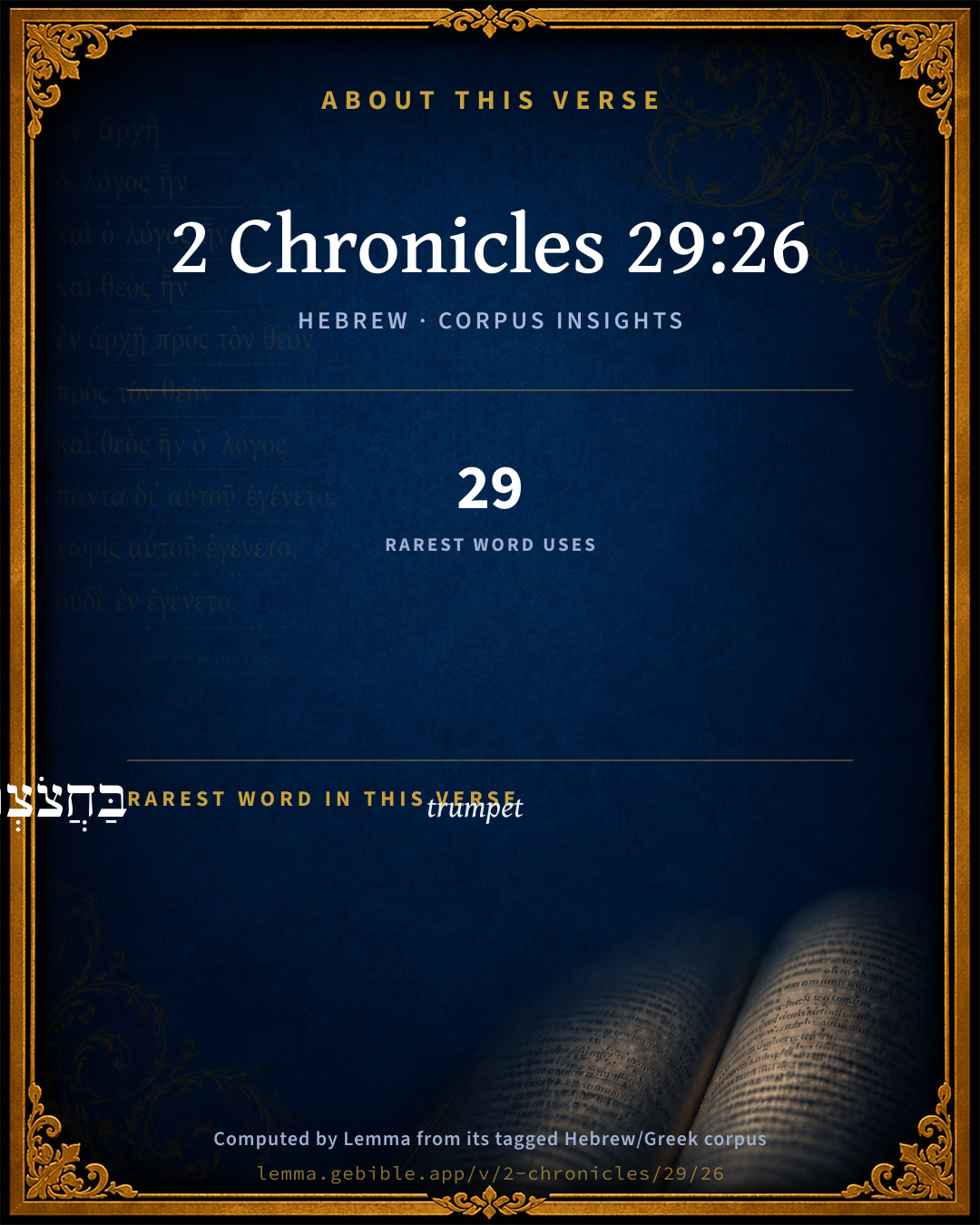
בַּחֲצֹצְרֽוֹת trumpet H2689 occurs in 27 verses of the Hebrew Bible. Also found in:

Grammatical profile

  • 1 verb
  • 5 nouns

Verb forms

  • וַיַּֽעַמְד֤וּ Qal · Sequential Imperfect

Hebrew & Septuagint length

In English translation the verse runs 14 words from the Hebrew and 15 from the Septuagint (LXX English) — closely comparable.

A rough comparison of the two English renderings, which tokenize alike — not a word-level alignment.

Word counts can differ between the Hebrew and the Greek without any difference in meaning — e.g. the Hebrew direct-object marker אֵת has no separate Greek word, and Greek often adds the article ὁ.

Cross-references

13

Topical passages linked to 2 Chronicles 29:26 in the Treasury of Scripture Knowledge — connected by theme and wording, ordered by reader-vote popularity; previews shown in the World English Bible.

  • 1 Chronicles 23:5 and four thousand were doorkeepers; and four thousand praised Yahweh with the instruments which I made, [said David], for giving praise.
  • 1 Chronicles 15:24 Shebaniah, and Joshaphat, and Nethanel, and Amasai, and Zechariah, and Benaiah, and Eliezer, the priests, did blow the trumpets before the ark of God: and Obed-edom and Jehiah were doorkeepers for the ark.
  • Amos 6:5 Who strum on the strings of a harp; Who invent for themselves instruments of music, like David;
  • Numbers 10:8 The sons of Aaron, the priests, shall blow the trumpets; and they shall be to you for a statute forever throughout your generations.
  • Numbers 10:10 Also in the day of your gladness, and in your set feasts, and in the beginnings of your months, you shall blow the trumpets over your burnt offerings, and over the sacrifices of your peace-offerings; and they shall be to you for a memorial before your God: I am Yahweh your God.
  • Joshua 6:4–9 Seven priests shall bear seven trumpets of rams' horns before the ark: and the seventh day you shall compass the city seven times, and the priests shall blow the trumpets.
  • 1 Chronicles 16:6 and Benaiah and Jahaziel the priests with trumpets continually, before the ark of the covenant of God.
  • 2 Chronicles 5:12–13 also the Levites who were the singers, all of them, even Asaph, Heman, Jeduthun, and their sons and their brothers, arrayed in fine linen, with cymbals and psalteries and harps, stood at the east end of the altar, and with them one hundred twenty priests sounding with trumpets;)
  • Psalms 81:3 Blow the trumpet at the New Moon, At the full moon, on our feast day.
  • Psalms 87:7 Those who sing as well as those who dance say, "All my springs are in you."
  • Psalms 98:5–6 Sing praises to Yahweh with the harp, With the harp and the voice of melody.
  • Psalms 150:3–5 Praise him with the sounding of the trumpet! Praise him with harp and lyre!
  • Isaiah 38:20 Yahweh is [ready] to save me: Therefore we will sing my songs with stringed instruments All the days of our life in the house of Yahweh.

Cross-references courtesy of OpenBible.info (CC BY 4.0).

Hebrew and Greek witnesses Masoretic Hebrew ↔ Greek Septuagint

The same verse in the two great witnesses to the Old Testament, shown verse-for-verse.

These are two independent witnesses, not word-aligned to each other, and the Septuagint is shown in lemma (dictionary) form.

Hebrew 2 Chronicles 29:26 Masoretic · Westminster Leningrad Codex

וַיַּֽעַמְד֤וּ הַלְוִיִּם֙ בִּכְלֵ֣י דָוִ֔יד וְהַכֹּהֲנִ֖ים בַּחֲצֹצְרֽוֹת

The Levites stood with the instruments of David, and the priests with the trumpets.

World English Bible · Public Domain

Greek LXX 2 Chronicles 29:26 Septuagint · lemma form

καί ἵστημι ὁ λευείτης ἐν ὄργανον δαυίδ καί ὁ ἱερεύς ὁ σάλπιγξ

And the Levites stood with the instruments of David, and the priests with the trumpets.

LXX2012 (modern English Septuagint) · Public Domain

On this verse, The Cambridge Bible for Schools and Colleges discusses the Septuagint’s reading. Read the note in Commentary ↓

Hebrew: Westminster Leningrad Codex (CC BY 4.0). Greek: Septuagint (public domain); English from LXX2012 (modern English Septuagint) (Public Domain). How the Septuagint differs from the Hebrew →

Commentary

Notes on 2 Chronicles 29:26 from classic Christian and Jewish commentators (each source and its license shown beneath its notes). The classic Christian expositions comment on the surrounding passage and are grouped to its opening verse, so a note may address several verses; the Jewish commentaries on the Tanakh (Rashi and others) are per-verse, so they appear only where the commentator wrote on this verse.

Lemma curates 59 commentaries, every one of them public domain or Creative Commons licensed, each selected and text-cleaned for this edition rather than reprinted as found. About our sources →

Trapp's Complete Commentary

John Trapp

2Ch 29:26 And the Levites stood with the instruments of David, and the priests with the trumpets.

Ver. 26. With instruments of David,] i.e., Appointed by David, not without God’s Holy Spirit. {1Ch 23:5}

John Trapp, A Commentary or Exposition upon All the Books of the Old and New Testament (1647–1656) — public domain. Text from a community e-Sword module.

Ellicott's Commentary for English Readers

(26) The instruments of David.—See on 1Ch_23:5. The writer’s interest in the musical portion of the Temple ritual receives one more illustration in these verses.

A Bible Commentary for English Readers, edited by Charles John Ellicott (1878–1897) — public domain. Text from a community e-Sword module.

The Cambridge Bible for Schools and Colleges

gen. ed. J. J. S. Perowne

26. with the instruments] LXX. ἐν ὀργάνοις. Cp. 1Ch_23:5.

The Cambridge Bible for Schools and Colleges (gen. ed. J. J. S. Perowne; Cambridge University Press, 1878–1918) — public domain. Text from a community e-Sword module.

John Gill's Exposition

And all the congregation worshipped,.... Bowed their heads as a token of divine adoration:

and the singers sang; both with vocal and instrumental music, who were the Levites:

and the trumpeters sounded; their silver trumpets; these were the priests: and all this continued

until the burnt offering was finished; with all appertaining to it, the meat and drink offerings.

John Gill's Exposition of the Whole Bible (1746–1763) — public domain (CC PDM 1.0). Text via the HelloAO Bible API.

The Pulpit Commentary

To references of foregoing verse may be added 1Ch_15:24.

Vers. 26-36.

The public worship of God.

The record of the latter part of the proceedings on this solemn occasion at Jerusalem may well suggest to us some aspects of public worship at all times.

I ANTICIPATIVE SERVICE. David, who lived several generations before, bad his hand in that good work. The Levites played with "the instruments of David King of Israel" (ver. 27); and they "sang praise with the words of David and of Asaph" (ver. 30). A very great and admirable service have those men rendered to Christian worship who have written hymns that are sung in all the Churches. In the words which they have given us, sweet and strong, our hearts ascend to God in adoration, are poured forth in praise, are humbled in confession, renew their vows in glad self-surrender. Few men have rendered their race a truer or greater service than those who have thus contributed to the worship of many generations.

II THE SERVICE OF SACRED SONG. "And the singers sang, and the trumpeters sounded." This part was rendered by the Levites, and no doubt it did much to brighten the engagements of that hallowed time. "The service of song in the house of the Lord" constitutes a very important part of public worship, for two reasons..

1. Therein and thereby all the spiritual attitudes and actions which become us in the near presence of God are expressed reverence, aspiration, penitence, submission, gratitude, etc.

2. Therein all the worshippers can join. It would not have been possible for all those who were in the temple to take audible part in the music and song without discord and confusion. But it is possible, and in every way desirable and delightful, for every voice among us (furnished, as we are, with all appliances) to bring its note of praise to the worship of the Lord. And thus there is ensured or there is facilitated

III COMMON PARTICIPATION. In this sacred service, on this great occasion, every one took his part and had his share. All the congregation worshipped" (ver. 28) "The king and all that were present with him bowed themselves, and worshipped." (ver. 29). It is best when all the people can take an audible part in public worship, u m the service of song. They can then and thus more readily enter into the spirit of it. But when this may not be, it is open to every one to take an appreciative and appreciated part by an unbroken, spiritual sympathy with all that is said and done; by an active, intelligent acquiescence, signified by the bowed head or by the final "Amen" when the ministering voice is silent. The unuttered sympathy of all reverent, earnest worshippers is a common participation, which, we may make quite sure, is observed and honoured in heaven.

IV THE SERVICE OF CONTRIBUTION. "And the congregation brought in sacrifices and thank offerings; and as many as were of a free heart burnt offerings" (ver. 31). The people gave of their own possessions freely as an offering to the Lord. This service of contribution should always be regarded as an integral part of Divine worship. It should be rendered as reverently as an act of prayer or praise.

1. It is or it should be, as it certainly may be-an offering that comesfrom the heart as well as from the hand.

2. It is an eminently appropriate service; for what can be more fitting than that, when and where we are recognizing the fulness and greatness of God"s gift to us, we should then and there offer him our humble, grateful gifts in response?

3. It is acceptable to the Lord whom we serve (see Mar_12:41-44; 1Co_16:2)

V REVERENT JOY. "And they sang praises with gladness" (ver. 30); "And Hezekiah rejoiced, and all the people" (ver. 36). What was more fitted to fill their hearts with overflowing joy than the feeling that they, as a nation, had returned unto the Lord, and had renewed their covenant with him; that he had accepted them; that "his anger was turned away;" that they might now look forward to a time when they would dwell in the light of his countenance and walk in his loving favour? It was an hour for the exuberance of the people"s heart, from the heart of the king to that of the humblest citizen of Judah. And there is no time when joy, reverent joy, is more becoming to ourselves than when we are worshipping in the sanctuary of Christ. There we are conscious of our reconcilation to our heavenly Father, in him who is our Divine Saviour; there we feel the nearness of our glorious Redeemer who is "present in the midst of us;" there we pour forth our gratitude and love, and there we renew our happy bends of holy service unto "him that loved us, and washed us from our sins in his own blood;" there we realize our substantial and abiding union with all his people, our fellow-citizens in the kingdom and fellow-workers in the vineyard of Christ; and.there we anticipate the purer joys and the nobler service of the heavenly land. Sacred joy is the true key-note of the strain when we meet in the sanctuary and engage in the worship of Christ. C.

The Pulpit Commentary (1880–1919), ed. H.D.M. Spence-Jones & Joseph S. Exell — public domain. Text from a community e-Sword module.

Rashi

Rabbi Shlomo Yitzchaki (Rashi)

and the priests with the trumpets as it is written (Num. 10:8): “And Aaron’s sons, the priests, shall blow the trumpets.”

Rashi on the Tanakh — English translations: “The Judaica Press complete Tanach with Rashi, translated by A. J. Rosenberg” (CC BY 4.0); “Pentateuch with Rashi's commentary by M. Rosenbaum and A.M. Silbermann, 1929-1934” (public domain); “The Metsudah Tanach series, Lakewood, N.J” (CC BY 4.0); and “The Book of Joshua, Metsudah Publications, 1997” (CC BY 4.0). Text via Sefaria.

Lesson kit

Teaching starters — assembled from the data on this page, not authored interpretation. Every prompt links to the verse data it draws on. Edit before teaching.

2 Chronicles, in the Historical, opens this verse with 6 words (6 distinct Hebrew lemmas). Its most distinctive word is chătsôtsᵉrâh (“trumpet”). A historical commentator’s framing appears above. Read the whole chapter for the surrounding context.

Discussion questions

  1. How does “trumpet” (chătsôtsᵉrâh) shape what this verse is saying?
  2. How does Numbers 10:2, which shares the word «trumpet», read alongside this verse?
  3. «וַיַּֽעַמְד֤וּ» is a Qal Sequential Imperfect verb. How does that grammatical form shape the action described?
  4. Compare how Trapp's Complete Commentary and Ellicott's Commentary for English Readers read this verse. Where do they agree or differ?

Reading settings

Reading text

Shown beneath each verse's original-language words.

Old Testament
Old Testament edition

Read the OT as the Masoretic Hebrew (MT) or the Greek Septuagint (LXX).

English shown for the Greek Septuagint (in the Hebrew ↔ Greek comparison).

Comparing translations? Open the Compare panel on any verse page to stack up to four side by side.