2 Chronicles 6:4

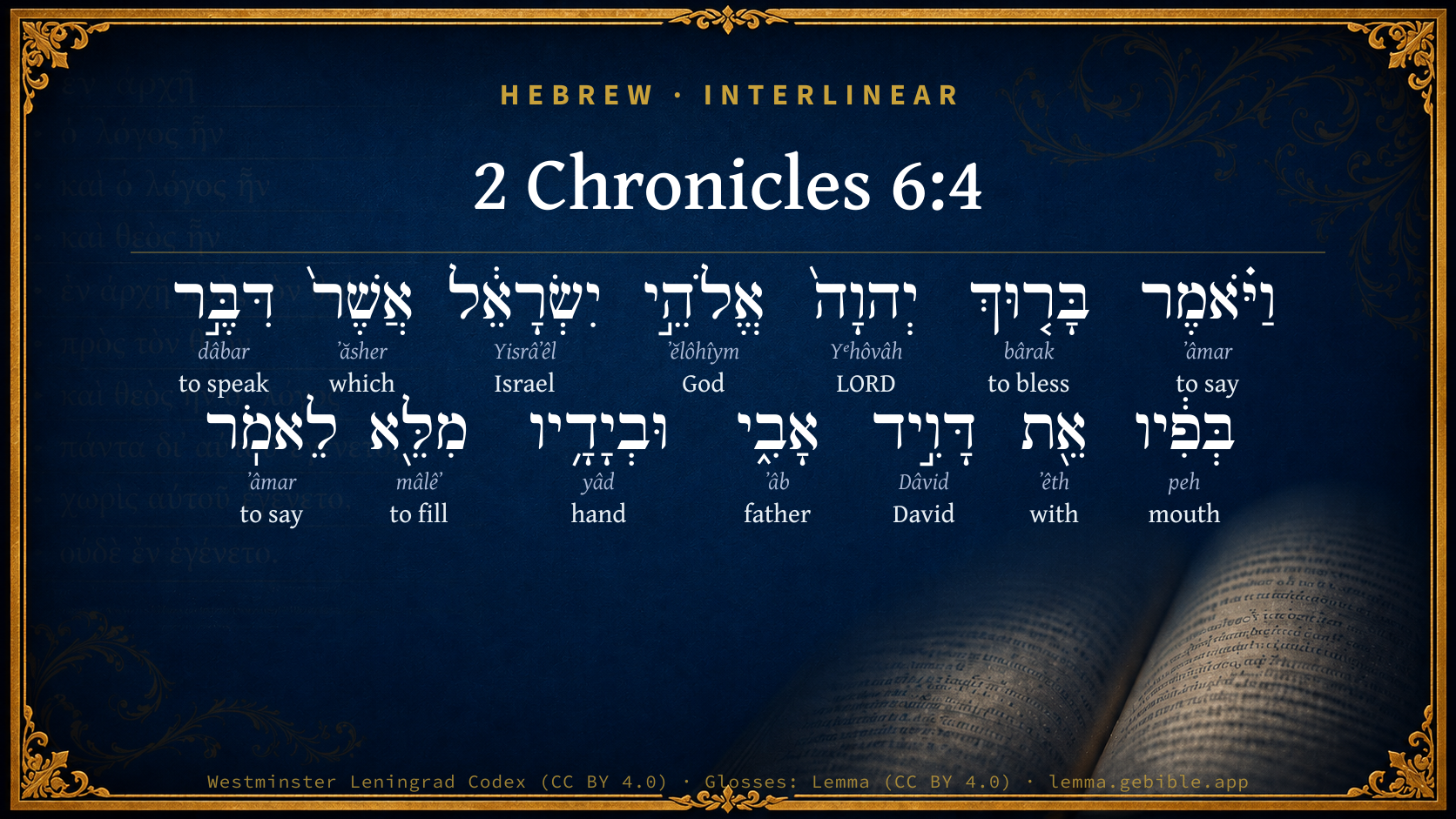
Hebrew (Westminster Leningrad Codex) 2 Chronicles 6:4 appears in the Hebrew Old Testament. The text above is from the Westminster Leningrad Codex. Each word links to its Strong’s number, a concise gloss, and parsing drawn from the Open Scriptures Hebrew Bible morphology. Click any word for its full Brown-Driver-Briggs (BDB) entry.
Download image
Cite this verse

2 Chronicles 6:4 (World English Bible). Public Domain. Lemma interlinear Bible study tool, https://lemma.gebible.app/v/2-chronicles/6/4.

Show BibTeX & RIS
BibTeX
RIS
English Translation
He said, Blessed be Yahweh, the God of Israel, who spoke with his mouth to David my father, and has with his hands fulfilled it, saying,
World English Bible · Public Domain
Download a study sheet

One document with this verse’s original text, its word-by-word gloss line, the meaning frame, cross-references with their text, attributed commentary, and full source and license credits — printable, and it pastes into notes with its structure intact.

This verse Autodidact and up

Study sheet (.html) Plain text (.txt)

A passage Seminary Student

Up to 50 verses in one chapter. A passage sheet keeps up to 6 commentary sources and 12 cross-references per verse, in the order this page ranks them, and says so on the sheet whenever that leaves anything out. Ask for a single verse and you get the Autodidact verse sheet above.

Everything on this page stays free to read, with no account — the sheet is a download of what is already on screen, not access to it.

Want to remove ads? Support Godless Engineer
Compare translations 3

The same verse in 3 English versions, stacked beneath the original-language interlinear above. Click any original word for its lexicon entry.

Each is an independent rendering of the whole verse — the interlinear is not word-aligned to these translations.

Highlighted words mark where these versions differ — a whole-verse word diff, not a word-by-word alignment.

  • World English Bible Public Domain
    He said, Blessed be Yahweh, the God of Israel, who spoke with his mouth to David my father, and has with his hands fulfilled it, saying,
  • King James Version Public Domain
    And he said, Blessed be the LORD God of Israel, who hath with his hands fulfilled that which he spake with his mouth to my father David, saying,
  • unfoldingWord Literal Text CC BY-SA 4.0
    And he said, “Blessed be Yahweh the God of Israel who spoke with his mouth to David my father, and with his hands he fulfilled, saying,

unfoldingWord Literal Text — © unfoldingWord, licensed CC BY-SA 4.0. Word-aligned USFM3 via Door43 (git.door43.org/unfoldingWord/en_ult).

Versions to compare (up to 4)

3 of 4 selected

Show all 18 translations

Every available English version of this verse, each an independent rendering of the whole verse.

  • World English Bible Public Domain
    He said, Blessed be Yahweh, the God of Israel, who spoke with his mouth to David my father, and has with his hands fulfilled it, saying,
  • Berean Standard Bible Public Domain
    and said: “Blessed be the LORD, the God of Israel, who has fulfilled with His own hand what He spoke with His mouth to my father David, saying,
  • Majority Standard Bible Public Domain
    and said: “Blessed be the LORD, the God of Israel, who has fulfilled with His own hand what He spoke with His mouth to my father David, saying,
  • King James Version Public Domain
    And he said, Blessed be the LORD God of Israel, who hath with his hands fulfilled that which he spake with his mouth to my father David, saying,
  • American Standard Version (1901) Public Domain
    And he said, Blessed be Jehovah, the God of Israel, who spake with his mouth unto David my father, and hath with his hands fulfilled it, saying,
  • Revised Version (1885) Public Domain
    And he said, Blessed be the LORD, the God of Israel, which spake with his mouth unto David my father, and hath with his hands fulfilled it, saying,
  • Geneva Bible (1599) Public Domain
    And he said, Blessed be the Lord God of Israel, who spake with his mouth vnto Dauid my father, and hath with his hand fulfilled it, saying,
  • Douay-Rheims (1899) Public Domain
    Blessed be the Lord the God of Israel, who hath accomplished in deed that which he spoke to David my father, saying:
  • Young's Literal Translation Public Domain
    and he saith, `Blessed `is' Jehovah, God of Israel, who hath spoken with His mouth with David my father, and with His hands hath fulfilled `it', saying:
  • Literal Standard Version CC BY-SA 4.0
    and he says, “Blessed [is] YHWH, God of Israel, who has spoken with His mouth with my father David, and with His hands has fulfilled [it], saying,
  • Unlocked Literal Bible CC BY-SA 4.0
    He said, “May Yahweh, the God of Israel, be praised, who spoke to David my father, and has fulfilled it with his own hands, saying,
  • unfoldingWord Literal Text CC BY-SA 4.0
    And he said, “Blessed be Yahweh the God of Israel who spoke with his mouth to David my father, and with his hands he fulfilled, saying,
  • Darby Bible Public Domain
    And he said: Blessed be Jehovah the God of Israel, who spoke with his mouth unto David my father, and hath with his hands fulfilled it, saying,
  • World Messianic Bible Public Domain
    He said, “Blessed be the LORD, the God of Israel, who spoke with his mouth to David my father, and has with his hands fulfilled it, saying,
  • Webster's Bible Public Domain
    And he said, Blessed be the LORD God of Israel, who hath with his hands fulfilled that which he spoke with his mouth to my father David, saying,
  • Free Bible Version CC BY-SA 4.0
    He said, “Praise the Lord God of Israel, who has kept the promise he made to my father David when he said,
  • Bible in Basic English Public Domain
    And he said, Praise be to the Lord, the God of Israel, who himself gave his word to my father David, and with his strong hand has made his word come true, saying,
  • JPS Tanakh (1917) Public Domain
    And he said: 'Blessed be the LORD, the God of Israel, who spoke with His mouth unto David my father, and hath with His hands fulfilled it, saying:

Literal Standard Version (2020), Covenant Press — licensed CC BY-SA 4.0. Text via the HelloAO Bible API (eBible.org). Unlocked Literal Bible (unfoldingWord) — licensed CC BY-SA 4.0. Text via the HelloAO Bible API (eBible.org). unfoldingWord Literal Text — © unfoldingWord, licensed CC BY-SA 4.0. Word-aligned USFM3 via Door43 (git.door43.org/unfoldingWord/en_ult). Free Bible Version, Dr. Jonathan Gallagher — licensed CC BY-SA 4.0. Text via the HelloAO Bible API (eBible.org).

Word by word

More ways to search: Search by grammar → Find every occurrence → Compare this word →

Practice this passage: Drill this verse → Learn its vocabulary →

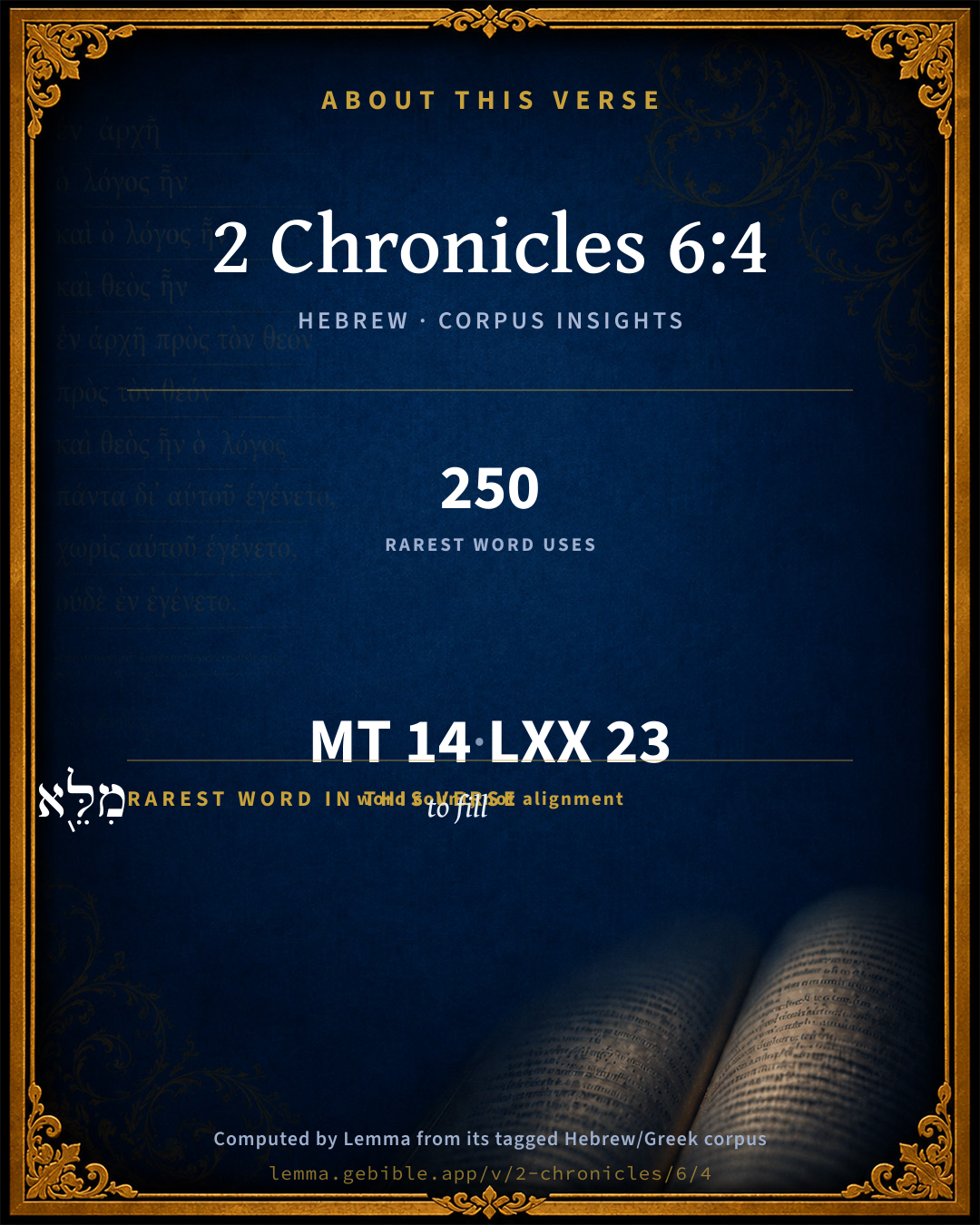
מִלֵּ֖א
mâlêʼ
H4390
“to fill”
Verb, Piel, Perfect, 3rd Person, Masculine, Singular
Part of Speech
Verb
Stem
Piel
Form
Perfect
Person
3rd Person
Gender
Masculine
Number
Singular
Full BDB Definition

Origin: a primitive root

TWOT: 1195

to fill, be full - (Qal) - to be full - fulness, abundance (participle) - to be full, be accomplished, be ended - to consecrate, fill the hand - (Niphal) - to be filled, be armed, be satisfied - to be accomplished, be ended - (Piel) - to fill - to satisfy - to fulfil, accomplish, complete - to confirm - (Pual) to be filled - (Hithpael) to mass themselves against
  1. וַיֹּ֗אמֶר ʼâmar H559 “and · to say” Conjunction + Verb, Qal, Sequential Imperfect, 3rd Person, Masculine, Singular
  2. בָּר֤וּךְ bârak H1288 “blessed” Verb, Qal, Participle Passive, Masculine, Singular, Absolute
  3. יְהוָה֙ Yᵉhôvâh H3068 “LORD” Noun, Proper
  4. אֱלֹהֵ֣י ʼĕlôhîym H430 “God(s) of” Noun, Common, Masculine, Plural, Construct
  5. יִשְׂרָאֵ֔ל Yisrâʼêl H3478 “Israel” Noun, Proper
  6. אֲשֶׁר֙ ʼăsher H834 “which” Particle, Relative
  7. דִּבֶּ֣ר dâbar H1696 “to speak” Verb, Piel, Perfect, 3rd Person, Masculine, Singular
  8. בְּפִ֔יו peh H6310 “in/at · mouth · his” Preposition + Noun, Common, Masculine, Singular, Construct + Suffix, Personal, 3rd Person, Masculine, Singular
  9. אֵ֖ת ʼêth H854 “with” Preposition
  10. דָּוִ֣יד Dâvid H1732 “David” Noun, Proper
  11. אָבִ֑י ʼâb H1 “father · my” Noun, Common, Masculine, Singular, Construct + Suffix, Personal, 1st Person, Common, Singular
  12. וּבְיָדָ֥יו yâd H3027 “and · in/at · hands · his” Conjunction + Preposition + Noun, Common, Both, Dual, Construct + Suffix, Personal, 3rd Person, Masculine, Singular
  13. לֵאמֹֽר ʼâmar H559 “to say” Preposition + Verb, Qal, Infinitive Construct

About this verse

These counts appear in no published source. They are computed here, from the morphology-tagged text and Lemma’s own curated glosses. What Lemma adds →

14
words
13
distinct lemmas
Historical
section

Grammatical profile

  • 5 verbs
  • 7 nouns
  • 1 preposition
  • 1 particle

Verb forms

  • וַיֹּ֗אמֶר Qal · Sequential Imperfect
  • בָּר֤וּךְ Qal · Participle Passive
  • דִּבֶּ֣ר Piel · Perfect
  • מִלֵּ֖א Piel · Perfect
  • לֵאמֹֽר Qal · Infinitive Construct

Repetition

A word recurs within this verse — often emphatic in Hebrew:

  • וַיֹּ֗אמֶר to say H559 ×2

Hebrew & Septuagint length

In English translation the verse runs 26 words from the Hebrew and 28 from the Septuagint (LXX English) — closely comparable.

A rough comparison of the two English renderings, which tokenize alike — not a word-level alignment.

Word counts can differ between the Hebrew and the Greek without any difference in meaning — e.g. the Hebrew direct-object marker אֵת has no separate Greek word, and Greek often adds the article ὁ.

In the original languages it is 14 Hebrew tokens and 23 Greek tokens — but the two are counted differently (Hebrew bundles its prefixes and suffixes into one token; the Greek is in lemma form), so that isn’t a like-for-like length.

Cross-references

12

Topical passages linked to 2 Chronicles 6:4 in the Treasury of Scripture Knowledge — connected by theme and wording, ordered by reader-vote popularity; previews shown in the World English Bible.

  • Psalms 68:32–35 Sing to God, you kingdoms of the earth! Sing praises to the Lord! Selah.
  • Psalms 72:18–19 Praise be to Yahweh God, the God of Israel, Who alone does marvelous deeds.
  • Matthew 24:35 Heaven and earth will pass away, but my words will not pass away.
  • 1 Kings 8:15 He said, Blessed be Yahweh, the God of Israel, who spoke with his mouth to David your father, and has with his hand fulfilled it, saying,
  • 1 Chronicles 17:12 He shall build me a house, and I will establish his throne forever.
  • 1 Chronicles 29:10 Therefore David blessed Yahweh before all the assembly; and David said, You are blessed, Yahweh, the God of Israel our father, forever and ever.
  • 1 Chronicles 29:20 David said to all the assembly, Now bless Yahweh your God. All the assembly blessed Yahweh, the God of their fathers, and bowed down their heads, and worshiped Yahweh, and the king.
  • Psalms 41:13 Blessed be Yahweh, the God of Israel, From everlasting and to everlasting! Amen and amen.
  • Psalms 68:4 Sing to God! Sing praises to his name! Extol him who rides on the clouds: To Yah, his name! Rejoice before him!
  • Psalms 138:1–2 I will give you thanks with my whole heart. Before the gods, I will sing praises to you.
  • Luke 1:68–70 "Blessed be the Lord, the God of Israel, For he has visited and worked redemption for his people;
  • Ephesians 1:3 Blessed be the God and Father of our Lord Jesus Christ, who has blessed us with every spiritual blessing in the heavenly places in Christ;

Cross-references courtesy of OpenBible.info (CC BY 4.0).

Hebrew and Greek witnesses Masoretic Hebrew ↔ Greek Septuagint

The same verse in the two great witnesses to the Old Testament, shown verse-for-verse.

These are two independent witnesses, not word-aligned to each other, and the Septuagint is shown in lemma (dictionary) form.

Hebrew 2 Chronicles 6:4 Masoretic · Westminster Leningrad Codex

וַיֹּ֗אמֶר בָּר֤וּךְ יְהוָה֙ אֱלֹהֵ֣י יִשְׂרָאֵ֔ל אֲשֶׁר֙ דִּבֶּ֣ר בְּפִ֔יו אֵ֖ת דָּוִ֣יד אָבִ֑י וּבְיָדָ֥יו מִלֵּ֖א לֵאמֹֽר

He said, Blessed be Yahweh, the God of Israel, who spoke with his mouth to David my father, and has with his hands fulfilled it, saying,

World English Bible · Public Domain

Greek LXX 2 Chronicles 6:4 Septuagint · lemma form

καί εἶπον εὐλογητός κύριος ὁ θεός ἰσραήλ ὅς λαλέω ἐν στόμα αὐτός πρός δαυίδ ὁ πατήρ ἐγώ καί ἐν χείρ αὐτός πληρόω λέγω

And he said, Blessed be the Lord God of Israel: he has even fulfilled with his hands as he spoke with his mouth to my father David, saying,

LXX2012 (modern English Septuagint) · Public Domain

Hebrew: Westminster Leningrad Codex (CC BY 4.0). Greek: Septuagint (public domain); English from LXX2012 (modern English Septuagint) (Public Domain). How the Septuagint differs from the Hebrew →

Commentary

Notes on 2 Chronicles 6:4 from classic Christian and Jewish commentators (each source and its license shown beneath its notes). The classic Christian expositions comment on the surrounding passage and are grouped to its opening verse, so a note may address several verses; the Jewish commentaries on the Tanakh (Rashi and others) are per-verse, so they appear only where the commentator wrote on this verse.

Lemma curates 59 commentaries, every one of them public domain or Creative Commons licensed, each selected and text-cleaned for this edition rather than reprinted as found. About our sources →

The Biblical Illustrator

Joseph S. Exell

2Ch_6:4-11

And he said, Blessed be the Lord God of Israel, who hath with His hands fulfilled that which He spake.

The performance of Gods promise

I. That God deals with His people in all ages by way of promise. Adam, Abraham, David.

II. That the performance of this promise is a source of joy to them.

1. In revealing God to them.

2. In the actual bestowment of good to them.

III. That there are special seasons to testify to Gods goodness in the performance of His promise.

1. Conversion.

2. Restoration from sickness and danger.

3. Dedication of places of worship.

4. Times of special favour. (J. Wolfendale.)

The Biblical Illustrator, edited by Joseph S. Exell (c. 1880s–1900s) — public domain. Text from a community e-Sword module.

Tyndale Open Study Notes

Tyndale Open Resources

6:4-6 Israel’s history as God’s people, originated at the Exodus, reached a climax when God chose David to be king and Jerusalem to be his capital. Both the city and the dynasty were aspects of God’s promise to David (see 1 Chr 28:4; cp. 2 Sam 7:8-17; Ps 2:6-7).

Tyndale Open Study Notes — © Tyndale Open Resources, licensed CC BY-SA 4.0. Text via the HelloAO Bible API.

Geneva Bible (1599)

Geneva Bible translators

Or, power.

Geneva Bible (1599) marginal notes — public domain. Text via Bolls.life.

Ellicott's Commentary for English Readers

(4) Who hath with his hands fulfilled . . . David.—Literally, who spake (“promised,” 2Ch_6:10), by his mouth with David my father, and by his hands fulfilled. (See 1Ch_11:2; 1Ch_17:4-14.) The only variant in this verse is hands for hand. The unpointed text of Kings might be read in either way. (Comp. 2Ch_6:15, infr.)

A Bible Commentary for English Readers, edited by Charles John Ellicott (1878–1897) — public domain. Text from a community e-Sword module.

The Cambridge Bible for Schools and Colleges

gen. ed. J. J. S. Perowne

4. who hath with his hands fulfilled that which he spake with his mouth to my father David] R.V. which spake with his mouth unto David my father, and hath with his hands fulfilled it. The A.V. has needlessly changed the order of the Hebrew.

The Cambridge Bible for Schools and Colleges (gen. ed. J. J. S. Perowne; Cambridge University Press, 1878–1918) — public domain. Text from a community e-Sword module.

The Pulpit Commentary

(See 2Sa_7:4-17; 1Ch_11:2 1Ch_17:4-14) With his hands, with his mouth. Expressions like this, antithesis and all, remind how language formed itself in the concrete mould at first, from that, ever becoming more abstract as time grew. The ampler language of later date would be, Who hath indeed fulfilled that which he spake.

The Pulpit Commentary (1880–1919), ed. H.D.M. Spence-Jones & Joseph S. Exell — public domain. Text from a community e-Sword module.

unfoldingWord translationNotes

Door43 World Missions Community

May Yahweh, the God of Israel, be praised

This can be stated in active form. AT: "Praise Yahweh, the God of Israel" (See: Active or Passive)

David my father

King Solomon actually was one of King David's sons.

has fulfilled it

"has caused it to happen." The word "it" refers to what God had promised. AT: "has ensured that he fulfilled his promises" (See: Assumed Knowledge and Implicit Information)

with his own hands

The hand is a metonym for power. AT: "by his own power" (See: Metonymy)

in order for my name to be there

Here the metonym "my name" represents Yahweh's reputation, and his name being there represents people recognizing his greatness and worshiping him there. AT: "for people to worship me there" (See: Metonymy)

to be prince over my people Israel

Being "prince over people" represents ruling them. AT: "to rule my people Israel" (See: Metaphor)

so that my name might be there

Here the metonym "my name" represents Yahweh's reputation, and his name being there represents people recognizing his greatness and worshiping him there. AT: "so that people might worship me there" (See: Metonymy)

to be over my people Israel

Being "over" people represents ruling them. AT: "to rule my people Israel" (See: Metaphor)

translationWords

God

Israel

David

people of God

Egypt

tribe

name

prince

chosen one

Jerusalem

unfoldingWord translationNotes — © Distant Shores Media and the Door43 World Missions Community, licensed CC BY-SA 4.0. Source: git.door43.org/Door43/en_tn.

Rashi

Rabbi Shlomo Yitzchaki (Rashi)

Who spoke with His mouth that He would give him a son who would build Him a House.

has fulfilled He fulfilled His good word.

Rashi on the Tanakh — English translations: “The Judaica Press complete Tanach with Rashi, translated by A. J. Rosenberg” (CC BY 4.0); “Pentateuch with Rashi's commentary by M. Rosenbaum and A.M. Silbermann, 1929-1934” (public domain); “The Metsudah Tanach series, Lakewood, N.J” (CC BY 4.0); and “The Book of Joshua, Metsudah Publications, 1997” (CC BY 4.0). Text via Sefaria.

Lesson kit

Teaching starters — assembled from the data on this page, not authored interpretation. Every prompt links to the verse data it draws on. Edit before teaching.

2 Chronicles, in the Historical, opens this verse with 14 words (13 distinct Hebrew lemmas). Its most distinctive word is mâlêʼ (“to fill”). A historical commentator’s framing appears above. Read the whole chapter for the surrounding context.

Discussion questions

  1. How does “to fill” (mâlêʼ) shape what this verse is saying?
  2. Psalms 68:32–35 shares this passage’s theme. How do the two illuminate each other?
  3. “to say” occurs 2× in this one verse. What is the effect of the repetition?
  4. These translations render this verse differently; the difference is in the English rendering, not the original. What questions does that raise?
  5. The verb «וַיֹּ֗אמֶר» is Qal Sequential Imperfect. How does its form color the action?
  6. Reading how The Biblical Illustrator and Tyndale Open Study Notes read this verse, where do the two commentators agree and where do they part?

Things to notice

Reading settings

Reading text

Shown beneath each verse's original-language words.

Old Testament
Old Testament edition

Read the OT as the Masoretic Hebrew (MT) or the Greek Septuagint (LXX).

English shown for the Greek Septuagint (in the Hebrew ↔ Greek comparison).

Comparing translations? Open the Compare panel on any verse page to stack up to four side by side.