
1 Chronicles 20:2

Hebrew (Westminster Leningrad Codex) 1 Chronicles 20:2 appears in the Hebrew Old Testament. The text above is from the Westminster Leningrad Codex. Each word links to its Strong’s number, a concise gloss, and parsing drawn from the Open Scriptures Hebrew Bible morphology. Click any word for its full Brown-Driver-Briggs (BDB) entry.
Download image
Cite this verse

1 Chronicles 20:2 (World English Bible). Public Domain. Lemma interlinear Bible study tool, https://lemma.gebible.app/v/1-chronicles/20/2.

Show BibTeX & RIS
BibTeX
RIS
English Translation
David took the crown of their king from off his head, and found it to weigh a talent of gold, and there were precious stones in it; and it was set on David's head: and he brought forth the spoil of the city, exceeding much.
World English Bible · Public Domain
Download a study sheet

One document with this verse’s original text, its word-by-word gloss line, the meaning frame, cross-references with their text, attributed commentary, and full source and license credits — printable, and it pastes into notes with its structure intact.

This verse Autodidact and up

Study sheet (.html) Plain text (.txt)

A passage Seminary Student

Up to 50 verses in one chapter. A passage sheet keeps up to 6 commentary sources and 12 cross-references per verse, in the order this page ranks them, and says so on the sheet whenever that leaves anything out. Ask for a single verse and you get the Autodidact verse sheet above.

Everything on this page stays free to read, with no account — the sheet is a download of what is already on screen, not access to it.

Want to remove ads? Support Godless Engineer
Compare translations 3

The same verse in 3 English versions, stacked beneath the original-language interlinear above. Click any original word for its lexicon entry.

Each is an independent rendering of the whole verse — the interlinear is not word-aligned to these translations.

Highlighted words mark where these versions differ — a whole-verse word diff, not a word-by-word alignment.

  • World English Bible Public Domain
    David took the crown of their king from off his head, and found it to weigh a talent of gold, and there were precious stones in it; and it was set on David's head: and he brought forth the spoil of the city, exceeding much.
  • King James Version Public Domain
    And David took the crown of their king from off his head, and found it to weigh a talent of gold, and there were precious stones in it; and it was set upon David's head: and he brought also exceeding much spoil out of the city.
  • unfoldingWord Literal Text CC BY-SA 4.0
    And David took the crown of their king from upon his head, and he found it, the weight, a kikkar of gold, and in it a precious stone, and it was on the head of David. And he brought out the plunder of the city, being very great.

unfoldingWord Literal Text — © unfoldingWord, licensed CC BY-SA 4.0. Word-aligned USFM3 via Door43 (git.door43.org/unfoldingWord/en_ult).

Versions to compare (up to 4)

3 of 4 selected

Show all 18 translations

Every available English version of this verse, each an independent rendering of the whole verse.

  • World English Bible Public Domain
    David took the crown of their king from off his head, and found it to weigh a talent of gold, and there were precious stones in it; and it was set on David's head: and he brought forth the spoil of the city, exceeding much.
  • Berean Standard Bible Public Domain
    Then David took the crown from the head of their king. It was found to weigh a talent of gold and was set with precious stones, and it was placed on David’s head. And David took a great amount of plunder from the city.
  • Majority Standard Bible Public Domain
    Then David took the crown from the head of their king. It was found to weigh a talent of gold and was set with precious stones, and it was placed on David’s head. And David took a great amount of plunder from the city.
  • King James Version Public Domain
    And David took the crown of their king from off his head, and found it to weigh a talent of gold, and there were precious stones in it; and it was set upon David's head: and he brought also exceeding much spoil out of the city.
  • American Standard Version (1901) Public Domain
    And David took the crown of their king from off his head, and found it to weigh a talent of gold, and there were precious stones in it; and it was set upon David's head: and he brought forth the spoil of the city, exceeding much.
  • Revised Version (1885) Public Domain
    And David took the crown of their king from off his head, and found it to weigh a talent of gold, and there were precious stones in it; and it was set upon David’s head: and he brought forth the spoil of the city, exceeding much.
  • Geneva Bible (1599) Public Domain
    Then Dauid tooke the crowne of their King from off his head, and founde it the weight of a talent of golde, with precious stones in it: and it was set on Dauids head, and he brought away the spoyle of the citie exceeding much.
  • Douay-Rheims (1899) Public Domain
    And David took the crown of Melchom from his head, and found in it a talent weight of gold, and most precious stones, and he made himself a diadem of it: he took also the spoils of the city which were very great.
  • Young's Literal Translation Public Domain
    And David taketh the crown of their king from off his head, and findeth it `in' weight a talent of gold, and in it a precious stone, and it is on the head of David: and spoil of the city he hath brought out very much,
  • Literal Standard Version CC BY-SA 4.0
    And David takes the crown of their king from off his head, and finds it [to be] a talent of gold [in] weight, and [with] precious stone in it, and it is on the head of David; and he has brought out very much spoil of the city,
  • Unlocked Literal Bible CC BY-SA 4.0
    David took the crown of their king from off his head, and he found that it weighed a talent of gold, and in it were precious stones. The crown was set on David's head, and he brought out the plunder of the city in large quantities.
  • unfoldingWord Literal Text CC BY-SA 4.0
    And David took the crown of their king from upon his head, and he found it, the weight, a kikkar of gold, and in it a precious stone, and it was on the head of David. And he brought out the plunder of the city, being very great.
  • Darby Bible Public Domain
    And David took the crown of their king from off his head, and found it to weigh a talent of gold, and there were precious stones in it; and it was [set] upon David's head: and he brought forth the spoil of the city in great abundance.
  • World Messianic Bible Public Domain
    David took the crown of their king from off his head, and found it to weigh a talent of gold, and there were precious stones in it. It was set on David’s head, and he brought very much plunder out of the city.
  • Webster's Bible Public Domain
    And David took the crown of their king from his head, and found it to weigh a talent of gold, and there were precious stones in it; and it was set upon David's head: and he brought also a great quantity of spoil out of the city.
  • Free Bible Version CC BY-SA 4.0
    David took the crown from the head of their idol Milcom. It was made of gold, and was set with gems. It weighed a talent and was placed on David's head. David also took a great deal of plunder from the city.
  • Bible in Basic English Public Domain
    And David took the crown of Milcom from off his head; its weight was a talent of gold and it had stones of great price in it; and it was put on David's head, and he took a great store of goods from the town.
  • JPS Tanakh (1917) Public Domain
    And David took the crown of Malcam from off his head, and found it to weigh a talent of gold, and there were precious stones in it; and it was set upon David's head; and he brought forth the spoil of the city, exceeding much.

Literal Standard Version (2020), Covenant Press — licensed CC BY-SA 4.0. Text via the HelloAO Bible API (eBible.org). Unlocked Literal Bible (unfoldingWord) — licensed CC BY-SA 4.0. Text via the HelloAO Bible API (eBible.org). unfoldingWord Literal Text — © unfoldingWord, licensed CC BY-SA 4.0. Word-aligned USFM3 via Door43 (git.door43.org/unfoldingWord/en_ult). Free Bible Version, Dr. Jonathan Gallagher — licensed CC BY-SA 4.0. Text via the HelloAO Bible API (eBible.org).

Word by word

More ways to search: Search by grammar → Find every occurrence → Compare this word →

Practice this passage: Drill this verse → Learn its vocabulary →

עֲטֶֽרֶת
ʻăṭârâh
H5850
“crown of”
Noun, Common, Feminine, Singular, Construct
Part of Speech
Noun
Type
Common
Gender
Feminine
Number
Singular
State
Construct
Full BDB Definition

Origin: from H5849

TWOT: 1608a

crown, wreath
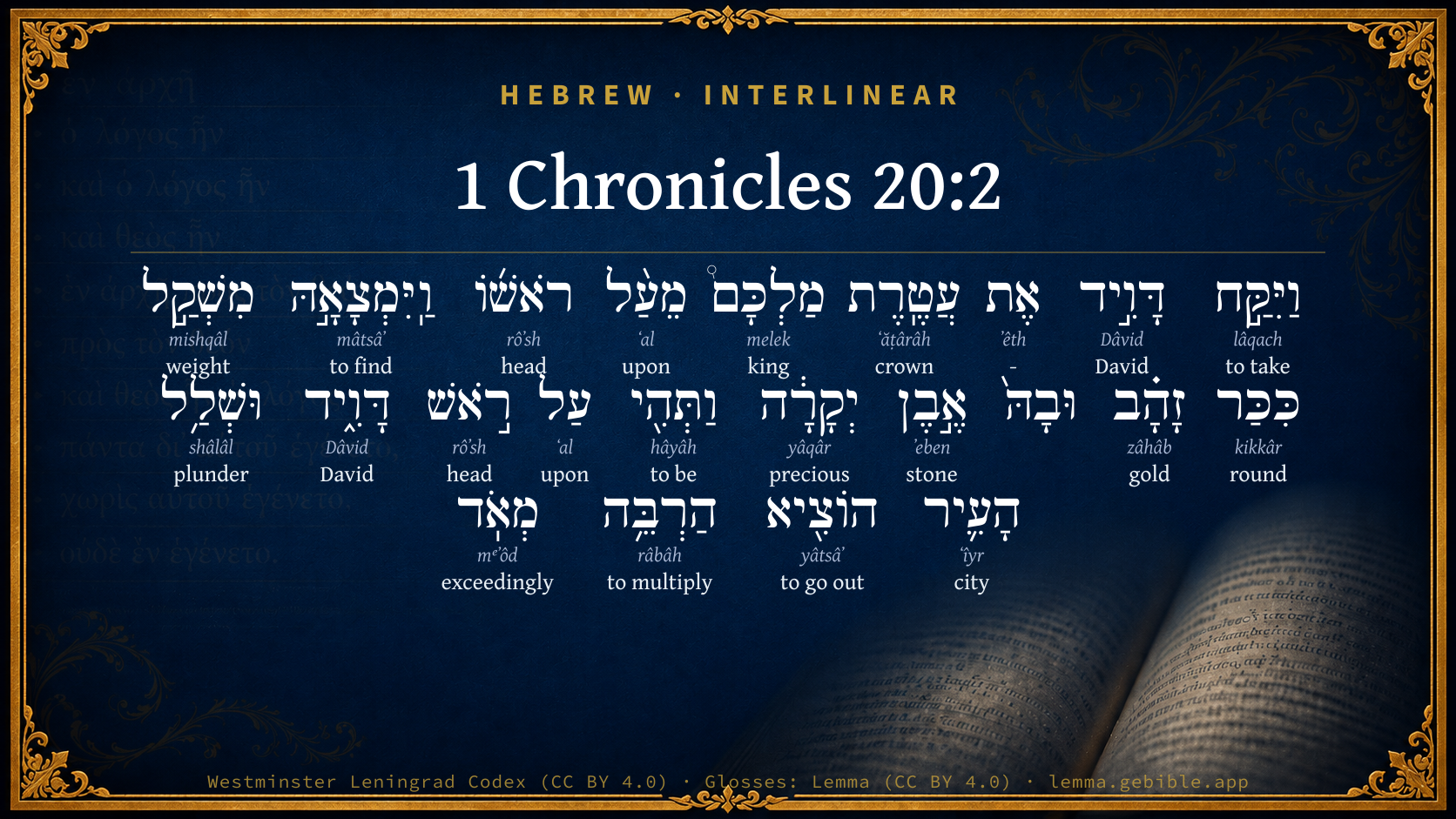
  1. וַיִּקַּ֣ח lâqach H3947 “and · to take” Conjunction + Verb, Qal, Sequential Imperfect, 3rd Person, Masculine, Singular
  2. דָּוִ֣יד Dâvid H1732 “David” Noun, Proper
  3. אֶת ʼêth H853 “-” Particle, Direct Object
  4. מַלְכָּם֩ melek H4428 “king · their” Noun, Common, Masculine, Singular, Construct + Suffix, Personal, 3rd Person, Masculine, Plural
  5. מֵעַ֨ל ʻal H5921 “from · upon” Preposition + Preposition
  6. רֹאשׁ֜וֹ rôʼsh H7218 “head · his” Noun, Common, Masculine, Singular, Construct + Suffix, Personal, 3rd Person, Masculine, Singular
  7. וַֽיִּמְצָאָ֣הּ mâtsâʼ H4672 “and · to find · her” Conjunction + Verb, Qal, Sequential Imperfect, 3rd Person, Masculine, Singular + Suffix, Personal, 3rd Person, Feminine, Singular
  8. מִשְׁקַ֣ל mishqâl H4948 “weight of” Noun, Common, Masculine, Singular, Construct
  9. כִּכַּר kikkâr H3603 “round of” Noun, Common, Both, Singular, Construct
  10. זָהָ֗ב zâhâb H2091 “gold” Noun, Common, Masculine, Singular, Absolute
  11. אֶ֣בֶן ʼeben H68 “stone” Noun, Common, Feminine, Singular, Absolute
  12. יְקָרָ֔ה yâqâr H3368 “precious” Adjective, Adjective, Feminine, Singular, Absolute
  13. וַתְּהִ֖י hâyâh H1961 “and · to be” Conjunction + Verb, Qal, Sequential Imperfect, 3rd Person, Feminine, Singular
  14. עַל ʻal H5921 “upon” Preposition
  15. רֹ֣אשׁ rôʼsh H7218 “head of” Noun, Common, Masculine, Singular, Construct
  16. דָּוִ֑יד Dâvid H1732 “David” Noun, Proper
  17. וּשְׁלַ֥ל shâlâl H7998 “and · plunder of” Conjunction + Noun, Common, Masculine, Singular, Construct
  18. הָעִ֛יר ʻîyr H5892 “the · city” Particle, Definite Article + Noun, Common, Feminine, Singular, Absolute
  19. הוֹצִ֖יא yâtsâʼ H3318 “to go out” Verb, Hiphil, Perfect, 3rd Person, Masculine, Singular
  20. הַרְבֵּ֥ה râbâh H7235 “to multiply” Verb, Hiphil, Infinitive Absolute
  21. מְאֹֽד mᵉʼôd H3966 “exceedingly” Adverb

About this verse

These counts appear in no published source. They are computed here, from the morphology-tagged text and Lemma’s own curated glosses. What Lemma adds →

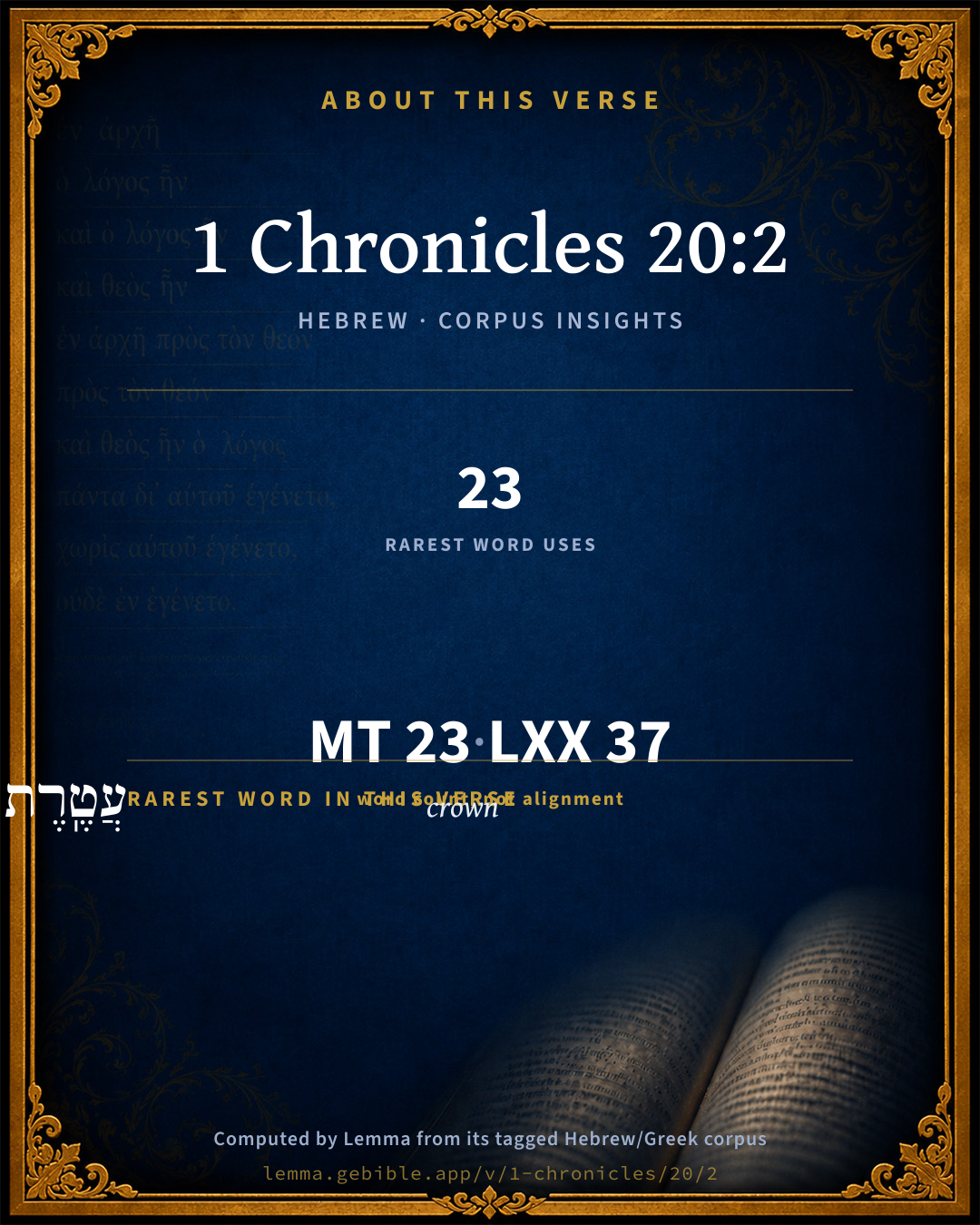
23
words
19
distinct lemmas
Historical
section

Notable vocabulary

The rarest word here is עֲטֶֽרֶת crown H5850 — appearing just 23 times in the whole Hebrew Bible.

Shared distinctive vocabulary

עֲטֶֽרֶת crown H5850 occurs in 23 verses of the Hebrew Bible. Also found in:

Grammatical profile

  • 5 verbs
  • 12 nouns
  • 1 adjective
  • 3 prepositions
  • 1 adverb
  • 1 particle

Verb forms

  • וַיִּקַּ֣ח Qal · Sequential Imperfect
  • וַֽיִּמְצָאָ֣הּ Qal · Sequential Imperfect
  • וַתְּהִ֖י Qal · Sequential Imperfect
  • הוֹצִ֖יא Hiphil · Perfect
  • הַרְבֵּ֥ה Hiphil · Infinitive Absolute

Repetition

Words recur within this verse — often emphatic in Hebrew:

  • דָּוִ֣יד David H1732 ×2
  • מֵעַ֨ל upon H5921 ×2
  • רֹאשׁ֜וֹ head H7218 ×2

Hebrew & Septuagint length

In English translation the verse runs 45 words from the Hebrew and 53 from the Septuagint (LXX English) — closely comparable.

A rough comparison of the two English renderings, which tokenize alike — not a word-level alignment.

Word counts can differ between the Hebrew and the Greek without any difference in meaning — e.g. the Hebrew direct-object marker אֵת has no separate Greek word, and Greek often adds the article ὁ.

In the original languages it is 23 Hebrew tokens and 37 Greek tokens — but the two are counted differently (Hebrew bundles its prefixes and suffixes into one token; the Greek is in lemma form), so that isn’t a like-for-like length.

Cross-references

3

Topical passages linked to 1 Chronicles 20:2 in the Treasury of Scripture Knowledge — connected by theme and wording, ordered by reader-vote popularity; previews shown in the World English Bible.

  • 2 Samuel 8:11–12 These also did king David dedicate to Yahweh, with the silver and gold that he dedicated of all the nations which he subdued;
  • 2 Samuel 12:30–31 He took the crown of their king from off his head; and the weight of it was a talent of gold, and [in it were] precious stones; and it was set on David's head. He brought forth the spoil of the city, exceeding much.
  • 1 Chronicles 18:11 These also did king David dedicate to Yahweh, with the silver and the gold that he carried away from all the nations; from Edom, and from Moab, and from the children of Ammon, and from the Philistines, and from Amalek.

Cross-references courtesy of OpenBible.info (CC BY 4.0).

Hebrew and Greek witnesses Masoretic Hebrew ↔ Greek Septuagint

The same verse in the two great witnesses to the Old Testament, shown verse-for-verse.

These are two independent witnesses, not word-aligned to each other, and the Septuagint is shown in lemma (dictionary) form.

Hebrew 1 Chronicles 20:2 Masoretic · Westminster Leningrad Codex

וַיִּקַּ֣ח דָּוִ֣יד אֶת עֲטֶֽרֶת מַלְכָּם֩ מֵעַ֨ל רֹאשׁ֜וֹ וַֽיִּמְצָאָ֣הּ מִשְׁקַ֣ל כִּכַּר זָהָ֗ב וּבָהּ֙ אֶ֣בֶן יְקָרָ֔ה וַתְּהִ֖י עַל רֹ֣אשׁ דָּוִ֑יד וּשְׁלַ֥ל הָעִ֛יר הוֹצִ֖יא הַרְבֵּ֥ה מְאֹֽד

David took the crown of their king from off his head, and found it to weigh a talent of gold, and there were precious stones in it; and it was set on David's head: and he brought forth the spoil of the city, exceeding much.

World English Bible · Public Domain

Greek LXX 1 Chronicles 20:2 Septuagint · lemma form

καί λαμβάνω δαυίδ ὁ στέφανος μολχολ βασιλεύς αὐτός ἀπό ὁ κεφαλή αὐτός καί εὑρίσκω ὁ σταθμός αὐτός τάλαντον χρυσίον καί ἐν αὐτός λίθος τίμιος καί εἰμί ἐπί ὁ κεφαλή δαυίδ καί σκῦλον ὁ πόλις ἐκφέρω πολύς σφόδρα

And David took the crown of Molchom their king off his head, and the weight of it was found to be a talent of gold, and on it were precious stones; and it was placed on the head of David: and he brought out the spoils of the city which were very great.

LXX2012 (modern English Septuagint) · Public Domain

On this verse, Ellicott's Commentary for English Readers discusses the Septuagint’s reading. Read the note in Commentary ↓

Hebrew: Westminster Leningrad Codex (CC BY 4.0). Greek: Septuagint (public domain); English from LXX2012 (modern English Septuagint) (Public Domain). How the Septuagint differs from the Hebrew →

Commentary

Notes on 1 Chronicles 20:2 from classic Christian and Jewish commentators (each source and its license shown beneath its notes). The classic Christian expositions comment on the surrounding passage and are grouped to its opening verse, so a note may address several verses; the Jewish commentaries on the Tanakh (Rashi and others) are per-verse, so they appear only where the commentator wrote on this verse.

Lemma curates 59 commentaries, every one of them public domain or Creative Commons licensed, each selected and text-cleaned for this edition rather than reprinted as found. About our sources →

Trapp's Complete Commentary

John Trapp

1Ch 20:2 And David took the crown of their king from off his head, and found it to weigh a talent of gold, and [there were] precious stones in it; and it was set upon David’s head: and he brought also exceeding much spoil out of the city.

1Ch 20:3 And he brought out the people that [were] in it, and cut [them] with saws, and with harrows of iron, and with axes. Even so dealt David with all the cities of the children of Ammon. And David and all the people returned to Jerusalem.

Ver. 2,3. {See Trapp on "2Sa 12:31"}

John Trapp, A Commentary or Exposition upon All the Books of the Old and New Testament (1647–1656) — public domain. Text from a community e-Sword module.

Geneva Bible (1599)

Geneva Bible translators

Which mounteth about the value of seven thousand and seventy crowns, which is about threescore pound weight.

Geneva Bible (1599) marginal notes — public domain. Text via Bolls.life.

Jamieson, Fausset & Brown

Robert Jamieson, A. R. Fausset & David Brown

David took the crown of their king . . ., and found it to weigh a talent of gold--equal to one hundred twenty-five pounds. Some think that Malcom, rendered in our version "their king," should be taken as a proper name, Milcom or Molech, the Ammonite idol, which, of course, might bear a heavy weight. But, like many other state crowns of Eastern kings, the crown got at Rabbah was not worn on the head, but suspended by chains of gold above the throne.

precious stones--Hebrew, a "stone," or cluster of precious stones, which was set on David's head.

Jamieson, Fausset & Brown — Commentary Critical and Explanatory on the Whole Bible (1871) — public domain (CC PDM 1.0). Text via the HelloAO Bible API.

Adam Clarke's Commentary

Verse 2. David took the crown of their king - off his head] See 2Sa 12:30.

Precious stones in it] The Targum says, "And there was set in it a precious stone, worth a talent of gold; this was that magnetic stone that supported the woven gold in the air." What does he mean?

Adam Clarke's Commentary on the Bible (1810–1826) — public domain. Text from a community e-Sword/MySword module.

Ellicott's Commentary for English Readers

(2) The crown of their king.—Or, “of Milcom” or “Moloch,” their god. The Heb. malkâm, “their Melech” (i.e., king), occurs in this sense (Zep_1:5. Comp. Amo_5:26.) The same title is applied by the prophets to Jehovah (Isa_6:5; Isa_44:6, “Jahweh, the king [melech] of Israel.” Comp. Zep_3:15, and Joh_1:49; Joh_12:15; 2Sa_12:12; Psa_5:2; Psa_89:18; Isa_8:21; and Jer_10:10). The LXX. here has “Molchom, their king”; Vulg., “Melchom”; Arabic, “Malcha, their god;” all confirming our rendering.

A talent of gold.—The Arabic Version says one hundred pounds. Modern scholars consider the “talent of gold” as about one hundred and thirty-one pounds troy. If the weight was anything like this, the crown was obviously more suited for the head of a big idol than of a man.

And there were precious stones in it.—Samuel includes their weight in the talent.

And it was set (Heb., became) upon David’s head.—Vulg., “he made himself a crown out of it.” This may be the meaning; or else the weighty mass of gold and jewels may have been held over the king’s head by his attendants on the occasion of its capture.

Exceeding much spoil.—Comp. the continual boast of the Assyrian conquerors: “spoils without number I carried off” (sallata la mani aslula).

A Bible Commentary for English Readers, edited by Charles John Ellicott (1878–1897) — public domain. Text from a community e-Sword module.

The Cambridge Bible for Schools and Colleges

gen. ed. J. J. S. Perowne

2. of their king] So A.V. (rightly). R.V. mg. of Malcam (cp. Zep_1:5), i.e. Milcom, the national god of the Ammonites (1Ki_11:5). LXX. has a double translation of the one Heb. word: Molchol (Molchom) their king. The name of the god, whether the right form be Molech (1Ki_11:7) or Milcom or Malcam, means either “king” or, less probably, “counsellor.” In the former case his image would in all probability wear a crown.

it was set upon David’s head] A symbolic action implying that David completely annexed the Ammonite territory; other conquered nations retained a partial independence on condition of the payment of tribute.

he brought also exceeding much spoil out of the city] R.V. he brought forth the spoil of the city, exceeding much. A kind of triumphal procession of captives and spoil such as an Assyrian relief in the British Museum represents as passing before Sennacherib at the capture of Lachish.

The Cambridge Bible for Schools and Colleges (gen. ed. J. J. S. Perowne; Cambridge University Press, 1878–1918) — public domain. Text from a community e-Sword module.

Haydock's Catholic Bible Commentary

Melchom. Septuagint add the explanation, "their king." It may also be referred to the idol of Ammon. (Haydock) --- The massy crown was suspended over David’s head. (Tirinus) (Du Hamel)

George Leo Haydock (1774–1849), Haydock's Catholic Family Bible and Commentary, 1859 edition — public domain. Excludes Psalms (Douay-Rheims chapter numbering differs from Protestant) and Deuterocanonical books (Catholic canon only).

The Pulpit Commentary

Found it to weigh a talent of gold. Two difficulties present themselves in this verse, viz. the reported weight of this crown, and the uncertainty as to what head it was from which David took it. Whatever was its weight, if David"s head was able to sustain it for a minute or two, the head of the King of the Ammonites might also occasionally have borne it. Yet it would scarcely be likely that the King of the Ammonites would have so ponderous a crown (calculated at a weight of a hundred and fourteen pounds Troy, or a little more or less than one hundredweight) as one of ordinary wear, or that he would have one of extraordinary wear on his head precisely at such a juncture. Both of these difficulties will remove if we suppose that the Hebrew l]m," instead of meaning their king, is the name of the Ammonitish and Moabitish idol (i.q. Moloch), and which we find (Authorized Version) in Zep_1:5, and probably (though not Authorized Version) in Jer_49:1, Jer_49:3, and Amo_1:15. The Septuagint treats the word thus. The point, however, cannot be considered settled.

The Pulpit Commentary (1880–1919), ed. H.D.M. Spence-Jones & Joseph S. Exell — public domain. Text from a community e-Sword module.

John Wesley's Explanatory Notes

To weigh a talent - Or, to be worth a talent, that is, five thousand four hundred and seventy five pounds.

John Wesley, Explanatory Notes Upon the Whole Bible (1754–1765) — public domain. Text via the GEBible commentary corpus.

unfoldingWord translationNotes

Door43 World Missions Community

talent

about 33 kilograms (See: Biblical Money)

The crown was set on David's head

This can be stated in active form. Possible meanings are 1) David put the crown on his own head or 2) David's men placed the crown on his head. (See: Active or Passive)

he brought out ... He brought out

These two occurrences of "he" refer to David, but they also refer to David's soldiers who helped David do these things. (See: Synecdoche)

plunder

valuable items taken in war

forced them to work with saws and iron picks and axes

These terms describe difficult manual labor that the defeated people were forced to do.

David required all the cities of the people

The people are referred to by their city. AT: "David required all the peoples of the cities" (See: Metonymy)

translationWords

crown

gold

precious

labor

unfoldingWord translationNotes — © Distant Shores Media and the Door43 World Missions Community, licensed CC BY-SA 4.0. Source: git.door43.org/Door43/en_tn.

Rashi

Rabbi Shlomo Yitzchaki (Rashi)

and in it was a precious stone in the crown.

and it was set on David’s head Some explain that it was literally on David’s head. It is, however, amazing how his head could endure it. Our Sages, however, explain that there was a magnet in it (A.Z. ad loc.). I heard in Narbonne that it is the prevalent custom in the land of Ishmael to suspend the king’s crown over his head, and he sits opposite it below on a throne, and that which is written: “... and it was on David’s head,” means that it appeared as though it were on his head.

Rashi on the Tanakh — English translations: “The Judaica Press complete Tanach with Rashi, translated by A. J. Rosenberg” (CC BY 4.0); “Pentateuch with Rashi's commentary by M. Rosenbaum and A.M. Silbermann, 1929-1934” (public domain); “The Metsudah Tanach series, Lakewood, N.J” (CC BY 4.0); and “The Book of Joshua, Metsudah Publications, 1997” (CC BY 4.0). Text via Sefaria.

Lesson kit

Teaching starters — assembled from the data on this page, not authored interpretation. Every prompt links to the verse data it draws on. Edit before teaching.

1 Chronicles, in the Historical, opens this verse with 23 words (19 distinct Hebrew lemmas). Its most distinctive word is ʻăṭârâh (“crown”). A historical commentator’s framing appears above. Read the whole chapter for the surrounding context.

Discussion questions

  1. The word ʻăṭârâh carries the sense “crown.” How does it shape the verse?
  2. How does 2 Samuel 12:30, which shares the word «crown», read alongside this verse?
  3. What does the repetition of “David” (2× in this one verse) do in this verse?
  4. These translations render this verse differently; the difference is in the English rendering, not the original. What questions does that raise?
  5. «וַיִּקַּ֣ח» is a Qal Sequential Imperfect verb. How does that grammatical form shape the action described?
  6. Compare how Trapp's Complete Commentary and Geneva Bible (1599) read this verse. Where do they agree or differ?

Things to notice

Reading settings

Reading text

Shown beneath each verse's original-language words.

Old Testament
Old Testament edition

Read the OT as the Masoretic Hebrew (MT) or the Greek Septuagint (LXX).

English shown for the Greek Septuagint (in the Hebrew ↔ Greek comparison).

Comparing translations? Open the Compare panel on any verse page to stack up to four side by side.