
2 Chronicles 32:30

Hebrew (Westminster Leningrad Codex) 2 Chronicles 32:30 appears in the Hebrew Old Testament. The text above is from the Westminster Leningrad Codex. Each word links to its Strong’s number, a concise gloss, and parsing drawn from the Open Scriptures Hebrew Bible morphology. Click any word for its full Brown-Driver-Briggs (BDB) entry.
Download image
Cite this verse

2 Chronicles 32:30 (World English Bible). Public Domain. Lemma interlinear Bible study tool, https://lemma.gebible.app/v/2-chronicles/32/30.

Show BibTeX & RIS
BibTeX
RIS
English Translation
This same Hezekiah also stopped the upper spring of the waters of Gihon, and brought them straight down on the west side of the city of David. Hezekiah prospered in all his works.
World English Bible · Public Domain
Download a study sheet

One document with this verse’s original text, its word-by-word gloss line, the meaning frame, cross-references with their text, attributed commentary, and full source and license credits — printable, and it pastes into notes with its structure intact.

This verse Autodidact and up

Study sheet (.html) Plain text (.txt)

A passage Seminary Student

Up to 50 verses in one chapter. A passage sheet keeps up to 6 commentary sources and 12 cross-references per verse, in the order this page ranks them, and says so on the sheet whenever that leaves anything out. Ask for a single verse and you get the Autodidact verse sheet above.

Everything on this page stays free to read, with no account — the sheet is a download of what is already on screen, not access to it.

Want to remove ads? Support Godless Engineer
Compare translations 3

The same verse in 3 English versions, stacked beneath the original-language interlinear above. Click any original word for its lexicon entry.

Each is an independent rendering of the whole verse — the interlinear is not word-aligned to these translations.

Highlighted words mark where these versions differ — a whole-verse word diff, not a word-by-word alignment.

  • World English Bible Public Domain
    This same Hezekiah also stopped the upper spring of the waters of Gihon, and brought them straight down on the west side of the city of David. Hezekiah prospered in all his works.
  • King James Version Public Domain
    This same Hezekiah also stopped the upper watercourse of Gihon, and brought it straight down to the west side of the city of David. And Hezekiah prospered in all his works.
  • unfoldingWord Literal Text CC BY-SA 4.0
    And this same Hezekiah stopped up the upper outlet of the waters of Gihon, and he directed them down to the west side of the city of David. And Hezekiah succeeded in all his work.

unfoldingWord Literal Text — © unfoldingWord, licensed CC BY-SA 4.0. Word-aligned USFM3 via Door43 (git.door43.org/unfoldingWord/en_ult).

Versions to compare (up to 4)

3 of 4 selected

Show all 18 translations

Every available English version of this verse, each an independent rendering of the whole verse.

  • World English Bible Public Domain
    This same Hezekiah also stopped the upper spring of the waters of Gihon, and brought them straight down on the west side of the city of David. Hezekiah prospered in all his works.
  • Berean Standard Bible Public Domain
    It was Hezekiah who blocked the upper outlet of the Spring of Gihon and channeled it down to the west side of the City of David. And Hezekiah prospered in all that he did.
  • Majority Standard Bible Public Domain
    It was Hezekiah who blocked the upper outlet of the Spring of Gihon and channeled it down to the west side of the City of David. And Hezekiah prospered in all that he did.
  • King James Version Public Domain
    This same Hezekiah also stopped the upper watercourse of Gihon, and brought it straight down to the west side of the city of David. And Hezekiah prospered in all his works.
  • American Standard Version (1901) Public Domain
    This same Hezekiah also stopped the upper spring of the waters of Gihon, and brought them straight down on the west side of the city of David. And Hezekiah prospered in all his works.
  • Revised Version (1885) Public Domain
    This same Hezekiah also stopped the upper spring of the waters of Gihon, and brought them straight down on the west side of the city of David. And Hezekiah prospered in all his works.
  • Geneva Bible (1599) Public Domain
    This same Hezekiah also stopped the vpper water springs of Gihon, and led them streight vnderneath towarde the citie of Dauid Westwarde. so Hezekiah prospered in all his workes.
  • Douay-Rheims (1899) Public Domain
    This same Ezechias was, he that stopped the upper source of the waters of Gihon, and turned them away underneath toward the west of the city of David: in ail his works he did prosperously what he would.
  • Young's Literal Translation Public Domain
    And Hezekiah himself hath stopped the upper source of the waters of Gihon, and directeth them beneath to the west of the city of David, and Hezekiah prospereth in all his work;
  • Literal Standard Version CC BY-SA 4.0
    And Hezekiah himself has stopped the upper source of the waters of Gihon, and directs them beneath to the west of the City of David, and Hezekiah prospers in all his work;
  • Unlocked Literal Bible CC BY-SA 4.0
    It was this same Hezekiah who also stopped up the upper spring of the waters of Gihon, and who brought them straight down on the west side of the city of David. Hezekiah succeeded in all his projects.
  • unfoldingWord Literal Text CC BY-SA 4.0
    And this same Hezekiah stopped up the upper outlet of the waters of Gihon, and he directed them down to the west side of the city of David. And Hezekiah succeeded in all his work.
  • Darby Bible Public Domain
    And he, Hezekiah, stopped the upper outlet of the waters of Gihon, and brought it straight down to the west side of the city of David. And Hezekiah prospered in all his works.
  • World Messianic Bible Public Domain
    This same Hezekiah also stopped the upper spring of the waters of Gihon, and brought them straight down on the west side of David’s city. Hezekiah prospered in all his works.
  • Webster's Bible Public Domain
    This same Hezekiah also stopped the upper watercourse of Gihon, and brought it straight down to the west side of the city of David. And Hezekiah prospered in all his works.
  • Free Bible Version CC BY-SA 4.0
    Hezekiah blocked off the outlet of the upper Gihon spring and made the water flow down to the west side of the City of David. Hezekiah was successful in everything he did.
  • Bible in Basic English Public Domain
    It was Hezekiah who had the higher spring of the water of Gihon stopped, and the water taken down on the west side of the town of David. In everything he undertook, Hezekiah did well.
  • JPS Tanakh (1917) Public Domain
    This same Hezekiah also stopped the upper spring of the waters of Gihon, and brought them straight down on the west side of the city of David. And Hezekiah prospered in all his works.

Literal Standard Version (2020), Covenant Press — licensed CC BY-SA 4.0. Text via the HelloAO Bible API (eBible.org). Unlocked Literal Bible (unfoldingWord) — licensed CC BY-SA 4.0. Text via the HelloAO Bible API (eBible.org). unfoldingWord Literal Text — © unfoldingWord, licensed CC BY-SA 4.0. Word-aligned USFM3 via Door43 (git.door43.org/unfoldingWord/en_ult). Free Bible Version, Dr. Jonathan Gallagher — licensed CC BY-SA 4.0. Text via the HelloAO Bible API (eBible.org).

Word by word

More ways to search: Search by grammar → Find every occurrence → Compare this word →

Practice this passage: Drill this verse → Learn its vocabulary →

גִיחוֹן֙
Gîychôwn
H1521
“Gihon”
Noun, Proper
Part of Speech
Noun
Type
Proper
Full BDB Definition

Origin: from H1518

TWOT: 345a

Gihon = "bursting forth" - one of the four rivers of the Garden of Eden - a spring near Jerusalem where the anointing and proclaiming of Solomon as king took place
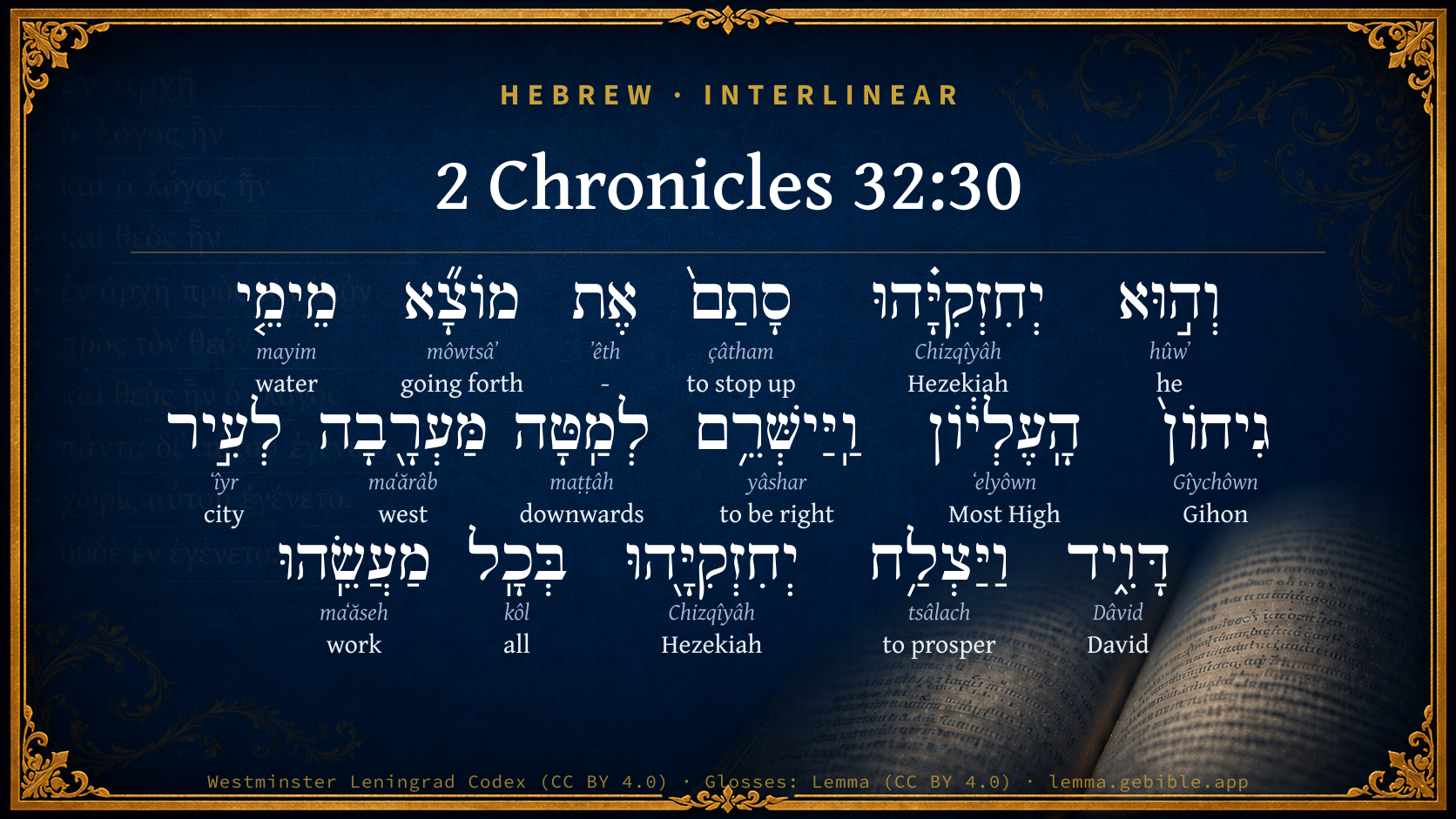
  1. וְה֣וּא hûwʼ H1931 “and · he” Conjunction + Pronoun, Personal, 3rd Person, Masculine, Singular
  2. יְחִזְקִיָּ֗הוּ Chizqîyâh H2396 “Hezekiah” Noun, Proper
  3. סָתַם֙ çâtham H5640 “to stop up” Verb, Qal, Perfect, 3rd Person, Masculine, Singular
  4. אֶת ʼêth H853 “-” Particle, Direct Object
  5. מוֹצָ֞א môwtsâʼ H4161 “going forth of” Noun, Common, Masculine, Singular, Construct
  6. מֵימֵ֤י mayim H4325 “water(s) of” Noun, Common, Masculine, Plural, Construct
  7. הָֽעֶלְי֔וֹן ʻelyôwn H5945 “the · Most High” Particle, Definite Article + Adjective, Adjective, Masculine, Singular, Absolute
  8. וַֽיַּישְּׁרֵ֥ם yâshar H3474 “and · to be right · them” Conjunction + Verb, Piel, Sequential Imperfect, 3rd Person, Masculine, Singular + Suffix, Personal, 3rd Person, Masculine, Plural
  9. לְמַֽטָּה maṭṭâh H4295 “to/for · downwards” Preposition + Adverb
  10. מַּעְרָ֖בָה maʻărâb H4628 “west · toward” Noun, Common, Masculine, Singular, Absolute + Suffix, Demonstrative
  11. לְעִ֣יר ʻîyr H5892 “to/for · city of” Preposition + Noun, Common, Feminine, Singular, Construct
  12. דָּוִ֑יד Dâvid H1732 “David” Noun, Proper
  13. וַיַּצְלַ֥ח tsâlach H6743 “and · to prosper” Conjunction + Verb, Hiphil, Sequential Imperfect, 3rd Person, Masculine, Singular
  14. יְחִזְקִיָּ֖הוּ Chizqîyâh H2396 “Hezekiah” Noun, Proper
  15. בְּכָֽל kôl H3605 “in/at · all of” Preposition + Noun, Common, Masculine, Singular, Construct
  16. מַעֲשֵֽׂהוּ maʻăseh H4639 “work · his” Noun, Common, Masculine, Singular, Construct + Suffix, Personal, 3rd Person, Masculine, Singular

About this verse

These counts appear in no published source. They are computed here, from the morphology-tagged text and Lemma’s own curated glosses. What Lemma adds →

17
words
16
distinct lemmas
Historical
section

Notable vocabulary

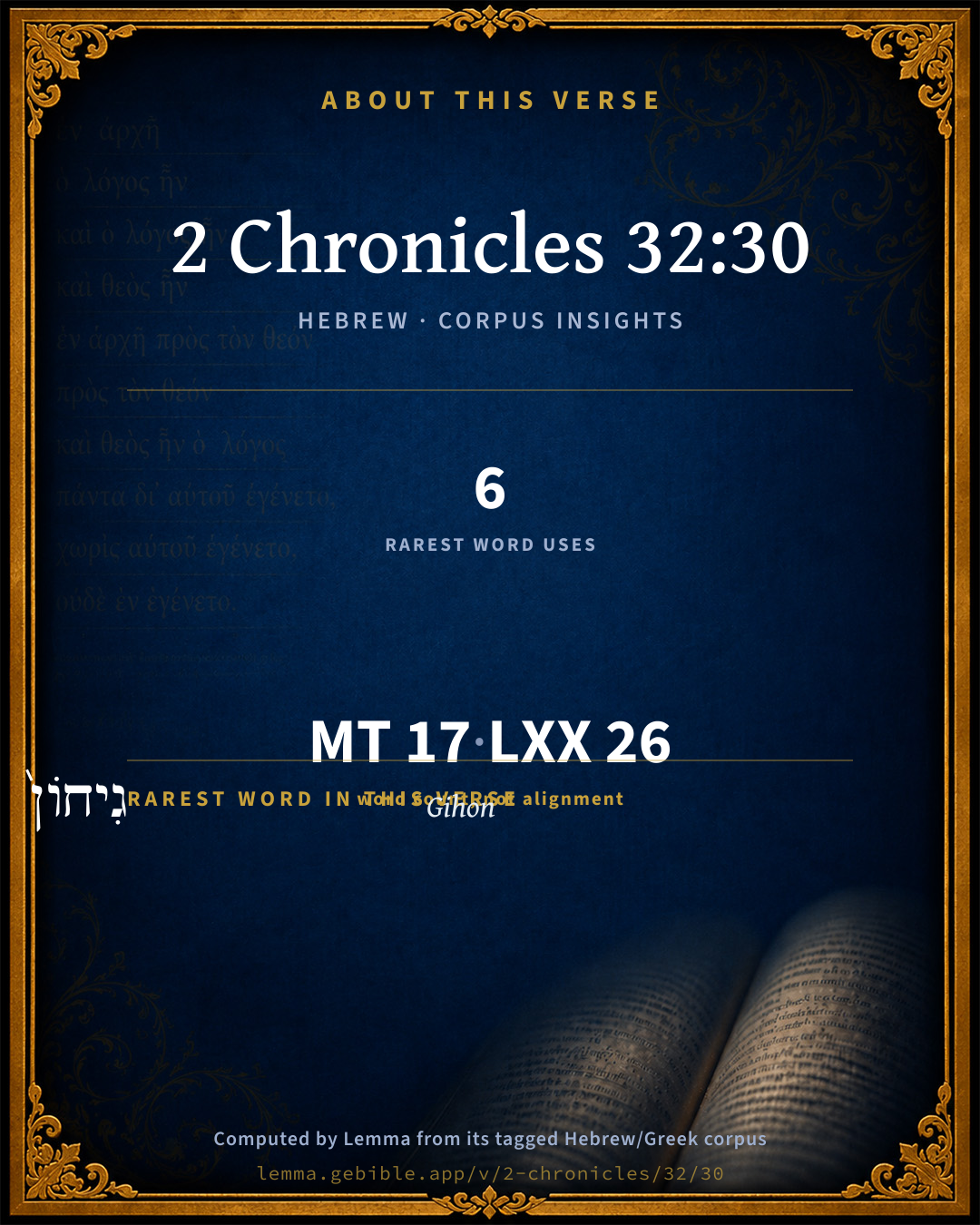
The rarest word here is גִיחוֹן֙ Gihon H1521 — appearing just 6 times in the whole Hebrew Bible.

Shared distinctive vocabulary

גִיחוֹן֙ Gihon H1521 occurs in 6 verses of the Hebrew Bible. Also found in:

Grammatical profile

  • 3 verbs
  • 10 nouns
  • 1 adjective
  • 1 pronoun
  • 1 adverb
  • 1 particle

Verb forms

  • סָתַם֙ Qal · Perfect
  • וַֽיַּישְּׁרֵ֥ם Piel · Sequential Imperfect
  • וַיַּצְלַ֥ח Hiphil · Sequential Imperfect

Repetition

A word recurs within this verse — often emphatic in Hebrew:

  • יְחִזְקִיָּ֗הוּ Hezekiah H2396 ×2

Hebrew & Septuagint length

In English translation the verse runs 33 words from the Hebrew and 32 from the Septuagint (LXX English) — closely comparable.

A rough comparison of the two English renderings, which tokenize alike — not a word-level alignment.

Word counts can differ between the Hebrew and the Greek without any difference in meaning — e.g. the Hebrew direct-object marker אֵת has no separate Greek word, and Greek often adds the article ὁ.

In the original languages it is 17 Hebrew tokens and 26 Greek tokens — but the two are counted differently (Hebrew bundles its prefixes and suffixes into one token; the Greek is in lemma form), so that isn’t a like-for-like length.

Cross-references

8

Topical passages linked to 2 Chronicles 32:30 in the Treasury of Scripture Knowledge — connected by theme and wording, ordered by reader-vote popularity; previews shown in the World English Bible.

  • 1 Kings 1:33 The king said to them, Take with you the servants of your lord, and cause Solomon my son to ride on my own mule, and bring him down to Gihon:
  • Joshua 1:7–8 Only be strong and very courageous, to observe to do according to all the law, which Moses my servant commanded you: don't turn from it to the right hand or to the left, that you may have good success wherever you go.
  • 1 Kings 1:38 So Zadok the priest, and Nathan the prophet, and Benaiah the son of Jehoiada, and the Cherethites and the Pelethites, went down, and caused Solomon to ride on king David's mule, and brought him to Gihon.
  • 1 Kings 1:45 and Zadok the priest and Nathan the prophet have anointed him king in Gihon; and they are come up from there rejoicing, so that the city rang again. This is the noise that you have heard.
  • 2 Kings 20:20 Now the rest of the acts of Hezekiah, and all his might, and how he made the pool, and the conduit, and brought water into the city, aren't they written in the book of the chronicles of the kings of Judah?
  • 2 Chronicles 32:4 So there was gathered much people together, and they stopped all the springs, and the brook that flowed through the midst of the land, saying, Why should the kings of Assyria come, and find much water?
  • Psalms 1:1–3 Blessed is the man who doesn't walk in the counsel of the wicked, Nor stand in the way of sinners, Nor sit in the seat of scoffers;
  • Isaiah 22:9–11 You saw the breaches of the city of David, that they were many; and you gathered together the waters of the lower pool;

Cross-references courtesy of OpenBible.info (CC BY 4.0).

Hebrew and Greek witnesses Masoretic Hebrew ↔ Greek Septuagint

The same verse in the two great witnesses to the Old Testament, shown verse-for-verse.

These are two independent witnesses, not word-aligned to each other, and the Septuagint is shown in lemma (dictionary) form.

Hebrew 2 Chronicles 32:30 Masoretic · Westminster Leningrad Codex

וְה֣וּא יְחִזְקִיָּ֗הוּ סָתַם֙ אֶת מוֹצָ֞א מֵימֵ֤י גִיחוֹן֙ הָֽעֶלְי֔וֹן וַֽיַּישְּׁרֵ֥ם לְמַֽטָּה מַּעְרָ֖בָה לְעִ֣יר דָּוִ֑יד וַיַּצְלַ֥ח יְחִזְקִיָּ֖הוּ בְּכָֽל מַעֲשֵֽׂהוּ

This same Hezekiah also stopped the upper spring of the waters of Gihon, and brought them straight down on the west side of the city of David. Hezekiah prospered in all his works.

World English Bible · Public Domain

Greek LXX 2 Chronicles 32:30 Septuagint · lemma form

αὐτός εζεκιας ἐνφράσσω ὁ ἔξοδος ὁ ὕδωρ γιων ὁ ἄνω καί αὐτός κάτω πρός λίψ ὁ πόλις δαυίδ καί εὐοδόω εζεκιας ἐν πᾶς ὁ ἔργον αὐτός

The same Ezekias stopped up the course of the water of Gion above, and brought the water down straight south of the city of David. And Ezekias prospered in all his works.

LXX2012 (modern English Septuagint) · Public Domain

Hebrew: Westminster Leningrad Codex (CC BY 4.0). Greek: Septuagint (public domain); English from LXX2012 (modern English Septuagint) (Public Domain). How the Septuagint differs from the Hebrew →

Commentary

Notes on 2 Chronicles 32:30 from classic Christian and Jewish commentators (each source and its license shown beneath its notes). The classic Christian expositions comment on the surrounding passage and are grouped to its opening verse, so a note may address several verses; the Jewish commentaries on the Tanakh (Rashi and others) are per-verse, so they appear only where the commentator wrote on this verse.

Lemma curates 59 commentaries, every one of them public domain or Creative Commons licensed, each selected and text-cleaned for this edition rather than reprinted as found. About our sources →

Trapp's Complete Commentary

John Trapp

2Ch 32:30 This same Hezekiah also stopped the upper watercourse of Gihon, and brought it straight down to the west side of the city of David. And Hezekiah prospered in all his works.

Ver. 30. Stopped the upper watercourse of Gihon.] See 2Ch 32:4.

And Hezekiah prospered.] See 2Ki 18:7.

John Trapp, A Commentary or Exposition upon All the Books of the Old and New Testament (1647–1656) — public domain. Text from a community e-Sword module.

Joseph Benson's Commentary

2Ch 32:30. Hezekiah stopped the upper watercourse of Gihon — A rivulet near Jerusalem, consisting of two streams, the upper, which was brought into one pool, called the upper pool, (Isa 7:3,) and the lower, which was brought into another, called the lower pool, Isa 22:9. The former he diverted, and brought by pipes into Jerusalem, which was a work of great art and labour. And brought it straight down to the city of David — Whereas before it fetched a compass, and therefore might have been beneficial to the Assyrian host.

Joseph Benson's Commentary on the Old and New Testaments (1811–1818) — public domain. Text from a community e-Sword module.

Geneva Bible (1599)

Geneva Bible translators

Which also was called Shiloah [Siloam], whereof mention is made, Isa. 8:6; John 9:7.

Geneva Bible (1599) marginal notes — public domain. Text via Bolls.life.

Jamieson, Fausset & Brown

Robert Jamieson, A. R. Fausset & David Brown

stopped the . . . watercourse of Gihon, and brought it . . . to the west side of the city, &c.--(Compare Kg2 20:20). Particular notice is here taken of the aqueduct, as among the greatest of Hezekiah's works. "In exploring the subterranean channel conveying the water from Virgin's Fount to Siloam, I discovered a similar channel entering from the north, a few yards from its commencement; and on tracing it up near the Mugrabin gate, where it became so choked with rubbish that it could be traversed no farther, I there found it turn to the west in the direction of the south end of the cleft, or saddle, of Zion, and if this channel was not constructed for the purpose of conveying the waters of Hezekiah's aqueduct, I am unable to suggest any purpose to which it could have been applied. Perhaps the reason why it was not brought down on the Zion side, was that Zion was already well-watered in its lower portion by the Great Pool, 'the lower pool of Gihon.' And accordingly WILLIAMS [Holy City] renders this passage, 'He stopped the upper outflow of the waters of Gihon, and led them down westward to the city'" [BARCLAY, City of the Great King]. The construction of this aqueduct required not only masonic but engineering skill; for the passage was bored through a continuous mass of rock. Hezekiah's pool or reservoir made to receive the water within the northwest part of the city still remains. It is an oblong quadrangular tank, two hundred forty feet in length, from one hundred forty-four to one hundred fifty in breadth, but, from recent excavations, appears to have extended somewhat farther towards the north.

Jamieson, Fausset & Brown — Commentary Critical and Explanatory on the Whole Bible (1871) — public domain (CC PDM 1.0). Text via the HelloAO Bible API.

Adam Clarke's Commentary

Verse 30. The upper watercourse] He made canals to bring the waters of Gihon from the west side of Jerusalem to the west side of the city of David.

Adam Clarke's Commentary on the Bible (1810–1826) — public domain. Text from a community e-Sword/MySword module.

Ellicott's Commentary for English Readers

(30) This same Hezekiah also stopped.—And he, Hezekiah, had closed in the upper outlet of the waters of Gihon. (See 2Ch_32:3.)

And brought . . . city of David.—And conducted them underground to the west of the city of David. (Comp. 2Ki_20:20, where also this great work of Hezekiah is referred to in concluding his history: “He made the pool, and the aqueduct, and brought the waters into the city.”) The chronicler gives further details.

Brought it straight.—Directed or conducted them (wayyashshĕrçm; the form in the Hebrew margin is a peculiar contraction of the ordinary piel form which appears in the text).

And Hezekiah prospered.—2Ch_31:21; 1Ch_29:23.

A Bible Commentary for English Readers, edited by Charles John Ellicott (1878–1897) — public domain. Text from a community e-Sword module.

The Cambridge Bible for Schools and Colleges

gen. ed. J. J. S. Perowne

30. stopped] Cp. 2Ch_32:3-4.

the upper watercourse] R.V. the upper spring of the waters.

Gihon] The upper spring of Gihon is perhaps represented to-day by St Mary’s Well; cp. Bädeker, p. 99, and note on 2Ch_32:3 above.

to the west side] R.V. on the west side. The present Lower Pool of Siloam is rather to the S.E. of the present Jerusalem but it may have been S.W. of the ancient City of David. The Ambrosian MS. of Pesh. reads, on the east side, and this may be right.

The Cambridge Bible for Schools and Colleges (gen. ed. J. J. S. Perowne; Cambridge University Press, 1878–1918) — public domain. Text from a community e-Sword module.

Albert Barnes' Notes on the Bible

See 2Ch 32:3 note. Either then or afterward, Hezekiah conducted the water of this spring by an underground channel down the Tyropoeon valley to a pool or reservoir (marginal reference).

Albert Barnes' Notes on the Bible (1834–1885) — public domain. Text from a community e-Sword/MySword module.

Haydock's Catholic Bible Commentary

Underneath the walls of the city, making them run westward, C. xxxiii. 14.

George Leo Haydock (1774–1849), Haydock's Catholic Family Bible and Commentary, 1859 edition — public domain. Excludes Psalms (Douay-Rheims chapter numbering differs from Protestant) and Deuterocanonical books (Catholic canon only).

Matthew Poole's English Annotations

The upper water-course of Gihon; a rivulet near Jerusalem consisting of two streams, the upper, which was brought into one pool, called the upper pool, Isa 7:3; and the lower, which was brought into another, called the lower pool, Isa 22:9. The former he diverted and brought by secret pipes into Jerusalem, which was a work of great art, and labour, and policy, and therefore is here commended.

Brought it straight down; whereas before it fetched a compass, and thereby might have been beneficial to the Assyrian host.

Matthew Poole's English Annotations on the Holy Bible (1683–1685) — public domain. Text from a community e-Sword/MySword module.

The Pulpit Commentary

Stopped the upper watercourse, etc. (see our vers. 3, 4). What Hezekiah "stopped" was the spring, or more strictly access to it, and guided its prized waters down, probably by an underground channel, to Siloam, or else to the pool in the city which he had constructed and enclosed by that "another wall without" (ver. 5), west of the "city of David."

The Pulpit Commentary (1880–1919), ed. H.D.M. Spence-Jones & Joseph S. Exell — public domain. Text from a community e-Sword module.

John Wesley's Explanatory Notes

Stopped, &c. - A rivulet near Jerusalem consisting of two streams, the upper which was brought into one pool, called the upper pool, Isaiah vii, 3, and the lower which was brought into another, called the lower pool, Isaiah xxii, 9. The former he diverted and brought by pipes into Jerusalem, which was a work of great art and labour.

John Wesley, Explanatory Notes Upon the Whole Bible (1754–1765) — public domain. Text via the GEBible commentary corpus.

unfoldingWord translationNotes

Door43 World Missions Community

Hezekiah who also stopped up ... and who brought them straight down

The readers should understand that Hezekiah probably commanded other people to do the actual work. AT: "Hezekiah who ordered his workers to stop up ... and to build a tunnel so that the water would flow down" (See: Metonymy)

waters of Gihon

This is the name of a stream near Jerusalem. (See: How to Translate Names)

the miraculous sign that had been done in the land

This can be stated in active form. AT: "the miracle that Yahweh had performed in the land" (See: Active or Passive)

to know all that was in his heart

Here "heart" represents a person's inner being. AT: "to reveal Hezekiah's true character" (See: Metonymy)

translationWords

water

city of David

ambassador

prince

Babylon

sign

test

heart

unfoldingWord translationNotes — © Distant Shores Media and the Door43 World Missions Community, licensed CC BY-SA 4.0. Source: git.door43.org/Door43/en_tn.

Rashi

Rabbi Shlomo Yitzchaki (Rashi)

and he led them straight down on the west He led them along a straight way down on the west to the City of David.

Rashi on the Tanakh — English translations: “The Judaica Press complete Tanach with Rashi, translated by A. J. Rosenberg” (CC BY 4.0); “Pentateuch with Rashi's commentary by M. Rosenbaum and A.M. Silbermann, 1929-1934” (public domain); “The Metsudah Tanach series, Lakewood, N.J” (CC BY 4.0); and “The Book of Joshua, Metsudah Publications, 1997” (CC BY 4.0). Text via Sefaria.

Lesson kit

Teaching starters — assembled from the data on this page, not authored interpretation. Every prompt links to the verse data it draws on. Edit before teaching.

2 Chronicles, in the Historical, opens this verse with 17 words (16 distinct Hebrew lemmas). Its most distinctive word is Gîychôwn (“Gihon”). A historical commentator’s framing appears above. Read the whole chapter for the surrounding context.

Discussion questions

  1. How does “Gihon” (Gîychôwn) shape what this verse is saying?
  2. Genesis 2:13 shares the word «Gihon» with this verse. How do the two illuminate each other?
  3. “Hezekiah” occurs 2× in this one verse. What is the effect of the repetition?
  4. These translations render this verse differently; the difference is in the English rendering, not the original. What questions does that raise?
  5. The verb «סָתַם֙» is Qal Perfect. How does its form color the action?
  6. Reading how Trapp's Complete Commentary and Joseph Benson's Commentary read this verse, where do the two commentators agree and where do they part?

Things to notice

Reading settings

Reading text

Shown beneath each verse's original-language words.

Old Testament
Old Testament edition

Read the OT as the Masoretic Hebrew (MT) or the Greek Septuagint (LXX).

English shown for the Greek Septuagint (in the Hebrew ↔ Greek comparison).

Comparing translations? Open the Compare panel on any verse page to stack up to four side by side.