
1 Chronicles 21:11

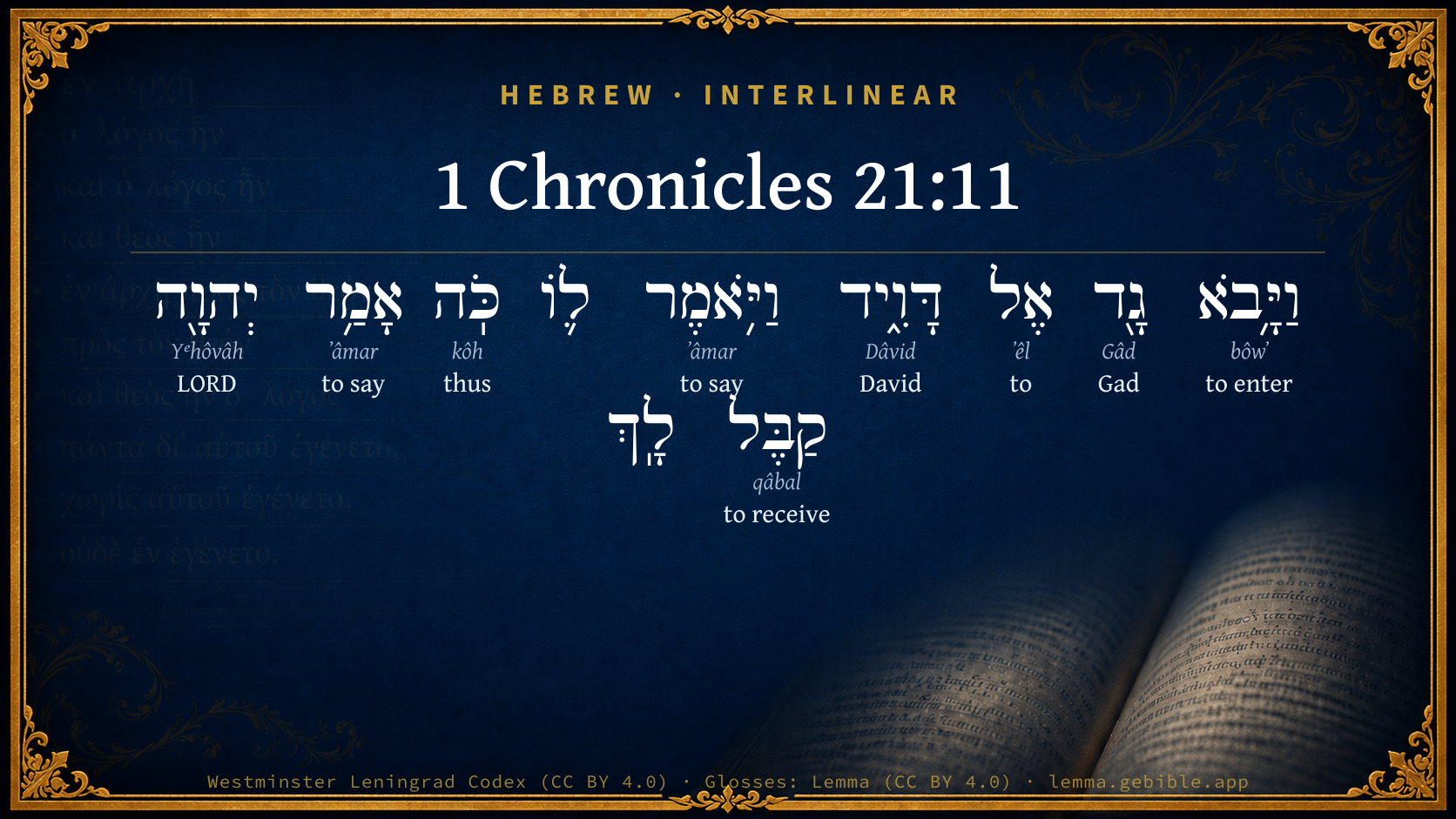
Hebrew (Westminster Leningrad Codex) 1 Chronicles 21:11 appears in the Hebrew Old Testament. The text above is from the Westminster Leningrad Codex. Each word links to its Strong’s number, a concise gloss, and parsing drawn from the Open Scriptures Hebrew Bible morphology. Click any word for its full Brown-Driver-Briggs (BDB) entry.
Download image
Cite this verse

1 Chronicles 21:11 (World English Bible). Public Domain. Lemma interlinear Bible study tool, https://lemma.gebible.app/v/1-chronicles/21/11.

Show BibTeX & RIS
BibTeX
RIS
English Translation
So Gad came to David, and said to him, Thus says Yahweh, Take which you will:
World English Bible · Public Domain
Download a study sheet

One document with this verse’s original text, its word-by-word gloss line, the meaning frame, cross-references with their text, attributed commentary, and full source and license credits — printable, and it pastes into notes with its structure intact.

This verse Autodidact and up

Study sheet (.html) Plain text (.txt)

A passage Seminary Student

Up to 50 verses in one chapter. A passage sheet keeps up to 6 commentary sources and 12 cross-references per verse, in the order this page ranks them, and says so on the sheet whenever that leaves anything out. Ask for a single verse and you get the Autodidact verse sheet above.

Everything on this page stays free to read, with no account — the sheet is a download of what is already on screen, not access to it.

Want to remove ads? Support Godless Engineer
Compare translations 3

The same verse in 3 English versions, stacked beneath the original-language interlinear above. Click any original word for its lexicon entry.

Each is an independent rendering of the whole verse — the interlinear is not word-aligned to these translations.

Highlighted words mark where these versions differ — a whole-verse word diff, not a word-by-word alignment.

  • World English Bible Public Domain
    So Gad came to David, and said to him, Thus says Yahweh, Take which you will:
  • King James Version Public Domain
    So Gad came to David, and said unto him, Thus saith the LORD, Choose thee
  • unfoldingWord Literal Text CC BY-SA 4.0
    And Gad came to David, and he said to him, “Thus says Yahweh, ‘Take for yourself,

unfoldingWord Literal Text — © unfoldingWord, licensed CC BY-SA 4.0. Word-aligned USFM3 via Door43 (git.door43.org/unfoldingWord/en_ult).

Versions to compare (up to 4)

3 of 4 selected

Show all 18 translations

Every available English version of this verse, each an independent rendering of the whole verse.

  • World English Bible Public Domain
    So Gad came to David, and said to him, Thus says Yahweh, Take which you will:
  • Berean Standard Bible Public Domain
    So Gad went and said to David, “This is what the LORD says: ‘You must choose
  • Majority Standard Bible Public Domain
    So Gad went and said to David, “This is what the LORD says: ‘You must choose
  • King James Version Public Domain
    So Gad came to David, and said unto him, Thus saith the LORD, Choose thee
  • American Standard Version (1901) Public Domain
    So Gad came to David, and said unto him, Thus saith Jehovah, Take which thou wilt:
  • Revised Version (1885) Public Domain
    So Gad came to David, and said unto him, Thus saith the LORD, Take which thou wilt;
  • Geneva Bible (1599) Public Domain
    So Gad came to Dauid, and sayde vnto him, Thus saith the Lord, Take to thee
  • Douay-Rheims (1899) Public Domain
    Go, and speak to David, and tell him: Thus saith the Lord: I give thee the choice of three things: choose one which thou wilt, and I will do it to thee.
  • Young's Literal Translation Public Domain
    And Gad cometh in unto David, and saith to him, `Thus said Jehovah, Take for thee --
  • Literal Standard Version CC BY-SA 4.0
    And Gad comes to David and says to him, “Thus said YHWH: Take for yourself—
  • Unlocked Literal Bible CC BY-SA 4.0
    So Gad went to David and said to him, “Yahweh says this, 'Choose one of these:
  • unfoldingWord Literal Text CC BY-SA 4.0
    And Gad came to David, and he said to him, “Thus says Yahweh, ‘Take for yourself,
  • Darby Bible Public Domain
    And Gad came to David, and said to him, Thus saith Jehovah:
  • World Messianic Bible Public Domain
    So Gad came to David and said to him, “The LORD says, ‘Take your choice:
  • Webster's Bible Public Domain
    So Gad came to David, and said to him, Thus saith the LORD, Choose thee
  • Free Bible Version CC BY-SA 4.0
    So Gad went and told David, “This is what the Lord says: ‘Make your choice:
  • Bible in Basic English Public Domain
    So Gad came to David and said to him, The Lord says, Take whichever you will:
  • JPS Tanakh (1917) Public Domain
    So Gad came to David, and said unto him: 'Thus saith the LORD: Take which thou wilt:

Literal Standard Version (2020), Covenant Press — licensed CC BY-SA 4.0. Text via the HelloAO Bible API (eBible.org). Unlocked Literal Bible (unfoldingWord) — licensed CC BY-SA 4.0. Text via the HelloAO Bible API (eBible.org). unfoldingWord Literal Text — © unfoldingWord, licensed CC BY-SA 4.0. Word-aligned USFM3 via Door43 (git.door43.org/unfoldingWord/en_ult). Free Bible Version, Dr. Jonathan Gallagher — licensed CC BY-SA 4.0. Text via the HelloAO Bible API (eBible.org).

Word by word

More ways to search: Search by grammar → Find every occurrence → Compare this word →

Practice this passage: Drill this verse → Learn its vocabulary →

קַבֶּל
qâbal
H6901
“receive”
Verb, Piel, Imperative, 2nd Person, Masculine, Singular
Part of Speech
Verb
Stem
Piel
Form
Imperative
Person
2nd Person
Gender
Masculine
Number
Singular
Full BDB Definition

Origin: a primitive root

TWOT: 1980

to take, receive, be before - (Piel) - to take, choose, receive - to accept - to accept, assume - (Hiphil) - to show oppositeness - to correspond, receive one to the other
  1. וַיָּ֥בֹא bôwʼ H935 “and · to enter” Conjunction + Verb, Qal, Sequential Imperfect, 3rd Person, Masculine, Singular
  2. גָ֖ד Gâd H1410 “Gad” Noun, Proper
  3. אֶל ʼêl H413 “to” Preposition
  4. דָּוִ֑יד Dâvid H1732 “David” Noun, Proper
  5. וַיֹּ֥אמֶר ʼâmar H559 “and · to say” Conjunction + Verb, Qal, Sequential Imperfect, 3rd Person, Masculine, Singular
  6. כֹּֽה kôh H3541 “thus” Adverb
  7. אָמַ֥ר ʼâmar H559 “to say” Verb, Qal, Perfect, 3rd Person, Masculine, Singular
  8. יְהוָ֖ה Yᵉhôvâh H3068 “LORD” Noun, Proper

About this verse

These counts appear in no published source. They are computed here, from the morphology-tagged text and Lemma’s own curated glosses. What Lemma adds →

11
words
8
distinct lemmas
Historical
section

Notable vocabulary

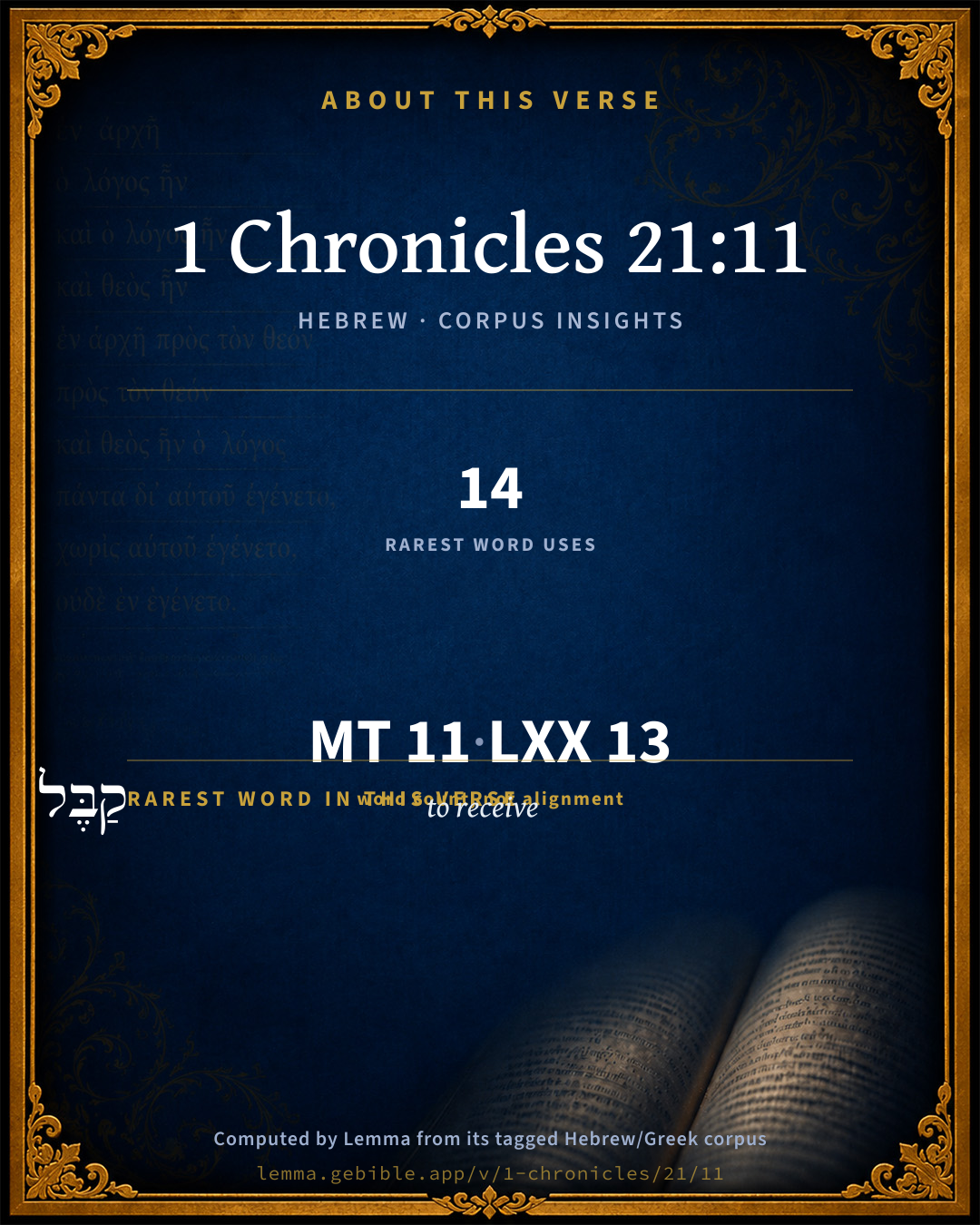
The rarest word here is קַבֶּל to receive H6901 — appearing just 14 times in the whole Hebrew Bible.

Shared distinctive vocabulary

קַבֶּל to receive H6901 occurs in 12 verses of the Hebrew Bible. Also found in:

Grammatical profile

  • 4 verbs
  • 3 nouns
  • 3 prepositions
  • 1 adverb

Verb forms

  • וַיָּ֥בֹא Qal · Sequential Imperfect
  • וַיֹּ֥אמֶר Qal · Sequential Imperfect
  • אָמַ֥ר Qal · Perfect
  • קַבֶּל Piel · Imperative

Repetition

A word recurs within this verse — often emphatic in Hebrew:

  • וַיֹּ֥אמֶר to say H559 ×2

Hebrew & Septuagint length

In English translation the verse runs 16 words from the Hebrew and 16 from the Septuagint (LXX English) — the same length.

A rough comparison of the two English renderings, which tokenize alike — not a word-level alignment.

Word counts can differ between the Hebrew and the Greek without any difference in meaning — e.g. the Hebrew direct-object marker אֵת has no separate Greek word, and Greek often adds the article ὁ.

In the original languages it is 11 Hebrew tokens and 13 Greek tokens — but the two are counted differently (Hebrew bundles its prefixes and suffixes into one token; the Greek is in lemma form), so that isn’t a like-for-like length.

Cross-references

1

Topical passages linked to 1 Chronicles 21:11 in the Treasury of Scripture Knowledge — connected by theme and wording, ordered by reader-vote popularity; previews shown in the World English Bible.

  • Proverbs 19:20 Listen to counsel and receive instruction, That you may be wise in your latter end.

Cross-references courtesy of OpenBible.info (CC BY 4.0).

Hebrew and Greek witnesses Masoretic Hebrew ↔ Greek Septuagint

The same verse in the two great witnesses to the Old Testament, shown verse-for-verse.

These are two independent witnesses, not word-aligned to each other, and the Septuagint is shown in lemma (dictionary) form.

Hebrew 1 Chronicles 21:11 Masoretic · Westminster Leningrad Codex

וַיָּ֥בֹא גָ֖ד אֶל דָּוִ֑יד וַיֹּ֥אמֶר ל֛וֹ כֹּֽה אָמַ֥ר יְהוָ֖ה קַבֶּל לָֽךְ

So Gad came to David, and said to him, Thus says Yahweh, Take which you will:

World English Bible · Public Domain

Greek LXX 1 Chronicles 21:11 Septuagint · lemma form

καί ἔρχομαι γαδ πρός δαυίδ καί εἶπον αὐτός οὕτως λέγω κύριος ἐκλέγω σεαυτοῦ

And Gad came to David, and said to him, Thus says the Lord, Choose for yourself,

LXX2012 (modern English Septuagint) · Public Domain

Hebrew: Westminster Leningrad Codex (CC BY 4.0). Greek: Septuagint (public domain); English from LXX2012 (modern English Septuagint) (Public Domain). How the Septuagint differs from the Hebrew →

Commentary

Notes on 1 Chronicles 21:11 from classic Christian and Jewish commentators (each source and its license shown beneath its notes). The classic Christian expositions comment on the surrounding passage and are grouped to its opening verse, so a note may address several verses; the Jewish commentaries on the Tanakh (Rashi and others) are per-verse, so they appear only where the commentator wrote on this verse.

Lemma curates 59 commentaries, every one of them public domain or Creative Commons licensed, each selected and text-cleaned for this edition rather than reprinted as found. About our sources →

The Biblical Illustrator

Joseph S. Exell

1Ch_21:11-15

Thus saith the Lord, choose thee.

The awful judgments

I. Judgments entailed by one mans sin.

II. Judgments easily prepared for execution.

III. Judgments sent according to human preference.

IV. Judgments arrested by earnest prayer.

Davids choice

I. As the result of an awakened conscience.

II. As the revelation of a principle of Christian life. He left himself confidently with God.

III. As a picture of future doom to all. (J. Wolfendale.)

Davids choice of chastisements

Davids preference justified when we Consider--

1. The harsh judgments which men pronounce on each other.

2. The harsh treatment of the guilty who are in mens power.

3. The absence of sympathetic kindness in human warfare.

4. That when God punishes He does so in righteousness.

5. That in the treatment of the guilty God always shows mercy.

Lessons:

1. Submission to God,

2. Hopeful trust. (J. Wolfendale.)

God an emblem of the true minister

Let us look at God as representing every true minister of Jesus Christ.

I. Gods message was Divine. The gospel is a message from God. This is attested--

1. By the facts of history,

2. By its congruity with the spiritual constitution of men.

3. By the experience of thousands of every age who have felt it to be the power of God unto salvation.

II. Gods message was an appeal to choice. Advise thyself. Deliberate, choose for thyself. The gospel message is submitted to your choice.

1. You can accept it.

2. You can reject it.

III. Gods message was to be accounted for.

1. He was responsible for its delivery. So with every gospel minister, and woe be to him if he declares not the whole counsel of God.

2. David was responsible for its results. So are also the hearers of the gospel. (Homilist.)

Religious lessons of pestilence

I. Pestilences are striking witnesses to the majesty of Gods law.

II. Pestilences are striking illustrations of the moral connection between men. Epidemics run rapidly from one to another. No man can live alone to himself. Every one who comes near us is the better or the worse for our influence upon them.

III. Pestilences may be the agency for executing Divine judgments. Nowadays men hesitate to believe that there can be any connection between a nations sin and a nations suffering. With eye fixed upon the natural and physical laws and conditions out of which disease comes, men fail to see Him who overrules all physical conditions, and controls all laws. What, then, is the attitude which Christians should take in relation to epidemic disease 7

(1) We ought to cherish a reverent awe of God, the spirit that is becoming in times of storm and tempest, awe of Him who is Lord of the great things.

(2) We should seek by prayer, and in the spirit of penitence, for the removal of the chastening hand.

(3) We should ask for grace that we may be brave, brotherly, and self-denying, should disease come actually into our spheres.

(4) We should, with calm seriousness, inquire whether we are prepared to face the risks of disease, prepared to die, prepared to meet our God. (R. Tuck, B. A.)

Alternative judgments

The whole story is mysterious. We feel at each step that much is kept back from us.

1. The fault of the king is mysterious. It is not enough to say that there was pride and vainglory in his heart. If this were all, it might have made the act sinful in the sight of God, but it would not account for the view taken of the act either by the minister or by the historian. There are many things in Scripture, as there are many things in life, which we must leave in the hands of God.

2. The mode of his punishment is full of mystery. A choice of punishments is offered him; but the punishments are all national. Rulers sin and peoples suffer has passed into a proverb. Scripture and Providence are at one in this matter. On a kings edict of passion or foolishness may hang a nations misery or a nations dishonour. A kings caprice or a kings miscalculation may hand over a nation to a bloody and ruinous war of which it may be the occupation of a century to bear or repair the consequences.

3. The peculiarity of Davids penalty is the choice offered him. The day of Divine alternatives is not ended. Every example of a sin brought face to face with its suffering presents an aspect of choice as well as of compulsion. The mere question of confession or denial, with the consequences of either, is such an alternative in the case of individual wrongdoing. The adoption of this expedient rather than that, in the way of avoidance or mitigation of consequences, is an alternative. The way of bearing punishment, the language of regret or of hardness, the tone of submission or of defiance, most of all the spirit of repentance or of impenitence, is an alternative for the individual transgressor. The question of stopping or continuing a hopeless struggle, of accepting a defeat, of submitting to abduction, of desiring conditions of peace, or on the contrary, of persisting in warfare for the chance of a turn of fortune--the question of renewing a struggle, years or generations afterwards, on the plea of a hereditary title or a popular invitation--is an alternative, real or responsible, on the stage of kings and nations.

4. How shall we read the words, Let me now fall into the hand of the Lord? Is it a choice made? or is it a choice referred back to the offerer? Is it, I choose pestilence? or is it, Let God choose? So the Lord sent the pestilence upon Israel indicates perhaps on the part of our translators a preference of the former. I choose that punishment which has no human inflicter. But, whatever the application, the principle stands steadfast. In everything let me be in Gods hands. Anything which God inflicts is preferable to any suffering which comes through man. But if this be the force of Davids words considered as a choice, there is at least an equal interest in them regarded as a refusal to choose. Yes, let us love to live these lives absolutely under Gods direction. War, famine, pestilence--if He sees any one necessary, leave Him to choose. Let us not fall into the hands of man--our own, or any others. We are ill judges--worst of all for ourselves. Our mercies to ourselves are not Gods mercies. We are self-sparers as well as self-excusers. If we had our choice, no nerve would ever throb, no hair would ever turn grey. We should grow up, we should go to the grave, we should wake from the dust of the earth spoilt children--with all the irregularities, and all the selfishness, and all the unhappiness, which cling to and cluster round that name. What are we to one another? How does selfishness warp our judgments--selfish love first, then selfish fear. (Dean Vaughan.)

The choice of troubles

Who is there that has not wished that God would give him the choice of the evils which he had to suffer; and who is there that would not have been seriously embarrassed if that wish had been fulfilled? But, it may be said, the text does not support that view. Does it not?

1. David was very much troubled when the time for decision came: he was in a great strait.

2. His choice was more devout in form than in substance; for, had he chosen defeat in war, he would still have been in the hand of God.

3. It is highly probable that, after the choice was made, David was doubtful of its wisdom. We may consider--

I. The element of choice in the evils of life.

Two things are open to us here.

1. One relates to the measure of trouble we experience. By healthy habits, by obedience to the laws of our spiritual and our physical nature, by keeping within the lines of wisdom and virtue, by commending ourselves to the approval of man and also of God, we may materially reduce the measure of evil which otherwise we should endure.

2. The other relates to the kind of trouble we are called to face. It is often left to our choice to decide whether we will meet the dangers, the difficulties, the temptations, the trials of our condition in life, or those of the opposite condition--whether those of ignorance or of learning, of loneliness or of society, of obscurity or of conspicuousness and responsibility. It may be timidity or cowardice that inclines us to the one, and high-minded courage that incites us to the other; or it may be modesty and wisdom that urge us to the one, and nothing better than an unhallowed ambition, or even an exaggerated sense of importance, that allures to the other. Ii; behoves us, as we stand in front of the future, with our path in life before us, very earnestly to seek the guidance of God, that we may choose that course, the perils of which we may face with hope, the evils of which we shall endure with calmness and fortitude.

II. The working of the Divine hand in them. The measure and the nature of our troubles is uncertain. That they will come is as certain as anything can be. No good fortune, no sagacity, no caution will exclude them from the experience of life.

1. Our preference in regard to their form. Like David, we prefer to feel ourselves in the hand of God rather than in the hand of men. We feel that our burden is heavier when it is due to human carelessness, and heavier still when due to human heartlessness and malignity. The severest aggravation of trouble is where the evil that has been wrought is the work of some near relative or some familiar friend, or some old colleague from whom we had a right to expect quite opposite treatment (see Psa_55:12-14). We feel that if we are to have suffering or sorrow we should much prefer the unaccountable sickness, or the unavoidable loss, or the inevitable bereavement which we can refer at once to the ordinary will of God.

2. The truth we recognise when we consider it. As we think on this subject we realise that all trouble is ultimately of God.

(1) Much of it is penal, the just consequence of ill-doing, the outcome of those laws which originate in Divine holiness.

(2) Much of it is disciplinary; it is the pruning, the refining process of Him who is seeking spiritual fruit; it is the ordering of the wise and faithful Father of spirits (Heb_12:1-12).

(3) All of it is permissive. If the sparrow does not fall without the Divine permission, how much less does the obedient son or daughter suffer grief or pass through troublesome times or go down to death without the sanction of the present and watchful Lord. So that, whatever comes and whencesoever it comes, we are free to think and say, Thy will be done, Lord; the trial never comes to us when we are not in the hand of the Lord.

3. The attitude we should assume toward it. Even when we have to reproach ourselves, or even when we are obliged to condemn our neighbours or our ancestors as the immediate authors of our trouble, we may and we should accept it as that which comes in the providence of God.

(1) We should bow submissively to His will who (to say the least) suffers us to be tried as we are.

(2) We should seek from Him the sustaining strength which will empower us to bear all things unrepiningly and even cheerfully.

(3) We should have an open mind to perceive, and an open heart to welcome the practical lessons which our heavenly Father is desiring to teach us. (William Clarkson, B. A.)

Let me fall now into the hand of the Lord.--

Falling into the hand of the Lord

The doctrine is, that as sinners, as sinners before God, and as sinners towards each other, our highest hope is not in the incomplete and perverted mercy of men, but in the infinite mercy which is founded upon the infinite righteousness of God. We may perhaps help ourselves to a clearer understanding of this doctrine by first considering that it is better to fall into the hands of the highest class of men than into the hands of the lowest.

1. Take a legal case. In the first instance it may be brought before the local magistracy; but very possibly the result may be considered unsatisfactory by one party or the other, hence the case may be moved to the court above; there again dissatisfaction may be the result, and an appeal may be carried to the highest court in the land. The result even then may not be satisfactory; still by so much as the case has been carried to the highest tribunal and pronounced upon by the highest wisdom, there is strong ground to rest upon. Not only so, but there is a point beyond this; for by so much as a man wishes that there were yet another superior court to which an appeal might be made does he show how deeply graven upon the heart is the law that it is better to fall into the hands of the highest than into the hands of the lowest; that it is better to fall into the hands of God than into the hands of men.

2. What is true in the law is equally true in all criticism.

3. Take the case of the young speaker. It will be for the advantage of such a man to be judged by the greatest orators which the country can supply. (J. Parker, D. D.)

Why is it better that the sinner should fall into the hand of God rather than into the hands of men

Good use might be made of the many pleasing considerations which arise in connection with Gods wisdom, Gods righteousness, and Gods perfect knowledge of facts; but we shall include all these in a higher answer, viz., because in His whole treatment of human sin God is constantly seeking not the destruction, but the salvation of the sinner. (J. Parker, D. D.)

David falling into the hand of God

We shall look at Davids exclamation here in three aspects.

I. As indicating what is a. Natural tendency in all souls. There is a strong propensity in all men to fall into the hand of others, giving up their judgment, freedom, individuality to others. This shows itself in the exercise of unbounded trust. Man is essentially dependent. Hence his existence is one of trust in others. This trust is the very base and bond of social life. Trusting others within certain limits is right and necessary, but when the principle carries us to the entire subjection of ourselves to our fellow-men, we have gone wrongly and ruinously.

II. As revealing the true spirit of life. Davids tendency to trust took the right direction.

1. His preference was right.

(1) God is our Owner.

(2) God is all-powerful in His character. There is everything in His character to command our unbounded trust, our entire surrender.

2. This preference is expedient. It is far better to fall into the hand of God than man.

(1) Unbounded trust in man must destroy your freedom. Such trust in God secures it.

(2) Unbounded trust in man pollutes and degrades the character. Such trust in God purifies and elevates it. He whom we most trust exerts the most influence on our characters.

(3) Unbounded trust in man must issue in the utmost disappointment and misery. Such trust in God leads to the highest blessedness.

III. As foreshadowing the inevitable doom of all. In one of two ways every man must fall into the hand of God.

1. Voluntarily, by the influence of His grace.

2. Compulsorily, by the force of justice. (Homilist.)

The hand of God and the hands of men

I. Davids strait.

II. The grounds of his choice.

III. Divine punishment and human punishment. Human punishment is necessarily to a great extent for self-protection, and therefore selfish. When the laws of society punish the crime of murder or of theft, it is primarily with the object of preventing the committal of more murders and more thefts. Gods laws have penalties attached to them, but when God punishes He seeks not the destruction of the sinner, but his healing and reformation. While mans punishments are in principle revengeful, or at best for the defence of society, Gods punishments are remedial and reformatory; and therefore it is better to fall into the hand of God than into the hands of men. Application:

1. God in human redemption.

2. Human legislation directed to the repression of wrong incomplete, because it can only reach the outward action. Gods laws deal with motives, and are therefore complete and perfect (1Sa_16:7; Heb_4:12). (Literary Churchman.)

Mans inhumanity

There is more mercy in the fang of a rattlesnake and in the tooth of a wolf than in the heart of men and women for a poor soul who has gone astray; and if she try to swim ashore and finally come up to the rock and get the tips of her fingers on the rock and try to climb up, then you will come out and with your hard heels smash the tips of her fingers until she falls off. (H. W. Beecher.)

The Biblical Illustrator, edited by Joseph S. Exell (c. 1880s–1900s) — public domain. Text from a community e-Sword module.

Jamieson, Fausset & Brown

Robert Jamieson, A. R. Fausset & David Brown

Choose thee, &c.--To the three evils these correspond in beautiful agreement: three years, three months, three days [BERTHEAU]. (See on Sa2 24:13).

Jamieson, Fausset & Brown — Commentary Critical and Explanatory on the Whole Bible (1871) — public domain (CC PDM 1.0). Text via the HelloAO Bible API.

Ellicott's Commentary for English Readers

(11) And said unto him.—Samuel has the pleonastic, “And told him, and said,” &c.

The following curse from the Annals of Tiglath Pileser I. (circ. 1120 B.C.) well illustrates the three penalties proposed by God to David: “May Assur and Anum, the great gods my lords, mightily rebuke him and curse him with grievous curse . . . The overthrow of his army may they work! In presence of his foes may they make him dwell altogether! May Rimaron with evil pestilence his land cut off! Want of crops, famine, corpses, to his country may be cast!”

Thus saith the Lord, Choose thee.—Not in Samuel, which has instead a direct question: “Shall there come to thee seven years’ famine in thy land?” Our “choose” (take) is a word of later use in Hebrew. The Syriac gives the same term (qabbél).

A Bible Commentary for English Readers, edited by Charles John Ellicott (1878–1897) — public domain. Text from a community e-Sword module.

The Pulpit Commentary

Vers. 11, 12.

The necessary connection between sin and judgment.

Prove and illustrate the universality of the connection. Illustrations may be found in every age and every sphere. See the idea of a Nemesis; and show that pointing out this connection is the commonplace of the moral and religious teacher.

I SEE CLEARLY WHAT SIN IS. Give the theories about sin; but apart from theory, or doctrine, endeavour to understand what sin is

(1) in itself;

(2) in its power of growth;

(3) in its subtle and mischievous influences;

(4) in its interference with the Divine order;

(5) in its relations with the Divine Law;

(6) in the sight of God, as intimated in the Scriptures.

When a suitable impression is gained of what sin is, we are prepared to

II SEE WHY IT MUST BE MET WITH JUDGMENTS. Because

(1) it beclouds mans conscience, and judgment alone removes such clouds;

(2) it subverts Divine authority, and such authority judgments alone can vindicate;

(3) it interferes with the Divine plans and purposes, and these judgments alone can rectify. The importance of the relation between sin and suffering, transgression and judgment, is best shown by the effort to realize what would now be the moral sentiments of men if this connection had not been assured, and men could now plead that any one of their number had ever sinned with impunity. So essential, indeed, is the connection, that when God grants forgiveness of the sin he seldom, if ever, interferes with the external consequences of the wrong. They are left to work on their severe but beneficent mission. Judgment, in both the small and the large spheres, is the minister, the angel, of the Divine mercy; and we may bless God for his judgments. Note also that Christ, as man, came, for man, under Divine judgments, because he was the Representative of sinners. R.T.

The Pulpit Commentary (1880–1919), ed. H.D.M. Spence-Jones & Joseph S. Exell — public domain. Text from a community e-Sword module.

unfoldingWord translationNotes

Door43 World Missions Community

being caught by their swords

Here "their swords" represents death in battle. AT: "being killed by them in battle" (See: Metonymy)

Yahweh's sword, that is, a plague in the land

Here the plague is spoken of as Yahweh's sword because the "sword" is a metonym for death. (See: Metonymy)

destroying throughout all the land

"killing people who live in every part of the land"

I should take to the one who sent me

The one who sent him was Yahweh. This can be stated explicitly. AT: "I should take to Yahweh who sent me" (See: Assumed Knowledge and Implicit Information)

translationWords

famine

adversary

sword

plague

angel

send

unfoldingWord translationNotes — © Distant Shores Media and the Door43 World Missions Community, licensed CC BY-SA 4.0. Source: git.door43.org/Door43/en_tn.

Lesson kit

Teaching starters — assembled from the data on this page, not authored interpretation. Every prompt links to the verse data it draws on. Edit before teaching.

1 Chronicles, in the Historical, opens this verse with 11 words (8 distinct Hebrew lemmas). Its most distinctive word is qâbal (“to receive”). A historical commentator’s framing appears above. Read the whole chapter for the surrounding context.

Discussion questions

  1. How does “to receive” (qâbal) shape what this verse is saying?
  2. Exodus 26:5 shares the word «to receive» with this verse. How do the two illuminate each other?
  3. “to say” occurs 2× in this one verse. What is the effect of the repetition?
  4. The translations on this page render this verse differently — a whole-verse word diff, not a word-by-word alignment. What might account for the different wordings?
  5. The verb «וַיָּ֥בֹא» is Qal Sequential Imperfect. How does its form color the action?
  6. Reading how The Biblical Illustrator and Jamieson, Fausset & Brown read this verse, where do the two commentators agree and where do they part?

Things to notice

Reading settings

Reading text

Shown beneath each verse's original-language words.

Old Testament
Old Testament edition

Read the OT as the Masoretic Hebrew (MT) or the Greek Septuagint (LXX).

English shown for the Greek Septuagint (in the Hebrew ↔ Greek comparison).

Comparing translations? Open the Compare panel on any verse page to stack up to four side by side.