
2 Chronicles 8:11

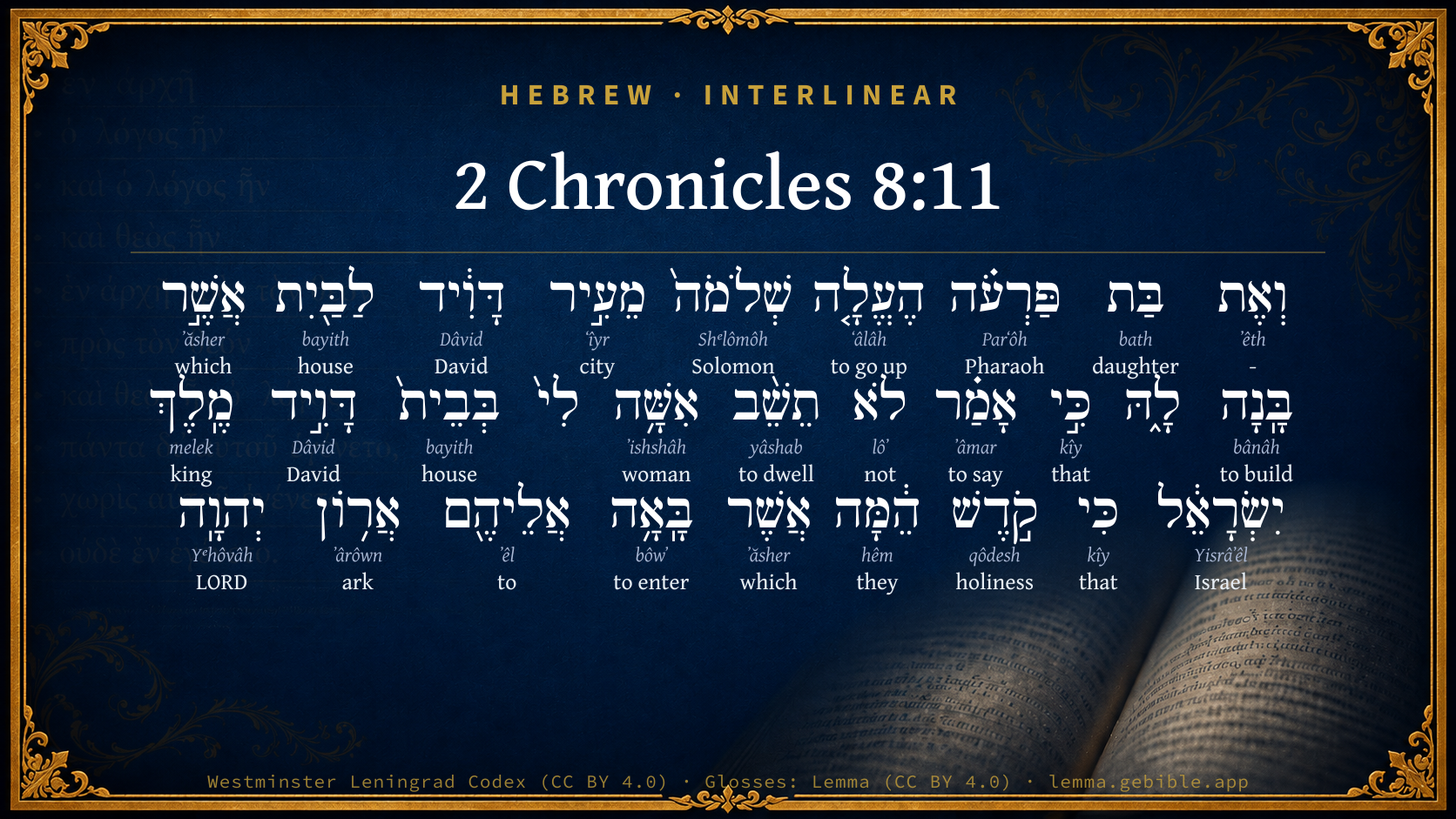
Hebrew (Westminster Leningrad Codex) 2 Chronicles 8:11 appears in the Hebrew Old Testament. The text above is from the Westminster Leningrad Codex. Each word links to its Strong’s number, a concise gloss, and parsing drawn from the Open Scriptures Hebrew Bible morphology. Click any word for its full Brown-Driver-Briggs (BDB) entry.
Download image
Cite this verse

2 Chronicles 8:11 (World English Bible). Public Domain. Lemma interlinear Bible study tool, https://lemma.gebible.app/v/2-chronicles/8/11.

Show BibTeX & RIS
BibTeX
RIS
English Translation
Solomon brought up the daughter of Pharaoh out of the city of David to the house that he had built for her; for he said, My wife shall not dwell in the house of David king of Israel, because the places are holy, whereunto the ark of Yahweh has come.
World English Bible · Public Domain
Download a study sheet

One document with this verse’s original text, its word-by-word gloss line, the meaning frame, cross-references with their text, attributed commentary, and full source and license credits — printable, and it pastes into notes with its structure intact.

This verse Autodidact and up

Study sheet (.html) Plain text (.txt)

A passage Seminary Student

Up to 50 verses in one chapter. A passage sheet keeps up to 6 commentary sources and 12 cross-references per verse, in the order this page ranks them, and says so on the sheet whenever that leaves anything out. Ask for a single verse and you get the Autodidact verse sheet above.

Everything on this page stays free to read, with no account — the sheet is a download of what is already on screen, not access to it.

Want to remove ads? Support Godless Engineer
Compare translations 3

The same verse in 3 English versions, stacked beneath the original-language interlinear above. Click any original word for its lexicon entry.

Each is an independent rendering of the whole verse — the interlinear is not word-aligned to these translations.

Highlighted words mark where these versions differ — a whole-verse word diff, not a word-by-word alignment.

  • World English Bible Public Domain
    Solomon brought up the daughter of Pharaoh out of the city of David to the house that he had built for her; for he said, My wife shall not dwell in the house of David king of Israel, because the places are holy, whereunto the ark of Yahweh has come.
  • King James Version Public Domain
    And Solomon brought up the daughter of Pharaoh out of the city of David unto the house that he had built for her: for he said, My wife shall not dwell in the house of David king of Israel, because the places are holy, whereunto the ark of the LORD hath come.
  • unfoldingWord Literal Text CC BY-SA 4.0
    And the daughter of Pharaoh Solomon brought up from the city of David to the house that he built for her, for he said, “My wife must not dwell in the house of David, the king of Israel, because sacred are the places where the Box of Yahweh has come into them.”

unfoldingWord Literal Text — © unfoldingWord, licensed CC BY-SA 4.0. Word-aligned USFM3 via Door43 (git.door43.org/unfoldingWord/en_ult).

Versions to compare (up to 4)

3 of 4 selected

Show all 18 translations

Every available English version of this verse, each an independent rendering of the whole verse.

  • World English Bible Public Domain
    Solomon brought up the daughter of Pharaoh out of the city of David to the house that he had built for her; for he said, My wife shall not dwell in the house of David king of Israel, because the places are holy, whereunto the ark of Yahweh has come.
  • Berean Standard Bible Public Domain
    Solomon brought the daughter of Pharaoh up from the City of David to the palace he had built for her. For he said, “My wife must not live in the house of David king of Israel, because the places the ark of the LORD has entered are holy.”
  • Majority Standard Bible Public Domain
    Solomon brought the daughter of Pharaoh up from the City of David to the palace he had built for her. For he said, “My wife must not live in the house of David king of Israel, because the places the ark of the LORD has entered are holy.”
  • King James Version Public Domain
    And Solomon brought up the daughter of Pharaoh out of the city of David unto the house that he had built for her: for he said, My wife shall not dwell in the house of David king of Israel, because the places are holy, whereunto the ark of the LORD hath come.
  • American Standard Version (1901) Public Domain
    And Solomon brought up the daughter of Pharaoh out of the city of David unto the house that he had built for her; for he said, My wife shall not dwell in the house of David king of Israel, because the places are holy, whereunto the ark of Jehovah hath come.
  • Revised Version (1885) Public Domain
    And Solomon brought up the daughter of Pharaoh out of the city of David unto the house that he had built for her: for he said, My wife shall not dwell in the house of David king of Israel, because the places are holy, whereunto the ark of the LORD hath come.
  • Geneva Bible (1599) Public Domain
    Then Salomon brought vp the daughter of Pharaoh out of the citie of Dauid, into the house that he had built for her: for he saide, My wife shall not dwel in the house of Dauid King of Israel: for it is holy, because that the Arke of the Lord came vnto it.
  • Douay-Rheims (1899) Public Domain
    And he removed the daughter of Pharao from the city of David, to the house which he had built for her. For the king said: My wife shall not dwell in the house of David king of Israel, for it is sanctified: because the ark of the Lord came into it.
  • Young's Literal Translation Public Domain
    And the daughter of Pharaoh hath Solomon brought up from the city of David to the house that he built for her, for he said, `My wife doth not dwell in the house of David king of Israel, for they are holy unto whom hath come the ark of Jehovah.'
  • Literal Standard Version CC BY-SA 4.0
    And Solomon has brought up the daughter of Pharaoh from the City of David to the house that he built for her, for he said, “My wife does not dwell in the house of David king of Israel, for they are holy to whom the Ark of YHWH has come.”
  • Unlocked Literal Bible CC BY-SA 4.0
    Solomon brought the daughter of Pharaoh out of the city of David to the house that he had built for her, for he said, “My wife must not live in the house of David king of Israel, because wherever the ark of Yahweh has come is holy.”
  • unfoldingWord Literal Text CC BY-SA 4.0
    And the daughter of Pharaoh Solomon brought up from the city of David to the house that he built for her, for he said, “My wife must not dwell in the house of David, the king of Israel, because sacred are the places where the Box of Yahweh has come into them.”
  • Darby Bible Public Domain
    And Solomon brought up the daughter of Pharaoh out of the city of David to the house which he had built for her; for he said, My wife shall not dwell in the house of David king of Israel, because the [places] are holy to which the ark of Jehovah has come.
  • World Messianic Bible Public Domain
    Solomon brought up Pharaoh’s daughter out of David’s city to the house that he had built for her; for he said, “My wife shall not dwell in the house of David king of Israel, because the places where the LORD’s ark has come are holy.”
  • Webster's Bible Public Domain
    And Solomon brought up the daughter of Pharaoh from the city of David to the house that he had built for her: for he said, My wife shall not dwell in the house of David king of Israel, because the places are holy, to which the ark of the LORD hath come.
  • Free Bible Version CC BY-SA 4.0
    Solomon moved Pharaoh's daughter from the City of David to the palace he had built for her. For he said, “My wife cannot live in the palace of David king of Israel, because wherever the Ark of the Lord has gone are holy places.”
  • Bible in Basic English Public Domain
    Then Solomon made Pharaoh's daughter come up from the town of David to the house which he had made for her; for he said, I will not have my wife living in the house of David, king of Israel, because those places where the ark of the Lord has come are holy.
  • JPS Tanakh (1917) Public Domain
    And Solomon brought up the daughter of Pharaoh out of the city of David unto the house that he had built for her; for he said: 'No wife of mine shall dwell in the house of David king of Israel, because the places are holy, whereunto the ark of the LORD hath come.'

Literal Standard Version (2020), Covenant Press — licensed CC BY-SA 4.0. Text via the HelloAO Bible API (eBible.org). Unlocked Literal Bible (unfoldingWord) — licensed CC BY-SA 4.0. Text via the HelloAO Bible API (eBible.org). unfoldingWord Literal Text — © unfoldingWord, licensed CC BY-SA 4.0. Word-aligned USFM3 via Door43 (git.door43.org/unfoldingWord/en_ult). Free Bible Version, Dr. Jonathan Gallagher — licensed CC BY-SA 4.0. Text via the HelloAO Bible API (eBible.org).

Word by word

More ways to search: Search by grammar → Find every occurrence → Compare this word →

Practice this passage: Drill this verse → Learn its vocabulary →

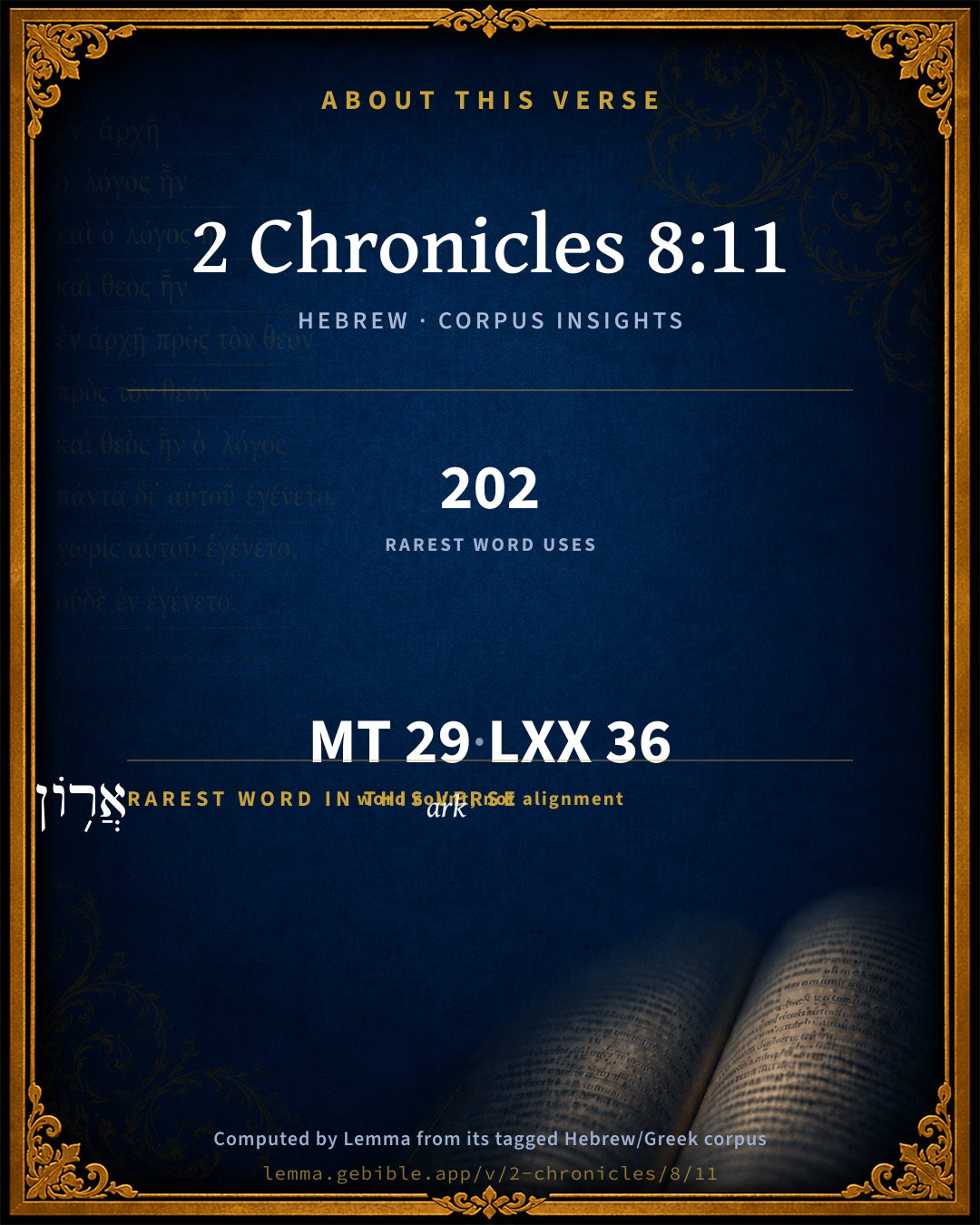
אֲר֥וֹן
ʼârôwn
H727
“ark of”
Noun, Common, Both, Singular, Construct
Part of Speech
Noun
Type
Common
Gender
Both
Number
Singular
State
Construct
Full BDB Definition

Origin: from H717 (in the sense of gathering)

TWOT: 166a

chest, ark - money chest - Ark of the Covenant - (TWOT)coffin
  1. וְאֶת ʼêth H853 “and · -” Conjunction + Particle, Direct Object
  2. בַּת bath H1323 “daughter of” Noun, Common, Feminine, Singular, Construct
  3. פַּרְעֹ֗ה Parʻôh H6547 “Pharaoh” Noun, Proper
  4. הֶעֱלָ֤ה ʻâlâh H5927 “to go up” Verb, Hiphil, Perfect, 3rd Person, Masculine, Singular
  5. שְׁלֹמֹה֙ Shᵉlômôh H8010 “Solomon” Noun, Proper
  6. מֵעִ֣יר ʻîyr H5892 “from · city of” Preposition + Noun, Common, Feminine, Singular, Construct
  7. דָּוִ֔יד Dâvid H1732 “David” Noun, Proper
  8. לַבַּ֖יִת bayith H1004 “to/for the · house” Preposition, Determined + Noun, Common, Masculine, Singular, Absolute
  9. אֲשֶׁ֣ר ʼăsher H834 “which” Particle, Relative
  10. בָּֽנָה bânâh H1129 “to build” Verb, Qal, Perfect, 3rd Person, Masculine, Singular
  11. כִּ֣י kîy H3588 “that” Conjunction
  12. אָמַ֗ר ʼâmar H559 “to say” Verb, Qal, Perfect, 3rd Person, Masculine, Singular
  13. לֹא lôʼ H3808 “not” Particle, Negative
  14. תֵשֵׁ֨ב yâshab H3427 “to dwell” Verb, Qal, Imperfect, 3rd Person, Feminine, Singular
  15. אִשָּׁ֥ה ʼishshâh H802 “woman” Noun, Common, Feminine, Singular, Absolute
  16. בְּבֵית֙ bayith H1004 “in/at · house of” Preposition + Noun, Common, Masculine, Singular, Construct
  17. דָּוִ֣יד Dâvid H1732 “David” Noun, Proper
  18. מֶֽלֶךְ melek H4428 “king of” Noun, Common, Masculine, Singular, Construct
  19. יִשְׂרָאֵ֔ל Yisrâʼêl H3478 “Israel” Noun, Proper
  20. כִּי kîy H3588 “that” Conjunction
  21. קֹ֣דֶשׁ qôdesh H6944 “holiness” Noun, Common, Masculine, Singular, Absolute
  22. הֵ֔מָּה hêm H1992 “they” Pronoun, Personal, 3rd Person, Masculine, Plural
  23. אֲשֶׁר ʼăsher H834 “which” Particle, Relative
  24. בָּֽאָ֥ה bôwʼ H935 “to enter” Verb, Qal, Perfect, 3rd Person, Feminine, Singular
  25. אֲלֵיהֶ֖ם ʼêl H413 “to · them” Preposition + Suffix, Personal, 3rd Person, Masculine, Plural
  26. יְהוָֽה Yᵉhôvâh H3068 “LORD” Noun, Proper

About this verse

These counts appear in no published source. They are computed here, from the morphology-tagged text and Lemma’s own curated glosses. What Lemma adds →

29
words
23
distinct lemmas
Historical
section

Grammatical profile

  • 5 verbs
  • 14 nouns
  • 1 pronoun
  • 3 prepositions
  • 2 conjunctions
  • 4 particles

Verb forms

  • הֶעֱלָ֤ה Hiphil · Perfect
  • בָּֽנָה Qal · Perfect
  • אָמַ֗ר Qal · Perfect
  • תֵשֵׁ֨ב Qal · Imperfect
  • בָּֽאָ֥ה Qal · Perfect

Repetition

Words recur within this verse — often emphatic in Hebrew:

  • דָּוִ֔יד David H1732 ×2
  • לַבַּ֖יִת house H1004 ×2
  • אֲשֶׁ֣ר which H834 ×2
  • כִּ֣י that H3588 ×2

Hebrew & Septuagint length

In English translation the verse runs 50 words from the Hebrew and 53 from the Septuagint (LXX English) — closely comparable.

A rough comparison of the two English renderings, which tokenize alike — not a word-level alignment.

Word counts can differ between the Hebrew and the Greek without any difference in meaning — e.g. the Hebrew direct-object marker אֵת has no separate Greek word, and Greek often adds the article ὁ.

In the original languages it is 29 Hebrew tokens and 36 Greek tokens — but the two are counted differently (Hebrew bundles its prefixes and suffixes into one token; the Greek is in lemma form), so that isn’t a like-for-like length.

Cross-references

7

Topical passages linked to 2 Chronicles 8:11 in the Treasury of Scripture Knowledge — connected by theme and wording, ordered by reader-vote popularity; previews shown in the World English Bible.

  • 1 Kings 3:1 Solomon made affinity with Pharaoh king of Egypt, and took Pharaoh's daughter, and brought her into the city of David, until he had made an end of building his own house, and the house of Yahweh, and the wall of Jerusalem round about.
  • 1 Kings 7:8 His house where he was to dwell, the other court within the porch, was of the like work. He made also a house for Pharaoh's daughter (whom Solomon had taken as wife), like this porch.
  • 1 Kings 9:24 But Pharaoh's daughter came up out of the city of David to her house which [Solomon] had built for her: then did he build Millo.
  • Exodus 3:5 He said, "Don't come close. Take off your sandals from off your feet, for the place you are standing on is holy ground."
  • Exodus 29:43 There I will meet with the children of Israel; and the place shall be sanctified by my glory.
  • Ezekiel 21:2 Son of man, set your face toward Jerusalem, and drop [your word] toward the sanctuaries, and prophesy against the land of Israel;
  • 2 Peter 1:18 This voice we heard come out of heaven when we were with him in the holy mountain.

Cross-references courtesy of OpenBible.info (CC BY 4.0).

Hebrew and Greek witnesses Masoretic Hebrew ↔ Greek Septuagint

The same verse in the two great witnesses to the Old Testament, shown verse-for-verse.

These are two independent witnesses, not word-aligned to each other, and the Septuagint is shown in lemma (dictionary) form.

Hebrew 2 Chronicles 8:11 Masoretic · Westminster Leningrad Codex

וְאֶת בַּת פַּרְעֹ֗ה הֶעֱלָ֤ה שְׁלֹמֹה֙ מֵעִ֣יר דָּוִ֔יד לַבַּ֖יִת אֲשֶׁ֣ר בָּֽנָה לָ֑הּ כִּ֣י אָמַ֗ר לֹא תֵשֵׁ֨ב אִשָּׁ֥ה לִי֙ בְּבֵית֙ דָּוִ֣יד מֶֽלֶךְ יִשְׂרָאֵ֔ל כִּי קֹ֣דֶשׁ הֵ֔מָּה אֲשֶׁר בָּֽאָ֥ה אֲלֵיהֶ֖ם אֲר֥וֹן יְהוָֽה

Solomon brought up the daughter of Pharaoh out of the city of David to the house that he had built for her; for he said, My wife shall not dwell in the house of David king of Israel, because the places are holy, whereunto the ark of Yahweh has come.

World English Bible · Public Domain

Greek LXX 2 Chronicles 8:11 Septuagint · lemma form

καί ὁ θυγάτηρ φαραώ σαλωμών ἀναἄγω ἐκ πόλις δαυίδ εἰς ὁ οἶκος ὅς οἰκοδομέω αὐτός ὅτι εἶπον οὐ καταοἰκέω ὁ γυνή ἐγώ ἐν πόλις δαυίδ ὁ βασιλεύς ἰσραήλ ὅτι ἅγιος εἰμί ὅς εἰςἔρχομαι ἐκεῖ κιβωτός κύριος

And Solomon brought up the daughter of Pharao from the city of David to the house which he had built for her: for he said, My wife shall not dwell in the city of David, the king of Israel, for the place is holy into which the ark of the Lord has entered.

LXX2012 (modern English Septuagint) · Public Domain

Hebrew: Westminster Leningrad Codex (CC BY 4.0). Greek: Septuagint (public domain); English from LXX2012 (modern English Septuagint) (Public Domain). How the Septuagint differs from the Hebrew →

Commentary

Notes on 2 Chronicles 8:11 from classic Christian and Jewish commentators (each source and its license shown beneath its notes). The classic Christian expositions comment on the surrounding passage and are grouped to its opening verse, so a note may address several verses; the Jewish commentaries on the Tanakh (Rashi and others) are per-verse, so they appear only where the commentator wrote on this verse.

Lemma curates 59 commentaries, every one of them public domain or Creative Commons licensed, each selected and text-cleaned for this edition rather than reprinted as found. About our sources →

Trapp's Complete Commentary

John Trapp

2Ch 8:11 And Solomon brought up the daughter of Pharaoh out of the city of David unto the house that he had built for her: for he said, My wife shall not dwell in the house of David king of Israel, because [the places are] holy, whereunto the ark of the LORD hath come.

Ver. 11. For he said, My wife shall not dwell.] Or, He had said so, sc., before he built a house for her: and while the ark was yet in the city of David.

Because the places are holy.] And she not yet too holy, but retaining some of her Egyptian profanenesses: vel propter multiplices huius sexus immunditles legales. Solomon had, against the law of God, married this and other strange wives, for political ends no doubt, and as hoping that by his wisdom he should reclaim them, or at least rule them. He did so at first, as we see in this instance. For we may not think that Solomon did this out of superstition, - as the monks at this day pare and sweep the rooms of their monasteries wherein women have been, as if they were unclean creatures, - but out of the reverential fear of God, and a religious respect to the ark. Howbeit afterwards, overcome by the importunities of his strange wives, he yielded to them shamefully. Watch, therefore, and beware.

John Trapp, A Commentary or Exposition upon All the Books of the Old and New Testament (1647–1656) — public domain. Text from a community e-Sword module.

The Biblical Illustrator

Joseph S. Exell

2Ch_8:11

And Solomon brought up the daughter of Pharaoh.

Solomon and Pharaohs daughter

We are to see in Solomons action the working of a tender conscience; even though he may be appeasing his conscience by some trick or ceremony, yet he is showing us the working of the moral nature within the kingly breast. Yet there is a point to be noted here which is common to human experience: why should Solomon have married the daughter of Pharaoh? Why should he have, in the first instance, placed himself in so vital a relation to heathenism? Are there not men who first plunge into great mistakes, and then seek to rectify their position by zealous care about comparatively trifling details? Do not men make money by base means, and then zealously betake themselves to book-keeping, as if they would not spend money except in approved directions? Are there not those who have steeped their hearts in iniquity, and yet have washed their hands with soap and nitre? We are to beware of the creation of a false or a partial conscience, that makes up for sins of a larger kind by ostentatious devotion at the altar of detail and ceremony and petty ritual. (J. Parker, D. D.)

Solomons marriage

Consider Solomons marriage with an Egyptian princess--

I. As a matter of policy. It sprang from--

1. A desire to counteract the influence of Hadad (1Ki_11:14-20).

2. The wish to obtain support for his new dynasty and recognition from one of older fame and greater power.

3. Anxiety to strengthen himself by foreign alliances.

II. As a source of moral perplexity. What must be done with her? Solomon felt that a broad distinction must be made between the worship of Jehovah and idolatry.

III. As the beginning of trouble. The policy advantageous at first, but ultimately proved hollow and impolitic. The reign which began so gloriously ended in gross darkness and fetish worship. (J. Wolfendale.)

The Biblical Illustrator, edited by Joseph S. Exell (c. 1880s–1900s) — public domain. Text from a community e-Sword module.

Tyndale Open Study Notes

Tyndale Open Resources

8:11 Solomon’s alliance with Egypt through his marriage to Pharaoh’s daughter is mentioned repeatedly in Kings (1 Kgs 3:1; 9:16, 24; 11:1). Solomon’s ability to marry into the Egyptian royal family shows the extent of his kingdom and international influence. Solomon provided her with a permanent personal residence to show that he regarded her as the most important of his wives. It also preserved the sanctity of David’s palace, probably because Pharaoh’s daughter was pagan.

Tyndale Open Study Notes — © Tyndale Open Resources, licensed CC BY-SA 4.0. Text via the HelloAO Bible API.

Jamieson, Fausset & Brown

Robert Jamieson, A. R. Fausset & David Brown

Solomon brought up the daughter of Pharaoh out of the city of David unto the house that he had built for her--On his marriage with the Egyptian princess at the beginning of his reign, he assigned her a temporary abode in the city of David, that is, Jerusalem, until a suitable palace for his wife had been erected. While that palace was in progress, he himself lodged in the palace of David, but he did not allow her to occupy it, because he felt that she being a heathen proselyte, and having brought from her own country an establishment of heathen maid-servants, there would have been an impropriety in her being domiciled in a mansion which was or had been hallowed by the reception of the ark. It seems she was received on her arrival into his mother's abode (Sol 3:4; Sol 8:2).

Jamieson, Fausset & Brown — Commentary Critical and Explanatory on the Whole Bible (1871) — public domain (CC PDM 1.0). Text via the HelloAO Bible API.

Adam Clarke's Commentary

Verse 11. The daughter of Pharaoh] "And Bithiah, the daughter of Pharaoh, Solomon brought up from the city of David to the palace which he had built for her." - T.

Because the places are holy] Is not this a proof that he considered his wife to be a heathen, and not proper to dwell in a place which had been sanctified? Solomon had not yet departed from the true God.

Adam Clarke's Commentary on the Bible (1810–1826) — public domain. Text from a community e-Sword/MySword module.

Ellicott's Commentary for English Readers

(11) And Solomon brought up the daughter of Pharaoh.—See 1Ki_9:24, which is much briefer than the present notice. The chronicler has not mentioned this princess before (comp. 1Ki_3:1; 1Ki_9:16), and mentions her here only in connection with Solomon’s buildings. (See Note on 2Ch_12:2.) Solomon’s Egyptian consort was probably a princess of the XXII. Bnbastite Dynasty, founded by Shishak, which was of Semitic origin.

For he said.—The motive here assigned is wanting in the other text, and is characteristic of the chronicler both in thought and language; though it is too much to say with Thenius that the princess could not have lived anywhere else than in the old palace of David, until the new one was built. 1Ki_3:1 says only that Solomon brought her “into the city of David.”

King of Israel.—In contrast with the Egyptian origin of the princess.

Because the places are holy.—For a holy thing is that unto which, &c. (The plural pronoun hçmmâh, “they,” is equivalent to a neuter-sing, in the usage of the chronicler.)

A Bible Commentary for English Readers, edited by Charles John Ellicott (1878–1897) — public domain. Text from a community e-Sword module.

The Cambridge Bible for Schools and Colleges

gen. ed. J. J. S. Perowne

11 (= 1Ki_9:24). The House of Pharaoh’s Daughter

11. for he said, My wife, etc.] These words are an addition of the Chronicler. In 1Ki_3:1 it is said simply that Solomon brought Pharaoh’s daughter into the city of David until his own house was finished.

My wife shall not dwell] Render, No wife of mine shall dwell.

The Cambridge Bible for Schools and Colleges (gen. ed. J. J. S. Perowne; Cambridge University Press, 1878–1918) — public domain. Text from a community e-Sword module.

Albert Barnes' Notes on the Bible

Of Pharaoh - Here again the writer of Chronicles assumes in his reader a knowledge of the facts recorded in the marginal references

Albert Barnes' Notes on the Bible (1834–1885) — public domain. Text from a community e-Sword/MySword module.

Haydock's Catholic Bible Commentary

Into it. It was deemed improper for a pagan woman to reside in the same place. (Calmet) --- She had perhaps pretended, at first, to be converted, but had lately given some signs of relapse. (Salien) --- Solomon was as yet far from communicating with infidels. (Worthington)

George Leo Haydock (1774–1849), Haydock's Catholic Family Bible and Commentary, 1859 edition — public domain. Excludes Psalms (Douay-Rheims chapter numbering differs from Protestant) and Deuterocanonical books (Catholic canon only).

Matthew Poole's English Annotations

Not because every place where once the ark came was thereby consecrated to God, and night not after the ark was gone be put to any common use; for then both the house of Obed-edom and all other places where the ark either rested or passed were made holy thereby, and unlawful for men to dwell in; but either,

1. Because she was a woman, and attended by many other women, who besides the common pollutions of all, are subject to many and frequent ceremonial pollutions peculiar to their sex, and either she, or at least many of her followers, might be heathens at this time; and therefore he thought it indecent that such persons should come as it were in God’s stead, and succeed him in the place where he had dwelt. Or,

2. He speaks not of the time when the ark was gone, but whilst it was there; and these words contain a reason not of the more remote words, why he now brought her up thither, but of the words immediately preceding, why

he built this house

for her; because the ark was now in the house of David, which therefore, ought to be kept pure and free from the very danger and appearance of pollution.

Matthew Poole's English Annotations on the Holy Bible (1683–1685) — public domain. Text from a community e-Sword/MySword module.

The Pulpit Commentary

(parallel,. As (1Ki_9:24) the writer of Chronicles has not before alluded to the marriage and the circumstances of it involved in this verse, his account and assignment of Solomon"s motive for the removal of his wife, Pharaoh"s daughter, is given something more specifically. (see 1Ki_3:1 1Ki_7:8) The valley of Tyropeum lay between the temple on the eastern hill and Solomon"s palace, which was on the western side of it. The name of this wife was probably Psusennes, last of the twenty-first dynasty.

Doubtful marriage alliance.

There was more astuteness than wisdom in the alliance which Solomon effected between the daughter of Pharaoh and himself. It is probable that he congratulated himself greatly thereupon, and that at first it was a source of much gladness of heart to him. But the end did not justify his hope. The political alliance with Egypt, which it was intended to confirm, was very soon broken; in the very next reign the king of that country came up against Jerusalem. (2Ch_12:9) And though the daughter of Pharaoh may herself have conformed, in part if not altogether, to the religion of Jehovah, it may be taken for granted that many of her retinue did not; that they brought up from Egypt idolatrous rites, superstitious practices, immoral usages. We gather from the text that Solomon himself felt that there was an unsuitableness and even an impropriety in having such a court in the rooms where David had prayed and sung, beneath the roof under which the ark of God had rested. If he felt thus, we may be sure that there was not a little about the new queen"s ways and those of her attendants to scandalize the simple faith and conscientious scruples of the people. And this was the beginning of that departure from the simplicity and purity of Hebrew faith and morals which ended in corruption and disaster. (1Ki_11:31) This matrimonial alliance was not a fine piece of policy; it was a distinct mistake. Perhaps the king may have begun to think so when he found that, instead of gracing his father"s home, his new wife could not take her place there without profaning it. In such alliances as these it is well to remember

I THAT APPARENT ADVANTAGES MAY EASILY BE OVERESTIMATED. To the one side or the other, to the husband or the wife, there may be the prospect of social standing, or of wealth, or of personal attraction; there may be the inducement of one or more of those favourable conditions which belong to the lower plane of life. But experience has proved again and again, in so many cases and with such startling and overwhelming power that all may see and know, that these worldly advantages are no security whatever against disappointment, against misery, against melancholy failure. Their worth and virtue only stretch a little way; they do not go to the heart of things; they only touch the outer fortifications, they cannot take the citadel.

II THAT COMMON PRINCIPLES AND SPIRITUAL AFFINITIES are the true basis on which this alliance should be founded. It is a poor prospect indeed when the wife is felt to be morally unworthy to be mistress of the old home; when it has to be acknowledged that her principles and her practice will dishonour rather than adorn the rooms where the Bible has been accustomed to be read and the praises of Christ to be sung. Surely it is not from fellowship with her spirit and not from the influences which will flow from her life that a blessing will come to the heart and to the home. It is not the full hand but the pure soul that brings joy and gladness to the hearth. It is a common love for the common Lord, and the walking together along the same path of eternal life, it is this which has the promise of the future. The splendid palace which Solomon built for Pharaoh"s daughter may have been little more than a fine mausoleum for a hope that soon withered and died; the humblest roof that shelters two true, loving, holy hearts will be the home of a happiness which grows and deepens with passing years, with mutual service, and with united efforts to train and bless. C.

The consort of a king.

I THE QUEEN"S PERSON. The daughter of Pharaoh. As to which Pharaoh, see homily on vers. 1-6. If the Song of Solomon was an epithalamium in honour of his wedding with this lady, her personal attractions, after making allowances for the rhapsody peculiar to a lover and the luxuriance of fancy characteristic of an Oriental, must have been considerable (@Son_1:8, Son_1:10; Son_4:1-7; Son_7:1-9)

II THE QUEEN"S CHARACTER. A heathen. However charming externally, there is no reason why her inward graces may not have been attractive. Like Egyptian ladies of rank, she would probably be skilled in needlework, perhaps also in using the spindle and in weaving. But still she was not acquainted with the true religion, being a worshipper of the god Ra, and the other divinities that claimed the homage of her countrymen, rather than of Jehovah living and true God. Physical loveliness may be a precious gift of Heaven, and moral sweetness desirable in one who is to be a wife; but nothing can compensate for the absence of religion. "Favour is deceitful," etc.. (Pro_31:30)

III THE QUEEN"S WEDDING.

1. Celebrated early in the kings reign, (1Ki_3:1) and doubtless with becoming splendour. It is not good for princes any more than for peasants to be alone, and "he that findeth a wife" (provided she be a woman that feareth the Lord) "findeth a good thing". (Pro_18:22)

2. Politically advantageous.for the state, though this is questionable. Israel required no buttress, either from Egypt or Assyria, so long as she remained true to Jehovah (Isa_30:3; Jer_2:18 Jer_42:19) In any case, neither political expedience nor social convenience is a proper motive for contracting marriage, which should always be inspired by love between the parties. (Eph_5:25-28)

3. Possibly against the Law of God. On the one hand, it is argued (Keil, Bahr)

(1) that the Mosaic statute (Exo_34:16; Deu_7:3) prohibited only marriage with Canaanitish women;

(2) that not prohibiting, it may be understood to have allowed, alliance with Egyptian maidens;

(3) that such marriages were contemplated by Moses as possible; (Deu_23:7, Deu_23:8)

(4) that Pharaoh"s daughter may have become a proselyte to the Jewish religion; and

(5) that the marriage is nowhere in Scripture explicitly condemned.

On the other hand, it is contended (Adam Clarke)

(1) that the principle of the law which forbade marriage with a Canaanitish maiden applied equally to an Egyptian princess, inasmuch as both were foreign or outlandish women;

(2) that Pharaoh"s daughter is classed with the outlandish women who caused Solomon to sin (1Ki_11:1; Neh_13:26) and

(3) that there is no proof that Pharaoh"s daughter was a proselyte.

The affirmative, however, of this last assertion is supposed to be justified by the following considerations:

(1) That Solomon, at the commencement of his reign, would hardly have married Pharaoh"s daughter had she not been a proselyte, he being at the time a lover of Jehovah and an observer of his ways;

(2) that Pharaoh"s daughter is not named in ch. 11. among the king"s wives who seduced their husband into idolatry;

(3) that there is not a trace of Egyptian worship to be found in Israel during this reign; and

(4) that the Song of Solomon and the forty-fifth psalm would not have been composed in honour of her wedding, and far less admitted to the canon, had she been an idolatress.

But none of these is convincing.

(1) Solomon had already an Ammonite wife Naamah, the mother of Rehoboam: (cf. 1Ki_11:42 with 14:21 and 2Ch_12:13) was she a proselyte?

(2) Ch. 11. is regarded by some as placing Pharaoh"s daughter among the outlandish women who caused Solomon to sin.

(3) Egyptian idolatry may have been practised in the queen"s house, though not in the land; and

(4) it is not certain that either the song or the psalm was written in honour of this lady. To these may be added

(5) that, had she been a proselyte, Solomon would not have needed to exclude her from the stronghold of Zion where the ark was, and

(6) that Pharaoh"s daughter was certainly an outlandish woman.

4. Extremely unadvised on Solomons part, It led to his decline into idolatry, if not directly yet indirectly, by leading him to add more wives and concubines to his harem.

IV THE QUEEN"S RESIDENCE,

1. In a separate house in the city of David. On her wedding, Solomon did not bring her into his father"s palace where himself resided though some hold he did (Bertheau) but lodged her in a temporary dwelling (Keil, Bahr), assigning as a reason that the rooms of the royal palace had been consecrated and rendered holy by the presence of the ark of Jehovah, and meaning thereby that to have introduced into them an Egyptian queen, even though a proselyte, with probably an establishment of heathen maids, would have been, to say the least, an impropriety. The fact that Solomon could not lodge his wife in his father"s house should have made him

2. hesitate as to his marriage. That matrimonial alliance must be doubtful the contemplation of which leads one to apprehend the Divine displeasure, or which one sees to be incongruous with right religious feeling.

3. In a house contiguous to Solomons palace. This house, specially prepared for her, not for a harem (Thenius), formed part of Solomon"s own dwelling, (1Ki_7:8) being situated either behind (Winer) or above (Keil), or perhaps at the side of it.

LESSONS.

1. Marriage is honourable in all. (Heb_13:4)

2. The duty of wedding only in the Lord. (1Co_7:39)

3. The sin of polygamy.

4. The obligation of husbands to maintain their wives. W.

The Pulpit Commentary (1880–1919), ed. H.D.M. Spence-Jones & Joseph S. Exell — public domain. Text from a community e-Sword module.

John Wesley's Explanatory Notes

The house - He built this house for her; because the ark was now in the house of David, which therefore ought to be kept pure and free from the very danger and appearance of pollution.

John Wesley, Explanatory Notes Upon the Whole Bible (1754–1765) — public domain. Text via the GEBible commentary corpus.

Keil & Delitzsch

C. F. Keil & F. Delitzsch

The remark that Solomon caused Pharaoh's daughter, whom he had married (Kg1 3:1), to remove from the city of David into the house which he had built her, i.e., into that part of his newly-built palace which was appointed for the queen, is introduced here, as in Kg1 9:24, because it belongs to the history of Solomon's buildings, although in the Chronicle it comes in very abruptly, the author not having mentioned Solomon's marriage to the daughter of Pharaoh (Kg1 3:1). The reason given for this change of residence on the part of the Egyptian princess is, that Solomon could not allow her, an Egyptian, to dwell in the palace of King David, which had been sanctified by the reception of the ark, and consequently assigned to her a dwelling in the city of David until he should have finished the building of his palace, in which she might dwell along with him. המּה is, as neuter, used instead of the singular; cf. Ew. 318, b. See also on Kg1 3:1 and Kg1 9:24.

Keil & Delitzsch — Biblical Commentary on the Old Testament (1861–1891) — public domain (CC PDM 1.0). Text via the HelloAO Bible API. (Old Testament only.)

Kretzmann's Popular Commentary

Paul E. Kretzmann

Solomon’s Worship and Navigation

v. 11. And Solomon brought up the daughter of Pharaoh out of the City of David unto the house that he had built for her, a special building of his palace for his chief wife; for he said, My wife shall not dwell in the house of David, king of Israel, because the places are holy whereunto the ark of the Lord hath come. She had lived in some part of the lower city since her marriage to Solomon, because the king deemed it improper for a former heathen, particularly with servants who were still heathen, to live on the premises where the Tabernacle of David had once stood, which had been hallowed by the presence of the Ark of the Covenant. In a similar manner we set our churches apart from ordinary use, preferably solely for the administration of the means of grace.

v. 12. Then Solomon, through the priests ordained for that ministry, offered burnt offerings unto the Lord on the altar of the Lord which he had built before the porch, just east of the great entrance portico leading to the Sanctuary,

v. 13. even after a certain rate every day, offering according to the commandment of Moses, on the Sabbaths, and on the new moons, and on the solemn feasts, above all, the great festivals, three times in the year, even in the Feast of Unleavened Bread, and in the Feast of Weeks, and in the Feast of Tabernacles, for all of which the sacrifices were exactly prescribed in the books of Moses.

v. 14. And he appointed, according to the order of David, his father, 2Ch 24:25-26, the courses of the priests to their service, their divisions and the sequence of their ministry having been established by David in solemn assembly, and the Levites to their charges, 1Ch 25:1, to praise and minister before the priests, by assisting them in the various tasks of the Temple, as the duty of every day required; the porters also by their courses at every gate, 1Ch 9:7; 1Ch 26:1; for so had David, the man of God, commanded.

v. 15. And they departed not from the commandment of the king, that is, of David, unto the priests and Levites concerning any matter, in regulating the courses and fixing the tasks, or concerning the treasures, in applying the available precious metals and votive gifts to the construction and adornment of the Temple.

v. 16. Now, all the work of Solomon was prepared unto the day of the foundation of the house of the Lord, and until it was finished, this including the entire fitting up and arrangement of the Temple for divine worship. So the house of the Lord was perfected, made ready in all its parts for the consecrated use for which it was intended.

v. 17. Then went Solomon to Ezion-geber, at the head of the Elanitic Gulf of the Red Sea, and to Eloth, another port on the same gulf, at the sea side in the land of Edom. Solomon was shrewd enough to see that his country needed more commercial enterprises if it was to become powerful among the nations.

v. 18. And Huram sent him by the hands of his servants ships, and servants that had knowledge of the sea, seasoned and experienced mariners; and they went with the servants of Solomon to Ophir, the location of which is unknown, though it is generally placed on the southeastern coast of Africa, and took thence four hundred and fifty talents of gold (almost $9,000,000), and brought them to King Solomon. That was the regular load of his navy. But all this wealth is as nothing beside the heavenly and eternal glory which the Second Solomon, Jesus Christ, gives to those who are faithful to Him to the end.

Paul E. Kretzmann, Popular Commentary of the Bible (1921–1924) — public domain. Text from a community e-Sword module.

unfoldingWord translationNotes

Door43 World Missions Community

the daughter of Pharaoh

"his wife, the daughter of Paharaoh"

to the house that he had built for her

The author writes about Solomon having his workers build a house for his wife as if he himself had built it. AT: "the house that he had his workers build for her" or "to the house he had commanded his workers to build for her" (See: Metonymy)

David king of Israel

David was Solomon's father and had been king before Solomon.

because wherever the ark of Yahweh has come is holy

It can be stated that the ark had been brought into King David's house. AT: "because the ark of Yahweh was brought into that house, and wherever the ark of Yahweh has come is holy" (See: Assumed Knowledge and Implicit Information)

translationWords

Pharaoh

city of David

ark of the covenant

holy

unfoldingWord translationNotes — © Distant Shores Media and the Door43 World Missions Community, licensed CC BY-SA 4.0. Source: git.door43.org/Door43/en_tn.

Rashi

Rabbi Shlomo Yitzchaki (Rashi)

Solomon brought up from the City of David That is Zion, for he let her dwell in the City of David when he married her, and she was there until he completed building his palace.

because they are holy The entire city and all the houses.

since the Ark of the Lord came to them because the Ark of the Lord had come to them. [The word] בָּאָה is a feminine expression, similar to (I Sam. 4:17): “and the Ark of the Covenant of the Lord (sic) was taken (נִלְקְחָה).”

Rashi on the Tanakh — English translations: “The Judaica Press complete Tanach with Rashi, translated by A. J. Rosenberg” (CC BY 4.0); “Pentateuch with Rashi's commentary by M. Rosenbaum and A.M. Silbermann, 1929-1934” (public domain); “The Metsudah Tanach series, Lakewood, N.J” (CC BY 4.0); and “The Book of Joshua, Metsudah Publications, 1997” (CC BY 4.0). Text via Sefaria.

Lesson kit

Teaching starters — assembled from the data on this page, not authored interpretation. Every prompt links to the verse data it draws on. Edit before teaching.

2 Chronicles, in the Historical, opens this verse with 29 words (23 distinct Hebrew lemmas). Its most distinctive word is ʼârôwn (“ark”). A historical commentator’s framing appears above. Read the whole chapter for the surrounding context.

Discussion questions

  1. How does “ark” (ʼârôwn) shape what this verse is saying?
  2. 1 Kings 3:1 shares this passage’s theme. How do the two illuminate each other?
  3. “David” occurs 2× in this one verse. What is the effect of the repetition?
  4. These translations render this verse differently; the difference is in the English rendering, not the original. What questions does that raise?
  5. The verb «הֶעֱלָ֤ה» is Hiphil Perfect. How does its form color the action?
  6. Reading how Trapp's Complete Commentary and The Biblical Illustrator read this verse, where do the two commentators agree and where do they part?

Things to notice

Reading settings

Reading text

Shown beneath each verse's original-language words.

Old Testament
Old Testament edition

Read the OT as the Masoretic Hebrew (MT) or the Greek Septuagint (LXX).

English shown for the Greek Septuagint (in the Hebrew ↔ Greek comparison).

Comparing translations? Open the Compare panel on any verse page to stack up to four side by side.