

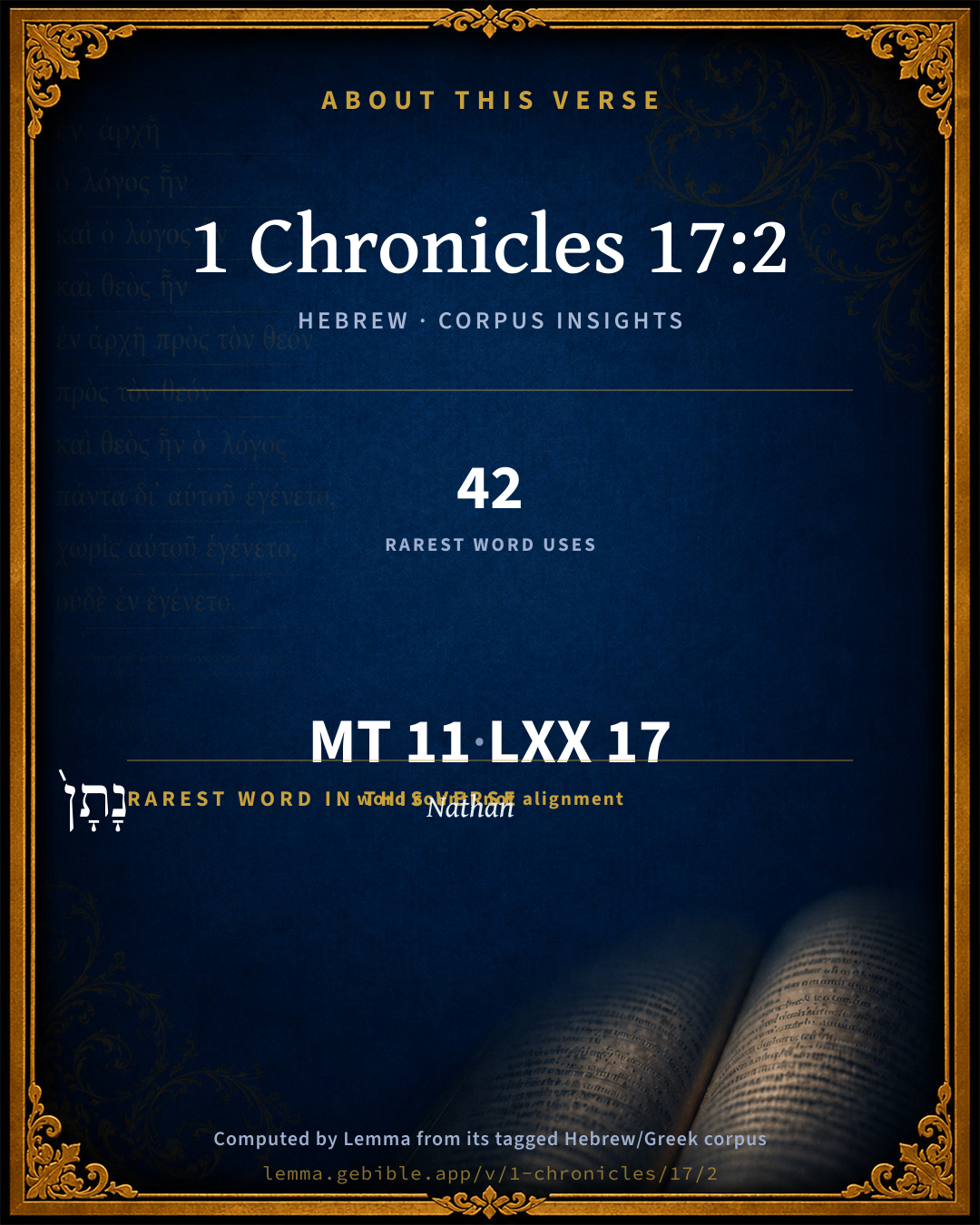
1 Chronicles 17:2

Hebrew (Westminster Leningrad Codex) 1 Chronicles 17:2 appears in the Hebrew Old Testament. The text above is from the Westminster Leningrad Codex. Each word links to its Strong’s number, a concise gloss, and parsing drawn from the Open Scriptures Hebrew Bible morphology. Click any word for its full Brown-Driver-Briggs (BDB) entry.
Download image
Cite this verse

1 Chronicles 17:2 (World English Bible). Public Domain. Lemma interlinear Bible study tool, https://lemma.gebible.app/v/1-chronicles/17/2.

Show BibTeX & RIS
BibTeX
RIS
English Translation
Nathan said to David, Do all that is in your heart; for God is with you.
World English Bible · Public Domain
Download a study sheet

One document with this verse’s original text, its word-by-word gloss line, the meaning frame, cross-references with their text, attributed commentary, and full source and license credits — printable, and it pastes into notes with its structure intact.

This verse Autodidact and up

Study sheet (.html) Plain text (.txt)

A passage Seminary Student

Up to 50 verses in one chapter. A passage sheet keeps up to 6 commentary sources and 12 cross-references per verse, in the order this page ranks them, and says so on the sheet whenever that leaves anything out. Ask for a single verse and you get the Autodidact verse sheet above.

Everything on this page stays free to read, with no account — the sheet is a download of what is already on screen, not access to it.

Want to remove ads? Support Godless Engineer
Compare translations 3

The same verse in 3 English versions, stacked beneath the original-language interlinear above. Click any original word for its lexicon entry.

Each is an independent rendering of the whole verse — the interlinear is not word-aligned to these translations.

Highlighted words mark where these versions differ — a whole-verse word diff, not a word-by-word alignment.

  • World English Bible Public Domain
    Nathan said to David, Do all that is in your heart; for God is with you.
  • King James Version Public Domain
    Then Nathan said unto David, Do all that is in thine heart; for God is with thee.
  • unfoldingWord Literal Text CC BY-SA 4.0
    And Nathan said to David, “All that in your heart, do, for God with you.”

unfoldingWord Literal Text — © unfoldingWord, licensed CC BY-SA 4.0. Word-aligned USFM3 via Door43 (git.door43.org/unfoldingWord/en_ult).

Versions to compare (up to 4)

3 of 4 selected

Show all 18 translations

Every available English version of this verse, each an independent rendering of the whole verse.

  • World English Bible Public Domain
    Nathan said to David, Do all that is in your heart; for God is with you.
  • Berean Standard Bible Public Domain
    And Nathan replied to David, “Do all that is in your heart, for God is with you.”
  • Majority Standard Bible Public Domain
    And Nathan replied to David, “Do all that is in your heart, for God is with you.”
  • King James Version Public Domain
    Then Nathan said unto David, Do all that is in thine heart; for God is with thee.
  • American Standard Version (1901) Public Domain
    And Nathan said unto David, Do all that is in thy heart; for God is with thee.
  • Revised Version (1885) Public Domain
    And Nathan said unto David, Do all that is in thine heart; for God is with thee.
  • Geneva Bible (1599) Public Domain
    Then Nathan said to Dauid, Do all that is in thine heart: for God is with thee.
  • Douay-Rheims (1899) Public Domain
    And Nathan said to David: Do all that is in thy heart: for God is with thee.
  • Young's Literal Translation Public Domain
    and Nathan saith unto David, `All that `is' in thy heart do, for God `is' with thee.'
  • Literal Standard Version CC BY-SA 4.0
    and Nathan says to David, “All that [is] in your heart do, for God [is] with you.”
  • Unlocked Literal Bible CC BY-SA 4.0
    Then Nathan said to David, “Go, do what is in your heart, for God is with you.”
  • unfoldingWord Literal Text CC BY-SA 4.0
    And Nathan said to David, “All that in your heart, do, for God with you.”
  • Darby Bible Public Domain
    And Nathan said to David, Do all that is in thy heart; for God is with thee.
  • World Messianic Bible Public Domain
    Nathan said to David, “Do all that is in your heart; for God is with you.”
  • Webster's Bible Public Domain
    Then Nathan said to David, Do all that is in thy heart; for God is with thee.
  • Free Bible Version CC BY-SA 4.0
    “Do what you think you should, for God is with you,” Nathan replied.
  • Bible in Basic English Public Domain
    And Nathan said to David, Do whatever is in your heart, for God is with you.
  • JPS Tanakh (1917) Public Domain
    And Nathan said unto David: 'Do all that is in thy heart; for God is with thee.'

Literal Standard Version (2020), Covenant Press — licensed CC BY-SA 4.0. Text via the HelloAO Bible API (eBible.org). Unlocked Literal Bible (unfoldingWord) — licensed CC BY-SA 4.0. Text via the HelloAO Bible API (eBible.org). unfoldingWord Literal Text — © unfoldingWord, licensed CC BY-SA 4.0. Word-aligned USFM3 via Door43 (git.door43.org/unfoldingWord/en_ult). Free Bible Version, Dr. Jonathan Gallagher — licensed CC BY-SA 4.0. Text via the HelloAO Bible API (eBible.org).

Word by word

More ways to search: Search by grammar → Find every occurrence → Compare this word →

Practice this passage: Drill this verse → Learn its vocabulary →

נָתָן֙
Nâthân
H5416
“Nathan”
Noun, Proper
Part of Speech
Noun
Type
Proper
Full BDB Definition

Origin: from H5414

TWOT: None

Nathan = "giver" - a son of David by Bathsheba - the eminent prophet in the time of David and Solomon - a man of Zobah, father of one of David's mighty warriors - father of Azariah who was over the officers of Solomon - son of Attai and father of Zabad of the tribe of Judah - brother of Joel of the tribe of Judah - one of the head men who returned from Babylon with Ezra - a man with a foreign wife in the time of Ezra - head of a family of Israel who shall mourn when they look on Him whom they pierced
  1. וַיֹּ֤אמֶר ʼâmar H559 “and · to say” Conjunction + Verb, Qal, Sequential Imperfect, 3rd Person, Masculine, Singular
  2. אֶל ʼêl H413 “to” Preposition
  3. דָּוִ֔יד Dâvid H1732 “David” Noun, Proper
  4. כֹּ֛ל kôl H3605 “all” Noun, Common, Masculine, Singular, Absolute
  5. אֲשֶׁ֥ר ʼăsher H834 “which” Particle, Relative
  6. בִּֽלְבָבְךָ֖ lêbâb H3824 “in/at · heart · your” Preposition + Noun, Common, Masculine, Singular, Construct + Suffix, Personal, 2nd Person, Masculine, Singular
  7. עֲשֵׂ֑ה ʻâsâh H6213 “do” Verb, Qal, Imperative, 2nd Person, Masculine, Singular
  8. כִּ֥י kîy H3588 “that” Conjunction
  9. הָאֱלֹהִ֖ים ʼĕlôhîym H430 “the · God(s)” Particle, Definite Article + Noun, Common, Masculine, Plural, Absolute
  10. עִמָּֽךְ ʻim H5973 “with · you” Preposition + Suffix, Personal, 2nd Person, Feminine, Singular

About this verse

These counts appear in no published source. They are computed here, from the morphology-tagged text and Lemma’s own curated glosses. What Lemma adds →

11
words
11
distinct lemmas
Historical
section

Shared distinctive vocabulary

נָתָן֙ Nathan H5416 occurs in 39 verses of the Hebrew Bible. Also found in:

Grammatical profile

  • 2 verbs
  • 5 nouns
  • 2 prepositions
  • 1 conjunction
  • 1 particle

Verb forms

  • וַיֹּ֤אמֶר Qal · Sequential Imperfect
  • עֲשֵׂ֑ה Qal · Imperative

Hebrew & Septuagint length

In English translation the verse runs 16 words from the Hebrew and 17 from the Septuagint (LXX English) — closely comparable.

A rough comparison of the two English renderings, which tokenize alike — not a word-level alignment.

Word counts can differ between the Hebrew and the Greek without any difference in meaning — e.g. the Hebrew direct-object marker אֵת has no separate Greek word, and Greek often adds the article ὁ.

In the original languages it is 11 Hebrew tokens and 17 Greek tokens — but the two are counted differently (Hebrew bundles its prefixes and suffixes into one token; the Greek is in lemma form), so that isn’t a like-for-like length.

Cross-references

10

Topical passages linked to 1 Chronicles 17:2 in the Treasury of Scripture Knowledge — connected by theme and wording, ordered by reader-vote popularity; previews shown in the World English Bible.

  • 1 Chronicles 28:2 Then David the king stood up on his feet, and said, Hear me, my brothers, and my people: as for me, it was in my heart to build a house of rest for the ark of the covenant of Yahweh, and for the footstool of our God; and I had made ready for the building.
  • 1 Corinthians 13:9 For we know in part, and we prophesy in part;
  • Joshua 9:14 The men took of their provision, and didn't ask counsel at the mouth of Yahweh.
  • 1 Samuel 10:7 Let it be, when these signs are come to you, that you do as occasion shall serve you; for God is with you.
  • 1 Samuel 16:7 But Yahweh said to Samuel, "Don't look on his face, or on the height of his stature; because I have rejected him: for [Yahweh sees] not as man sees; for man looks at the outward appearance, but Yahweh looks at the heart."
  • 2 Samuel 7:3 Nathan said to the king, Go, do all that is in your heart; for Yahweh is with you.
  • 1 Chronicles 22:7 David said to Solomon his son, As for me, it was in my heart to build a house to the name of Yahweh my God.
  • Psalms 20:4 May He grant you your heart's desire, And fulfill all your counsel.
  • Zechariah 8:23 Thus says Yahweh of Hosts: "In those days, ten men will take hold, out of all the languages of the nations, they will take hold of the skirt of him who is a Jew, saying, 'We will go with you, for we have heard that God is with you.'"
  • Luke 1:28 Having come in, the angel said to her, "Rejoice, you highly favored one! The Lord is with you. Blessed are you among women!"

Cross-references courtesy of OpenBible.info (CC BY 4.0).

Hebrew and Greek witnesses Masoretic Hebrew ↔ Greek Septuagint

The same verse in the two great witnesses to the Old Testament, shown verse-for-verse.

These are two independent witnesses, not word-aligned to each other, and the Septuagint is shown in lemma (dictionary) form.

Hebrew 1 Chronicles 17:2 Masoretic · Westminster Leningrad Codex

וַיֹּ֤אמֶר נָתָן֙ אֶל דָּוִ֔יד כֹּ֛ל אֲשֶׁ֥ר בִּֽלְבָבְךָ֖ עֲשֵׂ֑ה כִּ֥י הָאֱלֹהִ֖ים עִמָּֽךְ

Nathan said to David, Do all that is in your heart; for God is with you.

World English Bible · Public Domain

Greek LXX 1 Chronicles 17:2 Septuagint · lemma form

καί εἶπον ναθαν πρός δαυίδ πᾶς ὁ ἐν ὁ ψυχή σύ ποιέω ὅτι ὁ θεός μετά σύ

And Nathan said to David, Do all that is in your heart; for God is with you.

LXX2012 (modern English Septuagint) · Public Domain

Hebrew: Westminster Leningrad Codex (CC BY 4.0). Greek: Septuagint (public domain); English from LXX2012 (modern English Septuagint) (Public Domain). How the Septuagint differs from the Hebrew →

Commentary

Notes on 1 Chronicles 17:2 from classic Christian and Jewish commentators (each source and its license shown beneath its notes). The classic Christian expositions comment on the surrounding passage and are grouped to its opening verse, so a note may address several verses; the Jewish commentaries on the Tanakh (Rashi and others) are per-verse, so they appear only where the commentator wrote on this verse.

Lemma curates 59 commentaries, every one of them public domain or Creative Commons licensed, each selected and text-cleaned for this edition rather than reprinted as found. About our sources →

Geneva Bible (1599)

Geneva Bible translators

As yet God had not revealed to the Prophet what he purposed concerning David: therefore seeing God favored David, he spake what he thought.

Geneva Bible (1599) marginal notes — public domain. Text via Bolls.life.

Ellicott's Commentary for English Readers

(2) Do.—Samuel, “Go, do.”

All that is in thine heart.—According to Hebrew ideas, the heart was the seat of the mind and will, as well as of the emotions. But even the great Greek Aristotle, seven centuries later than David, supposed the brain to be merely a kind of cooling counterpoise to the heat of the liver.

God.—Samuel, “Jehovah;” but in last verse,” ark of God.

A Bible Commentary for English Readers, edited by Charles John Ellicott (1878–1897) — public domain. Text from a community e-Sword module.

The Cambridge Bible for Schools and Colleges

gen. ed. J. J. S. Perowne

2. in thine heart] The heart according to Heb. thought is the seat of intention and purpose.

The Cambridge Bible for Schools and Colleges (gen. ed. J. J. S. Perowne; Cambridge University Press, 1878–1918) — public domain. Text from a community e-Sword module.

The Pulpit Commentary

This verse gives Nathan"s response on the spur of the moment. And that it was not radically wrong from a prophet may be inferred from the stress afterwards laid upon the acceptableness to God of what had been in the heart of David to do. Even with God, silence would sometimes be understood by a prophet to be equivalent to assent.

Vers. 2-5.

God"s obstructions of the good purposes of men, and the uses of such obstructions.

The greatest trials of man"s faith lie in the working of the sovereignty of God. Yet there is not an individual attribute of the Creator to be yielded to him more unreservedly than this same sovereignty, which may be said to include in it the rights of many an attribute. The Divine frustration of our purposes, disappointment of our hopes, and summary determination of many a life that we thought made for the highest service, often enough elude all the acumen of our reason, and bring to nought in one moment the pride of creature-wisdom. But so soon as ever we are recovered from the first severity of the blow and from the deep prostration which it has inferred, it is always left to us to search for, gather, and compare the relative uses that may attend cases of this description of suffering. We may vainly seek the reason, as vainly as try to search the immortal mind itself; but far from vainly shall we attempt to observe attendant uses and lessons. Human wisdom is, indeed, never in so fair a way for increase and improvement as when thus engaged. The present narrative contains little or nothing of difficulty, however, either in respect of finding the reasons of God"s prohibition, in the instance before us, or in respect of gathering the lessons and uses suggested by that prohibition. Let us notice

I THE REASONS, SO FAR AS HERE GIVEN, OF GOD"S DENIAL OF DAVID IN THE GOOD PURPOSE OF HIS HEART. It is remarkable that neither this passage nor the parallel to it states the one of these reasons on which the real stress would have been supposed to fall. We will notice this, therefore, in its place, (1Ch_22:8) inasmuch as the silence about it here is entire. We must not pass unnoticed, however, one and perhaps the only sign of an explanation of this silence which we can find. In both this and the parallel place the historian speaks. In 1Ch_22:8, 1Ch_28:3, where all the facts are boldly stated, it is the noble-hearted David himself who speaks; and in 1Ki_5:3, where we have what may be called an intermediate account as regards fulness, the son Solomon speaks. Equally honourable to the historian and to David himself are these circumstances, to whatever further use they lend themselves. And no distant analogies will the New Testament yield, as e.g. when it is not the Evangelist John who will record some shortcoming of Peter, where Peter himself would have made clean breast of it all, with noble spirit of confession and self-surrender (comp. Joh_13:36-38, with Mar_14:29-31). Confining ourselves, then, to the reasons recorded in our present passage, they must stand confessed as of the most condescending and touching description. We must notice, first, that the reasons assigned for the refusal of permission to David to build do not carry the slightest reflection on him or his character, or the character of his foregoing life the matter is viewed now not from the "standpoint" of David at all, but, if that may be reverently said by human lip which is so graciously done by Divine act, from the "standpoint" of the Divine Personage himself; and secondly, that those reasons do not exclude from consideration the fulfilment of the purpose of David"s heart, but only his own fulfilment of that purpose. "Praying breath," sings one, "is never spent in vain." And holy purpose and noble religious ambition are not learn and nourished in vain. They often fulfil more purpose in the subject of them, than their realization by himself would fulfil for the object of them, or for others generally. Personal disappointment, times without number, shall signify personal improvement, and not signify any loss to the general community, nor to the course of the world. Those reasons are delicately put, but will have been fully appreciated by David; and they are full of tenderest suggestion. They are:

1. That the Divine Friend, Leader, Captain, has for ages and generationsshared the pilgrim lot of his people. If they have not had a fixed home, so has it been with him also. If they have travelled from place to place, so has he also.

2. That he has shared this pilgrim lot of the people without a murmur,without a reproach, a request, or even a suggestion addressed to them. How often had they murmured, but he never! How often had they done worse than murmur! They had rebelled against the Holy One of Israel; but he had forgiven their backslidings, had not forsaken them, and to the last ripe hour would carry on his own wise, consistent, gracious purpose. They for whose sake all the journey, all the discipline, all the teaching, all the promise were, had wearied, and been impatient; but he had borne all the sorrow, and stood the mark of all the ingratitude, and gives up no jot nor. tittle of the good purpose of his great decrees. He suffers with them, for them; he hears and still forbears.

3. That he will not even now anticipate by an hour, as it were, theestablished peace, happiness, and home of his people. Not till they are where he designs to place them, and have all that he purposes to give them, will he permit his own house to be builded, his own throne to be set, or himself to "arise and enter into his rest." Great every way is the moral sublimity of this position, when brought into comparison with that so often assumed by men. Each thinks for himself, each snatches for himself, each hastens to make secure above all his own position first. And in the very instance before us, whether more or less rightly, David has built his own house first has set the example, and established himself first, a representative of the people, and of how it should be with them also. But the Divine Leader and Lord of the people all, both nation and king, observes this different order. He fixes the time, the place, the peace and rest of all, before he will allow that the hour has come for himself. It is a little type and a suggestive analogy of what is ever going on throughout nature and the entire world. All the forces of these are at work, and intensely active; their push and strife and tumult are wonderful. They are beneath all appearances finding their own place and fulfilling their legitimate mission, till when they all are satisfied, the Lord shall enter in an emphatic sense his holy temple. A moment all the earth shall keep silence before him, but the next moment the vast theatre shall resound again with his praise. Whatever fitness of time there may have seemed to David to be present now, we may understand God to say that he knows all that shall he yet, and is biding the moment of supreme occasion. Nor is there a lesson that more needs, in all our impatience and short-sighted eagerness, to be made familiar with us, and to be accepted with the sacredness of a principle.

II THE USES OF GOD"S DENIAL OF HUMAN PURPOSES, EVEN WHEN AS WELL MEANT AS THAT OF DAVID. Such uses may have been very many, and a large proportion of them very indirect, in the present instance. But if not so in any one particular case if, on the contrary, very few and definite in their character the other alternative will prove the rule. The apparent slight which God puts on our purposes and our higher aspirations, we may rest assured, is but an apparent slight. It is not real, and is compensated for by what vastly outweighs the pain and disappointment and sorrow of it. Those Divine contradictions:

1. Save us from self-dependence and spiritual pride. These are two of themost noxious weeds, and most baneful their shade, which grow in a nature spiritually inclined.

1. They exert a direct tendency to increase the wisdom and circumspectionand adaptedness of our human purposes. If our aspirations are not still continued, they were not deep, and are not entitled to any sympathy if

2. blown away like chaff by the wind. But if they were deep and genuine, then we take them back again, nurse them in our hearts, and even improve upon them. The poor thing called our wisdom then grows perhaps only then.

3. They increase the deep, calm purity of our heart"s purpose. Amazing isthe proportion of ecclesiastical zeal, priestly zeal, zeal to have dominion over other men"s souls, and to usurp domination over their whole life thereby, compared with the zeal for God"s glory, simple and pure, and man"s soul in its infinite value, infinite danger. If any spiritual purpose were fed by the inflammable fuel of success, a fire would be lighted which would know no suppression, but which would inevitably, in a vast majority of cases, fatally envelop first of all them that lit it.

1. They will increase the reverence and deep religious fear of our noblesthuman purposes. Easy usefulness, uniform success, rapidly engenders perfunctory service, and perfunctory service bespeaks prompt disaster, wherever it touches the temple, the Church, the altar.

2. They will, in fact, increase force. No loss will in the event be sustained. That which can best be spared will have disappeared. The good will be left. And though that good may not show the same bulk, nor utter the larger volume of sound, it will be irresistible. It will work its way, steal its way, penetrate its way; it will thaw the ice, break the stone, melt the iron of human hearts; it will be mighty with the breath of God"s own spirit. When, therefore, God holds back awhile our good purpose, it is to make good better. And the better good will always make in the long run the mightier good.

The Pulpit Commentary (1880–1919), ed. H.D.M. Spence-Jones & Joseph S. Exell — public domain. Text from a community e-Sword module.

Lesson kit

Teaching starters — assembled from the data on this page, not authored interpretation. Every prompt links to the verse data it draws on. Edit before teaching.

1 Chronicles, in the Historical, opens this verse with 11 words (11 distinct Hebrew lemmas). Its most distinctive word is Nâthân (“Nathan”). A historical commentator’s framing appears above. Read the whole chapter for the surrounding context.

Discussion questions

  1. What does “Nathan” (Nâthân) contribute to the verse as a whole?
  2. How does 2 Samuel 5:14, which shares the word «Nathan», read alongside this verse?
  3. The translations on this page render this verse differently — a whole-verse word diff, not a word-by-word alignment. What might account for the different wordings?
  4. «וַיֹּ֤אמֶר» is a Qal Sequential Imperfect verb. How does that grammatical form shape the action described?
  5. Compare how Geneva Bible (1599) and Ellicott's Commentary for English Readers read this verse. Where do they agree or differ?

Things to notice

Reading settings

Reading text

Shown beneath each verse's original-language words.

Old Testament
Old Testament edition

Read the OT as the Masoretic Hebrew (MT) or the Greek Septuagint (LXX).

English shown for the Greek Septuagint (in the Hebrew ↔ Greek comparison).

Comparing translations? Open the Compare panel on any verse page to stack up to four side by side.