
1 Chronicles 18:10

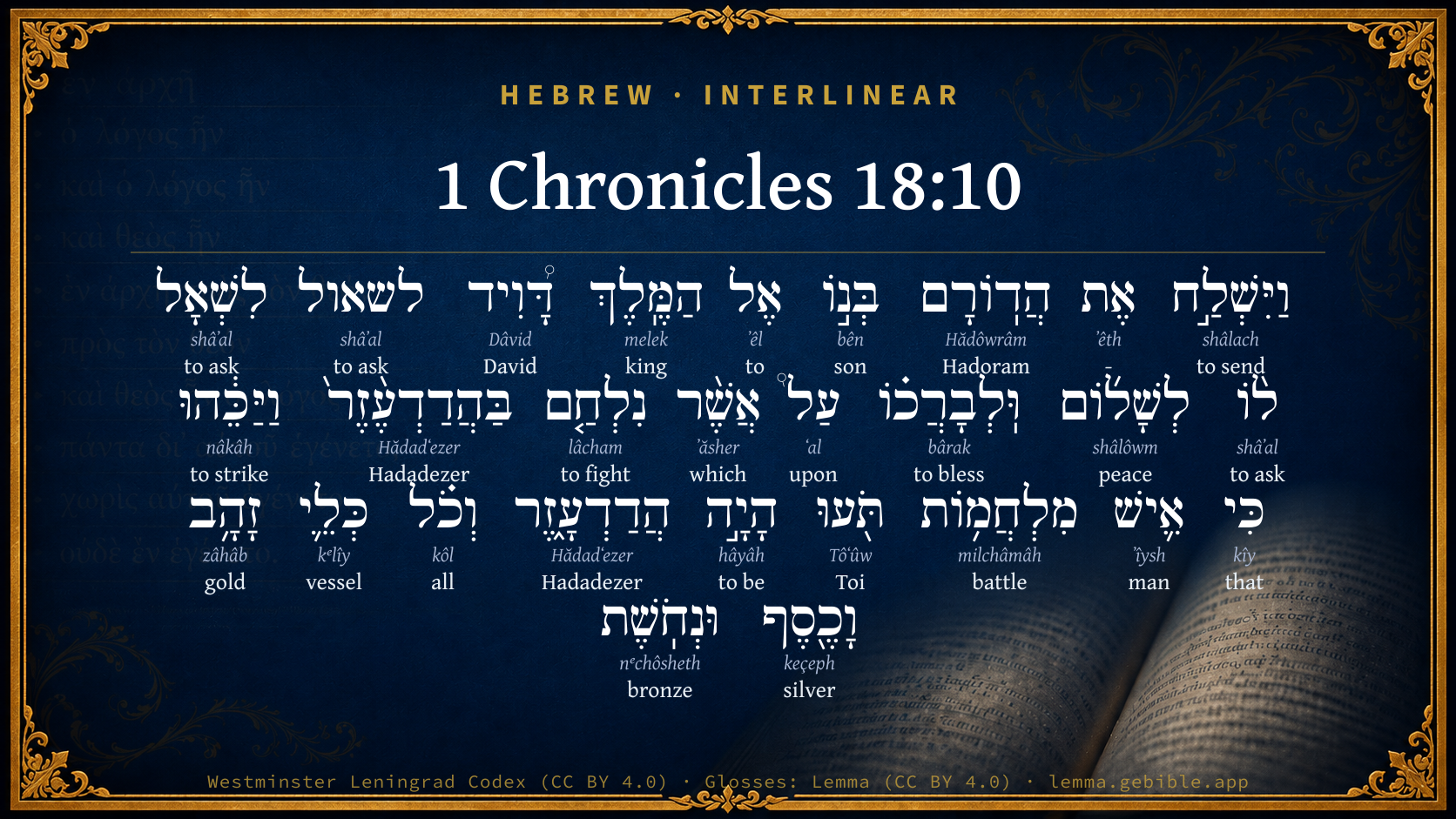
Hebrew (Westminster Leningrad Codex) 1 Chronicles 18:10 appears in the Hebrew Old Testament. The text above is from the Westminster Leningrad Codex. Each word links to its Strong’s number, a concise gloss, and parsing drawn from the Open Scriptures Hebrew Bible morphology. Click any word for its full Brown-Driver-Briggs (BDB) entry.
Download image
Cite this verse

1 Chronicles 18:10 (World English Bible). Public Domain. Lemma interlinear Bible study tool, https://lemma.gebible.app/v/1-chronicles/18/10.

Show BibTeX & RIS
BibTeX
RIS
English Translation
he sent Hadoram his son to king David, to Greet him, and to bless him, because he had fought against Hadarezer and struck him; (for Hadarezer had wars with Tou;) and [he had with him] all manner of vessels of gold and silver and brass.
World English Bible · Public Domain
Download a study sheet

One document with this verse’s original text, its word-by-word gloss line, the meaning frame, cross-references with their text, attributed commentary, and full source and license credits — printable, and it pastes into notes with its structure intact.

This verse Autodidact and up

Study sheet (.html) Plain text (.txt)

A passage Seminary Student

Up to 50 verses in one chapter. A passage sheet keeps up to 6 commentary sources and 12 cross-references per verse, in the order this page ranks them, and says so on the sheet whenever that leaves anything out. Ask for a single verse and you get the Autodidact verse sheet above.

Everything on this page stays free to read, with no account — the sheet is a download of what is already on screen, not access to it.

Want to remove ads? Support Godless Engineer
Compare translations 3

The same verse in 3 English versions, stacked beneath the original-language interlinear above. Click any original word for its lexicon entry.

Each is an independent rendering of the whole verse — the interlinear is not word-aligned to these translations.

Highlighted words mark where these versions differ — a whole-verse word diff, not a word-by-word alignment.

  • World English Bible Public Domain
    he sent Hadoram his son to king David, to Greet him, and to bless him, because he had fought against Hadarezer and struck him; (for Hadarezer had wars with Tou;) and [he had with him] all manner of vessels of gold and silver and brass.
  • King James Version Public Domain
    He sent Hadoram his son to king David, to enquire of his welfare, and to congratulate him, because he had fought against Hadarezer, and smitten him; (for Hadarezer had war with Tou;) and with him all manner of vessels of gold and silver and brass.
  • unfoldingWord Literal Text CC BY-SA 4.0
    And he sent Hadoram his son to King David to ask him for peace and to bless him because he had fought with Hadadezer and had struck him. For Tou had been a man of war Hadadezer. And all of the vessels of gold and silver and bronze,

unfoldingWord Literal Text — © unfoldingWord, licensed CC BY-SA 4.0. Word-aligned USFM3 via Door43 (git.door43.org/unfoldingWord/en_ult).

Versions to compare (up to 4)

3 of 4 selected

Show all 18 translations

Every available English version of this verse, each an independent rendering of the whole verse.

  • World English Bible Public Domain
    he sent Hadoram his son to king David, to Greet him, and to bless him, because he had fought against Hadarezer and struck him; (for Hadarezer had wars with Tou;) and [he had with him] all manner of vessels of gold and silver and brass.
  • Berean Standard Bible Public Domain
    he sent his son Hadoram to greet King David and bless him for fighting and defeating Hadadezer, who had been at war with Tou. Hadoram brought all kinds of articles of gold and silver and bronze,
  • Majority Standard Bible Public Domain
    he sent his son Hadoram to greet King David and bless him for fighting and defeating Hadadezer, who had been at war with Tou. Hadoram brought all kinds of articles of gold and silver and bronze,
  • King James Version Public Domain
    He sent Hadoram his son to king David, to enquire of his welfare, and to congratulate him, because he had fought against Hadarezer, and smitten him; (for Hadarezer had war with Tou;) and with him all manner of vessels of gold and silver and brass.
  • American Standard Version (1901) Public Domain
    he sent Hadoram his son to king David, to salute him, and to bless him, because he had fought against Hadarezer and smitten him; (for Hadarezer had wars with Tou;) and `he had with him' all manner of vessels of gold and silver and brass.
  • Revised Version (1885) Public Domain
    he sent Hadoram his son to king David, to salute him, and to bless him, because he had fought against Hadarezer and smitten him; for Hadarezer had wars with Tou; and he had with him all manner of vessels of gold and silver and brass.
  • Geneva Bible (1599) Public Domain
    Therefore he sent Hadoram his sonne to King Dauid, to salute him, and to reioyce with him, because he had fought against Hadarezer, and beaten him (for Tou had warre with Hadarezer) who brought all vessels of golde and siluer and brasse.
  • Douay-Rheims (1899) Public Domain
    He sent Adoram his son to king David, to desire peace of him, and to congratulate him that he had defeated and overthrown Adarezer: for Thou was an enemy to Adarezer.
  • Young's Literal Translation Public Domain
    and he sendeth Hadoram his son unto king David, to ask of him of peace, and to bless him (because that he hath fought against Hadarezer, and smiteth him, for a man of wars with Tou had Hadarezer been,) and all kinds of vessels, of gold, and silver, and brass;
  • Literal Standard Version CC BY-SA 4.0
    and he sends his son Hadoram to King David, to ask of him of peace, and to bless him, because that he has fought against Hadarezer and strikes him (for Hadarezer had been a man of wars with Tou); and [with him were] all kinds of vessels, of gold, and silver, and bronze;
  • Unlocked Literal Bible CC BY-SA 4.0
    and so Tou sent Hadoram his son to King David to greet him and to bless him. He did this because David had fought against Hadadezer and defeated him, and because Tou had often been at war with Hadadezer. Tou also sent David many different sorts of articles made of gold and silver and bronze.
  • unfoldingWord Literal Text CC BY-SA 4.0
    And he sent Hadoram his son to King David to ask him for peace and to bless him because he had fought with Hadadezer and had struck him. For Tou had been a man of war Hadadezer. And all of the vessels of gold and silver and bronze,
  • Darby Bible Public Domain
    and he sent Hadoram his son to king David to inquire of his welfare, and to congratulate him, because he had fought against Hadarezer and smitten him; for Hadarezer was continually at war with Tou; [he sent] also all manner of vessels of gold and silver and bronze.
  • World Messianic Bible Public Domain
    he sent Hadoram his son to King David to greet him and to bless him, because he had fought against Hadadezer and struck him (for Hadadezer had wars with Tou); and he had with him all kinds of vessels of gold and silver and bronze.
  • Webster's Bible Public Domain
    He sent Hadoram his son to king David to inquire of his welfare, and to congratulate him, because he had fought against Hadarezer, and smitten him; (for Hadarezer had warred with Tou;) and with him all manner of vessels of gold, and silver, and brass.
  • Free Bible Version CC BY-SA 4.0
    he sent his son Hadoram to David to make friends with him and to congratulate him on his victory in battle over Hadadezer. Tou and Hadadezer had often been at war. Hadoram brought gifts of gold, silver, and bronze.
  • Bible in Basic English Public Domain
    He sent his son Hadoram to King David, to give him words of peace and blessing, because he had overcome Hadadezer in the fight, for Hadadezer had been at war with Tou; and he gave him all sorts of vessels of gold and silver and brass.
  • JPS Tanakh (1917) Public Domain
    he sent Hadoram his son to king David, to salute him, and to bless him — because he had fought against Hadarezer and smitten him; for Hadarezer had wars with Tou — and he had with him all manner of vessels of gold and silver and brass.

Literal Standard Version (2020), Covenant Press — licensed CC BY-SA 4.0. Text via the HelloAO Bible API (eBible.org). Unlocked Literal Bible (unfoldingWord) — licensed CC BY-SA 4.0. Text via the HelloAO Bible API (eBible.org). unfoldingWord Literal Text — © unfoldingWord, licensed CC BY-SA 4.0. Word-aligned USFM3 via Door43 (git.door43.org/unfoldingWord/en_ult). Free Bible Version, Dr. Jonathan Gallagher — licensed CC BY-SA 4.0. Text via the HelloAO Bible API (eBible.org).

Word by word

More ways to search: Search by grammar → Find every occurrence → Compare this word →

Practice this passage: Drill this verse → Learn its vocabulary →

הֲדֽוֹרָם
Hădôwrâm
H1913
“Hadoram”
Noun, Proper
Part of Speech
Noun
Type
Proper
Full BDB Definition

Origin: probably of foreign derivation

TWOT: None

Hadoram = "noble honour" - the 5th son of Joktan - a son of Tou, king of Hamath, was his father's ambassador to congratulate David on his victory over Hadarezer, king of Zobah - the intendant of taxes under David, Solomon, and Rehoboam; called also 'Adoniram' and 'Adoram'
  1. וַיִּשְׁלַ֣ח shâlach H7971 “and · to send” Conjunction + Verb, Qal, Sequential Imperfect, 3rd Person, Masculine, Singular
  2. אֶת ʼêth H853 “-” Particle, Direct Object
  3. בְּנ֣וֹ bên H1121 “son · his” Noun, Common, Masculine, Singular, Construct + Suffix, Personal, 3rd Person, Masculine, Singular
  4. אֶל ʼêl H413 “to” Preposition
  5. הַמֶּֽלֶךְ melek H4428 “the · king” Particle, Definite Article + Noun, Common, Masculine, Singular, Absolute
  6. דָּ֠וִיד Dâvid H1732 “David” Noun, Proper
  7. לשאול shâʼal H7592 “to ask” Preposition + Verb, Qal, Infinitive Construct
  8. לִשְׁאָל shâʼal H7592 “to ask” Preposition + Verb, Qal, Infinitive Construct
  9. ל֨וֹ shâʼal H7592 “to/for · him” Preposition + Suffix, Personal, 3rd Person, Masculine, Singular
  10. לְשָׁל֜וֹם shâlôwm H7965 “to/for · peace” Preposition + Noun, Common, Masculine, Singular, Absolute
  11. וּֽלְבָרֲכ֗וֹ bârak H1288 “and · to bless · him” Conjunction + Preposition + Verb, Piel, Infinitive Construct + Suffix, Personal, 3rd Person, Masculine, Singular
  12. עַל֩ ʻal H5921 “upon” Preposition
  13. אֲשֶׁ֨ר ʼăsher H834 “which” Particle, Relative
  14. נִלְחַ֤ם lâcham H3898 “to fight” Verb, Niphal, Perfect, 3rd Person, Masculine, Singular
  15. בַּהֲדַדְעֶ֨זֶר֙ Hădadʻezer H1909 “in/at · Hadadezer” Preposition + Noun, Proper
  16. וַיַּכֵּ֔הוּ nâkâh H5221 “and · to strike · him” Conjunction + Verb, Hiphil, Sequential Imperfect, 3rd Person, Masculine, Singular + Suffix, Personal, 3rd Person, Masculine, Singular
  17. כִּי kîy H3588 “that” Conjunction
  18. אִ֛ישׁ ʼîysh H376 “man of” Noun, Common, Masculine, Singular, Construct
  19. מִלְחֲמ֥וֹת milchâmâh H4421 “battles of” Noun, Common, Feminine, Plural, Construct
  20. תֹּ֖עוּ Tôʻûw H8583 “Toi” Noun, Proper
  21. הָיָ֣ה hâyâh H1961 “to be” Verb, Qal, Perfect, 3rd Person, Masculine, Singular
  22. הֲדַדְעָ֑זֶר Hădadʻezer H1909 “Hadadezer” Noun, Proper
  23. וְכֹ֗ל kôl H3605 “and · all of” Conjunction + Noun, Common, Masculine, Singular, Construct
  24. כְּלֵ֛י kᵉlîy H3627 “vessels of” Noun, Common, Masculine, Plural, Construct
  25. זָהָ֥ב zâhâb H2091 “gold” Noun, Common, Masculine, Singular, Absolute
  26. וָכֶ֖סֶף keçeph H3701 “and · silver” Conjunction + Noun, Common, Masculine, Singular, Absolute
  27. וּנְחֹֽשֶׁת nᵉchôsheth H5178 “and · bronze” Conjunction + Noun, Common, Feminine, Singular, Absolute

About this verse

These counts appear in no published source. They are computed here, from the morphology-tagged text and Lemma’s own curated glosses. What Lemma adds →

28
words
25
distinct lemmas
Historical
section

Notable vocabulary

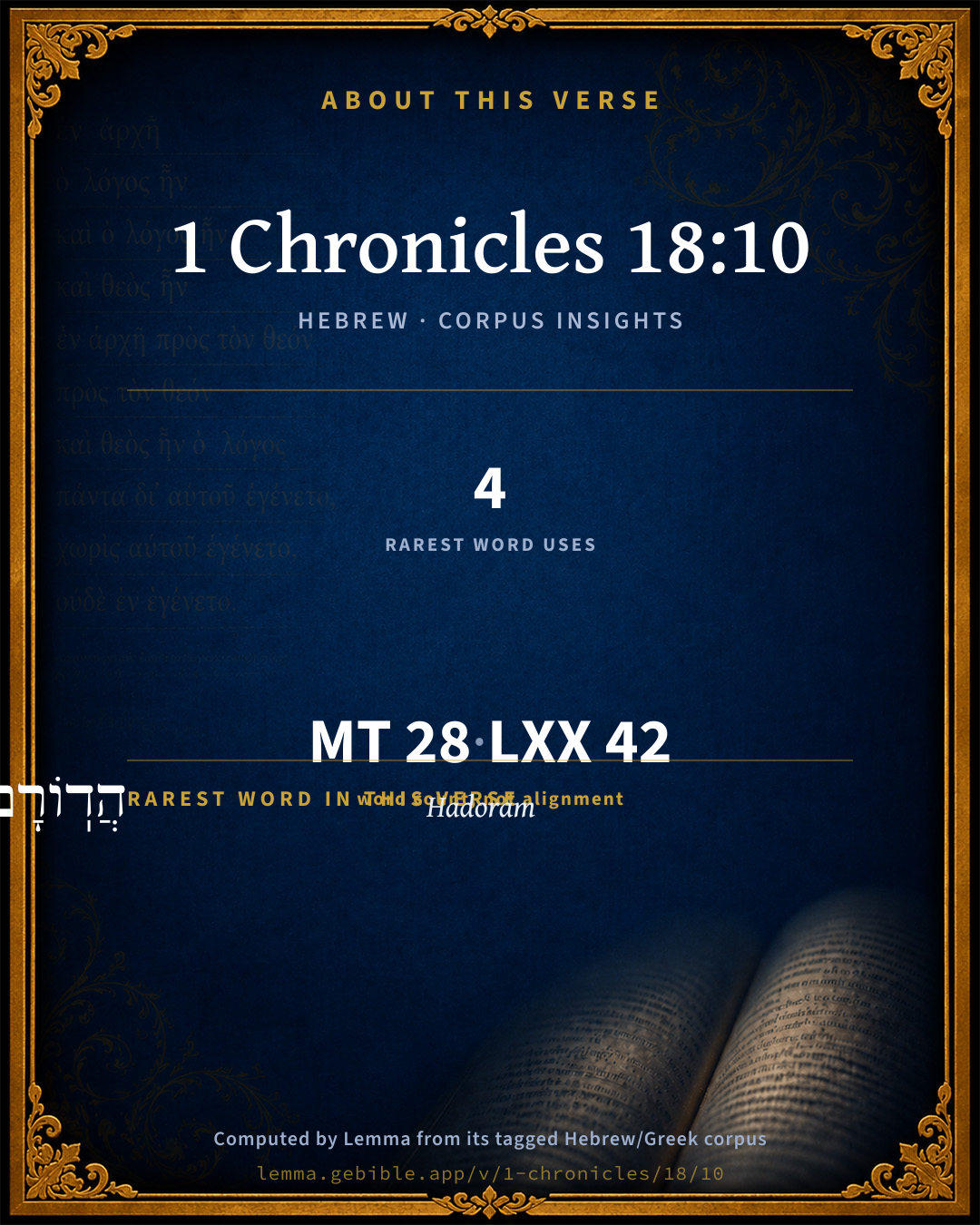
The rarest word here is הֲדֽוֹרָם Hadoram H1913 — appearing just 4 times in the whole Hebrew Bible.

Shared distinctive vocabulary

הֲדֽוֹרָם Hadoram H1913 occurs in 4 verses of the Hebrew Bible. Also found in:

Grammatical profile

  • 7 verbs
  • 15 nouns
  • 3 prepositions
  • 1 conjunction
  • 2 particles

Verb forms

  • וַיִּשְׁלַ֣ח Qal · Sequential Imperfect
  • לשאול Qal · Infinitive Construct
  • לִשְׁאָל Qal · Infinitive Construct
  • וּֽלְבָרֲכ֗וֹ Piel · Infinitive Construct
  • נִלְחַ֤ם Niphal · Perfect
  • וַיַּכֵּ֔הוּ Hiphil · Sequential Imperfect
  • הָיָ֣ה Qal · Perfect

Repetition

Words recur within this verse — often emphatic in Hebrew:

  • לשאול to ask H7592 ×3
  • בַּהֲדַדְעֶ֨זֶר֙ Hadadezer H1909 ×2

Hebrew & Septuagint length

In English translation the verse runs 45 words from the Hebrew and 34 from the Septuagint (LXX English) — closely comparable.

A rough comparison of the two English renderings, which tokenize alike — not a word-level alignment.

Word counts can differ between the Hebrew and the Greek without any difference in meaning — e.g. the Hebrew direct-object marker אֵת has no separate Greek word, and Greek often adds the article ὁ.

In the original languages it is 28 Hebrew tokens and 42 Greek tokens — but the two are counted differently (Hebrew bundles its prefixes and suffixes into one token; the Greek is in lemma form), so that isn’t a like-for-like length.

Cross-references

4

Topical passages linked to 1 Chronicles 18:10 in the Treasury of Scripture Knowledge — connected by theme and wording, ordered by reader-vote popularity; previews shown in the World English Bible.

  • 2 Samuel 8:10 then Toi sent Joram his son to king David, to Greet him, and to bless him, because he had fought against Hadadezer and struck him: for Hadadezer had wars with Toi. [Joram] brought with him vessels of silver, and vessels of gold, and vessels of brass:
  • 2 Chronicles 9:1 When the queen of Sheba heard of the fame of Solomon, she came to prove Solomon with hard questions at Jerusalem, with a very great train, and camels that bore spices, and gold in abundance, and precious stones: and when she was come to Solomon, she talked with him of all that was in her heart.
  • 2 Chronicles 9:23–24 All the kings of the earth sought the presence of Solomon, to hear his wisdom, which God had put in his heart.
  • Isaiah 39:1 At that time Merodach Baladan the son of Baladan, king of Babylon, sent letters and a present to Hezekiah; for he heard that he had been sick, and was recovered.

Cross-references courtesy of OpenBible.info (CC BY 4.0).

Hebrew and Greek witnesses Masoretic Hebrew ↔ Greek Septuagint

The same verse in the two great witnesses to the Old Testament, shown verse-for-verse.

These are two independent witnesses, not word-aligned to each other, and the Septuagint is shown in lemma (dictionary) form.

Hebrew 1 Chronicles 18:10 Masoretic · Westminster Leningrad Codex

וַיִּשְׁלַ֣ח אֶת הֲדֽוֹרָם בְּנ֣וֹ אֶל הַמֶּֽלֶךְ דָּ֠וִיד לשאול לִשְׁאָל ל֨וֹ לְשָׁל֜וֹם וּֽלְבָרֲכ֗וֹ עַל֩ אֲשֶׁ֨ר נִלְחַ֤ם בַּהֲדַדְעֶ֨זֶר֙ וַיַּכֵּ֔הוּ כִּי אִ֛ישׁ מִלְחֲמ֥וֹת תֹּ֖עוּ הָיָ֣ה הֲדַדְעָ֑זֶר וְכֹ֗ל כְּלֵ֛י זָהָ֥ב וָכֶ֖סֶף וּנְחֹֽשֶׁת

he sent Hadoram his son to king David, to Greet him, and to bless him, because he had fought against Hadarezer and struck him; (for Hadarezer had wars with Tou;) and [he had with him] all manner of vessels of gold and silver and brass.

World English Bible · Public Domain

Greek LXX 1 Chronicles 18:10 Septuagint · lemma form

καί ἀποστέλλω ὁ ιδουραμ υἱός αὐτός πρός ὁ βασιλεύς δαυίδ ὁ ἐρωτάω αὐτός ὁ εἰς εἰρήνη καί ὁ εὐλογέω αὐτός ὑπέρ ὅς πολεμέω ὁ αδρααζαρ καί πατάσσω αὐτός ὅτι ἀνήρ πολέμιος θωα εἰμί ὁ αδρααζαρ καί πᾶς ὁ σκεῦος ἀργυροῦς καί χρυσοῦς

And he sent Aduram his son to king David to ask how he was, and to congratulate him because he had fought against Adraazar, and struck him; for Thoa was the enemy of Adraazar.

LXX2012 (modern English Septuagint) · Public Domain

On this verse, Ellicott's Commentary for English Readers discusses the Septuagint’s reading. Read the note in Commentary ↓

Hebrew: Westminster Leningrad Codex (CC BY 4.0). Greek: Septuagint (public domain); English from LXX2012 (modern English Septuagint) (Public Domain). How the Septuagint differs from the Hebrew →

Commentary

Notes on 1 Chronicles 18:10 from classic Christian and Jewish commentators (each source and its license shown beneath its notes). The classic Christian expositions comment on the surrounding passage and are grouped to its opening verse, so a note may address several verses; the Jewish commentaries on the Tanakh (Rashi and others) are per-verse, so they appear only where the commentator wrote on this verse.

Lemma curates 59 commentaries, every one of them public domain or Creative Commons licensed, each selected and text-cleaned for this edition rather than reprinted as found. About our sources →

Joseph Benson's Commentary

1Ch 18:10. He sent Hadoram his son to King David, &c. — It is our interest to make those our friends who have the presence of God with them, as this king of Hamath, hearing of David’s great success, sent to congratulate him and to court his favour with a noble present, judging it in vain to oppose one whose cause God so evidently espoused. And is it not still more in vain to contend with the son of David? Reader, kiss the Son lest he be angry: let the kings and judges of the earth, and all inferior people, be thus wise, thus instructed. The presents which we are to bring to him are not vessels of gold and silver, as here: those shall be welcome to him, who have no such presents to bring: but our hearts and affections; ourselves, our whole selves we must present to him as living sacrifices.

Joseph Benson's Commentary on the Old and New Testaments (1811–1818) — public domain. Text from a community e-Sword module.

Geneva Bible (1599)

Geneva Bible translators

Called also Joram, 2 Sam. 8:10.

Geneva Bible (1599) marginal notes — public domain. Text via Bolls.life.

Ellicott's Commentary for English Readers

(10) He sent.—Heb., and he sent.

Hadoram.—Samuel, “and Toi sent Joram” (LXX., “Jeddûram”). Vulg., “Adoram;” but Syriac and Arabic, “Joram.” Hadoram, or Adoram (Hadar or Adar, is high), seems right; but Joram, i.e., Jehoram (Jehovah is high), may be correct, for it appears from an inscription of Sargon that the God of Israel was not unknown to the Hamathites. Sargon calls their king Iahu-bihdi.

To congratulate.—Bless—i.e., pronounce him happy.

Had war with Tou.—A man of wars (a foeman) of Tou was Hadadezer.

And . . . all manner . . .—Samuel, “and in his hand [were] vessels of silver, and vessels of gold,” &c. The clause is here curtailed.

A Bible Commentary for English Readers, edited by Charles John Ellicott (1878–1897) — public domain. Text from a community e-Sword module.

The Cambridge Bible for Schools and Colleges

gen. ed. J. J. S. Perowne

10. Hadoram] In 2Sa_8:10, “Joram.” Both these forms are probably Heb. adaptations of the real name.

to inquire of his welfare, and to congratulate him] R.V. to salute him, and to bless him (as Sam.).

and with him all manner of vessels] Such informal tribute was an acknowledgment of David’s suzerainty made in order to claim David’s protection in war. Cp. the action of Asa (1Ki_15:18-19) and of Ahaz (2Ki_16:7-8). In all three cases the policy was the same, i.e. to acknowledge a distant suzerain in order to gain the benefit of a valuable alliance, while losing the minimum of independence.

The Cambridge Bible for Schools and Colleges (gen. ed. J. J. S. Perowne; Cambridge University Press, 1878–1918) — public domain. Text from a community e-Sword module.

Haydock's Catholic Bible Commentary

Adoram, or Joram, 2 Kings. --- Desire. Hebrew, "to ask if all went well with him, and to bless him.

George Leo Haydock (1774–1849), Haydock's Catholic Family Bible and Commentary, 1859 edition — public domain. Excludes Psalms (Douay-Rheims chapter numbering differs from Protestant) and Deuterocanonical books (Catholic canon only).

The Pulpit Commentary

Hadoram. In the parallel place written Joram. The Septuagint has the name spelt with d in both places, which has led to the suggestion that possibly the real name was Jedorum. Josephus suggests that Tou had been brought into subjection by Hadadezer, and wished by his present congratulations and valuable gifts to ingratiate himself with David for a purpose. Had war; literally, was a man of war; i.e. he had shown his addictedness to war, or had warred abundantly with Tou. It is evident that Tou had generally fared the worst in their encounters.

The Pulpit Commentary (1880–1919), ed. H.D.M. Spence-Jones & Joseph S. Exell — public domain. Text from a community e-Sword module.

Rashi

Rabbi Shlomo Yitzchaki (Rashi)

for... had been Tou’s opponent in war He was his antagonist, and this is proven above (v. 3): “And David smote Hadarezer” (note Rashi’s reading). Now what connection do they have to Hamath to wage war there? But [the matter is that] Hadarezer, the king of Zobah, went to wage war against Tou the king of Hamath in Hamath, during which David came upon him and smote him. and all vessels of gold, of silver, and of copper he brought to David; and so it appears in II Samuel (8: 10): “... and in his possession were vessels of silver, and vessels of gold, and vessels of copper.”

Rashi on the Tanakh — English translations: “The Judaica Press complete Tanach with Rashi, translated by A. J. Rosenberg” (CC BY 4.0); “Pentateuch with Rashi's commentary by M. Rosenbaum and A.M. Silbermann, 1929-1934” (public domain); “The Metsudah Tanach series, Lakewood, N.J” (CC BY 4.0); and “The Book of Joshua, Metsudah Publications, 1997” (CC BY 4.0). Text via Sefaria.

Lesson kit

Teaching starters — assembled from the data on this page, not authored interpretation. Every prompt links to the verse data it draws on. Edit before teaching.

1 Chronicles, in the Historical, opens this verse with 28 words (25 distinct Hebrew lemmas). Its most distinctive word is Hădôwrâm (“Hadoram”). A historical commentator’s framing appears above. Read the whole chapter for the surrounding context.

Discussion questions

  1. How does “Hadoram” (Hădôwrâm) shape what this verse is saying?
  2. How does Genesis 10:27, which shares the word «Hadoram», read alongside this verse?
  3. What does the repetition of “to ask” (3× in this one verse) do in this verse?
  4. The translations on this page render this verse differently — a whole-verse word diff, not a word-by-word alignment. What might account for the different wordings?
  5. «וַיִּשְׁלַ֣ח» is a Qal Sequential Imperfect verb. How does that grammatical form shape the action described?
  6. Compare how Joseph Benson's Commentary and Geneva Bible (1599) read this verse. Where do they agree or differ?

Things to notice

Reading settings

Reading text

Shown beneath each verse's original-language words.

Old Testament
Old Testament edition

Read the OT as the Masoretic Hebrew (MT) or the Greek Septuagint (LXX).

English shown for the Greek Septuagint (in the Hebrew ↔ Greek comparison).

Comparing translations? Open the Compare panel on any verse page to stack up to four side by side.