
1 Kings 1:47

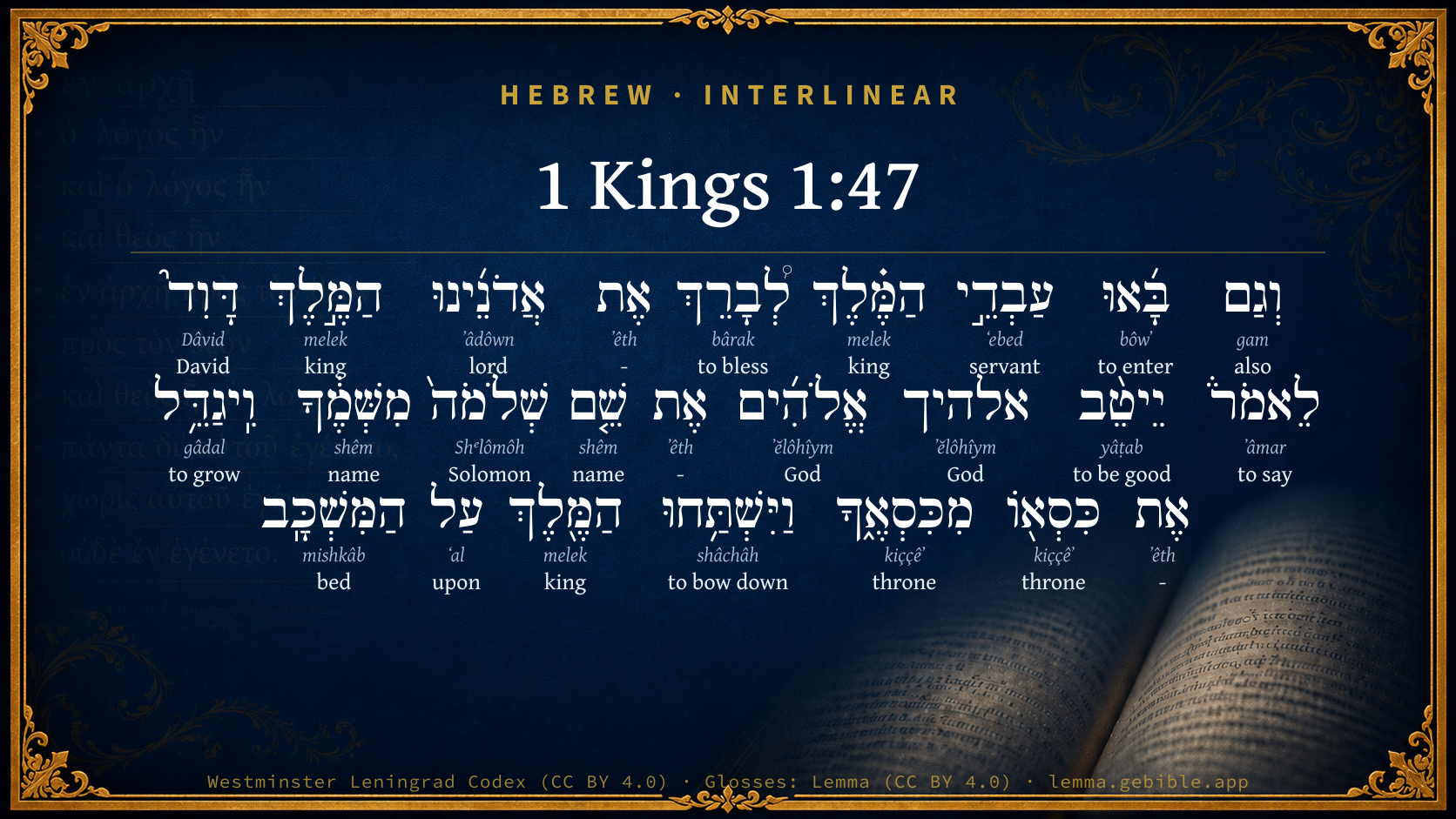
Hebrew (Westminster Leningrad Codex) 1 Kings 1:47 appears in the Hebrew Old Testament. The text above is from the Westminster Leningrad Codex. Each word links to its Strong’s number, a concise gloss, and parsing drawn from the Open Scriptures Hebrew Bible morphology. Click any word for its full Brown-Driver-Briggs (BDB) entry.
Download image
Cite this verse

1 Kings 1:47 (World English Bible). Public Domain. Lemma interlinear Bible study tool, https://lemma.gebible.app/v/1-kings/1/47.

Show BibTeX & RIS
BibTeX
RIS
English Translation
Moreover the king's servants came to bless our lord king David, saying, Your God make the name of Solomon better than your name, and make his throne greater than your throne: and the king bowed himself on the bed.
World English Bible · Public Domain
Download a study sheet

One document with this verse’s original text, its word-by-word gloss line, the meaning frame, cross-references with their text, attributed commentary, and full source and license credits — printable, and it pastes into notes with its structure intact.

This verse Autodidact and up

Study sheet (.html) Plain text (.txt)

A passage Seminary Student

Up to 50 verses in one chapter. A passage sheet keeps up to 6 commentary sources and 12 cross-references per verse, in the order this page ranks them, and says so on the sheet whenever that leaves anything out. Ask for a single verse and you get the Autodidact verse sheet above.

Everything on this page stays free to read, with no account — the sheet is a download of what is already on screen, not access to it.

Want to remove ads? Support Godless Engineer
Compare translations 3

The same verse in 3 English versions, stacked beneath the original-language interlinear above. Click any original word for its lexicon entry.

Each is an independent rendering of the whole verse — the interlinear is not word-aligned to these translations.

Highlighted words mark where these versions differ — a whole-verse word diff, not a word-by-word alignment.

  • World English Bible Public Domain
    Moreover the king's servants came to bless our lord king David, saying, Your God make the name of Solomon better than your name, and make his throne greater than your throne: and the king bowed himself on the bed.
  • King James Version Public Domain
    And moreover the king's servants came to bless our lord king David, saying, God make the name of Solomon better than thy name, and make his throne greater than thy throne. And the king bowed himself upon the bed.
  • unfoldingWord Literal Text CC BY-SA 4.0
    And also, the servants of the king came to bless our master King David, saying, ‘May God make the name of Solomon better than your name, and may he make his throne greater than your throne.’ And the king bowed himself on the bed.

unfoldingWord Literal Text — © unfoldingWord, licensed CC BY-SA 4.0. Word-aligned USFM3 via Door43 (git.door43.org/unfoldingWord/en_ult).

Versions to compare (up to 4)

3 of 4 selected

Show all 18 translations

Every available English version of this verse, each an independent rendering of the whole verse.

  • World English Bible Public Domain
    Moreover the king's servants came to bless our lord king David, saying, Your God make the name of Solomon better than your name, and make his throne greater than your throne: and the king bowed himself on the bed.
  • Berean Standard Bible Public Domain
    The king’s servants have also gone to congratulate our lord King David, saying, ‘May your God make the name of Solomon more famous than your own name, and may He make his throne greater than your throne.’ And the king has bowed in worship on his bed,
  • Majority Standard Bible Public Domain
    The king’s servants have also gone to congratulate our lord King David, saying, ‘May your God make the name of Solomon more famous than your own name, and may He make his throne greater than your throne.’ And the king has bowed in worship on his bed,
  • King James Version Public Domain
    And moreover the king's servants came to bless our lord king David, saying, God make the name of Solomon better than thy name, and make his throne greater than thy throne. And the king bowed himself upon the bed.
  • American Standard Version (1901) Public Domain
    And moreover the king's servants came to bless our lord king David, saying, Thy God make the name of Solomon better than thy name, and make his throne greater than thy throne: and the king bowed himself upon the bed.
  • Revised Version (1885) Public Domain
    And moreover the king’s servants came to bless our lord king David, saying, Thy God make the name of Solomon better than thy name, and make his throne greater than thy throne, and the king bowed himself upon the bed.
  • Geneva Bible (1599) Public Domain
    And moreouer the Kings seruantes came to blesse our lord King Dauid, saying, God make the name of Salomon more famous then thy name, and exalt his throne aboue thy throne: therefore the King worshipped vpon the bed.
  • Douay-Rheims (1899) Public Domain
    And the king's servants going in have blessed our lord king David, saying: May God make the name of Solomon greater than thy name, and make his throne greater than thy throne. And the king adored in his bed:
  • Young's Literal Translation Public Domain
    and also the servants of the king have come into bless our lord king David, saying, Thy God doth make the name of Solomon better than thy name, and his throne greater than thy throne; and the king boweth himself on the bed,
  • Literal Standard Version CC BY-SA 4.0
    and also the servants of the king have come into bless our lord King David, saying, Your God makes the name of Solomon better than your name, and his throne greater than your throne; and the king bows himself on the bed,
  • Unlocked Literal Bible CC BY-SA 4.0
    Moreover, the king's servants came to bless our master King David, saying, 'May your God make the name of Solomon better than your name, and make his throne greater than your throne.' Then the king bowed down on the bed.
  • unfoldingWord Literal Text CC BY-SA 4.0
    And also, the servants of the king came to bless our master King David, saying, ‘May God make the name of Solomon better than your name, and may he make his throne greater than your throne.’ And the king bowed himself on the bed.
  • Darby Bible Public Domain
    And moreover the king's servants came to bless our lord king David, saying, Thy God make the name of Solomon more excellent than thy name, and make his throne greater than thy throne! And the king bowed himself on the bed.
  • World Messianic Bible Public Domain
    Moreover the king’s servants came to bless our lord King David, saying, ‘May your God make the name of Solomon better than your name, and make his throne greater than your throne;’ and the king bowed himself on the bed.
  • Webster's Bible Public Domain
    And moreover the king's servants came to bless our lord king David, saying, God make the name of Solomon better than thy name, and make his throne greater than thy throne. And the king bowed himself upon the bed.
  • Free Bible Version CC BY-SA 4.0
    and the royal officials have also gone to voice their approval to our lord King David, saying, ‘May your God make Solomon's reputation even more famous than your own, and may he make his reign greater than your reign.’ The king on his bed bowed his head,
  • Bible in Basic English Public Domain
    And the king's servants came to our lord King David, blessing him and saying, May God make the name of Solomon better than your name, and the seat of his authority greater than your seat; and the king was bent low in worship on his bed.
  • JPS Tanakh (1917) Public Domain
    And moreover the king's servants came to bless our lord king David, saying: God make the name of Solomon better than thy name, and make his throne greater than thy throne; and the king bowed down upon the bed.

Literal Standard Version (2020), Covenant Press — licensed CC BY-SA 4.0. Text via the HelloAO Bible API (eBible.org). Unlocked Literal Bible (unfoldingWord) — licensed CC BY-SA 4.0. Text via the HelloAO Bible API (eBible.org). unfoldingWord Literal Text — © unfoldingWord, licensed CC BY-SA 4.0. Word-aligned USFM3 via Door43 (git.door43.org/unfoldingWord/en_ult). Free Bible Version, Dr. Jonathan Gallagher — licensed CC BY-SA 4.0. Text via the HelloAO Bible API (eBible.org).

Word by word

More ways to search: Search by grammar → Find every occurrence → Compare this word →

Practice this passage: Drill this verse → Learn its vocabulary →

הַמִּשְׁכָּֽב
mishkâb
H4904
“the · bed”
Particle, Definite Article + Noun, Common, Masculine, Singular, Absolute
Part of Speech
Particle + Noun
Type
Common
Gender
Masculine
Number
Singular
State
Absolute
Full BDB Definition

Origin: from H7901

TWOT: 2381c

a lying down, couch, bier, act of lying - couch, bed - act of lying, lying down or sleeping room, bedroom - lying down (for sexual contact)
  1. וְגַם gam H1571 “and · also” Conjunction + Particle, Accusative
  2. בָּ֜אוּ bôwʼ H935 “to enter” Verb, Qal, Perfect, 3rd Person, Common, Plural
  3. עַבְדֵ֣י ʻebed H5650 “servants of” Noun, Common, Masculine, Plural, Construct
  4. הַמֶּ֗לֶךְ melek H4428 “the · king” Particle, Definite Article + Noun, Common, Masculine, Singular, Absolute
  5. לְ֠בָרֵךְ bârak H1288 “to bless” Preposition + Verb, Piel, Infinitive Construct
  6. אֶת ʼêth H853 “-” Particle, Direct Object
  7. אֲדֹנֵ֜ינוּ ʼâdôwn H113 “lords · our” Noun, Common, Masculine, Plural, Construct + Suffix, Personal, 1st Person, Common, Plural
  8. הַמֶּ֣לֶךְ melek H4428 “the · king” Particle, Definite Article + Noun, Common, Masculine, Singular, Absolute
  9. דָּוִד֮ Dâvid H1732 “David” Noun, Proper
  10. לֵאמֹר֒ ʼâmar H559 “to say” Preposition + Verb, Qal, Infinitive Construct
  11. יֵיטֵ֨ב yâṭab H3190 “to be good” Verb, Hiphil, Jussive, 3rd Person, Masculine, Singular
  12. אלהיך ʼĕlôhîym H430 “God(s) · your” Noun, Common, Masculine, Plural, Construct + Suffix, Personal, 2nd Person, Masculine, Singular
  13. אֱלֹהִ֜ים ʼĕlôhîym H430 “God(s)” Noun, Common, Masculine, Plural, Absolute
  14. אֶת ʼêth H853 “-” Particle, Direct Object
  15. שֵׁ֤ם shêm H8034 “name of” Noun, Common, Masculine, Singular, Construct
  16. שְׁלֹמֹה֙ Shᵉlômôh H8010 “Solomon” Noun, Proper
  17. מִשְּׁמֶ֔ךָ shêm H8034 “from · name · your” Preposition + Noun, Common, Masculine, Singular, Construct + Suffix, Personal, 2nd Person, Masculine, Singular
  18. וִֽיגַדֵּ֥ל gâdal H1431 “and · to grow” Conjunction + Verb, Piel, Imperfect, 3rd Person, Masculine, Singular
  19. אֶת ʼêth H853 “-” Particle, Direct Object
  20. כִּסְא֖וֹ kiççêʼ H3678 “throne · his” Noun, Common, Masculine, Singular, Construct + Suffix, Personal, 3rd Person, Masculine, Singular
  21. מִכִּסְאֶ֑ךָ kiççêʼ H3678 “from · throne · your” Preposition + Noun, Common, Masculine, Singular, Construct + Suffix, Personal, 2nd Person, Masculine, Singular
  22. וַיִּשְׁתַּ֥חוּ shâchâh H7812 “and · to bow down” Conjunction + Verb, Hithpael, Sequential Imperfect, 3rd Person, Masculine, Singular
  23. הַמֶּ֖לֶךְ melek H4428 “the · king” Particle, Definite Article + Noun, Common, Masculine, Singular, Absolute
  24. עַל ʻal H5921 “upon” Preposition

About this verse

These counts appear in no published source. They are computed here, from the morphology-tagged text and Lemma’s own curated glosses. What Lemma adds →

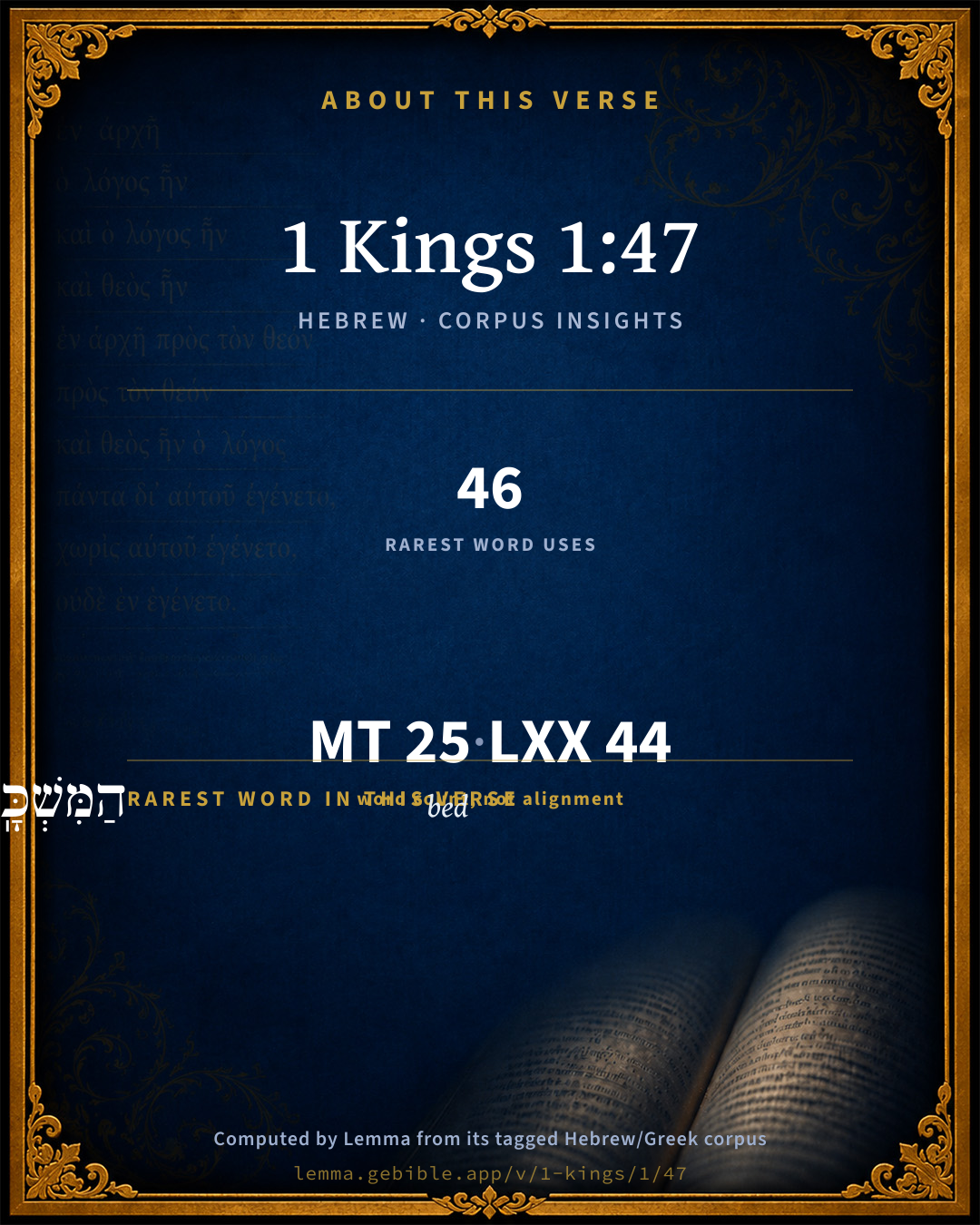
25
words
18
distinct lemmas
Historical
section

Shared distinctive vocabulary

הַמִּשְׁכָּֽב bed H4904 occurs in 44 verses of the Hebrew Bible. Also found in:

Grammatical profile

  • 6 verbs
  • 14 nouns
  • 1 preposition
  • 4 particles

Verb forms

  • בָּ֜אוּ Qal · Perfect
  • לְ֠בָרֵךְ Piel · Infinitive Construct
  • לֵאמֹר֒ Qal · Infinitive Construct
  • יֵיטֵ֨ב Hiphil · Jussive
  • וִֽיגַדֵּ֥ל Piel · Imperfect
  • וַיִּשְׁתַּ֥חוּ Hithpael · Sequential Imperfect

Repetition

Words recur within this verse — often emphatic in Hebrew:

  • הַמֶּ֗לֶךְ king H4428 ×3
  • אלהיך God H430 ×2
  • שֵׁ֤ם name H8034 ×2
  • כִּסְא֖וֹ throne H3678 ×2

Hebrew & Septuagint length

In English translation the verse runs 39 words from the Hebrew and 41 from the Septuagint (LXX English) — closely comparable.

A rough comparison of the two English renderings, which tokenize alike — not a word-level alignment.

Word counts can differ between the Hebrew and the Greek without any difference in meaning — e.g. the Hebrew direct-object marker אֵת has no separate Greek word, and Greek often adds the article ὁ.

In the original languages it is 25 Hebrew tokens and 44 Greek tokens — but the two are counted differently (Hebrew bundles its prefixes and suffixes into one token; the Greek is in lemma form), so that isn’t a like-for-like length.

Cross-references

9

Topical passages linked to 1 Kings 1:47 in the Treasury of Scripture Knowledge — connected by theme and wording, ordered by reader-vote popularity; previews shown in the World English Bible.

  • Genesis 47:31 He said, "Swear to me," and he swore to him. Israel bowed himself on the bed's head.
  • 1 Kings 1:37 As Yahweh has been with my lord the king, even so be he with Solomon, and make his throne greater than the throne of my lord king David.
  • Exodus 12:32 Take both your flocks and your herds, as you have said, and be gone; and bless me also!"
  • 2 Samuel 8:10 then Toi sent Joram his son to king David, to Greet him, and to bless him, because he had fought against Hadadezer and struck him: for Hadadezer had wars with Toi. [Joram] brought with him vessels of silver, and vessels of gold, and vessels of brass:
  • 2 Samuel 21:3 and David said to the Gibeonites, What shall I do for you? And with what shall I make atonement, that you may bless the inheritance of Yahweh?
  • Ezra 6:10 that they may offer sacrifices of sweet savor to the God of heaven, and pray for the life of the king, and of his sons.
  • Psalms 20:1–4 May Yahweh answer you in the day of trouble. May the name of the God of Jacob set you up on high,
  • Luke 19:38 saying, "Blessed is the King who comes in the name of the Lord! Peace in heaven, and glory in the highest!"
  • Hebrews 11:21 By faith, Jacob, when he was dying, blessed each of the sons of Joseph, and worshiped, leaning on the top of his staff.

Cross-references courtesy of OpenBible.info (CC BY 4.0).

Hebrew and Greek witnesses Masoretic Hebrew ↔ Greek Septuagint

The same verse in the two great witnesses to the Old Testament, shown verse-for-verse.

These are two independent witnesses, not word-aligned to each other, and the Septuagint is shown in lemma (dictionary) form.

Hebrew 1 Kings 1:47 Masoretic · Westminster Leningrad Codex

וְגַם בָּ֜אוּ עַבְדֵ֣י הַמֶּ֗לֶךְ לְ֠בָרֵךְ אֶת אֲדֹנֵ֜ינוּ הַמֶּ֣לֶךְ דָּוִד֮ לֵאמֹר֒ יֵיטֵ֨ב אלהיך אֱלֹהִ֜ים אֶת שֵׁ֤ם שְׁלֹמֹה֙ מִשְּׁמֶ֔ךָ וִֽיגַדֵּ֥ל אֶת כִּסְא֖וֹ מִכִּסְאֶ֑ךָ וַיִּשְׁתַּ֥חוּ הַמֶּ֖לֶךְ עַל הַמִּשְׁכָּֽב

Moreover the king's servants came to bless our lord king David, saying, Your God make the name of Solomon better than your name, and make his throne greater than your throne: and the king bowed himself on the bed.

World English Bible · Public Domain

Greek LXX 1 Kings 1:47 Septuagint · lemma form

καί εἰςἔρχομαι ὁ δοῦλος ὁ βασιλεύς εὐλογέω ὁ κύριος ἐγώ ὁ βασιλεύς δαυίδ λέγω ἀγαθύνω ὁ θεός ὁ ὄνομα σαλωμών ὁ υἱός σύ ὑπέρ ὁ ὄνομα σύ καί μεγαλύνω ὁ θρόνος αὐτός ὑπέρ ὁ θρόνος σύ καί προςκυνέω ὁ βασιλεύς ἐπί ὁ κοίτη αὐτός

And the servants of the king have gone in to bless our lord king David, saying, God make the name of Solomon better than your name, and make his throne greater than your throne; and the king worshipped upon his bed.

LXX2012 (modern English Septuagint) · Public Domain

Hebrew: Westminster Leningrad Codex (CC BY 4.0). Greek: Septuagint (public domain); English from LXX2012 (modern English Septuagint) (Public Domain). How the Septuagint differs from the Hebrew →

Targum (Aramaic paraphrase)

1

The Targum is the ancient Jewish Aramaic paraphrase of the Hebrew Scriptures — an interpretive translation, not the Hebrew text itself. Onkelos (literal) and Pseudo-Jonathan (expansive) render the Torah, and Jonathan the Prophets. Coverage is partial: where no permissively-licensed English translation exists for a verse, only the Aramaic is shown. This is verse-level text, not a word-by-word alignment to the Hebrew.

  1. Targum Jonathan Prophets (Joshua–Malachi)
    וְאַף עָלוּ עַבְדֵי מַלְכָּא לְבָרָכָא יַת רִבּוֹנָנָא מַלְכָּא דָוִד לְמֵימַר יוֹטִיב יְיָ יַת שׁוּם שְׁלֹמֹה מִשְׁמָךְ וִירַבֵּי יַת כּוּרְסוֹהִי מִכּוּרְסֵי מַלְכוּתָךְ וּסְגִיד מַלְכָּא עַל שִׁיווּיָא:

    (no public-domain English translation for this verse)

    Targum Jonathan — Aramaic: “Mikraot Gedolot” (public domain). English: “Sefaria Community Translation” (CC0 1.0 (public-domain dedication)); “London "Chaldee Paraphrase," 1871” (public domain). Text via Sefaria.

Commentary

Notes on 1 Kings 1:47 from classic Christian and Jewish commentators (each source and its license shown beneath its notes). The classic Christian expositions comment on the surrounding passage and are grouped to its opening verse, so a note may address several verses; the Jewish commentaries on the Tanakh (Rashi and others) are per-verse, so they appear only where the commentator wrote on this verse.

Lemma curates 59 commentaries, every one of them public domain or Creative Commons licensed, each selected and text-cleaned for this edition rather than reprinted as found. About our sources →

Trapp's Complete Commentary

John Trapp

1Ki 1:47 And moreover the king’s servants came to bless our lord king David, saying, God make the name of Solomon better than thy name, and make his throne greater than thy throne. And the king bowed himself upon the bed.

Ver. 47. Better than thy name, and his throne greater.] This wish of his servants was no grief of heart to the old king, but a matter of joy. So they prayed for Hector’s son in Homer,

“πατρος δ ογε πολλον αμεινων.”

And Claudian thus bespeaketh Honorius the emperor -

“ Aspice, completur votum; iam natus adaequat

Te meritis, et quod magis est optabile, vincit. ”

And the king bowed himself upon the bed.] Worshipping God, as Gen 47:31, and joining in prayer with his servants for his son. Some think he bowed himself to his son now crowned king: what, then, would he have done to his Lord, if present?, {Psa 110:1} quos non honores in illum supplex ac venerabundus certatim contulisset? {a}

{a} Bucholcer.

John Trapp, A Commentary or Exposition upon All the Books of the Old and New Testament (1647–1656) — public domain. Text from a community e-Sword module.

Geneva Bible (1599)

Geneva Bible translators

He gave God thanks for the good success.

To salute him, and to pray and praise God for him.

Geneva Bible (1599) marginal notes — public domain. Text via Bolls.life.

Adam Clarke's Commentary

Verse 47. Moreover, the king's servants came] The king himself was at this time confined to his own house, and probably to his bed, and could not possibly see these ceremonies; therefore his confidential servants came and told him. We know not how Jonathan, in so short a time, possessed himself of so much information.

Adam Clarke's Commentary on the Bible (1810–1826) — public domain. Text from a community e-Sword/MySword module.

Ellicott's Commentary for English Readers

(47) The king bowed himself, that is, in worship (comp. Gen_47:31), at once joining in the prayer of his servants, and thanking God for the fulfilment of His promise.

A Bible Commentary for English Readers, edited by Charles John Ellicott (1878–1897) — public domain. Text from a community e-Sword module.

The Cambridge Bible for Schools and Colleges

gen. ed. J. J. S. Perowne

47. the king’s servants] i.e. The general public of Jerusalem who gathered themselves to offer congratulations to David on the commencement of the reign of his son. That a son should begin to reign during his father’s lifetime was no uncommon occurrence in the East.

the king bowed himself upon the bed] The verb is that commonly used of an act of worship, and the language of the next verse shews that David’s bowing was of this nature. He prayed that the good wishes he had just heard might be fulfilled, and thanked God for what had already happened. The action and intention is similar to that of Jacob described Gen_47:31.

The Cambridge Bible for Schools and Colleges (gen. ed. J. J. S. Perowne; Cambridge University Press, 1878–1918) — public domain. Text from a community e-Sword module.

Albert Barnes' Notes on the Bible

The king bowed himself - The king worshipped God and prayed that it might be so. Compare Gen 47:31, with margin reference, Heb 11:21.

Albert Barnes' Notes on the Bible (1834–1885) — public domain. Text from a community e-Sword/MySword module.

Haydock's Catholic Bible Commentary

Blessed. Congratulating him on the exaltation of Solomon. --- Bed. Shewing respect to the new king, as Jacob had done to Joseph; (Genesis xlvii. 31.; Sanctius) or laying himself down again; (Calmet) or rather giving thanks to God, (Menochius) whom he adored, in gratitude for the favour of a successor being granted to him. (Worthington)

George Leo Haydock (1774–1849), Haydock's Catholic Family Bible and Commentary, 1859 edition — public domain. Excludes Psalms (Douay-Rheims chapter numbering differs from Protestant) and Deuterocanonical books (Catholic canon only).

Matthew Poole's English Annotations

To bless our lord king David; to praise and thank him for his great and good care, in leaving them in the hands of so excellent a successor, under whom they might expect peace and all prosperity; and to congratulate with him for God’s great mercy to him, in giving him such a son and successor, and that his eyes had now seen the actual accomplishment of God’s promise made to him concerning this thing.

The king bowed himself upon the bed; adoring God for this great mercy, and thereby declaring his hearty approbation and consent to this action. Compare Gen 47:31.

Matthew Poole's English Annotations on the Holy Bible (1683–1685) — public domain. Text from a community e-Sword/MySword module.

The Pulpit Commentary

And moreover as before the king"s servants see on ver. 33 came to bless our lord king David Jonathan here refers in all probability to the words of Benaiah, vers. 36, 37. He does not know the exact particulars, and ascribes to the "servants" the words of their commander. Of course it is possible that "the bodyguard took up the words of Jehoiada (Benaiah?) their captain and repeated them with some slight alteration." (Rawlinson) saying, God so the Keri. The Cethib has "thy God" make the name of Solomon better than thy name and make his throne greater than thy throne This prayer was fulfilled. (1Ki_3:12 1Ki_4:21-24) And the king bowed himself in worship. Cf. Gen_47:31 upon the bed.

The Pulpit Commentary (1880–1919), ed. H.D.M. Spence-Jones & Joseph S. Exell — public domain. Text from a community e-Sword module.

John Wesley's Explanatory Notes

Bowed himself - Adoring God for this great mercy, and thereby declaring his hearty consent to this action.

John Wesley, Explanatory Notes Upon the Whole Bible (1754–1765) — public domain. Text via the GEBible commentary corpus.

Lesson kit

Teaching starters — assembled from the data on this page, not authored interpretation. Every prompt links to the verse data it draws on. Edit before teaching.

1 Kings, in the Historical, opens this verse with 25 words (18 distinct Hebrew lemmas). Its most distinctive word is mishkâb (“bed”). A historical commentator’s framing appears above. Read the whole chapter for the surrounding context.

Discussion questions

  1. How does “bed” (mishkâb) shape what this verse is saying?
  2. How does Genesis 49:4, which shares the word «bed», read alongside this verse?
  3. What does the repetition of “king” (3× in this one verse) do in this verse?
  4. These translations render this verse differently. What is at stake in choosing one wording over another?
  5. «בָּ֜אוּ» is a Qal Perfect verb. How does that grammatical form shape the action described?
  6. Compare how Trapp's Complete Commentary and Geneva Bible (1599) read this verse. Where do they agree or differ?

Things to notice

Reading settings

Reading text

Shown beneath each verse's original-language words.

Old Testament
Old Testament edition

Read the OT as the Masoretic Hebrew (MT) or the Greek Septuagint (LXX).

English shown for the Greek Septuagint (in the Hebrew ↔ Greek comparison).

Comparing translations? Open the Compare panel on any verse page to stack up to four side by side.