2 Samuel 3:10

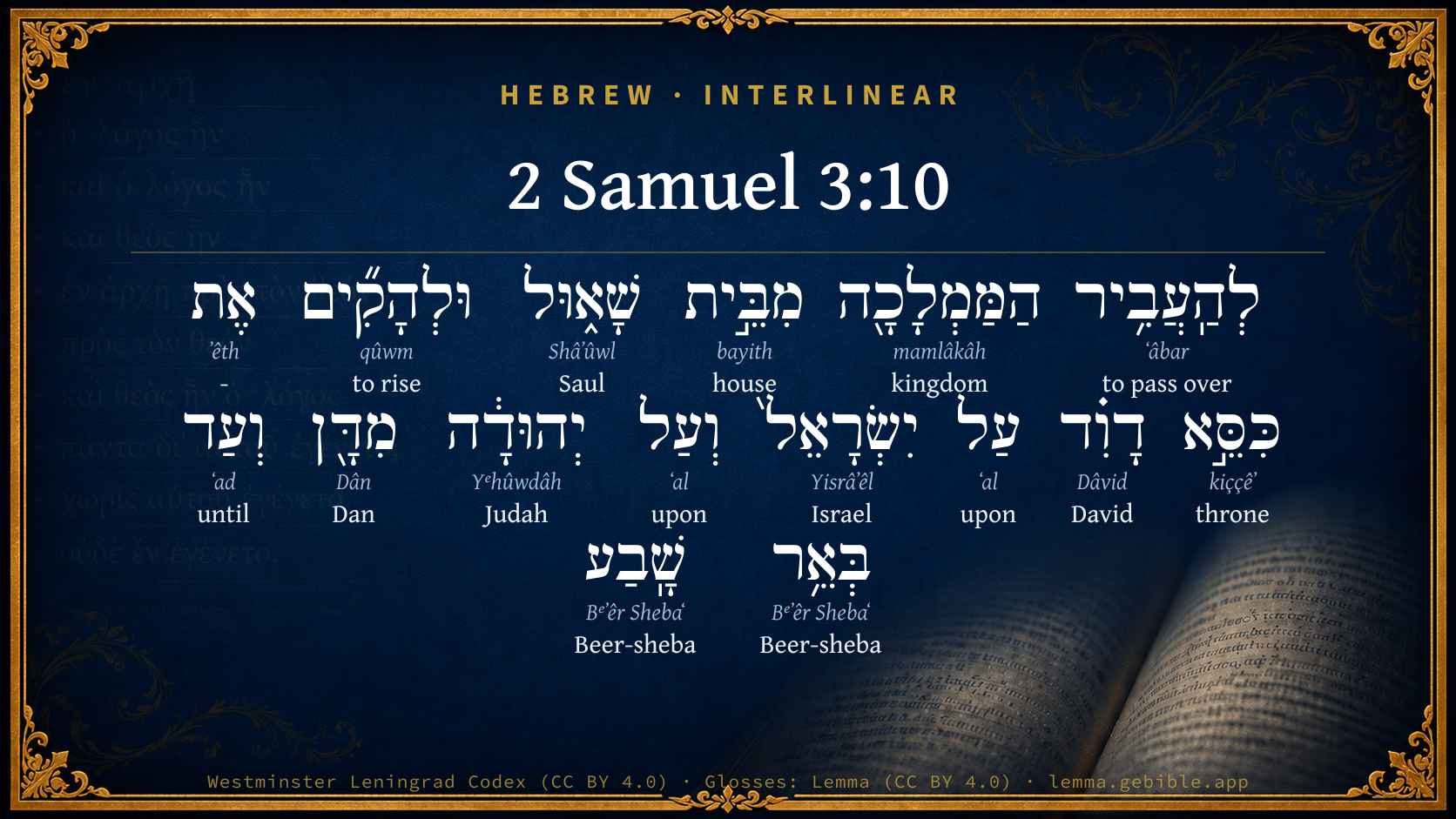
Hebrew (Westminster Leningrad Codex) 2 Samuel 3:10 appears in the Hebrew Old Testament. The text above is from the Westminster Leningrad Codex. Each word links to its Strong’s number, a concise gloss, and parsing drawn from the Open Scriptures Hebrew Bible morphology. Click any word for its full Brown-Driver-Briggs (BDB) entry.
Download image
Cite this verse

2 Samuel 3:10 (World English Bible). Public Domain. Lemma interlinear Bible study tool, https://lemma.gebible.app/v/2-samuel/3/10.

Show BibTeX & RIS
BibTeX
RIS
English Translation
to transfer the kingdom from the house of Saul, and to set up the throne of David over Israel and over Judah, from Dan even to Beersheba.
World English Bible · Public Domain
Download a study sheet

One document with this verse’s original text, its word-by-word gloss line, the meaning frame, cross-references with their text, attributed commentary, and full source and license credits — printable, and it pastes into notes with its structure intact.

This verse Autodidact and up

Study sheet (.html) Plain text (.txt)

A passage Seminary Student

Up to 50 verses in one chapter. A passage sheet keeps up to 6 commentary sources and 12 cross-references per verse, in the order this page ranks them, and says so on the sheet whenever that leaves anything out. Ask for a single verse and you get the Autodidact verse sheet above.

Everything on this page stays free to read, with no account — the sheet is a download of what is already on screen, not access to it.

Want to remove ads? Support Godless Engineer
Compare translations 3

The same verse in 3 English versions, stacked beneath the original-language interlinear above. Click any original word for its lexicon entry.

Each is an independent rendering of the whole verse — the interlinear is not word-aligned to these translations.

Highlighted words mark where these versions differ — a whole-verse word diff, not a word-by-word alignment.

  • World English Bible Public Domain
    to transfer the kingdom from the house of Saul, and to set up the throne of David over Israel and over Judah, from Dan even to Beersheba.
  • King James Version Public Domain
    To translate the kingdom from the house of Saul, and to set up the throne of David over Israel and over Judah, from Dan even to Beersheba.
  • unfoldingWord Literal Text CC BY-SA 4.0
    to cause the kingdom to pass over from the house of Saul and to raise up the throne of David over Israel and over Judah, from Dan and to Beersheba.”

unfoldingWord Literal Text — © unfoldingWord, licensed CC BY-SA 4.0. Word-aligned USFM3 via Door43 (git.door43.org/unfoldingWord/en_ult).

Versions to compare (up to 4)

3 of 4 selected

Show all 18 translations

Every available English version of this verse, each an independent rendering of the whole verse.

  • World English Bible Public Domain
    to transfer the kingdom from the house of Saul, and to set up the throne of David over Israel and over Judah, from Dan even to Beersheba.
  • Berean Standard Bible Public Domain
    to transfer the kingdom from the house of Saul and to establish the throne of David over Israel and Judah, from Dan to Beersheba.”
  • Majority Standard Bible Public Domain
    to transfer the kingdom from the house of Saul and to establish the throne of David over Israel and Judah, from Dan to Beersheba.”
  • King James Version Public Domain
    To translate the kingdom from the house of Saul, and to set up the throne of David over Israel and over Judah, from Dan even to Beersheba.
  • American Standard Version (1901) Public Domain
    to transfer the kingdom from the house of Saul, and to set up the throne of David over Israel and over Judah, from Dan even to Beer-sheba.
  • Revised Version (1885) Public Domain
    to translate the kingdom from the house of Saul, and to set up the throne of David over Israel and over Judah, from Dan even to Beer-sheba.
  • Geneva Bible (1599) Public Domain
    To remoue the kingdome from the house of Saul, that the throne of Dauid may be stablished ouer Israel, and ouer Iudah, euen from Dan to Beer-sheba.
  • Douay-Rheims (1899) Public Domain
    That the kingdom be translated from the house of Saul, and the throne of David be set up over Israel, and over Juda from Dan to Bersabee.
  • Young's Literal Translation Public Domain
    to cause the kingdom to pass over from the house of Saul, and to raise up the throne of David over Israel, and over Judah, from Dan even unto Beer-Sheba.'
  • Literal Standard Version CC BY-SA 4.0
    to cause the kingdom to pass over from the house of Saul, and to raise up the throne of David over Israel, and over Judah, from Dan even to Beer-Sheba.”
  • Unlocked Literal Bible CC BY-SA 4.0
    to transfer the kingdom from the house of Saul and set up the throne of David over Israel and over Judah, from Dan to Beersheba.”
  • unfoldingWord Literal Text CC BY-SA 4.0
    to cause the kingdom to pass over from the house of Saul and to raise up the throne of David over Israel and over Judah, from Dan and to Beersheba.”
  • Darby Bible Public Domain
    to translate the kingdom from the house of Saul, and to set up the throne of David over Israel and over Judah, from Dan even to Beer-sheba!
  • World Messianic Bible Public Domain
    to transfer the kingdom from Saul’s house, and to set up David’s throne over Israel and over Judah, from Dan even to Beersheba.”
  • Webster's Bible Public Domain
    To translate the kingdom from the house of Saul, and to set up the throne of David over Israel and over Judah, from Dan even to Beer-sheba.
  • Free Bible Version CC BY-SA 4.0
    I will hand over the kingdom from Saul's dynasty, and help set up David's rule over Israel and Judah, from Dan to Beersheba.”
  • Bible in Basic English Public Domain
    And if I do not take away the kingdom from the family of Saul and make David ruler over Israel and Judah from Dan as far as Beer-sheba!
  • JPS Tanakh (1917) Public Domain
    to transfer the kingdom from the house of Saul, and to set up the throne of David over Israel and over Judah, from Dan even to Beer-sheba.'

Literal Standard Version (2020), Covenant Press — licensed CC BY-SA 4.0. Text via the HelloAO Bible API (eBible.org). Unlocked Literal Bible (unfoldingWord) — licensed CC BY-SA 4.0. Text via the HelloAO Bible API (eBible.org). unfoldingWord Literal Text — © unfoldingWord, licensed CC BY-SA 4.0. Word-aligned USFM3 via Door43 (git.door43.org/unfoldingWord/en_ult). Free Bible Version, Dr. Jonathan Gallagher — licensed CC BY-SA 4.0. Text via the HelloAO Bible API (eBible.org).

Word by word

More ways to search: Search by grammar → Find every occurrence → Compare this word →

Practice this passage: Drill this verse → Learn its vocabulary →

בְּאֵ֥ר
Bᵉʼêr Shebaʻ
H884
“Beer-sheba”
Noun, Proper
Part of Speech
Noun
Type
Proper
Full BDB Definition

Origin: from H875 and H7651 (in the sense of H7650 )

TWOT: None

Beer-sheba = "well of the sevenfold oath" - a city at the south edge of Israel
  1. לְהַֽעֲבִ֥יר ʻâbar H5674 “to pass over” Preposition + Verb, Hiphil, Infinitive Construct
  2. הַמַּמְלָכָ֖ה mamlâkâh H4467 “the · kingdom” Particle, Definite Article + Noun, Common, Feminine, Singular, Absolute
  3. מִבֵּ֣ית bayith H1004 “from · house of” Preposition + Noun, Common, Masculine, Singular, Construct
  4. שָׁא֑וּל Shâʼûwl H7586 “Saul” Noun, Proper
  5. וּלְהָקִ֞ים qûwm H6965 “and · to rise” Conjunction + Preposition + Verb, Hiphil, Infinitive Construct
  6. אֶת ʼêth H853 “-” Particle, Direct Object
  7. כִּסֵּ֣א kiççêʼ H3678 “throne of” Noun, Common, Masculine, Singular, Construct
  8. דָוִ֗ד Dâvid H1732 “David” Noun, Proper
  9. עַל ʻal H5921 “upon” Preposition
  10. יִשְׂרָאֵל֙ Yisrâʼêl H3478 “Israel” Noun, Proper
  11. וְעַל ʻal H5921 “and · upon” Conjunction + Preposition
  12. יְהוּדָ֔ה Yᵉhûwdâh H3063 “Judah” Noun, Proper
  13. מִדָּ֖ן Dân H1835 “from · Dan” Preposition + Noun, Proper
  14. וְעַד ʻad H5704 “and · until” Conjunction + Preposition
  15. שָֽׁבַע Bᵉʼêr Shebaʻ H884 “Beer-sheba” Noun, Proper

About this verse

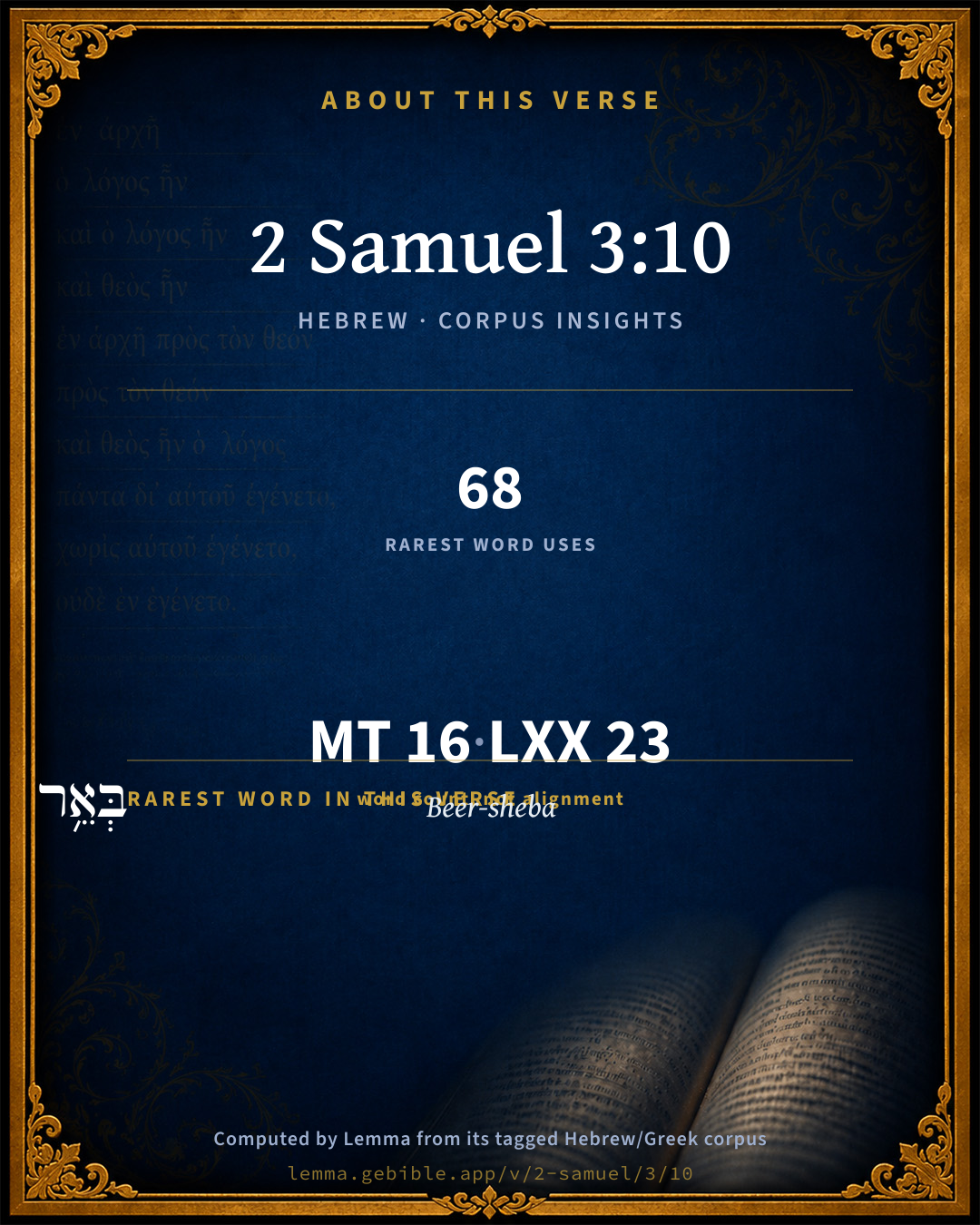
These counts appear in no published source. They are computed here, from the morphology-tagged text and Lemma’s own curated glosses. What Lemma adds →

16
words
14
distinct lemmas
Historical
section

Grammatical profile

  • 2 verbs
  • 10 nouns
  • 3 prepositions
  • 1 particle

Verb forms

  • לְהַֽעֲבִ֥יר Hiphil · Infinitive Construct
  • וּלְהָקִ֞ים Hiphil · Infinitive Construct

Repetition

Words recur within this verse — often emphatic in Hebrew:

  • עַל upon H5921 ×2
  • בְּאֵ֥ר Beer-sheba H884 ×2

Hebrew & Septuagint length

In English translation the verse runs 27 words from the Hebrew and 27 from the Septuagint (LXX English) — the same length.

A rough comparison of the two English renderings, which tokenize alike — not a word-level alignment.

Word counts can differ between the Hebrew and the Greek without any difference in meaning — e.g. the Hebrew direct-object marker אֵת has no separate Greek word, and Greek often adds the article ὁ.

In the original languages it is 16 Hebrew tokens and 23 Greek tokens — but the two are counted differently (Hebrew bundles its prefixes and suffixes into one token; the Greek is in lemma form), so that isn’t a like-for-like length.

Cross-references

5

Topical passages linked to 2 Samuel 3:10 in the Treasury of Scripture Knowledge — connected by theme and wording, ordered by reader-vote popularity; previews shown in the World English Bible.

  • Judges 20:1 Then all the children of Israel went out, and the congregation was assembled as one man, from Dan even to Beersheba, with the land of Gilead, to Yahweh at Mizpah.
  • 1 Samuel 3:20 All Israel from Dan even to Beersheba knew that Samuel was established to be a prophet of Yahweh.
  • 2 Samuel 17:11 But I counsel that all Israel be gathered together to you, from Dan even to Beersheba, as the sand that is by the sea for multitude; and that you go to battle in your own person.
  • 2 Samuel 24:2 The king said to Joab the captain of the host, who was with him, Go now back and forth through all the tribes of Israel, from Dan even to Beersheba, and number you the people, that I may know the sum of the people.
  • 1 Kings 4:25 Judah and Israel lived safely, every man under his vine and under his fig tree, from Dan even to Beersheba, all the days of Solomon.

Cross-references courtesy of OpenBible.info (CC BY 4.0).

Hebrew and Greek witnesses Masoretic Hebrew ↔ Greek Septuagint

The same verse in the two great witnesses to the Old Testament, shown verse-for-verse.

These are two independent witnesses, not word-aligned to each other, and the Septuagint is shown in lemma (dictionary) form.

Hebrew 2 Samuel 3:10 Masoretic · Westminster Leningrad Codex

לְהַֽעֲבִ֥יר הַמַּמְלָכָ֖ה מִבֵּ֣ית שָׁא֑וּל וּלְהָקִ֞ים אֶת כִּסֵּ֣א דָוִ֗ד עַל יִשְׂרָאֵל֙ וְעַל יְהוּדָ֔ה מִדָּ֖ן וְעַד בְּאֵ֥ר שָֽׁבַע

to transfer the kingdom from the house of Saul, and to set up the throne of David over Israel and over Judah, from Dan even to Beersheba.

World English Bible · Public Domain

Greek LXX 2 Samuel 3:10 Septuagint · lemma form

περιαἱρέω ὁ βασιλεία ἀπό ὁ οἶκος σαούλ καί ὁ ἀναἵστημι ὁ θρόνος δαυίδ ἐπί ἰσραήλ καί ἐπί ὁ ἰούδας ἀπό δαν ἕως βηρσαβεε

to take away the kingdom from the house of Saul, and to raise up the throne of David over Israel and over Juda from Dan to Bersabee.

LXX2012 (modern English Septuagint) · Public Domain

Hebrew: Westminster Leningrad Codex (CC BY 4.0). Greek: Septuagint (public domain); English from LXX2012 (modern English Septuagint) (Public Domain). How the Septuagint differs from the Hebrew →

Targum (Aramaic paraphrase)

1

The Targum is the ancient Jewish Aramaic paraphrase of the Hebrew Scriptures — an interpretive translation, not the Hebrew text itself. Onkelos (literal) and Pseudo-Jonathan (expansive) render the Torah, and Jonathan the Prophets. Coverage is partial: where no permissively-licensed English translation exists for a verse, only the Aramaic is shown. This is verse-level text, not a word-by-word alignment to the Hebrew.

  1. Targum Jonathan Prophets (Joshua–Malachi)
    לְאַעְבָּרָא מַלְכוּ מִבֵּית שָׁאוּל וְלַאֲקָמָא יַת כּוּרְסֵי דָוִד עַל יִשְׂרָאֵל וְעַל דְבֵית יְהוּדָה מִדָן וְעַד בְּאֵר שָׁבַע:

    (no public-domain English translation for this verse)

    Targum Jonathan — Aramaic: “Mikraot Gedolot” (public domain). English: “Sefaria Community Translation” (CC0 1.0 (public-domain dedication)); “London "Chaldee Paraphrase," 1871” (public domain). Text via Sefaria.

Commentary

Notes on 2 Samuel 3:10 from classic Christian and Jewish commentators (each source and its license shown beneath its notes). The classic Christian expositions comment on the surrounding passage and are grouped to its opening verse, so a note may address several verses; the Jewish commentaries on the Tanakh (Rashi and others) are per-verse, so they appear only where the commentator wrote on this verse.

Lemma curates 59 commentaries, every one of them public domain or Creative Commons licensed, each selected and text-cleaned for this edition rather than reprinted as found. About our sources →

Trapp's Complete Commentary

John Trapp

2Sa 3:10 To translate the kingdom from the house of Saul, and to set up the throne of David over Israel and over Judah, from Dan even to Beersheba.

Ver. 10. To translate the kingdom] This was Abner’s arrogance to boast such great things of himself, as if he had carried a king in his pocket, as that great Earl of Warwick in Edward IV’s time was said to have done.

John Trapp, A Commentary or Exposition upon All the Books of the Old and New Testament (1647–1656) — public domain. Text from a community e-Sword module.

The Biblical Illustrator

Joseph S. Exell

2Sa_3:10

To translate the kingdom from the house of Saul.

The translation of life

The kingdom was to pass from the house of Saul to the house of David, and David was to be king over Israel and over Judah, from Dan even to Beersheba. The thought is that kingdoms of an earthly kind change hands, and therefore they are to be regarded as belonging to things temporary and mutable, and not to things eternal and unchangeable. What hast thou that thou hast not received? By long use men come to entertain the idea of sole proprietorship, and thus the sense of monopoly increases. Our children are not ours, they are Gods; our lives are not our own, they belong to the Creator; we have no, thing, except in the sense of stewardship and in the sense of involving responsibility for the use we make of it. It is well that men can only reign for a certain time; it, would be well if royalty could change its point of origin, so that human vanity might be checked and human ambition might be baffled in many a course. We are not to think of earthly kingdoms alone as meaning political sovereignities; we are to think of personal influence, institutional functions, and all arrangements made to meet the necessity of the present day; all these things must be changed in order to be purified; the direction may be altered in order that attention may be wakened; those who imagine themselves secure for ever must be shaken out of their security, that they may learn that there is no permanence but in God. The Lord reigneth. All men reign under Him, and are subject to His will. They only are happy who use the world as not abusing it, and who hold it with so light a hand that at any moment they can lay it down again. (J. Parker, D. D.)

God in history

Someone has pithily said: There are three kinds of histories. There is that which makes the king the centre of the story. The tale is mainly one of wars and their causes. It speaks glowingly of the kings victories, and explains away his defeats. It has been dubbed, The Drum and Trumpet History. Then there is that which traces the growth of the people--their morals, customs, politics, and religion. This is the Bread and Success history. But, last of all, there is the history like that of the chosen nation, where the guide and ruler is God. This is true history, for it reckons in the mightiest fact and force of all. It is the Sane and Sublime History, and no other is worth the name.

The Biblical Illustrator, edited by Joseph S. Exell (c. 1880s–1900s) — public domain. Text from a community e-Sword module.

Joseph Benson's Commentary

2Sa 3:10. To translate the kingdom from the house of Saul — A wonderful change, which the study of revenge had wrought in him, that he who so lately had gone about the country confirming the Israelites in their opposition to David, now resolved to bring them all over to him! But here we see the hand of God. Providence made use of this unjust resentment of Abner to bring about its own designs with regard to David.

Joseph Benson's Commentary on the Old and New Testaments (1811–1818) — public domain. Text from a community e-Sword module.

Tyndale Open Study Notes

Tyndale Open Resources

3:10 and give it to David: Cp. 1 Sam 28:17. • I will establish the throne of David: Whether an ally or enemy, Abner was a powerful man. Here he speaks like God (see 2 Sam 7:13).

Tyndale Open Study Notes — © Tyndale Open Resources, licensed CC BY-SA 4.0. Text via the HelloAO Bible API.

Ellicott's Commentary for English Readers

(10) To translate the kingdom.—This sudden expression of Abner’s resolve seems to imply that he had before had the matter under consideration, and shows that there was some ground for the reproach of Ish-bosheth. The following verse brings out clearly the utter weakness of Ish-bosheth.

A Bible Commentary for English Readers, edited by Charles John Ellicott (1878–1897) — public domain. Text from a community e-Sword module.

The Cambridge Bible for Schools and Colleges

gen. ed. J. J. S. Perowne

10. from Dan even to Beer-sheba] Over the whole land of Israel. See note on 1Sa_3:20.

The Cambridge Bible for Schools and Colleges (gen. ed. J. J. S. Perowne; Cambridge University Press, 1878–1918) — public domain. Text from a community e-Sword module.

John Gill's Exposition

To translate the kingdom from the house of Saul,.... Which was what the Lord had sworn to do, Sa1 15:28; and which Abner now threatens to do, insolently taking that to himself which belonged to the Lord, and as if he could not do it without him:

and to set up the throne of David over Israel and over Judah; over the one as well as over the other; for it was set over Judah already:

from Dan even unto Beersheba; which were the utmost borders of the land of Israel, from north to south, and so includes the whole.

John Gill's Exposition of the Whole Bible (1746–1763) — public domain (CC PDM 1.0). Text via the HelloAO Bible API.

Lesson kit

Teaching starters — assembled from the data on this page, not authored interpretation. Every prompt links to the verse data it draws on. Edit before teaching.

2 Samuel, in the Historical, opens this verse with 16 words (14 distinct Hebrew lemmas). Its most distinctive word is Bᵉʼêr Shebaʻ (“Beer-sheba”). A historical commentator’s framing appears above. Read the whole chapter for the surrounding context.

Discussion questions

  1. What does “Beer-sheba” (Bᵉʼêr Shebaʻ) contribute to the verse as a whole?
  2. How does Judges 20:1, which shares this passage’s theme, read alongside this verse?
  3. What does the repetition of “upon” (2× in this one verse) do in this verse?
  4. These translations render this verse differently. What is at stake in choosing one wording over another?
  5. «לְהַֽעֲבִ֥יר» is a Hiphil Infinitive Construct verb. How does that grammatical form shape the action described?
  6. Compare how Trapp's Complete Commentary and The Biblical Illustrator read this verse. Where do they agree or differ?

Things to notice

Reading settings

Reading text

Shown beneath each verse's original-language words.

Old Testament
Old Testament edition

Read the OT as the Masoretic Hebrew (MT) or the Greek Septuagint (LXX).

English shown for the Greek Septuagint (in the Hebrew ↔ Greek comparison).

Comparing translations? Open the Compare panel on any verse page to stack up to four side by side.