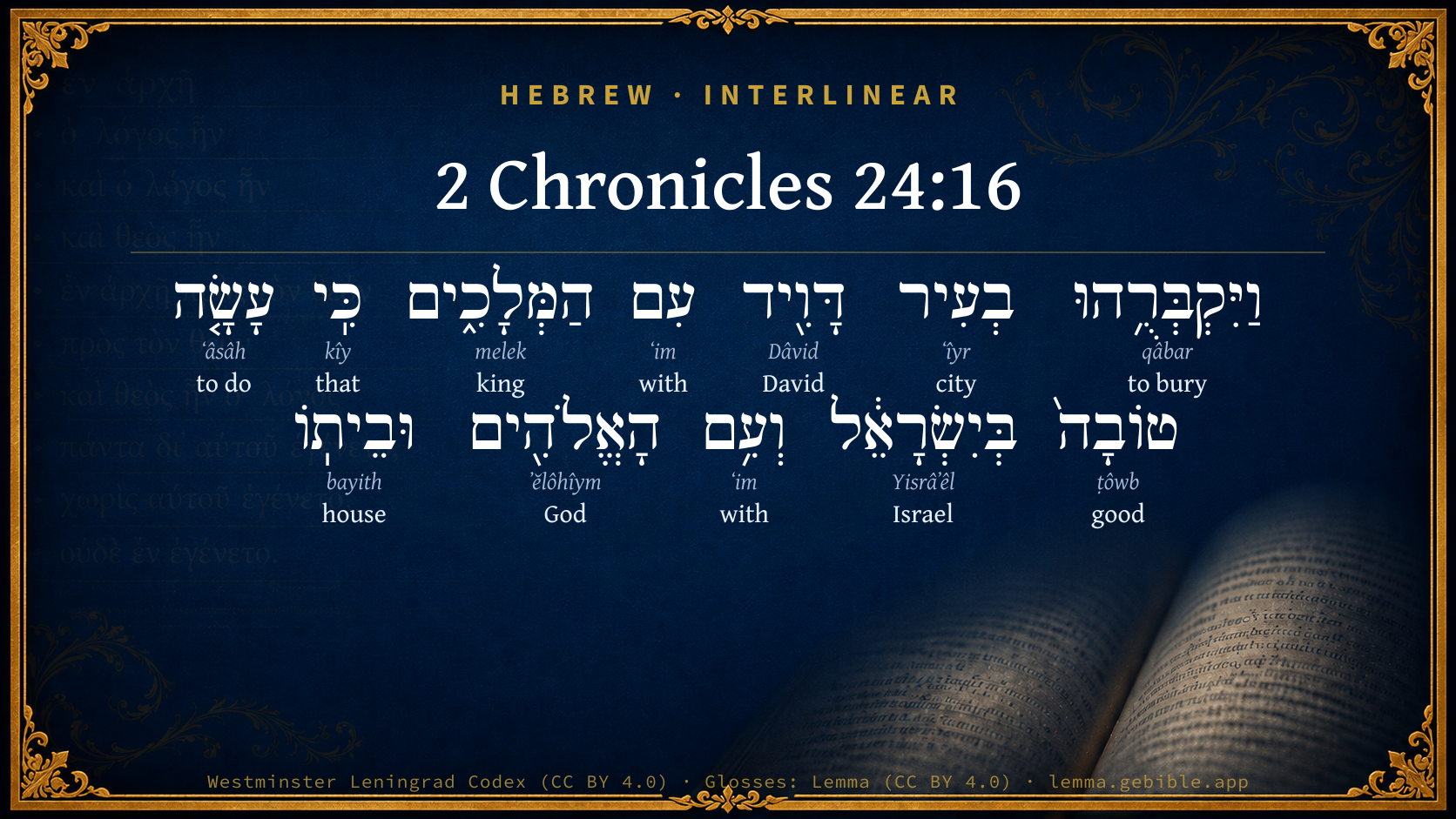
2 Chronicles 24:16

Hebrew (Westminster Leningrad Codex) 2 Chronicles 24:16 appears in the Hebrew Old Testament. The text above is from the Westminster Leningrad Codex. Each word links to its Strong’s number, a concise gloss, and parsing drawn from the Open Scriptures Hebrew Bible morphology. Click any word for its full Brown-Driver-Briggs (BDB) entry.
Download image
Cite this verse

2 Chronicles 24:16 (World English Bible). Public Domain. Lemma interlinear Bible study tool, https://lemma.gebible.app/v/2-chronicles/24/16.

Show BibTeX & RIS
BibTeX
RIS
English Translation
They buried him in the city of David among the kings, because he had done good in Israel, and toward God and his house.
World English Bible · Public Domain
Download a study sheet

One document with this verse’s original text, its word-by-word gloss line, the meaning frame, cross-references with their text, attributed commentary, and full source and license credits — printable, and it pastes into notes with its structure intact.

This verse Autodidact and up

Study sheet (.html) Plain text (.txt)

A passage Seminary Student

Up to 50 verses in one chapter. A passage sheet keeps up to 6 commentary sources and 12 cross-references per verse, in the order this page ranks them, and says so on the sheet whenever that leaves anything out. Ask for a single verse and you get the Autodidact verse sheet above.

Everything on this page stays free to read, with no account — the sheet is a download of what is already on screen, not access to it.

Want to remove ads? Support Godless Engineer
Compare translations 3

The same verse in 3 English versions, stacked beneath the original-language interlinear above. Click any original word for its lexicon entry.

Each is an independent rendering of the whole verse — the interlinear is not word-aligned to these translations.

Highlighted words mark where these versions differ — a whole-verse word diff, not a word-by-word alignment.

  • World English Bible Public Domain
    They buried him in the city of David among the kings, because he had done good in Israel, and toward God and his house.
  • King James Version Public Domain
    And they buried him in the city of David among the kings, because he had done good in Israel, both toward God, and toward his house.
  • unfoldingWord Literal Text CC BY-SA 4.0
    And they buried him in the city of David with the kings, because he did good in Israel and toward God and his house.

unfoldingWord Literal Text — © unfoldingWord, licensed CC BY-SA 4.0. Word-aligned USFM3 via Door43 (git.door43.org/unfoldingWord/en_ult).

Versions to compare (up to 4)

3 of 4 selected

Show all 18 translations

Every available English version of this verse, each an independent rendering of the whole verse.

  • World English Bible Public Domain
    They buried him in the city of David among the kings, because he had done good in Israel, and toward God and his house.
  • Berean Standard Bible Public Domain
    And Jehoiada was buried with the kings in the City of David, because he had done what was good in Israel for God and His temple.
  • Majority Standard Bible Public Domain
    And Jehoiada was buried with the kings in the City of David, because he had done what was good in Israel for God and His temple.
  • King James Version Public Domain
    And they buried him in the city of David among the kings, because he had done good in Israel, both toward God, and toward his house.
  • American Standard Version (1901) Public Domain
    And they buried him in the city of David among the kings, because he had done good in Israel, and toward God and his house.
  • Revised Version (1885) Public Domain
    And they buried him in the city of David among the kings, because he had done good in Israel, and toward God and his house.
  • Geneva Bible (1599) Public Domain
    And they buried him in the citie of Dauid with the kings, because he had done good in Israel, and toward God and his house.
  • Douay-Rheims (1899) Public Domain
    And they buried him in the city of David among the kings, because he had done good to Israel, and to his house.
  • Young's Literal Translation Public Domain
    and they bury him in the city of David, with the kings, for he hath done good in Israel, and with God, and his house.
  • Literal Standard Version CC BY-SA 4.0
    and they bury him in the City of David with the kings, for he has done good in Israel, and with God and his house.
  • Unlocked Literal Bible CC BY-SA 4.0
    They buried him in the city of David among the kings, because he had done good in Israel, toward God, and to God's house.
  • unfoldingWord Literal Text CC BY-SA 4.0
    And they buried him in the city of David with the kings, because he did good in Israel and toward God and his house.
  • Darby Bible Public Domain
    And they buried him in the city of David among the kings, because he had done good in Israel, both toward God and toward his house.
  • World Messianic Bible Public Domain
    They buried him in David’s city among the kings, because he had done good in Israel, and toward God and his house.
  • Webster's Bible Public Domain
    And they buried him in the city of David among the kings, because he had done good in Israel, both towards God, and towards his house.
  • Free Bible Version CC BY-SA 4.0
    He was buried with the kings in the City of David, for all the good he had done in Israel for God and his Temple.
  • Bible in Basic English Public Domain
    And they put him into his last resting-place in the town of David, among the kings, because he had done good in Israel for God and for his house.
  • JPS Tanakh (1917) Public Domain
    And they buried him in the city of David among the kings, because he had done good in Israel, and toward God and His house.

Literal Standard Version (2020), Covenant Press — licensed CC BY-SA 4.0. Text via the HelloAO Bible API (eBible.org). Unlocked Literal Bible (unfoldingWord) — licensed CC BY-SA 4.0. Text via the HelloAO Bible API (eBible.org). unfoldingWord Literal Text — © unfoldingWord, licensed CC BY-SA 4.0. Word-aligned USFM3 via Door43 (git.door43.org/unfoldingWord/en_ult). Free Bible Version, Dr. Jonathan Gallagher — licensed CC BY-SA 4.0. Text via the HelloAO Bible API (eBible.org).

Word by word

More ways to search: Search by grammar → Find every occurrence → Compare this word →

Practice this passage: Drill this verse → Learn its vocabulary →

וַיִּקְבְּרֻ֥הוּ
qâbar
H6912
“and · to bury · him”
Conjunction + Verb, Qal, Sequential Imperfect, 3rd Person, Masculine, Plural + Suffix, Personal, 3rd Person, Masculine, Singular
Part of Speech
Conjunction + Verb
Stem
Qal
Form
Sequential Imperfect
Person
3rd Person
Gender
Masculine
Number
Plural
Full BDB Definition

Origin: a primitive root

TWOT: 1984

to bury - (Qal) to bury - (Niphal) to be buried - (Piel) to bury, bury (in masses) - (Pual) to be buried
  1. בְעִיר ʻîyr H5892 “in/at · city of” Preposition + Noun, Common, Feminine, Singular, Construct
  2. דָּוִ֖יד Dâvid H1732 “David” Noun, Proper
  3. עִם ʻim H5973 “with” Preposition
  4. הַמְּלָכִ֑ים melek H4428 “the · kings” Particle, Definite Article + Noun, Common, Masculine, Plural, Absolute
  5. כִּֽי kîy H3588 “that” Conjunction
  6. עָשָׂ֤ה ʻâsâh H6213 “to do” Verb, Qal, Perfect, 3rd Person, Masculine, Singular
  7. טוֹבָה֙ ṭôwb H2896 “good” Adjective, Adjective, Feminine, Singular, Absolute
  8. בְּיִשְׂרָאֵ֔ל Yisrâʼêl H3478 “in/at · Israel” Preposition + Noun, Proper
  9. וְעִ֥ם ʻim H5973 “and · with” Conjunction + Preposition
  10. הָאֱלֹהִ֖ים ʼĕlôhîym H430 “the · God(s)” Particle, Definite Article + Noun, Common, Masculine, Plural, Absolute
  11. וּבֵיתֽוֹ bayith H1004 “and · house · his” Conjunction + Noun, Common, Masculine, Singular, Construct + Suffix, Personal, 3rd Person, Masculine, Singular

About this verse

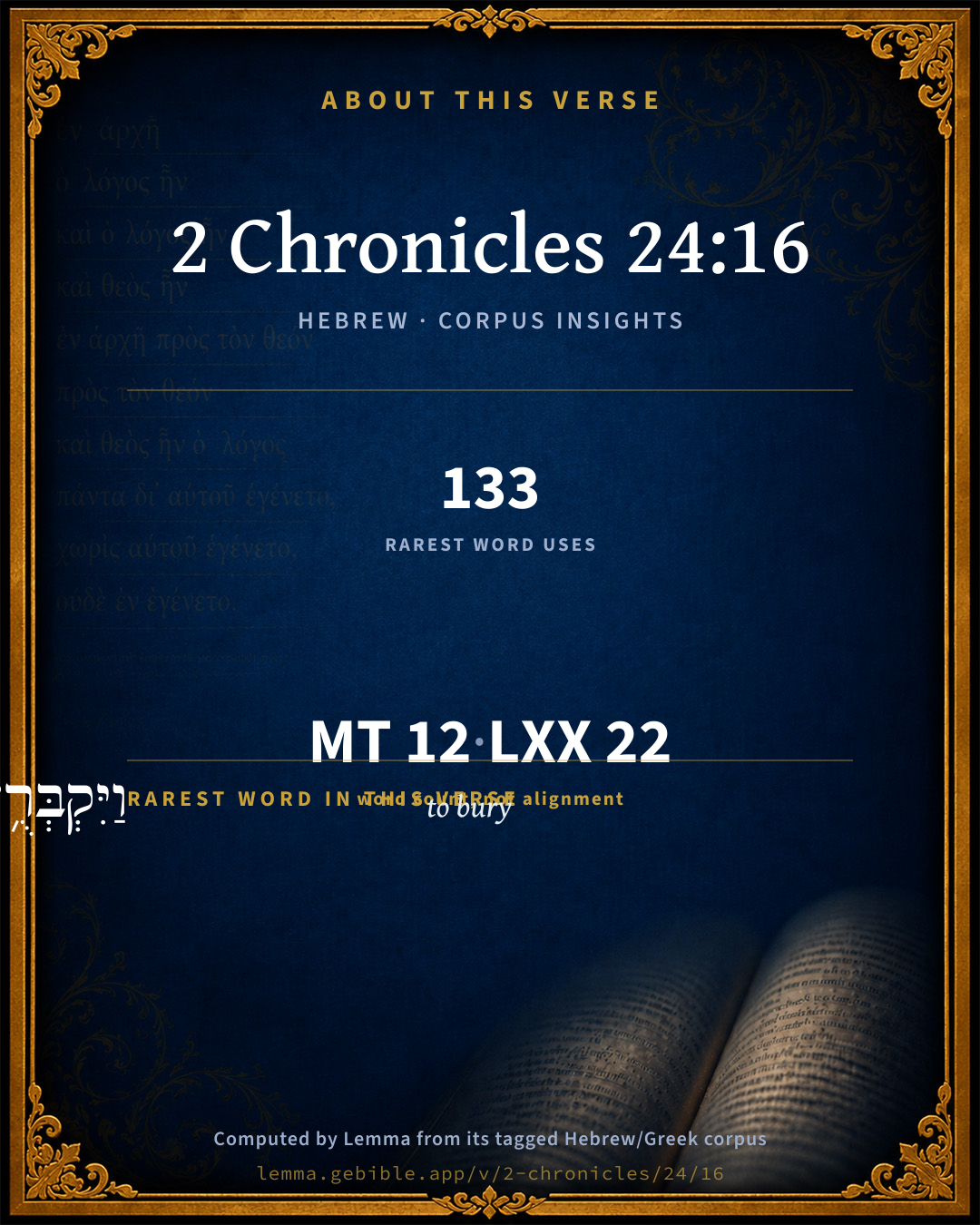
These counts appear in no published source. They are computed here, from the morphology-tagged text and Lemma’s own curated glosses. What Lemma adds →

12
words
11
distinct lemmas
Historical
section

Grammatical profile

  • 2 verbs
  • 6 nouns
  • 1 adjective
  • 2 prepositions
  • 1 conjunction

Verb forms

  • וַיִּקְבְּרֻ֥הוּ Qal · Sequential Imperfect
  • עָשָׂ֤ה Qal · Perfect

Repetition

A word recurs within this verse — often emphatic in Hebrew:

Hebrew & Septuagint length

In English translation the verse runs 24 words from the Hebrew and 25 from the Septuagint (LXX English) — closely comparable.

A rough comparison of the two English renderings, which tokenize alike — not a word-level alignment.

Word counts can differ between the Hebrew and the Greek without any difference in meaning — e.g. the Hebrew direct-object marker אֵת has no separate Greek word, and Greek often adds the article ὁ.

In the original languages it is 12 Hebrew tokens and 22 Greek tokens — but the two are counted differently (Hebrew bundles its prefixes and suffixes into one token; the Greek is in lemma form), so that isn’t a like-for-like length.

Cross-references

7

Topical passages linked to 2 Chronicles 24:16 in the Treasury of Scripture Knowledge — connected by theme and wording, ordered by reader-vote popularity; previews shown in the World English Bible.

  • Hebrews 6:10 For God is not unrighteous, so as to forget your work and the labor of love which you showed toward his name, in that you served the saints, and still do serve them.
  • 2 Chronicles 31:20 Thus did Hezekiah throughout all Judah; and he worked that which was good and right and faithful before Yahweh his God.
  • Nehemiah 13:14 Remember me, my God, concerning this, and don't wipe out my good deeds that I have done for the house of my God, and for the observances of it.
  • 1 Samuel 2:30 Therefore Yahweh, the God of Israel, says, I said indeed that your house, and the house of your father, should walk before me forever: but now Yahweh says, Be it far from me; for those who honor me I will honor, and those who despise me shall be lightly esteemed.
  • 1 Kings 2:10 David slept with his fathers, and was buried in the city of David.
  • 2 Chronicles 23:1–21 In the seventh year Jehoiada strengthened himself, and took the captains of hundreds, Azariah the son of Jeroham, and Ishmael the son of Jehohanan, and Azariah the son of Obed, and Maaseiah the son of Adaiah, and Elishaphat the son of Zichri, into covenant with him.
  • Acts 2:29 "Brothers, I may tell you freely of the patriarch David, that he both died and was buried, and his tomb is with us to this day.

Cross-references courtesy of OpenBible.info (CC BY 4.0).

Hebrew and Greek witnesses Masoretic Hebrew ↔ Greek Septuagint

The same verse in the two great witnesses to the Old Testament, shown verse-for-verse.

These are two independent witnesses, not word-aligned to each other, and the Septuagint is shown in lemma (dictionary) form.

Hebrew 2 Chronicles 24:16 Masoretic · Westminster Leningrad Codex

וַיִּקְבְּרֻ֥הוּ בְעִיר דָּוִ֖יד עִם הַמְּלָכִ֑ים כִּֽי עָשָׂ֤ה טוֹבָה֙ בְּיִשְׂרָאֵ֔ל וְעִ֥ם הָאֱלֹהִ֖ים וּבֵיתֽוֹ

They buried him in the city of David among the kings, because he had done good in Israel, and toward God and his house.

World English Bible · Public Domain

Greek LXX 2 Chronicles 24:16 Septuagint · lemma form

καί θάπτω αὐτός ἐν πόλις δαυίδ μετά ὁ βασιλεύς ὅτι ποιέω ἀγαθωσύνη μετά ἰσραήλ καί μετά ὁ θεός καί ὁ οἶκος αὐτός

And they buried him with the kings in the city of David, because he had dealt well with Israel, and with God and his house.

LXX2012 (modern English Septuagint) · Public Domain

Hebrew: Westminster Leningrad Codex (CC BY 4.0). Greek: Septuagint (public domain); English from LXX2012 (modern English Septuagint) (Public Domain). How the Septuagint differs from the Hebrew →

Commentary

Notes on 2 Chronicles 24:16 from classic Christian and Jewish commentators (each source and its license shown beneath its notes). The classic Christian expositions comment on the surrounding passage and are grouped to its opening verse, so a note may address several verses; the Jewish commentaries on the Tanakh (Rashi and others) are per-verse, so they appear only where the commentator wrote on this verse.

Lemma curates 59 commentaries, every one of them public domain or Creative Commons licensed, each selected and text-cleaned for this edition rather than reprinted as found. About our sources →

Trapp's Complete Commentary

John Trapp

2Ch 24:16 And they buried him in the city of David among the kings, because he had done good in Israel, both toward God, and toward his house.

Ver. 16. And they buried him among the kings.] A great honour surely, the like whereunto was lately done here to that most reverend archbishop Ussher, {a} who, though Jehoiada-like he had done much good in our Irish and English Israel, both towards God and toward his house, as it is here, yet died praying for pardon of his sins, and in special of his omissions, though he was never known to omit an hour, but ever employed in his Master’s business.

{a} Narration of his life and death by Dr Bernard.

John Trapp, A Commentary or Exposition upon All the Books of the Old and New Testament (1647–1656) — public domain. Text from a community e-Sword module.

Geneva Bible (1599)

Geneva Bible translators

Signifying that they could not honor him too much, who had so excellently served in the work of the Lord, and in the affairs of the commonwealth.

Geneva Bible (1599) marginal notes — public domain. Text via Bolls.life.

Adam Clarke's Commentary

Verse 16. They buried him - among the kings] He had, in fact, been king in Judah; for Joash, who appears to have been a weak man, was always under his tutelage. Jehoiada governed the state in the name of the king; and his being buried among the kings is a proof of the high estimation in which he was held among the people.

Adam Clarke's Commentary on the Bible (1810–1826) — public domain. Text from a community e-Sword/MySword module.

Ellicott's Commentary for English Readers

(16) Among the kings.—Literally, with. “Because he had done good;” and also, perhaps, as having been regent for so many years, and connected by marriage with the royal house (2Ch_22:11).

A Bible Commentary for English Readers, edited by Charles John Ellicott (1878–1897) — public domain. Text from a community e-Sword module.

The Cambridge Bible for Schools and Colleges

gen. ed. J. J. S. Perowne

16. among the kings] Cp. 2Ch_24:25 and 2Ch_21:20.

The Cambridge Bible for Schools and Colleges (gen. ed. J. J. S. Perowne; Cambridge University Press, 1878–1918) — public domain. Text from a community e-Sword module.

John Gill's Exposition

And they left the house of the Lord God of their fathers,.... Came no more to the temple at Jerusalem, forsook the worship and service of it:

and served groves and idols; worshipped idols in groves, which were upon high places:

and wrath came upon Judah and Jerusalem for this their trespass: their idolatry, and particularly on these princes, the Syrian army coming against them, and destroying them, Ch2 24:23.

John Gill's Exposition of the Whole Bible (1746–1763) — public domain (CC PDM 1.0). Text via the HelloAO Bible API.

Albert Barnes' Notes on the Bible

They buried him in the city of David among the kings - This unparalleled honor, due in part to the respect felt for Jehoiada’s religious character, was probably, also, in part attributable to his connection with the royal family through his wife 2Ch 22:11, and to the fact that, for 10 or 12 years, he had practically held the kingly office.

Toward his house - “i. e. toward God’s house,” the temple.

Albert Barnes' Notes on the Bible (1834–1885) — public domain. Text from a community e-Sword/MySword module.

Haydock's Catholic Bible Commentary

Israel, particularly to those of the kingdom of Juda. H. --- His, David’s, house, (M.) as he had restored the crown to his offspring.

George Leo Haydock (1774–1849), Haydock's Catholic Family Bible and Commentary, 1859 edition — public domain. Excludes Psalms (Douay-Rheims chapter numbering differs from Protestant) and Deuterocanonical books (Catholic canon only).

Matthew Poole's English Annotations

He had done good in Israel, i.e. in Judah, which was an eminent part of Israel, and the only part of it which owned God, or was owned by God as his Israel, to whom therefore he oft appropriates this name, thereby signifying that the other tribes were unworthy of that honourable title, and had forfeited all their right in it to Judah. See Poole "2Ch 21:2".

Matthew Poole's English Annotations on the Holy Bible (1683–1685) — public domain. Text from a community e-Sword/MySword module.

The Pulpit Commentary

The honour done Jehoiada well belonged to him, not only for his goodness, his greatness, his practical services to the kingdom, but for the fact that those practical services had entailed the necessity of his standing in loco regis for some time. His royal alliance with Jeheram"s daughter, and, if it were so, his extreme patriarchal age, may all have contributed to the honour now put upon him. Little stress can be laid, however, upon this last consideration, failing any other allusion to it, or any emphasized statement of what we have in our ver. 15.

The Pulpit Commentary (1880–1919), ed. H.D.M. Spence-Jones & Joseph S. Exell — public domain. Text from a community e-Sword module.

John Wesley's Explanatory Notes

Israel - In Judah, which was an eminent part of Israel, and the only part of it which owned God, or was owned by God as his Israel, to whom therefore he often appropriates this name.

John Wesley, Explanatory Notes Upon the Whole Bible (1754–1765) — public domain. Text via the GEBible commentary corpus.

Lesson kit

Teaching starters — assembled from the data on this page, not authored interpretation. Every prompt links to the verse data it draws on. Edit before teaching.

2 Chronicles, in the Historical, opens this verse with 12 words (11 distinct Hebrew lemmas). Its most distinctive word is qâbar (“to bury”). A historical commentator’s framing appears above. Read the whole chapter for the surrounding context.

Discussion questions

  1. How does “to bury” (qâbar) shape what this verse is saying?
  2. How does Hebrews 6:10, which shares this passage’s theme, read alongside this verse?
  3. What does the repetition of “with” (2× in this one verse) do in this verse?
  4. These translations render this verse differently; the difference is in the English rendering, not the original. What questions does that raise?
  5. «וַיִּקְבְּרֻ֥הוּ» is a Qal Sequential Imperfect verb. How does that grammatical form shape the action described?
  6. Compare how Trapp's Complete Commentary and Geneva Bible (1599) read this verse. Where do they agree or differ?

Things to notice

Reading settings

Reading text

Shown beneath each verse's original-language words.

Old Testament
Old Testament edition

Read the OT as the Masoretic Hebrew (MT) or the Greek Septuagint (LXX).

English shown for the Greek Septuagint (in the Hebrew ↔ Greek comparison).

Comparing translations? Open the Compare panel on any verse page to stack up to four side by side.