
1 Chronicles 21:26

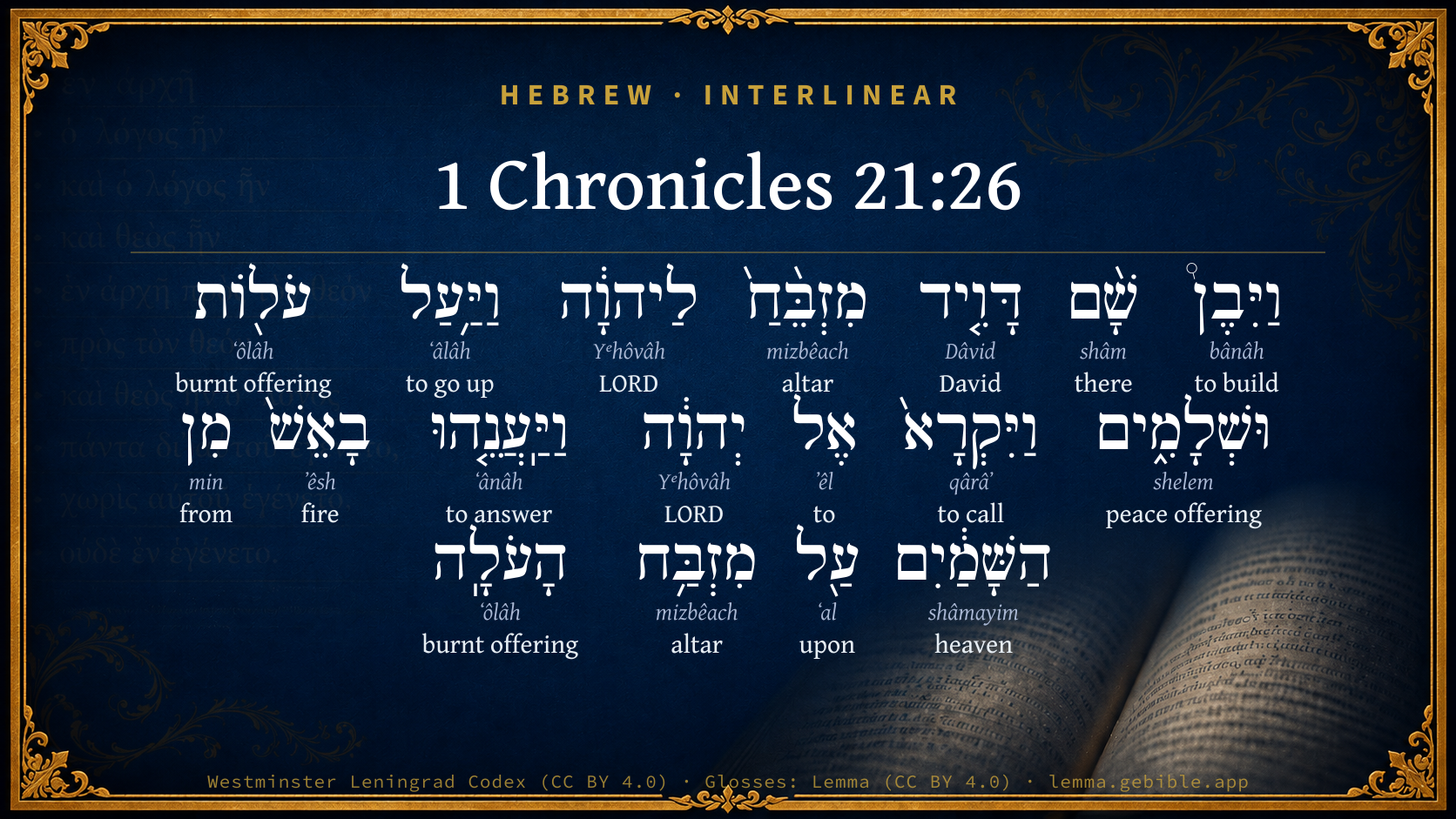
Hebrew (Westminster Leningrad Codex) 1 Chronicles 21:26 appears in the Hebrew Old Testament. The text above is from the Westminster Leningrad Codex. Each word links to its Strong’s number, a concise gloss, and parsing drawn from the Open Scriptures Hebrew Bible morphology. Click any word for its full Brown-Driver-Briggs (BDB) entry.
Download image
Cite this verse

1 Chronicles 21:26 (World English Bible). Public Domain. Lemma interlinear Bible study tool, https://lemma.gebible.app/v/1-chronicles/21/26.

Show BibTeX & RIS
BibTeX
RIS
English Translation
David built there an altar to Yahweh, and offered burnt offerings and peace-offerings, and called on Yahweh; and he answered him from the sky by fire on the altar of burnt offering.
World English Bible · Public Domain
Download a study sheet

One document with this verse’s original text, its word-by-word gloss line, the meaning frame, cross-references with their text, attributed commentary, and full source and license credits — printable, and it pastes into notes with its structure intact.

This verse Autodidact and up

Study sheet (.html) Plain text (.txt)

A passage Seminary Student

Up to 50 verses in one chapter. A passage sheet keeps up to 6 commentary sources and 12 cross-references per verse, in the order this page ranks them, and says so on the sheet whenever that leaves anything out. Ask for a single verse and you get the Autodidact verse sheet above.

Everything on this page stays free to read, with no account — the sheet is a download of what is already on screen, not access to it.

Want to remove ads? Support Godless Engineer
Compare translations 3

The same verse in 3 English versions, stacked beneath the original-language interlinear above. Click any original word for its lexicon entry.

Each is an independent rendering of the whole verse — the interlinear is not word-aligned to these translations.

Highlighted words mark where these versions differ — a whole-verse word diff, not a word-by-word alignment.

  • World English Bible Public Domain
    David built there an altar to Yahweh, and offered burnt offerings and peace-offerings, and called on Yahweh; and he answered him from the sky by fire on the altar of burnt offering.
  • King James Version Public Domain
    And David built there an altar unto the LORD, and offered burnt offerings and peace offerings, and called upon the LORD; and he answered him from heaven by fire upon the altar of burnt offering.
  • unfoldingWord Literal Text CC BY-SA 4.0
    And David built there an altar to Yahweh, and he offered burnt offerings and peace offerings. And he called to Yahweh, and he answered him with fire from the heavens on the altar of the burnt offering.

unfoldingWord Literal Text — © unfoldingWord, licensed CC BY-SA 4.0. Word-aligned USFM3 via Door43 (git.door43.org/unfoldingWord/en_ult).

Versions to compare (up to 4)

3 of 4 selected

Show all 18 translations

Every available English version of this verse, each an independent rendering of the whole verse.

  • World English Bible Public Domain
    David built there an altar to Yahweh, and offered burnt offerings and peace-offerings, and called on Yahweh; and he answered him from the sky by fire on the altar of burnt offering.
  • Berean Standard Bible Public Domain
    And there he built an altar to the LORD and offered burnt offerings and peace offerings. He called upon the LORD, who answered him with fire from heaven on the altar of burnt offering.
  • Majority Standard Bible Public Domain
    And there he built an altar to the LORD and offered burnt offerings and peace offerings. He called upon the LORD, who answered him with fire from heaven on the altar of burnt offering.
  • King James Version Public Domain
    And David built there an altar unto the LORD, and offered burnt offerings and peace offerings, and called upon the LORD; and he answered him from heaven by fire upon the altar of burnt offering.
  • American Standard Version (1901) Public Domain
    And David built there an altar unto Jehovah, and offered burnt-offerings and peace-offerings, and called upon Jehovah; and he answered him from heaven by fire upon the altar of burnt-offering.
  • Revised Version (1885) Public Domain
    And David built there an altar unto the LORD, and offered burnt offerings and peace offerings, and called upon the LORD; and he answered him from heaven by fire upon the altar of burnt offering.
  • Geneva Bible (1599) Public Domain
    And Dauid built there an altar vnto the Lord, and offred burnt offrings, and peace offrings, and called vpon the Lord, and he answered him by fire from heauen vpon the altar of burnt offring.
  • Douay-Rheims (1899) Public Domain
    So David gave to Ornan for the place, six hundred sides of gold of just weight.
  • Young's Literal Translation Public Domain
    and David buildeth there an altar to Jehovah, and offereth burnt-offerings and peace-offerings, and calleth unto Jehovah, and He answereth him with fire from the heavens on the altar of the burnt-offering.
  • Literal Standard Version CC BY-SA 4.0
    and David builds an altar to YHWH there, and offers burnt-offerings and peace-offerings, and calls to YHWH, and He answers him from the heavens with fire on the altar of the burnt-offering.
  • Unlocked Literal Bible CC BY-SA 4.0
    David built an altar for Yahweh there and offered on it burnt offerings and fellowship offerings. He called on Yahweh, who answered him with fire from heaven on the altar for burnt offerings.
  • unfoldingWord Literal Text CC BY-SA 4.0
    And David built there an altar to Yahweh, and he offered burnt offerings and peace offerings. And he called to Yahweh, and he answered him with fire from the heavens on the altar of the burnt offering.
  • Darby Bible Public Domain
    And David built there an altar to Jehovah, and offered up burnt-offerings and peace-offerings, and called upon Jehovah; and he answered him from the heavens by fire upon the altar of burnt-offering.
  • World Messianic Bible Public Domain
    David built an altar to the LORD there, and offered burnt offerings and peace offerings, and called on the LORD; and he answered him from the sky by fire on the altar of burnt offering.
  • Webster's Bible Public Domain
    And David built there an altar to the LORD, and offered burnt-offerings and peace-offerings, and called upon the LORD; and he answered him from heaven by fire upon the altar of burnt-offering.
  • Free Bible Version CC BY-SA 4.0
    David built an altar to the Lord there and presented burnt offerings and friendship offerings. He called on the Lord in prayer, and the Lord answered him with fire from heaven on the altar of burnt offering.
  • Bible in Basic English Public Domain
    And David put up an altar there to the Lord, offering burned offerings and peace-offerings with prayers to the Lord; and he gave him an answer from heaven, sending fire on the altar of burned offering.
  • JPS Tanakh (1917) Public Domain
    And David built there an altar unto the LORD, and offered burnt-offerings and peace-offerings, and called upon the LORD; and He answered him from heaven by fire upon the altar of burnt-offering.

Literal Standard Version (2020), Covenant Press — licensed CC BY-SA 4.0. Text via the HelloAO Bible API (eBible.org). Unlocked Literal Bible (unfoldingWord) — licensed CC BY-SA 4.0. Text via the HelloAO Bible API (eBible.org). unfoldingWord Literal Text — © unfoldingWord, licensed CC BY-SA 4.0. Word-aligned USFM3 via Door43 (git.door43.org/unfoldingWord/en_ult). Free Bible Version, Dr. Jonathan Gallagher — licensed CC BY-SA 4.0. Text via the HelloAO Bible API (eBible.org).

Word by word

More ways to search: Search by grammar → Find every occurrence → Compare this word →

Practice this passage: Drill this verse → Learn its vocabulary →

וּשְׁלָמִ֑ים
shelem
H8002
“and · peace offerings”
Conjunction + Noun, Common, Masculine, Plural, Absolute
Part of Speech
Conjunction + Noun
Type
Common
Gender
Masculine
Number
Plural
State
Absolute
Full BDB Definition

Origin: from H7999

TWOT: 2401b

peace offering, requital, sacrifice for alliance or friendship - voluntary sacrifice of thanks
  1. וַיִּבֶן֩ bânâh H1129 “and · to build” Conjunction + Verb, Qal, Sequential Imperfect, 3rd Person, Masculine, Singular
  2. שָׁ֨ם shâm H8033 “there” Adverb
  3. דָּוִ֤יד Dâvid H1732 “David” Noun, Proper
  4. מִזְבֵּ֨חַ֙ mizbêach H4196 “altar” Noun, Common, Masculine, Singular, Absolute
  5. לַיהוָ֔ה Yᵉhôvâh H3068 “to/for · LORD” Preposition + Noun, Proper
  6. וַיַּ֥עַל ʻâlâh H5927 “and · to go up” Conjunction + Verb, Hiphil, Sequential Imperfect, 3rd Person, Masculine, Singular
  7. עֹל֖וֹת ʻôlâh H5930 “burnt offerings” Noun, Common, Feminine, Plural, Absolute
  8. וַיִּקְרָא֙ qârâʼ H7121 “and · to call” Conjunction + Verb, Qal, Sequential Imperfect, 3rd Person, Masculine, Singular
  9. אֶל ʼêl H413 “to” Preposition
  10. יְהוָ֔ה Yᵉhôvâh H3068 “LORD” Noun, Proper
  11. וַיַּֽעֲנֵ֤הוּ ʻânâh H6030 “and · to answer · him” Conjunction + Verb, Qal, Sequential Imperfect, 3rd Person, Masculine, Singular + Suffix, Personal, 3rd Person, Masculine, Singular
  12. בָאֵשׁ֙ ʼêsh H784 “in/at the · fire” Preposition, Determined + Noun, Common, Both, Singular, Absolute
  13. מִן min H4480 “from” Preposition
  14. הַשָּׁמַ֔יִם shâmayim H8064 “the · heaven(s)” Particle, Definite Article + Noun, Common, Masculine, Plural, Absolute
  15. עַ֖ל ʻal H5921 “upon” Preposition
  16. מִזְבַּ֥ח mizbêach H4196 “altar of” Noun, Common, Masculine, Singular, Construct
  17. הָעֹלָֽה ʻôlâh H5930 “the · burnt offering” Particle, Definite Article + Noun, Common, Feminine, Singular, Absolute

About this verse

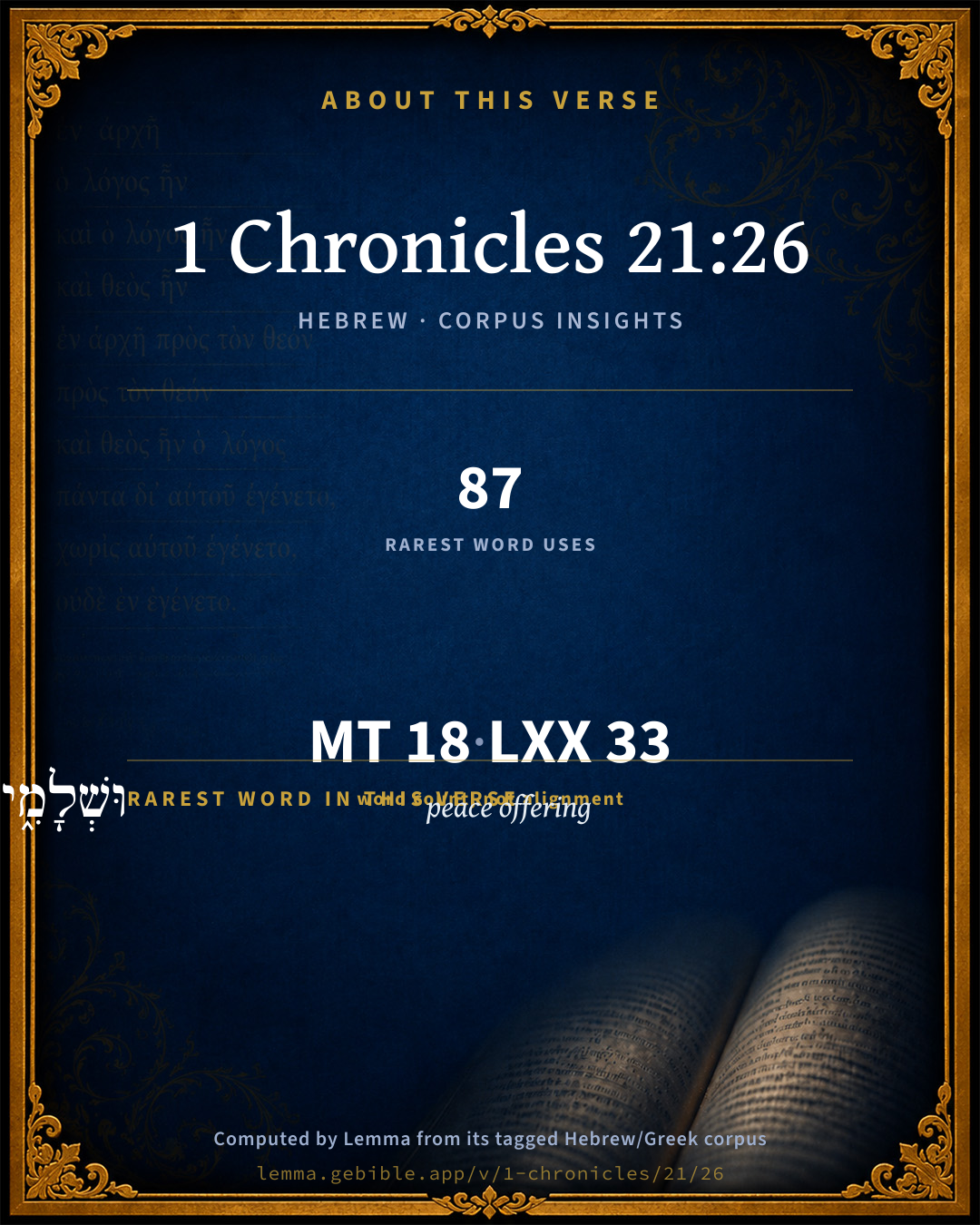
These counts appear in no published source. They are computed here, from the morphology-tagged text and Lemma’s own curated glosses. What Lemma adds →

18
words
15
distinct lemmas
Historical
section

Grammatical profile

  • 4 verbs
  • 10 nouns
  • 3 prepositions
  • 1 adverb

Verb forms

  • וַיִּבֶן֩ Qal · Sequential Imperfect
  • וַיַּ֥עַל Hiphil · Sequential Imperfect
  • וַיִּקְרָא֙ Qal · Sequential Imperfect
  • וַיַּֽעֲנֵ֤הוּ Qal · Sequential Imperfect

Repetition

Words recur within this verse — often emphatic in Hebrew:

  • מִזְבֵּ֨חַ֙ altar H4196 ×2
  • לַיהוָ֔ה LORD H3068 ×2
  • עֹל֖וֹת burnt offering H5930 ×2

Hebrew & Septuagint length

In English translation the verse runs 32 words from the Hebrew and 46 from the Septuagint (LXX English) — the Septuagint runs noticeably longer here. See the side-by-side →

A rough comparison of the two English renderings, which tokenize alike — not a word-level alignment.

Word counts can differ between the Hebrew and the Greek without any difference in meaning — e.g. the Hebrew direct-object marker אֵת has no separate Greek word, and Greek often adds the article ὁ.

In the original languages it is 18 Hebrew tokens and 33 Greek tokens — but the two are counted differently (Hebrew bundles its prefixes and suffixes into one token; the Greek is in lemma form), so that isn’t a like-for-like length.

Cross-references

16

Topical passages linked to 1 Chronicles 21:26 in the Treasury of Scripture Knowledge — connected by theme and wording, ordered by reader-vote popularity; previews shown in the World English Bible.

  • Leviticus 9:24 There came forth fire from before Yahweh, and consumed the burnt offering and the fat upon the altar: and when all the people saw it, they shouted, and fell on their faces.
  • Judges 6:21 Then the angel of Yahweh put forth the end of the staff that was in his hand, and touched the flesh and the unleavened cakes; and there went up fire out of the rock, and consumed the flesh and the unleavened cakes; and the angel of Yahweh departed out of his sight.
  • 1 Kings 18:38 Then the fire of Yahweh fell, and consumed the burnt offering, and the wood, and the stones, and the dust, and licked up the water that was in the trench.
  • Proverbs 15:8 The sacrifice made by the wicked is an abomination to Yahweh, But the prayer of the upright is his delight.
  • Exodus 20:24–25 You shall make an altar of earth for me, and shall sacrifice on it your burnt offerings and your peace-offerings, your sheep and your oxen. In every place where I record my name I will come to you and I will bless you.
  • Exodus 24:4–5 Moses wrote all the words of Yahweh, and rose up early in the morning, and built an altar under the mountain, and twelve pillars for the twelve tribes of Israel.
  • Judges 13:20 For it happened, when the flame went up toward the sky from off the altar, that the angel of Yahweh ascended in the flame of the altar: and Manoah and his wife looked on; and they fell on their faces to the ground.
  • 1 Samuel 7:8–9 The children of Israel said to Samuel, "Don't cease to cry to Yahweh our God for us, that he will save us out of the hand of the Philistines."
  • 1 Kings 18:24 You call on the name of your god, and I will call on the name of Yahweh; and the God who answers by fire, let him be God." All the people answered, "It is well said."
  • 2 Chronicles 3:1 Then Solomon began to build the house of Yahweh at Jerusalem on Mount Moriah, where [Yahweh] appeared to David his father, which he made ready in the place that David had appointed, in the threshing floor of Ornan the Jebusite.
  • 2 Chronicles 7:1 Now when Solomon had made an end of praying, the fire came down from heaven, and consumed the burnt offering and the sacrifices; and the glory of Yahweh filled the house.
  • Psalms 51:15 Lord, open my lips. My mouth shall declare your praise.
  • Psalms 91:15 He will call on me, and I will answer him. I will be with him in trouble. I will deliver him, and honor him.
  • Psalms 99:9 Exalt Yahweh, our God. Worship at his holy hill, For Yahweh, our God, is holy!
  • Isaiah 65:24 It shall happen that, before they call, I will answer; and while they are yet speaking, I will hear.
  • Jeremiah 33:3 Call to me, and I will answer you, and will show you great things, and difficult, which you don't know.

Cross-references courtesy of OpenBible.info (CC BY 4.0).

Hebrew and Greek witnesses Masoretic Hebrew ↔ Greek Septuagint

The same verse in the two great witnesses to the Old Testament, shown verse-for-verse.

Here the Septuagint runs noticeably longer than the Hebrew — LXX2012 (modern English Septuagint) 46 words vs World English Bible 32. A rough length comparison of the two English translations, not a word-level alignment — read both below.

These are two independent witnesses, not word-aligned to each other, and the Septuagint is shown in lemma (dictionary) form.

Hebrew 1 Chronicles 21:26 Masoretic · Westminster Leningrad Codex

וַיִּבֶן֩ שָׁ֨ם דָּוִ֤יד מִזְבֵּ֨חַ֙ לַיהוָ֔ה וַיַּ֥עַל עֹל֖וֹת וּשְׁלָמִ֑ים וַיִּקְרָא֙ אֶל יְהוָ֔ה וַיַּֽעֲנֵ֤הוּ בָאֵשׁ֙ מִן הַשָּׁמַ֔יִם עַ֖ל מִזְבַּ֥ח הָעֹלָֽה

David built there an altar to Yahweh, and offered burnt offerings and peace-offerings, and called on Yahweh; and he answered him from the sky by fire on the altar of burnt offering.

World English Bible · Public Domain

Greek LXX 1 Chronicles 21:26 Septuagint · lemma form

καί οἰκοδομέω δαυίδ ἐκεῖ θυσιαστήριον κύριος καί ἀναφέρω ὁλοκαύτωμα καί σωτήριον καί βοάω πρός κύριος καί ἐπιἀκούω αὐτός ἐν πῦρ ἐκ ὁ οὐρανός ἐπί ὁ θυσιαστήριον ὁ ὁλοκαύτωσις καί κατα ἀναἁλίσκω ὁ ὁλοκαύτωσις

And David built there an altar to the Lord, and offered up whole burnt offerings and peace-offerings: and he cried to the Lord, and he answered him by fire out of heaven on the altar of whole burnt offerings, and it consumed the whole burnt offering.

LXX2012 (modern English Septuagint) · Public Domain

On this verse, The Cambridge Bible for Schools and Colleges discusses the Septuagint’s reading. Read the note in Commentary ↓

Hebrew: Westminster Leningrad Codex (CC BY 4.0). Greek: Septuagint (public domain); English from LXX2012 (modern English Septuagint) (Public Domain). How the Septuagint differs from the Hebrew →

Commentary

Notes on 1 Chronicles 21:26 from classic Christian and Jewish commentators (each source and its license shown beneath its notes). The classic Christian expositions comment on the surrounding passage and are grouped to its opening verse, so a note may address several verses; the Jewish commentaries on the Tanakh (Rashi and others) are per-verse, so they appear only where the commentator wrote on this verse.

Lemma curates 59 commentaries, every one of them public domain or Creative Commons licensed, each selected and text-cleaned for this edition rather than reprinted as found. About our sources →

Joseph Benson's Commentary

1Ch 21:26. He answered him from heaven by fire — Hebrew, by fire from heaven; which was a sign of God’s acceptance. The fire that might justly have fastened on the sinner, fastened upon the sacrifice and consumed it. Thus Christ was made sin and a curse for us, and it pleased the Lord to bruise him, that through him God might be to us, not a consuming fire, but a reconciled Father.

Joseph Benson's Commentary on the Old and New Testaments (1811–1818) — public domain. Text from a community e-Sword module.

Tyndale Open Study Notes

Tyndale Open Resources

21:26–22:1 The census and plague led up to the dedication of Araunah’s threshing floor as the site for the new sanctuary. Typically, offerings would have been made at Gibeon, where the Tabernacle was located (see 16:39; 21:29; 2 Chr 1:3). The halting of the plague at the threshing floor enabled David to make offerings there in accordance with the word he received through Gad the seer (1 Chr 21:18). David then designated the new location for the future Temple of the Lord God.

Tyndale Open Study Notes — © Tyndale Open Resources, licensed CC BY-SA 4.0. Text via the HelloAO Bible API.

Geneva Bible (1599)

Geneva Bible translators

God declared that he heard his request, in that he sent down fire from heaven, for else they might use no fire in sacrifice, but of that which was reserved still upon the altar, Lev. 6:13, and came down from heaven, Lev. 9:24, as appeared by the punishment of Nadab and Abihu, Lev. 10:1.

Geneva Bible (1599) marginal notes — public domain. Text via Bolls.life.

Jamieson, Fausset & Brown

Robert Jamieson, A. R. Fausset & David Brown

David built there an altar--He went in procession with his leading men from the royal palace, down Mount Zion, and through the intervening city. Although he had plenty of space on his own property, he was commanded, under peremptory direction, to go a considerable distance from his home, up Mount Moriah, to erect an altar on premises which he had to buy. It was on or close to the spot where Abraham had offered up Isaac.

answered him by fire from heaven--(See Lev 9:24; Kg1 18:21-23; Kg2 1:12; Ch2 7:1).

Jamieson, Fausset & Brown — Commentary Critical and Explanatory on the Whole Bible (1871) — public domain (CC PDM 1.0). Text via the HelloAO Bible API.

Adam Clarke's Commentary

Verse 26. He answered him - by fire] In answer to David's prayers, God, to show that he had accepted him, and was now pacified towards him and the people, sent fire from heaven and consumed the offerings.

Adam Clarke's Commentary on the Bible (1810–1826) — public domain. Text from a community e-Sword/MySword module.

Ellicott's Commentary for English Readers

(26) And David built . . . peace offerings.—Word for word as in Samuel.

And called upon the Lord.—Not in Samuel, where the narrative ends with the words, “And the Lord was entreated for the land, and the plague was stayed from Israel.”

From heaven by fire (with the fire from the heavens).—The Divine inauguration of the new altar and place of sacrifice. (See Lev_9:24; 1Ki_18:24; 1Ki_18:38—Elijah’s sacrifice; 2Ch_7:1.) Also a sign that David’s prayer was heard.

A Bible Commentary for English Readers, edited by Charles John Ellicott (1878–1897) — public domain. Text from a community e-Sword module.

The Cambridge Bible for Schools and Colleges

gen. ed. J. J. S. Perowne

26. peace offerings] See 1Ch_16:1, note. At the end of the verse LXX. (cp. Pesh.) adds, and consumed the burnt offering. Cp. 1Ki_18:38. The fire is not mentioned in 2 Sam.

The Cambridge Bible for Schools and Colleges (gen. ed. J. J. S. Perowne; Cambridge University Press, 1878–1918) — public domain. Text from a community e-Sword module.

Albert Barnes' Notes on the Bible

He answered him from heaven by fire - This fact is not mentioned by the author of Samuel, since his object is to give an account of the sin of David, its punishment, and the circumstances by which that punishment was brought to a close, not to connect those circumstances with anything further in the history. With the writer of Chronicles the case is different. He would probably have omitted the whole narrative, as he did the sin of David in the matter of Uriah, but for its connection with the fixing of the temple site 1 Chr. 22. It was no doubt mainly the fact that God answered him by fire from heaven on this altar, which determined David, and Solomon after him, to build the temple on the spot so consecrated.

Albert Barnes' Notes on the Bible (1834–1885) — public domain. Text from a community e-Sword/MySword module.

Haydock's Catholic Bible Commentary

Fire, to testify his approbation. (Worthington; Tirinus) See Genesis iv. 4., and 2 Paralipomenon vii. 1. (Calmet) --- This altar represented the cross, on which the Victim of our reconciliation [Jesus Christ] was offered. (Du Hamel)

George Leo Haydock (1774–1849), Haydock's Catholic Family Bible and Commentary, 1859 edition — public domain. Excludes Psalms (Douay-Rheims chapter numbering differs from Protestant) and Deuterocanonical books (Catholic canon only).

Matthew Poole's English Annotations

From heaven by fire, Heb. by fire sent

from heaven; which was the sign of God’s acceptance. See Lev 9:24; 1Ki 18:24,38; 2Ch 7:1.

Matthew Poole's English Annotations on the Holy Bible (1683–1685) — public domain. Text from a community e-Sword/MySword module.

The Pulpit Commentary

He answered him from heaven by fire. There is no doubt significance in the fact that the compiler of Chronicles records this answer by fire, unmentioned in the Book of Samuel. He would give prominence to this great token, as determining, or going a great way towards determining, the site of the temple. The answer by fire was given on critical and special occasions (Lev_9:24; 1Ki_18:24, 1Ki_18:38)

Accepted offerings.

The site of Ornan"s threshing-floor, once secured, was without delay consecrated to the appointed purpose. The altar was reared, the priests were summoned, the victims were prepared, the prayers were offered; and then the favour of the Most High was manifested, and the nation was spared.

I THE OFFERINGS. Those which were presented on this occasion were of two kinds. The burnt offerings were typical of the consecration of the worshipper, body, soul, and spirit, to the God of Israel. The peace offerings were expressive of reconciliation and fellowship with Heaven. The appropriateness of both in the case before us is manifest.

II THE OFFERER. In David"s offering we remark as characteristic of himself:

1. His obedience. As appears from ver. 18, he was acting in literal and immediate compliance with the direction he had received from the Lord through the angel. He had learned from Samuel the seer that "to obey is better than sacrifice, and to hearken than the fat of rams." In this case the sacrifice and the obedience were one.

2. His prayer. David called upon the Lord. He was emphatically a man of prayer, and it was in answer to his prayer that the plague was stayed. We learn that his sacrifice was not merely a ceremonial act, but that it was accompanied with spiritual desires and acknowledgments.

3. His humility and submission. The king clothed himself in sackcloth and fell upon his face; and the man who in such a spirit sought to avert the Lord"s anger would certainly accompany his offering with contrition and submission.

III THE ACCEPTANCE. This was apparent in two ways.

1. God answered him from heaven by fire, thus showing that the sacrificeand the worshipper were not rejected.

2. "The Lord commanded the angel, and he put up his sword again into the sheath thereof." His wrath was laid aside, his mercy was manifested, the people were spared.

PRACTICAL LESSONS.

1. The spirit of David is an example to every suppliant sinner whodeprecates the wrath, and would be delivered from the condemnation, of the righteous Judge.

2. The offerings of David are a symbol of the one Offering, Christ Jesus,provided by God himself.

3. The acceptance of David is an encouragement to every true penitent toapproach the Lord with confidence, coming in God"s own appointed way, and in the spirit God approves. T.

Propitiation.

On a subject of so much complexity, it is hardly fitting to raise a full discussion from a merely incidental illustration, especially in view of the fact that this incident is in harmony with the Old Testament conceptions of propitiation, and fuller and clear doctrinal light has since come in the teachings of the apostles. Here we note that David offered himself to God by a sacrifice, as a man convicted, penitent, and recovered to a right mind, and cherishing a spirit of full consecration. This offering God was pleased to accept by a symbol of fire, and to make a ground on which he could be propitiated. With the distinct understanding that we do but touch one side or aspect of a profound and mysterious subject, and that to deal with a part fully recognizes the importance of the other parts which go to make up the whole, we suggest the consideration of the following points:

I JUDGMENT IS THE DIVINE RECOGNITION OF A MAN"S WRONG STATE. Carefully distinguish between a man"s wrong state of mind and will, and a wrong act. Both must be evil in the sight of God, but he must consider the wrong state as more serious than the wrong act. Judgment, coming as it must in the human and earthly spheres, will always seem to us to be the recognition of wrong acts; but when we come to see the deeper truth, we find it is Divine revelation of man"s state, and due punishment of it. This David found out. The plague seemed to be judgment on his wrong act, in ordering the "census." When he came to his right mind, he found that it was Divine recognition of the wilfulness and self-glorying out of which the foolish command to take the census had come. Show that precisely the convictions which God"s judgments aim to produce are convictions of inner wrong, heart-evil, sin of will.

II PROPITIATION IS THE OFFERING TO GOD OF A MAN"S STATE RECOVERED TO RIGHT. This is the essence, but, as may be seen in David"s example, it may properly find outward expression in fitting acts. And this view helps us most materially in our apprehension of the propitiation made by the Lord Jesus Christ. In the light of his spotlessness and sinless obedience, we can see that, standing for man, as man"s Representative and Head, he presented to God man recovered to right.

III UPON THE RECOGNITION OF MAN"S RIGHT STATE, JUDGMENT CAN BE REMOVED AND THE SENSE OF ACCEPTANCE GRANTED. Because the end of judgment is evidently reached (for we can only conceive of Divine judgments as revelational and corrective) and mercy may have its free, unhindered path. And it therefore appears that all the humiliations and all the persuasions of the gospel have this for their supreme aim, to bring us men into a right state so that we may actually be represented by the infinitely acceptable Son of God and Son of man. For what Christ pledges on our behalf we are bound actually to be. But this further truth needs to be here stated, that Christ is now working in us, by his Spirit, that right state of mind and heart which he has, in his great sacrifice, pledged us to win. R.T.

The Pulpit Commentary (1880–1919), ed. H.D.M. Spence-Jones & Joseph S. Exell — public domain. Text from a community e-Sword module.

Lesson kit

Teaching starters — assembled from the data on this page, not authored interpretation. Every prompt links to the verse data it draws on. Edit before teaching.

1 Chronicles, in the Historical, opens this verse with 18 words (15 distinct Hebrew lemmas). Its most distinctive word is shelem (“peace offering”). The Greek Septuagint runs longer here. A historical commentator’s framing appears above. Read the whole chapter for the surrounding context.

Discussion questions

  1. The word shelem carries the sense “peace offering.” How does it shape the verse?
  2. Leviticus 9:24 shares this passage’s theme. How do the two illuminate each other?
  3. “altar” occurs 2× in this one verse. What is the effect of the repetition?
  4. Compared with the Hebrew, the Septuagint runs longer here. What questions does that raise?
  5. These translations render this verse differently. What is at stake in choosing one wording over another?
  6. The verb «וַיִּבֶן֩» is Qal Sequential Imperfect. How does its form color the action?
  7. Reading how Joseph Benson's Commentary and Tyndale Open Study Notes read this verse, where do the two commentators agree and where do they part?

Things to notice

Reading settings

Reading text

Shown beneath each verse's original-language words.

Old Testament
Old Testament edition

Read the OT as the Masoretic Hebrew (MT) or the Greek Septuagint (LXX).

English shown for the Greek Septuagint (in the Hebrew ↔ Greek comparison).

Comparing translations? Open the Compare panel on any verse page to stack up to four side by side.