
2 Chronicles 29:30

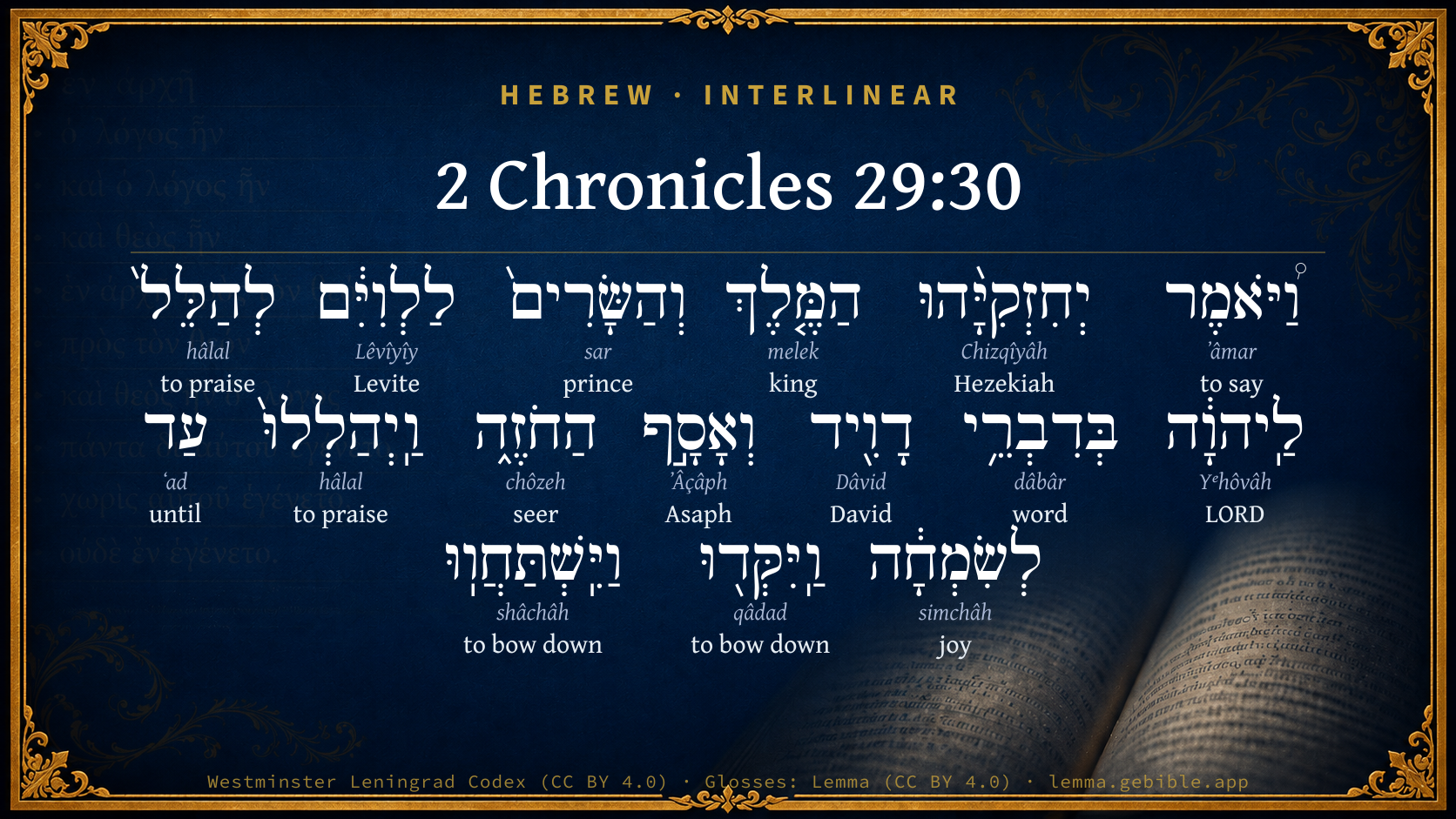
Hebrew (Westminster Leningrad Codex) 2 Chronicles 29:30 appears in the Hebrew Old Testament. The text above is from the Westminster Leningrad Codex. Each word links to its Strong’s number, a concise gloss, and parsing drawn from the Open Scriptures Hebrew Bible morphology. Click any word for its full Brown-Driver-Briggs (BDB) entry.
Download image
Cite this verse

2 Chronicles 29:30 (World English Bible). Public Domain. Lemma interlinear Bible study tool, https://lemma.gebible.app/v/2-chronicles/29/30.

Show BibTeX & RIS
BibTeX
RIS
English Translation
Moreover Hezekiah the king and the princes commanded the Levites to sing praises to Yahweh with the words of David, and of Asaph the seer. They sang praises with gladness, and they bowed their heads and worshiped.
World English Bible · Public Domain
Download a study sheet

One document with this verse’s original text, its word-by-word gloss line, the meaning frame, cross-references with their text, attributed commentary, and full source and license credits — printable, and it pastes into notes with its structure intact.

This verse Autodidact and up

Study sheet (.html) Plain text (.txt)

A passage Seminary Student

Up to 50 verses in one chapter. A passage sheet keeps up to 6 commentary sources and 12 cross-references per verse, in the order this page ranks them, and says so on the sheet whenever that leaves anything out. Ask for a single verse and you get the Autodidact verse sheet above.

Everything on this page stays free to read, with no account — the sheet is a download of what is already on screen, not access to it.

Want to remove ads? Support Godless Engineer
Compare translations 3

The same verse in 3 English versions, stacked beneath the original-language interlinear above. Click any original word for its lexicon entry.

Each is an independent rendering of the whole verse — the interlinear is not word-aligned to these translations.

Highlighted words mark where these versions differ — a whole-verse word diff, not a word-by-word alignment.

  • World English Bible Public Domain
    Moreover Hezekiah the king and the princes commanded the Levites to sing praises to Yahweh with the words of David, and of Asaph the seer. They sang praises with gladness, and they bowed their heads and worshiped.
  • King James Version Public Domain
    Moreover Hezekiah the king and the princes commanded the Levites to sing praise unto the LORD with the words of David, and of Asaph the seer. And they sang praises with gladness, and they bowed their heads and worshipped.
  • unfoldingWord Literal Text CC BY-SA 4.0
    And King Hezekiah said, and the chiefs, to the Levites to praise Yahweh according to the words of David and Asaph the seer. And they praised with joy, and they bowed down, and they worshiped.

unfoldingWord Literal Text — © unfoldingWord, licensed CC BY-SA 4.0. Word-aligned USFM3 via Door43 (git.door43.org/unfoldingWord/en_ult).

Versions to compare (up to 4)

3 of 4 selected

Show all 18 translations

Every available English version of this verse, each an independent rendering of the whole verse.

  • World English Bible Public Domain
    Moreover Hezekiah the king and the princes commanded the Levites to sing praises to Yahweh with the words of David, and of Asaph the seer. They sang praises with gladness, and they bowed their heads and worshiped.
  • Berean Standard Bible Public Domain
    Then King Hezekiah and his officials ordered the Levites to sing praises to the LORD in the words of David and of Asaph the seer. So they sang praises with gladness and bowed their heads and worshiped.
  • Majority Standard Bible Public Domain
    Then King Hezekiah and his officials ordered the Levites to sing praises to the LORD in the words of David and of Asaph the seer. So they sang praises with gladness and bowed down and worshiped.
  • King James Version Public Domain
    Moreover Hezekiah the king and the princes commanded the Levites to sing praise unto the LORD with the words of David, and of Asaph the seer. And they sang praises with gladness, and they bowed their heads and worshipped.
  • American Standard Version (1901) Public Domain
    Moreover Hezekiah the king and the princes commanded the Levites to sing praises unto Jehovah with the words of David, and of Asaph the seer. And they sang praises with gladness, and they bowed their heads and worshipped.
  • Revised Version (1885) Public Domain
    Moreover Hezekiah the king and the princes commanded the Levites to sing praises unto the LORD with the words of David, and of Asaph the seer. And they sang praises with gladness, and they bowed their heads and worshipped.
  • Geneva Bible (1599) Public Domain
    Then Hezekiah the King and the princes commanded the Leuites to prayse the Lord with the wordes of Dauid, and of Asaph the Seer. so they praysed with ioy, and they bowed themselues, and worshipped.
  • Douay-Rheims (1899) Public Domain
    And Ezechias and the princes commanded the Levites to praise the Lord with the words of David, and Asaph the seer: and they praised him with great joy, and bowing the knee adored.
  • Young's Literal Translation Public Domain
    And Hezekiah the king saith, and the princes, to the Levites to give praise to Jehovah in the words of David, and of Asaph the seer, and they praise -- unto joy, and they bow, and do obeisance.
  • Literal Standard Version CC BY-SA 4.0
    And Hezekiah the king commands—and the princes—to the Levites [to cause them] to give praise to YHWH in the words of David, and of Asaph the seer, and they praise—to joy, and they bow, and pay respect.
  • Unlocked Literal Bible CC BY-SA 4.0
    Moreover, Hezekiah, the king, and the leaders commanded the Levites to sing praises to Yahweh with the words of David and of Asaph, the seer. They sang praises with gladness, and they bowed down and worshiped.
  • unfoldingWord Literal Text CC BY-SA 4.0
    And King Hezekiah said, and the chiefs, to the Levites to praise Yahweh according to the words of David and Asaph the seer. And they praised with joy, and they bowed down, and they worshiped.
  • Darby Bible Public Domain
    And king Hezekiah and the princes commanded the Levites to sing praise to Jehovah with the words of David, and of Asaph the seer. And they sang praises with gladness, and bowed their heads and worshipped.
  • World Messianic Bible Public Domain
    Moreover Hezekiah the king and the princes commanded the Levites to sing praises to the LORD with the words of David, and of Asaph the seer. They sang praises with gladness, and they bowed their heads and worshiped.
  • Webster's Bible Public Domain
    Moreover, Hezekiah the king and the princes commanded the Levites to sing praise to the LORD, with the words of David, and of Asaph the seer. And they sang praises with gladness, and they bowed their heads and worshiped.
  • Free Bible Version CC BY-SA 4.0
    Then King Hezekiah and his officials ordered the Levites to sing praises to the Lord using the words of David and of Asaph the seer. So they sang praises with joy, and bowed their heads and worshiped.
  • Bible in Basic English Public Domain
    Then King Hezekiah and the captains gave orders to the Levites to give praise to God in the words of David and Asaph the seer. And they made songs of praise with joy, and with bent heads gave worship.
  • JPS Tanakh (1917) Public Domain
    Moreover Hezekiah the king and the princes commanded the Levites to sing praises unto the LORD with the words of David, and of Asaph the seer. And they sang praises with gladness, and they bowed their heads and prostrated themselves.

Literal Standard Version (2020), Covenant Press — licensed CC BY-SA 4.0. Text via the HelloAO Bible API (eBible.org). Unlocked Literal Bible (unfoldingWord) — licensed CC BY-SA 4.0. Text via the HelloAO Bible API (eBible.org). unfoldingWord Literal Text — © unfoldingWord, licensed CC BY-SA 4.0. Word-aligned USFM3 via Door43 (git.door43.org/unfoldingWord/en_ult). Free Bible Version, Dr. Jonathan Gallagher — licensed CC BY-SA 4.0. Text via the HelloAO Bible API (eBible.org).

Word by word

More ways to search: Search by grammar → Find every occurrence → Compare this word →

Practice this passage: Drill this verse → Learn its vocabulary →

וַֽיִּקְּד֖וּ
qâdad
H6915
“and · to bow down”
Conjunction + Verb, Qal, Sequential Imperfect, 3rd Person, Masculine, Plural
Part of Speech
Conjunction + Verb
Stem
Qal
Form
Sequential Imperfect
Person
3rd Person
Gender
Masculine
Number
Plural
Full BDB Definition

Origin: a primitive root

TWOT: 1985

(Qal) to bow down
  1. וַ֠יֹּאמֶר ʼâmar H559 “and · to say” Conjunction + Verb, Qal, Sequential Imperfect, 3rd Person, Masculine, Singular
  2. יְחִזְקִיָּ֨הוּ Chizqîyâh H2396 “Hezekiah” Noun, Proper
  3. הַמֶּ֤לֶךְ melek H4428 “the · king” Particle, Definite Article + Noun, Common, Masculine, Singular, Absolute
  4. וְהַשָּׂרִים֙ sar H8269 “and · the · princes” Conjunction + Particle, Definite Article + Noun, Common, Masculine, Plural, Absolute
  5. לַלְוִיִּ֔ם Lêvîyîy H3881 “to/for the · Levites” Preposition, Determined + Noun, Gentilic, Masculine, Plural, Absolute
  6. לְהַלֵּל֙ hâlal H1984 “to praise” Preposition + Verb, Piel, Infinitive Construct
  7. לַֽיהוָ֔ה Yᵉhôvâh H3068 “to/for · LORD” Preposition + Noun, Proper
  8. בְּדִבְרֵ֥י dâbâr H1697 “in/at · words of” Preposition + Noun, Common, Masculine, Plural, Construct
  9. דָוִ֖יד Dâvid H1732 “David” Noun, Proper
  10. וְאָסָ֣ף ʼÂçâph H623 “and · Asaph” Conjunction + Noun, Proper
  11. הַחֹזֶ֑ה chôzeh H2374 “the · seer” Particle, Definite Article + Noun, Common, Masculine, Singular, Absolute
  12. וַֽיְהַלְלוּ֙ hâlal H1984 “and · to praise” Conjunction + Verb, Piel, Sequential Imperfect, 3rd Person, Masculine, Plural
  13. עַד ʻad H5704 “until” Preposition
  14. לְשִׂמְחָ֔ה simchâh H8057 “to/for · joy” Preposition + Noun, Common, Feminine, Singular, Absolute
  15. וַיִּֽשְׁתַּחֲוֽוּ shâchâh H7812 “and · to bow down” Conjunction + Verb, Hithpael, Sequential Imperfect, 3rd Person, Masculine, Plural

About this verse

These counts appear in no published source. They are computed here, from the morphology-tagged text and Lemma’s own curated glosses. What Lemma adds →

16
words
15
distinct lemmas
Historical
section

Notable vocabulary

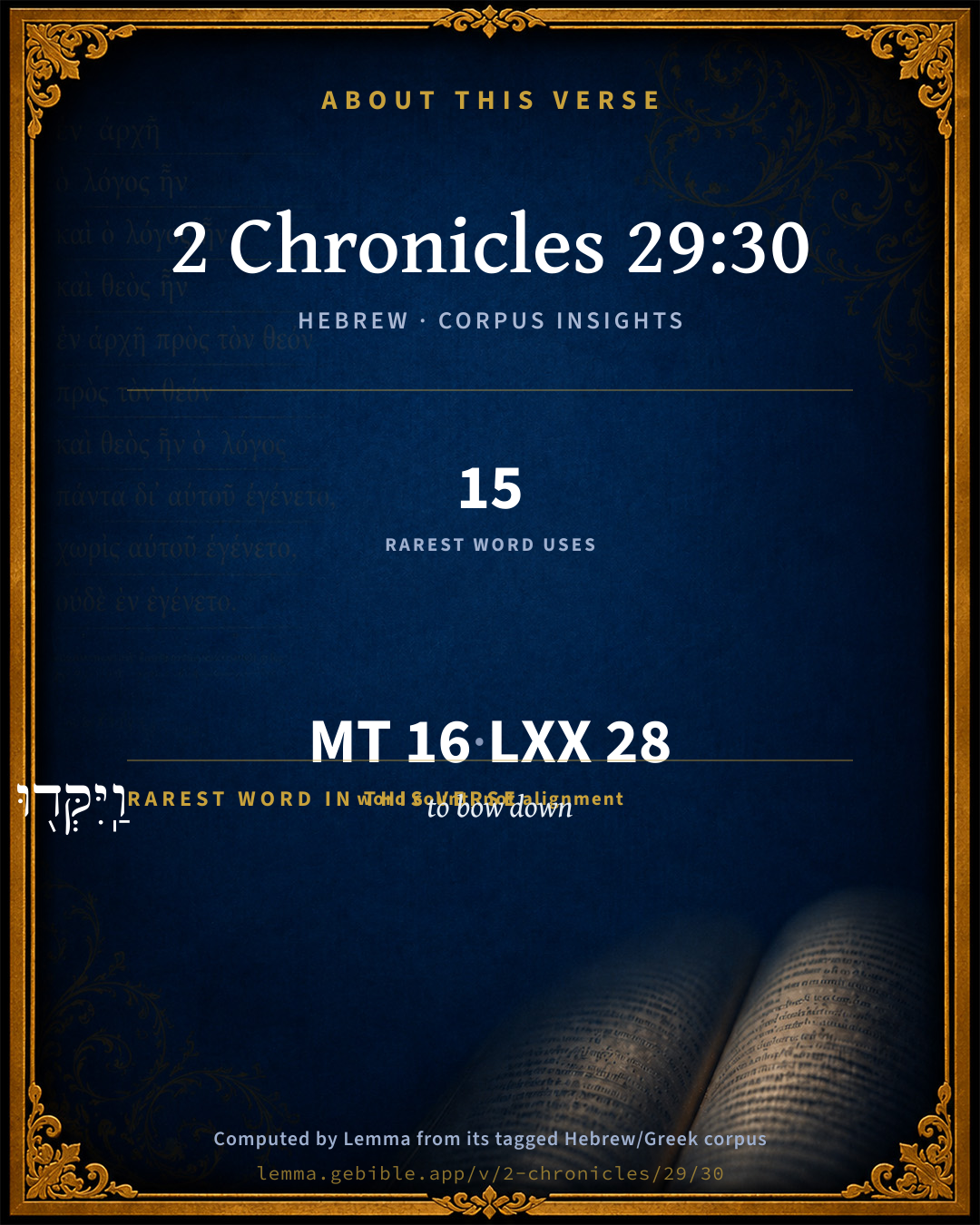
The rarest word here is וַֽיִּקְּד֖וּ to bow down H6915 — appearing just 15 times in the whole Hebrew Bible.

Shared distinctive vocabulary

וַֽיִּקְּד֖וּ to bow down H6915 occurs in 15 verses of the Hebrew Bible. Also found in:

Grammatical profile

  • 5 verbs
  • 10 nouns
  • 1 preposition

Verb forms

  • וַ֠יֹּאמֶר Qal · Sequential Imperfect
  • לְהַלֵּל֙ Piel · Infinitive Construct
  • וַֽיְהַלְלוּ֙ Piel · Sequential Imperfect
  • וַֽיִּקְּד֖וּ Qal · Sequential Imperfect
  • וַיִּֽשְׁתַּחֲוֽוּ Hithpael · Sequential Imperfect

Repetition

A word recurs within this verse — often emphatic in Hebrew:

  • לְהַלֵּל֙ to praise H1984 ×2

Hebrew & Septuagint length

In English translation the verse runs 37 words from the Hebrew and 36 from the Septuagint (LXX English) — closely comparable.

A rough comparison of the two English renderings, which tokenize alike — not a word-level alignment.

Word counts can differ between the Hebrew and the Greek without any difference in meaning — e.g. the Hebrew direct-object marker אֵת has no separate Greek word, and Greek often adds the article ὁ.

In the original languages it is 16 Hebrew tokens and 28 Greek tokens — but the two are counted differently (Hebrew bundles its prefixes and suffixes into one token; the Greek is in lemma form), so that isn’t a like-for-like length.

Cross-references

8

Topical passages linked to 2 Chronicles 29:30 in the Treasury of Scripture Knowledge — connected by theme and wording, ordered by reader-vote popularity; previews shown in the World English Bible.

  • Philippians 4:4 Rejoice in the Lord always! Again I will say, Rejoice!
  • Psalms 32:11–33:1 Be glad in Yahweh, and rejoice, you righteous! Shout for joy, all you who are upright in heart!
  • Psalms 95:1–2 Oh come, let's sing to Yahweh. Let's shout aloud to the rock of our salvation!
  • 1 Chronicles 16:7–36 Then on that day David first ordained to give thanks to Yahweh, by the hand of Asaph and his brothers.
  • Psalms 100:1–2 Shout for joy to Yahweh, all you lands!
  • Psalms 149:2 Let Israel rejoice in him who made them. Let the children of Zion be joyful in their King.
  • 2 Samuel 23:1–2 Now these are the last words of David. David the son of Jesse says, The man who was raised on high says, The anointed of the God of Jacob, The sweet psalmist of Israel:
  • Psalms 95:6 Oh come, let's worship and bow down. Let's kneel before Yahweh, our Maker,

Cross-references courtesy of OpenBible.info (CC BY 4.0).

Hebrew and Greek witnesses Masoretic Hebrew ↔ Greek Septuagint

The same verse in the two great witnesses to the Old Testament, shown verse-for-verse.

These are two independent witnesses, not word-aligned to each other, and the Septuagint is shown in lemma (dictionary) form.

Hebrew 2 Chronicles 29:30 Masoretic · Westminster Leningrad Codex

וַ֠יֹּאמֶר יְחִזְקִיָּ֨הוּ הַמֶּ֤לֶךְ וְהַשָּׂרִים֙ לַלְוִיִּ֔ם לְהַלֵּל֙ לַֽיהוָ֔ה בְּדִבְרֵ֥י דָוִ֖יד וְאָסָ֣ף הַחֹזֶ֑ה וַֽיְהַלְלוּ֙ עַד לְשִׂמְחָ֔ה וַֽיִּקְּד֖וּ וַיִּֽשְׁתַּחֲוֽוּ

Moreover Hezekiah the king and the princes commanded the Levites to sing praises to Yahweh with the words of David, and of Asaph the seer. They sang praises with gladness, and they bowed their heads and worshiped.

World English Bible · Public Domain

Greek LXX 2 Chronicles 29:30 Septuagint · lemma form

καί εἶπον εζεκιας ὁ βασιλεύς καί ὁ ἄρχων ὁ λευείτης ὑμνέω ὁ κύριος ἐν λόγος δαυίδ καί ασαφ ὁ προφήτης καί ὑμνέω ἐν εὐφροσύνη καί πίπτω καί προςκυνέω

And king Ezekias and the princes told the Levites to sing hymns to the Lord in the words of David, and of Asaph the prophet: and they sang hymns with gladness, and fell down and worshipped.

LXX2012 (modern English Septuagint) · Public Domain

Hebrew: Westminster Leningrad Codex (CC BY 4.0). Greek: Septuagint (public domain); English from LXX2012 (modern English Septuagint) (Public Domain). How the Septuagint differs from the Hebrew →

Commentary

Notes on 2 Chronicles 29:30 from classic Christian and Jewish commentators (each source and its license shown beneath its notes). The classic Christian expositions comment on the surrounding passage and are grouped to its opening verse, so a note may address several verses; the Jewish commentaries on the Tanakh (Rashi and others) are per-verse, so they appear only where the commentator wrote on this verse.

Lemma curates 59 commentaries, every one of them public domain or Creative Commons licensed, each selected and text-cleaned for this edition rather than reprinted as found. About our sources →

Trapp's Complete Commentary

John Trapp

2Ch 29:30 Moreover Hezekiah the king and the princes commanded the Levites to sing praise unto the LORD with the words of David, and of Asaph the seer. And they sang praises with gladness, and they bowed their heads and worshipped.

Ver. 30. Moreover the king Hezekiah and the princes.] This Parliament {2Ch 29:20} might well have been called, as that was here in the 25th of Edward III, Benedictum Parlementum.

John Trapp, A Commentary or Exposition upon All the Books of the Old and New Testament (1647–1656) — public domain. Text from a community e-Sword module.

Geneva Bible (1599)

Geneva Bible translators

With that Psalm whereof mention is made, 1 Chron. 16:7.

Geneva Bible (1599) marginal notes — public domain. Text via Bolls.life.

Ellicott's Commentary for English Readers

(30) With the words of David, and of Asaph.—Heb., in the words. This appears to mean that the singing (2Ch_29:28) consisted in chanting Davidic and Asaphite psalms, and it is usually so explained. But the expression “in the words of David and of Asaph” may be compared with “in the words of Jehovah,” 2Ch_29:15, and “in the command of David and Gad the king’s seer,” 2Ch_29:25; and so may be understood to assert merely that the singing was in accordance with the arrangements of David and Asaph. (1Ch_25:1-2; 1Ch_25:9.)

Asaph the seer.—So Heman is called (1Ch_25:5); and Jeduthun (2Ch_25:15).

With gladness.—Literally, unto exultation—i.e., rapturously.

And they bowed their heads.—When the song was ended (2Ch_29:29).

A Bible Commentary for English Readers, edited by Charles John Ellicott (1878–1897) — public domain. Text from a community e-Sword module.

The Cambridge Bible for Schools and Colleges

gen. ed. J. J. S. Perowne

30. to sing praise] R.V. to sing praises. Since (1) the Heb. word for “Psalms” means “Praises,” and (2) the words of David and Asaph are specially mentioned in this verse, it is clear that the Chronicler by this phrase means “to sing Psalms.”

The Cambridge Bible for Schools and Colleges (gen. ed. J. J. S. Perowne; Cambridge University Press, 1878–1918) — public domain. Text from a community e-Sword module.

John Gill's Exposition

And the number of the burnt offerings which the congregation brought were seventy bullocks, one hundred rams, and two hundred lambs; all these were for a burnt offering to the Lord. Of which they had no part to feast but were wholly devoted to the Lord, by way of thankfulness to him.

And the number of the burnt offerings which the congregation brought were seventy bullocks, one hundred rams, and two hundred lambs; all these were for a burnt offering to the Lord. Of which they had no part to feast but were wholly devoted to the Lord, by way of thankfulness to him.

2 Chronicles 29:33

ch2 29:33

ch2 29:33

ch2 29:33And the consecrated things,.... Which were devoted for peace offerings, of which the owners had a part: were six hundred oxen, and three thousand sheep; which was a much lesser number than what were offered upon occasion in the times of David and Solomon, the nation being poorer; and besides, these were only the oblation of two tribes, they of all Israel.

John Gill's Exposition of the Whole Bible (1746–1763) — public domain (CC PDM 1.0). Text via the HelloAO Bible API.

Haydock's Catholic Bible Commentary

Princes of the priests. H. --- Words; psalms. T. --- Asaph, so famous for music. He had composed some psalms, (C.) and twelve bear his name. T. --- But he might only have set them to music, (H.) or his band sung them. D. --- Knee. Prot. "head." Sept. "they prostrated themselves."

George Leo Haydock (1774–1849), Haydock's Catholic Family Bible and Commentary, 1859 edition — public domain. Excludes Psalms (Douay-Rheims chapter numbering differs from Protestant) and Deuterocanonical books (Catholic canon only).

The Pulpit Commentary

With the words of David, and of Asaph. We can scarcely exclude from our thought the impression that loving human reverence for their own past religious helpers of song and music, and enthusiasm for the memory of them, were hero glanced at. The king"s and the princes" supplementary (moreover) injunction and instruction to the Levites as to what words they should put on their lips. Asaph the seer. This is the only place in which Asaph is thus distinctly named seer, but it is contained virtually in 1Ch_25:2; and for the substantive title given to two colleagues, see 1Ch_25:5; 2Ch_35:15. The princes (see their growing prominence in 2Ch_24:17 2Ch_28:21 2Ch_30:2, 2Ch_30:6, 2Ch_30:12, 24 32:3).

The Pulpit Commentary (1880–1919), ed. H.D.M. Spence-Jones & Joseph S. Exell — public domain. Text from a community e-Sword module.

Rashi

Rabbi Shlomo Yitzchaki (Rashi)

to praise the Lord with the words of David and Asaph the seer i.e., “Give thanks to the Lord, call out in His name,” as is written above (I Chron. 16:8f): “On that day, David placed Nathan at the head to give thanks to the Lord by the hand of Asaph and his brethren, etc.”

Rashi on the Tanakh — English translations: “The Judaica Press complete Tanach with Rashi, translated by A. J. Rosenberg” (CC BY 4.0); “Pentateuch with Rashi's commentary by M. Rosenbaum and A.M. Silbermann, 1929-1934” (public domain); “The Metsudah Tanach series, Lakewood, N.J” (CC BY 4.0); and “The Book of Joshua, Metsudah Publications, 1997” (CC BY 4.0). Text via Sefaria.

Lesson kit

Teaching starters — assembled from the data on this page, not authored interpretation. Every prompt links to the verse data it draws on. Edit before teaching.

2 Chronicles, in the Historical, opens this verse with 16 words (15 distinct Hebrew lemmas). Its most distinctive word is qâdad (“to bow down”). A historical commentator’s framing appears above. Read the whole chapter for the surrounding context.

Discussion questions

  1. How does “to bow down” (qâdad) shape what this verse is saying?
  2. Genesis 24:26 shares the word «to bow down» with this verse. How do the two illuminate each other?
  3. “to praise” occurs 2× in this one verse. What is the effect of the repetition?
  4. These translations render this verse differently. What is at stake in choosing one wording over another?
  5. The verb «וַ֠יֹּאמֶר» is Qal Sequential Imperfect. How does its form color the action?
  6. Reading how Trapp's Complete Commentary and Geneva Bible (1599) read this verse, where do the two commentators agree and where do they part?

Things to notice

Reading settings

Reading text

Shown beneath each verse's original-language words.

Old Testament
Old Testament edition

Read the OT as the Masoretic Hebrew (MT) or the Greek Septuagint (LXX).

English shown for the Greek Septuagint (in the Hebrew ↔ Greek comparison).

Comparing translations? Open the Compare panel on any verse page to stack up to four side by side.