
1 Kings 1:13

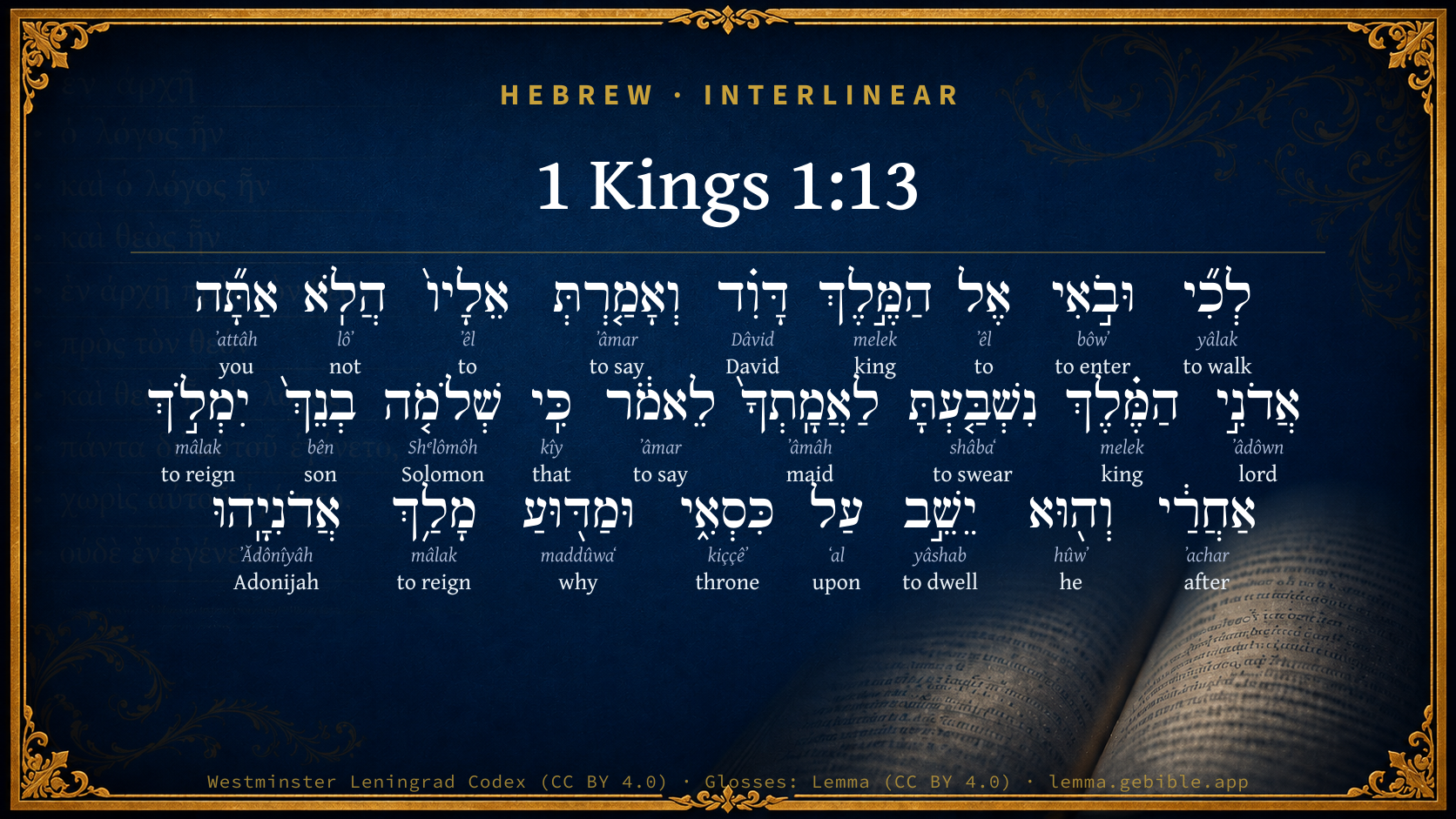
Hebrew (Westminster Leningrad Codex) 1 Kings 1:13 appears in the Hebrew Old Testament. The text above is from the Westminster Leningrad Codex. Each word links to its Strong’s number, a concise gloss, and parsing drawn from the Open Scriptures Hebrew Bible morphology. Click any word for its full Brown-Driver-Briggs (BDB) entry.
Download image
Cite this verse

1 Kings 1:13 (World English Bible). Public Domain. Lemma interlinear Bible study tool, https://lemma.gebible.app/v/1-kings/1/13.

Show BibTeX & RIS
BibTeX
RIS
English Translation
Go and get you in to king David, and tell him, Didn't you, my lord, king, swear to your handmaid, saying, Assuredly Solomon your son shall reign after me, and he shall sit on my throne? why then does Adonijah reign?
World English Bible · Public Domain
Download a study sheet

One document with this verse’s original text, its word-by-word gloss line, the meaning frame, cross-references with their text, attributed commentary, and full source and license credits — printable, and it pastes into notes with its structure intact.

This verse Autodidact and up

Study sheet (.html) Plain text (.txt)

A passage Seminary Student

Up to 50 verses in one chapter. A passage sheet keeps up to 6 commentary sources and 12 cross-references per verse, in the order this page ranks them, and says so on the sheet whenever that leaves anything out. Ask for a single verse and you get the Autodidact verse sheet above.

Everything on this page stays free to read, with no account — the sheet is a download of what is already on screen, not access to it.

Want to remove ads? Support Godless Engineer
Compare translations 3

The same verse in 3 English versions, stacked beneath the original-language interlinear above. Click any original word for its lexicon entry.

Each is an independent rendering of the whole verse — the interlinear is not word-aligned to these translations.

Highlighted words mark where these versions differ — a whole-verse word diff, not a word-by-word alignment.

  • World English Bible Public Domain
    Go and get you in to king David, and tell him, Didn't you, my lord, king, swear to your handmaid, saying, Assuredly Solomon your son shall reign after me, and he shall sit on my throne? why then does Adonijah reign?
  • King James Version Public Domain
    Go and get thee in unto king David, and say unto him, Didst not thou, my lord, O king, swear unto thine handmaid, saying, Assuredly Solomon thy son shall reign after me, and he shall sit upon my throne? why then doth Adonijah reign?
  • unfoldingWord Literal Text CC BY-SA 4.0
    Go, and come to King David, and you shall say to him, ‘My lord the king, you, have you not sworn to your female servant, saying, “Surely Solomon your son will reign after me, and he will sit on my throne”? Then why does Adonijah reign?’

unfoldingWord Literal Text — © unfoldingWord, licensed CC BY-SA 4.0. Word-aligned USFM3 via Door43 (git.door43.org/unfoldingWord/en_ult).

Versions to compare (up to 4)

3 of 4 selected

Show all 18 translations

Every available English version of this verse, each an independent rendering of the whole verse.

  • World English Bible Public Domain
    Go and get you in to king David, and tell him, Didn't you, my lord, king, swear to your handmaid, saying, Assuredly Solomon your son shall reign after me, and he shall sit on my throne? why then does Adonijah reign?
  • Berean Standard Bible Public Domain
    Go at once to King David and say, ‘My lord the king, did you not swear to your maidservant, “Surely your son Solomon will reign after me, and he will sit on my throne”? Why then has Adonijah become king?’
  • Majority Standard Bible Public Domain
    Go at once to King David and say, ‘My lord the king, did you not swear to your maidservant, “Surely your son Solomon will reign after me, and he will sit on my throne”? Why then has Adonijah become king?’
  • King James Version Public Domain
    Go and get thee in unto king David, and say unto him, Didst not thou, my lord, O king, swear unto thine handmaid, saying, Assuredly Solomon thy son shall reign after me, and he shall sit upon my throne? why then doth Adonijah reign?
  • American Standard Version (1901) Public Domain
    Go and get thee in unto king David, and say unto him, Didst not thou, my lord, O king, swear unto thy handmaid, saying, Assuredly Solomon thy son shall reign after me, and he shall sit upon my throne? why then doth Adonijah reign?
  • Revised Version (1885) Public Domain
    Go and get thee in unto king David, and say unto him, Didst not thou, my lord, O king, swear unto thine handmaid, saying, Assuredly Solomon thy son shall reign after me, and he shall sit upon my throne? why then doth Adonijah reign?
  • Geneva Bible (1599) Public Domain
    Go, and get thee in vnto King Dauid, and say vnto him, Didest not thou, my lorde, O King, sweare vnto thine handmaide, saying, Assuredly Salomon thy sonne shall reigne after me, and he shall sit vpon my throne? why is then Adoniiah King?
  • Douay-Rheims (1899) Public Domain
    Go, and get thee in to king David, and say to him: Didst not thou, my lord O king, swear to me thy handmaid, saying: Solomon thy son shall reign after me, and he shall sit on my throne? why then doth Adonias reign?
  • Young's Literal Translation Public Domain
    go and enter in unto king David, and thou hast said unto him, Hast thou not, my lord, O king, sworn to thy handmaid, saying, Surely Solomon thy son doth reign after me, and he doth sit on my throne? and wherefore hath Adonijah reigned?
  • Literal Standard Version CC BY-SA 4.0
    go and enter in to King David, and you have said to him: Have you not, my lord, O king, sworn to your handmaid, saying, Surely your son Solomon reigns after me, and he sits on my throne? And why has Adonijah reigned?
  • Unlocked Literal Bible CC BY-SA 4.0
    Go to King David; say to him, 'My master the king, did you not swear to your servant, saying, “Surely Solomon your son will reign after me, and he will sit on my throne?” Why then is Adonijah reigning?'
  • unfoldingWord Literal Text CC BY-SA 4.0
    Go, and come to King David, and you shall say to him, ‘My lord the king, you, have you not sworn to your female servant, saying, “Surely Solomon your son will reign after me, and he will sit on my throne”? Then why does Adonijah reign?’
  • Darby Bible Public Domain
    Go and get thee in to king David, and say to him, Didst not thou, my lord, O king, swear to thy handmaid saying, Solomon thy son shall reign after me, and he shall sit on my throne? why then does Adonijah reign?
  • World Messianic Bible Public Domain
    Go in to King David, and tell him, ‘Didn’t you, my lord the king, swear to your servant, saying, “Assuredly Solomon your son shall reign after me, and he shall sit on my throne”? Why then does Adonijah reign?’
  • Webster's Bible Public Domain
    Go, and enter in to king David, and say to him, Didst not thou, my lord, O king, swear to thy handmaid, saying, Assuredly Solomon thy son shall reign after me, and he shall sit upon my throne? why then doth Adonijah reign?
  • Free Bible Version CC BY-SA 4.0
    Go immediately to King David and ask him, ‘Didn't Your Majesty swear to me, your servant, saying, Your son Solomon will definitely be king after me and will sit on my throne? So why is Adonijah saying he's king?’
  • Bible in Basic English Public Domain
    Come now, go to King David and say to him, Did you not, O my lord, take an oath to me, your servant, saying, Truly Solomon your son will be king after me, seated on the seat of my kingdom? why then is Adonijah acting as king?
  • JPS Tanakh (1917) Public Domain
    Go and get thee in unto king David, and say unto him: Didst not thou, my lord, O king, swear unto thy handmaid, saying: Assuredly Solomon thy son shall reign after me, and he shall sit upon my throne? why then doth Adonijah reign?

Literal Standard Version (2020), Covenant Press — licensed CC BY-SA 4.0. Text via the HelloAO Bible API (eBible.org). Unlocked Literal Bible (unfoldingWord) — licensed CC BY-SA 4.0. Text via the HelloAO Bible API (eBible.org). unfoldingWord Literal Text — © unfoldingWord, licensed CC BY-SA 4.0. Word-aligned USFM3 via Door43 (git.door43.org/unfoldingWord/en_ult). Free Bible Version, Dr. Jonathan Gallagher — licensed CC BY-SA 4.0. Text via the HelloAO Bible API (eBible.org).

Word by word

More ways to search: Search by grammar → Find every occurrence → Compare this word →

Practice this passage: Drill this verse → Learn its vocabulary →

אֲדֹנִיָֽהוּ
ʼĂdônîyâh
H138
“Adonijah”
Noun, Proper
Part of Speech
Noun
Type
Proper
Full BDB Definition

Origin: from H113 and H3050

TWOT: None

Adonijah = "my lord is Jehovah" - fourth son of David and Solomon's rival for the throne - Levite sent by Jehoshaphat to teach the Law - a chief of the people who co-operated with Nehemiah
  1. לְכִ֞י yâlak H3212 “walk” Verb, Qal, Imperative, 2nd Person, Feminine, Singular
  2. וּבֹ֣אִי bôwʼ H935 “and · enter” Conjunction + Verb, Qal, Imperative, 2nd Person, Feminine, Singular
  3. אֶל ʼêl H413 “to” Preposition
  4. הַמֶּ֣לֶךְ melek H4428 “the · king” Particle, Definite Article + Noun, Common, Masculine, Singular, Absolute
  5. דָּוִ֗ד Dâvid H1732 “David” Noun, Proper
  6. וְאָמַ֤רְתְּ ʼâmar H559 “and · to say” Conjunction + Verb, Qal, Sequential Perfect, 2nd Person, Feminine, Singular
  7. אֵלָיו֙ ʼêl H413 “to · him” Preposition + Suffix, Personal, 3rd Person, Masculine, Singular
  8. הֲלֹֽא lôʼ H3808 “not” Particle, Interrogative + Particle, Negative
  9. אַתָּ֞ה ʼattâh H859 “you” Pronoun, Personal, 2nd Person, Masculine, Singular
  10. אֲדֹנִ֣י ʼâdôwn H113 “lord · my” Noun, Common, Masculine, Singular, Construct + Suffix, Personal, 1st Person, Common, Singular
  11. הַמֶּ֗לֶךְ melek H4428 “the · king” Particle, Definite Article + Noun, Common, Masculine, Singular, Absolute
  12. נִשְׁבַּ֤עְתָּ shâbaʻ H7650 “to swear” Verb, Niphal, Perfect, 2nd Person, Masculine, Singular
  13. לַאֲמָֽתְךָ֙ ʼâmâh H519 “to/for · maid · your” Preposition + Noun, Common, Feminine, Singular, Construct + Suffix, Personal, 2nd Person, Masculine, Singular
  14. לֵאמֹ֔ר ʼâmar H559 “to say” Preposition + Verb, Qal, Infinitive Construct
  15. כִּֽי kîy H3588 “that” Conjunction
  16. שְׁלֹמֹ֤ה Shᵉlômôh H8010 “Solomon” Noun, Proper
  17. בְנֵךְ֙ bên H1121 “son · your” Noun, Common, Masculine, Singular, Construct + Suffix, Personal, 2nd Person, Feminine, Singular
  18. יִמְלֹ֣ךְ mâlak H4427 “to reign” Verb, Qal, Imperfect, 3rd Person, Masculine, Singular
  19. אַחֲרַ֔י ʼachar H310 “after · me” Preposition + Suffix, Personal, 1st Person, Common, Singular
  20. וְה֖וּא hûwʼ H1931 “and · he” Conjunction + Pronoun, Personal, 3rd Person, Masculine, Singular
  21. יֵשֵׁ֣ב yâshab H3427 “to dwell” Verb, Qal, Imperfect, 3rd Person, Masculine, Singular
  22. עַל ʻal H5921 “upon” Preposition
  23. כִּסְאִ֑י kiççêʼ H3678 “throne · my” Noun, Common, Masculine, Singular, Construct + Suffix, Personal, 1st Person, Common, Singular
  24. וּמַדּ֖וּעַ maddûwaʻ H4069 “and · why” Conjunction + Particle, Interrogative
  25. מָלַ֥ךְ mâlak H4427 “to reign” Verb, Qal, Perfect, 3rd Person, Masculine, Singular

About this verse

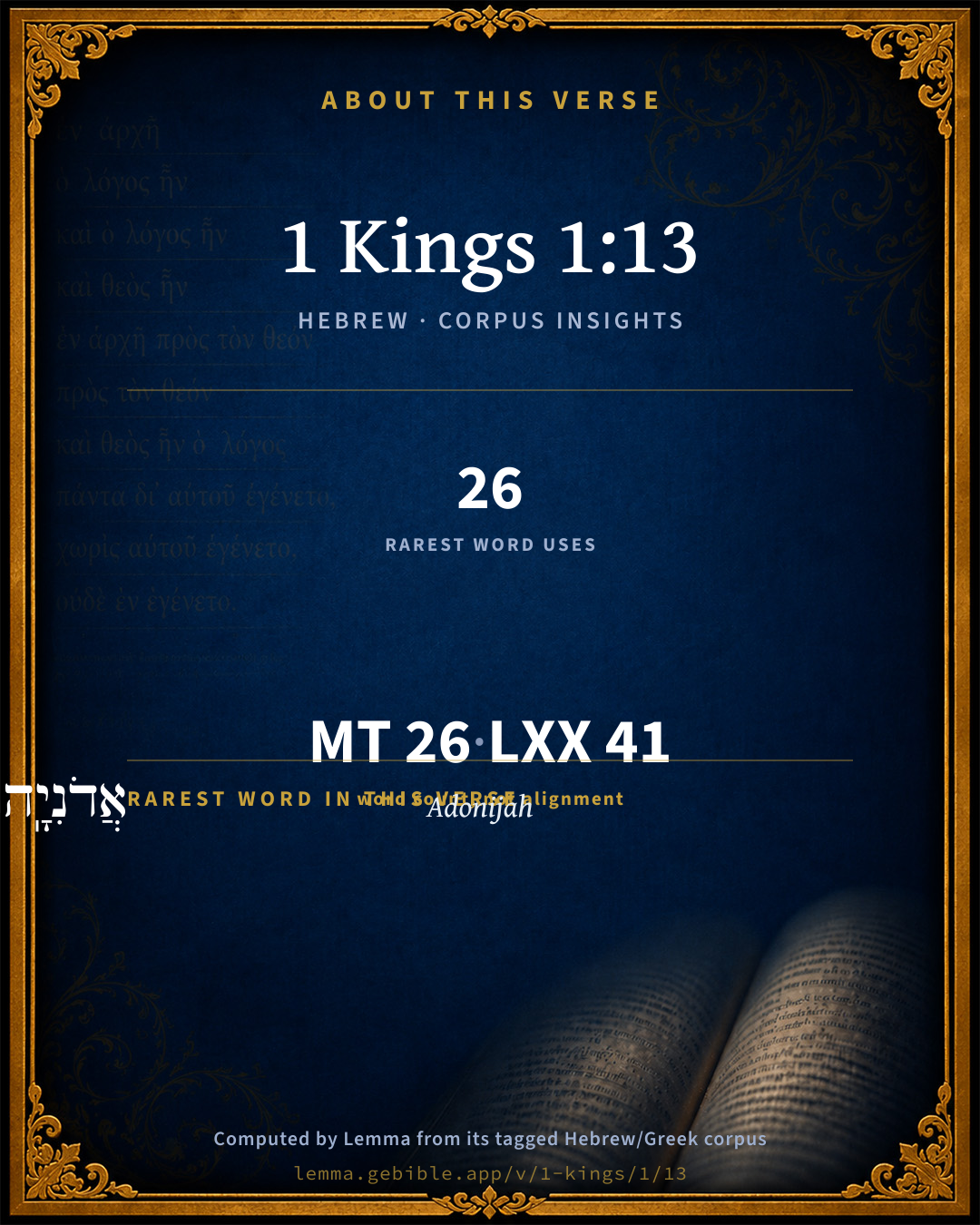
These counts appear in no published source. They are computed here, from the morphology-tagged text and Lemma’s own curated glosses. What Lemma adds →

26
words
22
distinct lemmas
Historical
section

Shared distinctive vocabulary

אֲדֹנִיָֽהוּ Adonijah H138 occurs in 26 verses of the Hebrew Bible. Also found in:

Grammatical profile

  • 8 verbs
  • 9 nouns
  • 2 pronouns
  • 4 prepositions
  • 1 conjunction
  • 2 particles

Verb forms

  • לְכִ֞י Qal · Imperative
  • וּבֹ֣אִי Qal · Imperative
  • וְאָמַ֤רְתְּ Qal · Sequential Perfect
  • נִשְׁבַּ֤עְתָּ Niphal · Perfect
  • לֵאמֹ֔ר Qal · Infinitive Construct
  • יִמְלֹ֣ךְ Qal · Imperfect
  • יֵשֵׁ֣ב Qal · Imperfect
  • מָלַ֥ךְ Qal · Perfect

Repetition

Words recur within this verse — often emphatic in Hebrew:

  • הַמֶּ֣לֶךְ king H4428 ×2
  • וְאָמַ֤רְתְּ to say H559 ×2
  • יִמְלֹ֣ךְ to reign H4427 ×2
  • אֶל to H413 ×2

Hebrew & Septuagint length

In English translation the verse runs 41 words from the Hebrew and 45 from the Septuagint (LXX English) — closely comparable.

A rough comparison of the two English renderings, which tokenize alike — not a word-level alignment.

Word counts can differ between the Hebrew and the Greek without any difference in meaning — e.g. the Hebrew direct-object marker אֵת has no separate Greek word, and Greek often adds the article ὁ.

In the original languages it is 26 Hebrew tokens and 41 Greek tokens — but the two are counted differently (Hebrew bundles its prefixes and suffixes into one token; the Greek is in lemma form), so that isn’t a like-for-like length.

Cross-references

14

Topical passages linked to 1 Kings 1:13 in the Treasury of Scripture Knowledge — connected by theme and wording, ordered by reader-vote popularity; previews shown in the World English Bible.

  • 1 Kings 1:30 most assuredly as I swore to you by Yahweh, the God of Israel, saying, Assuredly Solomon your son shall reign after me, and he shall sit on my throne in my place; most assuredly so will I do this day.
  • 1 Kings 1:17 She said to him, My lord, you swore by Yahweh your God to your handmaid, [saying], Assuredly Solomon your son shall reign after me, and he shall sit on my throne.
  • 1 Kings 2:12 Solomon sat on the throne of David his father; and his kingdom was established greatly.
  • 1 Chronicles 22:6–13 Then he called for Solomon his son, and charged him to build a house for Yahweh, the God of Israel.
  • Psalms 132:11–12 Yahweh has sworn to David in truth. He will not turn from it: "I will set the fruit of your body on your throne.
  • Luke 1:32–33 He will be great, and will be called the Son of the Most High. The Lord God will give him the throne of his father, David,
  • 1 Kings 1:11 Then Nathan spoke to Bathsheba the mother of Solomon, saying, Haven't you heard that Adonijah the son of Haggith reigns, and David our lord doesn't know it?
  • 1 Kings 1:24 Nathan said, My lord, king, have you said, Adonijah shall reign after me, and he shall sit on my throne?
  • 1 Kings 1:48 Also thus said the king, Blessed be Yahweh, the God of Israel, who has given one to sit on my throne this day, my eyes even seeing it.
  • 1 Chronicles 29:23 Then Solomon sat on the throne of Yahweh as king instead of David his father, and prospered; and all Israel obeyed him.
  • Isaiah 9:7 Of the increase of his government and of peace there shall be no end, on the throne of David, and on his kingdom, to establish it, and to uphold it with justice and with righteousness from henceforth even forever. The zeal of Yahweh of Hosts will perform this.
  • Jeremiah 33:21 then may also my covenant be broken with David my servant, that he shall not have a son to reign on his throne; and with the Levites the priests, my ministers.
  • Deuteronomy 17:18 It shall be, when he sits on the throne of his kingdom, that he shall write him a copy of this law in a book, out of [that which is] before the priests the Levites:
  • 1 Kings 1:35 Then you shall come up after him, and he shall come and sit on my throne; for he shall be king in my place; and I have appointed him to be prince over Israel and over Judah.

Cross-references courtesy of OpenBible.info (CC BY 4.0).

Hebrew and Greek witnesses Masoretic Hebrew ↔ Greek Septuagint

The same verse in the two great witnesses to the Old Testament, shown verse-for-verse.

These are two independent witnesses, not word-aligned to each other, and the Septuagint is shown in lemma (dictionary) form.

Hebrew 1 Kings 1:13 Masoretic · Westminster Leningrad Codex

לְכִ֞י וּבֹ֣אִי אֶל הַמֶּ֣לֶךְ דָּוִ֗ד וְאָמַ֤רְתְּ אֵלָיו֙ הֲלֹֽא אַתָּ֞ה אֲדֹנִ֣י הַמֶּ֗לֶךְ נִשְׁבַּ֤עְתָּ לַאֲמָֽתְךָ֙ לֵאמֹ֔ר כִּֽי שְׁלֹמֹ֤ה בְנֵךְ֙ יִמְלֹ֣ךְ אַחֲרַ֔י וְה֖וּא יֵשֵׁ֣ב עַל כִּסְאִ֑י וּמַדּ֖וּעַ מָלַ֥ךְ אֲדֹנִיָֽהוּ

Go and get you in to king David, and tell him, Didn't you, my lord, king, swear to your handmaid, saying, Assuredly Solomon your son shall reign after me, and he shall sit on my throne? why then does Adonijah reign?

World English Bible · Public Domain

Greek LXX 1 Kings 1:13 Septuagint · lemma form

δεῦρο εἰςἔρχομαι πρός ὁ βασιλεύς δαυίδ καί εἶπον πρός αὐτός λέγω οὐ σύ κύριος ἐγώ βασιλεύς ὄμνυμι ὁ δούλη σύ λέγω ὅτι σαλωμών ὁ υἱός σύ βασιλεύω μετά ἐγώ καί αὐτός καταἵζω ἐπί ὁ θρόνος ἐγώ καί τίς ὅτι βασιλεύω αδωνίας

Haste, and go in to king David, and you shall speak to him, saying, Have not you, my lord, O king, sworn to your handmaid, saying, Your son Solomon shall reign after me, and he shall sit upon my throne? why then does Adonias reign?

LXX2012 (modern English Septuagint) · Public Domain

Hebrew: Westminster Leningrad Codex (CC BY 4.0). Greek: Septuagint (public domain); English from LXX2012 (modern English Septuagint) (Public Domain). How the Septuagint differs from the Hebrew →

Targum (Aramaic paraphrase)

1

The Targum is the ancient Jewish Aramaic paraphrase of the Hebrew Scriptures — an interpretive translation, not the Hebrew text itself. Onkelos (literal) and Pseudo-Jonathan (expansive) render the Torah, and Jonathan the Prophets. Coverage is partial: where no permissively-licensed English translation exists for a verse, only the Aramaic is shown. This is verse-level text, not a word-by-word alignment to the Hebrew.

  1. Targum Jonathan Prophets (Joshua–Malachi)
    אֱזֵילִי וְתַעֲלִין לְוַת מַלְכָּא דָוִד וְתֵימְרִין לֵיהּ הֲלָא אַתְּ רִבּוֹנִי מַלְכָּא קַיֵמְתָּא לְאַמְתָךְ לְמֵימַר אֲרֵי שְׁלֹמֹה בְרִיךְ יִמְלוֹךְ בַּתְרַי וְהוּא יִתֵּיב עַל כּוּרְסֵי מַלְכוּתִי וּמָה דֵין מְלַךְ אֲדוֹנִיָהוּ:

    (no public-domain English translation for this verse)

    Targum Jonathan — Aramaic: “Mikraot Gedolot” (public domain). English: “Sefaria Community Translation” (CC0 1.0 (public-domain dedication)); “London "Chaldee Paraphrase," 1871” (public domain). Text via Sefaria.

Commentary

Notes on 1 Kings 1:13 from classic Christian and Jewish commentators (each source and its license shown beneath its notes). The classic Christian expositions comment on the surrounding passage and are grouped to its opening verse, so a note may address several verses; the Jewish commentaries on the Tanakh (Rashi and others) are per-verse, so they appear only where the commentator wrote on this verse.

Lemma curates 59 commentaries, every one of them public domain or Creative Commons licensed, each selected and text-cleaned for this edition rather than reprinted as found. About our sources →

Trapp's Complete Commentary

John Trapp

1Ki 1:13 Go and get thee in unto king David, and say unto him, Didst not thou, my lord, O king, swear unto thine handmaid, saying, Assuredly Solomon thy son shall reign after me, and he shall sit upon my throne? why then doth Adonijah reign?

Ver. 13. Didst not thou swear … unto thine handmaid?] This was done, say the Rabbis, at that time when David comforted Bathsheba, and went in unto her, and lay with her. {2Sa 12:24} Lyra saith, that then it was revealed unto him, that this son of his by Bathsheba should reign after him: this was no small comfort to her.

John Trapp, A Commentary or Exposition upon All the Books of the Old and New Testament (1647–1656) — public domain. Text from a community e-Sword module.

Joseph Benson's Commentary

1Ki 1:13-15. Didst thou not, O king, swear unto thy handmaid? — We do not read anywhere else of this oath: but, no doubt, David had solemnly sworn to her that he would make her son his successor, knowing that God himself had designed him to that honour. And it is probable that Adonijah was not an entire stranger to what God had declared to Nathan and David on this subject: and if so, his crime was the greater in setting himself to oppose the decree of heaven. Indeed he acknowledges as much, 1Ki 2:15. The king was very old — And therefore, probably, could not see so as to discern who had entered the chamber till Abishag, who ministered unto him, informed him.

Joseph Benson's Commentary on the Old and New Testaments (1811–1818) — public domain. Text from a community e-Sword module.

Adam Clarke's Commentary

Verse 13. Go and get thee in unto King David] He knew that this woman had a sovereign influence over the king. If Bath-sheba was a source of pleasure to David, must she not also have been a source of pain to him? For could he ever forget the guilty manner in which he acquired her?

Didst not thou - swear] It is very likely that David made such an oath, and that was known only to Bath-sheba and Nathan. It is nowhere else mentioned.

Adam Clarke's Commentary on the Bible (1810–1826) — public domain. Text from a community e-Sword/MySword module.

Ellicott's Commentary for English Readers

(13) Didst not thou . . . swear.—Of this oath we have no mention elsewhere. It may have belonged to the time of Solomon’s birth (2Sa_12:24-25). In 1Ch_22:6-13, we find a designation of Solomon for succession, apparently earlier than this time—it being clearly understood (see 1Ki_1:20), according to Oriental custom, that such designation, without strict regard to priority of birth, lay in the prerogative of the reigning king.

A Bible Commentary for English Readers, edited by Charles John Ellicott (1878–1897) — public domain. Text from a community e-Sword module.

The Cambridge Bible for Schools and Colleges

gen. ed. J. J. S. Perowne

13. Didst not thou … swear unto thine handmaid] She uses terms of great humility, even though she be pleading the king’s former solemn promise. We have no record of the oath to which Bath-sheba alludes, but we may be sure that the king had imparted to her the promise which God had made to him that Solomon should be his successor in the kingdom.

The Hebrew particle כִּי, which is here and in 1Ki_1:30 translated ‘assuredly’, seems often not intended for anything more than a mark of quotation. Like the Greek ὄτι, when it stands before a direct quotation, it should be left in most cases untranslated. In 1Ki_11:22 it is rendered ‘but’, which would be better omitted.

shall reign after me, and he shall sit upon my throne] The fuller phrase seems intended to imply that Solomon should be in all respects the equal of his father. The pronoun ‘he’ is emphatically expressed in the original as also in 1Ki_1:24; 1Ki_1:30; 1Ki_1:35. In each case the force is ‘he and no other.’

The Cambridge Bible for Schools and Colleges (gen. ed. J. J. S. Perowne; Cambridge University Press, 1878–1918) — public domain. Text from a community e-Sword module.

John Gill's Exposition

Go and get thee in unto King David,.... That is, go into the chamber where the king lay, at once, without any ceremony:

and say unto him, didst not thou, my lord, O king, swear unto thine handmaid, saying, assuredly Solomon thy son shall reign after me, and he shall sit upon my throne? though no mention is elsewhere made of such an oath, there undoubtedly was one, of which Nathan had knowledge, either from David or Bathsheba, or from them both, or might be present himself at the making of it; for not only Bathsheba affirms it, Kg1 1:17; but David owns it and confirms it, Kg1 1:30;

why then doth Adonijah reign? surely it cannot be with the king's knowledge and consent, so manifestly contrary to his promise and oath.

John Gill's Exposition of the Whole Bible (1746–1763) — public domain (CC PDM 1.0). Text via the HelloAO Bible API.

Haydock's Catholic Bible Commentary

Swear. This he did, either when he comforted her, after the death of her first-born; (2 Kings xii. 24.) or rather, when Solomon had received so glorious a name, and was declared the heir by Nathan, 2 Kings vii. 12., and 1 Paralipomenon xxii. 20., and xxviii. 5. Adonias acknowledges that God had made choice of his brother, chap. ii. 15. (Calmet)

George Leo Haydock (1774–1849), Haydock's Catholic Family Bible and Commentary, 1859 edition — public domain. Excludes Psalms (Douay-Rheims chapter numbering differs from Protestant) and Deuterocanonical books (Catholic canon only).

Matthew Poole's English Annotations

Didst not thou swear, i.e. Thou didst swear; which David himself owneth, 1Ki 1:30, which probably he did to satisfy Bath-sheba’s doubts and fears about it, and to oblige himself to a compliance with the Divine will declared about it. See 1Ki 2:15; 1Ch 28:5. Thine handmaid; so she calleth herself, to testify her reverence and subjection to him, not only as her husband, but as her king.

He shall sit upon my throne; another expression of the same thing, to signify David’s sincerity and fervency in his swearing, which adds to his obligation.

Why then doth Adonijah reign? how comes this to pass? or why dost thou suffer it?

Matthew Poole's English Annotations on the Holy Bible (1683–1685) — public domain. Text from a community e-Sword/MySword module.

Whedon's Commentary on the Bible

Daniel D. Whedon

13. Didst not thou… swear — According to 1Ch_22:9, the Lord had foretold to David the birth and name and destiny of Solomon. Before his birth, then, this child of Bathsheba had been chosen of God to succeed David on the throne of Israel, and it is therefore but natural to suppose, though we find no express record of it, that in accordance with the Divine oracle, David had sworn to Bathsheba as is here stated.

Daniel D. Whedon (gen. ed.), Commentary on the Old and New Testaments (1874–1909) — public domain. Text from a community e-Sword module.

The Pulpit Commentary

Go and get thee in Hebrews come unto king David, and say unto him, Didst not thou, my lord, O king swear unto thine handmaid this oath of David"s to Bathsheba (see vers. 17, 30) is not elsewhere recorded, but it was evidently well known to Nathan, and probably, therefore, to others also saying, Assuredly Hebrews that, yKi, recitantis Solomon thy son shall reign after me, and he emphatic shall sit upon my throne? why therefore doth Adonijah reign? And I have also given thee that which thou hast not asked, both riches and honour Heb. glory; so that there shall not be any among the kings lure unto thee all thy days.

The Pulpit Commentary (1880–1919), ed. H.D.M. Spence-Jones & Joseph S. Exell — public domain. Text from a community e-Sword module.

unfoldingWord translationNotes

Door43 World Missions Community

General Information:

The prophet Nathan continues to speak to Bathsheba.

did you not swear to your servant ... throne?

The purpose of this question was to remind David of what he had promised Bathsheba. AT: "you swore to your servant ... throne." (See: Rhetorical Question)

to your servant

Bathsheba speaks to David as if she were someone else to show that she respects David. AT: "to me, your servant" (See: Pronouns)

he will sit on my throne

Sitting on the throne is a metonym for being king. AT: "he will be king just as I was" (See: Metonymy)

Why then is Adonijah reigning?

Bathsheba was to use a question so David would pay attention. AT: "So then, Adonijah should not be reigning." (See: Rhetorical Question)

confirm your words

"tell him that what you have said is true"

translationWords

oath

reign

throne

word

unfoldingWord translationNotes — © Distant Shores Media and the Door43 World Missions Community, licensed CC BY-SA 4.0. Source: git.door43.org/Door43/en_tn.

Lesson kit

Teaching starters — assembled from the data on this page, not authored interpretation. Every prompt links to the verse data it draws on. Edit before teaching.

1 Kings, in the Historical, opens this verse with 26 words (22 distinct Hebrew lemmas). Its most distinctive word is ʼĂdônîyâh (“Adonijah”). A historical commentator’s framing appears above. Read the whole chapter for the surrounding context.

Discussion questions

  1. How does “Adonijah” (ʼĂdônîyâh) shape what this verse is saying?
  2. 2 Samuel 3:4 shares the word «Adonijah» with this verse. How do the two illuminate each other?
  3. “king” occurs 2× in this one verse. What is the effect of the repetition?
  4. The translations on this page render this verse differently — a whole-verse word diff, not a word-by-word alignment. What might account for the different wordings?
  5. The verb «לְכִ֞י» is Qal Imperative. How does its form color the action?
  6. Reading how Trapp's Complete Commentary and Joseph Benson's Commentary read this verse, where do the two commentators agree and where do they part?

Things to notice

Reading settings

Reading text

Shown beneath each verse's original-language words.

Old Testament
Old Testament edition

Read the OT as the Masoretic Hebrew (MT) or the Greek Septuagint (LXX).

English shown for the Greek Septuagint (in the Hebrew ↔ Greek comparison).

Comparing translations? Open the Compare panel on any verse page to stack up to four side by side.