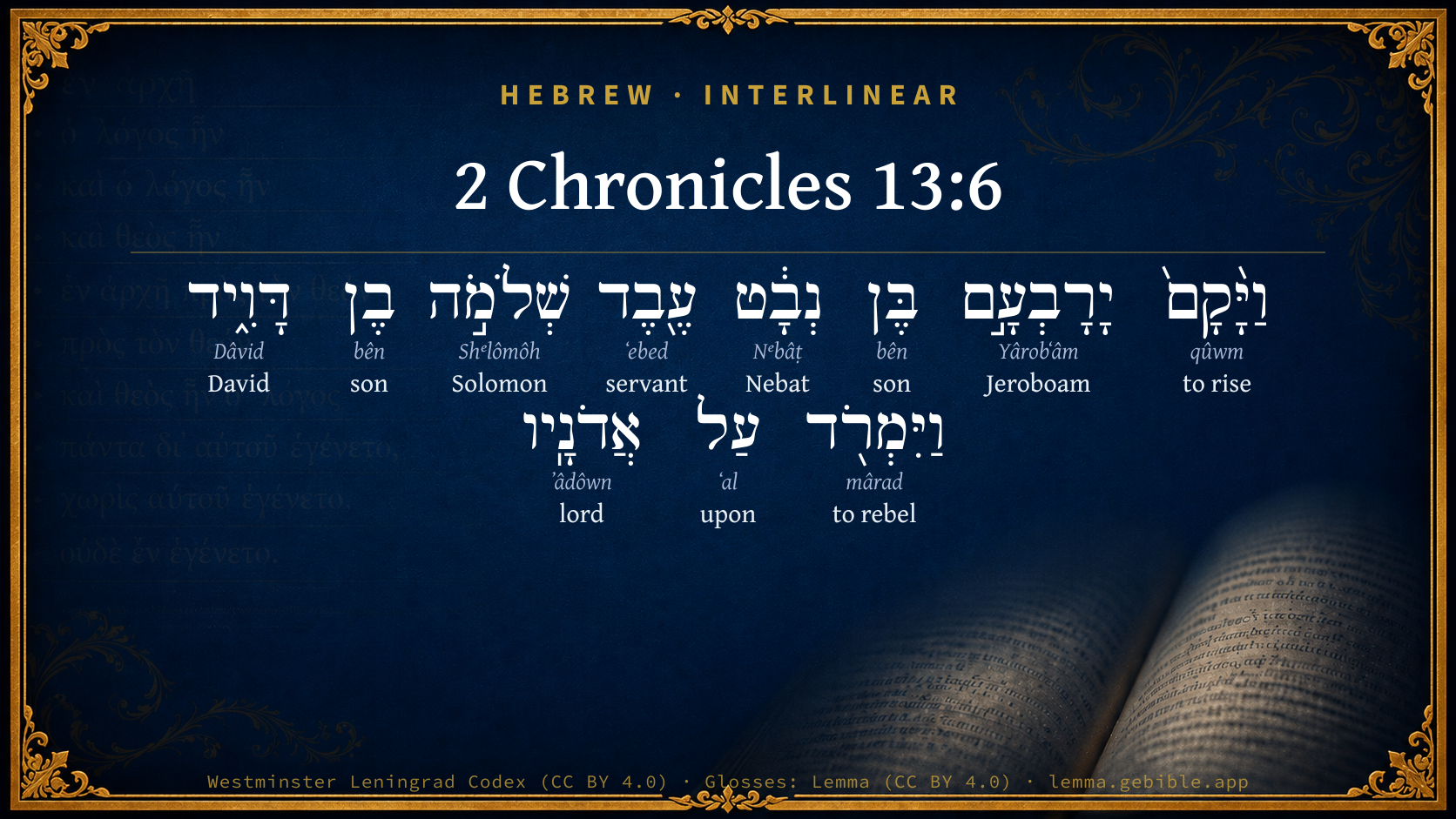
2 Chronicles 13:6

Hebrew (Westminster Leningrad Codex) 2 Chronicles 13:6 appears in the Hebrew Old Testament. The text above is from the Westminster Leningrad Codex. Each word links to its Strong’s number, a concise gloss, and parsing drawn from the Open Scriptures Hebrew Bible morphology. Click any word for its full Brown-Driver-Briggs (BDB) entry.
Download image
Cite this verse

2 Chronicles 13:6 (World English Bible). Public Domain. Lemma interlinear Bible study tool, https://lemma.gebible.app/v/2-chronicles/13/6.

Show BibTeX & RIS
BibTeX
RIS
English Translation
Yet Jeroboam the son of Nebat, the servant of Solomon the son of David, rose up, and rebelled against his lord.
World English Bible · Public Domain
Download a study sheet

One document with this verse’s original text, its word-by-word gloss line, the meaning frame, cross-references with their text, attributed commentary, and full source and license credits — printable, and it pastes into notes with its structure intact.

This verse Autodidact and up

Study sheet (.html) Plain text (.txt)

A passage Seminary Student

Up to 50 verses in one chapter. A passage sheet keeps up to 6 commentary sources and 12 cross-references per verse, in the order this page ranks them, and says so on the sheet whenever that leaves anything out. Ask for a single verse and you get the Autodidact verse sheet above.

Everything on this page stays free to read, with no account — the sheet is a download of what is already on screen, not access to it.

Want to remove ads? Support Godless Engineer
Compare translations 3

The same verse in 3 English versions, stacked beneath the original-language interlinear above. Click any original word for its lexicon entry.

Each is an independent rendering of the whole verse — the interlinear is not word-aligned to these translations.

Highlighted words mark where these versions differ — a whole-verse word diff, not a word-by-word alignment.

  • World English Bible Public Domain
    Yet Jeroboam the son of Nebat, the servant of Solomon the son of David, rose up, and rebelled against his lord.
  • King James Version Public Domain
    Yet Jeroboam the son of Nebat, the servant of Solomon the son of David, is risen up, and hath rebelled against his lord.
  • unfoldingWord Literal Text CC BY-SA 4.0
    But Jeroboam the son of Nebat, the servant of Solomon, the son of David, arose, and he rebelled against his lord.

unfoldingWord Literal Text — © unfoldingWord, licensed CC BY-SA 4.0. Word-aligned USFM3 via Door43 (git.door43.org/unfoldingWord/en_ult).

Versions to compare (up to 4)

3 of 4 selected

Show all 18 translations

Every available English version of this verse, each an independent rendering of the whole verse.

  • World English Bible Public Domain
    Yet Jeroboam the son of Nebat, the servant of Solomon the son of David, rose up, and rebelled against his lord.
  • Berean Standard Bible Public Domain
    Yet Jeroboam son of Nebat, a servant of Solomon son of David, rose up and rebelled against his master.
  • Majority Standard Bible Public Domain
    Yet Jeroboam son of Nebat, a servant of Solomon son of David, rose up and rebelled against his master.
  • King James Version Public Domain
    Yet Jeroboam the son of Nebat, the servant of Solomon the son of David, is risen up, and hath rebelled against his lord.
  • American Standard Version (1901) Public Domain
    Yet Jeroboam the son of Nebat, the servant of Solomon the son of David, rose up, and rebelled against his lord.
  • Revised Version (1885) Public Domain
    Yet Jeroboam the son of Nebat, the servant of Solomon the son of David, rose up, and rebelled against his lord.
  • Geneva Bible (1599) Public Domain
    And Ieroboam the sonne of Nebat the seruant of Salomon the sonne of Dauid is risen vp, and hath rebelled against his lord:
  • Douay-Rheims (1899) Public Domain
    And Jeroboam the son of Nabat, the servant of Solomon the son of David, rose up: m and rebelled against his lord.
  • Young's Literal Translation Public Domain
    and rise up doth Jeroboam, son of Nebat, servant of Solomon son of David, and rebelleth against his lord!
  • Literal Standard Version CC BY-SA 4.0
    And Jeroboam, son of Nebat, servant of Solomon son of David, rises up and rebels against his lord!
  • Unlocked Literal Bible CC BY-SA 4.0
    Yet Jeroboam son of Nebat, the servant of Solomon son of David, rose up and rebelled against his master.
  • unfoldingWord Literal Text CC BY-SA 4.0
    But Jeroboam the son of Nebat, the servant of Solomon, the son of David, arose, and he rebelled against his lord.
  • Darby Bible Public Domain
    But Jeroboam the son of Nebat, the servant of Solomon the son of David, rose up and rebelled against his lord.
  • World Messianic Bible Public Domain
    Yet Jeroboam the son of Nebat, the servant of Solomon the son of David, rose up, and rebelled against his lord.
  • Webster's Bible Public Domain
    Yet Jeroboam the son of Nebat the servant of Solomon the son of David, hath risen up, and hath rebelled against his lord.
  • Free Bible Version CC BY-SA 4.0
    Yet Jeroboam, son of Nebat, just a servant of Solomon, son of David, had the audacity to rebel against his master.
  • Bible in Basic English Public Domain
    But Jeroboam, the son of Nebat, the servant of Solomon, the son of David, took up arms against his lord.
  • JPS Tanakh (1917) Public Domain
    Yet Jeroboam the son of Nebat, the servant of Solomon the son of David, rose up, and rebelled against his lord.

Literal Standard Version (2020), Covenant Press — licensed CC BY-SA 4.0. Text via the HelloAO Bible API (eBible.org). Unlocked Literal Bible (unfoldingWord) — licensed CC BY-SA 4.0. Text via the HelloAO Bible API (eBible.org). unfoldingWord Literal Text — © unfoldingWord, licensed CC BY-SA 4.0. Word-aligned USFM3 via Door43 (git.door43.org/unfoldingWord/en_ult). Free Bible Version, Dr. Jonathan Gallagher — licensed CC BY-SA 4.0. Text via the HelloAO Bible API (eBible.org).

Word by word

More ways to search: Search by grammar → Find every occurrence → Compare this word →

Practice this passage: Drill this verse → Learn its vocabulary →

About this verse

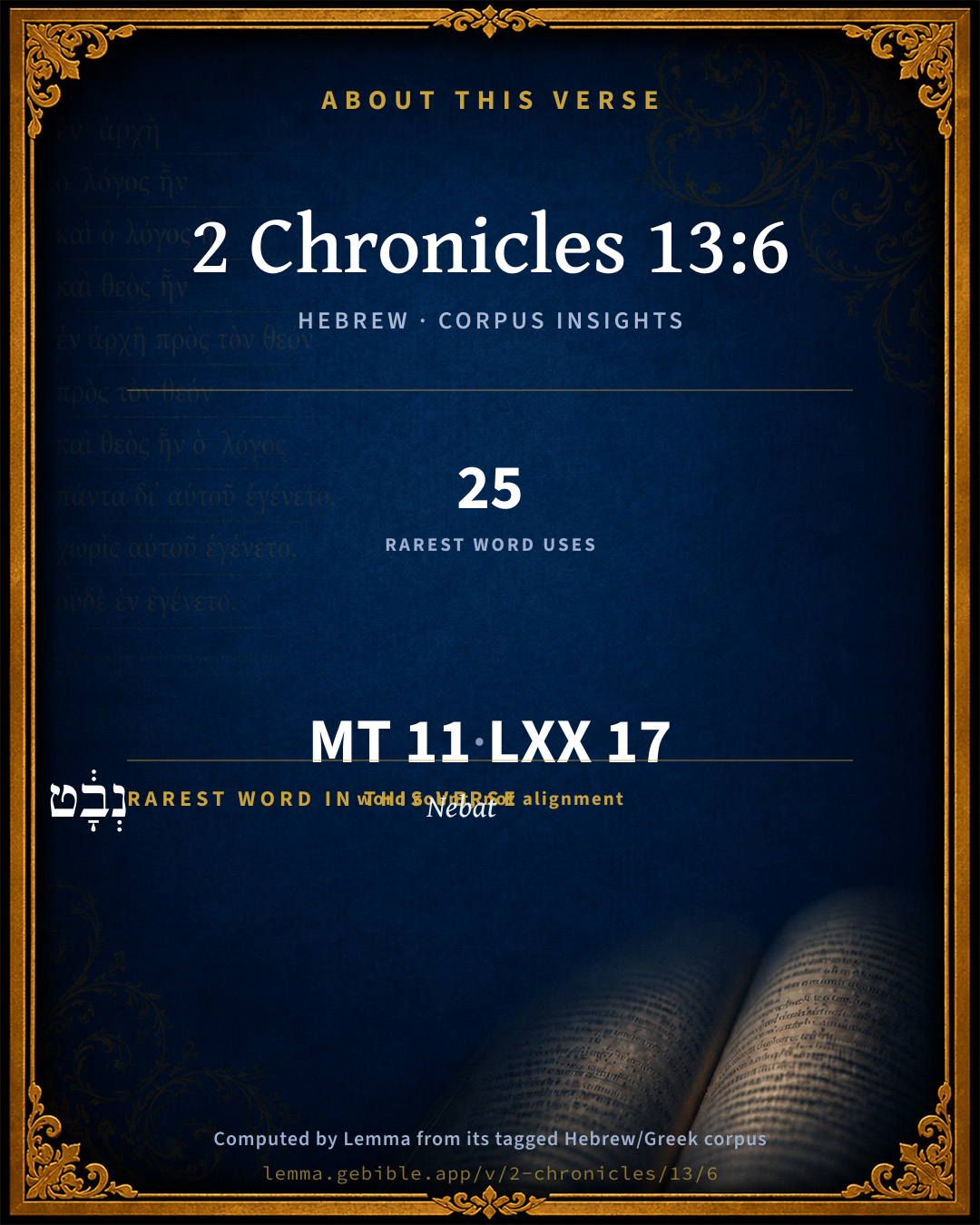
These counts appear in no published source. They are computed here, from the morphology-tagged text and Lemma’s own curated glosses. What Lemma adds →

11
words
10
distinct lemmas
Historical
section

Notable vocabulary

The rarest word here is נְבָ֔ט Nebat H5028 — appearing just 25 times in the whole Hebrew Bible.

Shared distinctive vocabulary

נְבָ֔ט Nebat H5028 occurs in 25 verses of the Hebrew Bible. Also found in:

Grammatical profile

  • 2 verbs
  • 8 nouns
  • 1 preposition

Verb forms

  • וַיָּ֨קָם֙ Qal · Sequential Imperfect
  • וַיִּמְרֹ֖ד Qal · Sequential Imperfect

Repetition

A word recurs within this verse — often emphatic in Hebrew:

Hebrew & Septuagint length

In English translation the verse runs 21 words from the Hebrew and 23 from the Septuagint (LXX English) — closely comparable.

A rough comparison of the two English renderings, which tokenize alike — not a word-level alignment.

Word counts can differ between the Hebrew and the Greek without any difference in meaning — e.g. the Hebrew direct-object marker אֵת has no separate Greek word, and Greek often adds the article ὁ.

In the original languages it is 11 Hebrew tokens and 17 Greek tokens — but the two are counted differently (Hebrew bundles its prefixes and suffixes into one token; the Greek is in lemma form), so that isn’t a like-for-like length.

Cross-references

4

Topical passages linked to 2 Chronicles 13:6 in the Treasury of Scripture Knowledge — connected by theme and wording, ordered by reader-vote popularity; previews shown in the World English Bible.

  • 1 Kings 11:26 Jeroboam the son of Nebat, an Ephraimite of Zeredah, a servant of Solomon, whose mother's name was Zeruah, a widow, he also lifted up his hand against the king.
  • 1 Kings 12:20 It happened, when all Israel heard that Jeroboam was returned, that they sent and called him to the congregation, and made him king over all Israel: there was none who followed the house of David, but the tribe of Judah only.
  • 1 Kings 12:27 if this people go up to offer sacrifices in the house of Yahweh at Jerusalem, then will the heart of this people turn again to their lord, even to Rehoboam king of Judah; and they will kill me, and return to Rehoboam king of Judah.
  • 2 Chronicles 10:19 So Israel rebelled against the house of David to this day.

Cross-references courtesy of OpenBible.info (CC BY 4.0).

Hebrew and Greek witnesses Masoretic Hebrew ↔ Greek Septuagint

The same verse in the two great witnesses to the Old Testament, shown verse-for-verse.

These are two independent witnesses, not word-aligned to each other, and the Septuagint is shown in lemma (dictionary) form.

Hebrew 2 Chronicles 13:6 Masoretic · Westminster Leningrad Codex

וַיָּ֨קָם֙ יָרָבְעָ֣ם בֶּן נְבָ֔ט עֶ֖בֶד שְׁלֹמֹ֣ה בֶן דָּוִ֑יד וַיִּמְרֹ֖ד עַל אֲדֹנָֽיו

Yet Jeroboam the son of Nebat, the servant of Solomon the son of David, rose up, and rebelled against his lord.

World English Bible · Public Domain

Greek LXX 2 Chronicles 13:6 Septuagint · lemma form

καί ἀναἵστημι ιεροβοαμ ὁ ὁ ναβατ ὁ παῖς σαλωμών ὁ δαυίδ καί ἀποἵστημι ἀπό ὁ κύριος αὐτός

But Jeroboam the son of Nabat, the servant of Solomon the son of David, is risen up, and has revolted from his master:

LXX2012 (modern English Septuagint) · Public Domain

Hebrew: Westminster Leningrad Codex (CC BY 4.0). Greek: Septuagint (public domain); English from LXX2012 (modern English Septuagint) (Public Domain). How the Septuagint differs from the Hebrew →

Commentary

Notes on 2 Chronicles 13:6 from classic Christian and Jewish commentators (each source and its license shown beneath its notes). The classic Christian expositions comment on the surrounding passage and are grouped to its opening verse, so a note may address several verses; the Jewish commentaries on the Tanakh (Rashi and others) are per-verse, so they appear only where the commentator wrote on this verse.

Lemma curates 59 commentaries, every one of them public domain or Creative Commons licensed, each selected and text-cleaned for this edition rather than reprinted as found. About our sources →

Trapp's Complete Commentary

John Trapp

2Ch 13:6 Yet Jeroboam the son of Nebat, the servant of Solomon the son of David, is risen up, and hath rebelled against his lord.

Ver. 6. Yet Jeroboam the son of Nebat, the servant of Solomon.] But such a servant, as being delicately brought up by him, and courteously dealt with, would needsly become his son at length, as Pro 29:21, rising up and rebelling against his lord, as he is justly charged, though God foretold that he should be king. {1Ki 11:35}

John Trapp, A Commentary or Exposition upon All the Books of the Old and New Testament (1647–1656) — public domain. Text from a community e-Sword module.

Tyndale Open Study Notes

Tyndale Open Resources

13:6-7 Abijah’s speech castigated the northerners for refusing to support the kingdom of David.

Tyndale Open Study Notes — © Tyndale Open Resources, licensed CC BY-SA 4.0. Text via the HelloAO Bible API.

Ellicott's Commentary for English Readers

(6) The servant of Solomon.—See 1Ki_11:26.

Is risen up, and hath rebelled.—Arose and rebelled. (See 1Ki_11:26-40).

A Bible Commentary for English Readers, edited by Charles John Ellicott (1878–1897) — public domain. Text from a community e-Sword module.

The Cambridge Bible for Schools and Colleges

gen. ed. J. J. S. Perowne

6. is risen up, and hath rebelled] R.V. rose up, and rebelled.

The Cambridge Bible for Schools and Colleges (gen. ed. J. J. S. Perowne; Cambridge University Press, 1878–1918) — public domain. Text from a community e-Sword module.

John Gill's Exposition

And there are gathered unto him vain men,.... Void of the fear of God, and all that is good:

the children of Belial: men unprofitable, good for nothing, or that had cast off the yoke of the law of God, were lawless and abandoned persons:

And have strengthened themselves against Rehoboam the son of Solomon: rejected his government of them; went into a strong opposition to him, and set up another king over them:

when Rehoboam was young and tender hearted, and could not withstand them; not that he was young in years, for he was forty one years of age when he began to reign; though Joshua is called a young man when he is supposed to be between fifty and sixty years of age Exo 33:11, and though "adolescentia" and "juventus" are both used in Latin writers for "youth", yet Varro (q) distinguishes them, and makes the former to begin at the year fifteen, and continue to the year thirty, and the latter to begin at thirty, and end at forty five; so that, according to this, Rehoboam was then in his stage of youth; but perhaps the meaning here is, that he was young in the kingdom, scarcely settled on his throne, and the advantage of that was taken; not was he cowardly and fearful; and if Abijah meant that by "tender heartedness", he not only reproached but belied his father; for he would have fought with Israel in order to have reduced them to obedience, but was forbidden by the Lord; if by "tender hearted", he means that he had a tender regard to the command of God, it is true; but that seems not to be his sense, but the former.

(q) Apud Stockim in voce p. 688.

John Gill's Exposition of the Whole Bible (1746–1763) — public domain (CC PDM 1.0). Text via the HelloAO Bible API.

The Pulpit Commentary

The servant of Solomon. 1Ki_11:28 is evidently the apter reference for this verse, rather than 26, as generally given.

The Pulpit Commentary (1880–1919), ed. H.D.M. Spence-Jones & Joseph S. Exell — public domain. Text from a community e-Sword module.

unfoldingWord translationNotes

Door43 World Missions Community

base fellows

"wicked men" or "evil men"

gathered to him

"joined with Jeroboam"

translationWords

servant

Solomon

raise

rebel

lord

worthy

Rehoboam

unfoldingWord translationNotes — © Distant Shores Media and the Door43 World Missions Community, licensed CC BY-SA 4.0. Source: git.door43.org/Door43/en_tn.

Rashi

Rabbi Shlomo Yitzchaki (Rashi)

Jeroboam, etc. the servant of Solomon the son of David, arose, etc. and a great stigma is attached to this.

Rashi on the Tanakh — English translations: “The Judaica Press complete Tanach with Rashi, translated by A. J. Rosenberg” (CC BY 4.0); “Pentateuch with Rashi's commentary by M. Rosenbaum and A.M. Silbermann, 1929-1934” (public domain); “The Metsudah Tanach series, Lakewood, N.J” (CC BY 4.0); and “The Book of Joshua, Metsudah Publications, 1997” (CC BY 4.0). Text via Sefaria.

Lesson kit

Teaching starters — assembled from the data on this page, not authored interpretation. Every prompt links to the verse data it draws on. Edit before teaching.

2 Chronicles, in the Historical, opens this verse with 11 words (10 distinct Hebrew lemmas). Its most distinctive word is Nᵉbâṭ (“Nebat”). A historical commentator’s framing appears above. Read the whole chapter for the surrounding context.

Discussion questions

  1. How does “Nebat” (Nᵉbâṭ) shape what this verse is saying?
  2. 1 Kings 11:26 shares the word «Nebat» with this verse. How do the two illuminate each other?
  3. “son” occurs 2× in this one verse. What is the effect of the repetition?
  4. These translations render this verse differently; the difference is in the English rendering, not the original. What questions does that raise?
  5. The verb «וַיָּ֨קָם֙» is Qal Sequential Imperfect. How does its form color the action?
  6. Reading how Trapp's Complete Commentary and Tyndale Open Study Notes read this verse, where do the two commentators agree and where do they part?

Things to notice

Reading settings

Reading text

Shown beneath each verse's original-language words.

Old Testament
Old Testament edition

Read the OT as the Masoretic Hebrew (MT) or the Greek Septuagint (LXX).

English shown for the Greek Septuagint (in the Hebrew ↔ Greek comparison).

Comparing translations? Open the Compare panel on any verse page to stack up to four side by side.