2 Kings 8:19

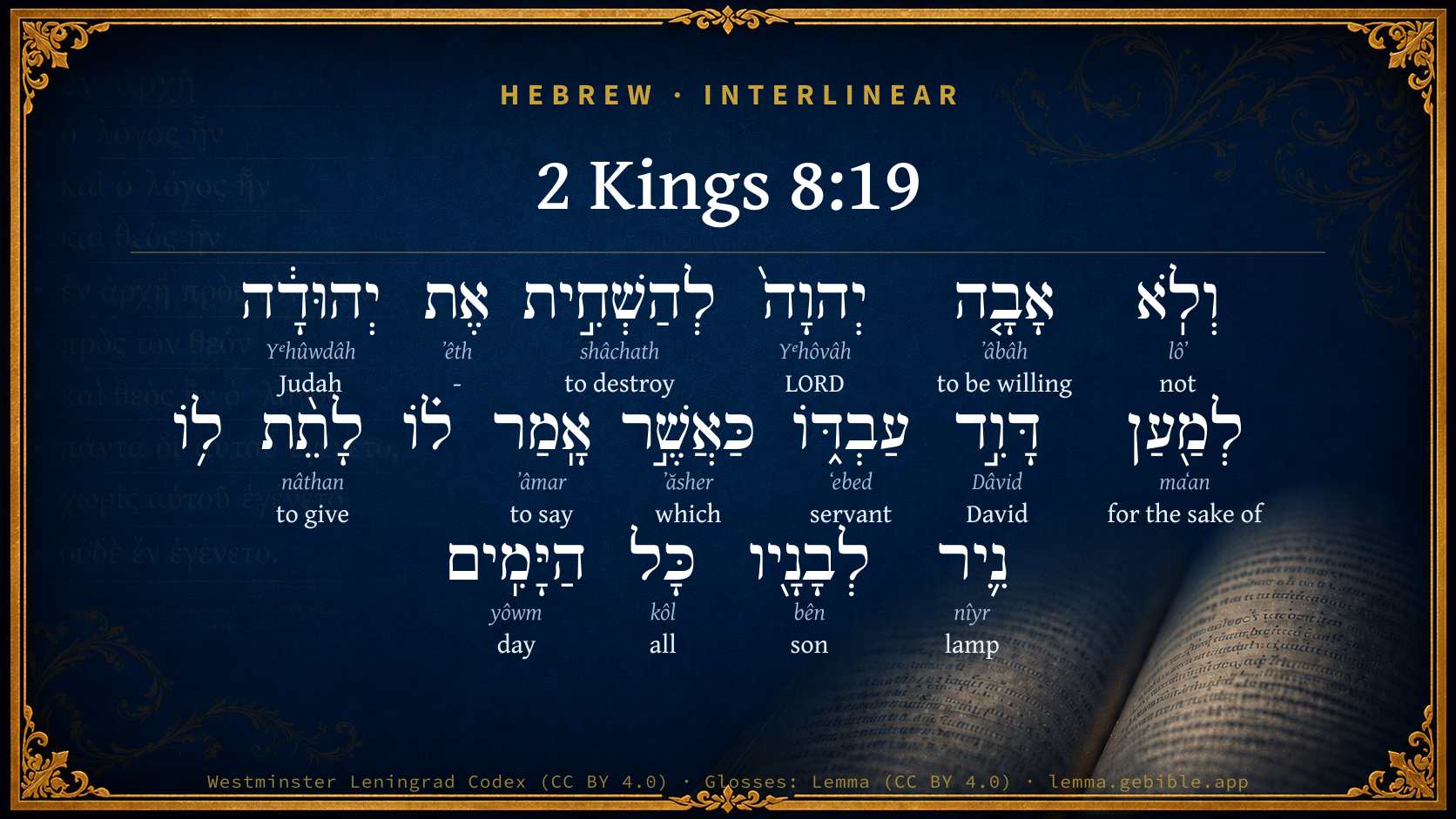
Hebrew (Westminster Leningrad Codex) 2 Kings 8:19 appears in the Hebrew Old Testament. The text above is from the Westminster Leningrad Codex. Each word links to its Strong’s number, a concise gloss, and parsing drawn from the Open Scriptures Hebrew Bible morphology. Click any word for its full Brown-Driver-Briggs (BDB) entry.
Download image
Cite this verse

2 Kings 8:19 (World English Bible). Public Domain. Lemma interlinear Bible study tool, https://lemma.gebible.app/v/2-kings/8/19.

Show BibTeX & RIS
BibTeX
RIS
English Translation
However Yahweh would not destroy Judah, for David his servant's sake, as he promised him to give to him a lamp for his children always.
World English Bible · Public Domain
Download a study sheet

One document with this verse’s original text, its word-by-word gloss line, the meaning frame, cross-references with their text, attributed commentary, and full source and license credits — printable, and it pastes into notes with its structure intact.

This verse Autodidact and up

Study sheet (.html) Plain text (.txt)

A passage Seminary Student

Up to 50 verses in one chapter. A passage sheet keeps up to 6 commentary sources and 12 cross-references per verse, in the order this page ranks them, and says so on the sheet whenever that leaves anything out. Ask for a single verse and you get the Autodidact verse sheet above.

Everything on this page stays free to read, with no account — the sheet is a download of what is already on screen, not access to it.

Want to remove ads? Support Godless Engineer
Compare translations 3

The same verse in 3 English versions, stacked beneath the original-language interlinear above. Click any original word for its lexicon entry.

Each is an independent rendering of the whole verse — the interlinear is not word-aligned to these translations.

Highlighted words mark where these versions differ — a whole-verse word diff, not a word-by-word alignment.

  • World English Bible Public Domain
    However Yahweh would not destroy Judah, for David his servant's sake, as he promised him to give to him a lamp for his children always.
  • King James Version Public Domain
    Yet the LORD would not destroy Judah for David his servant's sake, as he promised him to give him alway a light, and to his children.
  • unfoldingWord Literal Text CC BY-SA 4.0
    But Yahweh was not willing to destroy Judah, for the sake of David his servant, just as he had said to him, to give to him a lamp for his sons all of the days.

unfoldingWord Literal Text — © unfoldingWord, licensed CC BY-SA 4.0. Word-aligned USFM3 via Door43 (git.door43.org/unfoldingWord/en_ult).

Versions to compare (up to 4)

3 of 4 selected

Show all 18 translations

Every available English version of this verse, each an independent rendering of the whole verse.

  • World English Bible Public Domain
    However Yahweh would not destroy Judah, for David his servant's sake, as he promised him to give to him a lamp for his children always.
  • Berean Standard Bible Public Domain
    Yet for the sake of His servant David, the LORD was unwilling to destroy Judah, since He had promised to maintain a lamp for David and his descendants forever.
  • Majority Standard Bible Public Domain
    Yet for the sake of His servant David, the LORD was unwilling to destroy Judah, since He had promised to maintain a lamp for David and his descendants forever.
  • King James Version Public Domain
    Yet the LORD would not destroy Judah for David his servant's sake, as he promised him to give him alway a light, and to his children.
  • American Standard Version (1901) Public Domain
    Howbeit Jehovah would not destroy Judah, for David his servant's sake, as he promised him to give unto him a lamp for his children alway.
  • Revised Version (1885) Public Domain
    Howbeit the LORD would not destroy Judah, for David his servant’s sake, as he promised him to give unto him a lamp for his children alway.
  • Geneva Bible (1599) Public Domain
    Yet the Lord would not destroy Iudah, for Dauid his seruants sake, as he had promised him to giue him a light, and to his children for euer.
  • Douay-Rheims (1899) Public Domain
    But the Lord would not destroy Juda, for David his servant's sake, as he had promised him, to give him a light, and to his children always.
  • Young's Literal Translation Public Domain
    and Jehovah was not willing to destroy Judah, for the sake of David his servant, as He said to him, to give to him a lamp -- to his sons all the days.
  • Literal Standard Version CC BY-SA 4.0
    and YHWH was not willing to destroy Judah, for the sake of His servant David, as He said to him, to give a lamp to him—to his sons [for] all the days.
  • Unlocked Literal Bible CC BY-SA 4.0
    However, because of his servant David, Yahweh did not want to destroy Judah, since he had told him that he would always give him descendants.
  • unfoldingWord Literal Text CC BY-SA 4.0
    But Yahweh was not willing to destroy Judah, for the sake of David his servant, just as he had said to him, to give to him a lamp for his sons all of the days.
  • Darby Bible Public Domain
    But Jehovah would not destroy Judah, for David his servant's sake, as he had promised him to give him always a lamp for his sons.
  • World Messianic Bible Public Domain
    However, the LORD would not destroy Judah, for David his servant’s sake, as he promised him to give to him a lamp for his children always.
  • Webster's Bible Public Domain
    Yet the LORD would not destroy Judah, for David his servant's sake, as he promised him to give him always a light, and to his children.
  • Free Bible Version CC BY-SA 4.0
    But for the sake of David his servant the Lord didn't want to destroy Judah since he had promised him that there would always be a ruler from his descendants, like a lamp forever.
  • Bible in Basic English Public Domain
    But it was not the Lord's purpose to send destruction on Judah, because of David his servant, to whom he had given his word that he would have a light for ever.
  • JPS Tanakh (1917) Public Domain
    Howbeit the LORD would not destroy Judah, for David His servant's sake, as He promised him to give unto him a lamp and to his children alway.

Literal Standard Version (2020), Covenant Press — licensed CC BY-SA 4.0. Text via the HelloAO Bible API (eBible.org). Unlocked Literal Bible (unfoldingWord) — licensed CC BY-SA 4.0. Text via the HelloAO Bible API (eBible.org). unfoldingWord Literal Text — © unfoldingWord, licensed CC BY-SA 4.0. Word-aligned USFM3 via Door43 (git.door43.org/unfoldingWord/en_ult). Free Bible Version, Dr. Jonathan Gallagher — licensed CC BY-SA 4.0. Text via the HelloAO Bible API (eBible.org).

Word by word

More ways to search: Search by grammar → Find every occurrence → Compare this word →

Practice this passage: Drill this verse → Learn its vocabulary →

נִ֛יר
nîyr
H5216
“lamp”
Noun, Common, Masculine, Singular, Absolute
Part of Speech
Noun
Type
Common
Gender
Masculine
Number
Singular
State
Absolute
Full BDB Definition

Origin: from a primitive root [see H5214 ; H5135 ] properly, meaning to glisten

TWOT: 1333b

lamp
  1. וְלֹֽא lôʼ H3808 “and · not” Conjunction + Particle, Negative
  2. אָבָ֤ה ʼâbâh H14 “to be willing” Verb, Qal, Perfect, 3rd Person, Masculine, Singular
  3. יְהוָה֙ Yᵉhôvâh H3068 “LORD” Noun, Proper
  4. לְהַשְׁחִ֣ית shâchath H7843 “to destroy” Preposition + Verb, Hiphil, Infinitive Construct
  5. אֶת ʼêth H853 “-” Particle, Direct Object
  6. יְהוּדָ֔ה Yᵉhûwdâh H3063 “Judah” Noun, Proper
  7. לְמַ֖עַן maʻan H4616 “for the sake of” Preposition
  8. דָּוִ֣ד Dâvid H1732 “David” Noun, Proper
  9. עַבְדּ֑וֹ ʻebed H5650 “servant · his” Noun, Common, Masculine, Singular, Construct + Suffix, Personal, 3rd Person, Masculine, Singular
  10. כַּאֲשֶׁ֣ר ʼăsher H834 “like/as · which” Preposition + Particle, Relative
  11. אָֽמַר ʼâmar H559 “to say” Verb, Qal, Perfect, 3rd Person, Masculine, Singular
  12. לָתֵ֨ת nâthan H5414 “to give” Preposition + Verb, Qal, Infinitive Construct
  13. לְבָנָ֖יו bên H1121 “to/for · sons · his” Preposition + Noun, Common, Masculine, Plural, Construct + Suffix, Personal, 3rd Person, Masculine, Singular
  14. כָּל kôl H3605 “all of” Noun, Common, Masculine, Singular, Construct
  15. הַיָּמִֽים yôwm H3117 “the · days” Particle, Definite Article + Noun, Common, Masculine, Plural, Absolute

About this verse

These counts appear in no published source. They are computed here, from the morphology-tagged text and Lemma’s own curated glosses. What Lemma adds →

18
words
16
distinct lemmas
Historical
section

Shared distinctive vocabulary

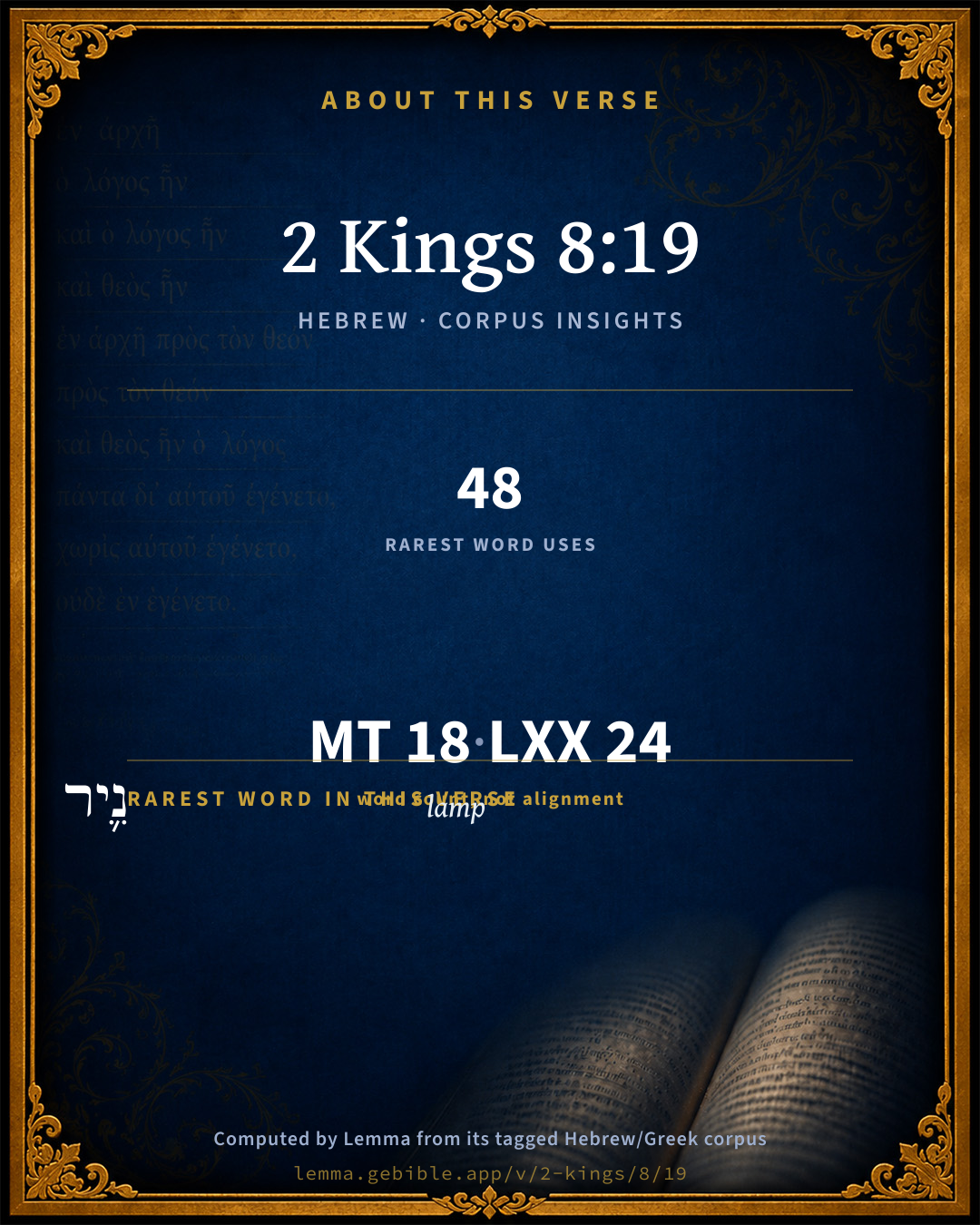
נִ֛יר lamp H5216 occurs in 42 verses of the Hebrew Bible. Also found in:

Grammatical profile

  • 4 verbs
  • 8 nouns
  • 3 prepositions
  • 3 particles

Verb forms

  • אָבָ֤ה Qal · Perfect
  • לְהַשְׁחִ֣ית Hiphil · Infinitive Construct
  • אָֽמַר Qal · Perfect
  • לָתֵ֨ת Qal · Infinitive Construct

Hebrew & Septuagint length

In English translation the verse runs 25 words from the Hebrew and 27 from the Septuagint (LXX English) — closely comparable.

A rough comparison of the two English renderings, which tokenize alike — not a word-level alignment.

Word counts can differ between the Hebrew and the Greek without any difference in meaning — e.g. the Hebrew direct-object marker אֵת has no separate Greek word, and Greek often adds the article ὁ.

In the original languages it is 18 Hebrew tokens and 24 Greek tokens — but the two are counted differently (Hebrew bundles its prefixes and suffixes into one token; the Greek is in lemma form), so that isn’t a like-for-like length.

Cross-references

12

Topical passages linked to 2 Kings 8:19 in the Treasury of Scripture Knowledge — connected by theme and wording, ordered by reader-vote popularity; previews shown in the World English Bible.

  • 1 Kings 11:36 To his son will I give one tribe, that David my servant may have a lamp always before me in Jerusalem, the city which I have chosen me to put my name there.
  • 2 Samuel 7:12–13 When your days are fulfilled, and you shall sleep with your fathers, I will set up your seed after you, who shall proceed out of your bowels, and I will establish his kingdom.
  • 2 Samuel 7:15 but my loving kindness shall not depart from him, as I took it from Saul, whom I put away before you.
  • Isaiah 37:35 For I will defend this city to save it, for my own sake, and for my servant David's sake.
  • Hosea 11:9 I will not execute the fierceness of my anger. I will not return to destroy Ephraim: For I am God, and not man; the Holy One in the midst of you; And I will not come in wrath.
  • Luke 1:32–33 He will be great, and will be called the Son of the Most High. The Lord God will give him the throne of his father, David,
  • 2 Samuel 21:17 But Abishai the son of Zeruiah helped him, and struck the Philistine, and killed him. Then the men of David swore to him, saying, You shall go no more out with us to battle, that you don't quench the lamp of Israel.
  • 1 Kings 15:4–5 Nevertheless for David's sake did Yahweh his God give him a lamp in Jerusalem, to set up his son after him, and to establish Jerusalem;
  • 2 Kings 19:34 For I will defend this city to save it, for my own sake, and for my servant David's sake.
  • 2 Chronicles 21:7 However Yahweh would not destroy the house of David, because of the covenant that he had made with David, and as he promised to give a lamp to him and to his children always.
  • Isaiah 7:14 Therefore the Lord himself will give you a sign. Behold, the virgin will conceive, and bear a son, and shall call his name Immanuel.
  • Jeremiah 33:25–26 Thus says Yahweh: If my covenant of day and night fails, if I have not appointed the ordinances of heaven and earth;

Cross-references courtesy of OpenBible.info (CC BY 4.0).

Hebrew and Greek witnesses Masoretic Hebrew ↔ Greek Septuagint

The same verse in the two great witnesses to the Old Testament, shown verse-for-verse.

These are two independent witnesses, not word-aligned to each other, and the Septuagint is shown in lemma (dictionary) form.

Hebrew 2 Kings 8:19 Masoretic · Westminster Leningrad Codex

וְלֹֽא אָבָ֤ה יְהוָה֙ לְהַשְׁחִ֣ית אֶת יְהוּדָ֔ה לְמַ֖עַן דָּוִ֣ד עַבְדּ֑וֹ כַּאֲשֶׁ֣ר אָֽמַר ל֗וֹ לָתֵ֨ת ל֥וֹ נִ֛יר לְבָנָ֖יו כָּל הַיָּמִֽים

However Yahweh would not destroy Judah, for David his servant's sake, as he promised him to give to him a lamp for his children always.

World English Bible · Public Domain

Greek LXX 2 Kings 8:19 Septuagint · lemma form

καί οὐ θέλω κύριος διαφθείρω ὁ ἰούδας διά δαυίδ ὁ δοῦλος αὐτός καθώς εἶπον δίδωμι αὐτός λύχνος καί ὁ υἱός αὐτός πᾶς ὁ ἡμέρα

But the Lord would not destroy Juda for David his servant's sake, as he said he would give a light to him and to his sons continually.

LXX2012 (modern English Septuagint) · Public Domain

On this verse, Ellicott's Commentary for English Readers discusses the Septuagint’s reading. Read the note in Commentary ↓

Hebrew: Westminster Leningrad Codex (CC BY 4.0). Greek: Septuagint (public domain); English from LXX2012 (modern English Septuagint) (Public Domain). How the Septuagint differs from the Hebrew →

Targum (Aramaic paraphrase)

1

The Targum is the ancient Jewish Aramaic paraphrase of the Hebrew Scriptures — an interpretive translation, not the Hebrew text itself. Onkelos (literal) and Pseudo-Jonathan (expansive) render the Torah, and Jonathan the Prophets. Coverage is partial: where no permissively-licensed English translation exists for a verse, only the Aramaic is shown. This is verse-level text, not a word-by-word alignment to the Hebrew.

  1. Targum Jonathan Prophets (Joshua–Malachi)
    וְלָא הֲוָה רַעֲוָא קֳדָם יְיָ לְחַבָּלָא יַת דְבֵית יְהוּדָה בְּדִיל דָוִד עַבְדֵיהּ כְּמָא דַאֲמַר לֵיהּ לְמִתַּן לֵיהּ מַלְכוּ וְלִבְנוֹהִי כָּל יוֹמַיָא:

    (no public-domain English translation for this verse)

    Targum Jonathan — Aramaic: “Mikraot Gedolot” (public domain). English: “Sefaria Community Translation” (CC0 1.0 (public-domain dedication)); “London "Chaldee Paraphrase," 1871” (public domain). Text via Sefaria.

Commentary

Notes on 2 Kings 8:19 from classic Christian and Jewish commentators (each source and its license shown beneath its notes). The classic Christian expositions comment on the surrounding passage and are grouped to its opening verse, so a note may address several verses; the Jewish commentaries on the Tanakh (Rashi and others) are per-verse, so they appear only where the commentator wrote on this verse.

Lemma curates 59 commentaries, every one of them public domain or Creative Commons licensed, each selected and text-cleaned for this edition rather than reprinted as found. About our sources →

Trapp's Complete Commentary

John Trapp

2Ki 8:19 Yet the LORD would not destroy Judah for David his servant’s sake, as he promised him to give him alway a light, [and] to his children.

Ver. 19. To give him alway a light.] i.e., A successor, till Shiloh should come. {Luk 1:31} For although the Maccabees, who were of another tribe, bore sway for a season; yet at the same time, as Calvin well observeth, sat the Synedrium, who were of David’s posterity, exercised chief authority, and lasted till Christ’s nativity in great power.

John Trapp, A Commentary or Exposition upon All the Books of the Old and New Testament (1647–1656) — public domain. Text from a community e-Sword module.

Joseph Benson's Commentary

2Ki 8:19. To give him always a light — A son and successor, until the coming of the Messiah: for so long, and not longer, this succession might seem necessary for the making good of God’s promise and covenant made with David. But when the Messiah was once come, there was no more need of any succession, and the sceptre might and did without any inconvenience depart from Judah, and from all the succeeding branches of David’s family, because the Messiah was to hold the kingdom for ever in his own person, though not in so gross a way as the carnal Jews imagined.

Joseph Benson's Commentary on the Old and New Testaments (1811–1818) — public domain. Text from a community e-Sword module.

Tyndale Open Study Notes

Tyndale Open Resources

8:19 Despite Jehoram’s wickedness, God did not destroy Judah but honored his covenant with David (2 Sam 7:11-16). • The Lord had promised to preserve David’s descendants on the throne of Judah as a shining . . . lamp of God’s grace (1 Kgs 11:36). God’s promises to David ultimately find fulfillment in Jesus (Ezek 34:23-31), the light of the world (John 4:1-5).

Tyndale Open Study Notes — © Tyndale Open Resources, licensed CC BY-SA 4.0. Text via the HelloAO Bible API.

Adam Clarke's Commentary

Verse 19. To give him alway a light] To give him a successor in his own family.

Adam Clarke's Commentary on the Bible (1810–1826) — public domain. Text from a community e-Sword/MySword module.

Ellicott's Commentary for English Readers

(19) To give him alway a light.—Comp. 1Ki_15:4; 1Ki_11:36; and for the promise to David, 2Sa_7:12-16.

And to his children.—The reading of many Heb. MSS., the LXX., Vulg., and Targum. Thenius calls this a reading devised for the removal of a difficulty, and asserts that the promise was made to David alone. He would omit the conjunction, and render, “To give him alway a lamp in respect of (i.e., through) his sons.” (See 2Ch_21:7, Note.) Keil adopts the same reading, but translates, “To give him, that is, his sons, a lamp,” making “to his sons” an explanatory apposition.

A Bible Commentary for English Readers, edited by Charles John Ellicott (1878–1897) — public domain. Text from a community e-Sword module.

The Cambridge Bible for Schools and Colleges

gen. ed. J. J. S. Perowne

19. Yet [R.V. Howbeit] the Lord would not destroy] The R.V. has adopted the rendering of Chronicles, where the original is the same as here.

as he promised him to give him alway a lights, and to his children] R.V. as he promised him to give unto him a lamp for his children alway. The italic ‘and’ in A.V. shews that there is no conjunction in the Hebrew. Hence the change in R.V. But in 2Ch_21:7 the ‘and’ is expressed, and probably should be here. In 2Sa_21:17 David is called ‘the lamp of Israel’. For the promise to David and his seed see 2Sa_7:12-16, and for the expression ‘to give him a lamp’ see 1Ki_11:36; 1Ki_15:4, in which last passage the A.V. renders the noun ‘lamp’, which for consistency the R.V. has adopted in all the parallel places.

The Cambridge Bible for Schools and Colleges (gen. ed. J. J. S. Perowne; Cambridge University Press, 1878–1918) — public domain. Text from a community e-Sword module.

John Gill's Exposition

Yet the Lord would not destroy Judah for David his servant's sake,.... Not for his merits, but for the mercy he assured him of:

as he promised him to give to him always a light, and to his children; or a kingdom, as the Targum; therefore he would not utterly destroy the tribe, nor suffer the sceptre or government to depart from it till the Messiah came, see Psa 132:11.

John Gill's Exposition of the Whole Bible (1746–1763) — public domain (CC PDM 1.0). Text via the HelloAO Bible API.

Haydock's Catholic Bible Commentary

Light, or lamp, posterity and regal power, 3 Kings xi. 36. (Haydock)

George Leo Haydock (1774–1849), Haydock's Catholic Family Bible and Commentary, 1859 edition — public domain. Excludes Psalms (Douay-Rheims chapter numbering differs from Protestant) and Deuterocanonical books (Catholic canon only).

Matthew Poole's English Annotations

Alway, Heb. all days, until the coming of the Messiah, as it is elsewhere limited and explained; for so long, and not longer, this succession might seem necessary for the making good of God’s promise and covenant made with David. But when the Messiah was once come, there was no more need of any succession, and the sceptre might and did without any inconvenience depart from Judah, and from all the succeeding branches of David’s family, because the Messiah was to hold the kingdom for ever in his own person, though not in so gross a way as the carnal Jews imagined, but in a spiritual manner.

A light, i.e. a son and successor. Of this phrase, See Poole "1Ki 11:36".

Matthew Poole's English Annotations on the Holy Bible (1683–1685) — public domain. Text from a community e-Sword/MySword module.

The Pulpit Commentary

Yet the Lord would not destroy Judah for David his servant"s sake. The natural punishment of apostasy was rejection by God, and on rejection would, as a matter of course, follow destruction and ruin. God had declared by Moses, "If thou wilt not hearken unto the voice of the Lord thy God, to observe to do all his commandments and statutes, which I command thee this day; all these curses shall come upon thee The Lord shall send upon thee cursing, vexation, and rebuke, in all that thou settest thine hand unto for to do, until thou be destroyed, and until thou perish quickly; because of the wickedness of thy doings, whereby thou hast forsaken me. The Lord shall make the pestilence cleave unto thee, until he have consumed thee from off the land, whither thou goest to possess it. The Lord shall smite thee with a consumption, and with a fever, and with an inflammation, and with an extreme burning, and with the sword, and with blasting, and with mildew; and they shall pursue thee till thou perish. And thy heaven which is over thy head shall be brass, and the earth that is underneath thee shall be iron.... The Lord shall cause thee to be smitten of thine enemies; thou shalt go out one way against them, and flee seven ways before them: and thou shalt be removed into all the kingdoms of the earth.... Thou shall become an astonishment, a proverb, and a byword, among all nations whither the Lord shall lead thee". (Deu_28:15-37) The apostasy of Jeheram, and of the nation under him, was calculated to bring about the immediate fulfillment of all these threats, and would have done so but for a restraining cause. God had made promises to David, and to his seed after him (2Sa_7:13-16; Psa_89:29-37, etc.) which would be unfulfilled if Judah"s candlestick were at once removed. He had declared, "If thy children forsake my Law, and walk not in my statutes... I will visit their offences with the rod, and their sin with scourges. Nevertheless my loving-kindness will I not utterly take away, nor suffer my truth to fail. My covenant will I not break, nor alter the thing that is gone out of my lips; I have sworn once by my holiness that I will not fail David." If he had now swept away the Jewish kingdom, he would have dealt more hardly with these who clave to David than with those that broke off from him. He would not have shown the "faithfulness" or the "mercy" which he had promised, tie would have forgotten "the loving-kindnesses which he aware unto David in his truth". (Psa_89:49) Therefore he would not he could not as yet "destroy Judah," with which, in point of fact, he bore for above three centuries longer, until at last the cup of their iniquities was full, and "there was no remedy." As he promised him to give him always a light, and to his children. There is no "and" in the original. TranslateAs he promised him to give him always a light in respect of his children, and compare, for the promise of "a light". (1Ki_11:36 1Ki_15:4; and Psa_132:17)

The Pulpit Commentary (1880–1919), ed. H.D.M. Spence-Jones & Joseph S. Exell — public domain. Text from a community e-Sword module.

John Wesley's Explanatory Notes

Alway - Until the coming of the Messiah: for so long, and not longer, this succession might seem necessary for the making good of God's promise and covenant made with David. But when the Messiah, was once come, there was no more need of any succession, and the scepter might and did without any inconvenience depart from Judah, and from all the succeeding branches of David's family, because the Messiah was to hold the kingdom forever in his own person, though not in so gross a way as the carnal Jews imagined. A light - A son and successor.

John Wesley, Explanatory Notes Upon the Whole Bible (1754–1765) — public domain. Text via the GEBible commentary corpus.

Rashi

Rabbi Shlomo Yitzchaki (Rashi)

A kingdom. Kingdom.

Rashi on the Tanakh — English translations: “The Judaica Press complete Tanach with Rashi, translated by A. J. Rosenberg” (CC BY 4.0); “Pentateuch with Rashi's commentary by M. Rosenbaum and A.M. Silbermann, 1929-1934” (public domain); “The Metsudah Tanach series, Lakewood, N.J” (CC BY 4.0); and “The Book of Joshua, Metsudah Publications, 1997” (CC BY 4.0). Text via Sefaria.

Lesson kit

Teaching starters — assembled from the data on this page, not authored interpretation. Every prompt links to the verse data it draws on. Edit before teaching.

2 Kings, in the Historical, opens this verse with 18 words (16 distinct Hebrew lemmas). Its most distinctive word is nîyr (“lamp”). A historical commentator’s framing appears above. Read the whole chapter for the surrounding context.

Discussion questions

  1. The word nîyr carries the sense “lamp.” How does it shape the verse?
  2. Exodus 25:37 shares the word «lamp» with this verse. How do the two illuminate each other?
  3. These translations render this verse differently. What is at stake in choosing one wording over another?
  4. The verb «אָבָ֤ה» is Qal Perfect. How does its form color the action?
  5. Reading how Trapp's Complete Commentary and Joseph Benson's Commentary read this verse, where do the two commentators agree and where do they part?

Things to notice

Reading settings

Reading text

Shown beneath each verse's original-language words.

Old Testament
Old Testament edition

Read the OT as the Masoretic Hebrew (MT) or the Greek Septuagint (LXX).

English shown for the Greek Septuagint (in the Hebrew ↔ Greek comparison).

Comparing translations? Open the Compare panel on any verse page to stack up to four side by side.