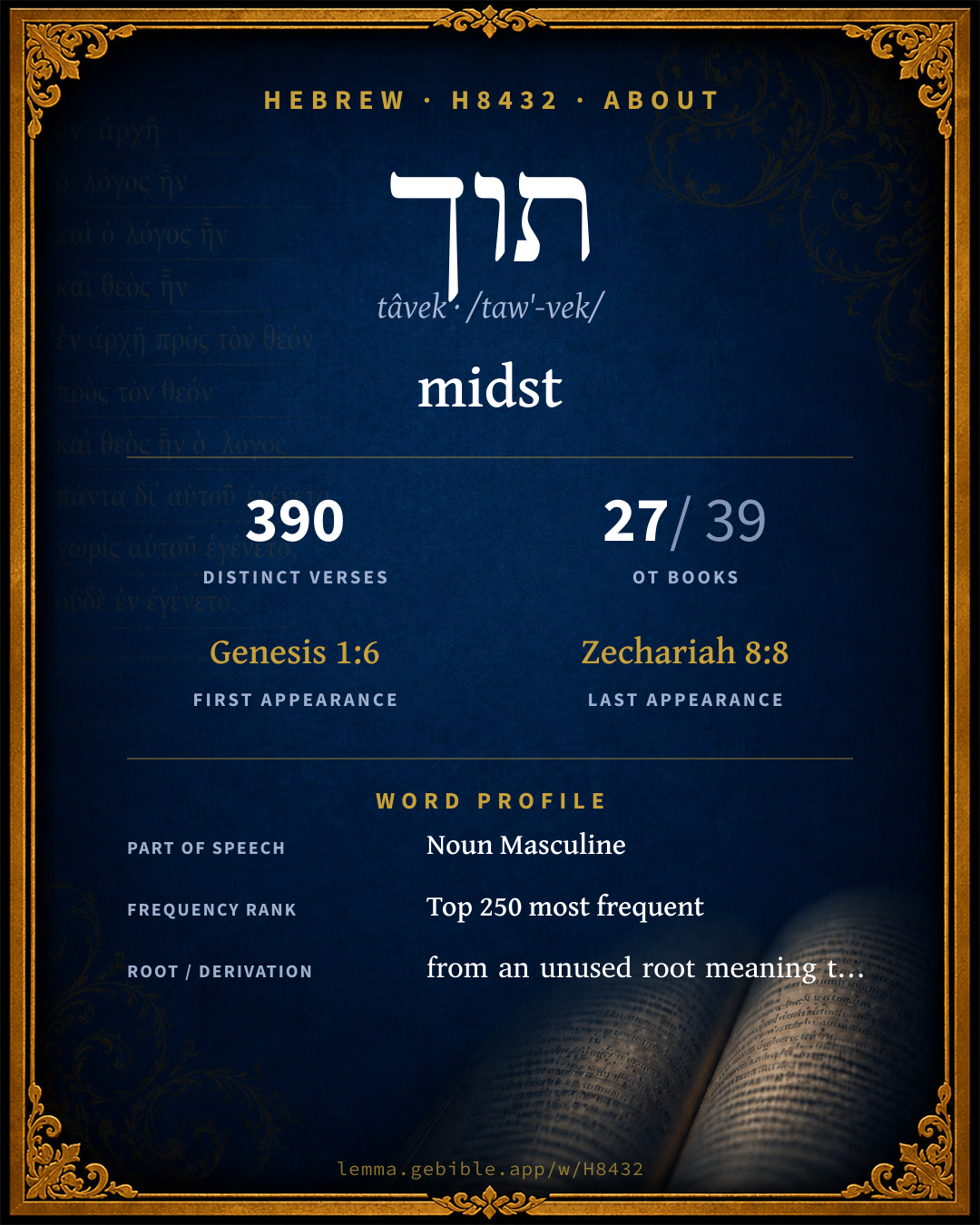
תָּ֫וֶךְ
midst
‘midst’ is one of 5 main senses fuller range ↓
Full lexicon entry — Brown-Driver-Briggs (BDB)
From Brown-Driver-Briggs (BDB)
Where this word appears
See every Construct-state word in the Hebrew Bible →
Grammar key — what these labels mean
Part of speech
- Noun
- A naming word — a person, place, thing, or idea.
Noun type
- Common
- A common noun — a general class of person, place, or thing (“king,” “city,” “water”), not a specific name.
State
- Construct
- A noun bound to a following noun in a possessive / “of” relationship (the construct chain).
- Absolute
- The independent form of a noun, not bound to a following word.
Gender
- Masculine
- Grammatically masculine.
Number
- Singular
- One.
Grammatical forms
- Noun, Common, Masculine, Singular, Construct 413 times (98%)
- Noun, Common, Masculine, Singular, Absolute 7 times (2%)
Parsed forms decoded from the imported morphology (morphhb / Westminster Leningrad Codex — WLC text public domain, morphhb tagging CC BY 4.0), counted across 420 parsed occurrences — not distinct verses.
Page 1 of 2 — showing verses 1–200 of 390 distinct verses where H8432 appears, across 27 books. Click any verse to open its interlinear word-by-word view. Verse text shown in the World English Bible for context — . Each verse’s Hebrew form is shown with its reference; the English is not keyword-highlighted, since the data carries no word-level English alignment. Use “Compare translations” on any verse to read it across multiple English versions. This concordance covers the Hebrew Bible; Septuagint (Greek Old Testament) occurrences are not indexed here.
Genesis 17 verses
- Genesis 1:6 בְּ/ת֣וֹךְ prep + n c ms cs God said, "Let there be an expanse in the midst of the waters, and let it divide the waters from the waters."
- Genesis 2:9 בְּ/ת֣וֹךְ prep + n c ms cs Out of the ground Yahweh God made every tree to grow that is pleasant to the sight, and good for food; the tree of life also in the midst of the garden, and the tree of the knowledge of good and evil.
- Genesis 3:3 בְּ/תוֹךְ prep + n c ms cs but of the fruit of the tree which is in the midst of the garden, God has said, 'You shall not eat of it, neither shall you touch it, lest you die.'"
- Genesis 3:8 בְּ/ת֖וֹךְ prep + n c ms cs They heard the voice of Yahweh God walking in the garden in the cool of the day, and the man and his wife hid themselves from the presence of Yahweh God among the trees of the garden.
- Genesis 9:21 בְּ/ת֥וֹךְ prep + n c ms cs He drank of the wine, and got drunk. He was uncovered within his tent.
- Genesis 15:10 בַּ/תָּ֔וֶךְ prep det + n c ms He took him all these, and divided them in the middle, and laid each half opposite the other; but he didn't divide the birds.
- Genesis 18:24 בְּ/ת֣וֹךְ prep + n c ms cs What if there are fifty righteous within the city? Will you consume and not spare the place for the fifty righteous who are therein?
- Genesis 18:26 בְּ/ת֣וֹךְ prep + n c ms cs Yahweh said, "If I find in Sodom fifty righteous within the city, then I will spare all the place for their sake."
- Genesis 19:29 מִ/תּ֣וֹךְ prep + n c ms cs It happened, when God destroyed the cities of the plain, that God remembered Abraham, and sent Lot out of the midst of the overthrow, when he overthrew the cities in which Lot lived.
- Genesis 23:6 בְּ/תוֹכֵ֔/נוּ prep + n c ms cs + sfx pers 1cp "Hear us, my lord. You are a prince of God among us. In the choice of our tombs bury your dead. None of us will withhold from you his tomb, but that you may bury your dead."
- Genesis 23:9 בְּ/תוֹכְ/כֶ֖ם prep + n c ms cs + sfx pers 2mp that he may give me the cave of Machpelah, which he has, which is in the end of his field. For the full price let him give it to me in the midst of you for a possession of a burying-place."
- Genesis 23:10 בְּ/ת֣וֹךְ prep + n c ms cs Now Ephron was sitting in the midst of the children of Heth. Ephron the Hittite answered Abraham in the hearing of the children of Heth, even of all who went in at the gate of his city, saying,
- Genesis 35:2 בְּ/תֹכְ/כֶ֔ם prep + n c ms cs + sfx pers 2mp Then Jacob said to his household, and to all who were with him, "Put away the foreign gods that are among you, purify yourselves, change your garments.
- Genesis 37:7 בְּ/ת֣וֹךְ prep + n c ms cs for, behold, we were binding sheaves in the field, and behold, my sheaf arose and also stood upright; and behold, your sheaves came around, and bowed down to my sheaf."
- Genesis 40:20 בְּ/ת֥וֹךְ prep + n c ms cs It happened the third day, which was Pharaoh's birthday, that he made a feast for all his servants, and he lifted up the head of the chief cupbearer and the head of the chief baker among his servants.
- Genesis 41:48 בְּ/תוֹכָֽ/הּ prep + n c ms cs + sfx pers 3fs He gathered up all the food of the seven years which were in the land of Egypt, and laid up the food in the cities: the food of the field, which was round about every city, he laid up in the same.
- Genesis 42:5 בְּ/ת֣וֹךְ prep + n c ms cs The sons of Israel came to buy among those who came, for the famine was in the land of Canaan.
Exodus 28 verses
- Exodus 2:5 בְּ/ת֣וֹךְ prep + n c ms cs Pharaoh's daughter came down to bathe at the river. Her maidens walked along by the riverside. She saw the basket among the reeds, and sent her handmaid to get it.
- Exodus 3:2 מִ/תּ֣וֹךְ prep + n c ms cs The angel of Yahweh appeared to him in a flame of fire out of the midst of a bush. He looked, and behold, the bush burned with fire, and the bush was not consumed.
- Exodus 3:4 מִ/תּ֣וֹךְ prep + n c ms cs When Yahweh saw that he turned aside to see, God called to him out of the midst of the bush, and said, "Moses! Moses!" He said, "Here I am."
- Exodus 7:5 מִ/תּוֹכָֽ/ם prep + n c ms cs + sfx pers 3mp The Egyptians shall know that I am Yahweh, when I stretch forth my hand on Egypt, and bring out the children of Israel from among them."
- Exodus 9:24 בְּ/ת֣וֹךְ prep + n c ms cs So there was very severe hail, and lightning mixed with the hail, such as had not been in all the land of Egypt since it became a nation.
- Exodus 11:4 בְּ/ת֥וֹךְ prep + n c ms cs Moses said, "This is what Yahweh says: 'About midnight I will go out into the midst of Egypt,
- Exodus 12:31 מִ/תּ֣וֹךְ prep + n c ms cs He called for Moses and Aaron by night, and said, "Rise up, get out from among my people, both you and the children of Israel; and go, serve Yahweh, as you have said!
- Exodus 12:49 בְּ/תוֹכְ/כֶֽם prep + n c ms cs + sfx pers 2mp One law shall be to him who is born at home, and to the stranger who lives as a foreigner among you."
- Exodus 14:16 בְּ/ת֥וֹךְ prep + n c ms cs Lift up your rod, and stretch out your hand over the sea, and divide it: and the children of Israel shall go into the midst of the sea on dry ground.
- Exodus 14:22 בְּ/ת֥וֹךְ prep + n c ms cs The children of Israel went into the midst of the sea on the dry ground, and the waters were a wall to them on their right hand, and on their left.
- Exodus 14:23 תּ֖וֹךְ n c ms cs The Egyptians pursued, and went in after them into the midst of the sea: all of Pharaoh's horses, his chariots, and his horsemen.
- Exodus 14:27 בְּ/ת֥וֹךְ prep + n c ms cs Moses stretched out his hand over the sea, and the sea returned to its strength when the morning appeared; and the Egyptians fled against it. Yahweh overthrew the Egyptians in the midst of the sea.
- Exodus 14:29 בְּ/ת֣וֹךְ prep + n c ms cs But the children of Israel walked on dry land in the midst of the sea, and the waters were a wall to them on their right hand, and on their left.
- Exodus 15:19 בְּ/ת֥וֹךְ prep + n c ms cs For the horses of Pharaoh went in with his chariots and with his horsemen into the sea, and Yahweh brought back the waters of the sea on them; but the children of Israel walked on dry land in the midst of the sea.
- Exodus 24:16 מִ/תּ֥וֹךְ prep + n c ms cs The glory of Yahweh settled on Mount Sinai, and the cloud covered it six days. The seventh day he called to Moses out of the midst of the cloud.
- Exodus 24:18 בְּ/ת֥וֹךְ prep + n c ms cs Moses entered into the midst of the cloud, and went up on the mountain; and Moses was on the mountain forty days and forty nights.
- Exodus 25:8 בְּ/תוֹכָֽ/ם prep + n c ms cs + sfx pers 3mp Let them make me a sanctuary, that I may dwell among them.
- Exodus 26:28 בְּ/ת֣וֹךְ prep + n c ms cs The middle bar in the midst of the boards shall pass through from end to end.
- Exodus 28:1 מִ/תּ֛וֹךְ prep + n c ms cs "Bring Aaron your brother, and his sons with him, near to you from among the children of Israel, that he may minister to me in the priest's office, even Aaron, Nadab and Abihu, Eleazar and Ithamar, Aaron's sons.
- Exodus 28:32 בְּ/תוֹכ֑/וֹ prep + n c ms cs + sfx pers 3ms It shall have a hole for the head in the midst of it: it shall have a binding of woven work round about the hole of it, as it were the hole of a coat of mail, that it not be torn.
- Exodus 28:33 בְּ/תוֹכָ֖/ם prep + n c ms cs + sfx pers 3mp On its hem you shall make pomegranates of blue, and of purple, and of scarlet, around its hem; and bells of gold between them round about:
- Exodus 29:45 בְּ/ת֖וֹךְ prep + n c ms cs I will dwell among the children of Israel, and will be their God.
- Exodus 29:46 בְ/תוֹכָ֑/ם prep + n c ms cs + sfx pers 3mp They shall know that I am Yahweh their God, who brought them forth out of the land of Egypt, that I might dwell among them: I am Yahweh their God.
- Exodus 33:11 מִ/תּ֥וֹךְ prep + n c ms cs Yahweh spoke to Moses face to face, as a man speaks to his friend. He turned again into the camp, but his servant Joshua, the son of Nun, a young man, didn't depart out of the Tent.
- Exodus 36:33 בְּ/ת֣וֹךְ prep + n c ms cs He made the middle bar to pass through in the midst of the boards from the one end to the other.
- Exodus 39:3 בְּ/ת֤וֹךְ וּ/בְ/ת֣וֹךְ וּ/בְ/ת֛וֹךְ וּ/בְ/ת֣וֹךְ prep + n c ms cs conj + prep + n c ms cs conj + prep + n c ms cs conj + prep + n c ms cs They beat the gold into thin plates, and cut it into wires, to work it in the blue, in the purple, in the scarlet, and in the fine linen, the work of the skillful workman.
- Exodus 39:23 בְּ/תוֹכ֖/וֹ prep + n c ms cs + sfx pers 3ms The opening of the robe in the midst of it was like the opening of a coat of mail, with a binding around its opening, that it should not be torn.
- Exodus 39:25 בְּ/ת֣וֹךְ בְּ/ת֖וֹךְ prep + n c ms cs prep + n c ms cs They made bells of pure gold, and put the bells between the pomegranates around the skirts of the robe, between the pomegranates;
Leviticus 16 verses
- Leviticus 11:33 תּוֹכ֑/וֹ בְּ/תוֹכ֛/וֹ n c ms cs + sfx pers 3ms prep + n c ms cs + sfx pers 3ms Every earthen vessel, into which any of them falls, all that is in it shall be unclean, and you shall break it.
- Leviticus 15:31 בְּ/תוֹכָֽ/ם prep + n c ms cs + sfx pers 3mp "'Thus you shall separate the children of Israel from their uncleanness, so they will not die in their uncleanness, when they defile my tabernacle that is in their midst.'"
- Leviticus 16:16 בְּ/ת֖וֹךְ prep + n c ms cs and he shall make atonement for the Holy Place, because of the uncleanness of the children of Israel, and because of their transgressions, even all their sins; and so he shall do for the Tent of Meeting, that dwells with them in the midst of their uncleanness.
- Leviticus 16:29 בְּ/תוֹכְ/כֶֽם prep + n c ms cs + sfx pers 2mp "It shall be a statute to you forever: in the seventh month, on the tenth day of the month, you shall afflict your souls, and shall do no manner of work, the native-born, or the stranger who lives as a foreigner among you:
- Leviticus 17:8 בְּ/תוֹכָ֑/ם prep + n c ms cs + sfx pers 3mp "You shall say to them, 'Any man there is of the house of Israel, or of the strangers who live as foreigners among them, who offers a burnt offering or sacrifice,
- Leviticus 17:10 בְּ/תוֹכָ֔/ם prep + n c ms cs + sfx pers 3mp "'Any man of the house of Israel, or of the strangers who live as foreigners among them, who eats any kind of blood, I will set my face against that soul who eats blood, and will cut him off from among his people.
- Leviticus 17:12 בְּ/תוֹכְ/כֶ֖ם prep + n c ms cs + sfx pers 2mp Therefore I have said to the children of Israel, "No person among you shall eat blood, neither shall any stranger who lives as a foreigner among you eat blood."
- Leviticus 17:13 בְּ/תוֹכָ֔/ם prep + n c ms cs + sfx pers 3mp "'Whatever man there is of the children of Israel, or of the strangers who live as foreigners among them, who takes in hunting any animal or bird that may be eaten; he shall pour out its blood, and cover it with dust.
- Leviticus 18:26 בְּ/תוֹכְ/כֶֽם prep + n c ms cs + sfx pers 2mp You therefore shall keep my statutes and my ordinances, and shall not do any of these abominations; neither the native-born, nor the stranger who lives as a foreigner among you;
- Leviticus 20:14 בְּ/תוֹכְ/כֶֽם prep + n c ms cs + sfx pers 2mp "'If a man takes a wife and her mother, it is wickedness: they shall be burned with fire, both he and they; that there may be no wickedness among you.
- Leviticus 22:32 בְּ/ת֖וֹךְ prep + n c ms cs You shall not profane my holy name, but I will be made holy among the children of Israel. I am Yahweh who makes you holy,
- Leviticus 24:10 בְּ/ת֖וֹךְ prep + n c ms cs The son of an Israelite woman, whose father was an Egyptian, went out among the children of Israel; and the son of the Israelite woman and a man of Israel strove together in the camp.
- Leviticus 25:33 בְּ/ת֖וֹךְ prep + n c ms cs The Levites may redeem the house that was sold, and the city of his possession, and it shall be released in the Jubilee; for the houses of the cities of the Levites are their possession among the children of Israel.
- Leviticus 26:11 בְּ/תוֹכְ/כֶ֑ם prep + n c ms cs + sfx pers 2mp I will set my tent among you: and my soul won't abhor you.
- Leviticus 26:12 בְּ/ת֣וֹכְ/כֶ֔ם prep + n c ms cs + sfx pers 2mp I will walk among you, and will be your God, and you will be my people.
- Leviticus 26:25 בְּ/ת֣וֹכְ/כֶ֔ם prep + n c ms cs + sfx pers 2mp I will bring a sword upon you, that will execute the vengeance of the covenant; and you will be gathered together within your cities: and I will send the pestilence among you; and you will be delivered into the hand of the enemy.
Numbers 42 verses
- Numbers 1:47 בְּ/תוֹכָֽ/ם prep + n c ms cs + sfx pers 3mp But the Levites after the tribe of their fathers were not numbered among them.
- Numbers 1:49 בְּ/ת֖וֹךְ prep + n c ms cs "Only the tribe of Levi you shall not number, neither shall you take a census of them among the children of Israel;
- Numbers 2:17 בְּ/ת֣וֹךְ prep + n c ms cs "Then the tent of meeting shall set out, with the camp of the Levites in the midst of the camps. As they encamp, so shall they set out, every man in his place, by their standards.
- Numbers 2:33 בְּ/ת֖וֹךְ prep + n c ms cs But the Levites were not numbered among the children of Israel; as Yahweh commanded Moses.
- Numbers 3:12 מִ/תּוֹךְ֙ prep + n c ms cs "Behold, I have taken the Levites from among the children of Israel instead of all the firstborn who open the womb among the children of Israel; and the Levites shall be mine:
- Numbers 4:2 מִ/תּ֖וֹךְ prep + n c ms cs "Take a census of the sons of Kohath from among the sons of Levi, by their families, by their fathers' houses,
- Numbers 4:18 מִ/תּ֖וֹךְ prep + n c ms cs "Don't cut off the tribe of the families of the Kohathites from among the Levites;
- Numbers 5:3 בְּ/תוֹכָֽ/ם prep + n c ms cs + sfx pers 3mp Both male and female shall you put out, outside of the camp shall you put them; that they not defile their camp, in the midst of which I dwell."
- Numbers 5:21 בְּ/ת֣וֹךְ prep + n c ms cs then the priest shall cause the woman to swear with the oath of cursing, and the priest shall tell the woman, 'Yahweh make you a curse and an oath among your people, when Yahweh allows your thigh to fall away, and your body to swell;
- Numbers 8:6 מִ/תּ֖וֹךְ prep + n c ms cs "Take the Levites from among the children of Israel, and cleanse them.
- Numbers 8:14 מִ/תּ֖וֹךְ prep + n c ms cs Thus you shall separate the Levites from among the children of Israel, and the Levites shall be mine.
- Numbers 8:16 מִ/תּ֖וֹךְ prep + n c ms cs For they are wholly given to me from among the children of Israel; instead of all who open the womb, even the firstborn of all the children of Israel, I have taken them to me.
- Numbers 8:19 מִ/תּוֹךְ֮ prep + n c ms cs I have given the Levites as a gift to Aaron and to his sons from among the children of Israel, to do the service of the children of Israel in the Tent of Meeting, and to make atonement for the children of Israel; that there be no plague among the children of Israel, when the children of Israel come near to the sanctuary."
- Numbers 9:7 בְּ/ת֖וֹךְ prep + n c ms cs Those men said to him, "We are unclean because of the dead body of a man. Why are we kept back, that we may not offer the offering of Yahweh in its appointed season among the children of Israel?"
- Numbers 13:32 בְ/תוֹכָ֖/הּ prep + n c ms cs + sfx pers 3fs They brought up an evil report of the land which they had spied out to the children of Israel, saying, The land, through which we have gone to spy it out, is a land that eats up the inhabitants of it; and all the people who we saw in it are men of great stature.
- Numbers 15:14 בְּ/תֽוֹכְ/כֶם֙ prep + n c ms cs + sfx pers 2mp If a stranger lives as a foreigner with you, or whoever may be among you throughout your generations, and will offer an offering made by fire, of a sweet savor to Yahweh; as you do, so he shall do.
- Numbers 15:26 בְּ/תוֹכָ֑/ם prep + n c ms cs + sfx pers 3mp and all the congregation of the children of Israel shall be forgiven, and the stranger who lives as a foreigner among them; for in respect of all the people it was done unwittingly.
- Numbers 15:29 בְּ/תוֹכָ֑/ם prep + n c ms cs + sfx pers 3mp You shall have one law for him who does anything unwittingly, for him who is home-born among the children of Israel, and for the stranger who lives as a foreigner among them.
- Numbers 16:3 וּ/בְ/תוֹכָ֖/ם conj + prep + n c ms cs + sfx pers 3mp and they assembled themselves together against Moses and against Aaron, and said to them, You take too much on you, seeing all the congregation are holy, everyone of them, and Yahweh is among them: why then lift yourselves up above the assembly of Yahweh?
- Numbers 16:21 מִ/תּ֖וֹךְ prep + n c ms cs Separate yourselves from among this congregation, that I may consume them in a moment.
- Numbers 16:33 מִ/תּ֥וֹךְ prep + n c ms cs So they, and all that appertained to them, went down alive into Sheol: and the earth closed on them, and they perished from among the assembly.
- Numbers 16:45 מִ/תּוֹךְ֙ prep + n c ms cs Get away from among this congregation, that I may consume them in a moment. They fell on their faces.
- Numbers 16:47 תּ֣וֹך n c ms cs Aaron took as Moses spoke, and ran into the midst of the assembly; and, behold, the plague was begun among the people: and he put on the incense, and made atonement for the people.
- Numbers 17:6 בְּ/ת֥וֹךְ prep + n c ms cs Moses spoke to the children of Israel; and all their princes gave him rods, for each prince one, according to their fathers' houses, even twelve rods: and the rod of Aaron was among their rods.
- Numbers 18:6 מִ/תּ֖וֹךְ prep + n c ms cs I, behold, I have taken your brothers the Levites from among the children of Israel: to you they are a gift, given to Yahweh, to do the service of the tent of meeting.
- Numbers 18:20 בְּ/תוֹכָ֑/ם בְּ/ת֖וֹךְ prep + n c ms cs + sfx pers 3mp prep + n c ms cs Yahweh said to Aaron, You shall have no inheritance in their land, neither shall you have any portion among them: I am your portion and your inheritance among the children of Israel.
- Numbers 18:23 וּ/בְ/תוֹךְ֙ conj + prep + n c ms cs But the Levites shall do the service of the tent of meeting, and they shall bear their iniquity: it shall be a statute forever throughout your generations; and among the children of Israel they shall have no inheritance.
- Numbers 18:24 בְּ/תוֹךְ֙ prep + n c ms cs For the tithe of the children of Israel, which they offer as a heave-offering to Yahweh, I have given to the Levites for an inheritance: therefore I have said to them, Among the children of Israel they shall have no inheritance.
- Numbers 19:6 תּ֖וֹךְ n c ms cs and the priest shall take cedar-wood, and hyssop, and scarlet, and cast it into the midst of the burning of the heifer.
- Numbers 19:10 בְּ/תוֹכָ֖/ם prep + n c ms cs + sfx pers 3mp He who gathers the ashes of the heifer shall wash his clothes, and be unclean until the even: and it shall be to the children of Israel, and to the stranger who lives as a foreigner among them, for a statute forever.
- Numbers 19:20 מִ/תּ֣וֹךְ prep + n c ms cs But the man who shall be unclean, and shall not purify himself, that soul shall be cut off from the midst of the assembly, because he has defiled the sanctuary of Yahweh: the water for impurity has not been sprinkled on him; he is unclean.
- Numbers 25:7 מִ/תּ֣וֹךְ prep + n c ms cs When Phinehas, the son of Eleazar, the son of Aaron the priest, saw it, he rose up from the midst of the congregation, and took a spear in his hand;
- Numbers 25:11 בְּ/תוֹכָ֑/ם prep + n c ms cs + sfx pers 3mp Phinehas, the son of Eleazar, the son of Aaron the priest, has turned my wrath away from the children of Israel, in that he was jealous with my jealousy among them, so that I didn't consume the children of Israel in my jealousy.
- Numbers 26:62 בְּ/תוֹךְ֙ בְּ/ת֖וֹךְ prep + n c ms cs prep + n c ms cs Those who were numbered of them were twenty-three thousand, every male from a month old and upward: for they were not numbered among the children of Israel, because there was no inheritance given them among the children of Israel.
- Numbers 27:3 בְּ/ת֣וֹךְ prep + n c ms cs Our father died in the wilderness, and he was not among the company of those who gathered themselves together against Yahweh in the company of Korah: but he died in his own sin; and he had no sons.
- Numbers 27:4 מִ/תּ֣וֹךְ בְּ/ת֖וֹךְ prep + n c ms cs prep + n c ms cs Why should the name of our father be taken away from among his family, because he had no son? Give to us a possession among the brothers of our father.
- Numbers 27:7 בְּ/ת֖וֹךְ prep + n c ms cs The daughters of Zelophehad speak right: you shall surely give them a possession of an inheritance among their father's brothers; and you shall cause the inheritance of their father to pass to them.
- Numbers 32:30 בְ/תֹכְ/כֶ֖ם prep + n c ms cs + sfx pers 2mp but if they will not pass over with you armed, they shall have possessions among you in the land of Canaan.
- Numbers 33:8 בְ/תוֹךְ prep + n c ms cs They traveled from before Hahiroth, and passed through the midst of the sea into the wilderness: and they went three days' journey in the wilderness of Etham, and encamped in Marah.
- Numbers 35:5 בַּ/תָּ֑וֶךְ prep det + n c ms You shall measure outside of the city for the east side two thousand cubits, and for the south side two thousand cubits, and for the west side two thousand cubits, and for the north side two thousand cubits, the city being in the midst. This shall be to them the suburbs of the cities.
- Numbers 35:15 בְּ/תוֹכָ֔/ם prep + n c ms cs + sfx pers 3mp For the children of Israel, and for the stranger and for the foreigner living among them, shall these six cities be for refuge; that everyone who kills any person unwittingly may flee there.
- Numbers 35:34 בְּ/תוֹכָ֑/הּ בְּ/ת֖וֹךְ prep + n c ms cs + sfx pers 3fs prep + n c ms cs You shall not defile the land which you inhabit, in the midst of which I dwell: for I, Yahweh, dwell in the midst of the children of Israel.
Deuteronomy 20 verses
- Deuteronomy 3:16 תּ֥וֹךְ n c ms cs To the Reubenites and to the Gadites I gave from Gilead even to the valley of the Arnon, the middle of the valley, and the border [of it], even to the river Jabbok, which is the border of the children of Ammon;
- Deuteronomy 4:12 מִ/תּ֣וֹךְ prep + n c ms cs Yahweh spoke to you out of the midst of the fire: you heard the voice of words, but you saw no form; only [you heard] a voice.
- Deuteronomy 4:15 מִ/תּ֥וֹךְ prep + n c ms cs Take therefore good heed to yourselves; for you saw no manner of form on the day that Yahweh spoke to you in Horeb out of the midst of the fire.
- Deuteronomy 4:33 מִ/תּוֹךְ prep + n c ms cs Did ever a people hear the voice of God speaking out of the midst of the fire, as you have heard, and live?
- Deuteronomy 4:36 מִ/תּ֥וֹךְ prep + n c ms cs Out of heaven he made you to hear his voice, that he might instruct you: and on earth he made you to see his great fire; and you heard his words out of the midst of the fire.
- Deuteronomy 5:4 מִ/תּ֥וֹךְ prep + n c ms cs Yahweh spoke with you face to face on the mountain out of the midst of the fire,
- Deuteronomy 5:22 מִ/תּ֤וֹךְ prep + n c ms cs These words Yahweh spoke to all your assembly on the mountain out of the midst of the fire, of the cloud, and of the thick darkness, with a great voice: and he added no more. He wrote them on two tables of stone, and gave them to me.
- Deuteronomy 5:23 מִ/תּ֣וֹךְ prep + n c ms cs It happened, when you heard the voice out of the midst of the darkness, while the mountain was burning with fire, that you came near to me, even all the heads of your tribes, and your elders;
- Deuteronomy 5:24 מִ/תּ֣וֹךְ prep + n c ms cs and you said, Behold, Yahweh our God has shown us his glory and his greatness, and we have heard his voice out of the midst of the fire: we have seen this day that God does speak with man, and he lives.
- Deuteronomy 5:26 מִ/תּוֹךְ prep + n c ms cs For who is there of all flesh, that has heard the voice of the living God speaking out of the midst of the fire, as we have, and lived?
- Deuteronomy 9:10 מִ/תּ֥וֹךְ prep + n c ms cs Yahweh delivered to me the two tables of stone written with the finger of God; and on them [was written] according to all the words, which Yahweh spoke with you on the mountain out of the midst of the fire in the day of the assembly.
- Deuteronomy 10:4 מִ/תּ֥וֹךְ prep + n c ms cs He wrote on the tables, according to the first writing, the ten commandments, which Yahweh spoke to you on the mountain out of the midst of the fire in the day of the assembly: and Yahweh gave them to me.
- Deuteronomy 11:3 בְּ/ת֣וֹךְ prep + n c ms cs and his signs, and his works, which he did in the midst of Egypt to Pharaoh the king of Egypt, and to all his land;
- Deuteronomy 13:16 תּ֣וֹךְ n c ms cs You shall gather all the spoil of it into the midst of the street of it, and shall burn with fire the city, and all the spoil of it every whit, to Yahweh your God: and it shall be a heap forever; it shall not be built again.
- Deuteronomy 19:2 בְּ/ת֣וֹךְ prep + n c ms cs you shall set apart three cities for you in the midst of your land, which Yahweh your God gives you to possess it.
- Deuteronomy 21:12 תּ֣וֹךְ n c ms cs then you shall bring her home to your house; and she shall shave her head, and pare her nails;
- Deuteronomy 22:2 תּ֣וֹךְ n c ms cs If your brother isn't near to you, or if you don't know him, then you shall bring it home to your house, and it shall be with you until your brother seek after it, and you shall restore it to him.
- Deuteronomy 23:10 תּ֥וֹךְ n c ms cs If there be among you any man, who is not clean by reason of that which happens him by night, then shall he go abroad out of the camp, he shall not come within the camp:
- Deuteronomy 23:11 תּ֥וֹךְ n c ms cs but it shall be, when evening comes on, he shall bathe himself in water; and when the sun is down, he shall come within the camp.
- Deuteronomy 32:51 בְּ/תוֹךְ֙ בְּ/ת֖וֹךְ prep + n c ms cs prep + n c ms cs because you trespassed against me in the midst of the children of Israel at the waters of Meribah of Kadesh, in the wilderness of Zin; because you didn't sanctify me in the midst of the children of Israel.
Joshua 28 verses
- Joshua 3:17 בְּ/ת֥וֹךְ prep + n c ms cs The priests who bore the ark of the covenant of Yahweh stood firm on dry ground in the midst of the Jordan; and all Israel passed over on dry ground, until all the nation were passed clean over the Jordan.
- Joshua 4:3 מִ/תּ֣וֹךְ prep + n c ms cs and command you them, saying, Take hence out of the midst of the Jordan, out of the place where the priests' feet stood firm, twelve stones, and carry them over with you, and lay them down in the lodging-place, where you shall lodge this night.
- Joshua 4:5 תּ֣וֹךְ n c ms cs and Joshua said to them, Pass over before the ark of Yahweh your God into the midst of the Jordan, and take up every man of you a stone on his shoulder, according to the number of the tribes of the children of Israel;
- Joshua 4:8 מִ/תּ֣וֹךְ prep + n c ms cs The children of Israel did so as Joshua commanded, and took up twelve stones out of the midst of the Jordan, as Yahweh spoke to Joshua, according to the number of the tribes of the children of Israel; and they carried them over with them to the place where they lodged, and laid them down there.
- Joshua 4:9 בְּ/ת֣וֹךְ prep + n c ms cs Joshua set up twelve stones in the midst of the Jordan, in the place where the feet of the priests who bore the ark of the covenant stood: and they are there to this day.
- Joshua 4:10 בְּ/ת֣וֹךְ prep + n c ms cs For the priests who bore the ark stood in the midst of the Jordan, until everything was finished that Yahweh commanded Joshua to speak to the people, according to all that Moses commanded Joshua: and the people hurried and passed over.
- Joshua 4:18 מִ/תּ֣וֹךְ prep + n c ms cs It happened, when the priests who bore the ark of the covenant of Yahweh were come up out of the midst of the Jordan, and the soles of the priests' feet were lifted up to the dry ground, that the waters of the Jordan returned to their place, and went over all its banks, as before.
- Joshua 7:21 בְּ/ת֥וֹךְ prep + n c ms cs when I saw among the spoil a goodly Babylonian mantle, and two hundred shekels of silver, and a wedge of gold of fifty shekels weight, then I coveted them, and took them; and, behold, they are hid in the earth in the midst of my tent, and the silver under it.
- Joshua 7:23 מִ/תּ֣וֹךְ prep + n c ms cs They took them from the midst of the tent, and brought them to Joshua, and to all the children of Israel; and they laid them down before Yahweh.
- Joshua 8:9 בְּ/ת֥וֹךְ prep + n c ms cs Joshua sent them forth; and they went to set up the ambush, and stayed between Bethel and Ai, on the west side of Ai: but Joshua lodged that night among the people.
- Joshua 8:13 בְּ/ת֥וֹךְ prep + n c ms cs So they set the people, even all the host who was on the north of the city, and their liers-in-wait who were on the west of the city; and Joshua went that night into the midst of the valley.
- Joshua 8:22 בַּ/תָּ֔וֶךְ prep det + n c ms The others came forth out of the city against them; so they were in the midst of Israel, some on this side, and some on that side: and they struck them, so that they let none of them remain or escape.
- Joshua 12:2 וְ/ת֤וֹךְ conj + n c ms cs Sihon king of the Amorites, who lived in Heshbon, and ruled from Aroer, which is on the edge of the valley of the Arnon, and [the city that is in] the middle of the valley, and half Gilead, even to the river Jabbok, the border of the children of Ammon;
- Joshua 13:9 בְּ/תוֹךְ prep + n c ms cs from Aroer, that is on the edge of the valley of the Arnon, and the city that is in the middle of the valley, and all the plain of Medeba to Dibon;
- Joshua 13:16 בְּ/תוֹךְ prep + n c ms cs Their border was from Aroer, that is on the edge of the valley of the Arnon, and the city that is in the middle of the valley, and all the plain by Medeba;
- Joshua 14:3 בְּ/תוֹכָֽ/ם prep + n c ms cs + sfx pers 3mp For Moses had given the inheritance of the two tribes and the half-tribe beyond the Jordan: but to the Levites he gave no inheritance among them.
- Joshua 15:13 בְּ/ת֣וֹךְ prep + n c ms cs To Caleb the son of Jephunneh he gave a portion among the children of Judah, according to the commandment of Yahweh to Joshua, even Kiriath Arba, [which Arba was] the father of Anak (the same is Hebron).
- Joshua 16:9 בְּ/ת֖וֹךְ prep + n c ms cs together with the cities which were set apart for the children of Ephraim in the midst of the inheritance of the children of Manasseh, all the cities with their villages.
- Joshua 17:4 בְּ/ת֣וֹךְ בְּ/ת֖וֹךְ prep + n c ms cs prep + n c ms cs They came near before Eleazar the priest, and before Joshua the son of Nun, and before the princes, saying, Yahweh commanded Moses to give us an inheritance among our brothers: therefore according to the commandment of Yahweh he gave them an inheritance among the brothers of their father.
- Joshua 17:6 בְּ/ת֣וֹךְ prep + n c ms cs because the daughters of Manasseh had an inheritance among his sons. The land of Gilead belonged to the rest of the sons of Manasseh.
- Joshua 17:9 בְּ/ת֖וֹךְ prep + n c ms cs The border went down to the brook of Kanah, southward of the brook: these cities belonged to Ephraim among the cities of Manasseh: and the border of Manasseh was on the north side of the brook, and the goings out of it were at the sea:
- Joshua 19:1 בְּ/ת֖וֹךְ prep + n c ms cs The second lot came out for Simeon, even for the tribe of the children of Simeon according to their families: and their inheritance was in the midst of the inheritance of the children of Judah.
- Joshua 19:9 בְּ/ת֥וֹךְ prep + n c ms cs Out of the part of the children of Judah was the inheritance of the children of Simeon; for the portion of the children of Judah was too much for them: therefore the children of Simeon had inheritance in the midst of their inheritance.
- Joshua 19:49 בְּ/תוֹכָֽ/ם prep + n c ms cs + sfx pers 3mp So they made an end of distributing the land for inheritance by the borders of it; and the children of Israel gave an inheritance to Joshua the son of Nun in the midst of them:
- Joshua 20:9 בְּ/תוֹכָ֔/ם prep + n c ms cs + sfx pers 3mp These were the appointed cities for all the children of Israel, and for the stranger who sojourns among them, that whoever kills any person unwittingly might flee there, and not die by the hand of the avenger of blood, until he stood before the congregation.
- Joshua 21:41 בְּ/ת֖וֹךְ prep + n c ms cs All the cities of the Levites in the midst of the possession of the children of Israel were forty-eight cities with their suburbs.
- Joshua 22:19 בְּ/תוֹכֵ֑/נוּ prep + n c ms cs + sfx pers 1cp However, if the land of your possession be unclean, then pass over to the land of the possession of Yahweh, in which Yahweh's tent dwells, and take possession among us: but don't rebel against Yahweh, nor rebel against us, in building you an altar besides the altar of Yahweh our God.
- Joshua 22:31 בְ/תוֹכֵ֣/נוּ prep + n c ms cs + sfx pers 1cp Phinehas the son of Eleazar the priest said to the children of Reuben, and to the children of Gad, and to the children of Manasseh, This day we know that Yahweh is in the midst of us, because you have not committed this trespass against Yahweh: now have you delivered the children of Israel out of the hand of Yahweh.
Judges 7 verses
- Judges 7:16 בְּ/ת֥וֹךְ prep + n c ms cs He divided the three hundred men into three companies, and he put into the hands of all of them trumpets, and empty pitchers, with torches within the pitchers.
- Judges 9:51 בְ/תוֹךְ prep + n c ms cs But there was a strong tower within the city, and there fled all the men and women, and all they of the city, and shut themselves in, and got them up to the roof of the tower.
- Judges 12:4 בְּ/ת֥וֹךְ בְּ/ת֥וֹךְ prep + n c ms cs prep + n c ms cs Then Jephthah gathered together all the men of Gilead, and fought with Ephraim; and the men of Gilead struck Ephraim, because they said, You are fugitives of Ephraim, you Gileadites, in the midst of Ephraim, [and] in the midst of Manasseh.
- Judges 15:4 בַּ/תָּֽוֶךְ prep det + n c ms Samson went and caught three hundred foxes, and took firebrands, and turned tail to tail, and put a firebrand in the midst between every two tails.
- Judges 16:29 הַ/תָּ֗וֶךְ ptcl def.art + n c ms Samson took hold of the two middle pillars on which the house rested, and leaned on them, the one with his right hand, and the other with his left.
- Judges 18:1 בְּ/תוֹךְ prep + n c ms cs In those days there was no king in Israel: and in those days the tribe of the Danites sought them an inheritance to dwell in; for to that day [their] inheritance had not fallen to them among the tribes of Israel.
- Judges 20:42 בְּ/תוֹכֽ/וֹ prep + n c ms cs + sfx pers 3ms Therefore they turned their backs before the men of Israel to the way of the wilderness; but the battle followed hard after them; and those who came out of the cities destroyed them in the midst of it.
1 Samuel 9 verses
- 1 Samuel 7:3 מִ/תּוֹכְ/כֶ֖ם prep + n c ms cs + sfx pers 2mp Samuel spoke to all the house of Israel, saying, If you do return to Yahweh with all your heart, then put away the foreign gods and the Ashtaroth from among you, and direct your hearts to Yahweh, and serve him only; and he will deliver you out of the hand of the Philistines.
- 1 Samuel 9:14 בְּ/ת֣וֹךְ prep + n c ms cs They went up to the city; [and] as they came within the city, behold, Samuel came out toward them, to go up to the high place.
- 1 Samuel 9:18 בְּ/ת֣וֹךְ prep + n c ms cs Then Saul drew near to Samuel in the gate, and said, Tell me, Please, where the seer's house is.
- 1 Samuel 10:10 בְּ/תוֹכָֽ/ם prep + n c ms cs + sfx pers 3mp When they came there to the hill, behold, a band of prophets met him; and the Spirit of God came mightily on him, and he prophesied among them.
- 1 Samuel 10:23 בְּ/ת֣וֹךְ prep + n c ms cs They ran and fetched him there; and when he stood among the people, he was higher than any of the people from his shoulders and upward.
- 1 Samuel 11:11 בְ/תוֹךְ prep + n c ms cs It was so on the next day, that Saul put the people in three companies; and they came into the midst of the camp in the morning watch, and struck the Ammonites until the heat of the day: and it happened, that those who remained were scattered, so that no two of them were left together.
- 1 Samuel 15:6 מִ/תּ֣וֹךְ מִ/תּ֥וֹךְ prep + n c ms cs prep + n c ms cs Saul said to the Kenites, Go, depart, get you down from among the Amalekites, lest I destroy you with them; for you shown kindness to all the children of Israel, when they came up out of Egypt. So the Kenites departed from among the Amalekites.
- 1 Samuel 18:10 בְ/תוֹךְ prep + n c ms cs It happened on the next day, that an evil spirit from God came mightily on Saul, and he prophesied in the midst of the house: and David played with his hand, as he did day by day. Saul had his spear in his hand;
- 1 Samuel 25:29 בְּ/ת֖וֹךְ prep + n c ms cs Though men be risen up to pursue you, and to seek your soul, yet the soul of my lord shall be bound in the bundle of life with Yahweh your God; and the souls of your enemies, them shall he sling out, as from the hollow of a sling.
2 Samuel 9 verses
- 2 Samuel 1:25 בְּ/ת֖וֹךְ prep + n c ms cs How are the mighty fallen in the midst of the battle! Jonathan is slain on your high places.
- 2 Samuel 3:27 תּ֣וֹךְ n c ms cs When Abner was returned to Hebron, Joab took him aside into the midst of the gate to speak with him quietly, and struck him there in the body, so that he died, for the blood of Asahel his brother.
- 2 Samuel 4:6 תּ֤וֹךְ n c ms cs They came there into the midst of the house, as though they would have fetched wheat; and they struck him in the body: and Rechab and Baanah his brother escaped.
- 2 Samuel 6:17 בְּ/ת֣וֹךְ prep + n c ms cs They brought in the ark of Yahweh, and set it in its place, in the midst of the tent that David had pitched for it; and David offered burnt offerings and peace-offerings before Yahweh.
- 2 Samuel 7:2 בְּ/ת֥וֹךְ prep + n c ms cs that the king said to Nathan the prophet, See now, I dwell in a house of cedar, but the ark of God dwells within curtains.
- 2 Samuel 20:12 בְּ/ת֣וֹךְ prep + n c ms cs Amasa lay wallowing in his blood in the midst of the highway. When the man saw that all the people stood still, he carried Amasa out of the highway into the field, and cast a garment over him, when he saw that everyone who came by him stood still.
- 2 Samuel 23:12 בְּ/תוֹךְ prep + n c ms cs But he stood in the midst of the plot, and defended it, and killed the Philistines; and Yahweh worked a great victory.
- 2 Samuel 23:20 בְּ/ת֥וֹךְ prep + n c ms cs Benaiah the son of Jehoiada, the son of a valiant man of Kabzeel, who had done mighty deeds, he killed the two [sons of] Ariel of Moab: he went down also and killed a lion in the midst of a pit in time of snow.
- 2 Samuel 24:5 בְּ/תוֹךְ prep + n c ms cs They passed over the Jordan, and encamped in Aroer, on the right side of the city that is in the middle of the valley of Gad, and to Jazer:
1 Kings 9 verses
- 1 Kings 3:8 בְּ/ת֥וֹךְ prep + n c ms cs Your servant is in the midst of your people which you have chosen, a great people, that can't be numbered nor counted for multitude.
- 1 Kings 3:20 בְּ/ת֨וֹךְ prep + n c ms cs She arose at midnight, and took my son from beside me, while your handmaid slept, and laid it in her bosom, and laid her dead child in my bosom.
- 1 Kings 6:13 בְּ/ת֖וֹךְ prep + n c ms cs I will dwell among the children of Israel, and will not forsake my people Israel.
- 1 Kings 6:19 בְּ/תוֹךְ prep + n c ms cs He prepared an oracle in the midst of the house within, to set there the ark of the covenant of Yahweh.
- 1 Kings 6:27 בְּ/ת֣וֹךְ תּ֣וֹךְ prep + n c ms cs n c ms cs He set the cherubim within the inner house; and the wings of the cherubim were stretched forth, so that the wing of the one touched the one wall, and the wing of the other cherub touched the other wall; and their wings touched one another in the midst of the house.
- 1 Kings 8:51 מִ/תּ֖וֹךְ prep + n c ms cs (for they are your people, and your inheritance, which you brought forth out of Egypt, from the midst of the furnace of iron);
- 1 Kings 8:64 תּ֣וֹךְ n c ms cs The same day did the king make the middle of the court holy that was before the house of Yahweh; for there he offered the burnt offering, and the meal-offering, and the fat of the peace-offerings, because the brazen altar that was before Yahweh was too little to receive the burnt offering, and the meal-offering, and the fat of the peace-offerings.
- 1 Kings 11:20 בְּ/ת֖וֹךְ בְּ/ת֖וֹךְ prep + n c ms cs prep + n c ms cs The sister of Tahpenes bore him Genubath his son, whom Tahpenes weaned in Pharaoh's house; and Genubath was in Pharaoh's house among the sons of Pharaoh.
- 1 Kings 14:7 מִ/תּ֣וֹךְ prep + n c ms cs Go, tell Jeroboam, Thus says Yahweh, the God of Israel: Because I exalted you from among the people, and made you prince over my people Israel,
2 Kings 5 verses
- 2 Kings 4:13 בְּ/ת֥וֹךְ prep + n c ms cs He said to him, Say now to her, Behold, you have been careful for us with all this care; what is to be done for you? would you be spoken for to the king, or to the captain of the host? She answered, I dwell among my own people.
- 2 Kings 6:20 בְּ/ת֥וֹךְ prep + n c ms cs It happened, when they were come into Samaria, that Elisha said, Yahweh, open the eyes of these men, that they may see. Yahweh opened their eyes, and they saw; and, behold, they were in the midst of Samaria.
- 2 Kings 9:2 מִ/תּ֣וֹך prep + n c ms cs When you come there, look out there Jehu the son of Jehoshaphat the son of Nimshi, and go in, and make him arise up from among his brothers, and carry him to an inner chamber.
- 2 Kings 11:2 מִ/תּ֤וֹךְ prep + n c ms cs But Jehosheba, the daughter of king Joram, sister of Ahaziah, took Joash the son of Ahaziah, and stole him away from among the king's sons who were slain, even him and his nurse, [and put them] in the bedchamber; and they hid him from Athaliah, so that he was not slain;
- 2 Kings 23:9 בְּ/ת֥וֹךְ prep + n c ms cs Nevertheless the priests of the high places didn't come up to the altar of Yahweh in Jerusalem, but they ate unleavened bread among their brothers.
1 Chronicles 4 verses
- 1 Chronicles 11:14 בְ/תוֹךְ prep + n c ms cs They stood in the midst of the plot, and defended it, and killed the Philistines; and Yahweh saved them by a great victory.
- 1 Chronicles 11:22 בְּ/ת֥וֹךְ prep + n c ms cs Benaiah the son of Jehoiada, the son of a valiant man of Kabzeel, who had done mighty deeds, he killed the two [sons of] Ariel of Moab: he went down also and killed a lion in the midst of a pit in time of snow.
- 1 Chronicles 16:1 בְּ/ת֣וֹךְ prep + n c ms cs They brought in the ark of God, and set it in the midst of the tent that David had pitched for it: and they offered burnt offerings and peace-offerings before God.
- 1 Chronicles 21:6 בְּ/תוֹכָ֑/ם prep + n c ms cs + sfx pers 3mp But he didn't count Levi and Benjamin among them; for the king's word was abominable to Joab.
2 Chronicles 6 verses
- 2 Chronicles 6:13 בְּ/ת֣וֹךְ prep + n c ms cs (for Solomon had made a brazen scaffold, five cubits long, and five cubits broad, and three cubits high, and had set it in the midst of the court; and on it he stood, and kneeled down on his knees before all the assembly of Israel, and spread forth his hands toward heaven;)
- 2 Chronicles 7:7 תּ֤וֹךְ n c ms cs Moreover Solomon made the middle of the court holy that was before the house of Yahweh; for there he offered the burnt offerings, and the fat of the peace-offerings, because the brazen altar which Solomon had made was not able to receive the burnt offering, and the meal-offering, and the fat.
- 2 Chronicles 20:14 בְּ/ת֖וֹךְ prep + n c ms cs Then on Jahaziel the son of Zechariah, the son of Benaiah, the son of Jeiel, the son of Mattaniah, the Levite, of the sons of Asaph, came the Spirit of Yahweh in the midst of the assembly;
- 2 Chronicles 22:11 מִ/תּ֤וֹךְ prep + n c ms cs But Jehoshabeath, the daughter of the king, took Joash the son of Ahaziah, and stole him away from among the king's sons who were slain, and put him and his nurse in the bedchamber. So Jehoshabeath, the daughter of king Jehoram, the wife of Jehoiada the priest (for she was the sister of Ahaziah), hid him from Athaliah, so that she didn't kill him.
- 2 Chronicles 23:20 בְּ/תֽוֹךְ prep + n c ms cs He took the captains of hundreds, and the nobles, and the governors of the people, and all the people of the land, and brought down the king from the house of Yahweh: and they came through the upper gate to the king's house, and set the king on the throne of the kingdom.
- 2 Chronicles 32:4 בְּ/תוֹךְ prep + n c ms cs So there was gathered much people together, and they stopped all the springs, and the brook that flowed through the midst of the land, saying, Why should the kings of Assyria come, and find much water?
About this entry
At a glance — auto-summarized from this page’s data, not written by a person. Every figure links to its source below. This summary describes the numbers; it doesn’t interpret them.
“midst” is the headline sense of the Hebrew noun תוך (tâvek). Translators differ — “midst” in the King James Version, then “midst of” (unfoldingWord Literal Text), as the renderings breakdown shows. It turns up in 390 verses across 27 books, a common footprint. It concentrates in Ezekiel, which alone accounts for 27% of its uses. Catalogued under 5 senses, its meaning is not single-sense. The sections below give every sense, occurrence, and version rendering.
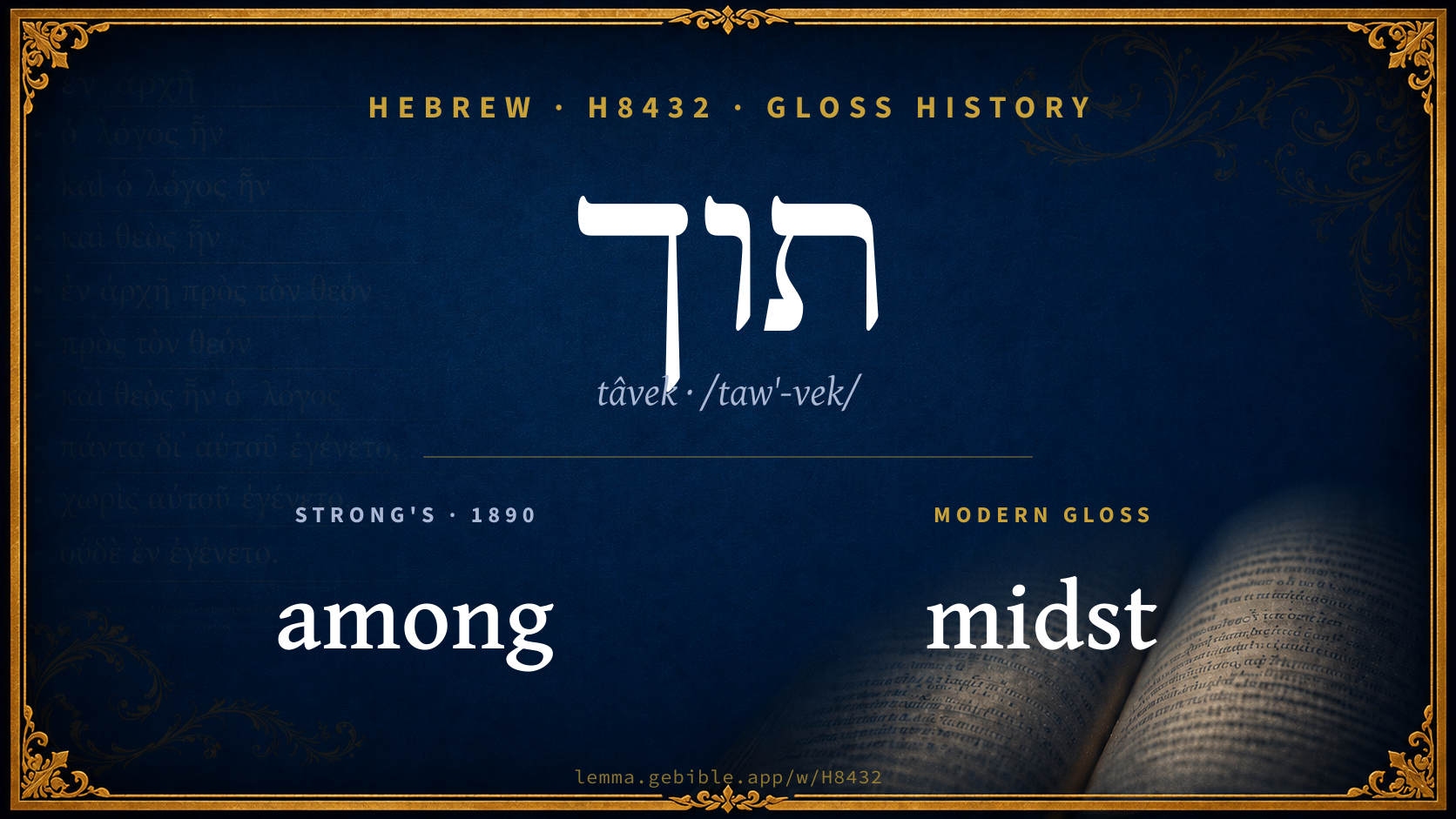
Gloss history
Strong's 1890 vs modern scholarship
About this word
Strong's H8432 catalogs a Hebrew word from the Hebrew Old Testament.
These counts are not copied from any lexicon or concordance. They are computed here, from the morphology-tagged Hebrew Old Testament. What Lemma adds →
- 390
- distinct verses
- The word appears in 390 distinct verses.
- 27 / 39
- OT books
- The word appears in 27 of 39 Old Testament books.
- #119
- by frequency
- Top 250 most frequent Hebrew words (rank 119 of 8,640 Hebrew words by occurrence).
View all 390 occurrences in the concordance →
By section of the Old Testament
By traditional corpus
Conventional, traditional groupings — biblical authorship is debated, so this is a traditional corpus grouping, not an authorship claim. Each share is this word’s portion of its verses in that division of the Hebrew canon. Each figure is a share of the word’s 390 distinct verses.
- Prophets (Nevi'im) 221 verses · 57%
- Torah (Pentateuch) 123 verses · 32%
- Writings (Ketuvim) 46 verses · 12%
How translations render this word
Counts come from each version’s own published word-to-Strong’s tagging or interlinear alignment — an approximate guide to how each version renders this word, not a word-level alignment the data otherwise carries. Because each total is that version’s own tagged count, the per-version totals vary from one another and need not match the appearance or distinct-verse counts above. These counts may also differ from a printed concordance because Lemma counts each distinctly tagged rendering and does not collapse phrase taggings into a single head-word total. This is a fixed set of word-tagged versions (KJV, ASV, BSB, ULT) and does not change with the reading translation you choose elsewhere. Each version’s license is shown beside its name below (and on Sources).
- King James Version: Midst 170×, Among 118×, Within 17×
- American Standard Version: Midst 154×, Among 83×, Within 17×
- Berean Standard Bible: Among 83×, Among them 30×, Middle 30×
- unfoldingWord Literal Text: Midst of 135×, Midst 92×, Middle of 28×
King James Version Public Domain
Renders H8432 across 411 tagged occurrences — most commonly:
Plus other, less common renderings. Plus 47 renderings that appear only once — usually multi-word phrases or single function words the recovered tagging swept in, not distinct renderings. Not rendered by a distinct English word in 4 further occurrences.
American Standard Version Public Domain
Renders H8432 across 407 tagged occurrences — most commonly:
Plus other, less common renderings. Plus 71 renderings that appear only once — usually multi-word phrases or single function words the recovered tagging swept in, not distinct renderings.
Berean Standard Bible Public Domain
Renders H8432 across 379 tagged occurrences — most commonly:
Plus other, less common renderings. Plus 36 renderings that appear only once — usually multi-word phrases or single function words the recovered tagging swept in, not distinct renderings. Not rendered by a distinct English word in 38 further occurrences.
unfoldingWord Literal Text CC BY-SA 4.0
Renders H8432 across 404 tagged occurrences — most commonly:
Plus other, less common renderings. Plus 51 renderings that appear only once — usually multi-word phrases or single function words the recovered tagging swept in, not distinct renderings.
Senses in BDB
The 5 senses BDB distinguishes for this word, in lexicon order (not ranked by frequency or importance). The full entry — with sub-senses — is in the Lexicon Entry tab.
- midst, middle
- into, through (after verbs of motion)
- among (of a number of persons)
- between (of things arranged by twos)
- from among (as to take or separate etc)
Word origin
subst. midst (NH id., also denom. תִּוֵּוךְ; √ unknown; not apparently in cognate languages);—abs. תָּ֫וֶךְ Gn 15:10 +; cstr. תּוֹךְ 1:6 +; תּוֹכִי, תּוֹכוֹ, etc., 2 fs. תּוֹכֵ֫כִי †ψ 116:19; 135:9, תּוֹכֹה †Ez 48:15, 2f, תּוֹכֲכֶם Gn 23:9 +, תּוֹכָ֑הְנָה † Ez 16:53 (Ges§ 91 f);—midst, whether of a space or place, a number of people or things, or of a line: abs. †Ju 16:29 עַמּוּדֵי הַתָּוֶךְ = the middle columns, Je 39:3 שַׁעַר הַתּ׳, בַּתָּוֶךְ Gn 15:10 וַיְבַתֵּר אֹתָם בַּתּ׳, Nu 35:5 וְהָעִיר בַּתָּוֶךְ, Jos 8:22 Ju 15:4 Is 66:17 אַחַר אֶחָד בַּתָּוֶךְ; cstr. 1 K 8:64 קִדַּשׁ הַמֶּלֶךְ אֶת־ תּוֹךְ הֶחָצֵר, Ez 15:4 וְתוֹכוֹ נָחָר; usually c. prep., as בְּ (often = an emph. in, in the very heart and midst of), Gn 1:6 בְּתוֹךְ הַמַּיִם, 2:9 בְּת׳ הַגָּן, 9:21 בְּת׳ אָהֳלֹה, 18:24 בְּת׳ הָעִיר, 37:7 בְּת׳ הַשָּׂדֶה, Ex 11:4 אני יוצא בת׳ מצרים, 39:3, Jos 8:9 בְּת׳ הָעָם, Ju 7:16 בת׳ הַכַּדִּים, 1 K 3:20 בְּת׳ הַלַּיְלָה; בְּתוֹכָהּ (of land or city) Nu 13:32 Is 7:6, etc.; in Ez בְּתוֹכֵךְ, בְּתוֹכָהּ, etc., of sins done, or judgment to be wrought, in the very midst of Jerusalem, Ez 5:8, 10; 9:4; 22:3, 7, 9, 13 +; בְּת׳ מֵעַי ψ 22:15, 40:9 תּוֹרָֽתְךָ בְּת׳ מֵעָ֑י, בְּת׳ לִבִּי v 11, cf. Pr 4:21; after verbs of motion, = into Ex 14:27 1 S 9:14, = through Ex 14:29; Nu 33:8; Ez 9:4; Ne 9:11; of a number of persons = among (not necess. of the actual middle), Gn 40:20 בְּת׳ עֲבָדָיו, בְּתוֹכֵנוּ 23:6, בְּתוֹכָם 1 S 10:10; Jb 1:6, etc., הַגָּר בְּתוֹכֲכֶם Lv 17:8, 10, 13 +; = between (of things arranged by twos) Ex 39:25; in P often (12 times) of the divine presence, or dwelling, in the midst of Isr., Ex 25:8; 29:45, 46; Lv 15:31; 16:16 + (CarpenterHex. i. 209, ed. 2, 410; JED in such cases have always קֶרֶב), so Ez 37:26, 28; 43:7, 9, cf. Hg. 2:5; מִן, as Gn 19:29 מִתּוֹךְ הַהֲפֵכָה, Ex 3:2 מִתּ׳ הַסְּנֶה, 33:11 לֹא יָמִישׁ מִתּ׳ הָאֹהֶל, Dt 4:12 + מִתּ׳ הָאֵשׁ, 1 S 15:6 רְדוּ מִתּ׳ עֲמָלֵק; = from among, as to take, separate, etc., מִתּוֹכָם, מִתּ׳ הָעָם, etc., Ex 7:5; 28:1; Nu 3:12; 4:2, 18; 16:21, 33; 17:10; 19:20 (all P) +; אֶל, as Ex 14:23 ויבאו … אֶל־תּוֹךְ הַיָּם, Lv 11:33; Nu 17:12 וַיָּרָץ אֶל־תּ׳ הַקָּהָל, 19:6 Dt 21:12 וַהֲבֵאתָהּ אֶל־תּ׳ בֵּיתֶ֑ךָ, 22:2; 23:11; 2 S 3:27; Je 21:4 +; עַד 2 S 4:6; מֵעַל †Ez 11:23.—תוך is used by most writers, occ. c. 8–10 times in many books, but is especially frequent in P (c. 106 times) and Ez (116 times). Syn. קֶרֶב, q.v.
— Brown-Driver-Briggs (Oxford 1906, public domain), digitized via Sefaria, supplemented by the OpenScriptures HebrewLexicon (CC BY 4.0). See Sources.
Origin: from an unused root meaning to sever
Jastrow Dictionary
A second Hebrew/Aramaic lexicon for comparison, covering Aramaic and post-biblical (Talmudic, Targumic, Midrashic) usage that the biblical-Hebrew BDB does not. Matched by lemma rather than by Strong’s number, so a lemma may carry more than one Jastrow headword (shown separately below), and the entries cover usage well beyond the Bible.
תָּוֶוךְ
- (b. h.) middle. Num. R. s. 149 כנגד שני עמודי הת׳ אשר הפיל corresponding to the two middle pillars which he (Samson) pulled down. Y. Erub. V, 22ᶜ שער הת׳ the Middle Gate, name of a Temple gate.—V. תּוֹךְ.
תָּוֶךְ
- , v. תָּוֶוךְ, a. תּוֹךְ II.
תָּוַךְ
- , Pi. תִּוֵּוךְ, v. תִּוֵּוךְ.
תּוֹךְ I
- tokh, the sound of boiling. Ber. 39ᵃ יתיב … ועביד ת׳ ת׳ it stands on the stove and makes tokh tokh (boils thoroughly); Erub. 29ᵃ. Pes. 74ᵃ ר"י קוריהו ת׳ ת׳ R. J. called it (the kid roasted with its loose pieces inside) tokh tokh (boiled); v., however, תַּכְבְּרָא.
תּוֹךְ II
- , constr. תּוֹךְ)
- 1. middle, inside, receptacle. Kel. XXVII, 1 כל שאין לו ת׳ וכ׳ earthen vessels which have no inside (receptacle), have no back, i.e. their back is not susceptible of levitical uncleanness. Ib. XXV, 2. Ib. 4 כלי שנטמאו … לא נטמא תוֹכוֹ if the outside of a vessel has become unclean, its inside is not affected thereby. Yoma 72ᵇ, v. בַּר I; a. fr.—Pl. תּוֹכוֹת. Gitt. 20ᵃ חק ת׳, v. חָקַק.
- 2. (prep.) in, into, within. Nidd. 45ᵇ ת׳ זמן within the period (during the year of developing puberty); B. Bath. 155ᵇ. Ib. 5ᵃ פרעתיך בת׳ זמני I paid thee within my appointed time (before the debt was due). Dem. VII, 5 בת׳ ביתו in his house. Kil. I, 8 לת׳ האבטיח into a melon; a. v. fr.–ת׳ כדי דיבור, v. דַּי.—מִתּ׳ immediately from, through, because of. Ber. V, 1 מת׳ כובד ראש in a mood of humility, v. כּוֹבֶד. Ib. 31ᵃ אין … לא מת׳ דין וכ׳ you must not rise for prayer immediately after giving judgment, or after an undecided discussion &c. Ib. מת׳ עצבות from a mood of grief. Pes. 50ᵇ מת׳ שלא לשמה, v. שֵׁם; Naz. 23ᵇ.—Shebu. 32ᵇ, a. fr. מת׳ שאינו יכול לישבע וכ׳ because he cannot make oath, he must pay. Bets. 12ᵃ, a. e. מת׳ שהותרה הוצאה וכ׳ since carrying for an immediate need (on the Holy Bay) has once been permitted, it has also been permitted for a less immediate need; a. v. fr.
תּוּךְ
- to press, make to suffer, punish, v. תְּכַךְ I.
A Dictionary of the Targumim, the Talmud Babli and Yerushalmi, and the Midrashic Literature (Marcus Jastrow; London, Luzac, 1903) — Public Domain. Digitized via Sefaria. Digitized via Sefaria. Full attribution on Sources.
Forms in the corpus
The 108 distinct written forms H8432 takes in the Hebrew Bible, most frequent first — each parse links to that state’s occurrences in the concordance. Hebrew forms include their vowel points and cantillation, so a single lemma takes many written forms.
The 60 most common forms are shown; 48 rarer forms follow in the full concordance.
Same root — word family
Other BDB entries built from the same root as H8432, grouped by Strong’s listed origin. These share a root / origin per the lexicon — not necessarily a shared meaning. Each links to that word’s own entry.
Derived from this word
Compare all same-root words → They share a root, not necessarily a meaning.
Septuagint verse parallels
This word appears in 368 verses that also exist in the Greek Old Testament (Septuagint), out of the 390 Hebrew verses it occurs in. You can read those verses in Greek by switching the Old Testament edition to the Septuagint.
Read these verses in the Septuagint
- Genesis 1:6
- Exodus 2:5
- Leviticus 11:33
- Numbers 1:47
- Deuteronomy 3:16
- Joshua 3:17
- Judges 7:16
- 1 Samuel 7:3
- 2 Samuel 1:25
- 1 Kings 3:8
- 2 Kings 4:13
- 1 Chronicles 11:14
This is a verse-level parallel only — the same verses exist in both the Hebrew and Greek Old Testaments. No word-level Hebrew↔Greek correspondence is claimed: the data carries no such alignment, so no Greek word is shown as this Hebrew word’s translation. Coverage is not total — the Septuagint omits the deuterocanon and renumbers the Psalms, so some Hebrew verses have no direct Greek parallel.