
1 Kings 6:13

Hebrew (Westminster Leningrad Codex) 1 Kings 6:13 appears in the Hebrew Old Testament. The text above is from the Westminster Leningrad Codex. Each word links to its Strong’s number, a concise gloss, and parsing drawn from the Open Scriptures Hebrew Bible morphology. Click any word for its full Brown-Driver-Briggs (BDB) entry.
Download image
Cite this verse

1 Kings 6:13 (World English Bible). Public Domain. Lemma interlinear Bible study tool, https://lemma.gebible.app/v/1-kings/6/13.

Show BibTeX & RIS
BibTeX
RIS
English Translation
I will dwell among the children of Israel, and will not forsake my people Israel.
World English Bible · Public Domain
Download a study sheet

One document with this verse’s original text, its word-by-word gloss line, the meaning frame, cross-references with their text, attributed commentary, and full source and license credits — printable, and it pastes into notes with its structure intact.

This verse Autodidact and up

Study sheet (.html) Plain text (.txt)

A passage Seminary Student

Up to 50 verses in one chapter. A passage sheet keeps up to 6 commentary sources and 12 cross-references per verse, in the order this page ranks them, and says so on the sheet whenever that leaves anything out. Ask for a single verse and you get the Autodidact verse sheet above.

Everything on this page stays free to read, with no account — the sheet is a download of what is already on screen, not access to it.

Want to remove ads? Support Godless Engineer
Compare translations 3

The same verse in 3 English versions, stacked beneath the original-language interlinear above. Click any original word for its lexicon entry.

Each is an independent rendering of the whole verse — the interlinear is not word-aligned to these translations.

Highlighted words mark where these versions differ — a whole-verse word diff, not a word-by-word alignment.

  • World English Bible Public Domain
    I will dwell among the children of Israel, and will not forsake my people Israel.
  • King James Version Public Domain
    And I will dwell among the children of Israel, and will not forsake my people Israel.
  • unfoldingWord Literal Text CC BY-SA 4.0
    and I will dwell in the midst of the sons of Israel, and I will not forsake my people Israel.”

unfoldingWord Literal Text — © unfoldingWord, licensed CC BY-SA 4.0. Word-aligned USFM3 via Door43 (git.door43.org/unfoldingWord/en_ult).

Versions to compare (up to 4)

3 of 4 selected

Show all 18 translations

Every available English version of this verse, each an independent rendering of the whole verse.

  • World English Bible Public Domain
    I will dwell among the children of Israel, and will not forsake my people Israel.
  • Berean Standard Bible Public Domain
    And I will dwell among the Israelites and will not abandon My people Israel.”
  • Majority Standard Bible Public Domain
    And I will dwell among the Israelites and will not abandon My people Israel.”
  • King James Version Public Domain
    And I will dwell among the children of Israel, and will not forsake my people Israel.
  • American Standard Version (1901) Public Domain
    And I will dwell among the children of Israel, and will not forsake my people Israel.
  • Revised Version (1885) Public Domain
    And I will dwell among the children of Israel, and will not forsake my people Israel.
  • Geneva Bible (1599) Public Domain
    And I will dwell among the children of Israel, and wil not forsake my people Israel.
  • Douay-Rheims (1899) Public Domain
    And I will dwell in the midst of the children of Israel, and will not forsake my people Israel.
  • Young's Literal Translation Public Domain
    and have tabernacled in the midst of the sons of Israel, and do not forsake My people Israel.'
  • Literal Standard Version CC BY-SA 4.0
    and have dwelt in the midst of the sons of Israel, and do not forsake My people Israel.”
  • Unlocked Literal Bible CC BY-SA 4.0
    I will live among the people of Israel and will not forsake them.”
  • unfoldingWord Literal Text CC BY-SA 4.0
    and I will dwell in the midst of the sons of Israel, and I will not forsake my people Israel.”
  • Darby Bible Public Domain
    and I will dwell among the children of Israel, and will not forsake my people Israel.
  • World Messianic Bible Public Domain
    I will dwell among the children of Israel, and will not forsake my people Israel.”
  • Webster's Bible Public Domain
    And I will dwell among the children of Israel, and will not forsake my people Israel.
  • Free Bible Version CC BY-SA 4.0
    I will live among the Israelites and will not abandon Israel, my people.”
  • Bible in Basic English Public Domain
    And I will be ever among the children of Israel, and will not go away from my people.
  • JPS Tanakh (1917) Public Domain
    in that I will dwell therein among the children of Israel, and will not forsake My people Israel.'

Literal Standard Version (2020), Covenant Press — licensed CC BY-SA 4.0. Text via the HelloAO Bible API (eBible.org). Unlocked Literal Bible (unfoldingWord) — licensed CC BY-SA 4.0. Text via the HelloAO Bible API (eBible.org). unfoldingWord Literal Text — © unfoldingWord, licensed CC BY-SA 4.0. Word-aligned USFM3 via Door43 (git.door43.org/unfoldingWord/en_ult). Free Bible Version, Dr. Jonathan Gallagher — licensed CC BY-SA 4.0. Text via the HelloAO Bible API (eBible.org).

Word by word

More ways to search: Search by grammar → Find every occurrence → Compare this word →

Practice this passage: Drill this verse → Learn its vocabulary →

וְשָׁ֣כַנְתִּ֔י
shâkan
H7931
“and · to dwell”
Conjunction + Verb, Qal, Sequential Perfect, 1st Person, Common, Singular
Part of Speech
Conjunction + Verb
Stem
Qal
Form
Sequential Perfect
Person
1st Person
Gender
Common
Number
Singular
Full BDB Definition

Origin: a primitive root [apparently akin (by transmission) to H7901 through the idea of lodging]

TWOT: 2387

to settle down, abide, dwell, tabernacle, reside - (Qal) - to settle down to abide - to abide, dwell, reside - (Piel) - to make settle down, establish - to make or cause to dwell - (Hiphil) - to lay, place, set, establish, settle, fix - to cause to dwell or abide
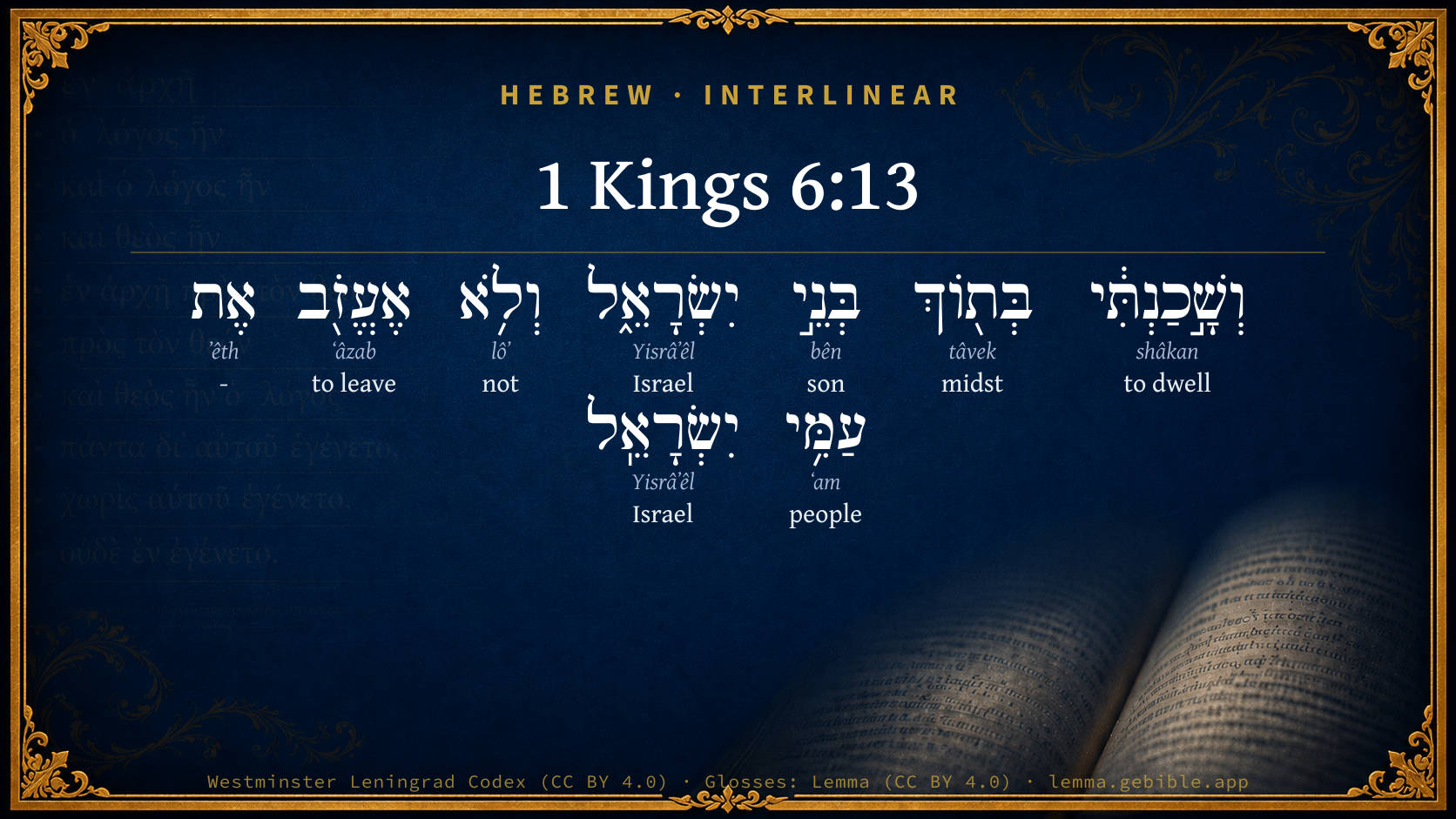
  1. בְּת֖וֹךְ tâvek H8432 “in/at · midst of” Preposition + Noun, Common, Masculine, Singular, Construct
  2. בְּנֵ֣י bên H1121 “sons of” Noun, Common, Masculine, Plural, Construct
  3. יִשְׂרָאֵ֑ל Yisrâʼêl H3478 “Israel” Noun, Proper
  4. וְלֹ֥א lôʼ H3808 “and · not” Conjunction + Particle, Negative
  5. אֶעֱזֹ֖ב ʻâzab H5800 “to leave” Verb, Qal, Imperfect, 1st Person, Common, Singular
  6. אֶת ʼêth H853 “-” Particle, Direct Object
  7. עַמִּ֥י ʻam H5971 “people · my” Noun, Common, Masculine, Singular, Construct + Suffix, Personal, 1st Person, Common, Singular
  8. יִשְׂרָאֵֽל Yisrâʼêl H3478 “Israel” Noun, Proper

About this verse

These counts appear in no published source. They are computed here, from the morphology-tagged text and Lemma’s own curated glosses. What Lemma adds →

9
words
8
distinct lemmas
Historical
section

Grammatical profile

  • 2 verbs
  • 5 nouns
  • 2 particles

Verb forms

  • וְשָׁ֣כַנְתִּ֔י Qal · Sequential Perfect
  • אֶעֱזֹ֖ב Qal · Imperfect

Repetition

A word recurs within this verse — often emphatic in Hebrew:

  • יִשְׂרָאֵ֑ל Israel H3478 ×2

Cross-references

16

Topical passages linked to 1 Kings 6:13 in the Treasury of Scripture Knowledge — connected by theme and wording, ordered by reader-vote popularity; previews shown in the World English Bible.

  • Deuteronomy 31:6 Be strong and of good courage, don't be afraid, nor be scared of them: for Yahweh your God, he it is who does go with you; he will not fail you, nor forsake you.
  • Exodus 25:8 Let them make me a sanctuary, that I may dwell among them.
  • Leviticus 26:11 I will set my tent among you: and my soul won't abhor you.
  • Hebrews 13:5 Be free from the love of money, content with such things as you have, for he has said, "I will in no way leave you, neither will I in any way forsake you."
  • Revelation 21:3 I heard a loud voice out of heaven saying, "Behold, God's dwelling is with people, and he will dwell with them, and they will be his people, and God himself will be with them as their God.
  • Deuteronomy 31:8 Yahweh, he it is who does go before you; he will be with you, he will not fail you, neither forsake you: don't be afraid, neither be dismayed.
  • 1 Kings 8:27 But will God in very deed dwell on the earth? behold, heaven and the heaven of heavens can't contain you; how much less this house that I have built!
  • Joshua 1:5 There shall not any man be able to stand before you all the days of your life. As I was with Moses, so I will be with you; I will not fail you, nor forsake you.
  • 1 Samuel 12:22 For Yahweh will not forsake his people for his great name's sake, because it has pleased Yahweh to make you a people to himself.
  • 1 Chronicles 28:9 You, Solomon my son, know the God of your father, and serve him with a perfect heart and with a willing mind; for Yahweh searches all hearts, and understands all the imaginations of the thoughts: if you seek him, he will be found of you; but if you forsake him, he will cast you off forever.
  • 1 Chronicles 28:20 David said to Solomon his son, Be strong and of good courage, and do it: don't be afraid, nor be dismayed; for Yahweh God, even my God, is with you; he will not fail you, nor forsake you, until all the work for the service of the house of Yahweh is finished.
  • Psalms 68:18 You have ascended on high. You have led away captives. You have received gifts among men, Yes, among the rebellious also, that Yah God might dwell there.
  • Psalms 132:12–13 If your children will keep my covenant, My testimony that I will teach them, Their children also will sit on your throne forevermore."
  • Isaiah 57:15 For thus says the high and lofty One who inhabits eternity, whose name is Holy: I dwell in the high and holy place, with him also who is of a contrite and humble spirit, to revive the spirit of the humble, and to revive the heart of the contrite.
  • Ezekiel 37:26–28 Moreover I will make a covenant of peace with them; it shall be an everlasting covenant with them; and I will place them, and multiply them, and will set my sanctuary in the midst of them forevermore.
  • 2 Corinthians 6:16 What agreement has a temple of God with idols? For you are a temple of the living God. Even as God said, "I will dwell in them, and walk in them; and I will be their God, and they will be my people."

Cross-references courtesy of OpenBible.info (CC BY 4.0).

Hebrew and Greek witnesses Masoretic Hebrew ↔ Greek Septuagint

The same verse in the two great witnesses to the Old Testament, shown verse-for-verse.

These are two independent witnesses, not word-aligned to each other, and the Septuagint is shown in lemma (dictionary) form.

Hebrew 1 Kings 6:13 Masoretic · Westminster Leningrad Codex

וְשָׁ֣כַנְתִּ֔י בְּת֖וֹךְ בְּנֵ֣י יִשְׂרָאֵ֑ל וְלֹ֥א אֶעֱזֹ֖ב אֶת עַמִּ֥י יִשְׂרָאֵֽל

I will dwell among the children of Israel, and will not forsake my people Israel.

World English Bible · Public Domain

Hebrew: Westminster Leningrad Codex (CC BY 4.0). Greek: Septuagint (public domain); English from a public-domain English Septuagint. How the Septuagint differs from the Hebrew →

Targum (Aramaic paraphrase)

1

The Targum is the ancient Jewish Aramaic paraphrase of the Hebrew Scriptures — an interpretive translation, not the Hebrew text itself. Onkelos (literal) and Pseudo-Jonathan (expansive) render the Torah, and Jonathan the Prophets. Coverage is partial: where no permissively-licensed English translation exists for a verse, only the Aramaic is shown. This is verse-level text, not a word-by-word alignment to the Hebrew.

  1. Targum Jonathan Prophets (Joshua–Malachi)
    וְאַשְׁרֵי שְׁכִנְתִּי בְּגוֹ בְּנֵי יִשְׂרָאֵל וְלָא אַרְחֵיק יַת עַמִי יִשְׂרָאֵל:

    (no public-domain English translation for this verse)

    Targum Jonathan — Aramaic: “Mikraot Gedolot” (public domain). English: “Sefaria Community Translation” (CC0 1.0 (public-domain dedication)); “London "Chaldee Paraphrase," 1871” (public domain). Text via Sefaria.

Commentary

Notes on 1 Kings 6:13 from classic Christian and Jewish commentators (each source and its license shown beneath its notes). The classic Christian expositions comment on the surrounding passage and are grouped to its opening verse, so a note may address several verses; the Jewish commentaries on the Tanakh (Rashi and others) are per-verse, so they appear only where the commentator wrote on this verse.

Lemma curates 59 commentaries, every one of them public domain or Creative Commons licensed, each selected and text-cleaned for this edition rather than reprinted as found. About our sources →

Trapp's Complete Commentary

John Trapp

1Ki 6:13 And I will dwell among the children of Israel, and will not forsake my people Israel.

Ver. 13. And I will dwell among the children of Israel.] This was a high favour: what is it then to the saints, that he will indwell in them. {2Co 6:16} We have no vines, said the Scythians, but we have gods. And, ενθα δε οι θεοι, here are household gods, said the philosopher, pointing to his poor cottage.

John Trapp, A Commentary or Exposition upon All the Books of the Old and New Testament (1647–1656) — public domain. Text from a community e-Sword module.

Geneva Bible (1599)

Geneva Bible translators

According as he promised unto Moses, Exod. 25:22.

Geneva Bible (1599) marginal notes — public domain. Text via Bolls.life.

The Cambridge Bible for Schools and Colleges

gen. ed. J. J. S. Perowne

13. and I will dwell among the children of Israel] This is an expansion of the promise made to David. The same words are used (Exo_29:45) in connexion with the furnishing and completion of the tabernacle. As God’s presence in both Tabernacle and Temple was to point on to the Incarnation, the fitness of the phrase on both occasions is manifest.

and will not forsake my people Israel] The threat that God would do so, if Israel were disobedient, is found Deu_31:17.

The Cambridge Bible for Schools and Colleges (gen. ed. J. J. S. Perowne; Cambridge University Press, 1878–1918) — public domain. Text from a community e-Sword module.

John Gill's Exposition

And I will dwell among the children of Israel,.... In this house now building, and which was in the middle of the land, and where he would meet with them, and accept their sacrifices, not only of slain beasts, but of prayer and praise:

and will not forsake my people Israel; and leave them to the mercy of their enemies, and to be carried captive by them, but protect and defend them.

John Gill's Exposition of the Whole Bible (1746–1763) — public domain (CC PDM 1.0). Text via the HelloAO Bible API.

Albert Barnes' Notes on the Bible

The first promise to “dwell among” the Israelites had been made to Moses Exo 25:8; Exo 29:45, but had not been repeated to David. The next promise, “I will not forsake, etc.,” if not absolutely new, seems to have been more positive and general than previous similar promises Deu 31:6, Deu 31:8; Jos 1:5. God will not at any time or under any circumstances wholly forsake Israel.

Albert Barnes' Notes on the Bible (1834–1885) — public domain. Text from a community e-Sword/MySword module.

The Pulpit Commentary

And I will dwell among the children of Israel, and will not forsake my people Israel cf. Deu_31:6. A fresh element is here introduced into the promise, arising out of the erection of the temple. God had pledged His presence to the tabernacle (Exo_25:8 Exo_29:45; Lev_26:11) And the temple was reared to be His dwelling (1Ki_8:13; 2Ch_6:2) He now assures the royal builder that he will occupy it. Jehovah Shammah. (Eze_48:35) The covenant relation shall be more firmly established.

The Pulpit Commentary (1880–1919), ed. H.D.M. Spence-Jones & Joseph S. Exell — public domain. Text from a community e-Sword module.

Lesson kit

Teaching starters — assembled from the data on this page, not authored interpretation. Every prompt links to the verse data it draws on. Edit before teaching.

1 Kings, in the Historical, opens this verse with 9 words (8 distinct Hebrew lemmas). Its most distinctive word is shâkan (“to dwell”). A historical commentator’s framing appears above. Read the whole chapter for the surrounding context.

Discussion questions

  1. What does “to dwell” (shâkan) contribute to the verse as a whole?
  2. How does Deuteronomy 31:6, which shares this passage’s theme, read alongside this verse?
  3. What does the repetition of “Israel” (2× in this one verse) do in this verse?
  4. The translations on this page render this verse differently — a whole-verse word diff, not a word-by-word alignment. What might account for the different wordings?
  5. «וְשָׁ֣כַנְתִּ֔י» is a Qal Sequential Perfect verb. How does that grammatical form shape the action described?
  6. Compare how Trapp's Complete Commentary and Geneva Bible (1599) read this verse. Where do they agree or differ?

Things to notice

  • These translations choose different wording for 4 words in this verse.
  • “Israel” occurs 2× in this single verse.
  • 8 distinct Hebrew lemmas span 9 words in this verse.

Reading settings

Reading text

Shown beneath each verse's original-language words.

Old Testament
Old Testament edition

Read the OT as the Masoretic Hebrew (MT) or the Greek Septuagint (LXX).

English shown for the Greek Septuagint (in the Hebrew ↔ Greek comparison).

Comparing translations? Open the Compare panel on any verse page to stack up to four side by side.