Ezekiel 22:9

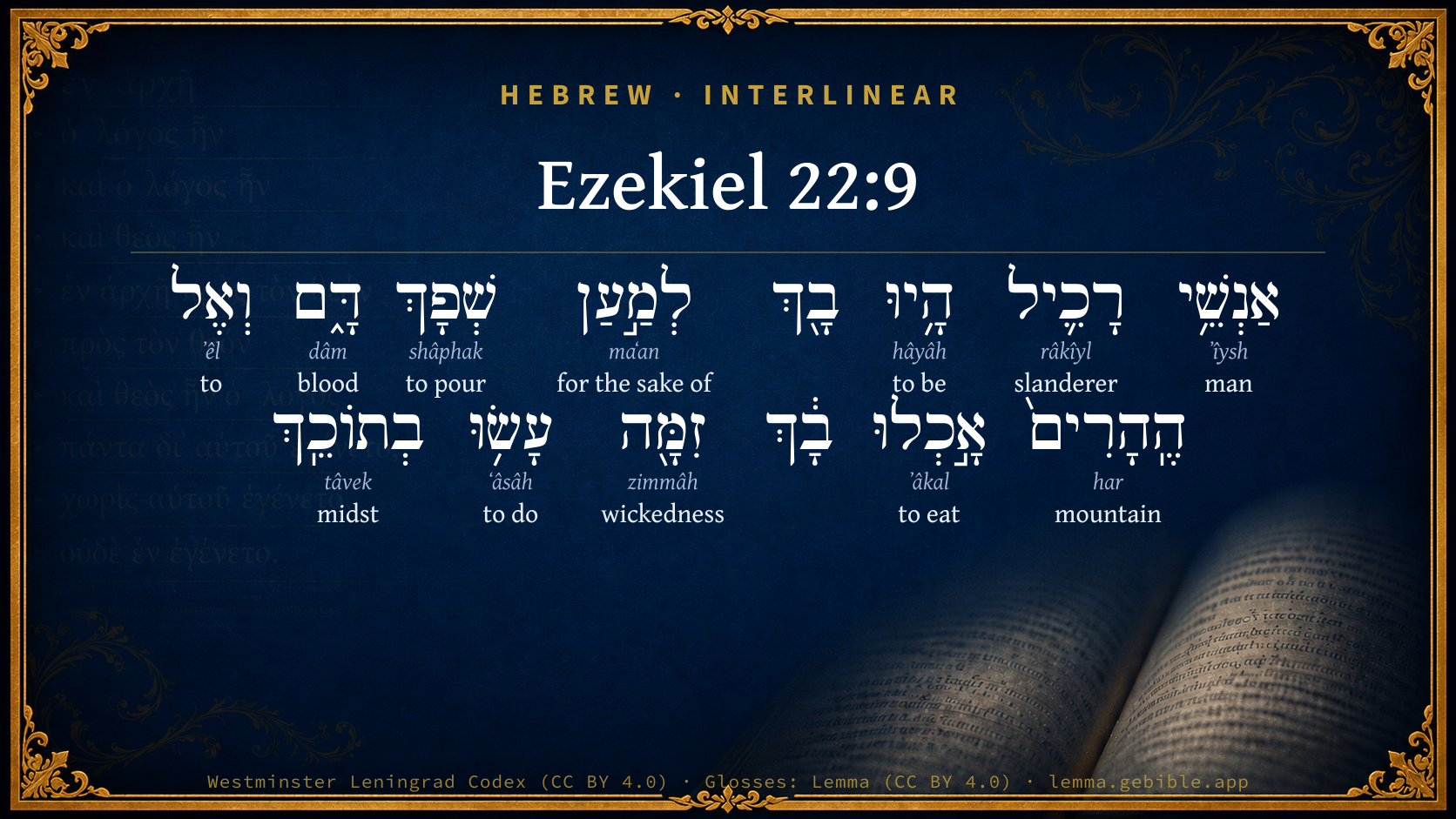
Hebrew (Westminster Leningrad Codex) Ezekiel 22:9 appears in the Hebrew Old Testament. The text above is from the Westminster Leningrad Codex. Each word links to its Strong’s number, a concise gloss, and parsing drawn from the Open Scriptures Hebrew Bible morphology. Click any word for its full Brown-Driver-Briggs (BDB) entry.
Download image
Cite this verse

Ezekiel 22:9 (World English Bible). Public Domain. Lemma interlinear Bible study tool, https://lemma.gebible.app/v/ezekiel/22/9.

Show BibTeX & RIS
BibTeX
RIS
English Translation
Slanderous men have been in you to shed blood; and in you they have eaten on the mountains: in the midst of you they have committed lewdness.
World English Bible · Public Domain
Download a study sheet

One document with this verse’s original text, its word-by-word gloss line, the meaning frame, cross-references with their text, attributed commentary, and full source and license credits — printable, and it pastes into notes with its structure intact.

This verse Autodidact and up

Study sheet (.html) Plain text (.txt)

A passage Seminary Student

Up to 50 verses in one chapter. A passage sheet keeps up to 6 commentary sources and 12 cross-references per verse, in the order this page ranks them, and says so on the sheet whenever that leaves anything out. Ask for a single verse and you get the Autodidact verse sheet above.

Everything on this page stays free to read, with no account — the sheet is a download of what is already on screen, not access to it.

Want to remove ads? Support Godless Engineer
Compare translations 3

The same verse in 3 English versions, stacked beneath the original-language interlinear above. Click any original word for its lexicon entry.

Each is an independent rendering of the whole verse — the interlinear is not word-aligned to these translations.

Highlighted words mark where these versions differ — a whole-verse word diff, not a word-by-word alignment.

  • World English Bible Public Domain
    Slanderous men have been in you to shed blood; and in you they have eaten on the mountains: in the midst of you they have committed lewdness.
  • King James Version Public Domain
    In thee are men that carry tales to shed blood: and in thee they eat upon the mountains: in the midst of thee they commit lewdness.
  • unfoldingWord Literal Text CC BY-SA 4.0
    Slanderous men have come within you in order to pour out blood, and they eat on the mountains. They perform wickedness in your midst.

unfoldingWord Literal Text — © unfoldingWord, licensed CC BY-SA 4.0. Word-aligned USFM3 via Door43 (git.door43.org/unfoldingWord/en_ult).

Versions to compare (up to 4)

3 of 4 selected

Show all 18 translations

Every available English version of this verse, each an independent rendering of the whole verse.

  • World English Bible Public Domain
    Slanderous men have been in you to shed blood; and in you they have eaten on the mountains: in the midst of you they have committed lewdness.
  • Berean Standard Bible Public Domain
    Among you are slanderous men bent on bloodshed; within you are those who eat on the mountain shrines and commit acts of indecency.
  • Majority Standard Bible Public Domain
    Among you are slanderous men bent on bloodshed; within you are those who eat on the mountain shrines and commit acts of indecency.
  • King James Version Public Domain
    In thee are men that carry tales to shed blood: and in thee they eat upon the mountains: in the midst of thee they commit lewdness.
  • American Standard Version (1901) Public Domain
    Slanderous men have been in thee to shed blood; and in thee they have eaten upon the mountains: in the midst of thee they have committed lewdness.
  • Revised Version (1885) Public Domain
    Slanderous men have been in thee to shed blood: and in thee they have eaten upon the mountains: in the midst of thee they have committed lewdness.
  • Geneva Bible (1599) Public Domain
    In thee are men that cary tales to shed blood: in thee are they that eate vpon the mountaines: in ye mids of thee they comit abomination.
  • Douay-Rheims (1899) Public Domain
    Slanderers have been in thee to shed blood, and they have eaten upon the mountains in thee, they have committed wickedness in the midst of thee.
  • Young's Literal Translation Public Domain
    Men of slander have been in thee to shed blood, And on the mountains they have eaten in thee, Wickedness they have done in thy midst.
  • Literal Standard Version CC BY-SA 4.0
    Men of slander have been in you to shed blood, || And they have eaten on the mountains in you, || They have done wickedness in your midst.
  • Unlocked Literal Bible CC BY-SA 4.0
    Slanderous men have come within you in order to pour out blood, and they eat on the mountains. They perform wickedness in your midst.
  • unfoldingWord Literal Text CC BY-SA 4.0
    Slanderous men have come within you in order to pour out blood, and they eat on the mountains. They perform wickedness in your midst.
  • Darby Bible Public Domain
    In thee there have been slanderous men to shed blood; and in thee have they eaten upon the mountains; in the midst of thee they have committed lewdness;
  • World Messianic Bible Public Domain
    Slanderous men have been in you to shed blood. In you they have eaten on the mountains. They have committed lewdness among you.
  • Webster's Bible Public Domain
    In thee are men that carry tales to shed blood: and in thee they eat upon the mountains: in the midst of thee they commit lewdness.
  • Free Bible Version CC BY-SA 4.0
    Living among you are people who falsely accuse others in order to put them to death. You also have those who eat religious meals at pagan shrines in the mountains, and commit immoral acts within the city.
  • Bible in Basic English Public Domain
    In you there are men who say evil of others, causing death; in you they have taken the flesh with the blood for food; in your streets they have put evil designs into effect.
  • JPS Tanakh (1917) Public Domain
    In thee have been talebearers to shed blood; and in thee they have eaten upon the mountains; in the midst of thee they have committed lewdness.

Literal Standard Version (2020), Covenant Press — licensed CC BY-SA 4.0. Text via the HelloAO Bible API (eBible.org). Unlocked Literal Bible (unfoldingWord) — licensed CC BY-SA 4.0. Text via the HelloAO Bible API (eBible.org). unfoldingWord Literal Text — © unfoldingWord, licensed CC BY-SA 4.0. Word-aligned USFM3 via Door43 (git.door43.org/unfoldingWord/en_ult). Free Bible Version, Dr. Jonathan Gallagher — licensed CC BY-SA 4.0. Text via the HelloAO Bible API (eBible.org).

Word by word

More ways to search: Search by grammar → Find every occurrence → Compare this word →

Practice this passage: Drill this verse → Learn its vocabulary →

רָכִ֛יל
râkîyl
H7400
“slanderer”
Noun, Common, Masculine, Singular, Absolute
Part of Speech
Noun
Type
Common
Gender
Masculine
Number
Singular
State
Absolute
Full BDB Definition

Origin: from H7402 a scandal-monger (as travelling about)

TWOT: 2165b

slander, slanderer, tale bearer, informer
  1. אַנְשֵׁ֥י ʼîysh H376 “men of” Noun, Common, Masculine, Plural, Construct
  2. הָ֥יוּ hâyâh H1961 “to be” Verb, Qal, Perfect, 3rd Person, Common, Plural
  3. לְמַ֣עַן maʻan H4616 “for the sake of” Preposition
  4. שְׁפָךְ shâphak H8210 “to pour” Verb, Qal, Infinitive Construct
  5. דָּ֑ם dâm H1818 “blood” Noun, Common, Masculine, Singular, Absolute
  6. וְאֶל ʼêl H413 “and · to” Conjunction + Preposition
  7. הֶֽהָרִים֙ har H2022 “the · mountains” Particle, Definite Article + Noun, Common, Masculine, Plural, Absolute
  8. אָ֣כְלוּ ʼâkal H398 “to eat” Verb, Qal, Perfect, 3rd Person, Common, Plural
  9. זִמָּ֖ה zimmâh H2154 “wickedness” Noun, Common, Feminine, Singular, Absolute
  10. עָשׂ֥וּ ʻâsâh H6213 “to do” Verb, Qal, Perfect, 3rd Person, Common, Plural
  11. בְתוֹכֵֽךְ tâvek H8432 “in/at · midst · your” Preposition + Noun, Common, Masculine, Singular, Construct + Suffix, Personal, 2nd Person, Feminine, Singular

About this verse

These counts appear in no published source. They are computed here, from the morphology-tagged text and Lemma’s own curated glosses. What Lemma adds →

14
words
12
distinct lemmas
Prophets
section

Notable vocabulary

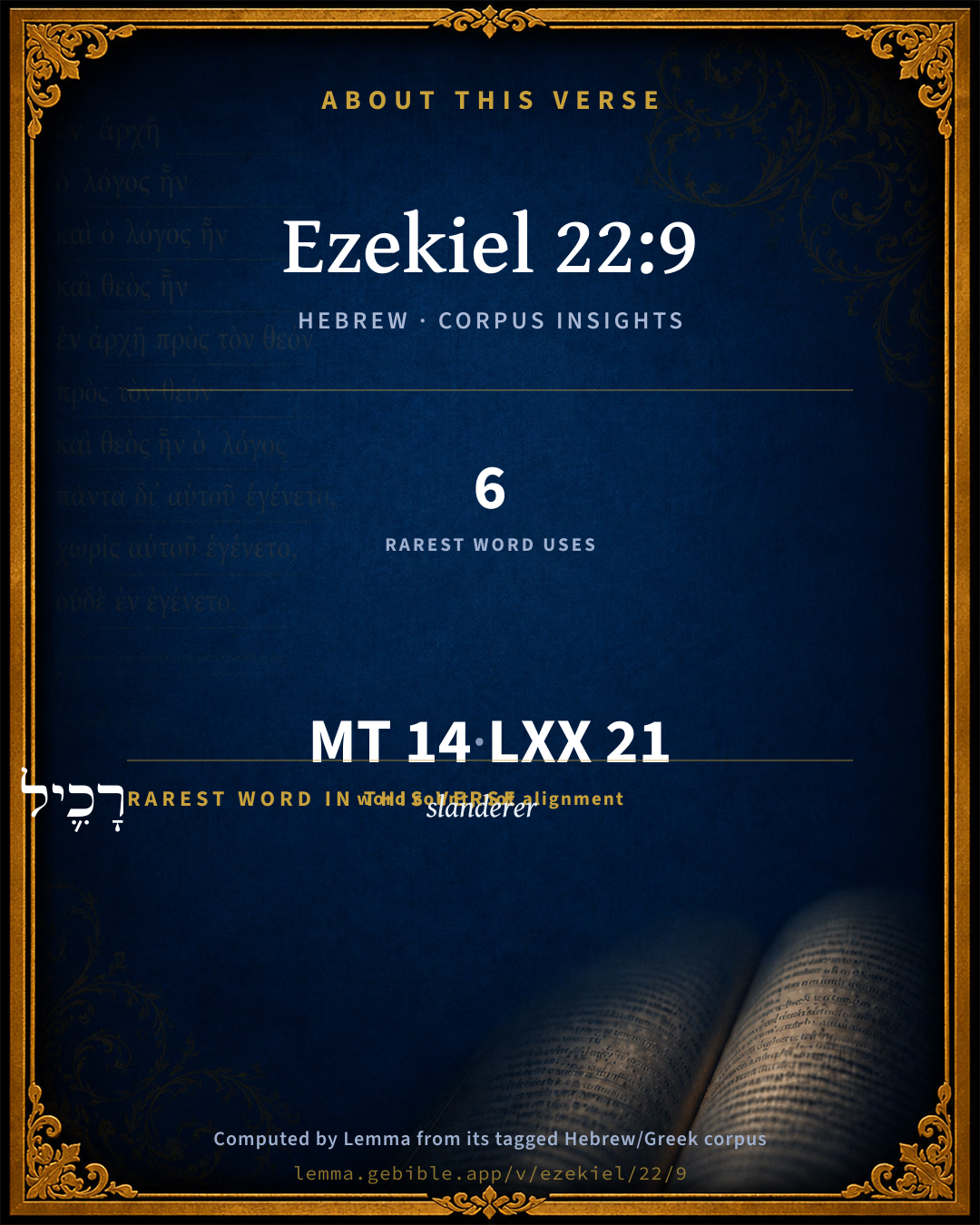
The rarest word here is רָכִ֛יל slanderer H7400 — appearing just 6 times in the whole Hebrew Bible.

Shared distinctive vocabulary

רָכִ֛יל slanderer H7400 occurs in 6 verses of the Hebrew Bible. Also found in:

Grammatical profile

  • 4 verbs
  • 6 nouns
  • 4 prepositions

Verb forms

  • הָ֥יוּ Qal · Perfect
  • שְׁפָךְ Qal · Infinitive Construct
  • אָ֣כְלוּ Qal · Perfect
  • עָשׂ֥וּ Qal · Perfect

Hebrew & Septuagint length

In English translation the verse runs 27 words from the Hebrew and 28 from the Septuagint (LXX English) — closely comparable.

A rough comparison of the two English renderings, which tokenize alike — not a word-level alignment.

Word counts can differ between the Hebrew and the Greek without any difference in meaning — e.g. the Hebrew direct-object marker אֵת has no separate Greek word, and Greek often adds the article ὁ.

In the original languages it is 14 Hebrew tokens and 21 Greek tokens — but the two are counted differently (Hebrew bundles its prefixes and suffixes into one token; the Greek is in lemma form), so that isn’t a like-for-like length.

Cross-references

31

Topical passages linked to Ezekiel 22:9 in the Treasury of Scripture Knowledge — connected by theme and wording, ordered by reader-vote popularity; previews shown in the World English Bible.

  • Hosea 4:14 I will not punish your daughters when they play the prostitute, Nor your brides when they commit adultery; Because the men consort with prostitutes, And they sacrifice with the shrine prostitutes; And the people that does not understand will come to ruin.
  • Leviticus 19:16 "'You shall not go up and down as a slanderer among your people; neither shall you stand against the life of your neighbor. I am Yahweh.
  • Hosea 4:2 There is cursing, lying, murder, stealing, and committing adultery; They break boundaries, and bloodshed causes bloodshed.
  • Hosea 4:10 They will eat, and not have enough. They will play the prostitute, and will not increase; Because they have abandoned giving to Yahweh.
  • Exodus 20:16 "You shall not give false testimony against your neighbor.
  • Psalms 50:20 You sit and speak against your brother. You slander your own mother's son.
  • Proverbs 10:18 He who hides hatred has lying lips. He who utters a slander is a fool.
  • Ezekiel 16:43 Because you have not remembered the days of your youth, but have raged against me in all these things; therefore, behold, I also will bring your way on your head, says the Lord Yahweh: and you shall not commit this lewdness with all your abominations.
  • Ezekiel 18:6 and has not eaten on the mountains, neither has lifted up his eyes to the idols of the house of Israel, neither has defiled his neighbor's wife, neither has come near to a woman in her impurity,
  • Ezekiel 18:11 and who does not any of those [duties], but even has eaten on the mountains, and defiled his neighbor's wife,
  • Matthew 26:59 Now the chief priests, the elders, and the whole council sought false testimony against Jesus, that they might put him to death;
  • 1 Corinthians 10:18–21 Consider Israel after the flesh. Don't those who eat the sacrifices have communion with the altar?
  • Revelation 12:9–10 The great dragon was thrown down, the old serpent, he who is called the devil and Satan, the deceiver of the whole world. He was thrown down to the earth, and his angels were thrown down with him.
  • Exodus 23:1 "You shall not spread a false report. Don't join your hand with the wicked to be a malicious witness.
  • Judges 20:6 I took my concubine, and cut her in pieces, and sent her throughout all the country of the inheritance of Israel; for they have committed lewdness and folly in Israel.
  • 1 Kings 21:10–13 and set two men, base fellows, before him, and let them testify against him, saying, You did curse God and the king. Then carry him out, and stone him to death.
  • Psalms 101:5 I will silence whoever secretly slanders his neighbor. I won't tolerate one who is haughty and conceited.
  • Psalms 106:28 They joined themselves also to Baal Peor, And ate the sacrifices of the dead.
  • Proverbs 18:8 The words of a gossip are like dainty morsels: They go down into a person's innermost parts.
  • Proverbs 26:22 The words of a whisperer are as dainty morsels, They go down into the innermost parts.
  • Jeremiah 6:28 They are all grievous rebels, going about with slanders; they are brass and iron: they all of them deal corruptly.
  • Jeremiah 9:4 Take you heed everyone of his neighbor, and don't you trust in any brother; for every brother will utterly supplant, and every neighbor will go about with slanders.
  • Jeremiah 37:13–15 When he was in the gate of Benjamin, a captain of the guard was there, whose name was Irijah, the son of Shelemiah, the son of Hananiah; and he laid hold on Jeremiah the prophet, saying, You are falling away to the Chaldeans.
  • Jeremiah 38:4–6 Then the princes said to the king, Let this man, we pray you, be put to death; because he weakens the hands of the men of war who remain in this city, and the hands of all the people, in speaking such words to them: for this man doesn't seek the welfare of this people, but the hurt.
  • Ezekiel 18:15 who has not eaten on the mountains, neither has lifted up his eyes to the idols of the house of Israel, has not defiled his neighbor's wife,
  • Ezekiel 24:13 In your filthiness is lewdness: because I have cleansed you and you weren't cleansed, you shall not be cleansed from your filthiness any more, until I have caused my wrath toward you to rest.
  • Hosea 6:9 As gangs of robbers wait to ambush a man, So the company of priests murder in the way toward Shechem, Committing shameful crimes.
  • Hosea 7:4 They are all adulterers. They are burning like an oven that the baker stops stirring, From the kneading of the dough, until it is leavened.
  • Acts 6:11–13 Then they secretly induced men to say, "We have heard him speak blasphemous words against Moses and God."
  • Acts 24:5 For we have found this man to be a plague, an instigator of insurrections among all the Jews throughout the world, and a ringleader of the sect of the Nazarenes.
  • Acts 24:13 Nor can they prove to you the things of which they now accuse me.

Cross-references courtesy of OpenBible.info (CC BY 4.0).

Hebrew and Greek witnesses Masoretic Hebrew ↔ Greek Septuagint

The same verse in the two great witnesses to the Old Testament, shown verse-for-verse.

These are two independent witnesses, not word-aligned to each other, and the Septuagint is shown in lemma (dictionary) form.

Hebrew Ezekiel 22:9 Masoretic · Westminster Leningrad Codex

אַנְשֵׁ֥י רָכִ֛יל הָ֥יוּ בָ֖ךְ לְמַ֣עַן שְׁפָךְ דָּ֑ם וְאֶל הֶֽהָרִים֙ אָ֣כְלוּ בָ֔ךְ זִמָּ֖ה עָשׂ֥וּ בְתוֹכֵֽךְ

Slanderous men have been in you to shed blood; and in you they have eaten on the mountains: in the midst of you they have committed lewdness.

World English Bible · Public Domain

Greek LXX Ezekiel 22:9 Septuagint · lemma form

ἀνήρ λῃστής ἐν σύ ὅπως ἐκχέω ἐν σύ αἷμα καί ἐπί ὁ ὄρος ἐσθίω ἐν σύ ἀνόσιος ποιέω ἐν μέσος σύ

There are robbers in you, to shed blood in you; and in you they have eaten upon the mountains: they have wrought ungodliness in the midst of you.

LXX2012 (modern English Septuagint) · Public Domain

On this verse, Trapp's Complete Commentary discusses the Septuagint’s reading. Read the note in Commentary ↓

Hebrew: Westminster Leningrad Codex (CC BY 4.0). Greek: Septuagint (public domain); English from LXX2012 (modern English Septuagint) (Public Domain). How the Septuagint differs from the Hebrew →

Targum (Aramaic paraphrase)

1

The Targum is the ancient Jewish Aramaic paraphrase of the Hebrew Scriptures — an interpretive translation, not the Hebrew text itself. Onkelos (literal) and Pseudo-Jonathan (expansive) render the Torah, and Jonathan the Prophets. Coverage is partial: where no permissively-licensed English translation exists for a verse, only the Aramaic is shown. This is verse-level text, not a word-by-word alignment to the Hebrew.

  1. Targum Jonathan Prophets (Joshua–Malachi)
    גַבְרֵי אָכְלֵי קוּרְצָא הֲיוֹ בִיךְ בְּדִיל לְמִשְׁפַּךְ דַם זַכַּאי וּבְטוּרַיָא פְלָחוּ בִיךְ לְטַעֲוָתָא אֲרֵי עֵיצַת חֶטְאִין עֲבָדוּ בְגַוִיךְ:

    (no public-domain English translation for this verse)

    Targum Jonathan — Aramaic: “Mikraot Gedolot” (public domain). English: “Sefaria Community Translation” (CC0 1.0 (public-domain dedication)); “London "Chaldee Paraphrase," 1871” (public domain). Text via Sefaria.

Commentary

Notes on Ezekiel 22:9 from classic Christian and Jewish commentators (each source and its license shown beneath its notes). The classic Christian expositions comment on the surrounding passage and are grouped to its opening verse, so a note may address several verses; the Jewish commentaries on the Tanakh (Rashi and others) are per-verse, so they appear only where the commentator wrote on this verse.

Lemma curates 59 commentaries, every one of them public domain or Creative Commons licensed, each selected and text-cleaned for this edition rather than reprinted as found. About our sources →

Trapp's Complete Commentary

John Trapp

Eze 22:9 In thee are men that carry tales to shed blood: and in thee they eat upon the mountains: in the midst of thee they commit lewdness.

Ver. 9. In thee are men that carry tales.] Heb., Men of slanders. {Exo 23:1 Lev 18:16} Whisperers, backbiters, tale bearers - pedlars, the Hebrew word, signifieth such as drop a tale here and another there - are viri latrones, thieves, as the Septuagint here translate, yea, they are murderers. The devil was first a slanderer, and then a murderer. His agents first take away the credit of the Church, and then wound her. {Son 5:6} The primitive Christians were first belied, and then cruelly handled; so were the French Protestants before the massacre of Paris. Humphry, Duke of Gloucester was by the people of England, notwithstanding the open showing of his body, and his pretended crimes, thought to be doubly murdered - viz., by detraction and deadly practice - saith the chronicler.

John Trapp, A Commentary or Exposition upon All the Books of the Old and New Testament (1647–1656) — public domain. Text from a community e-Sword module.

Jamieson, Fausset & Brown

Robert Jamieson, A. R. Fausset & David Brown

men that carry tales--informers, who by misrepresentations cause innocent blood to be shed (Lev 19:16). Literally, "one who goes to and fro as a merchant."

Jamieson, Fausset & Brown — Commentary Critical and Explanatory on the Whole Bible (1871) — public domain (CC PDM 1.0). Text via the HelloAO Bible API.

Adam Clarke's Commentary

Verse 9. In thee are men that carry tales] Witnesses that will swear any thing, even where life is concerned.

They eat upon the mountains] Sacrifice to idols, and celebrate their festivals.

Adam Clarke's Commentary on the Bible (1810–1826) — public domain. Text from a community e-Sword/MySword module.

The Cambridge Bible for Schools and Colleges

gen. ed. J. J. S. Perowne

9. Informers and false witnesses, Jer_9:3; Exo_23:1; Lev_19:16. Cf. ch. Eze_18:6; Eze_18:11.

commit lewdness] This clause should probably introduce the vices in Eze_22:10. Idolatry is metaphorically “lewdness,” but here it is not the community but individuals who are spoken of, cf. Eze_22:11.

The Cambridge Bible for Schools and Colleges (gen. ed. J. J. S. Perowne; Cambridge University Press, 1878–1918) — public domain. Text from a community e-Sword module.

John Gill's Exposition

In thee are men that carry tales to shed blood,.... Innocent blood, as the Targum; such who go from house to house, as pedlars do, with their wares or spices, as the word (a) signifies; hence the Syriac version renders it "merchants"; and carry tales and lies of innocent persons, and stir up others against them to wrath and revenge, and shed their blood; or that go to the courts of judicature, and there accuse innocent persons, and bear false witness against them, to the taking away of their lives. The Septuagint and Arabic versions render it "thieves": who commonly are murderers: and in thee they eat upon the mountains; that is, there were such in Jerusalem who used to go to the mountains where idols were worshipped, and eat the things that were sacrificed to them; or partook of the feast made to the honour of them. So the Targum,

"in thee they served idols on the mountains:''

in the midst of thee they commit lewdness; a general word for all manner of uncleanness, as adultery, fornication, incest, &c. of which some particulars follow.

(a) "homines mercaturae, vel aromatis"; so Ben Melech observes.

John Gill's Exposition of the Whole Bible (1746–1763) — public domain (CC PDM 1.0). Text via the HelloAO Bible API.

Haydock's Catholic Bible Commentary

Slanderers, hateful to all, Leviticus xix. 16., and Proverbs xi. 13. --- Mountains. Chap. xviii. 6.

George Leo Haydock (1774–1849), Haydock's Catholic Family Bible and Commentary, 1859 edition — public domain. Excludes Psalms (Douay-Rheims chapter numbering differs from Protestant) and Deuterocanonical books (Catholic canon only).

Matthew Poole's English Annotations

Men that carry tales; informers and trepanners, or persons that, corrupted with money, give in false witness against the innocent; and the princes of Israel had hand in it.

They eat, offer sacrifice, on the mountains, and feast there, celebrating the honour of their idols: see Eze 18:6,11,15.

Lewdness; enormous, contrived mischiefs, as the word imports.

Matthew Poole's English Annotations on the Holy Bible (1683–1685) — public domain. Text from a community e-Sword/MySword module.

Whedon's Commentary on the Bible

Daniel D. Whedon

9. Men that carry tales — Slanderers and false witnesses (Exo_23:1; Lev_19:16; 1Ki_21:10; Jer_9:3; Jer_37:13).

Eat upon the mountains — See Eze_18:6; Eze_18:11.

Lewdness — See Eze_16:43.

Daniel D. Whedon (gen. ed.), Commentary on the Old and New Testaments (1874–1909) — public domain. Text from a community e-Sword module.

The Pulpit Commentary

Men that carry tales, etc. Hebrew, men of slanders. (comp. Exo_23:1; Lev_19:16) The sin of the informers, ever ready to lend themselves to plots against the life or character of the innocent, was then, as at all times, the besetting evil of corrupt government in the East. Compare the story of Naboth (1Ki_21:10) and of Jeremiah. (Jer_37:13) (For eating on the mountains, see note on Eze_18:6; and for lewdness, that on Eze_16:43) What the lewdness consisted in is stated in the following verses.

The Pulpit Commentary (1880–1919), ed. H.D.M. Spence-Jones & Joseph S. Exell — public domain. Text from a community e-Sword module.

John Wesley's Explanatory Notes

Carry tales - Informers, or persons that for money, give in false witness against the innocent. They eat - Offer sacrifice on the mountains and feast there, in honour of their idols.

John Wesley, Explanatory Notes Upon the Whole Bible (1754–1765) — public domain. Text via the GEBible commentary corpus.

Rashi

Rabbi Shlomo Yitzchaki (Rashi)

and in you they have eaten upon the mountains and on the mountains they have worshipped in you to pagan deities.

they have held wicked plans Heb. זִמָה, plans of wickedness.

Rashi on the Tanakh — English translations: “The Judaica Press complete Tanach with Rashi, translated by A. J. Rosenberg” (CC BY 4.0); “Pentateuch with Rashi's commentary by M. Rosenbaum and A.M. Silbermann, 1929-1934” (public domain); “The Metsudah Tanach series, Lakewood, N.J” (CC BY 4.0); and “The Book of Joshua, Metsudah Publications, 1997” (CC BY 4.0). Text via Sefaria.

Lesson kit

Teaching starters — assembled from the data on this page, not authored interpretation. Every prompt links to the verse data it draws on. Edit before teaching.

Ezekiel, in the Prophets, opens this verse with 14 words (12 distinct Hebrew lemmas). Its most distinctive word is râkîyl (“slanderer”). A historical commentator’s framing appears above. Read the whole chapter for the surrounding context.

Discussion questions

  1. How does “slanderer” (râkîyl) shape what this verse is saying?
  2. Leviticus 19:16 shares the word «slanderer» with this verse. How do the two illuminate each other?
  3. These translations render this verse differently; the difference is in the English rendering, not the original. What questions does that raise?
  4. The verb «הָ֥יוּ» is Qal Perfect. How does its form color the action?
  5. Reading how Trapp's Complete Commentary and Jamieson, Fausset & Brown read this verse, where do the two commentators agree and where do they part?

Things to notice

Reading settings

Reading text

Shown beneath each verse's original-language words.

Old Testament
Old Testament edition

Read the OT as the Masoretic Hebrew (MT) or the Greek Septuagint (LXX).

English shown for the Greek Septuagint (in the Hebrew ↔ Greek comparison).

Comparing translations? Open the Compare panel on any verse page to stack up to four side by side.