
Ezekiel 7:4

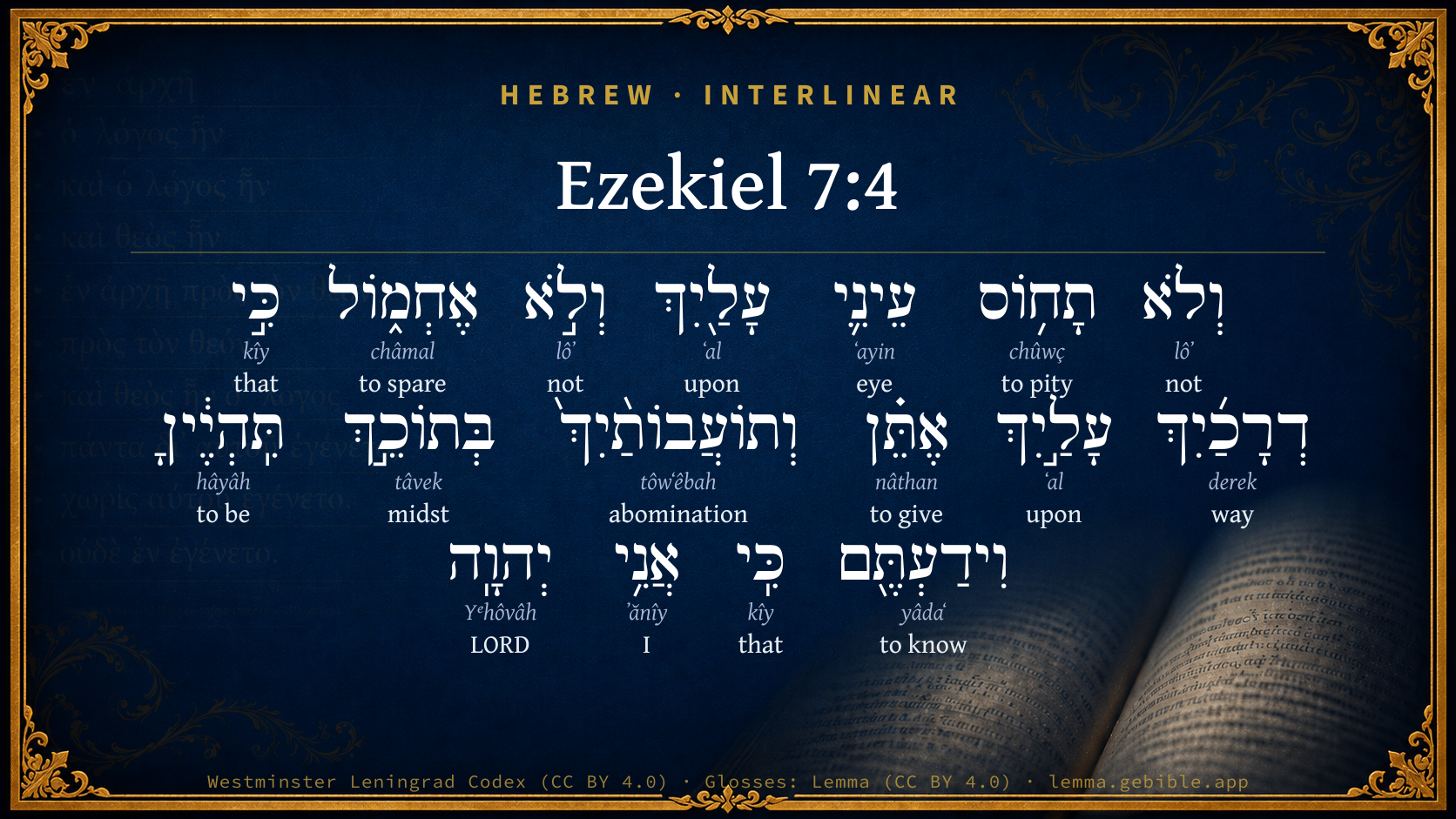
Hebrew (Westminster Leningrad Codex) Ezekiel 7:4 appears in the Hebrew Old Testament. The text above is from the Westminster Leningrad Codex. Each word links to its Strong’s number, a concise gloss, and parsing drawn from the Open Scriptures Hebrew Bible morphology. Click any word for its full Brown-Driver-Briggs (BDB) entry.
Download image
Cite this verse

Ezekiel 7:4 (World English Bible). Public Domain. Lemma interlinear Bible study tool, https://lemma.gebible.app/v/ezekiel/7/4.

Show BibTeX & RIS
BibTeX
RIS
English Translation
My eye shall not spare you, neither will I have pity; but I will bring your ways on you, and your abominations shall be in the midst of you: and you shall know that I am Yahweh.
World English Bible · Public Domain
Download a study sheet

One document with this verse’s original text, its word-by-word gloss line, the meaning frame, cross-references with their text, attributed commentary, and full source and license credits — printable, and it pastes into notes with its structure intact.

This verse Autodidact and up

Study sheet (.html) Plain text (.txt)

A passage Seminary Student

Up to 50 verses in one chapter. A passage sheet keeps up to 6 commentary sources and 12 cross-references per verse, in the order this page ranks them, and says so on the sheet whenever that leaves anything out. Ask for a single verse and you get the Autodidact verse sheet above.

Everything on this page stays free to read, with no account — the sheet is a download of what is already on screen, not access to it.

Want to remove ads? Support Godless Engineer
Compare translations 3

The same verse in 3 English versions, stacked beneath the original-language interlinear above. Click any original word for its lexicon entry.

Each is an independent rendering of the whole verse — the interlinear is not word-aligned to these translations.

Highlighted words mark where these versions differ — a whole-verse word diff, not a word-by-word alignment.

  • World English Bible Public Domain
    My eye shall not spare you, neither will I have pity; but I will bring your ways on you, and your abominations shall be in the midst of you: and you shall know that I am Yahweh.
  • King James Version Public Domain
    And mine eye shall not spare thee, neither will I have pity: but I will recompense thy ways upon thee, and thine abominations shall be in the midst of thee: and ye shall know that I am the LORD.
  • unfoldingWord Literal Text CC BY-SA 4.0
    For my eyes will not pity you, and I will not spare you. Instead, I will bring your ways upon you, and your abominations will be in your midst, so you will know that I am Yahweh.

unfoldingWord Literal Text — © unfoldingWord, licensed CC BY-SA 4.0. Word-aligned USFM3 via Door43 (git.door43.org/unfoldingWord/en_ult).

Versions to compare (up to 4)

3 of 4 selected

Show all 18 translations

Every available English version of this verse, each an independent rendering of the whole verse.

  • World English Bible Public Domain
    My eye shall not spare you, neither will I have pity; but I will bring your ways on you, and your abominations shall be in the midst of you: and you shall know that I am Yahweh.
  • Berean Standard Bible Public Domain
    I will not look on you with pity, nor will I spare you, but I will punish you for your ways and for the abominations among you. Then you will know that I am the LORD.’
  • Majority Standard Bible Public Domain
    I will not look on you with pity, nor will I spare you, but I will punish you for your ways and for the abominations among you. Then you will know that I am the LORD.’
  • King James Version Public Domain
    And mine eye shall not spare thee, neither will I have pity: but I will recompense thy ways upon thee, and thine abominations shall be in the midst of thee: and ye shall know that I am the LORD.
  • American Standard Version (1901) Public Domain
    And mine eye shall not spare thee, neither will I have pity; but I will bring thy ways upon thee, and thine abominations shall be in the midst of thee: and ye shall know that I am Jehovah.
  • Revised Version (1885) Public Domain
    And mine eye shall not spare thee, neither will I have pity: but I will bring thy ways upon thee, and thine abominations shall be in the midst of thee: and ye shall know that I am the LORD.
  • Geneva Bible (1599) Public Domain
    Neither shall mine eye spare thee, neither will I haue pitie: but I will laye thy waies vpon thee: and thine abomination shall bee in the middes of thee, and yee shall knowe that I am the Lord.
  • Douay-Rheims (1899) Public Domain
    And my eye shall not spare thee, and I will shew thee no pity: but I will lay thy ways upon thee, and thy abominations shall be in the midst of thee: and you shall know that I am the Lord.
  • Young's Literal Translation Public Domain
    And no pity on thee hath Mine eye, nor do I spare, For thy ways against thee I do set, And thine abominations are in thy midst, And ye have known that I `am' Jehovah.
  • Literal Standard Version CC BY-SA 4.0
    And My eye has no pity on you, nor do I spare, || For I set your ways against you, || And your abominations are in your midst, || And you have known that I [am] YHWH.
  • Unlocked Literal Bible CC BY-SA 4.0
    For my eyes will not pity you, and I will not spare you. Instead, I will bring your ways upon you, and your abominations will be in your midst, so you will know that I am Yahweh.
  • unfoldingWord Literal Text CC BY-SA 4.0
    For my eyes will not pity you, and I will not spare you. Instead, I will bring your ways upon you, and your abominations will be in your midst, so you will know that I am Yahweh.
  • Darby Bible Public Domain
    And mine eye shall not spare thee, neither will I have pity; but I will bring thy ways upon thee, and thine abominations shall be in the midst of thee; and ye shall know that I [am] Jehovah.
  • World Messianic Bible Public Domain
    My eye will not spare you, neither will I have pity; but I will bring your ways on you, and your abominations will be among you. Then you will know that I am the LORD.’
  • Webster's Bible Public Domain
    And my eye shall not spare thee, neither will I have pity: but I will recompense thy ways upon thee, and thy abominations shall be in the midst of thee: and ye shall know that I am the LORD.
  • Free Bible Version CC BY-SA 4.0
    I won't have any pity for you, or show you any mercy. I'm going to punish you for what you've done, for your disgusting sins. Then you'll know that I am the Lord.
  • Bible in Basic English Public Domain
    My eye will not have mercy on you, and I will have no pity: but I will send the punishment of your ways on you, and your disgusting works will be among you: and you will be certain that I am the Lord.
  • JPS Tanakh (1917) Public Domain
    And Mine eye shall not spare thee, neither will I have pity; but I will bring thy ways upon thee, and thine abominations shall be in the midst of thee; and ye shall know that I am the LORD.

Literal Standard Version (2020), Covenant Press — licensed CC BY-SA 4.0. Text via the HelloAO Bible API (eBible.org). Unlocked Literal Bible (unfoldingWord) — licensed CC BY-SA 4.0. Text via the HelloAO Bible API (eBible.org). unfoldingWord Literal Text — © unfoldingWord, licensed CC BY-SA 4.0. Word-aligned USFM3 via Door43 (git.door43.org/unfoldingWord/en_ult). Free Bible Version, Dr. Jonathan Gallagher — licensed CC BY-SA 4.0. Text via the HelloAO Bible API (eBible.org).

Word by word

More ways to search: Search by grammar → Find every occurrence → Compare this word →

Practice this passage: Drill this verse → Learn its vocabulary →

תָח֥וֹס
chûwç
H2347
“to pity”
Verb, Qal, Imperfect, 3rd Person, Feminine, Singular
Part of Speech
Verb
Stem
Qal
Form
Imperfect
Person
3rd Person
Gender
Feminine
Number
Singular
Full BDB Definition

Origin: a primitive root

TWOT: 626

(Qal) to pity, have compassion, spare, look upon with compassion
  1. וְלֹא lôʼ H3808 “and · not” Conjunction + Particle, Negative
  2. עֵינִ֛י ʻayin H5869 “eye · my” Noun, Common, Both, Singular, Construct + Suffix, Personal, 1st Person, Common, Singular
  3. עָלַ֖יִךְ ʻal H5921 “upon · you” Preposition + Suffix, Personal, 2nd Person, Feminine, Singular
  4. וְלֹ֣א lôʼ H3808 “and · not” Conjunction + Particle, Negative
  5. אֶחְמ֑וֹל châmal H2550 “to spare” Verb, Qal, Imperfect, 1st Person, Common, Singular
  6. כִּ֣י kîy H3588 “that” Conjunction
  7. דְרָכַ֜יִךְ derek H1870 “ways · your” Noun, Common, Both, Plural, Construct + Suffix, Personal, 2nd Person, Feminine, Singular
  8. עָלַ֣יִךְ ʻal H5921 “upon · you” Preposition + Suffix, Personal, 2nd Person, Feminine, Singular
  9. אֶתֵּ֗ן nâthan H5414 “to give” Verb, Qal, Imperfect, 1st Person, Common, Singular
  10. וְתוֹעֲבוֹתַ֨יִךְ֙ tôwʻêbah H8441 “and · abominations · your” Conjunction + Noun, Common, Feminine, Plural, Construct + Suffix, Personal, 2nd Person, Feminine, Singular
  11. בְּתוֹכֵ֣ךְ tâvek H8432 “in/at · midst · your” Preposition + Noun, Common, Masculine, Singular, Construct + Suffix, Personal, 2nd Person, Feminine, Singular
  12. תִּֽהְיֶ֔יןָ hâyâh H1961 “to be” Verb, Qal, Imperfect, 3rd Person, Feminine, Plural
  13. וִידַעְתֶּ֖ם yâdaʻ H3045 “and · to know” Conjunction + Verb, Qal, Sequential Perfect, 2nd Person, Masculine, Plural
  14. כִּֽי kîy H3588 “that” Conjunction
  15. אֲנִ֥י ʼănîy H589 “I” Pronoun, Personal, 1st Person, Common, Singular
  16. יְהוָֽה Yᵉhôvâh H3068 “LORD” Noun, Proper

About this verse

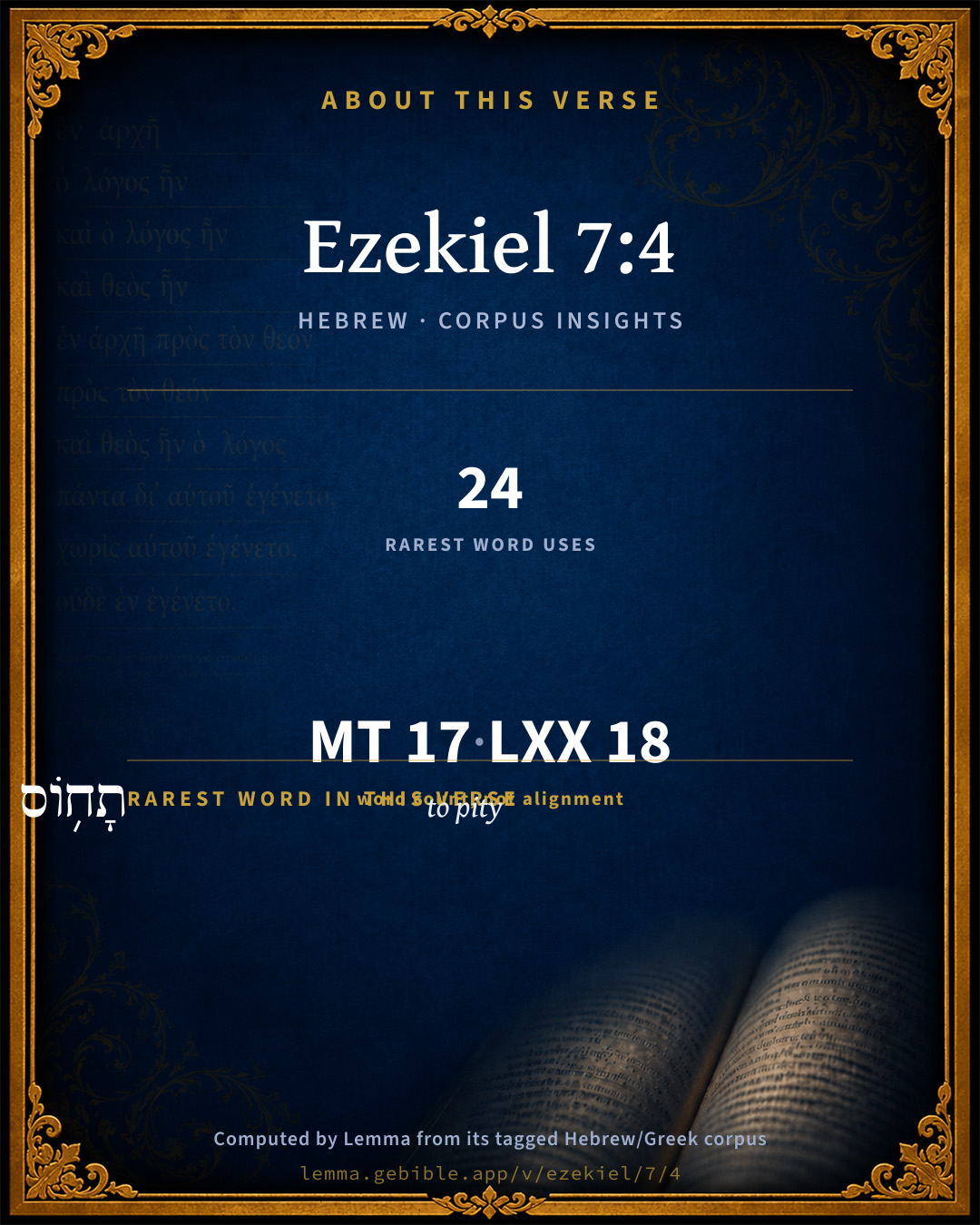
These counts appear in no published source. They are computed here, from the morphology-tagged text and Lemma’s own curated glosses. What Lemma adds →

17
words
14
distinct lemmas
Prophets
section

Notable vocabulary

The rarest word here is תָח֥וֹס to pity H2347 — appearing just 24 times in the whole Hebrew Bible.

Shared distinctive vocabulary

תָח֥וֹס to pity H2347 occurs in 24 verses of the Hebrew Bible. Also found in:

Grammatical profile

  • 5 verbs
  • 5 nouns
  • 1 pronoun
  • 2 prepositions
  • 2 conjunctions
  • 2 particles

Verb forms

  • תָח֥וֹס Qal · Imperfect
  • אֶחְמ֑וֹל Qal · Imperfect
  • אֶתֵּ֗ן Qal · Imperfect
  • תִּֽהְיֶ֔יןָ Qal · Imperfect
  • וִידַעְתֶּ֖ם Qal · Sequential Perfect

Repetition

Words recur within this verse — often emphatic in Hebrew:

  • עָלַ֖יִךְ upon H5921 ×2
  • וְלֹא not H3808 ×2
  • כִּ֣י that H3588 ×2

Hebrew & Septuagint length

In English translation the verse runs 37 words from the Hebrew and 20 from the Septuagint (LXX English) — the Septuagint runs noticeably shorter here. See the side-by-side →

A rough comparison of the two English renderings, which tokenize alike — not a word-level alignment.

Word counts can differ between the Hebrew and the Greek without any difference in meaning — e.g. the Hebrew direct-object marker אֵת has no separate Greek word, and Greek often adds the article ὁ.

In the original languages it is 17 Hebrew tokens and 18 Greek tokens — but the two are counted differently (Hebrew bundles its prefixes and suffixes into one token; the Greek is in lemma form), so that isn’t a like-for-like length.

Cross-references

21

Topical passages linked to Ezekiel 7:4 in the Treasury of Scripture Knowledge — connected by theme and wording, ordered by reader-vote popularity; previews shown in the World English Bible.

  • Ezekiel 6:7 The slain shall fall in the midst of you, and you shall know that I am Yahweh.
  • Ezekiel 5:11 Therefore, as I live, says the Lord Yahweh, surely, because you have defiled my sanctuary with all your detestable things, and with all your abominations, therefore will I also diminish [you]; neither shall my eye spare, and I also will have no pity.
  • Ezekiel 11:21 But as for them whose heart walks after the heart of their detestable things and their abominations, I will bring their way on their own heads, says the Lord Yahweh.
  • Ezekiel 6:14 I will stretch out my hand on them, and make the land desolate and waste, from the wilderness toward Diblah, throughout all their habitations: and they shall know that I am Yahweh.
  • Ezekiel 7:27 The king shall mourn, and the prince shall be clothed with desolation, and the hands of the people of the land shall be troubled: I will do to them after their way, and according to their deserts will I judge them; and they shall know that I am Yahweh.
  • Ezekiel 9:10 As for me also, my eye shall not spare, neither will I have pity, but I will bring their way on their head.
  • Ezekiel 16:43 Because you have not remembered the days of your youth, but have raged against me in all these things; therefore, behold, I also will bring your way on your head, says the Lord Yahweh: and you shall not commit this lewdness with all your abominations.
  • Hosea 9:7 The days of visitation have come. The days of reckoning have come. Israel will consider the prophet to be a fool, And the man who is inspired to be insane, Because of the abundance of your sins, And because your hostility is great.
  • Hosea 12:2 Yahweh also has a controversy with Judah, And will punish Jacob according to his ways; According to his deeds he will repay him.
  • Jeremiah 13:14 I will dash them one against another, even the fathers and the sons together, says Yahweh: I will not pity, nor spare, nor have compassion, that I should not destroy them.
  • Jeremiah 16:18 First I will recompense their iniquity and their sin double, because they have polluted my land with the carcasses of their detestable things, and have filled my inheritance with their abominations.
  • Jeremiah 25:14 For many nations and great kings shall make bondservants of them, even of them; and I will recompense them according to their deeds, and according to the work of their hands.
  • Ezekiel 7:9 My eye shall not spare, neither will I have pity: I will bring on you according to your ways; and your abominations shall be in the midst of you; and you shall know that I, Yahweh, do strike.
  • Ezekiel 8:18 Therefore will I also deal in wrath; my eye shall not spare, neither will I have pity; and though they cry in my ears with a loud voice, yet will I not hear them.
  • Ezekiel 12:20 The cities that are inhabited shall be laid waste, and the land shall be a desolation; and you shall know that I am Yahweh.
  • Ezekiel 22:31 Therefore have I poured out my indignation on them; I have consumed them with the fire of my wrath: their own way have I brought on their heads, says the Lord Yahweh.
  • Ezekiel 23:31 You have walked in the way of your sister; therefore will I give her cup into your hand.
  • Ezekiel 23:49 They shall recompense your lewdness on you, and you shall bear the sins of your idols; and you shall know that I am the Lord Yahweh.
  • Ezekiel 24:14 I, Yahweh, have spoken it: it shall happen, and I will do it: I will not go back, neither will I spare, neither will I repent; according to your ways, and according to your doings, shall they judge you, says the Lord Yahweh.
  • Zechariah 11:6 For I will no more pity the inhabitants of the land," says Yahweh; "but, behold, I will deliver the men everyone into his neighbor's hand, and into the hand of his king. They will strike the land, and out of their hand I will not deliver them."
  • Hebrews 10:30 For we know him who said, "Vengeance belongs to me," says the Lord, "I will repay." Again, "The Lord will judge his people."

Cross-references courtesy of OpenBible.info (CC BY 4.0).

Hebrew and Greek witnesses Masoretic Hebrew ↔ Greek Septuagint

The same verse in the two great witnesses to the Old Testament, shown verse-for-verse.

Here the Septuagint runs noticeably shorter than the Hebrew — LXX2012 (modern English Septuagint) 20 words vs World English Bible 37. A rough length comparison of the two English translations, not a word-level alignment — read both below.

These are two independent witnesses, not word-aligned to each other, and the Septuagint is shown in lemma (dictionary) form.

Hebrew Ezekiel 7:4 Masoretic · Westminster Leningrad Codex

וְלֹא תָח֥וֹס עֵינִ֛י עָלַ֖יִךְ וְלֹ֣א אֶחְמ֑וֹל כִּ֣י דְרָכַ֜יִךְ עָלַ֣יִךְ אֶתֵּ֗ן וְתוֹעֲבוֹתַ֨יִךְ֙ בְּתוֹכֵ֣ךְ תִּֽהְיֶ֔יןָ וִידַעְתֶּ֖ם כִּֽי אֲנִ֥י יְהוָֽה

My eye shall not spare you, neither will I have pity; but I will bring your ways on you, and your abominations shall be in the midst of you: and you shall know that I am Yahweh.

World English Bible · Public Domain

Greek LXX Ezekiel 7:4 Septuagint · lemma form

ἐπί σύ ὁ καταοἰκέω ὁ γῆ ἥκω ὁ καιρός ἐγγίζω ὁ ἡμέρα οὐ μετά θορύβος οὐδέ μετά ὠδίν

the inhabitant of the land: the time is come, the day has drawn near, not with tumult, nor with pangs.

LXX2012 (modern English Septuagint) · Public Domain

Hebrew: Westminster Leningrad Codex (CC BY 4.0). Greek: Septuagint (public domain); English from LXX2012 (modern English Septuagint) (Public Domain). How the Septuagint differs from the Hebrew →

Targum (Aramaic paraphrase)

1

The Targum is the ancient Jewish Aramaic paraphrase of the Hebrew Scriptures — an interpretive translation, not the Hebrew text itself. Onkelos (literal) and Pseudo-Jonathan (expansive) render the Torah, and Jonathan the Prophets. Coverage is partial: where no permissively-licensed English translation exists for a verse, only the Aramaic is shown. This is verse-level text, not a word-by-word alignment to the Hebrew.

  1. Targum Jonathan Prophets (Joshua–Malachi)
    וְלָא יְחוּס מֵימְרִי עֲלָךְ וְלָא אֶרְחַם אֲרֵי חוֹב אוֹרְחָתָיִךְ עֲלָךְ אֶתֵּן וּפוּרְעֲנוּת תּוֹעֲבָתַיִךְ בְּגַוִיךְ יֶהֶוְיָן וְתֵידְעוּן אֲרֵי אֲנָא יְיָ:

    (no public-domain English translation for this verse)

    Targum Jonathan — Aramaic: “Mikraot Gedolot” (public domain). English: “Sefaria Community Translation” (CC0 1.0 (public-domain dedication)); “London "Chaldee Paraphrase," 1871” (public domain). Text via Sefaria.

Commentary

Notes on Ezekiel 7:4 from classic Christian and Jewish commentators (each source and its license shown beneath its notes). The classic Christian expositions comment on the surrounding passage and are grouped to its opening verse, so a note may address several verses; the Jewish commentaries on the Tanakh (Rashi and others) are per-verse, so they appear only where the commentator wrote on this verse.

Lemma curates 59 commentaries, every one of them public domain or Creative Commons licensed, each selected and text-cleaned for this edition rather than reprinted as found. About our sources →

Trapp's Complete Commentary

John Trapp

Eze 7:4 And mine eye shall not spare thee, neither will I have pity: but I will recompense thy ways upon thee, and thine abominations shall be in the midst of thee: and ye shall know that I [am] the LORD.

Ver. 4. And mine eye shall not spare thee.] Eze 5:11. See on Jer 13:14.

And thine abominations shall be in the midst of thee.] Ut quae antea latuerant, in aperture prodeant.

And ye shall know that I am the Lord.] That smiteth you. {Eze 7:9}

An evil, an only evil,] viz., Without mixture of mercy, or that shall smite thee down at one only blow. {as 1Sa 26:8 Nah 1:9} The Vulgate, after the Chaldee, rendereth it, An evil after an evil - q.d., Lighter and lesser judgments have done no good upon thee. Now I will finish the work, and cut it short in righteousness. {Rom 9:28} Ruinam praecedunt stillicidia. Drops precede disaster.

John Trapp, A Commentary or Exposition upon All the Books of the Old and New Testament (1647–1656) — public domain. Text from a community e-Sword module.

Jamieson, Fausset & Brown

Robert Jamieson, A. R. Fausset & David Brown

thine abominations--the punishment of thine abominations.

shall be in the midst of thee--shall be manifest to all. They and thou shall recognize the fact of thine abominations by thy punishment which shall everywhere befall thee, and that manifestly.

Jamieson, Fausset & Brown — Commentary Critical and Explanatory on the Whole Bible (1871) — public domain (CC PDM 1.0). Text via the HelloAO Bible API.

Adam Clarke's Commentary

Verse 4. Thine abominations shall be in the midst of thee] They shall ever stare thee in the face, upbraid thee with thy ingratitude and disobedience, and be witnesses against thee.

Adam Clarke's Commentary on the Bible (1810–1826) — public domain. Text from a community e-Sword/MySword module.

John Calvin's Commentaries

In other words he confines his own sentence, that God will not spare them, nor will he be entreated. For when hypocrites hear the praises of God which are assigned to him in scripture, namely, that he is merciful and long-suffering, (Numbers 14:18; Psalm 103:8,) they seize upon them and fabricate for themselves the material of foolish and perverse confidence. God here pronounces that his pity would not be accessible to the wicked, who do not cease to repel it far from them. And this is worthy of notice, because nothing is more natural than to be intoxicated with false hope when we hear that God is merciful, unless we know for what purpose he testifies this concerning himself, namely, that sinners may betake themselves to him, and may fearlessly call upon him, and implore his mercy, of which they have such remarkable testimony. But hypocrites always become worse, meanwhile they wish God to be propitious to them. Hence when he says, his eye will not spare, neither would he pity them, his intention must be observed, that. wicked and ungodly men should not think his clemency prepared for them against which they have previously shut the door. Because I will put thy ways upon thee — that is, I will cast thy wickedness against thee. We see then that the people’s sins were placed before them, and as it were lay there as long as God spared them. Now, therefore, he first signifies that they should have no cause of quarrel or complaint, because he will cast against them the iniquities which they had heaped upon him. Then also he silently accuses them of too much security, because they never could be brought to repentance, while God sustained and tolerated their sins. And thy abominations, he says, shall be in the midst of thee They were so from the first as far as their guilt was concerned, but God had not yet poured forth his anger. He says, therefore, thy abominations shall be in the midst of thee, because it should really appear that they were not obstinate against God without punishment. Again he repeats, ye shall know that I am Jehovah It is quite clear, that by their obstinacy they compelled God to speak thus, since they despised Ezekiel. But although they pretended to some piety, it cannot be doubted that they would despise God himself.

Therefore he reproves their impiety so sharply, because they denied that God was God as often as they withdrew their confidence from the teaching of the holy man. It follows —

John Calvin's Commentaries (1540-1563) — public domain. Text from the Calvin Translation Society English edition (1840s-50s) via the Christian Classics Ethereal Library (ccel.org). Calvin's coverage is partial (roughly two-thirds of the Bible); uncommented books and verses are honest gaps, never fabricated. The 19th-century editor's footnotes and remarks are omitted so the notes are faithfully Calvin's own voice.

The Cambridge Bible for Schools and Colleges

gen. ed. J. J. S. Perowne

4. mine eye shall not spare] So Eze_7:9, ch. Eze_5:11, Eze_8:18, Eze_9:10. From their calamities the people shall learn not only that he that inflicts them is their God, whom they called Jehovah (a thing which they were slow to learn, Amo_3:2; Amo_5:18), but also what the nature of that God is—that he is Jehovah, the true and righteous God (a thing which they were even slower to learn), cf. Eze_7:27, ch. Eze_6:7, Eze_12:20, &c.

The Cambridge Bible for Schools and Colleges (gen. ed. J. J. S. Perowne; Cambridge University Press, 1878–1918) — public domain. Text from a community e-Sword module.

John Gill's Exposition

Thus saith the Lord God,.... Here should be a stop, a colon, requiring attention to what follows, it being something awful and terrible:

an evil, an only evil, behold, it cometh; meaning the destruction of the city and temple; which, though but one, was such an one as was never known before nor was there any like it. The Targum is,

"evil after evil, lo, it cometh;''

one evil after another; when one evil is gone, another comes, as in Eze 7:26. The Syriac version is, "behold, evil for evil comes"; the evil of punishment for the evil of sin.

John Gill's Exposition of the Whole Bible (1746–1763) — public domain (CC PDM 1.0). Text via the HelloAO Bible API.

Matthew Poole's English Annotations

Mine eye: see Eze 5:11.

Thine abominations, not only the punishment and smart, but the vileness, loathsomeness, and hatefulness of thy sins, shall be,

in the midst of thee; ever before thee, and openly known to others also, or shall reach thy very heart. See Eze 6:10,13.

Matthew Poole's English Annotations on the Holy Bible (1683–1685) — public domain. Text from a community e-Sword/MySword module.

Whedon's Commentary on the Bible

Daniel D. Whedon

4. Mine eye shall not spare thee, neither will I have pity — Although Jehovah is “merciful and gracious,” there comes a time when he must not spare the guilty (Exo_34:7). The pity which will not execute a promised and deserved punishment has little regard for the majesty of the law and the possible reformation of the offenders. (See Eze_5:11; Eze_7:9; Eze_8:18; Eze_9:10.) These judgments are redemptive. God’s wrath is the anger of love, and there is a divine compassion in his refusal to avert the just punishment of sin. I will recompense thy ways upon thee, etc. — “Sin, when it is full-grown, gendereth death” (Jas_1:15). Death is the legitimate child of persistent sin. The worst thing that can happen to a man or a nation is to have their evil ways fall upon them and their abominations bring forth their natural fruitage. When a nation which has sown to the wind begins to reap the whirlwind it begins also to think that there may be a God in Israel.

Daniel D. Whedon (gen. ed.), Commentary on the Old and New Testaments (1874–1909) — public domain. Text from a community e-Sword module.

The Pulpit Commentary

Thine abominations shall be in the midst of thee, etc. These are, of course, primarily the idolatries of Israel. The people are to reap what they have sown. Their sins should be recognized in their punishment.

HOMILIES BY J.R. THOMSON Ver. 4. Recompense.

All earthly government presumes the ideas of responsibility and retribution. Human nature itself contains what may be regarded as their conditions and elements. The welfare, and indeed in certain stages the very existence, of society renders recompense a necessity. What is true of human relations has truth also in reference to those that are Divine. The parallel, indeed, is not complete, but it is real.

I RECOMPENSE IMPLIES A FREE AND RESPONSIBLE NATURE ON THE PART OF MAN. There can be no recompense where there is no accountability; and there can be no accountability where there is no intelligence, no freedom. Natural objects, Kant tells us, act according to laws; spiritual beings, according to representation of laws. Man is capable of apprehending and approving moral ordinances prescribed for his guidance and control; he can recognize moral authority. And he is distinguished from unintelligent and involuntary natures in that he can obey or disobey the laws which he apprehends. If this were not so, consequences might indeed ensue from action; but recompense would be an impossibility.

II RECOMPENSE PRESUMES THAT THERE IS ON THE PART OF GOD NO INDIFFERENCE, BUT DEEP CONCERN, WITH REGARD TO MAN"S MORAL CHARACTER AND CONDUCT. If We think chiefly of law, or uniformity of action, we cannot but remember that law does not account for itself; if we think of the Lawgiver, we are constrained to recognize purpose in all his proceedings and provisions. It cannot be imagined that the great Ruler of all inflicts suffering for any delight in seeing his creatures suffer, or even that he regards their sufferings with perfect indifference. There must be a governmental, a moral end to be secured. The Lawgiver and Judge has what, in the case of a man, we should call a deep interest in the condition and action of the children of men.

III RECOMPENSE IMPLIES THE POSSESSION BY THE SUPREME GOVERNOR OF THE ATTRIBUTES WHICH QUALIFY FOR THE EXERCISE OF JUDICIAL FUNCTIONS. None but an omniscient Ruler can be acquainted with all the secret springs of action, as well as with all the varied circumstances of life; yet without such knowledge, how can recompense be other than imperfect and uncertain? None but a perfectly impartial Ruler can administer justice which shall be undisputed and indisputable: who but God is stainlessly and conspicuously just? All earthly retribution is open to suspicion, for the simple reason that every human judge acts upon partial knowledge, and is liable to be influenced by prejudice. But as from the Divine tribunal there is no appeal, so with the Divine decisions can no fault be found. The Judge of all the earth will surely and in every case do right.

IV RECOMPENSE AS A PRACTICAL PRINCIPLE OPERATING IN HIS LIFE WAS EXEMPLIFIED IN THE HISTORY OF THE CHOSEN PEOPLE. The Old Testament has been written to little purpose for those who do not recognize the action of retributive Providence; the narrative would be meaningless apart from this moral significance. The position of Ezekiel compelled him to trace the hand of God in the life and fortunes of his nation. For the Captivity in the East was an unmistakable instance of God"s judicial interposition. And if this was the most striking instance, others occur in abundance, witnessing to the fact that this earthly state is a scene of moral government, incomplete, indeed, yet not to be denied as real.

V RECOMPENSE IS A PRINCIPLE OF UNIVERSAL PREVALENCE IN GOD"S ADMINISTRATION OF THE AFFAIRS OF MANKIND. Doubtless the history of the children of Israel is intended to teach, among other lessons, in a very especial manner, the lesson of Divine government and human responsibility. Not only is the story told, but its moral significance is expressly.set forth. Yet the great principles which are explicit in Old Testament history are Implied in all history in the history of every nation which exists upon earth. Go where we may, we do not and cannot go beyond the sphere of Divine retribution. Everywhere "the way of transgressors is hard," and "the wages of sin is death.

VI RECOMPENSE IS A PRINCIPLE OF THE DIVINE GOVERNMENT WHICH, WHEN ITS ENDS ARE ANSWERED, ADMITS OF BEING TEMPERED WITH MERCY. It is observable that, in the prophetic writings, we find no unqualified denunciation. Threats of severe punishment are met with; but they are followed by offers of mercy and promises of pardon to the penitent. The gates of hope are not closed upon the sinner. And if the most complete and glorious manifestation of God"s character is to be found in the gospel of Christ, it must be remembered that, whilst that gospel was occasioned by man"s ruin by sin and his liability to punishment, it was intended to secure man"s salvation and deliverance "from the wrath to come. T.

The Pulpit Commentary (1880–1919), ed. H.D.M. Spence-Jones & Joseph S. Exell — public domain. Text from a community e-Sword module.

John Wesley's Explanatory Notes

Recompense - The punishment of them.

John Wesley, Explanatory Notes Upon the Whole Bible (1754–1765) — public domain. Text via the GEBible commentary corpus.

Lesson kit

Teaching starters — assembled from the data on this page, not authored interpretation. Every prompt links to the verse data it draws on. Edit before teaching.

Ezekiel, in the Prophets, opens this verse with 17 words (14 distinct Hebrew lemmas). Its most distinctive word is chûwç (“to pity”). The Greek Septuagint runs shorter here. A historical commentator’s framing appears above. Read the whole chapter for the surrounding context.

Discussion questions

  1. The word chûwç carries the sense “to pity.” How does it shape the verse?
  2. Genesis 45:20 shares the word «to pity» with this verse. How do the two illuminate each other?
  3. “upon” occurs 2× in this one verse. What is the effect of the repetition?
  4. Compared with the Hebrew, the Septuagint runs shorter here. What questions does that raise?
  5. These translations render this verse differently. What is at stake in choosing one wording over another?
  6. The verb «תָח֥וֹס» is Qal Imperfect. How does its form color the action?
  7. Reading how Trapp's Complete Commentary and Jamieson, Fausset & Brown read this verse, where do the two commentators agree and where do they part?

Things to notice

Reading settings

Reading text

Shown beneath each verse's original-language words.

Old Testament
Old Testament edition

Read the OT as the Masoretic Hebrew (MT) or the Greek Septuagint (LXX).

English shown for the Greek Septuagint (in the Hebrew ↔ Greek comparison).

Comparing translations? Open the Compare panel on any verse page to stack up to four side by side.